
Marine Steering System Market Size and Share
Market Overview
| Study Period | 2020 - 2031 |
|---|---|
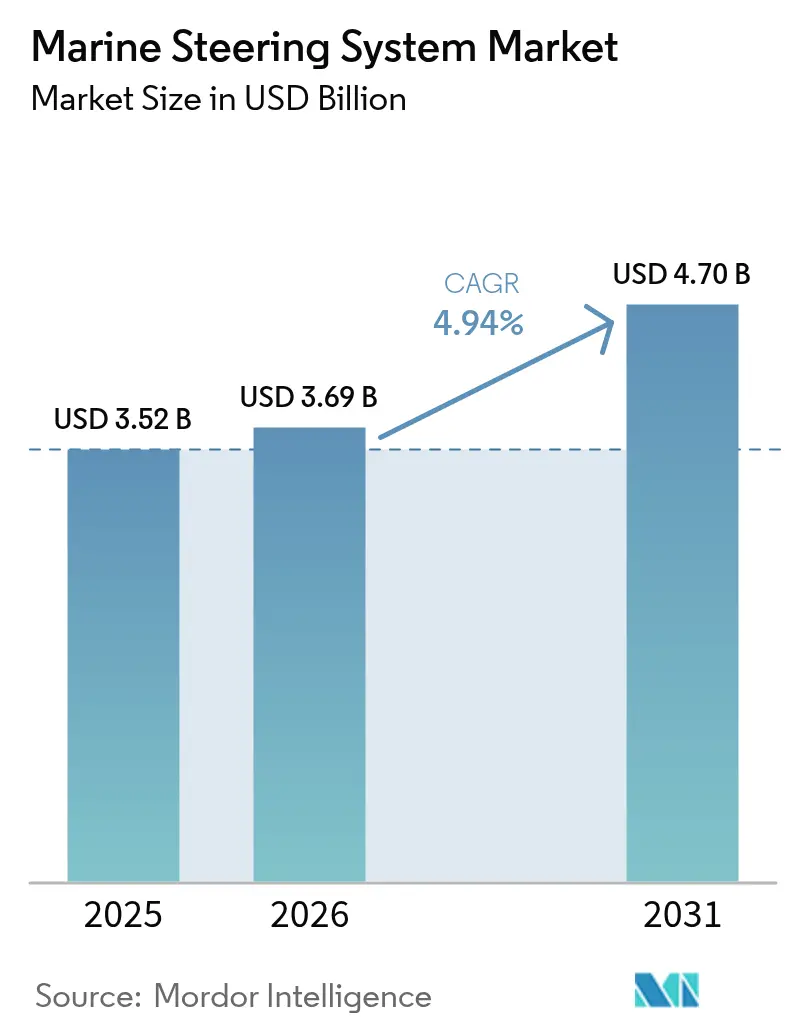
| Market Size (2026) | USD 3.69 Billion |
| Market Size (2031) | USD 4.7 Billion |
| Growth Rate (2026 - 2031) | 4.94 % |
| Fastest Growing Market | Asia Pacific |
| Largest Market | North America |
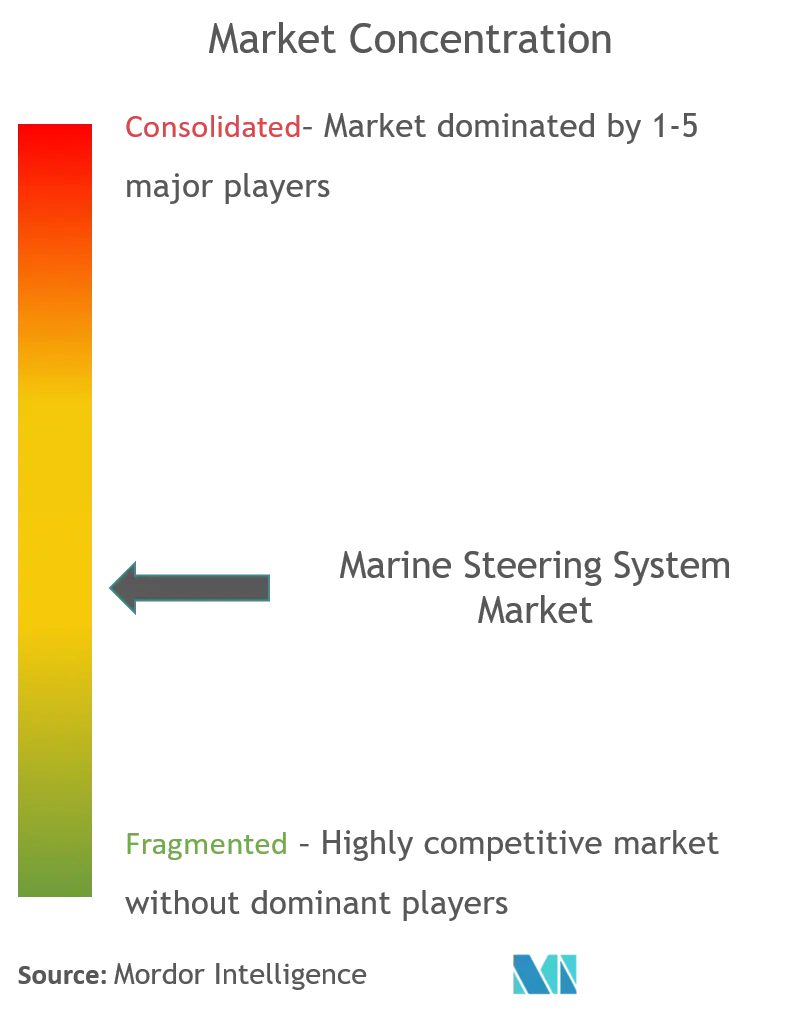
| Market Concentration | Medium |
Major Players *Disclaimer: Major Players sorted in no particular order Image © Mordor Intelligence. Reuse requires attribution under CC BY 4.0. | |
Marine Steering System Market Analysis by Mordor Intelligence
The marine steering systems market size is expected to grow from USD 3.52 billion in 2025 to USD 3.69 billion in 2026 and is forecast to reach USD 4.7 billion by 2031 at 4.94% CAGR over 2026-2031. Digital integration, autonomous‐ready control architectures, and tightening regulatory oversight are the structural forces sustaining this trajectory. Vessels ranging from recreational runabouts to naval frigates now embed cyber-secure, software-defined steering gear that links seamlessly with electric propulsion and dynamic-positioning suites. Accelerated fleet renewal in Asia, steady retrofit demand in North America, and Europe’s decarbonization rules collectively ensure broad geographic pull for new-build as well as aftermarket solutions. Competitive intensity is rising as traditional hydraulic specialists race against electronics-savvy entrants to field integrated helm, actuator, and sensor packages compliant with the International Maritime Organization’s evolving steering-gear testing framework[1]“Amendments to IMO Instruments: Upcoming Entry-Into-Force Dates,” International Maritime Organization, imo.org.
Key Report Takeaways
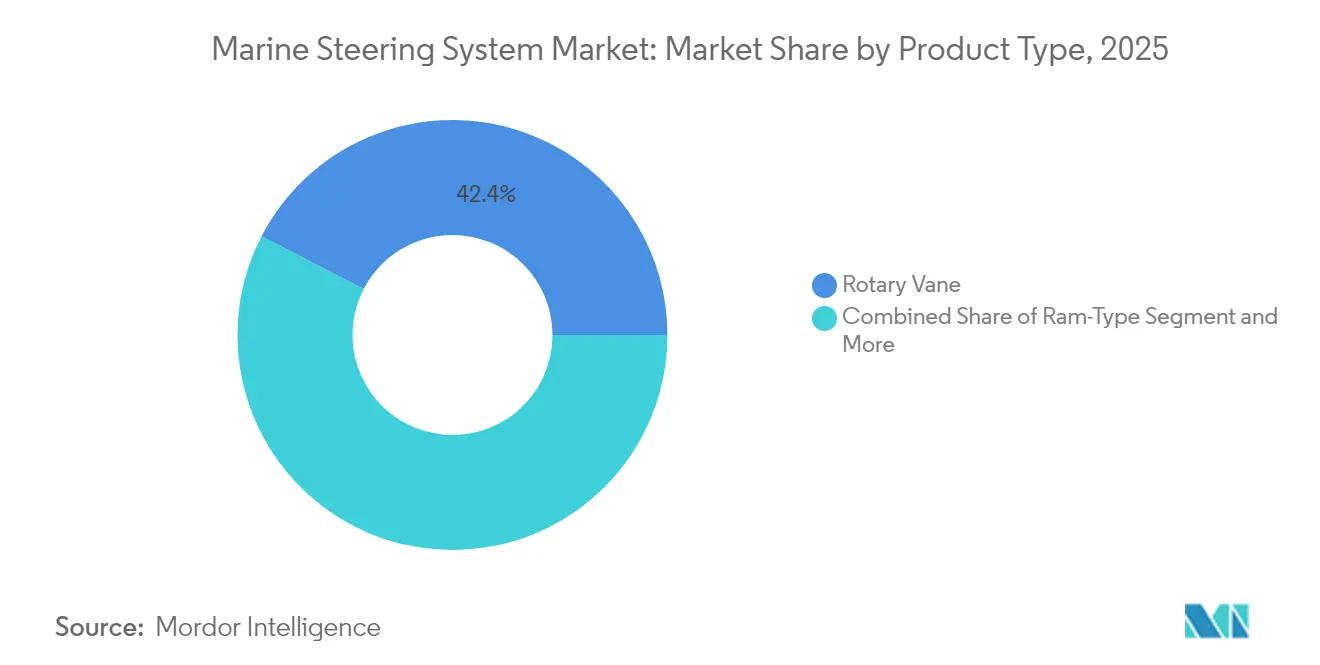
- By product type, rotary vane systems led with 42.41% of the marine steering systems market share in 2025; electro-mechanical integrated systems are projected to post the fastest 8.86% CAGR to 2031.
- By actuation technology, hydraulic platforms accounted for 51.86% share of the marine steering systems market size in 2025, while fully electric power steering is advancing at a 15.9% CAGR.
- By control mode, manual steering retained 61.12% of 2025 volumes; dynamic positioning and autonomous integration are the quickest movers at 14.12% CAGR through 2031.
- By vessel type, passenger craft captured 37.35% revenue share in 2025, whereas offshore energy support vessels are forecast to expand at 9.28% CAGR.
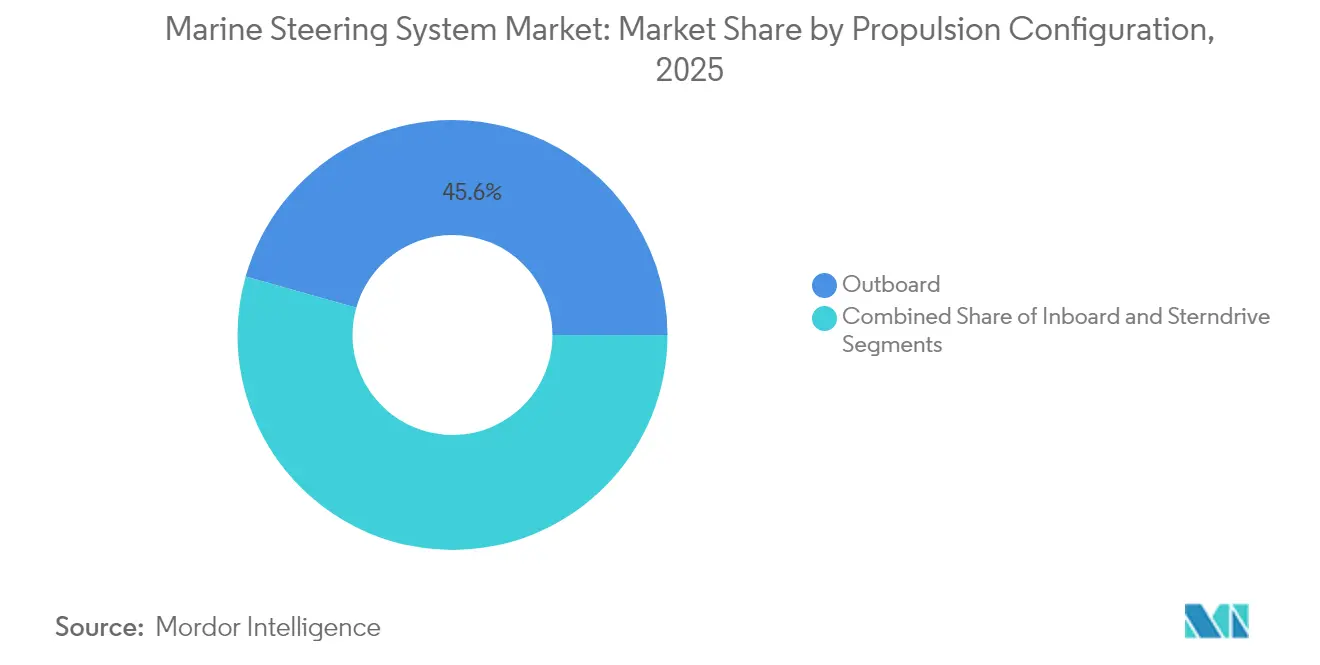
- By propulsion configuration, outboard units commanded a 45.61% share in 2025 and are projected to grow 7.52% annually to 2031.
- By distribution channel, OEM fitment represented 56.05% of sales in 2025; aftermarket retrofits show an 7.88% CAGR outlook.
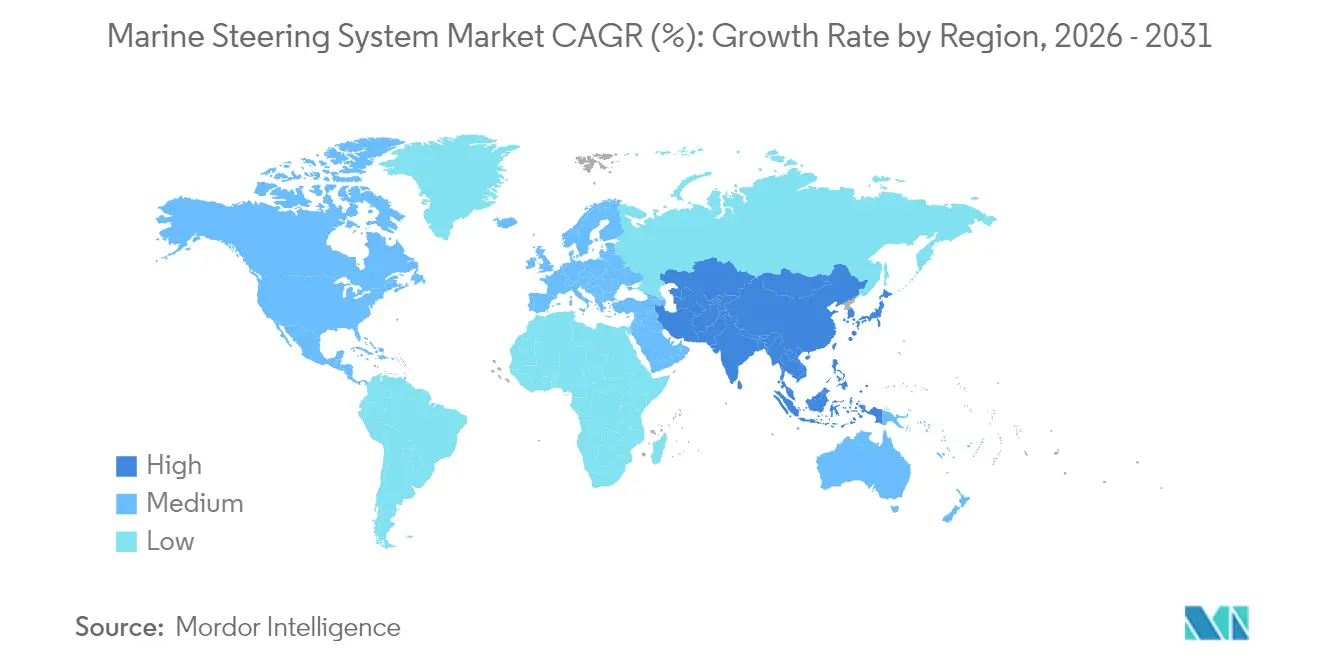
- By geography, North America held 45.98% of the market in 2025, while Asia-Pacific leads growth with an 8.27% CAGR to 2031.
Note: Market size and forecast figures in this report are generated using Mordor Intelligence’s proprietary estimation framework, updated with the latest available data and insights as of 2026.
Market Trends and Insights
Drivers Impact Analysis of Marine Steering System Market*
| Driver | (~) % Impact on CAGR Forecast | Geographic Relevance | Impact Timeline |
|---|---|---|---|
| Naval Modernisation Programmes in Asia and Europe | +1.2% | Asia-Pacific, Europe | Medium term (2-4 years) |
| Growth in Global Recreational Boating Fleet | +0.8% | North America, Europe | Short term (≤ 2 years) |
| Retrofitting Surge Due to IMO Steering Gear Testing Mandates | +0.7% | Global | Medium term (2-4 years) |
| Push Toward Electric-Power Steering for Outboards | +0.6% | Global, with focus on North America | Short term (≤ 2 years) |
| Autonomous-Ready 'Fly-By-Wire' Rudder Actuators' Surge | +0.5% | Asia-Pacific, North America | Long term (≥ 4 years) |
| Low-Sulphur-Fuel Compatible Electro-Hydraulic Fluids' Demand | +0.4% | Global | Medium term (2-4 years) |
| Source: Mordor Intelligence | |||
Naval Modernization Programmes in Asia and Europe
Rising defense budgets propel steady procurement of multi-role frigates, amphibious carriers, and submarines across China, South Korea, Japan, Germany, and the Netherlands. Each hull specifies cyber-secure, redundancy-rich steering systems capable of mating with integrated bridge and combat-management suites. China’s People’s Liberation Army Navy operated 234 major surface combatants in 2024, outnumbering the 219 units fielded by the U.S. Navy, a fleet expansion that keeps domestic yards at full tilt and draws on steering subcontractors throughout regional supply chains[2]“Unpacking China’s Naval Buildup,” Center for Strategic and International Studies, csis.org. Parallel NATO programs in Europe reinforce demand for electric or electro-hydraulic actuators that minimize acoustic signatures, accommodate dynamic-positioning holds, and support unmanned wingman craft.
Growth in Global Recreational Boating Fleet
Powerboat and personal-watercraft sales recorded 230,000–240,000 units in the United States during 2024 as buyers sought joystick docking, wireless helm controls, and integrated autopilots that simplify skippering for novice owners[3]“Innovation Driving U.S. Boat Sales Demand,” National Marine Manufacturers Association, nmma.org. OEMs bundle smart steering with propulsion upgrades, creating a compelling aftermarket funnel for older hulls. The segment’s domestic economic footprint sustains parts, service, and electronics revenues that cushion cyclical swings in new-boat registrations.
Retrofitting Demand Driven by IMO Mandates
SOLAS amendments and IMO cybersecurity guidelines that took effect in July 2024 oblige commercial operators to verify rudder response times, emergency back-up power, and network hardening every five years. Vessels built before 2010 frequently fail these audits, prompting retrofit contracts for digital pump sets, servo-valves, and control heads that can log diagnostic data and receive over-the-air firmware patches.
OEM Push Toward Electric-Power Steering for Outboards
Outboard builders now release electric helm packages that eliminate hydraulic hoses, reduce weight, and deliver millisecond torque response. Mercury’s 7,500-watt Avator propulsion pairs with drive-by-wire steering to execute autonomous docking routines, an integration path echoed by Yamaha and ZF. These systems also satisfy zero-leak rules in protected waters and simplify installation for boatyards.
Restraints Impact Analysis of Marine Steering System Market*
| Restraint | (~) % Impact on CAGR Forecast | Geographic Relevance | Impact Timeline |
|---|---|---|---|
| Cyclical Downturn in Commercial Shipbuilding | -0.9% | Global, particularly Asia | Short term (≤ 2 years) |
| High Upfront Cost of Electric Steering Conversions | -0.6% | Global | Medium term (2-4 years) |
| Shortage of Marine-Grade Semiconductor Chips | -0.4% | Global | Short term (≤ 2 years) |
| Class-Society Cyber-Resilience Rules | -0.3% | Global | Medium term (2-4 years) |
| Source: Mordor Intelligence | |||
Cyclical Downturn in Commercial Shipbuilding
Container-ship new-build bookings remain historically elevated, yet tanker, bulk, and general-cargo contracts softened through 2024 as operators delayed capital expenditures. Asian yards adjust output to match this mix, reducing baseline demand for standard helm sets even as retrofit work rises to offset capacity fluctuations.
High Upfront Cost of Electric Steering Conversions
Smaller workboat owners balk at rewiring vessels or swapping mechanical linkages for digital servo-motors. Return-on-investment calculations hinge on fuel savings and reduced service hours, but capital costs still deter immediate roll-outs outside subsidy programs. The economic challenge intensifies for older vessels where electric steering integration requires extensive electrical infrastructure upgrades, creating cost barriers that slow market penetration despite long-term operational benefits and regulatory compliance advantages.
*Our forecasts treat driver/restraint impacts as directional, not additive. The impact forecasts reflect baseline growth, mix effects, and variable interactions.
Marine Steering System Market Segment Analysis
By Product Type:
Electro-Mechanical Systems Lead InnovationRotary-vane designs retained 42.41% of the marine steering systems market share in 2025, anchored by reliability and simple service protocols. Yet electro-mechanical integrated units headline growth with a 8.86% CAGR through 2031 as shipyards specify precision control, noise reduction, and embedded diagnostics. Ram cylinders continue in heavy-lift naval and offshore support craft where extreme torque and redundancy are mandatory. Rack-and-pinion assemblies serve niche inland and small-craft segments needing compact footprints.
Demand tilts toward software-defined actuators that self-calibrate and interface with collision-avoidance algorithms. Classification societies now certify cyber-secure firmware, nudging operators toward new-generation electric or hybrid products rather than refurbishing legacy hydraulics. Consequently, the marine steering systems market sees product road-maps converge on modular electro-mechanical cartridges deployable across vessel classes.


By Actuation Technology:
Electric Systems Surge Despite Hydraulic DominanceHydraulic circuits still delivered 51.86% of 2025 installations, yet fully electric power steering is accelerating at 15.9% annually. Hybrid electro-hydraulic packages bridge the transition, offering on-demand pumps that spin only when commanded, trimming idle losses, and enabling engine-off maneuvering. Mechanical cable systems persist in low-horsepower craft but face gradual replacement as joystick and autopilot features move down-market.
Electric actuators achieve sub-millisecond lag and integrate regenerative braking that eases hotel-load demands on hybrid vessels. As flag administrations tighten oil-to-water discharge limits, operators view fluid-free architectures as both compliance facilitators and lifecycle cost reducers. This performance-plus-sustainability mix cements electric technology as the marine steering systems market’s most disruptive trend.
By Control Mode:
Autonomous Integration Transforms Manual DominanceManual wheels and tillers still represent 61.12% of shipped units in 2025, a legacy of regulatory insistence on human oversight. Autopilots fulfil mid-market adoption, combining course-keeping with fuel-saving algorithms. Dynamic-positioning and autonomous helm modules, however, post a 14.12% CAGR as offshore wind, survey, and research vessels demand centimeter-level station hold.
AI-stack suppliers embed sensor fusion, collision regulations, and weather routing into helm logic, lowering crew workloads and enabling reduced-manning operations. Updating software over secure channels extends feature life, reinforcing the perception that the marine steering systems market mirrors the smartphone model, where periodic upgrades supersede component replacement.
By Vessel Type:
Offshore Energy Support Drives GrowthPassenger craft, including cruise liners, ferries, and yachts, held 37.35% revenue in 2025, buoyed by post-pandemic leisure demand that prizes silent, vibration-free helm response. Offshore energy service vessels claim the fastest 9.28% CAGR, reflecting expanding wind-turbine installation fleets that require dynamic-positioning precision in congested sea lanes. Commercial cargo ships and workboats provide baseline volumes, while naval and coast-guard hulls inject specification-rich orders that push technological boundaries.
The marine steering systems market, therefore, balances high-spec defense contracts, volume recreational orders, and electrically intensive offshore platforms, each influencing design priorities across the supply chain.
By Propulsion Configuration:
Outboard Systems Lead InnovationOutboard layouts delivered 45.61% of 2025 shipments and are forecast to climb 7.52% annually. The segment benefits from modular rigging, swift electrification, and widespread dealer networks. Inboard engines dominate high-horsepower commercial and defense craft, where centralized machinery favors shaft lines. Sterndrive hybrids serve niche sport-cruiser customers, combining inboard power with outboard-like trim angles.
Outboards now integrate steering motors inside the cowl, minimizing parts and enabling 360-degree joystick maneuverability. As propulsion shifts to high-voltage battery packs, helm manufacturers collaborate directly with motor OEMs, embedding torque commands over single digital lines and reshaping competitive dynamics within the marine steering systems market.
By Distribution Channel:
Aftermarket Retrofit AcceleratesOEM installations comprised 56.05% of 2025 revenue, reflecting tight coordination between builders and component suppliers. Yet retrofit activity is expanding at 7.88% CAGR as fleets modernize for compliance and digital functionality. Independent dealers and service yards now market plug-and-play electric helm kits targeting vessels built since 2000 that lack CAN-bus infrastructure.
Regulatory deadlines, especially U.S. Coast Guard cyber rules entering force in July 2025, motivate commercial operators to schedule steering upgrades during routine dry-dock cycles. This dynamic ensures an enduring aftermarket pipeline even if new-build orders fluctuate.
Geography Analysis
North America Marine Steering System Market
North America held 45.98% of the marine steering system market in 2025 and is forecast to grow on robust discretionary spending and 85 million boating participants maintain high turnover in powerboat inventories, while U.S. Coast Guard cybersecurity directives accelerate the adoption of encrypted digital helms across commercial fleets. Canadian Arctic patrol programs further support the sophisticated steering demand for ice-classified hulls.
APAC Marine Steering System Market
Asia-Pacific leads growth with an 8.27% CAGR to 2031. Chinese naval expansion, underscored by 234 major warships in active service, fuels domestic shipbuilding production as yards aim for self-reliance in critical subsystems. Japan, South Korea, and Singapore pioneer autonomous surface research, seeding demand for AI-compatible helm actuators. Regional electrification policies add momentum, particularly in coastal tourism and island logistics fleets where zero-emission mandates emerge.
Europe Marine Steering System Market
Europe records growth, anchored by NATO frigate programs and stringent environmental statutes. The European Maritime Safety Agency’s STEERSAFE recommendations obligate continuous monitoring of rudder angle, load, and response times, leading operators to specify sensor-rich steering gear. Norway’s operational autonomous passenger ferry pilot validates real-world readiness of digital helm solutions, encouraging wider municipal deployments across the continent. Concurrently, the EU AI Act provides legal clarity for machine-learning functions embedded in steering firmware, spurring vendor investments.

Regulatory Landscape
Marine steering systems are governed by international safety conventions reflected in flag-state rules and class requirements, with SOLAS-aligned steering-gear performance and periodic verification forming a baseline for commercial tonnage. In the United States, U.S. Coast Guard regulations under 46 CFR Part 58.25 specify requirements for steering gear arrangements, including separation and independence between power-operated main and auxiliary steering systems, with plan review under 46 CFR 50.20 for steering gear and piping submissions.
In Europe, the Marine Equipment Directive (MED) 2014/90/EU ties marine equipment compliance to international instrument requirements and conformity assessment, shaping design, construction, and performance obligations for equipment supplied to EU-flagged vessels. Standardization work is also moving toward more electronically intensive control architectures: ISO 10592:2022 defines requirements for remote hydraulic steering systems for small craft, and in June 2026 the ISO work program registered ISO/AWI 25197 covering electrical and electronic control systems for steering, shift, and throttle, signaling additional test and documentation alignment for digital and by-wire steering components.
Value Chain Analysis
The value chain starts with raw materials and precision components (forged and cast metals for rudder stocks, tiller arms, and steering gear housings; seals, hoses, and electro-hydraulic valves; and marine-grade electronics such as sensors, controllers, and harnessing). It then moves through subsystem integration (helm, pumps and actuators, feedback units, and software) into OEM installation at shipyards and boatbuilders, followed by commissioning, class and flag verification, and lifecycle service. As steering architectures migrate toward integrated helm-to-rudder and steer-by-wire concepts, a larger share of value accrues to system integrators that can combine controls, diagnostics, cybersecurity features, and interoperability with propulsion, thrusters, and bridge systems.
Downstream, OEM fitment is supported by builder-aligned engineering and factory test procedures, while the aftermarket relies on regional distributors, dealers, and service yards for retrofit kits, calibration, and spares. Integration and distribution also influence channel leverage, as shown by Phoenix Marine partnering with Southern Cross Marine in February 2025 to distribute HyDrive hydraulic steering systems in the UK, and by ZF signing an MoU with Avikus in October 2025 to integrate autonomous navigation capabilities into ZF TotalCommand, reinforcing the move toward bundled control platforms. Key bottlenecks include concentration risk in heavy foundry output for forged parts and commissioning delays when legacy hydraulic rudders are interfaced with modern electronic helms and networked vessel systems.
Competitive Landscape
Competition features a blend of legacy hydraulics leaders and electronics-first insurgents. SeaStar Solutions leverages broad dealer networks, while ZF transfers automotive by-wire know-how to marine thrusters and helm modules. Mercury Marine integrates propulsion, steering, and cloud connectivity under a unified data ecosystem that underpins Brunswick’s “Boating Intelligence” brand proposition.
Strategic activity centers on vertically integrated packages that bundle helm wheels, actuators, sensors, and software licenses into subscription-ready platforms. Cybersecurity certification emerges as both a barrier and a differentiator, compelling suppliers to maintain in-house encryption and threat-model expertise. Start-ups focus on AI navigation overlays that ride atop open-architecture helm hardware, challenging incumbents to open their APIs without ceding market share. M&A is likely as companies seek to scale up and amortize R&D and certification costs within the marine steering systems market.
Marine Steering System Industry Leaders
Dometic Marine
ZF Friedrichshafen AG
Mercury Marine (Brunswick)
Bosch Rexroth
Kongsberg Maritime
- *Disclaimer: Major Players sorted in no particular order
Marine Steering System Market Companies Covered in this Report
- Dometic Marine
- Mercury Marine
- ZF Friedrichshafen AG
- Bosch Rexroth
- Kongsberg Maritime
- Kobelt Manufacturing
- Damen Marine Components
- Wills Ridley Ltd
- HyDrive Engineering Pty Ltd
- Hypro Marine
- Techno Italia Kft
- Dometic Group
- Yamaha Motor Co.
- Uflex SRL
- Lecomble and Schmitt
- Vetus B.V.
- Jastram Engineering
- Glendinning Products
- Engine Monitor Inc. (EMI)
- Multisteer (India)

Market Opportunities and Future Outlook
Opportunity is widening around retrofit-driven digitalization and compliance work, particularly where older fleets need steering performance verification, redundancy checks, and secure integration with bridge networks. The July 2024 SOLAS-related amendments and IMO cybersecurity guidance cited in the broader market context created a clearer inspection cadence, elevating demand for diagnostic-capable control heads, servo-valves, and upgradeable software alongside traditional actuators, extending retrofit and service activity beyond new-build cycles.
The main product and platform whitespace centers on electric and hybrid steering architectures that reduce leak risk and simplify integration with joystick maneuvering, dynamic positioning, and autonomous-ready functions across outboard and inboard applications. Mercury Marine is expanding connected control and joystick capabilities, including single-engine joystick piloting tied to electric steering, while ZF is advancing integrated electronic control platforms with autonomy-oriented partners, both of which increase demand for interoperable sensors, controllers, and software-defined steering modules. Parallel standards work also supports commercialization, including the ISO/AWI 25197 registration in June 2026 for electrical and electronic steering and control systems, which helps suppliers structure safety documentation, validation processes, and cybersecurity-ready designs.
Recent Industry Developments in Marine Steering System Market
- February 2026: Mercury Marine announced a new suite of digital and control innovations, including keyless functionality and joystick enhancements, aimed at unifying onboard hardware with software within its connected ecosystem. The releases reinforce the industry shift from standalone steering hardware toward integrated control stacks that combine helm input, propulsion response, and maneuvering automation. This raises the bar for steering suppliers on interoperability, software update pathways, and secure networked controls.
- February 2025: Mercury Marine launched Joystick Piloting for Single-Engine Outboards with Thruster, enabling 360-degree low-speed maneuvering by integrating joystick steering with bow thrusters and electric-steering-capable outboards. Bringing joystick capability to single-engine configurations broadens the addressable installed base for electric steering and compatible helm controllers. It also strengthens bundled propulsion-and-steering value propositions at the OEM and repower levels.
- September 2024: CMC Marine and Dometic formed a strategic partnership to integrate CMC Marine stabilizer technology with Dometic Optimus steering for yachts in the 40 to 115 foot range. The integration links stabilization and steering control domains, supporting more coordinated vessel handling and system-level optimization for builders and owners. The partnership also points to deeper cross-system collaboration as yacht OEMs standardize integrated maneuvering and comfort packages.


Marine Steering System Market Report Scope and Research Methodology
Market Definition and Coverage
This market covers the revenue generated from marine steering systems that control vessel direction, including the main steering gear and its core hardware and control elements used on recreational, commercial, offshore support, and naval vessels.
Scope exclusions: We exclude propulsion control systems, vessel construction value, and standalone hydraulic or electrical parts sold for general use when they are not part of a defined marine steering system sale.
Segments Covered in This Report
- By Product Type
- Rotary Vane
- Ram-Type
- Rack-and-Pinion
- Electro-Mechanical (Integrated)
- By Actuation Technology
- Conventional Hydraulic
- Electro-Hydraulic
- Fully Electric Power Steering (EPS)
- Mechanical/Cable
- By Control Mode
- Manual
- Auto-Pilot
- DP/Autonomous Integration
- By Vessel Type
- Passenger (Cruise, Ferry, Yacht)
- Commercial Cargo and Workboats
- Naval and Coast-Guard
- Offshore Energy Support
- By Propulsion Configuration
- Inboard
- Outboard
- Sterndrive
- By Distribution Channel
- OEM Fitment
- Aftermarket Retrofit
- By Geography
- North America
- United States
- Canada
- Rest of North America
- South America
- Brazil
- Argentina
- Rest of South America
- Europe
- Germany
- United Kingdom
- France
- Spain
- Russia
- Rest of Europe
- Asia-Pacific
- China
- Japan
- South Korea
- India
- Rest of Asia-Pacific
- Middle East and Africa
- United Arab Emirates
- Saudi Arabia
- Egypt
- Turkey
- South Africa
- Rest of Middle East and Africa
- North America
Data Sources, Market Sizing, and Validation
Desk Research
Desk research was used to set the base structure of the market model and to collect external data points that can be checked repeatedly. Sources reviewed include public shipbuilding and delivery statistics, such as those published by the UN International Maritime Organization for steering gear testing rules, and trade data references like UN Comtrade for related marine equipment flows.
We also referred to official maritime safety and classification guidance, along with government port and coastal agency publications, and peer reviewed engineering papers that discuss electro-hydraulic and electro-mechanical steering architectures. Company annual reports, investor decks, and reputable marine industry news were used to understand product positioning and retrofit demand signals, and paid subscriptions for company financials and patent databases were selectively used to validate revenue ranges and technology adoption timing. The desk sources listed here are illustrative only, and we reviewed many other public references for data collection, validation, and clarification.
Primary Interviews and Surveys
Primary work focused on validating what gets counted as a steering system sale across OEM fitment and retrofit, and on pressure testing price and mix assumptions for hydraulic, electro-hydraulic, and integrated electro-mechanical solutions. We spoke with stakeholders across steering system supply, vessel build and repair, and marine operations, and inputs were balanced across APAC, EMEA, and the Americas so regional build cycles and replacement rates were not over weighted.
Distribution of primary research fieldwork respondents
| Company type | Respondent position | Region |
|---|---|---|
| Top tier: 26% | CXOs: 19% | APAC: 43% |
| Mid tier: 55% | Functional/Unit leaders: 29% | EMEA: 33% |
| Smaller Players: 19% | Managers: 52% | Americas: 24% |
Market-Sizing & Forecasting
Sizing starts with a top-down build where vessel output and active fleet signals are translated into a steering-system demand pool, and then filtered by OEM installation versus retrofit replacement cycles. To keep the totals realistic, we corroborate the outcome using selective bottom-up approximations, such as sampled price bands by vessel class and channel checks on steering gear order patterns, which are then used to adjust outliers.
Inputs that materially shape the model include newbuild deliveries by major vessel categories, retrofit intensity tied to aging fleets, steering system technology mix shifts (hydraulic versus electro-hydraulic versus integrated electro-mechanical), regional shipyard activity, and average selling price movement by channel. Where direct price points were not consistently available, gaps were handled by using bounded ranges from interview feedback and then cross checking against public procurement and tender language.
For forecasting, scenario analysis was applied around fleet additions, retrofit timing, and technology penetration, and then smoothed through trend based checks so year to year jumps stayed consistent with build cycles. Assumptions were revisited when interview feedback suggested changes in component availability, regulatory testing impacts, or shipyard order backlogs.
Data Validation & Update Cycle
Model outputs are checked against independent signals, including shipyard throughput, regional marine equipment trade movement, and visible retrofit activity, before final numbers are signed off. Variance checks are run at the region and channel level, and unusual movements trigger a deeper review of the underlying drivers and, when needed, follow up outreach to clarify what shifted.
Each report is refreshed annually, with interim updates completed when material events occur, such as regulation changes, sharp currency moves affecting pricing, or step changes in shipbuilding pipelines. Before delivery, a final analyst pass is completed so clients receive the latest updated view.
Mordor Intelligence's Marine Steering Systems Market Size Versus Other Published Estimates
Published estimates for marine steering systems do not always match because groups draw the market line differently and then apply different build and retrofit assumptions. Differences also come from how technology mix is treated, which years are used for currency conversion, and whether OEM and aftermarket channels are counted together.
The main gap comes from whether retrofit steering-gear replacements are valued alongside newbuild installations, where Mordor Intelligence includes both but excludes propulsion controls and stand-alone hydraulic parts that are not sold as a steering system. When other estimates lean on broader marine equipment buckets or assume faster ASP escalation without a vessel-type mix check, the reported value can shift even if fleet activity is similar.
Benchmark comparison
| Source | Market Size | Gaps in Research Methodology |
|---|---|---|
| Mordor Intelligence | USD 3.69 B (2026) | |
| Global Research Publisher A | USD 3.48 B (2024) | Uses a 2024 base year and a longer horizon, and the scope appears to emphasize component level counting by vessel type, which can undercount integrated system value and channel mix in years with higher retrofit share. |
| Industry Research Publisher B | USD 3.68 B (2026) | Keeps the 2026 starting value close but applies a broader long-range growth path to 2036, which can differ if retrofit cycles, technology penetration, and price progression are not rechecked against shipyard order flow and regional build patterns each year. |
The table shows that even small scope choices, like whether integrated steering packages are separated from adjacent marine controls, can create noticeable spreads. By keeping the demand pool tied to vessel activity and then validating price and mix through repeated checks, our estimate stays traceable to practical inputs that can be revisited as the fleet and retrofit market shifts.


Key Questions Answered in the Report
What is the current size of the marine steering systems market?
The marine steering systems market size reached USD 3.69 billion in 2026 and is projected to climb to USD 4.7 billion by 2031.
Which product segment is growing the fastest?
Electro-mechanical integrated steering systems are expanding at a 8.86% CAGR through 2031, outpacing all other product categories.
How quickly are electric steering technologies being adopted?
Fully electric power steering shows a 15.9% CAGR, reflecting strong OEM commitment to energy efficiency and autonomous readiness.
Which region offers the highest growth potential?
Asia-Pacific leads with an 8.27% CAGR thanks to large-scale naval procurement and widespread investment in autonomous vessel programs.
Why is aftermarket retrofit becoming more important?
IMO safety tests and U.S. Coast Guard cyber rules require older vessels to upgrade steering gear, driving an 7.88% CAGR in retrofit sales.
Page last updated on:


 Your data is secure and never sold or shared.


