
Marine Seats Market Size and Share
Market Overview
| Study Period | 2020 - 2031 |
|---|---|
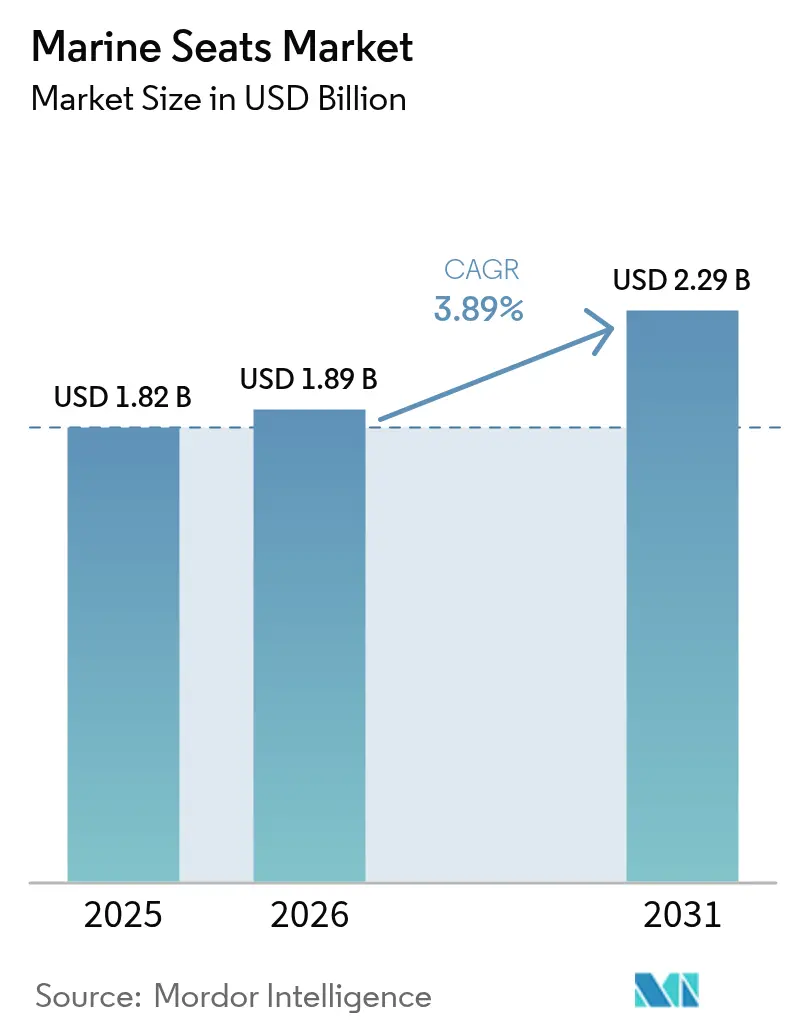
| Market Size (2026) | USD 1.89 Billion |
| Market Size (2031) | USD 2.29 Billion |
| Growth Rate (2026 - 2031) | 3.89 % |
| Fastest Growing Market | Asia Pacific |
| Largest Market | North America |
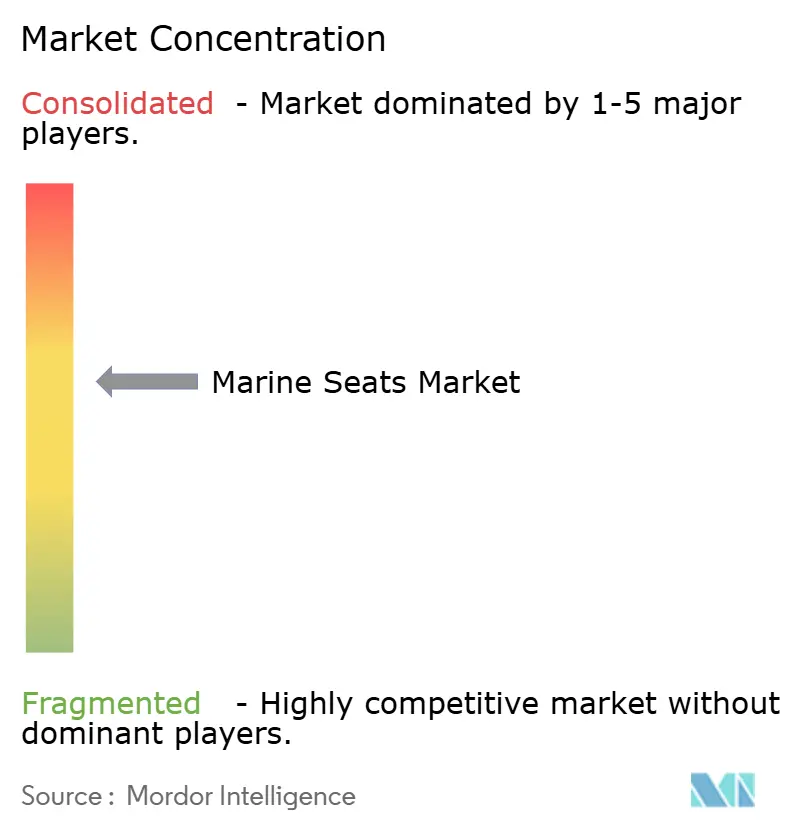
| Market Concentration | Medium |
Major Players *Disclaimer: Major Players sorted in no particular order Image © Mordor Intelligence. Reuse requires attribution under CC BY 4.0. | |
Marine Seats Market Analysis by Mordor Intelligence
The marine seats size market size in 2026 is estimated at USD 1.89 billion, growing from 2025 value of USD 1.82 billion with 2031 projections showing USD 2.29 billion, growing at 3.89% CAGR over 2026-2031. This trajectory signals the sector’s passage from post-pandemic recovery into a maturity phase where ergonomic innovation, weight reduction, and regulatory compliance carry more weight than raw production volume. Shipowners are upgrading cabins, bridges, and passenger-area seats to meet tighter vibration and fire-safety rules. At the same time, military and offshore operators seek shock-mitigating solutions that protect crews during high-speed maneuvers. Weight-saving composite frames, embedded sensors, and 3D-printed components enable builders to differentiate themselves on comfort, sustainability, and lifecycle cost. The growing preference for premium finishes in cruise, yacht, and fast ferry builds also supports value growth even as unit shipments level out.
Key Report Takeaways
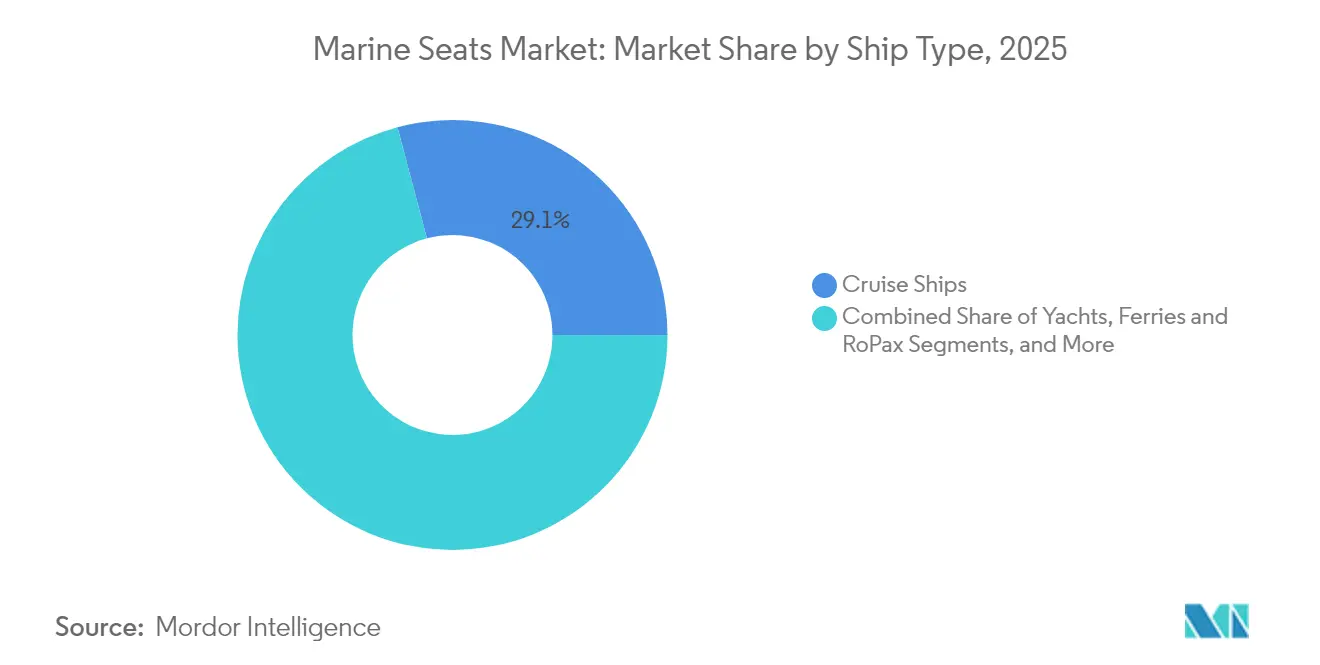
- By ship type, Cruise Ships led with 29.12% revenue share in 2025, whereas Commercial Workboats are poised to expand at a 6.78% CAGR through 2031.
- By component, Pedestals accounted for 32.60% of the marine seats market size in 2025; Suspension Systems are projected to grow the fastest at 5.12% CAGR.
- By seat technology, Manual Adjustable designs held 37.22% of the marine seats market share in 2025, while Suspension technology is set to advance at 5.55% CAGR.
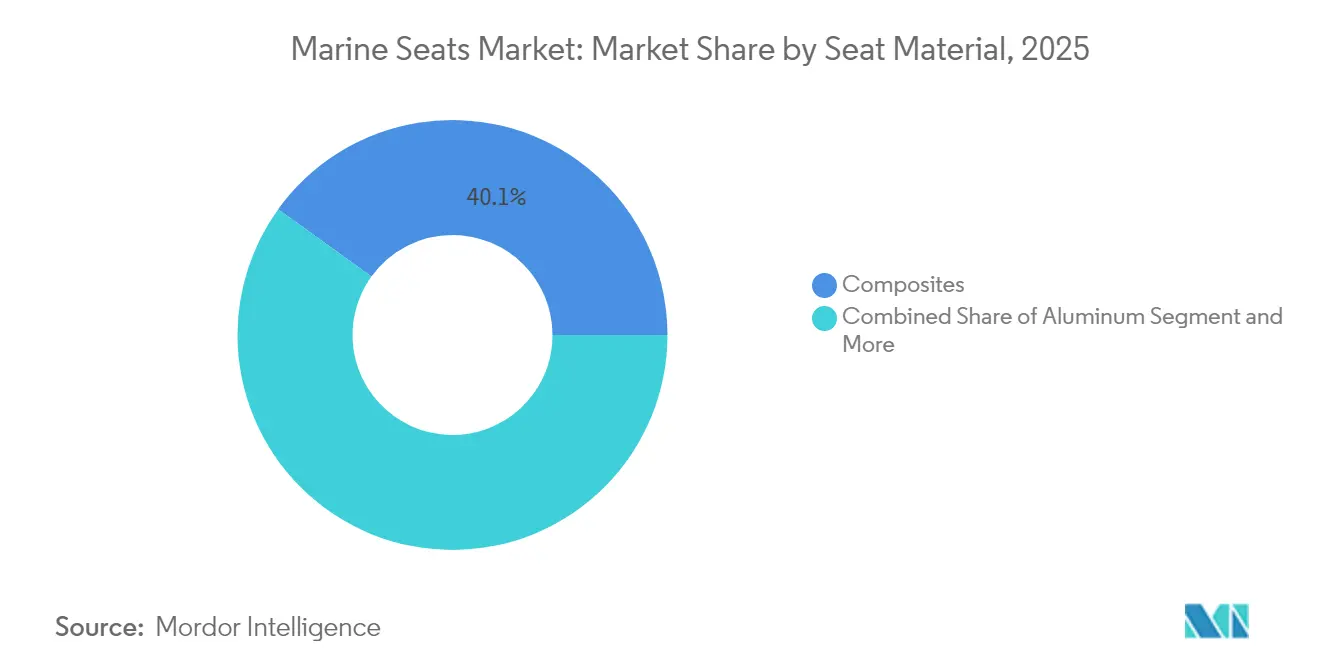
- By seat material, Composites commanded 40.05% share of the marine seats market size in 2025 and are forecast to climb at a 7.12% CAGR to 2031.
- By end user, Passenger Transport captured a 27.55% share in 2025; the Commercial segment is the fastest riser at 6.65% CAGR.
- By geography, North America dominated with a 31.70% share in 2025, whereas Asia Pacific is projected to register the highest 7.78% CAGR.
Note: Market size and forecast figures in this report are generated using Mordor Intelligence’s proprietary estimation framework, updated with the latest available data and insights as of 2026.
Market Trends and Insights
Drivers Impact Analysis of Marine Seats Market*
| Driver | (~) % Impact on CAGR Forecast | Geographic Relevance | Impact Timeline |
|---|---|---|---|
| Cruise-liner Refurbishment Cycles | +1.2% | Global, led by North America and Caribbean routes | Short term (≤ 2 years) |
| IMO Ergonomic Safety Regulations | +0.9% | Global maritime compliance zones | Long term (≥ 4 years) |
| Premium Yacht Production Boom | +0.8% | Global, concentrated in North America and Europe | Medium term (2-4 years) |
| Fast-patrol and SAR Vessel Shock-mitigation Mandates | +0.6% | North America, Europe, APAC defense sectors | Medium term (2-4 years) |
| Embedded Smart-sensor Seating | +0.4% | Premium segments globally | Long term (≥ 4 years) |
| 3-D Printed Composite Seat Structures | +0.3% | North America and Europe early adopters | Long term (≥ 4 years) |
| Source: Mordor Intelligence | |||
Cruise-Liner Refurbishment Cycles
Operators are spending record sums on mid-life overhauls, with Celebrity Cruises channeling more than USD 250 million into Solstice-class upgrades that include full seating replacements across dining, theater, and pool decks. According to Cruise Lines International Association (CLIA), member lines are anticipated to witness 9% rise in 2025 passenger counts, supporting these capex waves, making refurbishment the most reliable near-term catalyst for the marine seats market. Suppliers that possess turnkey design-install capabilities capture an outsized share by synchronizing deliveries with narrow dry-dock windows.
IMO Ergonomic Safety Regulations
The International Maritime Organization is broadening whole-body vibration and crew-welfare limits within its Code on Intact Stability, prompting owners to specify adjustable seats with lumbar support and automated height memory.[1]International Maritime Organization, “Code on Intact Stability Amendments,” imo.org A delayed roll-out of revised GMDSS standards until 2028 allows builders to integrate communication panels into armrests, further enriching the marine seats market value proposition.
Premium Yacht Production Boom
Global orderbooks list 633 superyachts over 30m in build, sustaining demand for bespoke seating that blends lightweight composites with luxury finishes. Shipyards such as Sanlorenzo are investing in high-margin projects after acquiring niche builders like Nautor Swan, widening the addressable marine seats market for premium solutions. Ergonomic requirements rise in parallel with green mandates, steering designers toward recyclable foams and bio-based laminates that trim emissions without sacrificing comfort.
Fast-Patrol and SAR Vessel Shock-Mitigation Mandates
Project Perfect Storm tests show advanced suspension seats cutting peak impacts by up to 40% during 50-knot transits. The UK Maritime & Coastguard Agency now requires shock-protective seating on small rescue craft under MGN 436, a rule likely to spread across NATO fleets.[2]UK Government, “MGN 436: Small Vessel High-Speed Craft Guidance,” gov.uk These mandates underpin a steady pipeline for high-end suspension modules and data-logging seat bases.
Restraints Impact Analysis of Marine Seats Market*
| Restraint | (~) % Impact on CAGR Forecast | Geographic Relevance | Impact Timeline |
|---|---|---|---|
| Marine-grade Alloy Price Volatility | -0.7% | Global, acute in aluminum-dependent regions | Medium term (2-4 years) |
| High Certification and Testing Costs | -0.5% | Global, regulatory compliance markets | Medium term (2-4 years) |
| Specialty Foam Supply Interruptions | -0.4% | North America & Europe manufacturing hubs | Short term (≤ 2 years) |
| IMO Fire-testing Bottlenecks | -0.3% | Global maritime compliance zones | Medium term (2-4 years) |
| Source: Mordor Intelligence | |||
Marine-Grade Alloy Price Volatility
Sudden price swings in aluminum and stainless steel squeeze margins, especially where fixed-price tenders dominate naval and ferry contracts. Builders are locking multi-year supply agreements and trialing composite-metal hybrids to curb exposure, yet these hedges tie up working capital and slow specification changes.
High Certification and Testing Costs
The American Bureau of Shipping lists more than 40 individual seat-related checks covering fire, vibration, structural, and upholstery toxicity. Full compliance often tops USD 0.2 million per seat family, discouraging small entrants and lengthening payback for novel designs.[3]American Bureau of Shipping, “Rules for Materials and Welding,” eagle.org Industry groups are pursuing common test protocols, but progress is uneven across flag states.
*Our forecasts treat driver/restraint impacts as directional, not additive. The impact forecasts reflect baseline growth, mix effects, and variable interactions.
Marine Seats Market Segment Analysis
By Ship Type:
Cruise Dominance Drives Premium PositioningCruise Ships controlled 29.12% of the marine seats market in 2025, thanks to USD 250 million retrofit programs that swapped thousands of theaters and pool-deck seats for ergonomic replacements. Refurbishment schedules guarantee short lead times between order and installation, favoring suppliers with proven global logistics. Commercial Workboats deliver the highest 6.78% CAGR as offshore energy and aquaculture operators adopt shock-mitigation seats to lower fatigue during multishift operations.
Across patrol, SAR, and naval craft, regulators such as the UK MCA now require suspension seats, putting defense programs in the premium tier of the marine seats market. Yacht builders focus on customization and lightweight frames, often blending carbon prepregs with stitched leather to secure visual appeal at displacement-friendly mass. Ferries and RoPax vessels concentrate on vandal-resistant upholstery and quick-change covers that limit downtime during daily turnarounds.


By Component Type:
Suspension Systems Lead Innovation WavePedestals contributed 32.60% to the marine seats market size in 2025, as every bridge and passenger seat relies on height and swivel adjustment platforms. However, Suspension Systems are set to grow 5.12% annually because owners want documented G-force reduction for crew claims and insurance compliance.
Swivels and Slides stay relevant for cabin and cockpit seating, though OEMs integrate corrosion-proof polymers to extend service life in tropical climates. Upholstery and foam suppliers face the dual challenge of resin shortages and stricter low-smoke toxicity benchmarks, making vertically integrated seat makers more attractive to shipbuilders needing guaranteed delivery windows.
By Seat Technology:
Manual Adjustable Dominance Faces Suspension ChallengeManual Adjustable models kept 37.22% of the marine seats market share in 2025 on the strength of proven durability and minimal maintenance in harsh salt environments. Budget-constrained operators favor their mechanical simplicity, yet regulatory momentum toward shock protection is accelerating orders for suspension seats that should post a 5.55% CAGR to 2031.
Smart Sensor-Integrated seats, although still a niche, capture headlines by pairing cloud-linked pressure mats with predictive maintenance dashboards. Manual fixed designs survive in utility barges and inland workboats where cost ceilings and low-speed duty cycles limit demand for advanced features.
By Seat Material:
Composites Accelerate Sustainability DriveComposites held 40.05% of the marine seats market size in 2025 and are expected to grow 7.12% annually as shipowners chase fuel savings through mass reduction. Recyclable resins and bio-fillers align with upcoming European end-of-life directives, giving composite frames an edge over aluminum for green-flag operators.
Aluminum retains its share due to global fabrication familiarity and straightforward recycling loops, whereas stainless steel serves niche fire-zone or offshore splash-zone uses. Breakthroughs in 3-D printed composite ribs cut tooling lead time and open the door to bespoke ergonomic contours at series-production prices.
By End User:
Commercial Segment Drives Growth AccelerationPassenger Transport applications, encompassing cruise vessels and ferries, owned 27.55% of the 2025 demand as lines invested in comfort upgrades to entice post-pandemic travelers. Meanwhile, Commercial operators from offshore energy, aquaculture, and crew supply constitute the fastest-growing user base, expanding at 6.65% CAGR on stronger capital spending and rising crew-welfare requirements.
Recreational buyers center on aesthetics and smart features to differentiate new-build yachts, whereas Military and government agencies procure rugged, certified shock-mitigation seats that interface with tactical displays and body armour geometry.
Geography Analysis
North America Marine Seats Market
North America captured 31.70% of global revenue in 2025, leveraging a mature defense procurement cycle, vibrant luxury yacht yards, and a dense ferry network on the US East and West coasts. Harmonized lifejacket standards between the US Coast Guard and Transport Canada lower cross-border barriers for seat makers, and offshore wind farm expansions create fresh demand for crew-transfer-vessel seating. Shipyards value locally supported certification services, leading to sticky supplier relationships within the marine seats market.
APAC Marine Seats Market
Asia-Pacific is forecast to grow 7.78% annually through 2031 as India’s Maritime Vision 2030 and China’s dominant shipbuilding capacity funnel newbuild orders to domestic yards. Rising labor-cost awareness pushes owners to specify ergonomic seats for fatigue mitigation, and regional defense budgets add volume for fast-patrol and missile craft. Suppliers that establish regional assembly plants gain tariff advantages and quicker response times for warranty calls.
Europe Marine Seats Market
Europe prioritizes sustainability and stringent safety, maintaining a steady retrofit cycle among Mediterranean cruise fleets and North Sea wind-farm service vessels. Proximity to IMO headquarters in London encourages early compliance adoption, and EU Green Deal initiatives offer grants for recyclable seating research. The competitive landscape includes long-standing brands that pair design heritage with advanced material science, reinforcing Europe’s influence on global seating standards.


Regulatory Landscape
Marine seating demand is shaped by international safety and performance regimes anchored in IMO conventions and codes. SOLAS and associated IMO requirements underpin fire-safety expectations for interiors, while the International Code of Safety for High-Speed Craft (2000 HSC Code) sets structural and mounting expectations for seats used on high-speed craft, with collision-acceleration design levels (gcoll) referenced across a defined range (3g to 12g). Dimensional and fit considerations that influence seat layouts and replacement programs also tie back to LSA Code parameters used in some seating-related applications.
In major compliance markets, approval and conformity pathways affect time-to-market and costs. In the United States, marine equipment approval is administered by the US Coast Guard Lifesaving and Fire Safety Division (CG-ENG-4), with approval certificates typically valid for five years after testing by a Coast Guard accepted or recognized independent laboratory. In Europe, Directive 2014/90/EU (Marine Equipment Directive, MED) governs conformity assessment for covered equipment categories via Commission implementing regulations, and a US/EC Mutual Recognition Agreement is used to reduce redundant testing for certain equipment classes. A recent compliance touchpoint was the US Coast Guard rule revision published September 18, 2024, covering approval, carriage, and maintenance expectations for required safety equipment on vessels and offshore units, reinforcing documentation discipline for onboard equipment changes and maintenance regimes.
Value Chain Analysis
The marine seats value chain starts with regulated and performance-critical inputs, including marine-grade aluminum alloys, stainless components, high-performance polymers and composites, foams, and marine textiles that must meet flammability and low-smoke or toxicity expectations for many commercial and passenger applications. Seat OEMs integrate these materials into certified assemblies (frames, pedestals, slides and swivels, and suspension modules), then navigate type approval and qualification, a gating step that can determine supplier eligibility for cruise, ferry/RoPax, offshore, and defense programs. Standards and guidance frameworks commonly referenced across sub-segments include IMO/SOLAS-linked requirements for larger vessels, US 46 CFR for US-flagged operations, and small-craft oriented references such as ABYC H-31 and ISO or industry dimensional guidance, which influence design validation and test plans.
Downstream, distribution splits between direct supply to shipyards and boatbuilders (newbuild and refit), regional dealer and distributor networks for recreational and light-commercial products, and growing aftermarket channels for refurbishment kits, replacement upholstery, and shock-mitigation upgrades. Compliance and test capacity remain recurring bottlenecks, pushing manufacturers toward vertical integration and consolidated platforms that combine engineering, upholstery, and certification know-how. One example of consolidation and capacity positioning is Scuderia AS finalizing the grouping of Eknes, Modell Mobler, and Alu Design/Seat Innovation in April 2026, alongside the establishment of a new 5,000-square-metre factory in Shanghai to support pilot and passenger seating supply into Asia, tightening lead times and expanding local production options for regional yards and operators.
Competitive Landscape
The marine seats market shows moderate concentration, with a cluster of global manufacturers commanding scale economies while niche innovators compete on technology. United Safety’s 2024 acquisition of Allsalt Maritime merged shock-monitoring electronics with seating hardware, illustrating vertical integration aimed at lifecycle analytics. Large OEMs market full interior packages, bundling helm chairs, passenger benches, and lounge recliners to secure sole-source contracts.
R&D priorities revolve around lighter composite frames, data-rich suspension modules, and fire-safe eco-foams. RECARO’s license deal with Sun Marine Seats transfers aerospace memory-function know-how into vessel cabins, quickening the shift toward personalized comfort. Mid-tier players differentiate through fast customization, offering color-matched stitching and digital print fabrics delivered within four-week windows.
Startup challengers target retrofit fleets with plug-and-play shock-data seats sold via subscription that include analytics dashboards and firmware updates. Legacy brands respond by launching upgrade kits compatible with existing pedestals, defending installed bases while exploring pay-per-use maintenance contracts. Pricing discipline remains firm as buyers weigh safety credentials and total ownership cost over headline discounts.
Marine Seats Industry Leaders
Stidd Systems Inc.
Grammer AG
Shockwave Seats
NorSap AS
Ullman Dynamics
- *Disclaimer: Major Players sorted in no particular order
Marine Seats Market Companies Covered in this Report
- NorSap AS
- Stidd Systems Inc.
- Shockwave Seats
- Jiangsu Trasea Marine Seating Ltd
- ScotSeat Group
- Springfield Marine Company
- Grammer AG
- Ullman Dynamics
- Alu Design & Services AS
- Todd Marine
- Recaro Maritime (Sun Marine Seats B.V.)
- Tek Seating
- Vetus B.V.
- Besenzoni S.p.A.
- West Mekan
- Cleemann Chair-Systems

Market Opportunities and Future Outlook
A clear whitespace exists in certified shock-mitigation and crew-welfare seating for high-speed workboats, patrol, and SAR craft, where buyers increasingly require demonstrable impact reduction and robust mounting performance aligned with high-speed craft codes. Product activity in 2026 highlights competition around advanced suspension architectures and premium helm seating: ERpro introduced the CH-T7 in January 2026 with an integrated shock-mitigation system using linear guides and Ohlins shock absorbers, while UnitedSeats announced a new range of static leisure boat captain seats in April 2026, signaling continued segmentation between professional shock-focused solutions and comfort-led recreational offerings.
A second opportunity area is regionalized manufacturing and faster fulfillment models that support refit windows and reduce landed-cost volatility, particularly for Asia-based newbuild and service fleets. Scuderia AS establishing a 5,000-square-metre Shanghai factory in April 2026 provides a concrete example of capacity moving closer to demand centers for pilot, passenger, and work seating, which can support localized customization and shorten warranty-response cycles. On the compliance side, harmonizing designs to meet IMO fire-safety expectations for upholstered furniture (via IMO FTP Code requirements) and dimensional guidance referenced in standards such as ISO 14946:2021 supports multi-market SKUs that reduce rework and documentation overhead when suppliers address both commercial and premium yacht interiors.
Recent Industry Developments in Marine Seats Market
- May 2026: Stidd Systems Inc. received a federal contract award (recorded May 19, 2026) tied to marine boat building procurement. The award reinforces demand for premium helm-chair suppliers in government and commercial programs where qualification history and traceable configuration control influence purchasing decisions.
- December 2025: Shockwave Seats unveiled the S3 MAX, a high-pivot, multi-axis shock-mitigation seat positioned to reduce lateral impact forces and address long-duration crew exposure concerns in high-speed vessels. The launch raises the competitive bar in suspension seating by emphasizing injury-mitigation performance, supporting higher-value seat bases and upgrade pathways for existing craft.
- March 2025: Shockwave Seats expanded its European distribution footprint by appointing Jan Comstedt AB as exclusive distributor for its recreational marine products across Sweden, Finland, and Denmark. The move strengthens local availability and service coverage in a region with active boating and professional small-craft operations, helping shorten lead times for both new installations and aftermarket replacement cycles.


Marine Seats Market Report Scope and Research Methodology
Market Definition and Coverage
This market covers the value of seats installed on marine vessels, including the seat assemblies and related mounting and adjustment elements used for helms, crew, and passengers across common boat and ship uses.
Scope exclusions: Military vessels and purely defense-driven marine seating demand are excluded from this sizing.
Segments Covered in This Report
- By Ship Type
- Yachts
- Cruise Ships
- Ferries and RoPax
- Patrol, SAR, and Military Craft
- Commercial Workboats
- By Component Type
- Pedestals
- Swivels
- Slides and Seat Mounts
- Suspension Systems
- Upholstery and Foam
- By Seat Technology
- Manual Fixed
- Manual Adjustable
- Suspension
- Smart Sensor-Integrated
- By Seat Material
- Aluminum
- Stainless Steel
- Composites
- Others
- By End User
- Recreational
- Passenger Transport
- Commercial
- Military and Patrol
- By Geography
- North America
- United States
- Canada
- Rest of North America
- South America
- Brazil
- Argentina
- Rest of South America
- Europe
- Germany
- United Kingdom
- France
- Italy
- Spain
- Rest of Europe
- Asia-Pacific
- China
- Japan
- South Korea
- India
- Australia
- New Zealand
- Rest of Asia-Pacific
- Middle East and Africa
- Saudi Arabia
- United Arab Emirates
- Egypt
- Turkey
- South Africa
- Rest of Middle East and Africa
- North America
Data Sources, Market Sizing, and Validation
Desk Research
Desk research was used to map the real-world demand pool and to anchor the model to observable marine activity. We reviewed public sources such as UN Comtrade trade statistics, national maritime administrations and port authority publications, US Coast Guard and similar boating safety datasets, and relevant regulatory material for marine equipment and passenger vessels.
To avoid building the size from one viewpoint, we also checked company annual reports and investor presentations, marine industry association updates, and reputable press coverage on boating and passenger vessel orders. Where needed, we complemented this with paid subscriptions for company financials and intelligence, patent lookups, and shipment-level import or export visibility for key seating-related items. These sources are illustrative, and many other public and proprietary references were also used for collection, cross-checks, and clarification.
Primary Interviews and Surveys
Primary work focused on validating what gets counted as a marine seat sale, what drives pricing, and how demand differs by vessel type and end use. We spoke with seat manufacturers, marine OEM and retrofit channels, boatbuilders, distributors, and installers across major consuming and producing regions, and then used their inputs to test the desk assumptions before finalizing the model.
Distribution of primary research fieldwork respondents
| Company type | Respondent position | Region |
|---|---|---|
| Top tier: 36% | CXOs: 16% | APAC: 44% |
| Mid tier: 47% | Functional/Unit leaders: 36% | EMEA: 36% |
| Smaller Players: 17% | Managers: 48% | Americas: 20% |
Market-Sizing & Forecasting
For sizing, we used top-down market reconstruction that starts from vessel activity and fleet signals, then narrows down to seating demand that is realistic for each vessel use and build cycle. In practice, the model links the number of new builds and refits, typical seat count per vessel class, and the adoption of specialized seats (such as shock-mitigating or ergonomic designs) to form a yearly demand pool.
Those totals were then corroborated using selective bottom-up approximations, including sampled price bands by seat category, channel checks on OEM versus aftermarket mixes, and sanity checks against supplier scale where public revenue splits were available. Key inputs that were actively tracked include recreational boating participation, passenger vessel capacity additions, refit and maintenance cycles, material preferences that affect pricing (for example aluminum versus stainless structures), and safety or comfort requirements that influence upgrade rates. Forecasts were built using scenario analysis supported by expert views on boating demand, tourism and passenger movement, and marine manufacturing pipelines, and then converted into a balanced base case. Where bottom-up inputs were missing for smaller or private players, gaps were handled through conservative share allocation and price normalization, followed by another review pass.
Data Validation & Update Cycle
Validation was done through multiple checks so the final numbers stay grounded in observable marine indicators. We compared the model output against independent signals such as trade flows for relevant components, vessel order momentum, and public commentary on marine OEM production, and then reviewed any sharp year-to-year swings before sign-off.
If a large variance appeared, the assumptions were revisited and, when needed, respondents were re-contacted to confirm changes in pricing, mix, or procurement timing. Reports are refreshed annually, with interim updates triggered by material events that can shift new-build or refit demand. Before delivery, the latest public updates are re-checked so clients receive a current view rather than an older snapshot.
Mordor Intelligence's Marine Seats Market Sizing Compared With Other Published Estimates
It is common to see different market values for marine seats, even when the topic name looks the same, because the boundary of what is counted varies a lot. The base year selected, how aftermarket replacement is treated, and whether adjacent marine interior items are included can all move the number up or down.
Key gaps usually come from scope and counting logic, then from how pricing is carried forward in the forecast. By tracking vessel build and refit cycles and refreshing the pricing bridge with channel checks, Mordor Intelligence keeps the count tied to seats and their mounting and adjustment elements, instead of folding in broader marine interior spend or defense-linked demand.
Benchmark comparison
| Source | Market Size | Gaps in Research Methodology |
|---|---|---|
| Mordor Intelligence | USD 1.89 B (2026) | |
| Global Consultancy A | USD 0.48 B (2026) | Uses a narrower view that appears to emphasize a smaller set of seat types and channels, with limited clarity on whether pedestals, suspension bases, and retrofit demand are counted consistently across vessel classes. |
| Industry Publisher B | USD 1.30 B (2025) | Anchors the market to an earlier base year and can understate upgrades by applying flat replacement rates and simplified ASP progression, which may not fully reflect mix shifts toward specialized seating on premium and commercial vessels. |
The table shows that the spread is mainly explained by what is included around the seat assembly, how aftermarket replacement is modeled, and which year is used for the anchor value. When the scope is kept consistent and the price and volume drivers are checked against vessel activity, the result becomes easier to trace and repeat across update cycles.


Key Questions Answered in the Report
What is the current size of the marine seats market?
The market stands at USD 1.89 billion in 2026 and is projected to reach USD 2.29 billion by 2031.
Which ship type generates the highest demand for marine seating?
Cruise Ships hold the largest share at 29.12% in 2025, driven by extensive refurbishment programs.
Which component category is growing the fastest?
Suspension Systems are advancing at a 5.12% CAGR thanks to regulatory focus on shock mitigation.
Why are composites gaining popularity in marine seat construction?
Composites offer weight savings, corrosion resistance and align with sustainability goals, helping the material segment achieve a 7.12% CAGR.
Page last updated on:


 Your data is secure and never sold or shared.


