
Managed Pressure Drilling Services Market Size and Share
Market Overview
| Study Period | 2021 - 2031 |
|---|---|
| Market Size (2026) | USD 4.77 Billion |
| Market Size (2031) | USD 5.87 Billion |
| Growth Rate (2026 - 2031) | 4.22 % |
| Fastest Growing Market | Asia Pacific |
| Largest Market | North America |
| Market Concentration | Medium |
Major Players *Disclaimer: Major Players sorted in no particular order Image © Mordor Intelligence. Reuse requires attribution under CC BY 4.0. | |
Managed Pressure Drilling Services Market Analysis by Mordor Intelligence
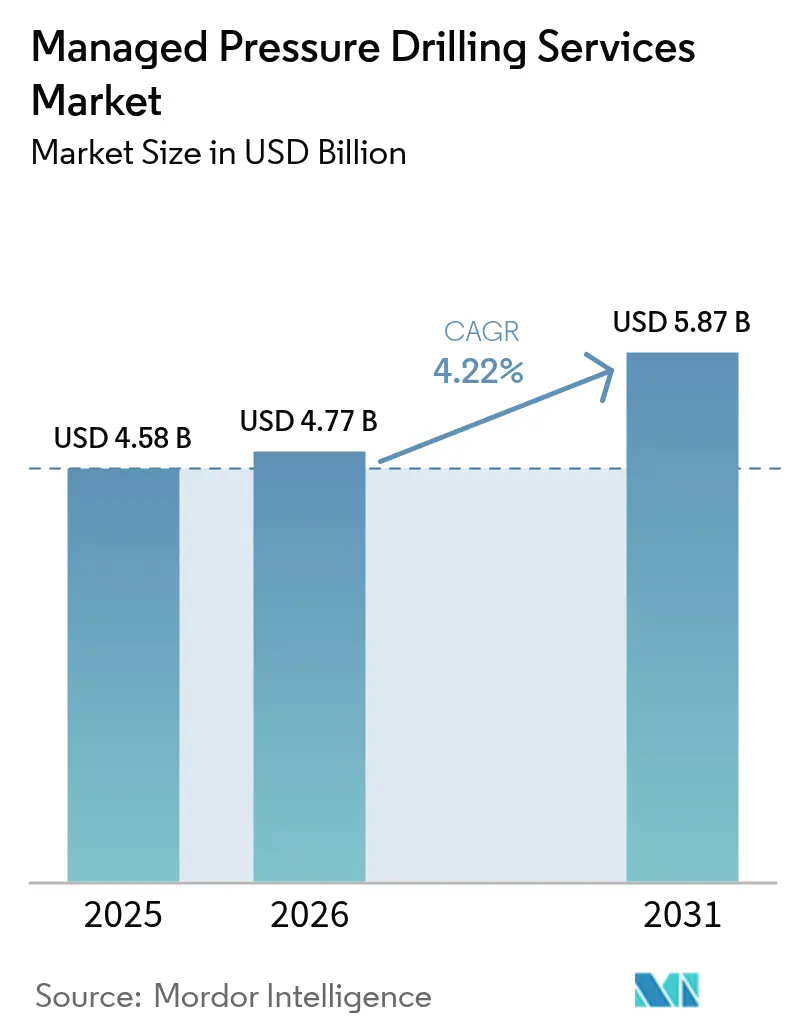
The Managed Pressure Drilling Services market size is expected to grow from USD 4.58 billion in 2025 to USD 4.77 billion in 2026 and is forecast to reach USD 5.87 billion by 2031 at 4.22% CAGR over 2026-2031.
Industry momentum is rooted in deepwater capital expenditure recovery, surging HPHT activity, and rapid automation that lets operators manage narrower pressure margins with fewer crew. Dual-gradient innovations, carbon capture projects, and geothermal well mandates provide fresh revenue lanes, while rig-day-rate volatility and certified crew shortages temper near-term spending. Market leaders Halliburton, SLB, and Weatherford emphasise AI-enabled pressure automation to secure premium contracts, whereas niche specialists target hydrogen-ready and geothermal wells. Operators increasingly favour integrated equipment-plus-execution packages, allowing service companies to capture higher wallet share and accelerate technology upgrades.
Key Report Takeaways
- By technology, constant bottom-hole pressure techniques led with 46.10% of managed pressure drilling services market share in 2025, while dual-gradient drilling is projected to advance at a 5.95% CAGR through 2031.
- By service type, equipment rental held 47.70% of revenue in 2025; operations and execution services are forecast to record a 5.55% CAGR to 2031 as operators seek turnkey offerings.
- By pressure regime, low-pressure/narrow window applications captured 63.10% share in 2025; HPHT environments are rising fastest at a 6.12% CAGR, especially across the Middle East and North Africa.
- By well type, development production wells commanded 53.20% of the managed pressure drilling services market size in 2025, whereas wildcat/exploration wells are set to expand at a 6.02% CAGR.
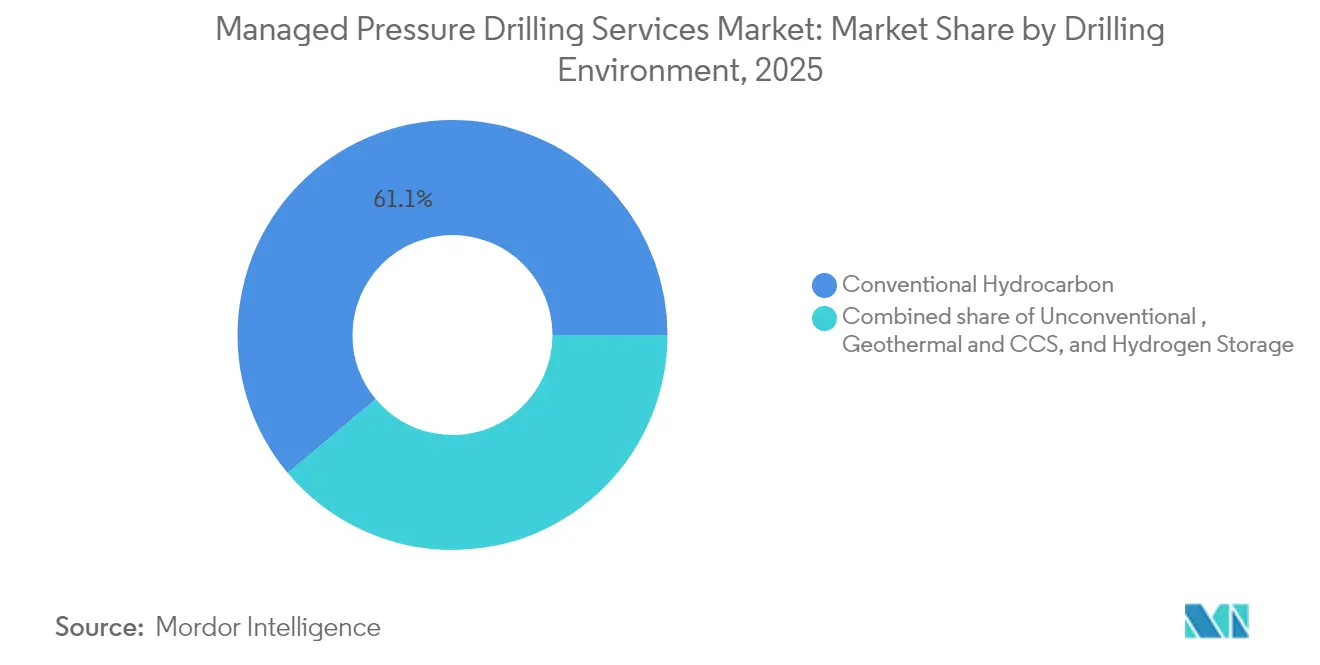
- By drilling environment, conventional hydrocarbon projects kept 61.10% share in 2025, but unconventional formations are growing at 6.35% CAGR, driven by North American shale refracs and European geothermal wells.
- By application, onshore projects represented 64.50% of 2025 revenue, and offshore developments are expected to climb at a 5.72% CAGR on the back of deepwater sanctions recovery.
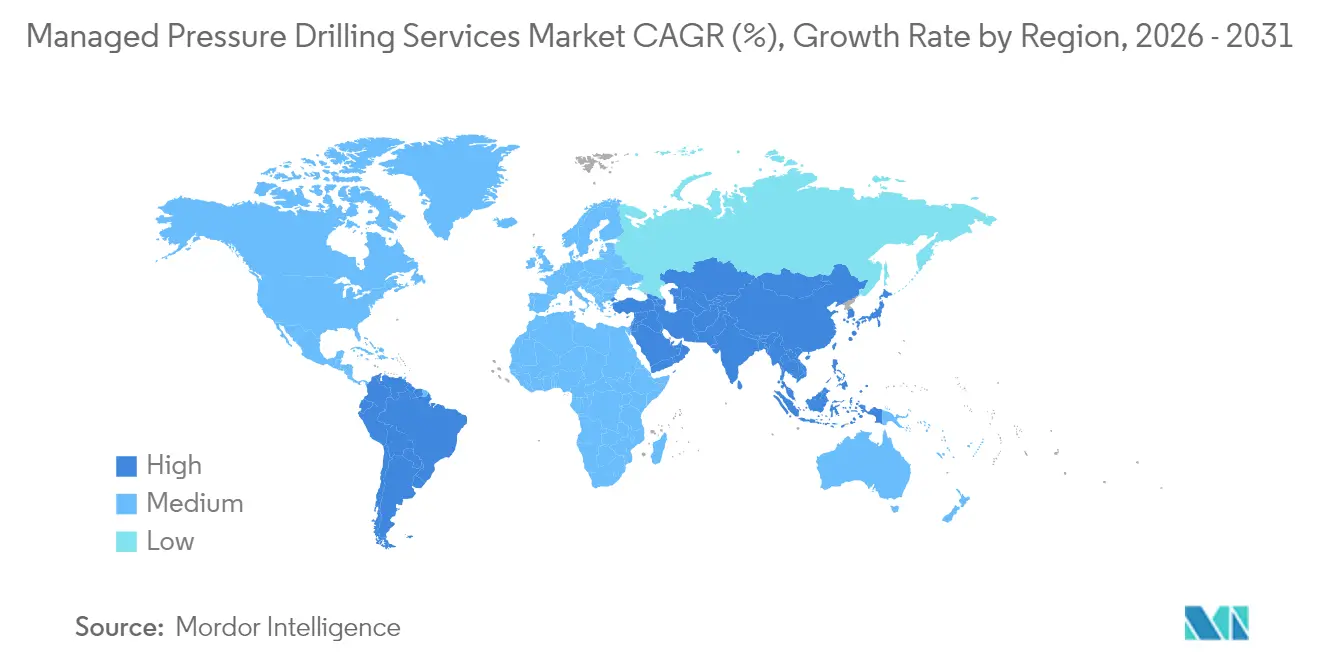
- By geography, North America led with 38.10% revenue share in 2025, while Asia-Pacific is forecast to post the fastest 6.82% CAGR to 2031 on heightened unconventional drilling in China and India.
Note: Market size and forecast figures in this report are generated using Mordor Intelligence’s proprietary estimation framework, updated with the latest available data and insights as of 2026.
Market Trends and Insights
Drivers Impact Analysis of Managed Pressure Drilling Services Market*
| Driver | ( ~ ) % Impact on CAGR Forecast | Geographic Relevance | Impact Timeline |
|---|---|---|---|
| Accelerating deep-water CAPEX rebound | +1.2% | Gulf of Mexico, Brazil, West Africa | Medium term (2-4 years) |
| Surge in HPHT well development in MENA | +0.8% | Middle East & North Africa; spill-over to Asia-Pacific | Long term (≥ 4 years) |
| Post-2025 shale refrac wave in North America | +0.6% | Permian & Eagle Ford basins | Short term (≤ 2 years) |
| AI-driven downhole pressure automation | +0.5% | Early use in North America & North Sea | Medium term (2-4 years) |
| CCS & hydrogen-ready well design standards | +0.3% | North America & EU; expanding to Asia-Pacific | Long term (≥ 4 years) |
| Mandatory MPD adoption for EU geothermal | +0.2% | European Union; potential global standardisation | Long term (≥ 4 years) |
| Source: Mordor Intelligence | |||


Accelerating Deep-water CAPEX Rebound
Sanctioned deepwater budgets have exceeded USD 200 billion annually since 2022, reversing the 2015-2020 investment drought and fuelling fresh demand for managed pressure drilling services market deployments[1]Journal of Petroleum Technology, “Deepwater CAPEX Resurgence Spurs MPD Demand,” jpt.spe.org. Chevron’s USD 5.7 billion Anchor project illustrates the shift, employing 20,000 psi systems that rely on sophisticated MPD to drill safely in ultra-narrow windows. Drillship utilisation nearing 97% in 2025 prioritises rigs fitted with advanced pressure control, allowing contractors to command premium dayrates. Each sanctioned deepwater campaign typically entails multiple MPD-enabled wells across exploration, appraisal, and production phases, compounding service demand. Technology differentiation remains a pivotal competitive lever for service providers positioning for multi-year contract backlogs.
Surge in HPHT Well Development in MENA
National oil companies across the Middle East and North Africa target reservoirs exceeding 15,000 psi and 350 °F, where managed pressure drilling services market solutions become indispensable for safe wellbore construction. Automated rotary and slide drilling executed in Oman by Halliburton and Nabors underscores how AI-enhanced MPD is fast becoming standard operating practice [2]Halliburton, “Automated Rotary & Slide Drilling in Oman,” halliburton.com. Regulatory frameworks in Saudi Arabia, the UAE, and Qatar now require MPD on wells surpassing defined pressure thresholds, accelerating adoption. As HPHT projects proliferate, service providers with proven HPHT toolkits and crew availability enjoy a clear advantage.
Post-2025 Shale Refrac Wave in North America
North American producers are pivoting capital toward refracturing legacy shale wells to amplify recovery, unlocking up to USD 2 billion in value from 400 Bakken candidates alone. Devon Energy registered an 8% production uplift in Q1 2024 from Eagle Ford refracs, validating the economic payoff. Refrac operations often entail complex multi-zone pressure management that puts MPD equipment and expertise at the heart of investment decisions. Integrated equipment-plus-execution packages resonate with operators seeking predictable cost and schedule outcomes amid crew tightness.
AI-driven Downhole Pressure Automation
Real-time optimisation platforms such as Halliburton’s LOGIX deliver 30% rate-of-penetration gains while slashing manual commands by roughly 5,000 per well, highlighting the operational efficiency upside. SLB’s Neuro system recorded 25 autonomous trajectory changes in Ecuador, proving the value of machine learning for geosteering and pressure modulation. Corva’s cloud analytics cuts well costs by USD 100,000-150,000 through predictive pressure control. The cumulative effect reduces non-productive time, mitigates crew shortages, and elevates safety, amplifying the technology’s attraction across the managed pressure drilling services market.
Restraints Impact Analysis of Managed Pressure Drilling Services Market*
| Restraint | ( ~ ) % Impact on CAGR Forecast | Geographic Relevance | Impact Timeline |
|---|---|---|---|
| Volatile rig-day rates squeezing MPD budgets | -0.7% | Global, particularly offshore markets | Short term (≤ 2 years) |
| Limited global pool of certified MPD crews | -0.5% | Global, acute in Asia-Pacific and emerging markets | Medium term (2-4 years) |
| Persistent data-ownership disputes in JV wells | -0.3% | Global, concentrated in international joint ventures | Medium term (2-4 years) |
| Stricter drilling-fluid discharge limits in offshore Arctic | -0.2% | Arctic regions, primarily Norwegian and Canadian Arctic | Long term (≥ 4 years) |
| Source: Mordor Intelligence | |||
Volatile Rig-day Rates Squeezing MPD Budgets
Harsh-environment semisubs commanded USD 390,000-510,000 per day in 2024, a nine-year high that narrowed discretionary drilling spend. MPD services typically add 15-25% to total well costs, so sudden rate spikes lead operators to defer or downgrade deployments. Ownership models such as TotalEnergies’ majority stake in a high-spec drillship highlight efforts to tame escalating costs. While rig rates are expected to ease modestly by 2026, the boom-bust cycle underpins cautious MPD budgeting.
Limited Global Pool of Certified MPD Crews
MPD crews require blended competencies in conventional drilling, real-time data interpretation, and automated pressure control, yet global training capacity lags demand [3]OnePetro, “Global MPD Crew Competency Gaps,” onepetro.org. Local content mandates compound shortages in markets such as India, Indonesia, and Nigeria, where nationalisation targets outstrip trained personnel numbers. Crew scarcity inflates service rates and stretches project schedules, compelling contractors to accelerate simulator-based training and remote-support models.
*Our forecasts treat driver/restraint impacts as directional, not additive. The impact forecasts reflect baseline growth, mix effects, and variable interactions.
Managed Pressure Drilling Services Market Segment Analysis
By Technology:
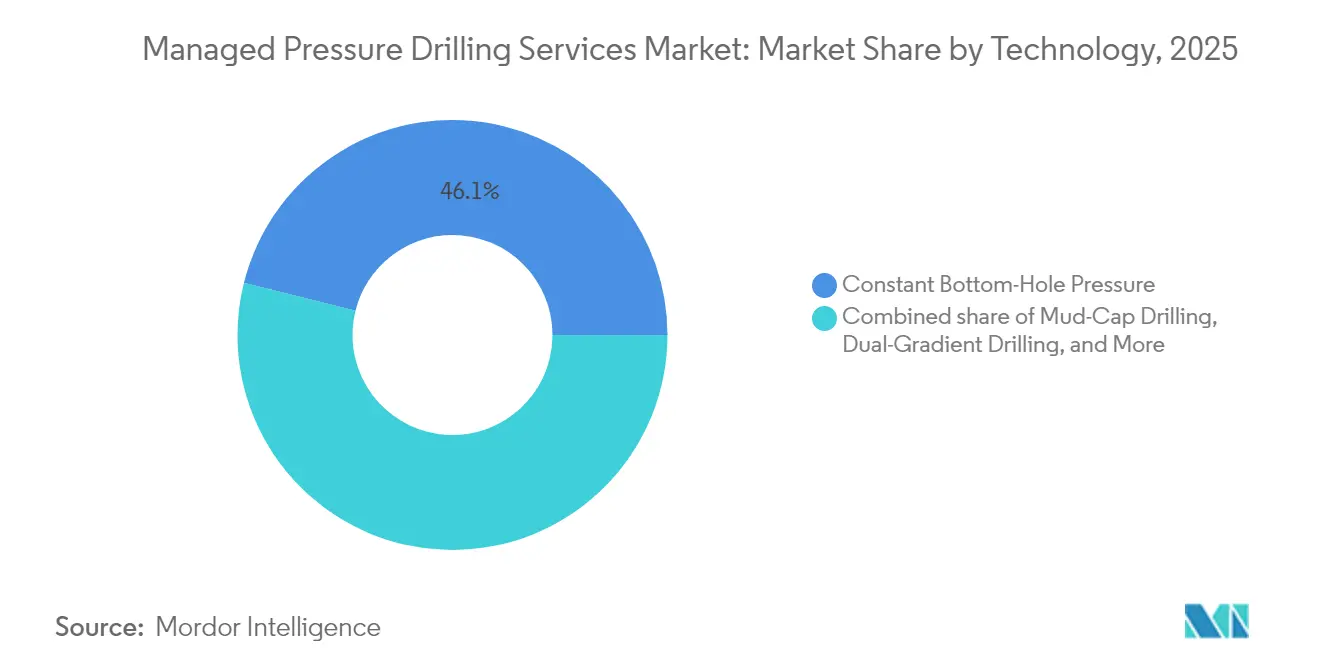
Dual-Gradient Innovation AcceleratesConstant bottom-hole pressure methods contributed 46.10% to the managed pressure drilling services market size in 2025, reflecting their broad applicability across shelf, HPHT, and onshore wells. However, dual-gradient systems are climbing at a 5.95% CAGR to 2031 as deepwater operators exploit their ability to decouple mudweight from riser pressure, lowering downhole stress and improving kick tolerance.
The dual-gradient surge coincides with integrated seabed pump deployments synchronizing with surface control loops for rapid pressure corrections. AI-linked sensors fine-tune bottomhole pressure analytics, cutting wellbore ballooning events. Mud-cap drilling remains niche for total-loss scenarios, and return-flow control methods serve laterals in shale plays, yet both benefit from the broader automation wave permeating the managed pressure drilling services market.


By Service Type:
Operations Integration Drives GrowthEquipment rental held 47.70% revenue in 2025 as operators avoided capital commitments tied to specialised manifolds, chokes, and rotating control devices. The managed pressure drilling services market size for operations and execution packages is forecast to rise faster at a 5.55% CAGR, propelled by crew scarcity and risk-sharing incentives.
Integrated contracts bundle hardware with certified personnel, real-time analytics, and performance guarantees, letting operators transfer execution risk while accessing the latest toolsets. Design and engineering services maintain a stable demand, particularly for frontier HPHT and CCS wells requiring bespoke hydraulics modelling. Training and support demand is swelling as contractors race to certify national crews and enable remote operations centres.
By Pressure Regime:
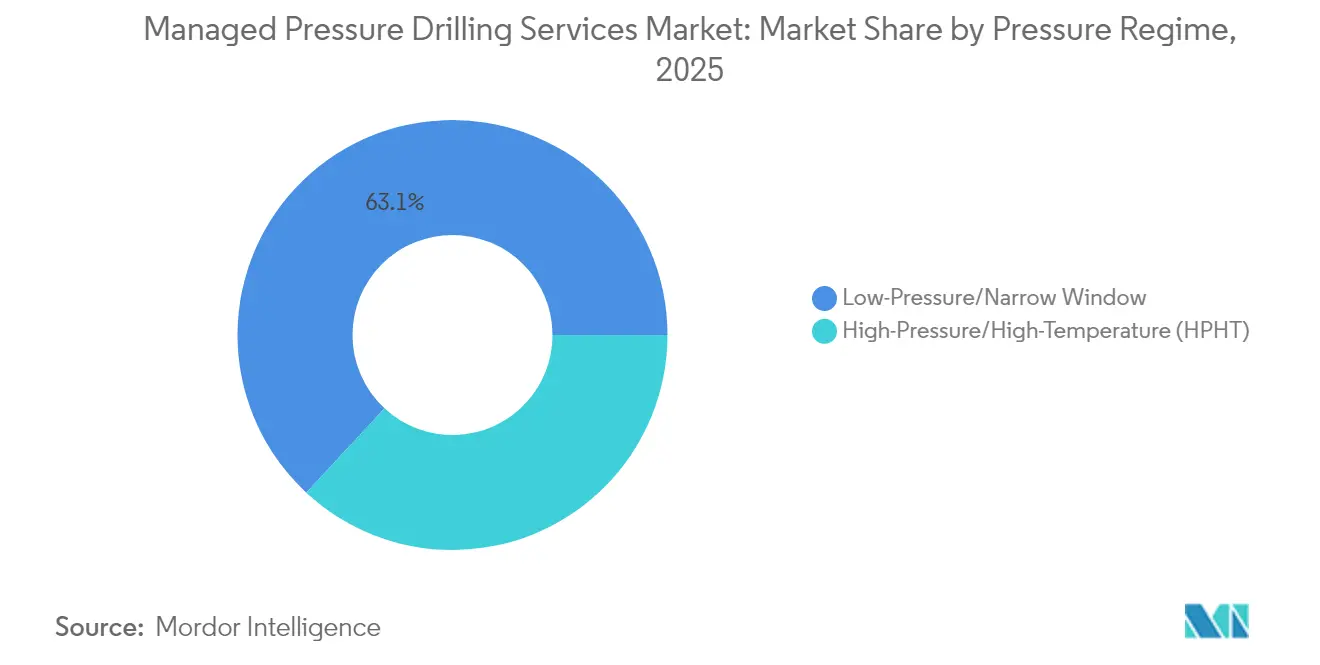
HPHT Applications AccelerateLow-pressure/narrow window projects dominated with 63.10% revenue in 2025, underscoring MPD’s roots in mature fields where formation stability is critical . Yet HPHT wells are expanding at 6.12% CAGR on the back of Middle East carbonate plays, US GoM ultra-deepwater, and Asia-Pacific deep targets.
Chevron’s Anchor well illustrates the frontier as 20,000 psi-rated BOPs force simultaneous MPD integration to mitigate surge-swab risks. New US Bureau of Safety and Environmental Enforcement rules effective October 2024 elevate pressure-control compliance, strengthening HPHT MPD demand. Vendors are responding with 20,000-psi rotating heads and high-temperature elastomers, extending the managed pressure drilling services market reach.
By Well Type:
Exploration Complexity Drives InnovationDevelopment production wells delivered 53.20% of the managed pressure drilling services market size in 2025 due to repeatable programmes in the shelf and onshore fields. Exploration wells, however, are set to expand at a 6.02% CAGR because unknown pore-pressure regimes amplify risk-reduction incentives.
Wildcat wells in Sierra Leone, Namibia, and Suriname now budget MPD from spud to mitigate blowout risk and data uncertainty. Work-over and re-entry niches grow as operators refrac shale laterals or sidetrack ageing offshore wells, requiring real-time pressure juggling around existing casing and completions.
By Drilling Environment:
Unconventional Surge ContinuesConventional hydrocarbons retained a 61.10% share in 2025, yet unconventional formations are on a 6.35% CAGR trajectory as North American refracs and multi-stage shale completions seek tighter pressure windows. European geothermal wells are another bright spot. Mandatory MPD clauses now appear in French Alsace tenders, and Italian operators trial geothermal MPD to pre-empt lost-circulation and induced seismicity. Carbon storage pilot projects in the Netherlands and California deploy MPD to protect caprock integrity during CO₂ injection, marking new horizons for the managed pressure drilling services market.
By Application:
Offshore Technology PushOnshore projects generated 64.50% of 2025 revenue thanks to prolific US shale, Middle East HPHT land rigs, and Latin American heavy-oil fields. Offshore demand is projected to lift at a 5.72% CAGR, anchored by Brazil’s pre-salt, Gulf of Mexico ultra-deepwater, and West Africa frontier plays .
Floating drilling units face heave, loop-current, and riser-pressure complications, making MPD hardware integration more complex but essential. Contractors retrofit older drillships with subsea rotating devices and riser-pressure control modules to secure higher utilisation, a trend that underpins the managed pressure drilling services market’s offshore momentum.
Geography Analysis
North America Managed Pressure Drilling Services Market
North America preserved a 38.10% revenue lead in 2025 as shale refracs, Permian HPHT horizontals, and Gulf of Mexico ultra-deepwater wells collectively boosted MPD demand. Early adoption of AI-enabled pressure automation and an established training infrastructure keeps service costs competitive. Mexico’s Trion field, backed by SLB’s integrated drilling contract, signals deeper regional penetration of MPD for national oil companies.
APAC Managed Pressure Drilling Services Market
Asia-Pacific is the fastest-growing managed pressure drilling services market segment, set for a 6.82% CAGR to 2031. China’s push into 8-km deep Shunbei wells and Sichuan over-pressured shales requires precise pressure envelopes to avoid H₂S influx. India’s rig count is projected to rise from 111 in 2024 to 142 by 2028, creating incremental MPD demand for offshore KG basin HPHT wells and onshore Rajasthan appraisal campaigns. Southeast Asia revives deepwater gas prospects in Malaysia and Indonesia, while Australia preps CCS pilot wells aligned with net-zero targets.
Europe Managed Pressure Drilling Services Market
Europe shows steady growth fuelled by North Sea HPHT wells, Baltic CCS pilots, and geothermal hotspots in Germany and France. The EU’s stringent well-integrity rules embed MPD in licensing conditions for geothermal and CCS wells, reinforcing technology pull. Norway’s full-field MPD adoption standard further diffuses best practice across the continent.
MEA and South America Managed Pressure Drilling Services Market
The Middle East and Africa benefit from HPHT carbonate developments in Saudi Arabia and Qatar, plus emerging deepwater campaigns in Namibia and Angola. National oil company mandates and HPHT targets underpin robust demand, though crew localisation remains a bottleneck. Brazil’s pre-salt and Argentina’s unconventional Vaca Muerta drive anchor South America's growth.

Regulatory Landscape
Offshore regulators are tightening formal guidance for managed pressure drilling services market deployments, particularly where subsea BOPs and HPHT conditions heighten well-control risk. In the United States, the Bureau of Safety and Environmental Enforcement (BSEE) issued NTL No. 2024-G05 (November 2024) to guide MPD projects using a subsea blowout preventer on the Gulf of Mexico OCS. The notice clarifies documentation and review expectations to demonstrate compliance with 30 CFR 250 requirements.
In Canada, Natural Resources Canada advanced the Frontier and Offshore Regulatory Renewal Initiative (FORRI) through the publication of the Canada-Newfoundland and Labrador and Canada-Nova Scotia Offshore Area Petroleum Operations Framework Regulations (Canada Gazette, Part II, February 2024), pointing toward more consolidated and modernized offshore operational requirements that intersect with MPD planning, competency, and well integrity practices. Environmental compliance also shapes MPD operating procedures and supporting services: the US Environmental Protection Agency finalized targeted revisions in April 2026 to the 2024 Clean Air Act oil and gas rules focused on flaring provisions and monitoring, which can influence how operators design drilling and well-testing workflows around pressure control and emissions management.
Competitive Landscape
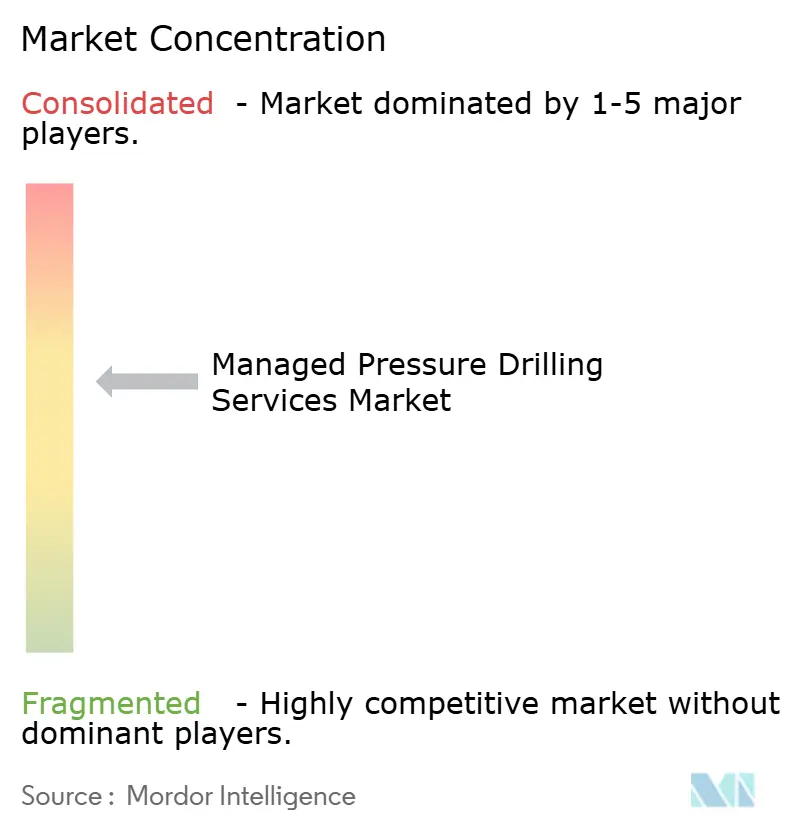
The managed pressure drilling services market is moderately fragmented. Halliburton, SLB, and Weatherford hold substantial shares, supported by global infrastructure and proprietary automation platforms. Halliburton’s LOGIX secured multiple North Sea contracts after demonstrating 30% penetration gains and lower downhole incidents. SLB’s 18-well Trion award in Mexico validates its AI-based Neuro stack and integrated service bundle strategy.
Partnerships remain critical. Halliburton teamed with Sekal to deliver the world’s first automated on-bottom drilling system for Equinor, integrating real-time hydraulics and drilling parameter optimisation. Nabors embeds MPD within its rig fleet, offering “MPD-ready” charters that shorten mobilisation schedules and cut interface risk. Enhanced Drilling captures niche Arctic and geothermal projects with sea-floor pump variants tailored for cold-water rheology.
Consolidation is ongoing. Helmerich & Payne’s USD 2 billion buyout of KCA Deutag broadens onshore reach and MPD capability, while SLB’s planned acquisition of ChampionX aims to merge drilling and completions chemistry insights with real-time pressure management. These moves herald a pivot toward vertically integrated well-construction suites that package rigs, digital workflows, and MPD in a single commercial offering, reshaping pricing and differentiation levers across the managed pressure drilling services market.
Managed Pressure Drilling Services Industry Leaders
Schlumberger Limited
Nabors Industries Ltd
Weatherford International PLC
Halliburton Company
NOV Inc.
- *Disclaimer: Major Players sorted in no particular order
Managed Pressure Drilling Services Market Companies Covered in this Report
- Halliburton Company
- Schlumberger Ltd
- Weatherford International plc
- NOV Inc.
- Nabors Industries Ltd
- Global MPD Services
- Ensign Energy Services Inc.
- Air Drilling Associates Inc.
- Blade Energy Partners Ltd
- Exceed (XCD) Holdings Ltd
- Pruitt MPD
- Beyond Energy Services & Technology
- Scientific Drilling International
- Secure Drilling (Petrofac)
- Wild Well Control
- Archer Ltd
- Helmerich & Payne (MPD unit)
- Welltec A/S
- Cougar Drilling Solutions
- GOSCO Drilling Solutions

Market Opportunities and Future Outlook
Near-term whitespace is opening around integrated automation plus MPD execution, as operators shift from standalone pressure-control packages to closed-loop workflows that combine surface equipment, well placement, and hydraulics. Halliburton and Eni completed an integrated closed-loop rig automation and MPD deployment on a deepwater exploration well offshore Indonesia in July 2026 using Halliburton's LOGIX automation platform, illustrating a replicable template for offshore campaigns where narrow pressure margins and crew constraints push adoption of remote operations and higher automation levels.
Deepwater and ultra-deepwater programs also support a broader role for MPD in standardized drilling plans and repeatable well delivery. Operator adoption signals include BP scaling autonomous drilling through MPD at Atlantis in the US Gulf of Mexico after an October 2025 deployment in 7,000 ft of water, confirmed in February 2026. At the same time, maturing governance and training frameworks reduce operational variability and widen qualified execution models: BSEE's NTL No. 2024-G05 (November 2024) formalizes the content needed for subsea BOP MPD project planning, while industry programs such as IADC MPD accreditation and ongoing work by IADC committees to revise MPD-related API recommended practices provide a route for contractors to expand certified crews and offer more turnkey operations and execution services across regions.
Recent Industry Developments in Managed Pressure Drilling Services Market
- July 2026: Halliburton and Eni completed an integrated closed-loop rig automation and MPD deployment on a deepwater exploration well offshore Indonesia using Halliburton's LOGIX automation platform. The implementation combined MPD controls with surface and downhole automation and remote operations, raising the benchmark for end-to-end automated drilling delivery in Asia-Pacific.
- May 2026: Expro announced a definitive agreement to acquire Enhanced Drilling, a specialist in MPD technology, with closing targeted for Q3 2026. The transaction expands Expro's MPD toolset and supports a broader integrated services position in offshore markets where automated pressure control and specialized equipment can differentiate contract awards.
- September 2024: Seadrill and Oil States announced a strategic collaboration to enhance offshore managed pressure drilling operations. The partnership focused on improving MPD system integration and execution on offshore rigs, aligning contractor and equipment-provider capabilities to reduce interface risk on complex wells.


Managed Pressure Drilling Services Market Report Scope and Research Methodology
Market Definition and Coverage
For this report, the market is the revenue earned from managed pressure drilling (MPD) services that help control annular pressure during well construction. This includes planning, onsite execution support, and the related equipment and tools that are provided as part of the service.
Scope exclusions: Excluded from sizing are general drilling services that do not involve MPD execution, plus stand-alone drilling fluid, cementing, and completion services.
Segments Covered in This Report
- By Technology
- Constant Bottom-Hole Pressure
- Mud-Cap Drilling
- Dual-Gradient Drilling
- Return-Flow Control Drilling
- Other Emerging Techniques
- By Service Type
- Design and Engineering
- Equipment Rental
- Operations and Execution
- Training and Support
- By Pressure Regime
- Low-Pressure/Narrow Window
- High-Pressure/High-Temperature (HPHT)
- By Well Type
- Wildcat/Exploration
- Development Production
- Work-over and Re-entry
- By Drilling Environment
- Conventional Hydrocarbon
- Unconventional (Shale, Tight, CBM)
- Geothermal
- CCS and Hydrogen Storage
- By Application
- Onshore
- Offshore
- By Geography
- North America
- United States
- Canada
- Mexico
- Europe
- Germany
- United Kingdom
- France
- Italy
- Spain
- Russia
- Rest of Europe
- Asia-Pacific
- China
- India
- Japan
- South Korea
- ASEAN Countries
- Rest of Asia-Pacific
- South America
- Brazil
- Argentina
- Rest of South America
- Middle East and Africa
- Saudi Arabia
- United Arab Emirates
- South Africa
- Egypt
- Rest of Middle East and Africa
- North America
Data Sources, Market Sizing, and Validation
Desk Research
Desk research builds the base layers of the model, especially around drilling activity and where MPD is most likely to be used, narrow pore pressure windows, deepwater, HPHT, and other challenging wellbore conditions. We relied on public drilling and production indicators, safety and well-control guidance, and offshore project signals to keep assumptions anchored to field activity.
Sources reviewed include public datasets and publications such as the EIA, the US Bureau of Labor Statistics (for supporting cost context), IEA, OPEC monthly reports, and regulator and standards bodies such as BSEE and API, along with SPE papers and other peer reviewed technical literature. We also used company filings, investor presentations, credible press coverage, and a paid subscription focused on company financials and news to cross-check exposure to MPD related revenue where disclosures allow. These examples are not exhaustive, and additional sources were used to collect inputs, validate figures, and clarify uncertainties.
Primary Interviews and Surveys
Primary work was used to confirm where MPD is actually being specified and how pricing behaves across offshore and onshore programs. In practice, contract structure and what is bundled into MPD packages can change totals more than headline rig counts. We spoke with service side specialists, drilling engineers, procurement teams, and operations leaders across major producing regions so we could close gaps from public data and stress-test assumptions before finalizing the model.
Distribution of primary research fieldwork respondents
| Company type | Respondent position | Region |
|---|---|---|
| Top tier: 31% | CXOs: 13% | APAC: 37% |
| Mid tier: 52% | Functional/Unit leaders: 43% | EMEA: 37% |
| Smaller Players: 17% | Managers: 44% | Americas: 26% |
Market-Sizing & Forecasting
Sizing starts with a top-down build where drilled well activity is reconstructed by region and environment, and then filtered through MPD suitability and adoption assumptions that came up repeatedly in interviews. Once the practical demand pool is formed, revenues are calculated using typical service intensity per well and blended pricing levels that reflect how MPD packages are contracted.
To keep the totals realistic, we corroborated them with selective bottom-up checks such as sampled day-rate style pricing for MPD spreads, rough well count by basin, and publicly visible offshore campaign timelines, then adjusted for areas where disclosure is thin. Inputs used in the model include onshore versus offshore well mix, deepwater project cadence, expected share of wells with tight pressure margins, split of execution support versus rental-heavy packages, and utilization signals tied to active rig and well construction trends. For forecasting, scenario analysis was applied around upstream spending and offshore sanctioning, followed by smoothing of the resulting trajectories so year-to-year changes match how drilling programs typically ramp.
Data Validation & Update Cycle
Outputs are checked against independent signals such as regional drilling activity and announced offshore developments, and whether implied revenue per active program looks reasonable based on primary feedback. If a region shows a jump that cannot be explained by activity, pricing, or mix changes, the inputs are reopened and the anomalies are reviewed in a separate analyst pass before sign-off.
Reports refresh annually, with interim updates triggered when material events occur, such as major shifts in upstream budgets or offshore project delays. Before delivery, we run a final update sweep to align assumptions with the latest available public indicators and any new expert feedback received.
Mordor Intelligence's Managed Pressure Drilling Services Market Estimate Compared With Other Published Estimates
Different market values for MPD services show up because publishers do not always count the same service bundle, and they often use different activity and pricing assumptions for the same drilling cycle. Timing also affects results, since upstream budgets and offshore schedules can change quickly, and not every estimate gets refreshed at the same pace.
Directional drilling and other non-MPD well construction services are outside Mordor Intelligence's scope, which helps reduce double counting when a broader drilling services number is repackaged as MPD. The spread also reflects how each source treats offshore versus onshore mix, whether rental-only tool revenue is included alongside execution support, and whether pricing is held flat or allowed to move with utilization and operator cost pressure.
Benchmark comparison
| Source | Market Size | Gaps in Research Methodology |
|---|---|---|
| Mordor Intelligence | USD 4.77 B (2026) | |
| Trade Journal A | USD 5.06 B (2026) | Tends to roll broader drilling pressure control and adjacent well construction services into MPD, and uses a higher assumed offshore mix without clearly separating rental-only tool revenue from full execution packages. |
| Industry Database B | USD 4.08 B (2023) | Uses an older base year with limited refresh for post-2023 offshore activity changes, and appears to apply conservative adoption rates for MPD in complex wells, which suppresses implied service intensity per well. |
The table shows that the gap is mostly explained by what gets counted as MPD service revenue and how the offshore pipeline is reflected in the base year. By keeping variables tied to drill activity, MPD adoption, and service intensity, the estimate remains traceable to clear inputs that can be checked and repeated over time.


Key Questions Answered in the Report
What is the current size of the managed pressure drilling services market?
The market was valued at USD 4.77 billion in 2026, with a forecast to reach USD 5.87 billion by 2031 at a 4.22% CAGR.
Which technology segment is growing the fastest?
Dual-gradient drilling is expected to post a 5.95% CAGR through 2031 due to its superior performance in deepwater wells.
Why is Asia-Pacific the fastest-growing regional market?
Aggressive ultra-deep and unconventional drilling in China plus India’s expanding rig fleet drive a projected 6.82% regional CAGR.
How are AI systems changing MPD operations?
AI platforms such as LOGIX and Neuro automate real-time pressure control, increasing penetration rates by up to 30% while reducing crew workload.
What restrains wider MPD adoption?
High rig-day-rate volatility and a limited pool of certified MPD crews are the main barriers, trimming forecast CAGR by a combined 1.2 percentage points.
Which emerging applications will boost future demand?
Carbon capture storage wells, geothermal drilling mandates in the EU, and hydrogen storage pilots are set to widen MPD’s addressable market over the next decade.
Page last updated on:


 Your data is secure and never sold or shared.


