
Market Overview
| Study Period | 2020 - 2031 |
|---|---|
| Forecast Data Period | 2026 - 2031 |
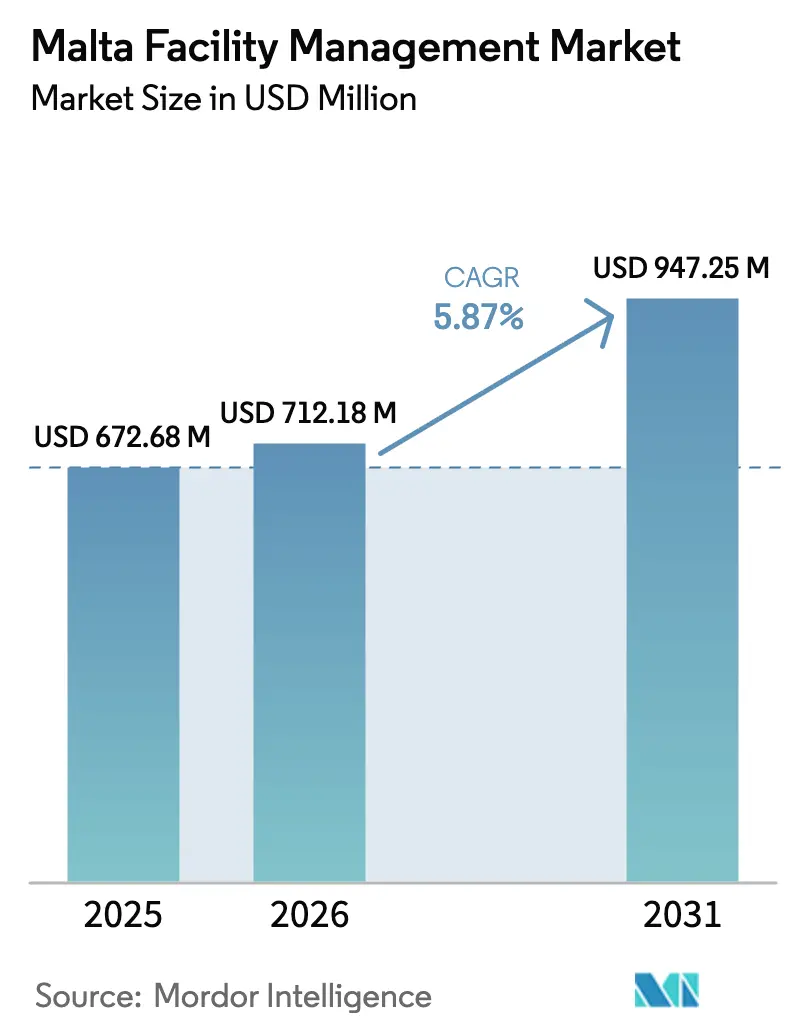
| Base Year Market Size (2025) | USD 672.68 Million |
| Market Size (2026) | USD 712.18 Million |
| Market Size (2031) | USD 947.25 Million |
| Growth Rate (2026 - 2031) | 5.87% CAGR |
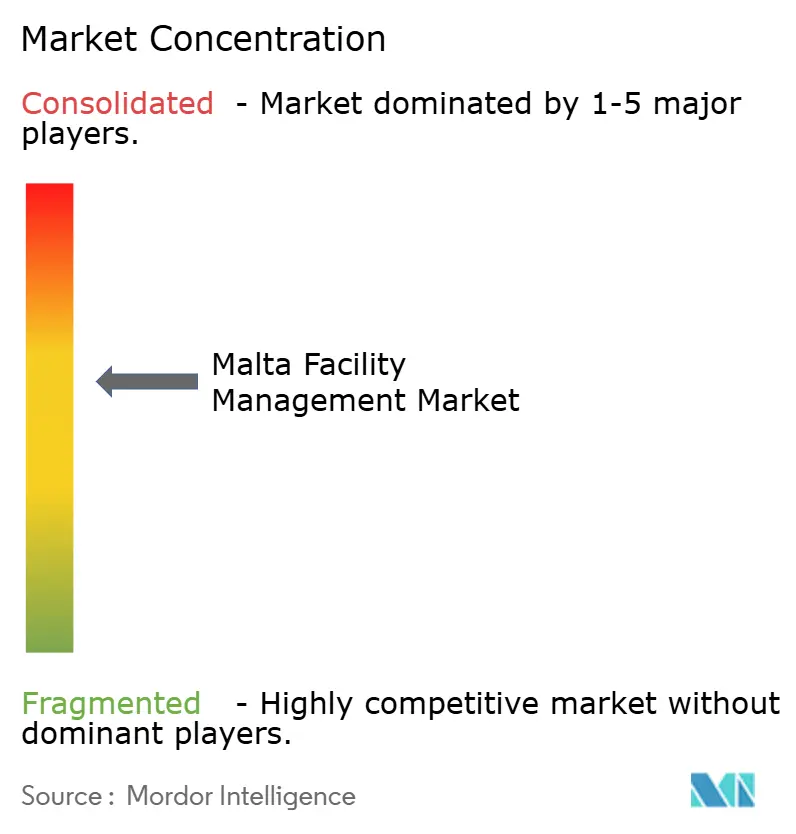
| Market Concentration | Medium |
Major Players *Disclaimer: Major Players sorted in no particular order Image © Mordor Intelligence. Reuse requires attribution under CC BY 4.0. | |
Malta Facility Management Market Analysis by Mordor Intelligence
The Malta Facility Management Market size is expected to grow from USD 672.68 million in 2025 to USD 712.18 million in 2026 and is forecast to reach USD 947.25 million by 2031 at 5.87% CAGR over 2026-2031. Growth is underpinned by infrastructure modernization, steady tourism recovery, and the island’s National Investment Plan, all of which intensify demand for integrated building services, digital maintenance platforms, and heritage-compliant solutions. Commercial real-estate expansion across Valletta, Sliema, and St. Julian’s keeps hard services in high demand, while public-sector projects enlarge the addressable pool for outsourced contracts. Labor regulation upgrades and rising occupancy rates encourage organizations to outsource for cost control and compliance assurance. Technology adoption—particularly AI-driven predictive maintenance and IoT-enabled building management—has become the pivotal differentiator, as Malta positions itself as the “Ultimate AI Launchpad” by 2030.
Key Report Takeaways
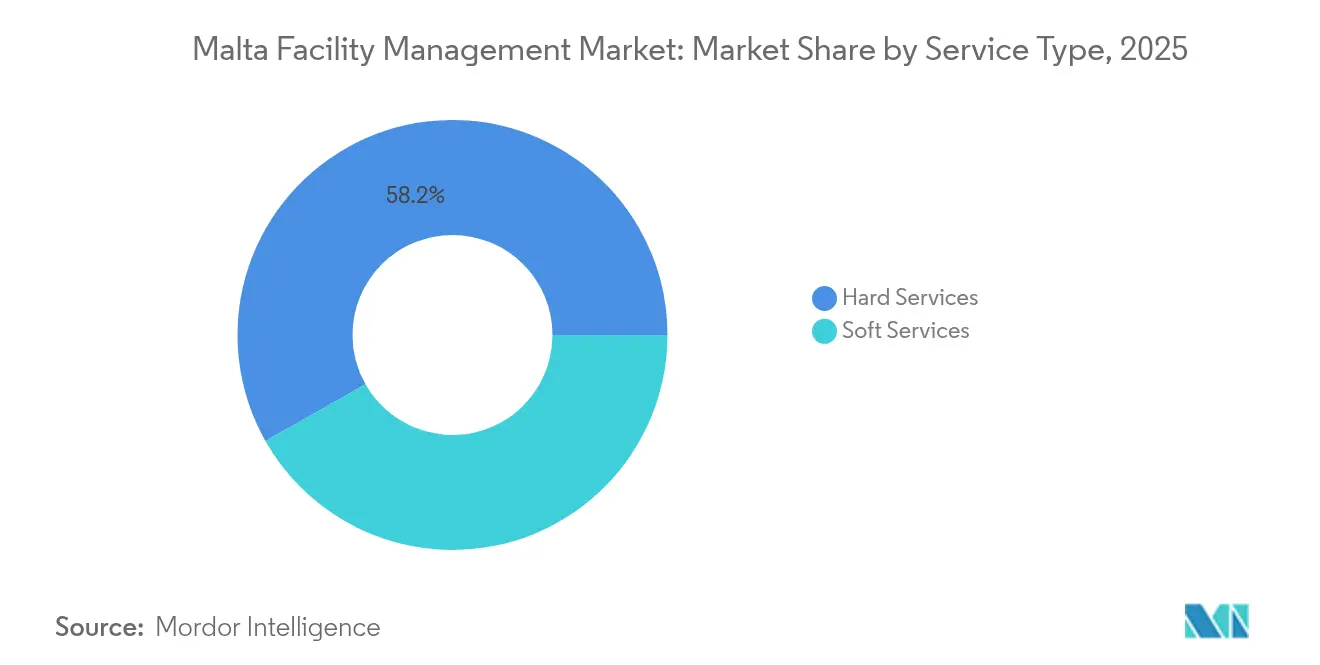
- By service type, hard services led with 58.20% Malta facility management market share in 2025; soft services are expanding at an 8.02% CAGR through 2031.
- By offering, outsourced services commanded 64.70% of the Malta facility management market size in 2025 and is projected to rise at a 7.39% CAGR; in-house services retained a 35.30% share of the Malta facility management market size in 2025.
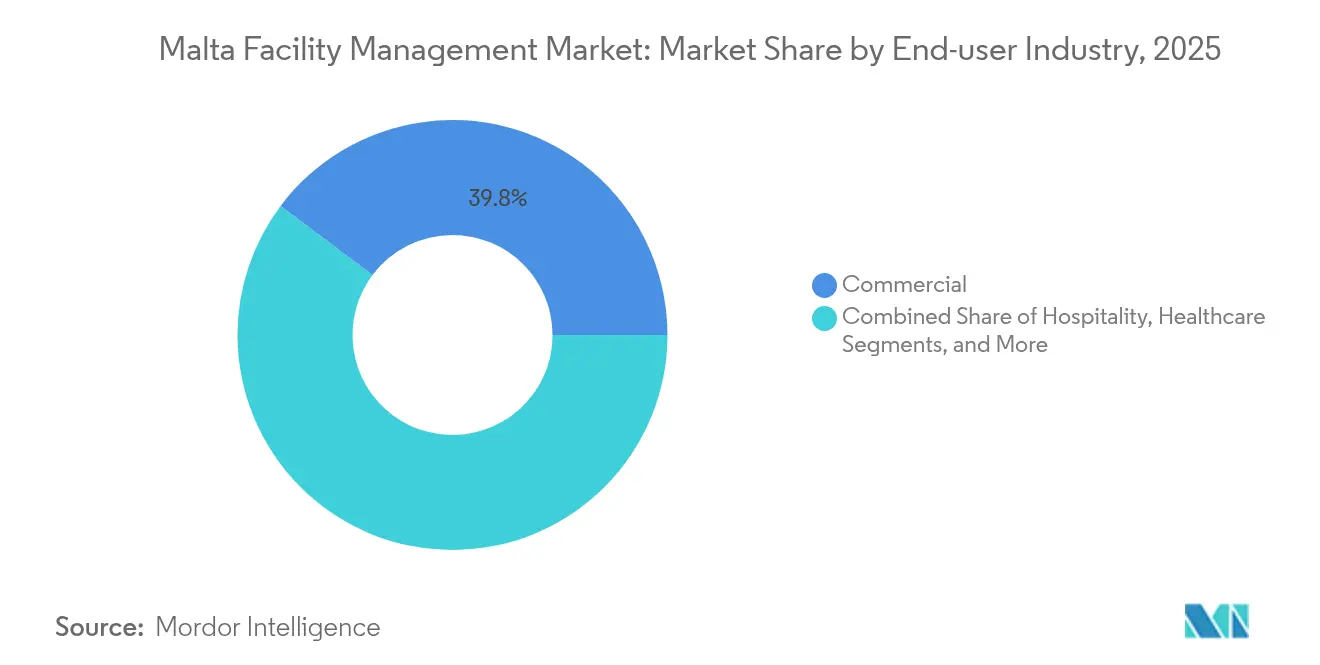
- By end-user industry, commercial facilities held 39.75% of the Malta facility management market share in 2025, while institutional and public infrastructure is advancing at a 7.68% CAGR through 2031.
Note: Market size and forecast figures in this report are generated using Mordor Intelligence’s proprietary estimation framework, updated with the latest available data and insights as of 2026.
Malta Facility Management Market Trends and Insights
Drivers Impact Analysis*
| Driver | (~) % Impact on CAGR Forecast | Geographic Relevance | Impact Timeline |
|---|---|---|---|
| Urbanization and population growth | +1.2% | National, concentrated in Valletta, Sliema, St. Julian's | Medium term (2-4 years) |
| Labor and safety regulation upgrade | +0.8% | National, with stricter enforcement in heritage zones | Short term (≤ 2 years) |
| Infrastructure investment pipeline | +1.5% | National, with focus on transport and utilities | Long term (≥ 4 years) |
| Rising occupancy rates | +0.9% | Commercial districts, hospitality zones | Medium term (2-4 years) |
| Digitalization and smart building adoption | +1.1% | Commercial and institutional sectors | Medium term (2-4 years) |
| Tourism-led revival in the hospitality sector | +0.7% | Hospitality zones, coastal areas | Short term (≤ 2 years) |
| Source: Mordor Intelligence | |||
Urbanization and Population Growth
The population density of 1,649 people per km² stresses Malta’s limited built environment and generates unprecedented service demand across residential, commercial, and public facilities. [1]International Monetary Fund, “Malta: Selected Issues,” imf.org The 25% population increase since 2014 has redirected many Valletta residences toward short-stay rentals, creating hybrid property portfolios that need adaptive maintenance schedules. Investment in social housing, exemplified by the EUR 22 million EIB-backed Luqa project, amplifies the need for modern MEP and life-safety systems. Urban crowding drives integrated waste, energy, and water solutions, encouraging IoT deployment for space-efficient asset management. A growing cohort of tech-savvy residents expects mobile service portals and real-time building analytics, prompting facility managers to digitize work-order flows.
Labor and Safety Regulation Upgrade
Statutory 40-hour work weeks and minimum wages of EUR 192.73 per week elevate cost bases, pushing firms toward outsourced, technology-augmented models. [2]Department for Industrial and Employment Relations, “Employment Conditions,” dier.gov.mt Safety directives in confined heritage structures require certified technicians, advantaging larger providers with compliance training capacity. Mandatory certifications spur predictive maintenance adoption to limit technician exposure to hazardous environments. These regulations raise entry barriers for smaller vendors yet enhance service quality, aligning Malta's facility management market standards with broader EU norms.
Infrastructure Investment Pipeline
Projects such as the EUR 34.7 million Msida Creek development embed 10-year operations-and-maintenance clauses, creating long-tail revenue for integrated service providers. The Water Services Corporation’s EUR 310.5 million program targets network efficiency gains from 52% in 2011 to 72% in 2023 and integrates AI modeling to predict system failures, widening the technology services segment. EU co-financing channels stable capital flows, encouraging suppliers to invest in advanced asset-management platforms that can be replicated across future concessions.
Rising Occupancy Rates
DoubleTree by Hilton’s new 485-room property reflects surging hospitality demand and introduces over 2,000 m² of event space that requires event-driven cleaning, security, and HVAC loads. Commercial offices are revisiting space allocations for hybrid work, requiring dynamic service scaling and sensor-based people-counting solutions. Higher utilization accelerates wear on MEP systems, pushing clients toward outcome-based maintenance contracts with uptime guarantees.
Restraints Impact Analysis*
| Restraint | (~) % Impact on CAGR Forecast | Geographic Relevance | Impact Timeline |
|---|---|---|---|
| Labor shortage and skill gaps | -1.3% | National, acute in specialized trades | Medium term (2-4 years) |
| Budget constraints and cost inflation | -0.9% | National, affecting all sectors | Short term (≤ 2 years) |
| Complex compliance for heritage and historical buildings | -0.6% | Heritage zones, Valletta, Mdina | Long term (≥ 4 years) |
| Limited economies of scale in a small domestic market | -0.4% | National, affecting service pricing | Long term (≥ 4 years) |
| Source: Mordor Intelligence | |||
Labor Shortage and Skill Gaps
Construction cost inflation between 30% and 40% reflects the scarcity of certified tradespeople, increasing wage bills for MEP and fire-safety works. Heritage conservation demands rare craftsmanship, compelling providers to source foreign artisans or invest in vocational training alliances with local institutes. Rising labor premiums incentivize robotics for façade cleaning and drone-based inspections, partially offsetting personnel constraints. Yet, small domestic scale limits the pool of apprenticeships, extending the skills gap beyond 2028. [3]Ministry for Finance and Employment, “Annual Report 2022,” finanzi.gov.mt
Budget Constraints and Cost Inflation
Producer-price inflation of 7.15% since 2021 squeezes FM budgets, encouraging life-cycle cost optimization over capex-heavy retrofits. Supply-chain frictions elevate spare-parts lead times, forcing stockpiling strategies that strain working capital for smaller vendors. Public authorities pursue value-based procurement to shield against overruns, demanding performance-linked fee structures. These fiscal pressures impel the adoption of open-protocol systems to avoid vendor lock-in and facilitate competitive tendering for upgrades.
*Our forecasts treat driver/restraint impacts as directional, not additive. The impact forecasts reflect baseline growth, mix effects, and variable interactions.
Segment Analysis
By Service Type: Hard Services Anchor Infrastructure Modernization
Hard Services held 58.20% of the Malta facility management market size in 2025, driven by the island’s aging building stock and the stringent regulatory framework that mandates professional upkeep of MEP, HVAC, and fire-protection assets. The Msida Creek flyover and Water Services upgrades lock in multi-year maintenance contracts that sustain revenue visibility. Heritage restoration norms oblige specialized stonework, elevating the technical barrier to entry. Demand for building resilience against salt-air corrosion further supports predictive asset-management platforms.
Soft Services, expanding at an 8.02% CAGR, rides on the back of workplace-experience programs and tourism revival. Digitally scheduled cleaning, security robots, and ESG-aligned waste minimization broaden the outsourced menu. Integration between soft and hard services via IoT dashboards allows single-pane visibility, encouraging bundled procurement. The Malta facility management market thus sees suppliers positioning themselves as total-lifecycle partners rather than stand-alone janitorial or MEP vendors.


By Offering Type: Outsourcing Dominates, Integrated FM Accelerates
Outsourced contracts commanded 64.70% of the Malta facility management market size in 2025 as enterprises and public bodies entrusted specialists with compliance and cost control. The model’s 7.39% CAGR through 2031 reflects labor-shortage mitigation and the need for capex-sharing in technology rollouts. Integrated FM, combining multi-vertical services under one SLA, delivers data-driven reporting coveted by ESG-focused investors.
In-house management persists among large campuses and critical infrastructure, where institutional knowledge and security sensitivities prevail. Nevertheless, hybrid models emerge—core teams oversee strategy while niche tasks, such as heritage façade upkeep or AI-based energy analytics, are subcontracted. The Malta facility management market’s small geographic footprint supports shared mobile teams, reducing response times and bolstering service-level compliance.
By End-user Industry: Commercial Stronghold Encounters Institutional Momentum
Commercial facilities held 39.75% Malta facility management market share in 2025, anchored by the financial and tech clusters lining the northern harbor. Grade-A offices, data centers, and mixed-use retail demand 24/7 uptime and cybersecurity-integrated BMS platforms. Space re-configurability for hybrid work elevates change-management requirements, fueling spend on sensor-driven occupancy analytics.
Institutional and Public Infrastructure is projected to grow at 7.68% CAGR, propelled by EU-funded water, transport, and educational programs. Hospitals operated under public-private partnerships require stringent environmental controls and continuous accreditation audits, providing steady income streams for specialized FM providers. Government ESG targets catalyze energy retrofits in schools and municipal buildings, magnifying the role of smart meters and AI-enabled efficiency dashboards. As a result, the Malta facility management market tilts toward K-12 campuses, water utilities, and transportation nodes as the next demand hotspots.
Geography Analysis
Malta’s compact 316 km² geography concentrates service demand, enabling rapid dispatch of technicians and cost-effective resource pooling. The Valletta-Sliema-St. Julian’s corridor hosts the lion’s share of premium offices and high-end hotels, translating into the highest revenue density per square kilometer. These assets call for heritage-sensitive HVAC retrofits and premium concierge-level soft services, contributing more than half of the Malta facility management market size within a 10-km radius.
Central and southern districts house industrial complexes such as the 29,000 m² De La Rue facility and STMicroelectronics’ semiconductor plant, both requiring clean-room maintenance, vibration-controlled flooring, and 24/7 utility oversight. Proximity to the freeport and airport streamlines spare-parts logistics. Gozo’s budding tourism and educational investments signal a nascent cluster that values eco-certified FM practices, supported by government incentives for renewable-ready buildings.
Coastal exposure demands anti-corrosion protocols, frequent façade inspections, and salt-resistant materials, differentiating Malta from inland European markets. Water scarcity shapes stringent leak-detection and wastewater reuse standards, broadening the scope for IoT sensor deployments. Alignment with the national carbon-neutrality roadmap drives island-wide retrocommissioning of HVAC systems and rooftop solar maintenance, positioning geography as both constraint and catalyst in the Malta facility management market.
Regulatory Landscape
Malta facility management operates under a tightening compliance perimeter shaped by labor, digital, and EU-aligned operational requirements. In October 2025, Legal Notice (LN) 226 of 2025 introduced Artificial Intelligence Regulations, 2025, raising governance expectations for AI-enabled building analytics, automated decision support, and platform-based service delivery used in integrated FM contracts.
Cybersecurity compliance has also moved up the priority list for connected buildings and digitally managed sites. In April 2026, LN 89 of 2026 amended Malta’s Measures for a High Common Level of Cybersecurity across the European Union, adding pressure on facility operators and their technology partners to manage cyber risk across building management systems, IoT sensors, and connected maintenance workflows. The Malta Communications Authority has also been progressing consultation work (March 2026) linked to transposing the EU Gigabit Infrastructure Act, supporting high-capacity connectivity that increasingly underpins smart-building FM models. Malta Enterprise incentive schemes, including the Smart and Sustainable Investment Grant (Subsidiary Legislation 463.45), steer the market by subsidizing adoption of IoT-based HVAC and lighting management systems used by FM providers to deliver measurable energy outcomes.
Value Chain Analysis
The Malta facility management value chain starts with asset owners and occupiers (commercial offices, hospitality venues, industrial sites, and public facilities) defining service requirements and performance outcomes, followed by procurement via direct contracts or tenders that often emphasize energy efficiency and sustainability criteria. Contracting is increasingly structured around outsourced or integrated FM bundles that combine hard services (MEP, HVAC, fire protection, and asset maintenance) with soft services (cleaning, security, and office support) and are managed through service-level agreements and digital reporting.
Delivery is coordinated by FM integrators and local specialists (for example, fmcore, Victor Estate, SOOLMAX, and UniCo Services), supported by a partner ecosystem of specialist subcontractors for niche technical work and certifications. Technology suppliers and system integrators provide building management systems, CAFM/helpdesk platforms, and IoT metering that enable remote monitoring, compliance documentation, and preventative maintenance scheduling. Malta Enterprise grant support for smart and sustainable investments, alongside public-sector procurement obligations tied to energy efficiency and Green Public Procurement criteria, reinforces the pull-through for these technologies. Key bottlenecks sit in skilled labor availability and multi-trade coordination, which increases the value of standardized processes, partner networks, and centralized platforms that orchestrate field work, parts logistics, and audit-ready documentation.
Competitive Landscape
The Malta facility management market is moderately concentrated, blending global multinationals with agile local champions. CBRE, JLL, and Cushman & Wakefield secure multinational clients by leveraging international best practices and deep capital resources. Local specialists—FMcore Limited, Clentec Malta, and Shine Management—edge ahead in heritage compliance and rapid site mobilization, aided by intimate knowledge of planning regulations. Mid-sized integrators fill the service gap for bundled contracts below the threshold of global firms, often subcontracting niche technical tasks to certified artisans.
Technology leadership is the key competitive lever. Johnson Controls and Schneider Electric supply AI-ready BMS hardware, while regional integrators layer analytics and user dashboards. Contract models evolve toward outcome-based SLAs guaranteeing energy savings or uptime, favoring vendors with robust data-science capabilities. Market entrants focusing on ESG consulting and digital platform integration exploit the white-space left by volume-oriented maintenance houses.
M&A activity remains selective; multinationals prefer strategic alliances over outright acquisitions to mitigate concentrated-market risk. However, rising compliance burdens and the lure of AI pilot projects could prompt consolidation as smaller firms struggle with capex demands for technology upgrades. The Malta facility management market, therefore, rewards scale balanced with local agility and technology prowess.
Malta Facility Management Industry Leaders
CBRE Group, Inc.
Jones Lang LaSalle Incorporated
Cushman & Wakefield plc
Sodexo SA
ISS A/S
- *Disclaimer: Major Players sorted in no particular order

Market Opportunities and Future Outlook
Energy-outcome-driven facility management stands out as a near-term opportunity, because it connects building controls, analytics, and service execution into a single operating model. In February 2026, Harbour Solutions described deployment of a cloud data-lake approach for the SEER project, positioning AI-driven optimization to reduce energy consumption in commercial buildings by 15% to 30%, and it also referenced Schneider Electric EcoXpert-aligned certifications that support higher-value integration and maintenance of advanced BMS environments. This creates whitespace for FM providers to package energy monitoring, tuning, and maintenance into outcome-based SLAs, particularly for older commercial stock undergoing refurbishment to meet modern operational and sustainability requirements.
The second opportunity is scaling digital-first FM delivery for both public and private estates as Malta accelerates digital transformation. In April 2026, Servizz.gov presented a new three-year modernization plan focused on AI and digital upgrades, and MITA’s 2024-2026 strategy highlights digitalization of public administration and services, expanding the addressable need for secure, auditable, data-driven operations across government-managed facilities. Demand pull also comes as technology and solution vendors deepen local building automation capability, including Elektra Ltd launching Schneider Electric EcoStruxure architecture for high-rise and commercial buildings in May 2026. FM providers that can operate, maintain, and cyber-harden these connected environments can differentiate through integrated service delivery, ISO 41001-aligned processes, and measurable performance reporting.
Recent Industry Developments
- June 2026: CBRE launched Experience by Industrious, a hospitality and front-of-office service platform integrated into its facilities and property management offerings. The platform broadens the scope of FM from maintenance execution into occupant experience and service-led workplace operations, aligning with integrated FM procurement patterns in commercial and hospitality-heavy markets.
- April 2026: CBRE reported facilities management revenue growth in Q1 2026, supported by demand linked to data center and infrastructure services. The performance signals stronger enterprise spend on uptime-critical environments and increases competitive pressure on providers to add technical capability around resilient power, cooling, and compliance-heavy operations.
- June 2024: JLL integrated Sclera AI-powered technology into its JLL Serve facilities management application. The update strengthens digital workflows for asset and service management, reinforcing the market shift toward AI-enabled maintenance planning, faster issue triage, and data-backed SLA reporting.


Research Methodology Framework and Report Scope
Market Definition and Coverage
For this study, the Malta facility management market is defined as the annual value of services used to operate, maintain, and support buildings and sites across Malta, covering both hard and soft facility services delivered through in-house teams or outsourced contracts.
Scope exclusions: We exclude one-off construction and fit-out work (capex projects), property buying and selling, and pure equipment sales when they are not bundled with ongoing facility services.
Segmentation Overview
- By Service Type
- Hard Services
- Asset Management
- MEP and HVAC Services
- Fire Systems and Safety
- Other Hard FM Services
- Soft Services
- Office Support and Security
- Cleaning Services
- Catering Services
- Other Soft FM Services
- Hard Services
- By Offering Type
- In-house
- Outsourced
- Single FM
- Bundled FM
- Integrated FM
- By End-user Industry
- Commercial (IT and Telecom, Retail and Warehouses, etc.)
- Hospitality (Hotels, Eateries, Large-scale Restaurants)
- Institutional and Public Infrastructure (Govt, Education, Transportation)
- Healthcare (Public and Private Facilities)
- Industrial and Process (Manufacturing, Energy, Mining)
- Other End-user Industries (Multi-housing, Entertainment, Sports and Leisure)
Data Sources, Market Sizing, and Validation
Desk Research
Desk research helped us map Malta specific demand pools and the service categories that typically sit under facility management contracts. We referred to public sources such as the National Statistics Office (Malta) for business counts and sector activity, Eurostat for comparable services indicators, and EU public procurement portals for awarded contract signals in cleaning, security, and maintenance.
We also used Malta government and regulator websites (for example, energy efficiency and building-related compliance notes), relevant trade and professional association pages, and reputable press coverage to track outsourcing trends and large facility additions. To cross-check company presence and revenue direction, we reviewed annual reports and public filings where available, and supplemented this with paid databases for company financials and news screening, and a global tenders and contracts database for structured contract metadata. The desk sources listed here are illustrative and not exhaustive, and many other documents were used for data collection, validation, and clarifying assumptions.
Primary Interviews and Surveys
Primary work was used to pressure-test service mix assumptions and realistic pricing ranges across hard and soft services in Malta, since contract structures vary by facility type. We spoke with facility managers, outsourced service providers, subcontractors, and procurement stakeholders across commercial, hospitality, public infrastructure, healthcare, and industrial sites to fill gaps left by public statistics and to align the final model with on-ground contracting behavior.
Distribution of primary research fieldwork respondents
| Company type | Respondent position | Region |
|---|---|---|
| Top tier: 25% | CXOs: 13% | APAC: 45% |
| Mid tier: 59% | Functional/Unit leaders: 34% | EMEA: 30% |
| Smaller Players: 16% | Managers: 53% | Americas: 25% |
Market-Sizing & Forecasting
Our sizing starts with a top-down reconstruction of Malta demand by linking the active building and facility base to service intensity and outsourcing propensity, then converting that demand into value using typical contract pricing. Since FM spend is not reported as one clean national statistic, the model is built by service lines and end-user facility groups and then rolled up to a total.
To keep the totals realistic, results are corroborated through selective bottom-up checks, such as sampled contract values, provider revenue direction, and channel checks on recurring scope items. Inputs that matter most in this market include the share of outsourced versus in-house delivery, the installed base and age profile of buildings that drives MEP and preventive maintenance, tourism linked occupancy patterns that influence cleaning and catering loads, wage and labor availability trends that affect service pricing, and public procurement activity for institutional sites.
For forecasting, we use scenario analysis supported by a light multivariate regression on a few drivers that are stable to track year to year, such as commercial and hospitality activity indicators, government facility spending signals, and wage inflation. When data is thin for smaller service niches, gaps are handled by using conservative ranges from primary inputs and then normalizing the results against observed contract structures.
Data Validation & Update Cycle
Outputs are validated in a few steps so single assumptions do not over-influence the final value. We compare modeled totals against independent signals like tender awards, known contract renewals, and the direction of service provider revenues, then investigate variances that look out of line with facility activity or pricing.
Before sign-off, the work is reviewed by another analyst who checks arithmetic integrity, unit consistency, and whether assumptions are supported by either desk evidence or interview feedback. Reports are refreshed annually, and if a material event occurs (for example, a large public outsourcing wave or a sharp labor cost shift), we re-contact sources and update the key inputs. Right before delivery, a final review pass is completed so clients receive the most current view available.
Mordor Intelligence's Malta Facility Management Market Size Compared Against Other Published Estimates
Published market values for facility management in Malta often differ because groups do not always count the same services, and they also handle in-house delivery, bundled contracts, and currency timing differently. Differences also come from how pricing is treated, since labor cost inflation and contract indexation can change market value even when volumes remain stable.
Some published figures effectively narrow the market to outsourced combined support activities and similar contracted services. In Mordor Intelligence sizing, both in-house and outsourced facility management are counted, and integrated facility management is included only inside outsourced totals, with one-off construction and fit-out work kept out to avoid mixing capex with recurring services.
Benchmark comparison
| Source | Market Size | Gaps in Research Methodology |
|---|---|---|
| Mordor Intelligence | USD 672.68 M (2025) | |
| Industry Publisher A | USD 747.78 M (2026) | Uses a different base year and forecast window, and it can also blend technology-led facility solutions and adjacent property support activities into FM totals, which lifts the value versus a services-only roll-up. |
| Trade Database B | USD 177.80 M (2026) | Tracks a narrower slice aligned to cleaning services activity, so it excludes most hard FM and other soft services like security, catering, and office support, which pushes the total far below a full FM definition. |
Taken together, the spread is mainly explained by service scope and by whether in-house delivery and bundled contracts are treated as part of the market or left out. By keeping the inputs tied to recurring services, checking assumptions against contract signals, and applying consistent pricing logic, our estimate stays traceable to clear demand drivers that can be repeated each year.


Key Questions Answered in the Report
What is the current value of the Malta facility management market?
The Malta facility management market size is USD 712.18 million in 2026.
How fast is the Malta facility management market expected to grow?
It is projected to reach USD 947.25 million by 2031, registering a 5.87% CAGR over 2026-2031.
Which service type holds the largest share?
Hard Services command 58.20% market share, reflecting the need for specialized MEP and asset-management expertise.
Why are outsourced contracts increasing in Malta?
Labor shortages, complex compliance rules, and advanced technology requirements push organizations to rely on providers offering scale and integrated digital platforms.
Which end-user segment is growing the fastest?
Institutional and Public Infrastructure facilities are forecast to expand at a 7.68% CAGR as EU-funded projects and modernization efforts accelerate demand.
Page last updated on:






