
Malaysia Refrigerated Trailer Market Size and Share
Market Overview
| Study Period | 2019 - 2030 |
|---|---|
| Forecast Data Period | 2025 - 2030 |
| Historical Data Period | 2019 - 2023 |
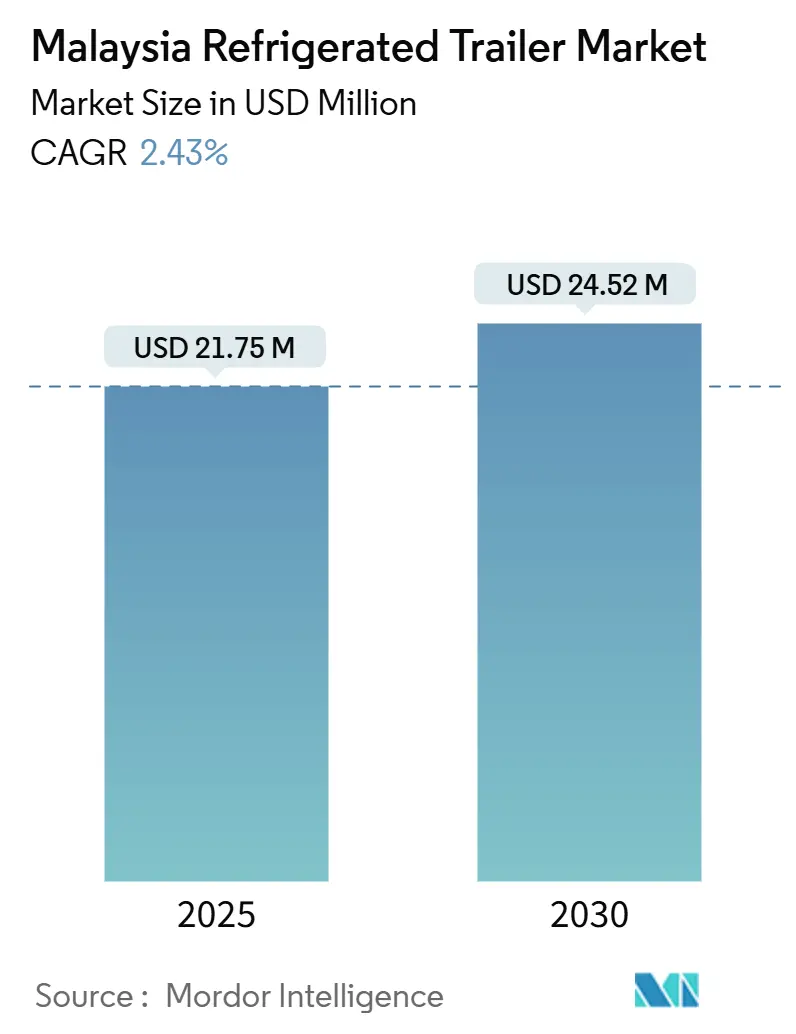
| Market Size (2025) | USD 21.75 Million |
| Market Size (2030) | USD 24.52 Million |
| Growth Rate (2025 - 2030) | 2.43 % |
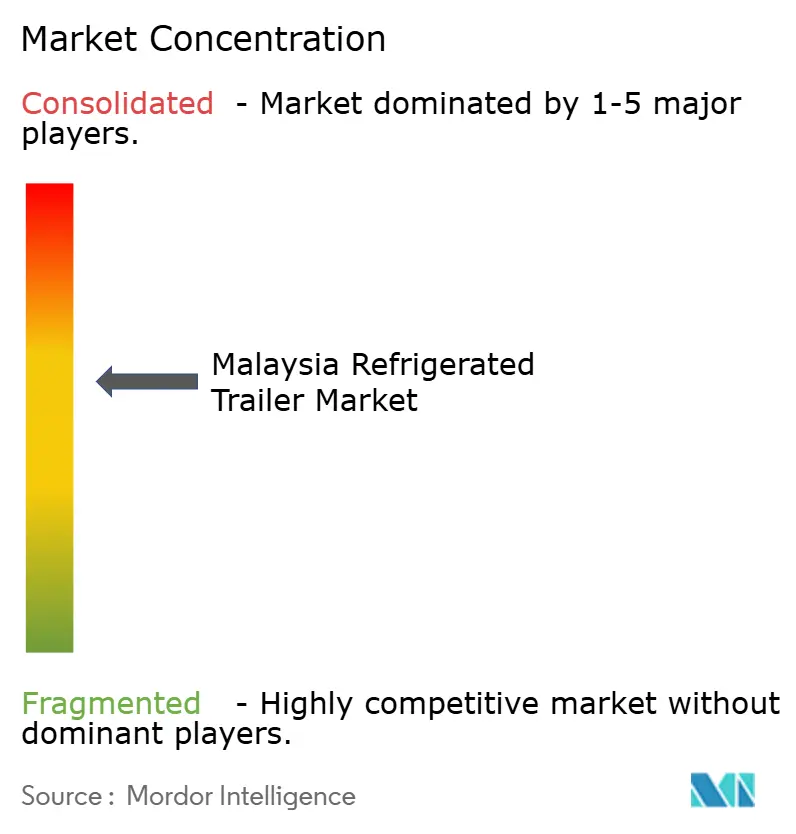
| Market Concentration | Medium |
Major Players *Disclaimer: Major Players sorted in no particular order Image © Mordor Intelligence. Reuse requires attribution under CC BY 4.0. | |
Malaysia Refrigerated Trailer Market Analysis by Mordor Intelligence
The Malaysia Refrigerated Trailer Market size is estimated at USD 21.75 million in 2025, and is expected to reach USD 24.52 million by 2030, at a CAGR of 2.43% during the forecast period (2025-2030). Malaysia’s halal food export strategy, systematic freight corridor upgrades with Singapore, and adoption of the MS 2400-1 halal supply chain standard collectively underpin demand. Accelerated e-grocery fulfillment, pharma cold-chain modernization, and mandated fleet energy-reporting requirements add steady tailwinds, even as skilled-labor shortages and high upfront electrification costs temper growth. Rising investments in multi-temperature trailers, IoT monitoring, and battery-electric refrigeration modules signal a gradual technology shift. Leading logistics groups leverage certification readiness and cross-border route density to defend margins in a price-sensitive environment.
Key Report Takeaways
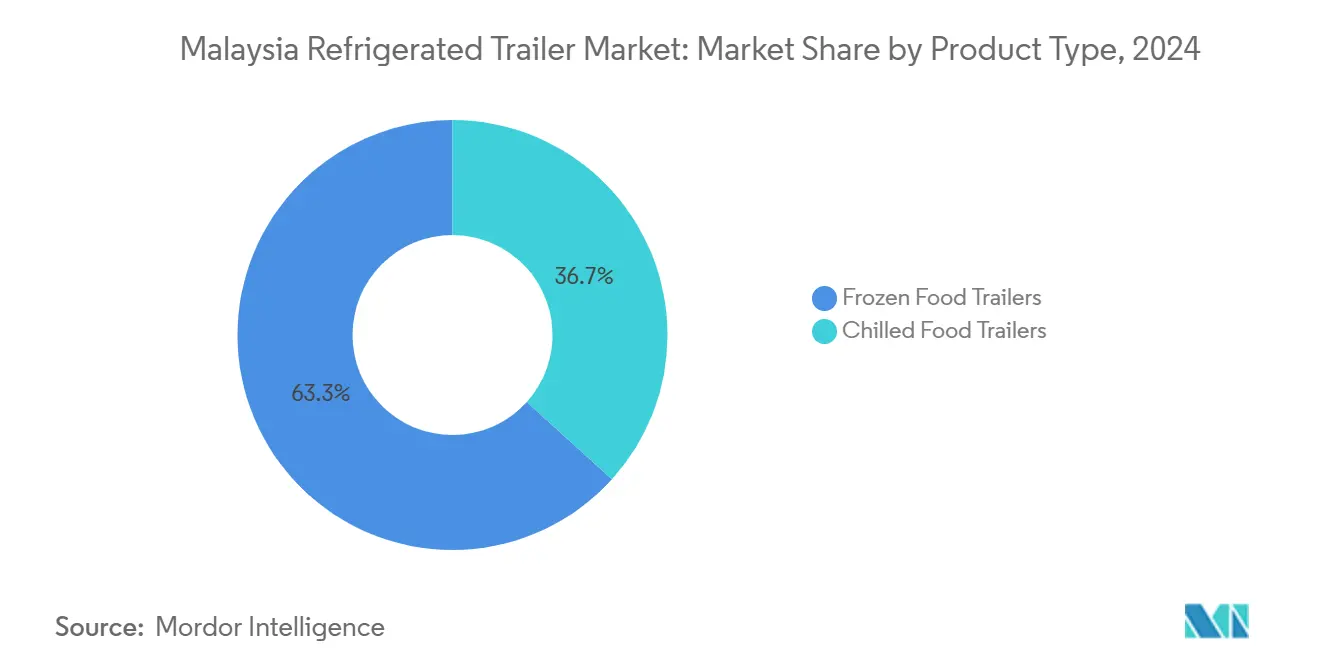
- By product type, frozen food trailers led the Malaysian refrigerated trailer market with a 63.27% share in 2024; chilled trailers are forecasted to grow at a 2.45% CAGR through 2030.
- By trailer length, the 29–49 ft segment accounted for 45.61% share of the Malaysian refrigerated trailer market in 2024, while trailers exceeding 49 ft posted the fastest growth rate of 2.51% through 2030.
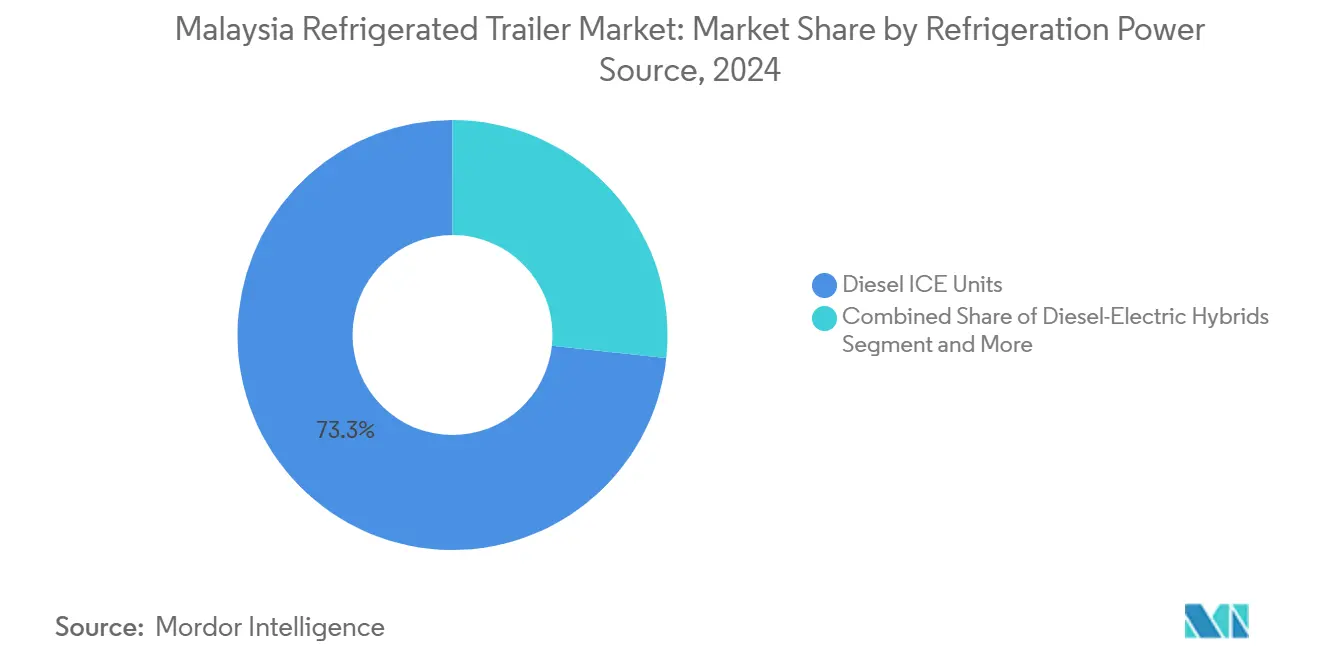
- By refrigeration power, diesel ICE systems held a 73.25% share of the Malaysian refrigerated trailer market size in 2024, while full-electric units recorded a 2.48% CAGR through 2030.
- By end user, meat and seafood accounted for 38.71% share of the Malaysian refrigerated trailer market size in 2024; pharmaceuticals and life sciences are expected to expand at a 2.46% CAGR through 2030.
Global valuation is built by aggregating outputs from multiple countries and regions, with Malaysia being one of the contributors. Our global refrigerated trailer market size represents that cumulative total.
Malaysia Refrigerated Trailer Market Trends and Insights
Drivers Impact Analysis*
| Driver | (~) % Impact on CAGR Forecast | Geographic Relevance | Impact Timeline |
|---|---|---|---|
| Rising Demand for Frozen Halal Meat Exports | +0.8% | National, with concentration in Selangor, Johor processing hubs | Medium term (2-4 years) |
| Expansion of E-Grocery Distribution | +0.6% | Urban centers: Klang Valley, Penang, Johor Bahru | Short term (≤ 2 years) |
| Pharma Cold-Chain Upgrades | +0.4% | National, with early adoption in Kuala Lumpur, Shah Alam | Medium term (2-4 years) |
| New Halal Supply-Chain Standard Compliance Push | +0.3% | National, export-oriented facilities prioritized | Long term (≥ 4 years) |
| Mandatory Energy-Efficiency & Conservation ACT 2024 | +0.2% | National, large fleet operators affected first | Medium term (2-4 years) |
| Cross-Border Electrified KL–Singapore Freight Pilots | +0.2% | KL-Singapore corridor, Johor-Singapore SEZ | Long term (≥ 4 years) |
| Source: Mordor Intelligence | |||
Rising Demand for Frozen Halal Meat Exports
In 2024, exports of halal-certified frozen meat experienced significant growth, highlighting a surge in demand for high-tech frozen trailers with continuous-temperature telemetry. Cold-storage capacity in Selangor and Johor expanded considerably, with processors now mandating IoT-enabled reefer fleets to meet compliance standards. Exporters with a focus on the Middle East and Southeast Asia are adopting zero-defect standards, resulting in more frequent fleet renewals. With shipment rejection rates on the rise, operators are increasingly opting for new trailers over retrofitted diesel units. Transport services adhering to the MS 2400-1 standard command a notable price premium [1]“MS 2400-1 Halal Supply-Chain Standard,” JAKIM, halal.gov.my .
Expansion of E-Grocery & Quick-Commerce Distribution
Malaysia's online grocery revenue experienced significant growth, with households sticking to their post-pandemic shopping habits in 2024. Platforms like GrabMart and foodpanda, among others, set up several micro-fulfillment centers. Each center is paired with appropriately sized chilled trailers, ensuring a commitment to fast deliveries. DHL has established a cold facility at KLIA, making a substantial investment to manage large-batch inbound flows before distributing them to city drops via a hub-and-spoke model. Given the emphasis on last-mile reliability as a key performance indicator for brands, logistics companies are now equipping themselves with predictive-maintenance sensors, successfully reducing reefer downtime by a notable margin [2]“Malaysia Cold-Chain Facility Fact Sheet,” DHL, dhl.com .
Pharma Cold-Chain Upgrades Post-COVID
The Ministry of Health mandated lane-by-lane temperature validation in its updated GDP-for-Medicines rules. Pharmaceutical exports experienced significant growth, with biologics capturing a notable share of the market. Duopharma Biotech is making a substantial investment in its Shah Alam expansion, featuring specialized ultra-low-temperature storage docks and cryogenic trailers. As a result of ultra-low-temperature vaccine projects, Malaysia placed its inaugural order for advanced battery-electric cryogenic refrigerators, complete with a liquid nitrogen backup. Compliance costs increased notably, prompting scale operators to consolidate and centralize their fleet telemetry dashboards.
New Halal Supply-Chain Standard (MS 2400-1) Compliance Push
Export-oriented plants must adhere to JAKIM's December 2025 deadline, which mandates certification for haulage, warehouse, and trailer segregation protocols. The retrofit costs for trailers are high, covering dual-zone partitions, RFID seals, and GPS monitors. Those who adopt these measures early enjoy priority customs clearance at Port Klang, which noticeably reduces container dwell times. Furthermore, with several import markets now referencing MS 2400-1, the demand for certified equipment remains robust.
Restraints Impact Analysis*
| Restraint | (~) % Impact on CAGR Forecast | Geographic Relevance | Impact Timeline |
|---|---|---|---|
| High Upfront Cost | -0.4% | National, affecting small-medium fleet operators | Short term (≤ 2 years) |
| Skilled Reefer-Technician | -0.3% | National, acute in East Malaysia | Medium term (2-4 years) |
| Fragmented Enforcement | -0.2% | National, with weaker enforcement in rural states | Medium term (2-4 years) |
| Grid-Capacity Gaps | -0.1% | National, acute in older industrial areas | Medium term (2-4 years) |
| Source: Mordor Intelligence | |||
High Upfront Cost of Diesel-Hybrid / Electric Trucks
Battery-electric trucks are significantly more expensive than their diesel counterparts, with a notable cost premium. Currently, only a few domestic banks provide loans for EV fleets, which extend the payback period over a longer horizon. Installing depot chargers adds substantial additional costs, and while government rebates offer some financial relief, they leave considerable gaps in affordability. Small operators focusing on intra-state routes are delaying the adoption of electric trucks until there is greater stability in their residual values. However, TNB's extensive charging network initiative, planned to include numerous commercial-vehicle DC points within a few years, is gradually addressing concerns related to range anxiety [3]“Commercial EV Charging Network Roadmap,” TNB, tnb.com.my .
Skilled Reefer-Technician & Driver Shortages
Malaysia faces a significant shortage of commercial drivers and qualified reefer technicians. With high attrition rates, many workers are drawn to neighboring countries offering substantial wage premiums. The limited number of accredited training centers, with only a few providing cold-chain curricula, restricts opportunities for new talent to enter the field. While initiatives aim to increase the number of licensed drivers in the coming years, only a small portion of the training focuses on refrigerated-vehicle specialization. Additionally, as a considerable share of technicians nears retirement, operators are increasingly investing in remote diagnostics to address workforce challenges.
*Our forecasts treat driver/restraint impacts as directional, not additive. The impact forecasts reflect baseline growth, mix effects, and variable interactions.
Segment Analysis
By Product Type: Frozen Dominance Amid Chilled Growth
Frozen trailers controlled 63.27% share of the Malaysian refrigerated trailer market in 2024, reflecting sustained seafood and poultry export flows to the Middle East and East Asia. This segment anchors the Malaysia refrigerated trailer market size for carriers committed to -18 °C thresholds. Chilled trailers, buoyed by e-grocery adoption, post a 2.45% CAGR to 2030 as retailers demand 2-8 °C delivery windows. Durian exporters utilize cryogenic systems to preserve the texture during multi-day voyages to China. Manufacturers now embed phase-change panels to hold cargo temperature for four-hour power outages, protecting mixed loads on congested urban routes.
Advances in multi-temperature bulkheads enable one trailer to haul frozen meats and fresh produce simultaneously, reducing empty-run ratios to a minimum. Halal-certification audits prioritize real-time data logs, prompting fleet owners to replace aging assets before 2028. Energy-optimized insulation and low-GWP refrigerants add incremental cost yet reduce fuel burn by minimal amounts, supporting ROI even at moderate freight rates. Market entrants differentiate by offering subscription-based telematics platforms that integrate with shipper ERPs.


By Trailer Length: Mid-Range Optimization for Urban Networks
Mid-length 29–49 ft equipment held 45.61% share of the Malaysian refrigerated trailer market in 2024, underscoring its agility within Klang Valley expressways while maintaining 18-pallet payloads. Above-49 ft trailers grow at a 2.51% CAGR on interstate and cross-border lanes, especially on the Port Klang–Pasir Gudang–Tuas route, where container backhauls align. The up to 28 ft class services pharma and high-value foods, requiring compact maneuverability into city alleys.
Ongoing 12th Malaysia Plan road widenings ease weight limits, helping operators switch to tri-axle 53-ft reefers for Thai backloads. Modular chassis designs reduce downtime, letting carriers swap damaged boxes without sidelining tractors. Port congestion mitigation at Tanjung Pelepas encourages longer decks that can accommodate two 20-ft ISO boxes under reefer conditions, thereby increasing turn-time productivity. Yet city-center low-bridge clearances keep the mid-length segment dominant for municipal deliveries until at least 2030.
By Refrigeration Power Source: Diesel Dominance with Electric Momentum
Diesel ICE units captured a 73.25% share of the Malaysian refrigerated trailer market in 2024, setting the baseline for the market. Hybrid trucks trim diesel runtime by 25% by utilizing electric standby at loading docks, which suits fleets with fixed hub schedules. Full-battery systems, although achieving only a 2.48% CAGR through 2030, gain traction on 150–300 km milk runs, where overnight depot charging aligns with driver rest periods.
TNB’s 2027 fast-charging blueprint positions 150 kW chargers every 150 km on the North–South Expressway, making round-trip logistics feasible within duty cycles. Plug-in hybrid reefers enable PTO-driven cooling under diesel propulsion and battery mode within low-emission zones. Cryogenic liquid-nitrogen reefers serve as a vital component in vaccine logistics, operating at -80 °C while emitting zero greenhouse gases at the point of use. Fleet managers weigh the familiarity of maintenance against potential diesel bans in major ports after 2028.

By End User: Meat Processing Drives Current Demand
Meat and seafood shippers held a 38.71% share of the Malaysian refrigerated trailer market in 2024, confirming their role as anchor customers for the Malaysian refrigerated trailer industry. Halal abattoirs in Selangor load multi-stop frozen routes to Port Klang and Singapore daily. Dairy distribution stays stable, tied to domestic consumption and cold-shelf expansion by convenience chains. Fruits and vegetables rely on chilled trailers that pivot between Cameron Highlands farms and city depots within six-hour windows.
Pharma payloads exhibit the fastest 2.46% CAGR as biologics exports surge. Ultra-cold storage trailers outfitted with redundant cryogenic modules underpin vaccine contract logistics. Bakery and confectionery operators specify humidity-controlled reefers to prevent chocolate bloom above 24 °C. Emerging cosmetics and specialty-chemical consignments demand tight thermal bands, nudging service providers to create dedicated SOPs and GMP-aligned cleaning protocols.
Geography Analysis
In 2024, Port Klang's container flows, KLIA's air cargo, and Shah Alam's food parks contributed to the Klang Valley accounting for a significant portion of the demand for refrigerated trailers. Selangor, as a central hub for the nation's halal meat processing, has established dense frozen-freight corridors, enabling efficient trailer turnaround times. E-grocery warehouses in Petaling Jaya send out chilled loads, reaching a substantial population within a short time during peak periods.
Johor, due to its proximity to Singapore, emerges as the second hub. High-value seafood and pharmaceuticals flow through cross-border lanes into Jurong's cold stores. Meanwhile, the Johor-Singapore SEZ has allocated significant investments for cold-chain infrastructure in the coming years. Battery-electric trials on the causeway indicate promising fuel savings. Additionally, Port Tanjung Pelepas manages feeder lines that transport chilled produce back to Peninsular Malaysia, encouraging the use of larger reefers to optimize load factors.
East Malaysia is still in its early stages; Sabah and Sarawak grapple with limited electricity redundancy and extended haul distances. The completion of the Pan Borneo Highway in the near future is anticipated to significantly reduce transit times, facilitating the transport of frozen seafood to Brunei and Kalimantan. Penang, serving as a northern hub, bolsters trade with the Thai border. The new cargo village at Kulim Airport will feature dedicated pharma bays, which will boost chilled-trailer rotations beyond current levels.
Coverage of the refrigerated trailer market by Mordor Intelligence spans a wide geographic footprint, with detailed country-level intelligence for Indonesia and Saudi Arabia, each shaped by local operating conditions.
Competitive Landscape
The Malaysian refrigerated trailer market is a competitive arena, characterized by moderate fragmentation, where no single operator holds a significant market share. In recent years, TASCO Berhad broadened its footprint by adding several temperature-controlled sites, incorporating telematics to monitor door-open events in real-time, ensuring adherence to halal standards. Swift Haulage forged a partnership with SJWD, jointly investing a substantial amount to roll out new reefers across multiple depots. DHL Supply Chain inaugurated a central cold hub at KLIA, bolstering its operations with additional trailer bays to clinch contracts in the pharmaceutical and e-grocery sectors.
Technological advancements are at the forefront of industry competition. Pioneering firms are harnessing predictive-maintenance algorithms, achieving a notable reduction in compressor failures. Comprehensive visibility platforms are facilitating data sharing with shippers, enabling agile rerouting amidst the congested arteries of the Klang Valley. Carriers are aligning with airfreight partners on Sustainable Aviation Fuel lanes, aiming for a competitive edge in integrated logistics contracts. Meanwhile, those unprepared for the MS 2400-1 standards are bracing for potential revenue losses, especially as halal auditors intensify their scrutiny.
High capital requirements continue to pose challenges for pure-play startups; for instance, financing a single electric reefer rig can demand significant investment. Yet, niche players specializing in ultra-cold pharmaceutical services are finding their ground, strategically leasing cryogenic pods. As mid-tier operators pursue scale advantages, the allure of consolidation becomes increasingly evident, particularly in the realm of energy reporting compliance. Multinational entities are contemplating joint ventures, not just to navigate Bumiputera equity regulations but also to secure rights on domestic routes.
Malaysia Refrigerated Trailer Industry Leaders
Utility Trailer Manufacturing Co.
Kögel GmbH
Wabash National Corporation
Great Dane LLC.
Schmitz Cargobull AG
- *Disclaimer: Major Players sorted in no particular order

Recent Industry Developments
- August 2025: DHL Supply Chain Malaysia has completed its RM250 million KLIA cold-chain expansion, featuring 45 refrigerated trailer bays, which reinforces regional pharma exports.
- January 2025: Swift Haulage and SJWD formed an RM 180 million cold-chain joint venture, rolling out 150 new refrigerated trailers and eight distribution centers.
- June 2024: TASCO Berhad announced a RM 400 million nationwide warehouse and reefer fleet expansion targeting pharma and halal exports.


Malaysia Refrigerated Trailer Market Report Scope
Refrigerator trailers, commonly referred to as reefer trailers, are freight shipping containers equipped with built-in refrigeration units. These units ensure that cargo remains at a safe and consistent temperature. Reefer trailers play a crucial role in transporting a wide range of perishable goods, including fruits, vegetables, dairy products, meats, chemicals, and even flowers.
The Malaysian Refrigerated Trailer Market is segmented by Product Type, Load Type, and Application. Based on product type, the market is segmented into Frozen Food and Chilled Food. Based on load capacity, the market is segmented into Light-duty, Medium-Duty, and Heavy-duty. Based on the Application, the market is segmented into Dairy Products, Fruits and Vegetables, Meat and Seafood, and Others. For each segment, market sizing and forecasting have been conducted based on value (USD).
| Frozen Food Trailers |
| Chilled Food Trailers |
| Up to 28 ft |
| 29 – 49 ft |
| Above 49 ft |
| Diesel ICE Units |
| Diesel-Electric Hybrids |
| Full-Electric / Battery-Powered Units |
| Cryogenic & Alt-Fuel Units |
| Dairy Products |
| Fruits & Vegetables |
| Meat & Seafood |
| Pharmaceuticals & Life Sciences |
| Bakery & Confectionery |
| Other |
| By Product Type | Frozen Food Trailers |
| Chilled Food Trailers | |
| By Trailer Length | Up to 28 ft |
| 29 – 49 ft | |
| Above 49 ft | |
| By Refrigeration Power Source | Diesel ICE Units |
| Diesel-Electric Hybrids | |
| Full-Electric / Battery-Powered Units | |
| Cryogenic & Alt-Fuel Units | |
| By End User | Dairy Products |
| Fruits & Vegetables | |
| Meat & Seafood | |
| Pharmaceuticals & Life Sciences | |
| Bakery & Confectionery | |
| Other |


Key Questions Answered in the Report
What is the 2025 value of the Malaysian refrigerated trailer market?
The Malaysian refrigerated trailer market size is expected to be USD 21.75 million by 2025.
How fast will refrigerated trailer demand grow in Malaysia by 2030?
Demand is projected to rise at a 2.43% CAGR, reaching USD 24.52 million by 2030.
Which segment holds the largest share of refrigerated trailers in Malaysia?
Frozen food trailers lead with 63.27% of national units in 2024.
Why are electric refrigerated trailers gaining interest?
Energy-reporting mandates and TNB’s fast-charging rollout encourage fleets to trial battery-electric reefers despite high upfront costs.
What regulation governs halal cold-chain operations in Malaysia?
JAKIM’s MS 2400-1 halal supply-chain standard mandates temperature monitoring and segregation from slaughter to export.
How severe is the skilled-technician shortage in Malaysian cold-chain logistics?
The sector is currently lacking approximately 3,800 certified reefer technicians, prompting carriers to adopt remote diagnostics and automation.
Page last updated on:


 Your data is secure and never sold or shared.


