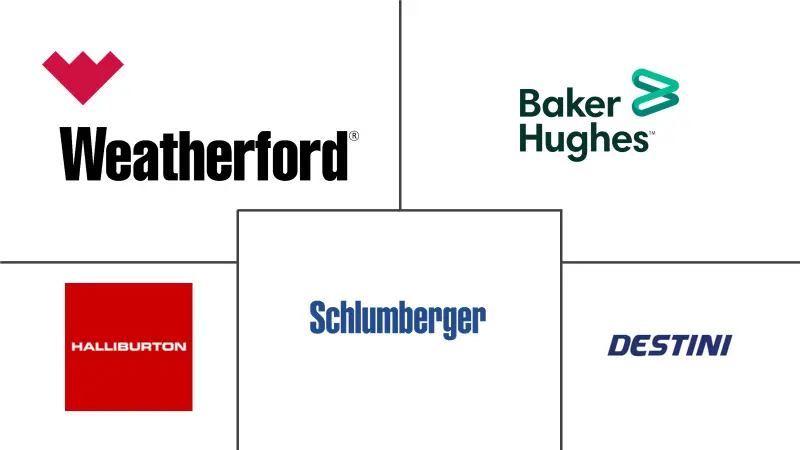
Top 5 Malaysia Oilfield Services Companies


Schlumberger Ltd.
Halliburton Company
Baker Hughes Company
Weatherford International plc
Destini Berhad
Source: Mordor Intelligence
Malaysia Oilfield Services Companies Matrix by Mordor Intelligence
Our comprehensive proprietary performance metrics of key Malaysia Oilfield Services players beyond traditional revenue and ranking measures
The MI Matrix can rate firms differently because it weighs what buyers feel day to day, not just annual totals. In Malaysia, that often comes down to local bases, service readiness, and the ability to support multi-year bundled well programs without stoppages. PETRONAS activity planning points to steady development wells and a rising backlog of improvement and late-life work, which tends to reward dependable execution over single campaign peaks. Provider selection in Malaysia usually starts with safety record, offshore mobilization speed, and verified in-country equipment support. It also hinges on whether a firm can support intervention and abandonment needs as decommissioning activity expands across facilities and pipelines. This MI Matrix by Mordor Intelligence is more useful for supplier and competitor evaluation than revenue tables alone because it ties observable capability signals to buying outcomes.
MI Competitive Matrix for Malaysia Oilfield Services
The MI Matrix benchmarks top Malaysia Oilfield Services Companies on dual axes of Impact and Execution Scale.
Analysis of Malaysia Oilfield Services Companies and Quadrants in the MI Competitive Matrix
Comprehensive positioning breakdown
Baker Hughes Company
Local services footprint matters more when operators push for faster mobilization and tighter supply chain control. Baker Hughes, a major supplier, signed a 14 July 2025 MoU with PETRONAS that includes plans to expand its Malaysia services footprint with a full aeroderivative gas turbine module repair facility. That commitment fits Malaysia's broader push for capability building as activity stays steady and intervention needs rise. A likely what-if is more packaged contracting that favors providers with local training and diagnostics capacity, which Baker Hughes already highlights through its Malaysia iCenter and service facilities. The key downside is over investing in fixed capacity if project phasing slows.
Schlumberger Ltd
Ninety years of in-country operating history shapes how SLB approaches Malaysian offshore delivery and workforce depth. SLB, a leading service provider, is leaning into data and automation, supported by a 6 November 2024 PETRONAS MPM MoU focused on AI and machine learning capabilities for upstream workflows in Malaysia. The upside is stronger tender defensibility as PETRONAS shifts to bundled well continuity and abandonment approaches. If deepwater expansions accelerate, the OneSubsea EPC awards from PTTEP for offshore Malaysia deepen the subsea pull through. A realistic risk is execution congestion when multiple multi-year packages overlap across regions.


Frequently Asked Questions
What should an operator prioritize when choosing an oilfield services partner in Malaysia?
Prioritize offshore mobilization speed, local spares, and a proven safety system that holds up under weather delays. Check whether the team is already qualified for PETRONAS style bundled work.
Which service lines are most sensitive to local capability in Malaysia?
Well intervention, workover, and abandonment work are very sensitive because they require repeatable procedures and trained crews. Subsea systems are also sensitive because logistics failures can stop production quickly.
How do bundled well continuity contracts change supplier selection?
Bundling favors providers that can coordinate multiple crews and tools under one plan and keep interfaces simple. It also increases the value of strong local partners that can cover peaks without quality slips.
What are the biggest near-term risks for oilfield services firms operating in Malaysia?
Schedule compression and vessel availability can create cost overruns, especially for offshore campaigns. Payment timing and working capital strain also rise when multi-year scopes ramp faster than expected.
How is decommissioning affecting demand for services in Malaysia?
More aging assets increase the volume of plugging, abandonment, and removal work, which shifts demand toward intervention and late-life services. Firms that can standardize execution and training tend to be chosen more often.
What indicators show a provider is truly committed to Malaysia delivery?
Look for Malaysia listed service centers, long dated local contracts, and public commitments to local repair capacity and training. Recent Malaysia focused partnerships with PETRONAS are also a strong signal.


Methodology
Research approach and analytical framework
Used company investor materials, official press rooms, and reputable journalism for post-2023 developments. Private firm scoring relied on observable contracts, facility listings, and operating signals. When Malaysia-only figures were not disclosed, scoring triangulated from Malaysia-specific sites and awards rather than global totals. Evidence was then converted into relative ranks per parameter and mapped to 1.0 to 5.0 scores.
Malaysia offshore work needs nearby bases in Labuan and coastal supply nodes for predictable mobilization.
PETRONAS and contractors favor proven names for high-risk offshore wells and regulated work scopes.
Relative Malaysia revenue proxies come from visible awards, installed base, and recurring multi-year work packages.
Tool inventories, service centers, and subsea delivery capacity determine how reliably offshore schedules are met.
AI workflows, subsea systems, and intervention tooling since 2023 improve uptime and reduce offshore days.
Malaysia delivery resilience depends on cash discipline to carry crews, spares, and vessel time through schedule shifts.