
Malaysia Mining Equipment Market Size and Share
Market Overview
| Study Period | 2019 - 2031 |
|---|---|
| Forecast Data Period | 2026 - 2031 |
| Base Year Market Size (2025) | USD 6.78 Billion |
| Market Size (2026) | USD 7.27 Billion |
| Market Size (2031) | USD 10.31 Billion |
| Growth Rate (2026 - 2031) | 7.23 % |
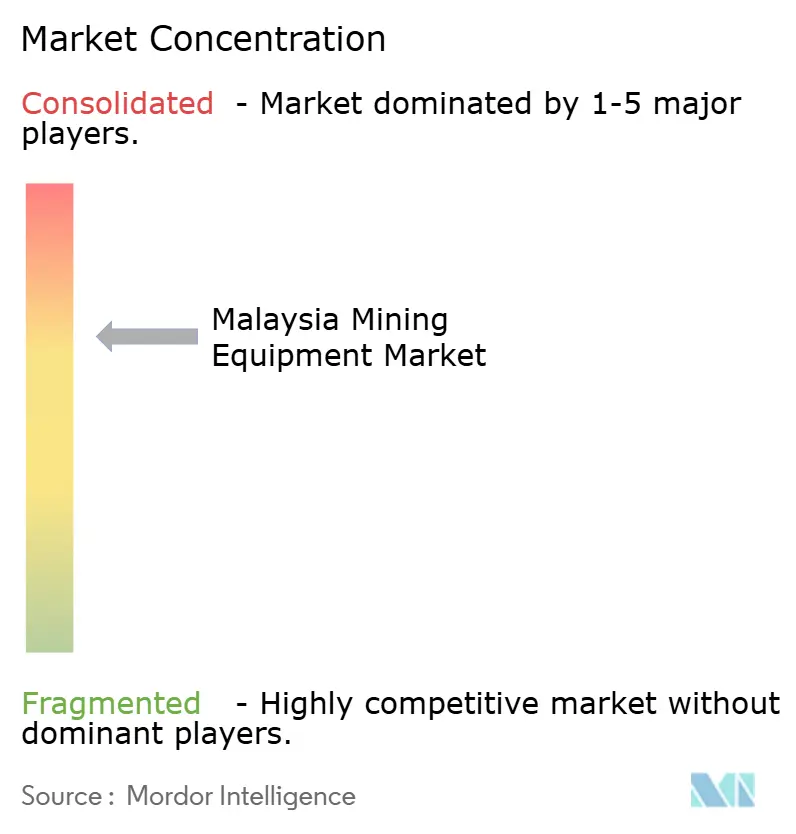
| Market Concentration | Medium |
Major Players *Disclaimer: Major Players sorted in no particular order Image © Mordor Intelligence. Reuse requires attribution under CC BY 4.0. | |
Malaysia Mining Equipment Market Analysis by Mordor Intelligence
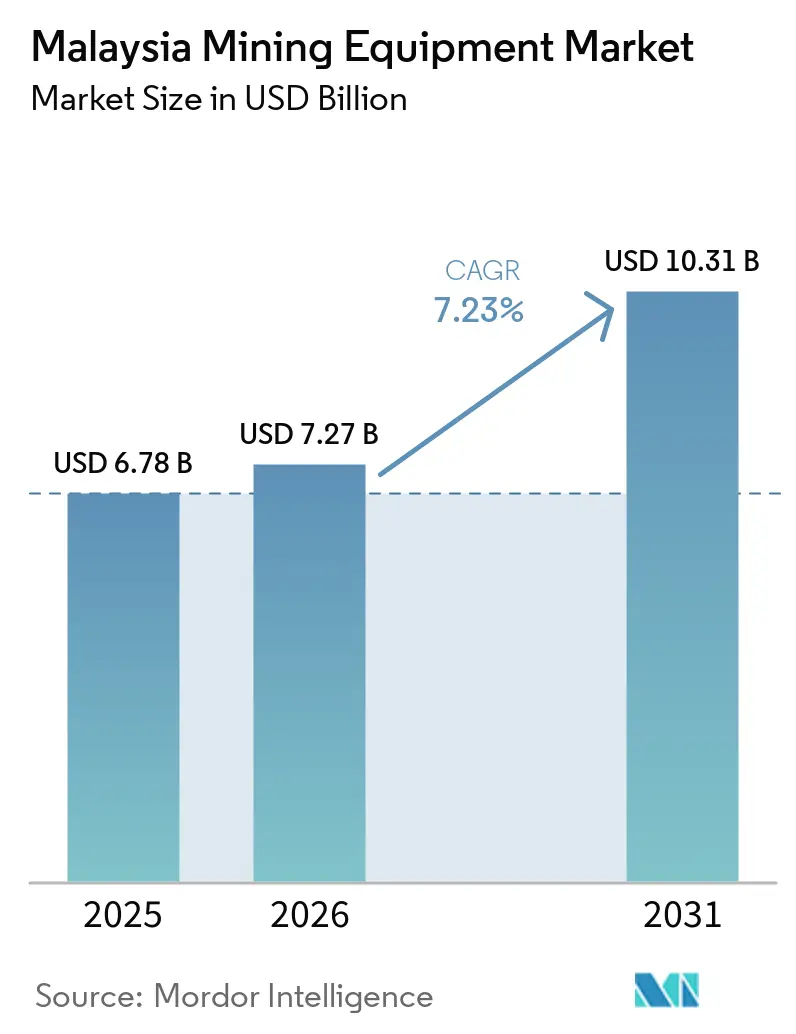
The Malaysia Mining Equipment Market size was valued at USD 6.78 billion in 2025 and is estimated to grow from USD 7.27 billion in 2026 to reach USD 10.31 billion by 2031, at a CAGR of 7.23% during the forecast period (2026-2031). Equipment demand is expanding as critical-mineral extraction for electric-vehicle batteries scales up, oil-and-gas brownfield work accelerates, and operators shift to lower-emission machinery to meet tighter permitting rules. Battery-electric loaders produced at Sandvik’s Seremban plant are anchoring a rapid push toward electrification, while Epiroc’s autonomous-fleet order signals growing acceptance of driverless systems. Government incentives that waive import duties on locally assembled machines are drawing OEM assembly programs to Malaysia, creating headroom for component suppliers. Commodity-price volatility still tempers fleet upgrades at small metal mines, but leasing and aftermarket services cushion OEM revenue when CAPEX cycles pause.
Key Report Takeaways
- By equipment type, surface mining equipment held 46.17% of the Malaysian mining equipment market share in 2025, while loaders and haul trucks are projected to expand at a 7.27% CAGR through 2031.
- By automation level, manual equipment accounted for a 56.34% share of the Malaysian mining equipment market in 2025, while fully autonomous equipment is advancing at a 7.25% CAGR over 2026-2031.
- By powertrain, internal-combustion-engine vehicles dominated, with 77.83% of Malaysia's mining equipment market share in 2025, whereas battery-electric vehicles are set to grow at a 7.37% CAGR through 2031.
- By power output, the 500-1,000 HP category captured a 43.48% share of the Malaysian mining equipment market in 2025, and machines above 1,000 HP are poised for a 7.26% CAGR during 2026-2031.
- By application, metal mining led with 55.47% of the Malaysian mining equipment market share in 2025, while rare-earth mining is projected to expand at a 7.31% CAGR to 2031.
- By geography, Peninsular Malaysia commanded 71.26% share of the Malaysian mining equipment market size in 2025, and East Malaysia is on track for a 7.34% CAGR over 2026-2031.
Note: Market size and forecast figures in this report are generated using Mordor Intelligence’s proprietary estimation framework, updated with the latest available data and insights as of January 2026.
Malaysia Mining Equipment Market Trends and Insights
Drivers Impact Analysis*
| Driver | (~) % Impact on CAGR Forecast | Geographic Relevance | Impact Timeline |
|---|---|---|---|
| Surging Demand for Critical Minerals for EV Supply Chain | +1.8% | Peninsular Malaysia (Pahang nickel, Perak rare earth), East Malaysia (Sabah phytomining) | Medium term (2-4 years) |
| Accelerating Adoption of Smart-Mining & Automation Solutions | +1.5% | National, with early gains in Sarawak (Bau gold), Pahang (Mengapur copper-gold) | Long term (≥ 4 years) |
| Government CAPEX in Oil & Gas Brown-Field Extensions | +1.3% | Peninsular Malaysia offshore fields, Sarawak LNG hubs, Terengganu logistics centers | Short term (≤ 2 years) |
| Tax Incentives for Locally-Assembled Heavy Machinery | +0.9% | National, with manufacturing concentration in Selangor (Seremban), Johor | Medium term (2-4 years) |
| Boom in Small-Scale Bauxite & Ilmenite Operations | +0.7% | Peninsular Malaysia (Pahang bauxite, Terengganu ilmenite), East Malaysia (Sarawak) | Short term (≤ 2 years) |
| Phytomining Pilots for Low-Impact Nickel Extraction | +0.6% | East Malaysia (Sabah Botanickel hyperaccumulator trials) | Long term (≥ 4 years) |
| Source: Mordor Intelligence | |||
Surging Demand for Critical Minerals for EV Supply Chain
Malaysia’s battery-materials ambitions extend beyond bauxite and tin. Lynas shipped 4,600 t of NdPr oxide in H1 2025, up 12% year-on-year, supporting global magnet supply [1]“Half-Year 2025 Production Report,” Lynas Rare Earths, lynasrareearths.com . Fortress Minerals ordered Metso crushers for Bukit Besi and Mengapur in 2025, thereby widening processing capacity for iron ore and copper-gold concentrates [2]“Fortress Minerals Places Order for Crushing Systems,” Metso, metso.com . Sabah’s Botanickel phytomining trial uses hyperaccumulator plants to lift nickel from laterite soils, driving demand for high-pressure grinding rolls and flotation cells that carry higher ticket prices than bulk earthmovers. Equipment suppliers able to package mineral-processing units with water-recycling systems secure premium margins under stricter environmental rules.
Accelerating Adoption of Smart-Mining & Automation Solutions
Autonomous technology is moving from Australian mega-mines to mid-scale pits in Southeast Asia. Epiroc’s SEK 380 million order in March 2026 marked one of the region’s largest autonomous-fleet deals outside Australia [3]“Epiroc Wins Large Autonomous Mining Order in Malaysia,” Epiroc Group, epirocgroup.com . Komatsu’s joint venture with Bangkok Motor Works, signed in November 2025, will assemble semi-autonomous excavators that bundle payload tracking and collision avoidance, trimming retrofit costs for Malaysian quarries. Hitachi’s ZAXIS-7G range, launched in January 2024, sends real-time fuel, hydraulic, and wear data to cloud dashboards, cutting downtime by up to 30%. Sarawak’s Centexs Lawas Green Mining Academy began training operators in December 2025, easing the skills gap that has slowed rollouts. Procurement frameworks now compare lifetime ownership cost, including software and connectivity, rather than upfront price alone.
Government CAPEX in Oil & Gas Brown-Field Extensions
PETRONAS lists more than 45 upstream projects for 2024-2026, many aimed at squeezing extra barrels from mature Malay Basin fields. Brownfield work calls for high-power rigs and subsea excavation tools that share hydraulic and control components with heavy open-pit mining gear. A dense supply chain in Terengganu and Labuan keeps demand for loaders and crushers resilient when metal prices wobble. Above-1,000-HP machinery, key to offshore lifts, is therefore set to log a 7.26% CAGR through 2031. Suppliers that can cross-sell diesel-electric hybrid powertrains to both mining and energy customers gain a competitive edge.
Phytomining Pilots for Low-Impact Nickel Extraction
Botanickel’s Phyllanthus securinegoides crops in Sabah extract nickel from soils with only 0.3% Ni content, avoiding open-pit excavation. The biomass is burned to yield nickel-rich ash for smelting, replacing truck-intensive haulage with specialized harvesters and dryers. Although commercial harvest is slated for 2027, early demand for equipment already tilts toward modular dryers and small furnaces. If scaled, phytomining will redirect capital to manufacturers that adapt construction or farm machinery for biomass logistics, disrupting entrenched diesel-haul-truck suppliers.
Restraints Impact Analysis*
| Restraint | % Impact on CAGR Forecast | Geographic Relevance | Impact Timeline |
|---|---|---|---|
| Tougher Environmental Permitting & Bauxite Moratoriums | -1.2% | Peninsular Malaysia (Pahang, Perak), with spillover to Johor | Medium term (2-4 years) |
| Commodity-Price Volatility Limiting CAPEX Cycles | -0.9% | National, with acute exposure in metal-mining regions (Pahang, Terengganu, Perak) | Short term (≤ 2 years) |
| Skills Gap for Autonomous Equipment Deployment | -0.8% | National, most acute in East Malaysia (Sabah, Sarawak) and rural Peninsular operations | Medium term (2-4 years) |
| Scarcity of High-Capacity Battery Packs for BEV Fleets | -0.6% | National, affecting large-scale operations in Pahang, Sarawak with BEV adoption plans | Medium term (2-4 years) |
| Source: Mordor Intelligence | |||
Tougher Environmental Permitting & Bauxite Moratoriums
The 2016 bauxite ban, partly lifted in 2019, still forces operators to pave haul roads, cap stockpiles, and fit real-time water monitors, raising capital needs by up to 30%. Battery-electric fleets and dust-suppression packages from Sandvik and Epiroc meet compliance, but low-cost Chinese imports struggle without environmental certification. Lengthier environmental-impact studies stretch project lead times to 18-24 months, delaying replacement cycles and trimming near-term equipment orders.
Commodity-Price Volatility Limiting CAPEX Cycles
Tin prices swung between USD 25,000 and USD 35,000 /t during 2024-2025, prompting small mines to refurbish rather than buy new fleets. Meta Bright Group logged a 40% jump in lease inquiries in H1 2025 as miners preserved cash. Aftermarket parts and rebuild kits now serve as a buffer for OEMs when new-unit sales dip, especially in the metal-mining belts of Pahang and Terengganu, where payback horizons stretch to 7-10 years.
*Our forecasts treat driver/restraint impacts as directional, not additive. The impact forecasts reflect baseline growth, mix effects, and variable interactions.
Segment Analysis
By Equipment Type: Loaders and Haul Trucks Lead Electrification Push
Surface mining equipment accounted for 46.17% of the Malaysian mining equipment market in 2025, reflecting the dominance of open-pit bauxite, tin, and gold operations concentrated in Pahang and Perak. The segment’s installed base favors high-capacity shovels, graders, and draglines that maintain low stripping ratios on lateritic orebodies. Loaders and haul trucks are forecast to expand at a 7.27% CAGR between 2026 and 2031, buoyed by Sandvik’s battery-electric production line in Seremban and Komatsu’s regional semi-autonomous assembly program. Demand for mineral-processing systems is also rising, following Fortress Minerals' September 2025 order of Metso crushers to raise throughput at Bukit Besi and Mengapur. Drills and breakers benefit from PETRONAS’s brownfield subsea work, which requires hydraulic breakers and rotary rigs that share hydraulic subassemblies with mining gear, helping suppliers amortize R&D across sectors.
The second-order effect is a technological pivot: real-time ore-grade sensors now arrive factory-installed in crushers, letting operators tweak closed-circuit settings and cut reprocessing energy by up to 15%. Chinese battery-cell makers such as CATL and BYD are courting OEMs with modular, high-capacity packs, forcing incumbent diesel-engine suppliers to race to secure electrification partnerships. Taken together, these shifts support a balanced outlook in which the Malaysian mining equipment market size for surface machines continues to dominate in terms of volumes, but loaders and haul trucks capture the steepest value growth on the back of electrification and autonomy premiums.
By Automation Level: Autonomous Systems Gain Traction Despite Skills Constraints
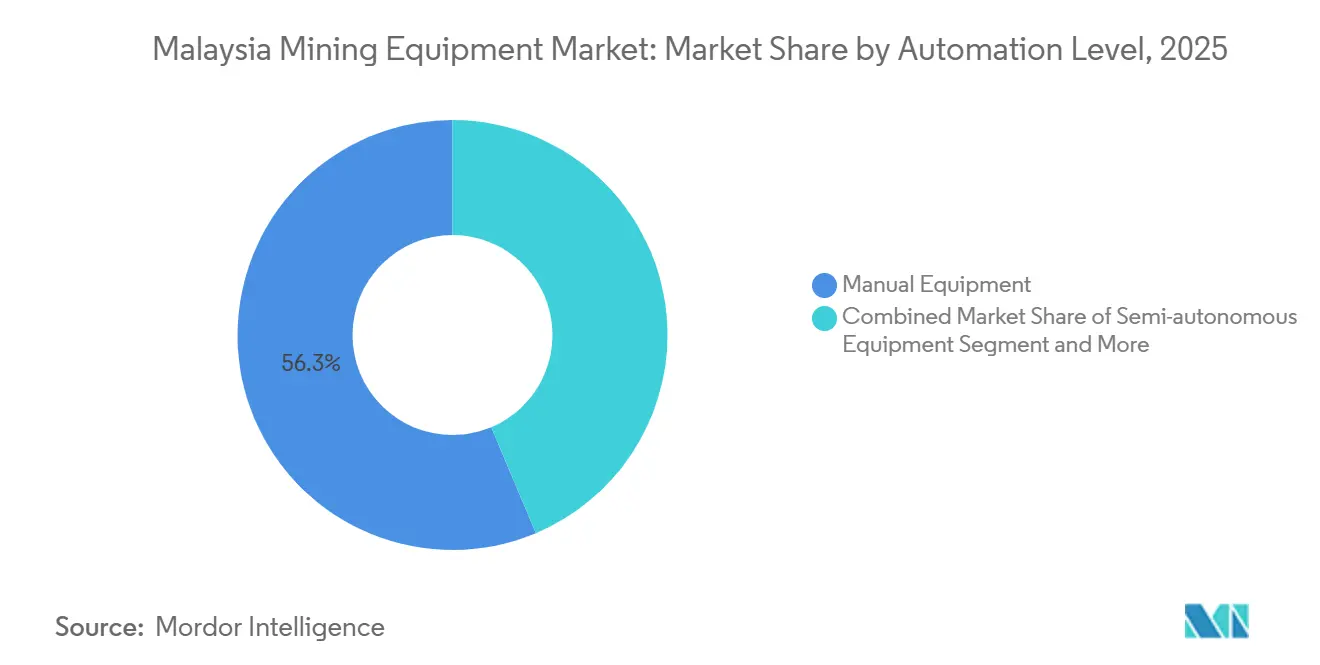
Manual equipment still controlled 56.34% of the Malaysian mining equipment market share in 2025 because 2,496 workers operate small bauxite and tin pits that lack the scale for wired control rooms. Yet fully autonomous fleets are projected to post a 7.25% CAGR through 2031 as mid-scale copper-gold and limestone operators chase labor and safety dividends. Semi-autonomous machines, which bundle payload monitoring and collision avoidance without full driverless capability, offer a bridge for quarries that need incremental upgrades rather than greenfield digital platforms.
Skills shortages remain the chief friction point. The federal RM 1 billion up-skilling fund and Sarawak’s Centexs Lawas Green Mining Academy aim to certify 500 technicians by 2027, closing the data-literacy gap that has slowed deployments. As training pipelines mature, procurement criteria are shifting from capex to total cost of ownership, including software licensing, over-the-air updates, and cybersecurity safeguards. This tiered adoption curve ensures the Malaysia mining equipment market size for manual units erodes gradually, while autonomous categories capture outsized margin expansion.


By Powertrain Type: Battery-Electric Vehicles Outpace Hybrids
Internal-combustion vehicles held 77.83% of the Malaysian mining equipment market share in 2025, anchored by legacy diesel haul trucks and hydraulic excavators. Battery-electric vehicles are set to grow fastest at a 7.37% CAGR through 2031, energized by MIDA’s September 2025 duty waivers on locally assembled BEV machinery and Sandvik’s serial output from its Seremban factory. Hybrid powertrains, such as Hitachi’s ZAXIS-7G diesel-electric excavator, appeal to sites lacking charging infrastructure by trimming fuel use 15-20% without grid upgrades.
Global cell supply constraints still cap BEV penetration rates, so OEMs promote modular battery packs that add capacity as inventories loosen. The National Energy Transition Roadmap’s call for 30% zero-emission heavy-vehicle sales by 2030 cements long-run demand. Over the forecast window, the Malaysian mining equipment market size will gradually rebalance as diesel rebuild cycles lengthen and electrified models absorb incremental spending, particularly in high-horsepower classes where fuel savings multiply quickly.
By Power Output: High-Power Machinery Dominates Offshore and Large-Scale Operations
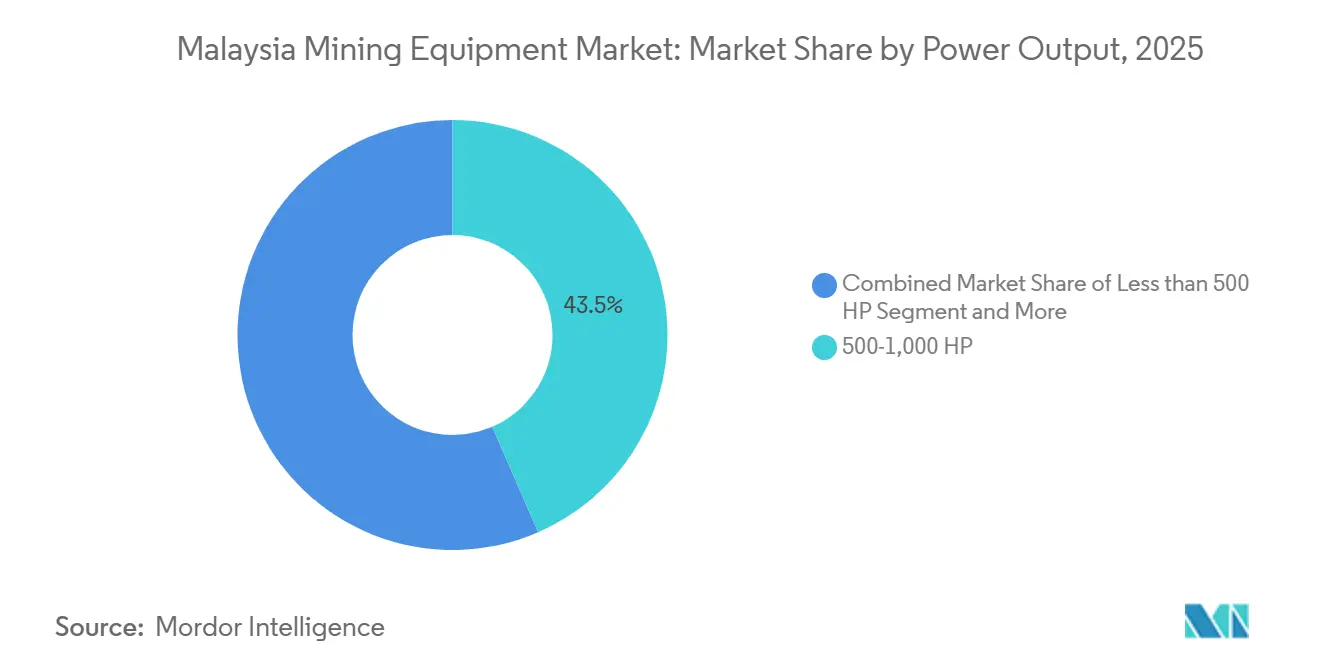
Equipment rated 500-1,000 HP accounted for 43.48% of the Malaysian mining equipment market share in 2025, supplying mid-scale quarries and aggregate yards that balance productivity with capex. Machines above 1,000 HP are forecast to rise at a 7.26% CAGR through 2031 as PETRONAS’s brown-field extensions require high-torque drilling rigs, subsea trenchers, and heavy-lift cranes. High-power fleets also show the fastest adoption of autonomy because central control rooms can spread network costs across many assets.
Battery-electric options are emerging in this class as energy density improves; modular packs now deliver peak load during mucking and tramming, while hybrids handle continuous drilling. Less-than-500 HP units serve owner-operated tin dredges, where price sensitivity keeps diesel dominant and manual controls prevalent. Collectively, horsepower segmentation acts as a proxy for technology readiness, with power and digitalization advancing in tandem across the Malaysian mining equipment market.
By Application: Rare-Earth Mining Emerges as Fastest-Growing Segment
Metal mining remained the largest segment in 2025, accounting for 55.47% of the Malaysian mining equipment market share, reflecting steady iron ore and copper-gold shipments to regional smelters. Rare-earth mining, however, is projected to grow at a 7.31% CAGR after Lynas lifted NdPr oxide output 12% year-on-year, and new Pahang concessions are being prepared for pilot runs. Coal equipment demand continues to dwindle as national power utilities pivot to gas and renewables. In contrast, demand for mineral mining for construction aggregates has softened amid slower roll-outs of 12th Malaysia Plan projects.
Rare-earth extraction is highly capital-intensive because plants require solvent-extraction circuits and radioactive-waste safeguards under the Atomic Energy Licensing Act, raising unit costs by 15-20%. That profile boosts revenue for suppliers of high-pressure grinding rolls, flotation cells, and radiation-monitoring hardware. As demand for magnet materials compounds with global EV output, rare-earth ventures will command a growing share of incremental spending, even though base-metal pits still account for the bulk of volumes in the Malaysian mining equipment market.
Geography Analysis
Peninsular Malaysia accounted for 71.26% of the Malaysian mining equipment market share in 2025 on the strength of Pahang’s rare-earth and iron-ore hubs and Terengganu’s offshore logistics clusters. East Malaysia is set to post the fastest 7.34% CAGR through 2031, powered by Sarawak’s RM 7.35 billion (USD 1.80 billion) private investment pipeline and Sabah’s nickel phytomining pilots, which lower environmental hurdles for greenfield projects.
Within the peninsula, Pahang’s Gebeng complex and Fortress Minerals’ twin sites drive high-spec processing orders, while Perak’s tin dredges anchor demand for sub-500 HP excavators. Terengganu’s fabrication yards feed PETRONAS campaigns, sustaining loaders and marine cranes.
As infrastructure corridors improve port access, equipment distributors are likely to stage more service hubs in Kuching and Kota Kinabalu, reducing downtime and helping the Malaysian mining equipment market size in East Malaysia narrow the absolute-value gap with the peninsula.
Competitive Landscape
Global OEMs, including Caterpillar, Komatsu, Hitachi, Sandvik, and Volvo, dominate the Malaysian mining equipment market, collectively accounting for a significant share of its revenue. Meanwhile, Chinese brands XCMG, Sany, and Zoomlion have aggressively captured a substantial share of the market by targeting smaller operators with competitive pricing.
Local distributors, UMW and Sime Darby, manage the sales of Komatsu and Caterpillar equipment. However, they face margin pressures as these OEMs increasingly establish direct service hubs. Sandvik has initiated its BEV loader line in Seremban, while Komatsu has formed a joint venture in Thailand, positioning itself advantageously against fully imported competitors.
The aftermarket services and leasing sectors have emerged as competitive arenas. Meta Bright Group reported a notable increase in lease inquiries during the first half of the year. Epiroc's recent sale of an autonomous fleet underscored the market's willingness to invest in productivity enhancements. Concurrently, Hitachi's pivot towards telematics highlights a broader industry trend, emphasizing a shift in value from traditional hardware to advanced software solutions. Moreover, bundling compliance services—ranging from dust control and water recycling to emissions monitoring—has created a significant barrier to entry, favoring OEMs with robust technological capabilities.
Malaysia Mining Equipment Industry Leaders
Caterpillar Inc.
Komatsu Ltd.
Liebherr Group
Hitachi Construction Machinery Co., Ltd.
Sandvik AB
- *Disclaimer: Major Players sorted in no particular order

Recent Industry Developments
- April 2026: Sandvik Mining ramped up operations at its 8,000+ sq. m factory in Sendayan TechValley, Seremban. The facility manufactures underground load-and-haul equipment, including Toro loaders and trucks, and supports battery-electric vehicle (BEV) production lines for the Asia-Pacific region.
- February 2026: SDLG delivered eight customized large excavators and one road roller to a key customer in Malaysia. The delivery will mark SDLG’s first entry of large excavators weighing 40 tons and above into Malaysia and a key breakthrough in Southeast Asia’s large-scale construction and mining equipment segment.
- August 2024: Komatsu acquired all remaining shares in UMW Komatsu Heavy Equipment, making it a wholly owned subsidiary. This strategic move strengthened Komatsu’s position in the heavy equipment market and marked a key step toward achieving greater operational control and synergy within the industry.


Malaysia Mining Equipment Market Report Scope
Malaysia's mining equipment market is segmented by equipment type, automation level, powertrain type, power output, application, and geography.
By Equipment Type, the market is segmented into surface mining equipment, underground mining equipment, mineral processing equipment, drills & breakers, crushing, pulverizing & screening, and loaders & haul Trucks. By Automation Level, the market is segmented into manual, semi-autonomous, and fully autonomous equipment. By Powertrain Type, the market is segmented into internal combustion engine (ICE), battery electric vehicle (BEV), and hybrid vehicles. By Power Output, the market is segmented into less than 500 HP, 500-1,000 HP, and above 1,000 HP. By Application, the market is segmented into metal mining, mineral mining, coal mining, and rare earth mining. By Geography, the market is segmented into Peninsular Malaysia (Perak, Pahang, Terengganu, Johor, Selangor) and East Malaysia (Sabah, Sarawak, Federal Territory of Labuan). Market forecasts are provided in terms of Value (USD) and Volume (Units).
| Surface Mining Equipment |
| Underground Mining Equipment |
| Mineral Processing Equipment |
| Drills & Breakers |
| Crushing, Pulverizing & Screening |
| Loaders & Haul Trucks |
| Manual Equipment |
| Semi-Autonomous Equipment |
| Fully Autonomous Equipment |
| Internal-Combustion Engine Vehicles |
| Battery-Electric Vehicles |
| Hybrid Vehicles |
| Less than 500 HP |
| 500 - 1,000 HP |
| Above 1,000 HP |
| Metal Mining |
| Mineral Mining |
| Coal Mining |
| Rare Earth Mining |
| Peninsular Malaysia | Perak |
| Pahang | |
| Terengganu | |
| Johor | |
| Selangor | |
| East Malaysia | Sabah |
| Sarawak | |
| Federal Territory of Labuan |
| By Equipment Type | Surface Mining Equipment | |
| Underground Mining Equipment | ||
| Mineral Processing Equipment | ||
| Drills & Breakers | ||
| Crushing, Pulverizing & Screening | ||
| Loaders & Haul Trucks | ||
| By Automation Level | Manual Equipment | |
| Semi-Autonomous Equipment | ||
| Fully Autonomous Equipment | ||
| By Powertrain Type | Internal-Combustion Engine Vehicles | |
| Battery-Electric Vehicles | ||
| Hybrid Vehicles | ||
| By Power Output | Less than 500 HP | |
| 500 - 1,000 HP | ||
| Above 1,000 HP | ||
| By Application | Metal Mining | |
| Mineral Mining | ||
| Coal Mining | ||
| Rare Earth Mining | ||
| By Geography | Peninsular Malaysia | Perak |
| Pahang | ||
| Terengganu | ||
| Johor | ||
| Selangor | ||
| East Malaysia | Sabah | |
| Sarawak | ||
| Federal Territory of Labuan | ||


Key Questions Answered in the Report
What is the current size and growth rate of the Malaysian mining equipment market?
The Malaysian Mining Equipment Market size was valued at USD 6.78 billion in 2025 and is estimated to grow from USD 7.27 billion in 2026 to reach USD 10.31 billion by 2031, at a CAGR of 7.23% during the forecast period.
Which equipment category is expanding the quickest?
Loaders and haul trucks lead with a projected 7.27% CAGR through 2031, powered by new battery-electric models from Sandvik’s Seremban plant.
Where will regional demand rise the most?
East Malaysia is set to post the fastest 7.34% CAGR, underpinned by Sarawak’s investment pipeline and Sabah’s nickel phytomining pilots.
What is the outlook for autonomous mining fleets?
Fully autonomous machines are projected to grow at 7.25% annually as mid-scale operators adopt Epiroc and Komatsu systems to cut labor and boost utilization.
How will tighter environmental rules affect equipment sales?
Stricter permitting favors premium machines with dust suppression, water recycling, and zero-emission powertrains, pushing OEMs toward battery-electric and compliance-bundled offerings.
Which companies dominate the supply landscape?
Caterpillar, Komatsu, Hitachi, Sandvik, and Volvo collectively hold about three-fifths of market revenue, while Chinese brands XCMG, Sany, and Zoomlion serve price-sensitive tiers.
Page last updated on:


 Your data is secure and never sold or shared.


