
Malaysia Floriculture Market Analysis by Mordor Intelligence
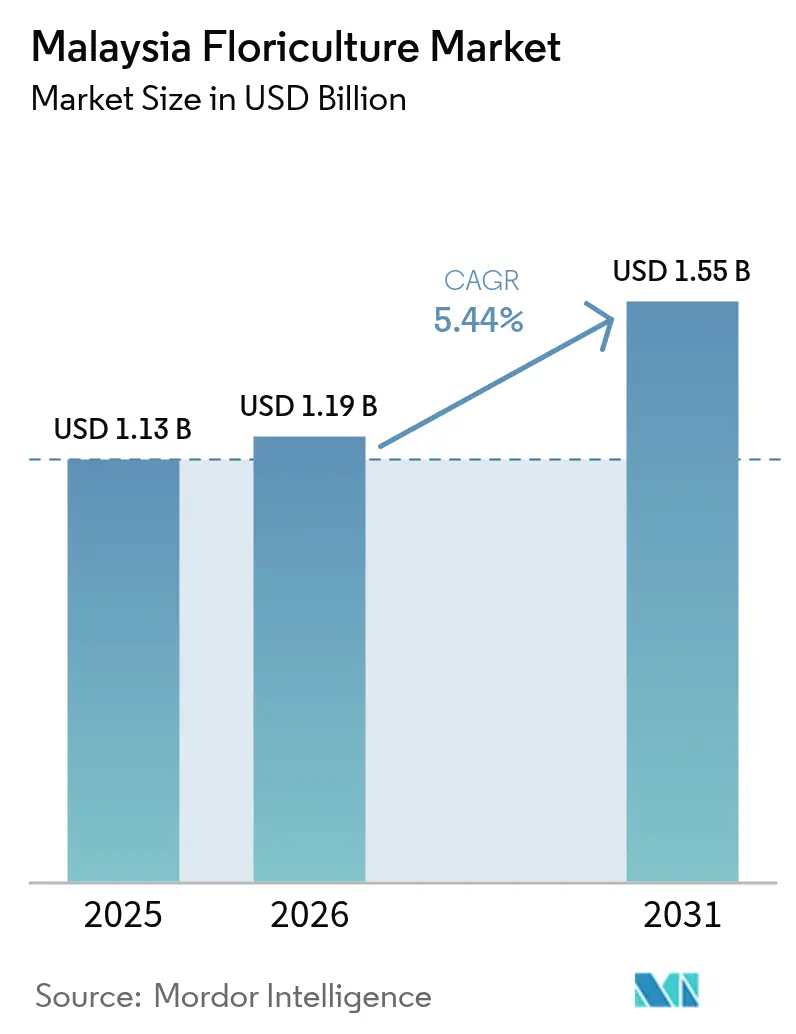
The Malaysia floriculture market size was valued at USD 1.13 billion in 2025 and estimated to grow from USD 1.19 billion in 2026 to reach USD 1.55 billion by 2031, at a CAGR of 5.44% during the forecast period (2026-2031). Solid demand from export partners, expanding e-commerce channels, and sustained government support anchor near-term sales momentum, while technology-led productivity gains underpin longer-term competitiveness. Continuous greenhouse automation and IoT-enabled monitoring lower unit costs, helping domestic growers counter volatile freight rates and rising labor expenses. Agri-tourism keeps local retail volumes healthy, and corporate sustainability targets reward producers that earn MyGAP or myOrganic certification[1]Source: Kementerian Pertanian dan Keterjaminan Makanan, “Kursus Teknikal Pertanian,” kpkm.gov.my. As cross-border distributors deepen procurement ties, especially with Singapore and Japan, the Malaysia floriculture market leverages its strategic Southeast Asian location and preferential trade pacts to widen revenue streams.
Key Report Takeaways
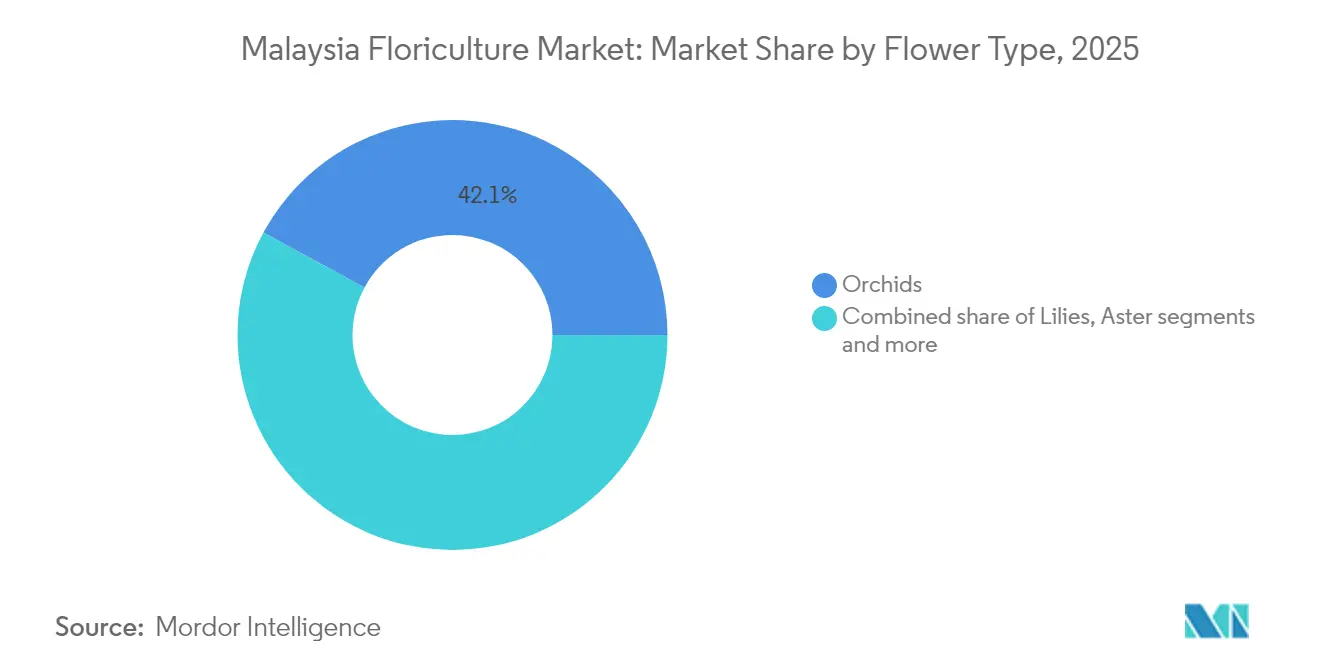
- By flower type, orchids led with 42.10% Malaysia floriculture market share in 2025, and lilies are forecast to post the fastest 7.12% CAGR through 2031.
Note: Market size and forecast figures in this report are generated using Mordor Intelligence’s proprietary estimation framework, updated with the latest available data and insights as of 2026.
Malaysia Floriculture Market Trends and Insights
Drivers Impact Analysis*
| Driver | (~) % Impact on CAGR Forecast | Geographic Relevance | Impact Timeline |
|---|---|---|---|
| Rising government subsidies for commercial orchid estates | +0.8% | National, concentrated in Cameron Highlands and Pahang | Medium term (2-4 years) |
| Expansion of e-commerce floral gifting platforms | +1.2% | Urban centers: Kuala Lumpur, Selangor, Penang, Johor Bahru | Short term (≤ 2 years) |
| Growing export demand from Japan and Singapore | +1.0% | National, with logistics hubs in Kuala Lumpur International Airport | Medium term (2-4 years) |
| Greenhouse automation cutting unit costs | +0.9% | Cameron Highlands, Pahang, with spillover to Selangor | Long term (≥ 4 years) |
| Agri-tourism initiatives boosting domestic flower sales | +0.6% | Cameron Highlands, Pahang, with expansion to other highland regions | Medium term (2-4 years) |
| Corporate ESG targets favoring eco-certified growers | +0.4% | National, with early adoption in Selangor and Kuala Lumpur | Long term (≥ 4 years) |
| Source: Mordor Intelligence | |||
Rising Government Subsidies for Orchid Estates
Federal incentives now cover cash grants up to USD 4,400 for young agro-preneurs, alongside low-interest loans at 2% that ease working-capital pressure[2]Source: Federal Agricultural Marketing Authority, “Jenis Bantuan – FAMA,” fama.gov.my. Additional allocations of USD 840,000 under the Malaysian Indian Transformative Agri Programme provide up to USD 6,600 per recipient, directly accelerating greenhouse expansion in 2024/2025. Technical upskilling delivered through the Digital Training Information and Management System supplies growers with standardized curricula on nutrient formulation and climate control. Together, these interventions reduce capital barriers and shorten payback periods for new commercial orchid projects. The policy direction aligns with the national goal of raising agriculture’s gross value to support rural incomes while diversifying export earnings.
Expansion of E-commerce Gifting Platforms
Urban consumers increasingly favor on-demand floral gifting, with same-day delivery windows as short as four hours for premium bundles. Average transaction values lie between USD 22- 216, much higher than wet-market purchases, boosting revenue per stem for growers that integrate directly with digital platforms. Marketplace start-ups such as TheFloristMarket eliminate website development costs for small retailers, broadening online penetration. Subscription services priced at USD 66 per month normalize recurrent orders and support predictable off-take from farms. The seamless link between greenhouse inventory and application programming interfaces (APIs) lets producers balance supply across multiple channels in real time, minimizing waste during peak seasons.
Growing Export Demand from Japan and Singapore
Japanese import share for Malaysian flowers climbed, underpinned by tight post-harvest handling protocols and favorable shipping times. Integrated wholesalers such as Floristika, a center in Kuala Lumpur, generate annual sales by consolidating orders for Singapore-based distributors. Diversified routes also target the Australian market, where shipments of live plants and cut flowers reached a high point. Containerized cold-chain options, equipped with controlled-atmosphere technology, lower freight cost per kilogram compared with exclusive air solutions, widening margins on long-haul deliveries.
Greenhouse Automation Cutting Unit Costs
Research by Malaysian universities validated LoRa-enabled sensor arrays that maintain data packet reliability in rugged highland terrain. Comfort-ratio algorithms fine-tune ventilation, misting, and supplemental lighting, ensuring optimal vapor-pressure deficits for orchids and chrysanthemums. Automated fertigation units use pH and electrical-conductivity probes to deliver nutrients precisely, cutting fertilizer expenditure and runoff. For smallholders confronting labor shortages, remote monitoring allows one technician to oversee multiple structures, raising productivity while containing payroll overheads.
Restraints Impact Analysis*
| Restraint | (~) % Impact on CAGR Forecast | Geographic Relevance | Impact Timeline |
|---|---|---|---|
| Volatile jet-freight rates for temperature-sensitive cargo | -0.7% | National, with a focus on Kuala Lumpur International Airport | Short term (≤ 2 years) |
| Labor shortage of skilled floriculturists | -0.9% | National with an acute impact in Cameron Highlands | Medium term (2-4 years) |
| Increasing pest and disease pressure under a humid climate | -0.6% | National, with a higher incidence in lowland regions | Long term (≥ 4 years) |
| High capital outlay for climate-controlled structures | -0.5% | Cameron Highlands and highland production areas | Long term (≥ 4 years) |
| Source: Mordor Intelligence | |||
Volatile Jet-freight Rates for Temperature-Sensitive Cargo
Flowers rely on air transit for 95% of export volume, exposing growers to aviation-fuel surcharges and capacity constraints during popular gifting peaks. Maintaining a 1–2 °C cold chain from farm gate to aircraft belly adds specialized packaging costs that compress export margins. Kuala Lumpur’s single-hub dominance creates seasonal bottlenecks, raising the risk of delays that degrade stem life. Competitors such as Kenya and Colombia operate dedicated flower corridors, forcing Malaysian shippers to absorb higher logistics expenses to match landed prices in Tokyo, Sydney, and Hong Kong markets.
Labor Shortage of Skilled Floriculturists
The aging farmer demographic compounds the challenge as experienced growers retire without adequate knowledge transfer to younger generations. Competition from palm oil plantations and manufacturing sectors for agricultural labor further constrains the available workforce for labor-intensive floriculture operations. Educational programs like the Diploma in Landscape and Horticulture at Kolej Profesional MARA Beranang provide structured training, but graduation rates remain insufficient to meet industry demand for qualified floriculturists and nursery managers.
*Our forecasts treat driver/restraint impacts as directional, not additive. The impact forecasts reflect baseline growth, mix effects, and variable interactions.
Segment Analysis
By Flower Type: Orchid Dominance and Lily Momentum
Orchids captured 42.10% of Malaysia floriculture market share in 2025, buoyed by Phalaenopsis and Dendrobium lines that trade at premium export prices. Government grants and tissue-culture know-how shorten propagation cycles, allowing estates to replenish benches quickly and maintain year-round supply. The Malaysia floriculture market size for orchids is projected to grow steadily, supported by entrenched demand from Singapore wholesalers and rising Japanese orders.
Lilies, while smaller, record the highest forecast growth at a 7.12% CAGR as lifestyle gift trends pivot toward elegant mono-stem arrangements. E-commerce bundles featuring Oriental hybrids command higher unit revenues than mixed bouquets, encouraging growers to trial new cultivars under net-house conditions. Roses, produced mainly in Cameron Highlands, continue to meet domestic demand, although growers face pressure from red-mite infestations that necessitate integrated pest-management regimens. Chrysanthemums leverage LED-driven photo-period manipulation to hit Valentine’s and Mother’s Day peaks reliably. Carnations, aster, gerberas, and emerging lines such as amaryllis round out portfolios, offering diversification against disease or price shocks in primary crops.


Geography Analysis
Cameron Highlands anchors the Malaysia floriculture market, drawing on elevations near 1,500 meters that reduce heat-stress loads and enable temperate species to flourish without energy-intensive cooling. Growers employ multi-span greenhouses with polycarbonate glazing to stabilize daily temperature swings, improving bud count in roses and stem strength in chrysanthemums. The Malaysia floriculture market size, attributable to Cameron Highlands' benefits further from tourist inflows who purchase fresh-cut stems and potted plants onsite, creating a secondary revenue stream complementary to wholesale exports.
Selangor and Kuala Lumpur function as downstream distribution hubs, housing consolidation centers, and last-mile cold-storage nodes. Digital platforms integrate directly with these facilities, allowing same-day dispatch across dense urban corridors. Johor Bahru leverages its proximity to Singapore to facilitate cross-border truck shipments, while Penang attracts niche lifestyle consumers with curated floral experiences. Emerging disruptors include specialized packaging companies like Floratex, which manufactures floral foam and supplies with an annual output valued at USD 1-2.5 million, indicating opportunities for value-added services within the floriculture supply chain. The Malaysia floriculture market share generated by urban clusters reflects the growing influence of consumer convenience and digital payments on purchase behavior.
Externally, Singapore remains the single largest re-export partner, with vertically integrated wholesalers minimizing transaction friction for Malaysian producers. Japan’s market share gains validate the sector’s emphasis on post-harvest quality and supply reliability. Australia and other Regional Comprehensive Economic Partnership (RCEP) members widen the addressable opportunity, lowering tariff thresholds and standardizing phytosanitary protocols that once restricted entry. Ongoing investment in Kuala Lumpur International Airport’s perishable-cargo facilities aims to mitigate current capacity crunches and ensure consistent transit temperatures, supporting future export volume growth.
Regulatory Landscape
Malaysia floriculture exporters operate under the Department of Agriculture (DOA) as the National Plant Protection Organization (NPPO), with plant movement and market access anchored in the Plant Quarantine Act 1976 and Plant Quarantine Regulations 1981. Export consignments of cut flowers and live plants typically need to meet destination phytosanitary import conditions, supported by DOA-issued phytosanitary certification, while import and border inspection functions sit with Malaysian Quarantine and Inspection Services (MAQIS).
At farm level, buyer and program requirements increasingly favor Malaysia Good Agricultural Practices (myGAP) and related sustainability certifications (such as myOrganic) as evidence on pesticide management, traceability, and production hygiene, especially for shipments routed to premium regional buyers. In May 2026, the Ministry of Agriculture and Food Security (KPKM) publicly signaled coordinated agency action (including DOA and FAMA) to address cultivation disruptions in Cameron Highlands linked to heavy rainfall, which reinforces the government role in production continuity and quality assurance for an export-oriented value chain.
Value Chain Analysis
The value chain starts with planting materials and inputs (tissue culture, seedlings, substrates, fertilizers, crop protection, and greenhouse structures), followed by cultivation concentrated in highland clusters such as Cameron Highlands for temperate flowers and mixed locations for tropical orchids. Production is increasingly tied to protected cultivation and automation (irrigation and fertigation control, sensors, and climate management) to stabilize quality under labor and weather constraints, with compliance practices (myGAP and phytosanitary protocols) shaping agronomy and recordkeeping.
Post-harvest handling, grading, and cold-chain logistics are pivotal for exports, given the reliance on air freight. Aggregation and consolidation are common among smallholders to meet minimum volumes. Downstream, integrated wholesalers and distribution centers in the Klang Valley link farms to retailers, corporate gifting, e-commerce platforms, and export agents serving Singapore and Japan. Orchidmas International LLC's Dubai Orchid Export Farm (LEOD) pilot project announced in February 2024 is a clear example of value chain extension, with the 29.14 hectares spanning Negeri Sembilan and Selangor and increasing emphasis on standardized post-harvest quality and export logistics.
Market Opportunities and Future Outlook
Export market diversification and higher-value product formats create whitespace beyond the traditional Singapore and Japan corridors. Malaysia has positioned itself as a leading ASEAN exporter, with cut flower exports reported around USD 100 million in 2024 and export value cited at RM405.3 million in 2025. Company initiatives such as Orchidmas International LLC's Dubai Orchid Export Farm (LEOD) pilot project in February 2024 for Gulf markets indicate active pursuit of non-traditional destinations and new sales pathways, including digital storefront-led ordering. This supports opportunities in export-oriented assortment development (tropical orchids and curated gift-ready products) and in professionalized post-harvest services that reduce shrinkage and preserve vase life during long-haul distribution.
Operational constraints also create investable themes inside Malaysia. The Thirteenth Malaysia Plan (2026-2030) sets targets to reduce foreign labor dependency (10% by 2030 and 5% by 2035), strengthening the business case for greenhouse automation, remote monitoring, and mechanization suited to SMEs. National Agrofood Policy 2021-2030 (NAP 2.0) prioritizes smart agriculture and value chain strengthening. Alongside reported weather-related cultivation disruptions in Cameron Highlands highlighted by KPKM in May 2026, demand is building for climate-resilient infrastructure, expanded cold-chain capacity around Kuala Lumpur International Airport, and service providers in packaging, grading, and compliant traceability to protect export quality under tighter labor and climate conditions.
Recent Industry Developments
- May 2026: Malaysias Ministry of Agriculture and Food Security (KPKM) announced it would coordinate with agencies such as the Department of Agriculture (DOA) and FAMA to assess and address cultivation disruptions for Cameron Highlands flower growers following heavy rainfall. The focus spotlights climate-linked supply volatility and can accelerate adoption of protected cultivation, better drainage, and tighter post-harvest controls to stabilize export-grade output.
- April 2025: Labuan hosted the inaugural Borneo Flora Festival 2025, widening the industrys promotional and sales footprint into East Malaysia beyond the traditional Peninsular production and trading centers. The event supports broader domestic demand creation and provides a platform for nurseries and retailers to build distribution links with new regional buyers.
- February 2024: Orchidmas International LLC, a subsidiary of Syarikat Orchidmas Sdn Bhd, announced the Dubai Orchid Export Farm (LEOD) pilot project spanning 29.14 hectares across Negeri Sembilan and Selangor to supply hybrid Mokara orchids to Gulf markets. The project signals a push to diversify export destinations and strengthens the role of coordinated cold-chain logistics and standardized quality management for long-haul shipments.


Research Methodology Framework and Report Scope
Market Definition and Coverage
For this study, the Malaysia floriculture market is defined as the value generated from cultivating and selling flowers and ornamental plants grown for decorative and commercial use within Malaysia, including domestic use and trade flows that influence local supply and pricing.
Scope exclusions: We exclude artificial flowers and non-ornamental field crops, and we also do not count downstream event services or florist retail service fees as market value.
Segmentation Overview
- By Flower Type
- Orchids
- Roses
- Chrysanthemums
- Carnations
- Aster
- Lilies
- Gerberas
- Others
Data Sources, Market Sizing, and Validation
Desk Research
Desk work starts with building a factual base on production, planted area, yields, and trade flows so the model does not rely on opinions alone. We used public sources such as Malaysia Department of Statistics releases, the Department of Agriculture Malaysia publications, FAOSTAT, UN Comtrade trade statistics, and ITC Trade Map for cross-checking export and import trends.
To connect volumes to value, we reviewed price trend references and seasonality cues from government agriculture portals and industry association websites, followed by company annual reports, investor presentations, and reputable press coverage on farmgate and wholesale pricing. We also used paid subscriptions for company financials and intelligence, plus shipment-level import and export data where it helped validate trade-linked volumes and unit values. These references are illustrative only, and we reviewed many other public and paid sources for data collection, validation, and clarification.
Primary Interviews and Surveys
Primary discussions were used to validate what is actually sold in the market and how prices move across peak gifting seasons, weddings, and institutional demand. We spoke with growers, traders, wholesalers, distributors, and institutional buyers across Malaysia so gaps in product mix, spoilage, and channel margins could be resolved and reflected back into the sizing model.
Distribution of primary research fieldwork respondents
| Company type | Respondent position |
|---|---|
| Top tier: 26% | CXOs: 12% |
| Mid tier: 54% | Functional/Unit leaders: 30% |
| Smaller Players: 20% | Managers: 58% |
Market-Sizing & Forecasting
The size model uses a top-down reconstruction that ties Malaysia production and trade data to an estimated domestic availability pool, which is then valued using observed price bands across key flower types. After this total is formed, we corroborate it with selective bottom-up approximations, such as sampled grower output converted with realistic average selling prices and channel checks from distributors, and then adjust totals where the two views do not align.
Key inputs in the model include planted area and yield indicators, import and export volumes by major flower categories, average unit values inferred from trade statistics, local wholesale price movements, and demand signals tied to events and gifting seasonality. When information is missing for a smaller flower type, the gap is handled by using proportional shares derived from nearby years and then re-tested with interview feedback so the mix remains realistic.
For forecasting, we run scenario analysis around production expansion and price realization, and we check the year-by-year path using simple regression-style relationships between trade intensity, domestic consumption shifts, and expected price progression. Assumptions are kept traceable so updates can be made quickly when new trade or production statistics are released.
Data Validation & Update Cycle
Model outputs are checked against independent signals such as direction of import dependence, export momentum, and whether the implied average prices are consistent with the latest trade unit values and interview ranges. Outliers are reviewed in a second pass, and if a swing looks too large for a single year, we revisit the underlying drivers and re-contact respondents to confirm what changed.
Each report is refreshed annually, and interim updates are made when material events occur, such as policy changes, supply shocks, or visible price breaks in major flower categories. Before delivery, we do a final update sweep so the numbers reflect the latest available public statistics and field feedback.
Mordor Intelligence's Malaysia Floriculture Market Size Compared Against Other Published Estimates
Published numbers for Malaysia floriculture can appear far apart because each publisher defines the product set differently and then values it using different price points and timing. Differences also come from whether trade and domestic production are jointly modeled, and whether the estimate is updated when new customs and agriculture statistics are released.
Event decor services and florist retail service margins are two common add-ons that can widen totals, and those items sit outside Mordor Intelligence's scope for this market, which keeps the value focused on cultivated floriculture output and trade-linked supply. Some sources also apply aggressive growth assumptions without re-checking implied unit prices against trade statistics, or they mix base years, which can produce a large jump that is hard to reconcile with observed volumes.
Benchmark comparison
| Source | Market Size | Gaps in Research Methodology |
|---|---|---|
| Mordor Intelligence | USD 1.13 B (2025) | |
| Industry Publisher A | USD 1.12 B (2024) | Uses a different base year and may include broader application layers and retail-related value capture, which can shift what is counted as market value from cultivated output to downstream activity. |
| Market Publisher B | USD 1.12 B (2024) | The scope appears to include a wider set of types and end uses and extends the forecast to a different horizon, and the CAGR and end-year projection imply unit value changes that are not always tied back to trade unit values and local price checks. |
Overall, the spread is largely explained by scope items that sit above farm and trade value, plus differences in base year and how price progression is handled. By keeping the model tied to production, imports, exports, and realistic price bands, the estimate stays easier to audit and repeat when new statistics are released.


Key Questions Answered in the Report
What is the current size of the Malaysia floriculture market?
The sector is valued at USD 1.19 billion in 2026 and is on track to reach USD 1.55 billion by 2031.
Which flower type holds the largest share?
Orchids lead with 42.10% of Malaysia floriculture market share in 2025.
Which segment is growing the fastest?
Lilies show the highest momentum, advancing at a 7.12% CAGR through 2031.
How important is Cameron Highlands to domestic production?
It is the chief production hub, leveraging high-altitude conditions to supply export-quality orchids, roses, and chrysanthemums year-round.
What technologies are growers adopting to improve yields?
IoT-enabled greenhouse monitoring, automated fertigation, and LED lighting are widely implemented to control microclimates and cut unit costs.
Which export markets are most significant?
Japan and Singapore remain the top destinations, with emerging demand from Australia and other RCEP member economies.
Page last updated on:


 Your data is secure and never sold or shared.


