
Market Overview
| Study Period | 2020 - 2031 |
|---|---|
| Forecast Data Period | 2026 - 2031 |
| Base Year Market Size (2025) | 180.23 Million Liters |
| Market Volume (2026) | 183.04 Million Liters |
| Market Volume (2031) | 197.81 Million Liters |
| Growth Rate (2026 - 2031) | 1.56 % |
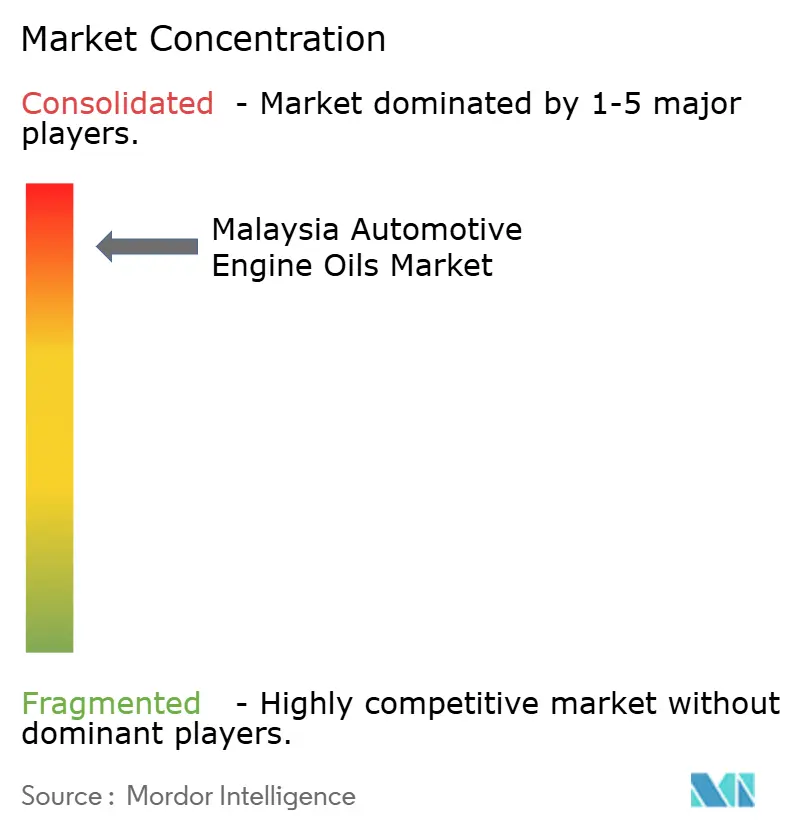
| Market Concentration | High |
Major Players *Disclaimer: Major Players sorted in no particular order Image © Mordor Intelligence. Reuse requires attribution under CC BY 4.0. | |
Malaysia Automotive Engine Oils Market Analysis by Mordor Intelligence
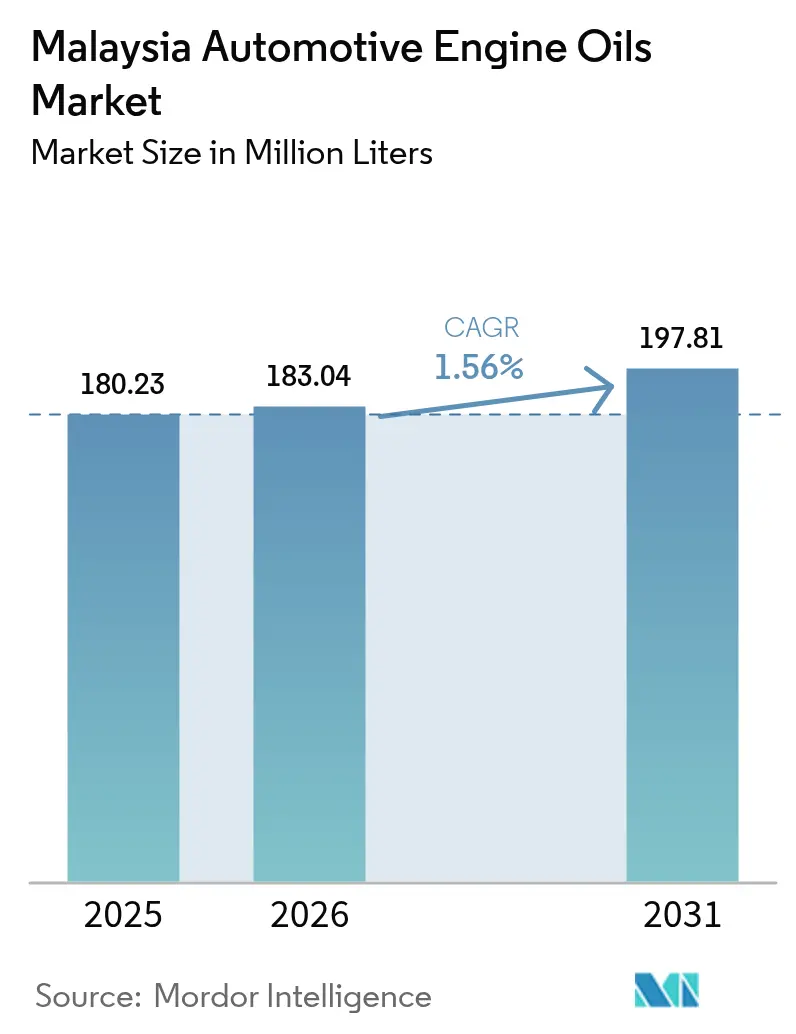
The Malaysia Automotive Engine Oils Market size was valued at 180.23 million liters in 2025 and estimated to grow from 183.04 million liters in 2026 to reach 197.81 million liters by 2031, at a CAGR of 1.56% during the forecast period (2026-2031). Demand holds firm because two-wheelers remain the workhorse of urban and last-mile transport, mineral oils still dominate rural servicing, and regulatory moves such as mandatory SIRIM certification are pruning grey-market supply. Rapid platform-economy growth, an e-commerce-driven courier boom, and stricter Euro-5 fuel standards are nudging owners and fleets toward low-SAPs synthetics that command higher ticket sizes per fill. New domestic blending capacity from UMW Lubetech and MSB Global underpins supply security, while the Sime-UMW merger aggregates more than half of vehicle distribution under one roof, reinforcing OEM influence over lubricant specifications.
Key Report Takeaways
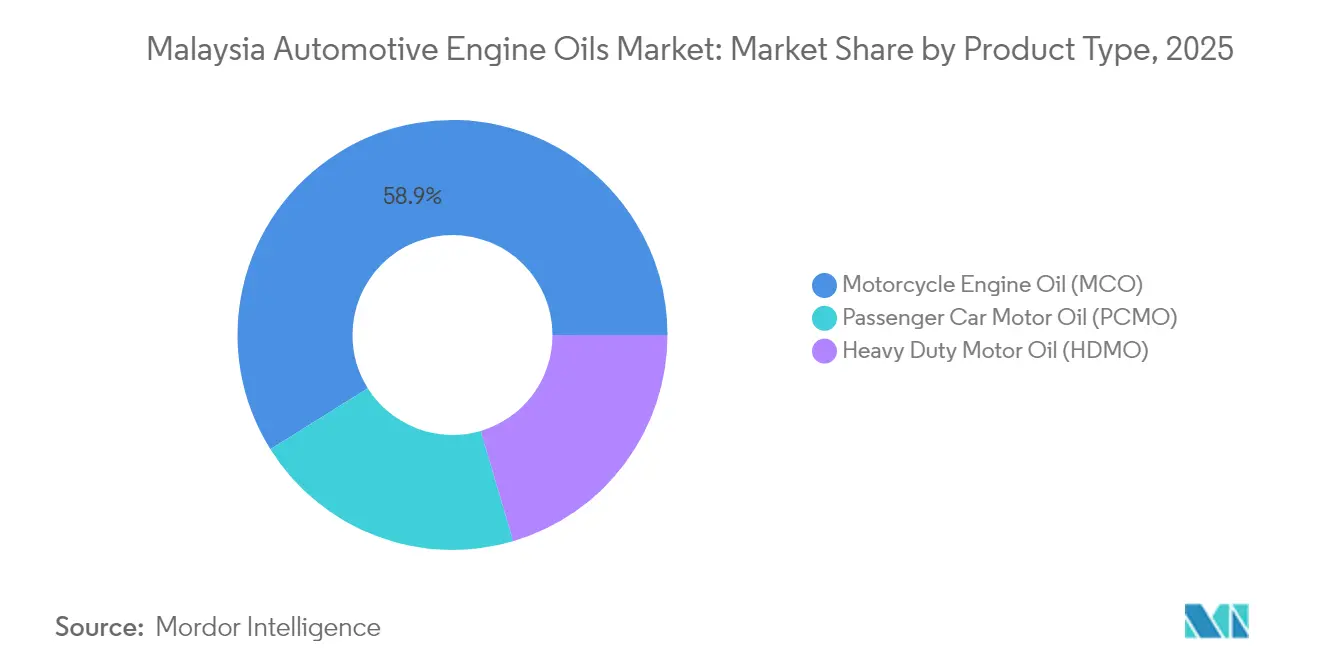
- By product type, motorcycle engine oil led with a 58.92% Malaysia automotive engine oils market share in 2025, whereas passenger car motor oil posts the quickest expansion at a 1.28% CAGR through 2031.
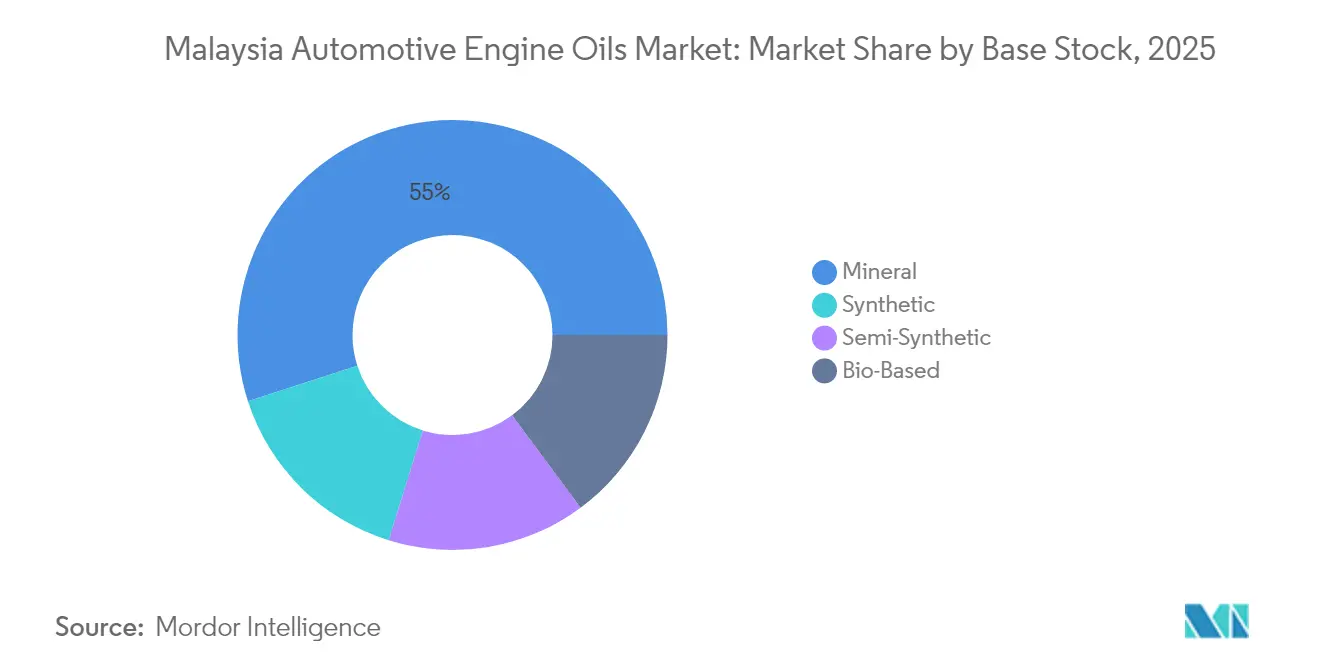
- By base stock, mineral formulations captured 54.98% share of the Malaysia automotive engine oils market size in 2025, yet synthetics advance the fastest at a 1.65% CAGR thanks to Euro-5 and OEM-mandated extended-drain needs.
Note: Market size and forecast figures in this report are generated using Mordor Intelligence’s proprietary estimation framework, updated with the latest available data and insights as of 2026.
Malaysia Automotive Engine Oils Market Trends and Insights
Drivers Impact Analysis*
| Driver | (~) % Impact on CAGR Forecast | Geographic Relevance | Impact Timeline |
|---|---|---|---|
| Rapid growth of last-mile delivery fleets | +0.30% | National, with early gains in Klang Valley, Johor, Penang | Medium term (2-4 years) |
| Surge in ride-hailing platform vehicles and bulk-service tie-ups | +0.25% | Urban centers, spill-over to secondary cities | Short term (≤ 2 years) |
| Tightening CO₂ / Euro 6-equivalent emission norms driving premium synthetics | +0.40% | National implementation, stricter enforcement in major cities | Long term (≥ 4 years) |
| OEM-mandated extended-drain intervals raising per-fill value | +0.35% | Global OEM influence, local assembly compliance | Medium term (2-4 years) |
| Motorcycle enthusiast culture boosting high-performance oils | +0.15% | National, with concentration in motorsport regions | Long term (≥ 4 years) |
| Source: Mordor Intelligence | |||
Rapid growth of last-mile delivery fleets
Courier and food-delivery operators continue to enlarge two-wheeler pools as online retail volume grows, and Pos Malaysia alone added 1,092 electric bikes in 2024 while still running a far larger internal-combustion roster. Electric penetration remains below 1% through 2025 as charging gaps and high upfront costs slow migration, so mineral and increasingly synthetic MCO grades keep flowing into workshops. Fleet managers specify synthetic 10W-40 or 5W-40 blends to extend service to 6,000–8,000 km, reducing downtime and aligning with rider incentive schemes that reward higher on-road hours. These operating economics sustain premium-grade uptake despite the rise of electric delivery bikes, supporting incremental volume and value for the Malaysia automotive engine oils market.
Surge in ride-hailing platform vehicles and bulk-service tie-ups
Grab and other e-hailing platforms report double-digit booking growth, and Grab’s Malaysian arm booked MYR 673 million revenue in 2023, underpinning a fleet of leased and owned vehicles that undergo standardized servicing. Operators use bulk agreements with branded lubricant chains, guaranteeing minimum volumes for 5W-30 synthetics that meet OEM API SP or ILSAC GF-6A specs. Predictable maintenance cycles at 10,000 km intervals secure repeat demand, while platform data analytics alert drivers to oil-change milestones, keeping churn low for preferred brands. As a result, synthetic PCMO penetration rises faster in urban centers, reinforcing value growth for the Malaysia automotive engine oils market.
Tightening CO₂ / Euro 6-equivalent emission norms driving premium synthetics
Malaysia starts enforcing Euro-5 petrol in September 2025 and migrates toward Euro-6, compelling OEMs to recommend low-SAP oils that protect particulate filters and three-way catalysts. Commercial fleets hauling palm oil and consumer goods now trial CK-4/FA-4-ready formulations to stay ahead of future standards showcased by additive suppliers at ALIA/F+L Asia 2024[1]. Longer intervals and oxidative stability make 5W-30 full synthetics attractive despite price premiums, especially when downtime costs override the extra MYR 40-60 per 7-liter HDMO fill. These regulatory tailwinds fortify synthetic demand within the Malaysia automotive engine oils market.
Motorcycle enthusiast culture boosting high-performance oils
Events like the RXZ Members rally attract 80,000 fans annually, and PETRONAS’s Sprinta RXZ limited edition sold out its first 15,000-bottle run in under a week at MYR 45 per liter. Motul’s 300V 4T Factory Line claims up to 1.9% horsepower gains and 12,000 km drains, widening performance credentials among superbike owners. Gulf Syntrac pushes endurance marketing in Sepang track-days, reinforcing brand equity at the enthusiast end of the Malaysia automotive engine oils industry. Although this niche contributes smaller volumes, its high margins lift blended average unit revenue across suppliers.
Restraints Impact Analysis*
| Restraint | (~) % Impact on CAGR Forecast | Geographic Relevance | Impact Timeline |
|---|---|---|---|
| Shared-mobility consolidation reducing private-car kilometres | -0.08% | Urban centers, limited suburban penetration | Medium term (2-4 years) |
| Grey-import lubricants eroding branded volumes | -0.15% | National, stronger in price-sensitive segments | Short term (≤ 2 years) |
| Rising drain-intervals lowering service frequency | -0.12% | Global OEM influence, premium segment focus | Long term (≥ 4 years) |
| Source: Mordor Intelligence | |||
Shared-mobility consolidation reducing private-car kilometres
Car-sharing and subscription models gain media attention, yet Kuala Lumpur’s vehicle density exceeds 700,000 units across just 244 km², reflecting entrenched ownership culture and subsidized petrol at MYR 2 per liter. Operators struggle with parking shortages and depreciation risk, limiting shared-fleet growth to low-single-digit percentages of total registered cars. Even so, any incremental shift toward pooled usage compresses oil-change frequency, nibbling 0.08 percentage points off the Malaysia automotive engine oils market CAGR forecast.
Grey-market lubricants eroding branded volumes
Prior to SIRIM enforcement, counterfeit oils sold at up to 50% discounts siphoned roughly 12 million liters annually, denting brand trust and workshop profitability. Enforcement recorded 36 seizures worth MYR 1.15 million between 2019 and February 2025, yet the illicit trade depressed premium uptake and constrained marketing budgets. Mandatory hologram labeling and fines reaching MYR 200,000 from October 2025 are expected to neutralize this restraint by 2026, restoring clean share for the Malaysia automotive engine oils market.
*Our forecasts treat driver/restraint impacts as directional, not additive. The impact forecasts reflect baseline growth, mix effects, and variable interactions.
Segment Analysis
By Product Type: Two-wheeler dominance balances rising car-owner sophistication
Motorcycle Engine Oil still commanded 58.92% of the Malaysia automotive engine oils market share in 2025, a reflection of Malaysia’s 1-bike-per-2-persons ratio and a large courier workforce. PETRONAS Sprinta, Motul 300V, and Gulf Syntrac now headline performance marketing, while bulk fleet contracts with Pos Malaysia and GrabFood anchor high-volume SKUs. Passenger Car Motor Oil, though smaller, grows at the swiftest 1.28% CAGR as Toyota, Perodua, and Honda broaden synthetic service packages, trebling 0W-20 and 5W-30 share since 2022. Sime-UMW’s unified distributor footprint allows bundled lubricant-plus-service promotions that accelerate synthetic PCMO adoption among cost-sensitive B-segment hatchback owners, bolstering value for the Malaysia automotive engine oils market size.
Heavy Duty Motor Oil trails in growth terms but remains vital for palm-oil logistics, construction, and cross-border haulage. Castrol VECTON CK-4 and PETRONAS Urania CI-4+ command loyalty by proving oxidation stability with B20 biodiesel, extending drains to 80,000–120,000 km in fleet trials with Hap Seng and Tiong Nam. Upcoming Euro 6 and higher biodiesel blends create an opening for FA-4 grades, positioning heavy-duty synthetics for renewed expansion beyond 2027.

By Base Stock: Mineral bulk remains, but synthetics set the pace
Mineral oils still represented 54.98% of 2025 volumes as older Perodua Viva, Proton Saga, and pre-Euro-4 motorcycles are perfectly compatible, and workshops in rural Sabah and Kelantan stock mainly 20W-50 API SL blends at MYR 17 per liter. Yet the mineral share slips year-on-year because SIRIM rules raise compliance costs for small repackers, narrowing the price gap with entry-level semi-synthetics and nudging switchovers.
Full synthetics expand at a 1.65% CAGR as OEMs link warranty coverage to API SP and ACEA C3 approvals, a mandate clearly printed on Toyota and Mercedes-Benz service coupons. Product innovation is robust: UMW Lubetech’s Grantt G-Syn 0W-20 leverages fresh Pulau Indah capacity for low pour-point formulations, while LIQUI MOLY’s Leichtlauf 10W-40 posts 30% sales gain in East Malaysia via online marketplaces. Semi-synthetics play the bridge role, priced 15–20% over minerals, and win conversions among price-watchful GrabRentals drivers seeking credible API SN performance on tight budgets, helping diversify revenue for the Malaysia automotive engine oils industry. Bio-based palm-oil esters remain largely experimental, restricted to small university fleet pilots, and are awaiting cost parity and additional test data.
Geography Analysis
Klang Valley dominates lubricant consumption in 2025, driven by the presence of Perodua's Serendah plant, numerous multi-brand dealerships, and the region's high courier activity, which significantly boosts synthetic lubricant usage. Johor follows with a significant share due to Iskandar manufacturing clusters and cross-border servicing for Singapore commuters, while its palm-oil logistics boosts heavy-duty demand. Proximity to the Thai automotive corridor boosts competitive pricing and product cross-flows, enabling Penang and Kedah to play a significant role in Malaysia's automotive engine oils market.
East Malaysia—Sabah and Sarawak—collectively consumed significant million liters in 2025, after PETRONAS tripled its distributor count to nine and LIQUI MOLY opened hubs in Kuching and Kota Kinabalu. Geographic spread forces suppliers to rely on coastal shipping and river barges, adding 6–8 cents per liter in logistics cost that favors embedded brands like PETRONAS and Shell with bulk storage tanks in Bintulu and Sipitang. Mineral share remains dominant due to the prevalence of older 2-wire trucks and motorcycles, while state initiatives like the Pan Borneo Highway are driving the adoption of HDMO synthetics for extended hauls.
The East Coast Rail Link under construction is catalyzing spare-parts hubs in Kuantan; Perodua is building a regional warehouse to cut lead times to Terengganu and Kelantan by 40%. Once operational in 2027, suppliers expect up to 5 million liter incremental demand from construction equipment and freight trains, broadening the Malaysia automotive engine oils market size across the peninsula. Overall, urban corridors see rapid synthetic adoption, whereas rural pockets keep mineral leadership, delivering a balanced national growth profile.
Regulatory Landscape
Malaysia regulates automotive engine oils through trade description enforcement, petroleum supply controls, and environmental rules for used oil. The Trade Descriptions (Certification and Marking of Engine Oil for Motor Vehicle) Order 2024 was gazetted in October 2024 and took effect in April 2025, requiring SIRIM QAS certification and a conformity label on engine-oil packs sold in Malaysia. This framework strengthens action against counterfeit and grey-market products. In parallel, the Ministry of Domestic Trade and Cost of Living (KPDN) administers supply-control and retail-licensing requirements for controlled petroleum items, which affects how lubricant marketers structure compliant distribution and retail practices.
Environmental compliance also shapes service networks because spent lubricating oil is regulated as scheduled waste (SW 305) under the Environmental Quality Act 1974 and associated scheduled-waste rules administered by the Department of Environment (DOE). Operators must maintain controlled collection, transport, and recovery pathways. On the fuel side, biodiesel blending programs (B10/B20 frameworks managed under biofuel policy) influence HDMO performance requirements, while April 2026 enforcement actions tightening subsidized fuel sales by KPDN add further scrutiny to downstream petroleum retail activity, increasing the value of formal and auditable supply chains for lubricant marketers.
Value Chain Analysis
The value chain starts with base oil and additive procurement, followed by blending and packaging, and then distribution into OEM workshops, independent service centers, and retail. Upstream supply is supported by domestic refining and base-oil availability (including PETRONAS-linked infrastructure), while midstream blending is carried out by integrated majors (PETRONAS Lubricants International, Shell, Castrol, Mobil) and local blenders such as Feoso Oil, Add Oil, JP Lubricant Group, Advance Lube Enterprise (Power Up), and Enerlube Group. With SIRIM QAS marking and certification implemented from April 2025, there is a more formal compliance gate at the product and packaging stage, which increases the importance of traceability, approved testing, and controlled labeling processes.
Downstream, distribution is concentrated around branded service-station networks, dealership and OEM service channels, and workshop distributors, alongside growing B2B ordering for fleet accounts. Logistics performance and inventory positioning around major industrial and port corridors (for example, Port Klang-linked industrial hubs) remain central to national coverage, while East Malaysia supply typically requires additional warehousing and coastal shipping, favoring players with established bulk handling and distributor footprints. As counterfeit enforcement tightens and OEM specifications become more prescriptive, the chain shifts toward certified SKUs and documented product provenance, limiting space for informal repacking and improving the relative position of integrated brands and compliant local blenders.
Competitive Landscape
The Malaysia automotive engine oils market is highly consolidated. PETRONAS Lubricants International retains pole position through an integrated value chain spanning base-oil refining in Melaka, over 1,000 PETRONAS stations, and long-standing Formula One co-branding, collectively securing a significant share of the Malaysia automotive engine oils market. Its 2024 partnership with Mercedes-Benz Global Customer Service accelerates co-engineered after-sales fluids, boosting OEM workshops’ loyalty.
Shell, Castrol and Mobil compete on technical differentiation; Shell leverages Pennzoil PurePlus gas-to-liquid technology while Castrol emphasizes 100% malaysian coverage through nine master distributors[2]. Castrol VECTON’s nationwide trials with palm-oil biodiesel haulers won large HDMO contracts that lift its heavy-duty share in 2025. In 2024, Exxon Mobil's pricing strategy adjustment reduced its premium over Shell Helix Ultra, effectively stabilizing its market share.
Domestic challenger UMW Lubetech opened a 60 million-liter automated plant in January 2024, replacing a 35 million-liter Shah Alam site and raising Grantt’s capacity for OEM fill-and-finish contracts with Komatsu and Toyota forklifts. MSB Global’s planned 8.55 million-liter line in Johor will feed private-label supermarket SKUs and selective 5W-30 synthetics for ride-hailing fleets once its ACE Market IPO proceeds in late-2025. Gulf, Motul and LIQUI MOLY carve profitable niches among motorsport and enthusiast circles; Motul’s 300V 4T launch at MotoGP Sepang included recyclable packaging that resonates with eco-aware bikers.
Industry digitalization accelerates: PETRONAS Nexta pilots QR-code authenticity checks, Castrol rolls out an IoT-enabled fleet-management dashboard, and YCP analysis suggests predictive-maintenance apps could cut fleet lubricant consumption 3–5% by optimizing change intervals. Sustainability also rises on agendas, with Sime-UMW and Chevron Oronite exploring re-refining partnerships to recycle used oil back into base stocks under a circular economy model, aligning with Malaysia’s 2040 net-zero roadmap.
Malaysia Automotive Engine Oils Industry Leaders
-
BP plc (Castrol)
-
ExxonMobil Corporation
-
PETRONAS Lubricants International
-
Shell plc
-
TotalEnergies
- *Disclaimer: Major Players sorted in no particular order
Market Opportunities and Future Outlook
The April 2025 SIRIM QAS certification and labeling requirement under the Trade Descriptions Order creates room for compliant brands to expand in workshops and online channels that previously carried higher counterfeit exposure. Enforcement activity also provides a clear commercial signal, with authorities reporting seizures of illicit engine-oil products valued at RM 1.15 million between January 2019 and February 2025, and the move to mandatory conformity labels supports premiumization by making authenticity easier to verify at the point of sale. This environment encourages consolidation of supply among certified blenders and importers, while also increasing focus on packaging controls (holograms/QR checks) and distributor education to protect channel integrity.
Within product portfolios, opportunities center on higher-spec low-SAPS and fuel-economy engine oils aligned with newer API/ILSAC and OEM requirements, particularly in urban fleet-servicing ecosystems tied to ride-hailing and last-mile delivery maintenance routines. PETRONAS Lubricants International has refreshed its technology positioning through launches and partnerships, including market-first JASO-certified lubricants unveiled in January 2026 and a broader push into advanced fluids via collaborations such as its Malaysia partnership with Quaker Houghton (effective from 2Q 2025) for metalworking solutions. These steps support a broader move toward bundled higher-technical-value fluids offerings that can be mirrored through OEM programs, fleet service agreements, and workshop franchise models. In parallel, environmental compliance around scheduled-waste oil handling (DOE framework for used oil) supports more structured used-oil collection and recovery programs, creating an adjacent opportunity for lubricant marketers and service chains to formalize take-back logistics alongside engine-oil sales.
Recent Industry Developments
- June 2026: PETRONAS Lubricants International introduced the next generation of PETRONAS Syntium engine oils in Malaysia, aligned to newer API SQ and ILSAC GF-7 performance requirements. The launch strengthens its premium PCMO positioning as OEM and fleet buyers tighten specifications around fuel economy and emissions-system protection.
- December 2025: BP agreed to sell a 65% stake in its Castrol lubricants business to Stonepeak for USD 6 billion, while retaining a 35% interest. The ownership change can influence capital allocation and competitive strategy for one of the major brands active in Malaysia, with potential implications for channel investment and product portfolio focus.
- April 2025: PETRONAS Lubricants International signed a collaboration agreement with Glide Technology to manufacture and distribute premium insulating oils (PETRONAS Tranol Glide) in Malaysia. Although centered on specialty fluids, the move expands local manufacturing and partnering capabilities that can spill over into broader lubricant supply-chain resilience and technical-service depth.
Research Methodology Framework and Report Scope
Market Definition and Coverage
This market covers automotive engine oil demand within Malaysia, counted as lubricant volume used for engine oil changes in on-road vehicles through OEM fill and the aftermarket, and expressed in liters.
Scope exclusions: This sizing excludes industrial engine oils, marine oils, and non-engine automotive fluids such as transmission, gear, brake, and hydraulic fluids.
Segmentation Overview
- By Product Type
- Passenger Car Motor Oil (PCMO)
- 0W-XX
- 5W-XX
- 10W-XX
- 15W-XX
- Monogrades
- Other Grades
- Heavy Duty Motor Oil (HDMO)
- 0W-XX
- 5W-XX
- 10W-XX
- 15W-XX
- Monogrades
- Other Grades
- Motorcycle Engine Oil (MCO)
- 0W-XX
- 5W-XX
- 10W-XX
- 15W-XX
- Monogrades
- Other Grades
- Passenger Car Motor Oil (PCMO)
- By Base Stock
- Mineral
- Synthetic
- Semi-Synthetic
- Bio-Based
Data Sources, Market Sizing, and Validation
Desk Research
Desk work starts by pinning down the vehicle parc and how it moves each year, because that decides the real oil-change pool that can be served. We referenced public Malaysia transport and registration statistics, customs and trade releases, and national standards guidance such as SIRIM updates, then moved to technical references that explain oil performance and drain intervals.
To translate activity into liters, we leaned on sources such as Department of Statistics Malaysia releases, Royal Malaysian Customs trade summaries, road safety and transport publications (vehicle population indicators), and peer reviewed automotive lubrication papers. We also reviewed company annual reports, product data sheets, and distributor communications to understand pack sizes, viscosity grade mix, and how quickly synthetics are adopted. Where available, a paid subscription that aggregates company financials and a shipment-level trade view were used only to cross-check directionally, not to replace the main model. These examples are not exhaustive, and many other public sources were also used for data collection, validation, and clarification.
Primary Interviews and Surveys
Primary work was used to confirm practical numbers that desk sources rarely spell out clearly, such as average sump fill by vehicle type, real drain intervals in urban versus rural driving, and how workshop recommendations shift with warranty and certification needs. We spoke with participants across the supply chain and demand side, including blenders, distributors, workshops, fleet maintenance teams, and informed aftermarket channel contacts, and then reconciled differences in views before finalizing assumptions.
Distribution of primary research fieldwork respondents
| Company type | Respondent position |
|---|---|
| Top tier: 26% | CXOs: 13% |
| Mid tier: 54% | Functional/Unit leaders: 43% |
| Smaller Players: 20% | Managers: 44% |
Market-Sizing & Forecasting
We built the size using top-down and bottom-up checks so the totals stay explainable and traceable. From the top-down side, the demand pool was reconstructed from Malaysia vehicle parc by key on-road categories, multiplied by typical oil-fill volume per service, and then filtered through service frequency (drain interval behavior) to arrive at annual liters.
After that, the totals were corroborated with selective bottom-up approximations, such as sampled workshop throughput checks, channel mix splits between branded packs and bulk oil, and a sanity check on import and local blending availability against implied consumption. When information was missing for smaller channels, the gap was handled using conservative shares based on similar vehicle groups and then adjusted after expert feedback.
For forecasting, we used scenario analysis supported by simple time series smoothing on the core drivers, because parc growth and drain interval shifts tend to move steadily rather than jump each year. Inputs that mattered most included changes in registered vehicle population, mix shift toward motorcycles versus passenger cars, synthetic and semi-synthetic penetration, average drain intervals influenced by driving patterns, and changes in engine oil specifications that move viscosity and performance requirements.
Data Validation & Update Cycle
Model outputs were checked against independent signals, including trade direction, stated local blending activity, and whether implied liters per vehicle looked realistic versus service practices discussed in interviews. Large variances were flagged, and then the underlying inputs were re-checked, followed by a second pass review so arithmetic and logic errors do not slip through.
When a clear anomaly appeared, the team re-contacted selected respondents to confirm whether the change was real or driven by a one-time factor, such as inventory shifts or price-led substitution between pack types. Reports refresh annually, and interim updates are made when there is a material market event. Before delivery, a final update pass is completed so the latest available indicators are reflected in the outputs.
Mordor Intelligence's Malaysia Automotive Engine Oils Market Size Compared With Other Published Estimates
Published market sizes for Malaysia automotive engine oils do not always line up, mostly because the unit of measurement and the market boundary are not consistent across sources. Differences also come from how firms treat OEM fill versus aftermarket demand, and whether drain intervals and the mix shift to synthetics are updated using current on-ground feedback.
Another common gap comes from reporting value in USD versus volume in liters, which can inflate or depress totals depending on the assumed average selling price, currency timing, and pack mix. Some sources also blend adjacent categories like other automotive lubricants into an engine oils number, or they assume uniform service intervals across vehicle types, which can overstate liters in a two-wheeler heavy parc.
Benchmark comparison
| Source | Market Size | Gaps in Research Methodology |
|---|---|---|
| Mordor Intelligence | USD 180.23 M (2025) | |
| Industry Association A | USD 205.00 M (2025) | Often presented as a lubricant consumption proxy that can blend engine oils with nearby automotive lubricant buckets, and it may assume a flatter drain interval across vehicle types. |
| Trade Journal B | USD 155.00 M (2025) | Typically derived from partial channel visibility, and it can undercount bulk workshop volumes and informal rural servicing where mineral oils remain common. |
The table shows a fairly wide spread even for the same year, and in Mordor Intelligence's model the total is built in liters tied to engine oil changes only, and then validated with parc-linked service frequency and channel checks before converting to a clean annual view. In practice, the closer an estimate stays to vehicle parc, sump fill, and drain interval behavior, the easier it is to explain why the number moved and what would change it next.
Key Questions Answered in the Report
What is the 2026 volume for Malaysia automotive engine oils?
The market reached 183.04 million liters in 2026.
Which product type currently holds the biggest share?
Motorcycle Engine Oil leads with 58.92% share.
How fast will the overall market grow toward 2031?
The forecast shows a 1.56% CAGR through 2031.
When will SIRIM certification become mandatory?
Enforcement starts in October 2025.
Which base stock segment is expanding the quickest?
Full synthetics grow the fastest at a 1.65% CAGR through 2031.
Why are extended-drain oils gaining traction?
OEMs now recommend 10,000 km service intervals, raising per-fill value even as visit frequency falls.