
Luxury SUV Market Size and Share
Market Overview
| Study Period | 2019 - 2031 |
|---|---|
| Market Size (2026) | USD 252.56 Billion |
| Market Size (2031) | USD 330.48 Billion |
| Growth Rate (2026 - 2031) | 5.52 % |
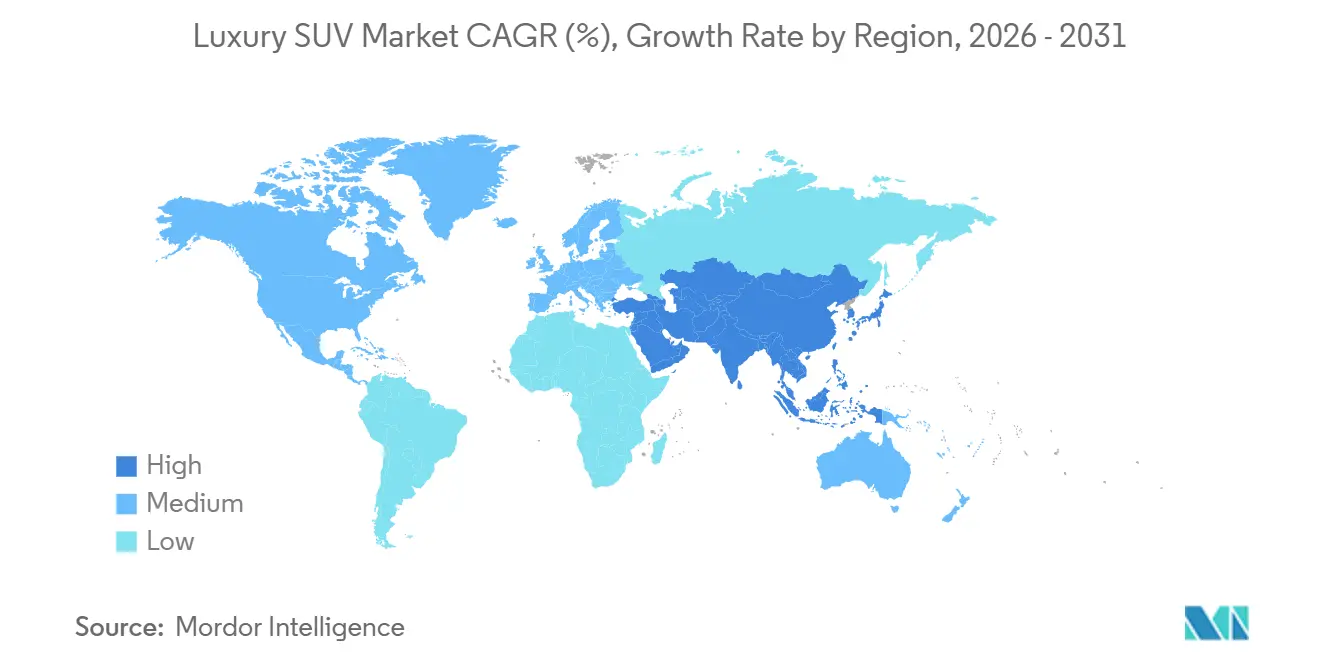
| Fastest Growing Market | Asia-Pacific |
| Largest Market | Europe |
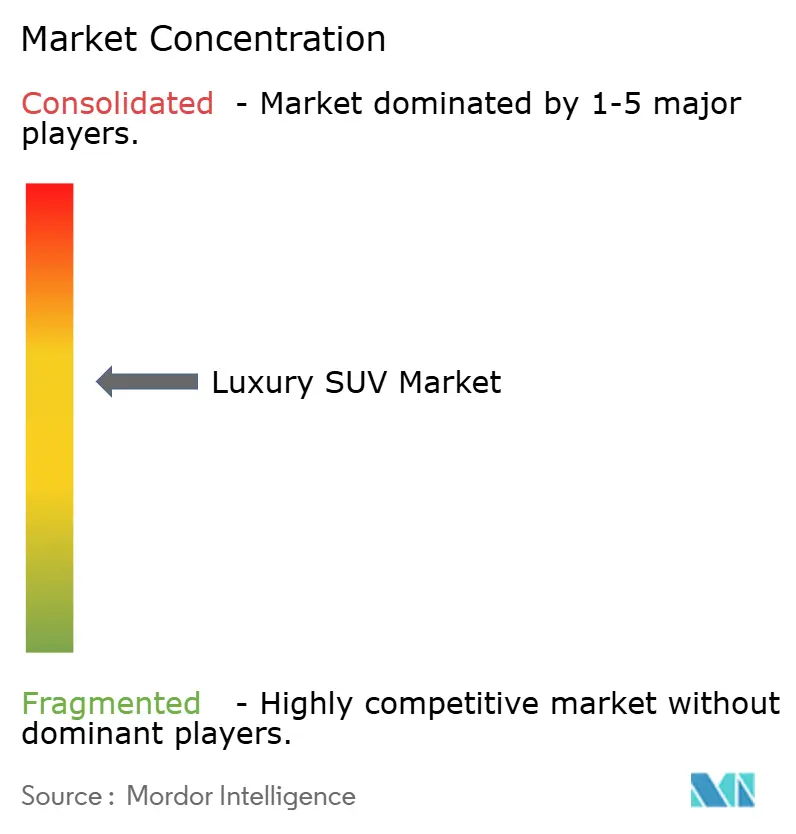
| Market Concentration | Medium |
Major Players *Disclaimer: Major Players sorted in no particular order Image © Mordor Intelligence. Reuse requires attribution under CC BY 4.0. | |
Luxury SUV Market Analysis by Mordor Intelligence
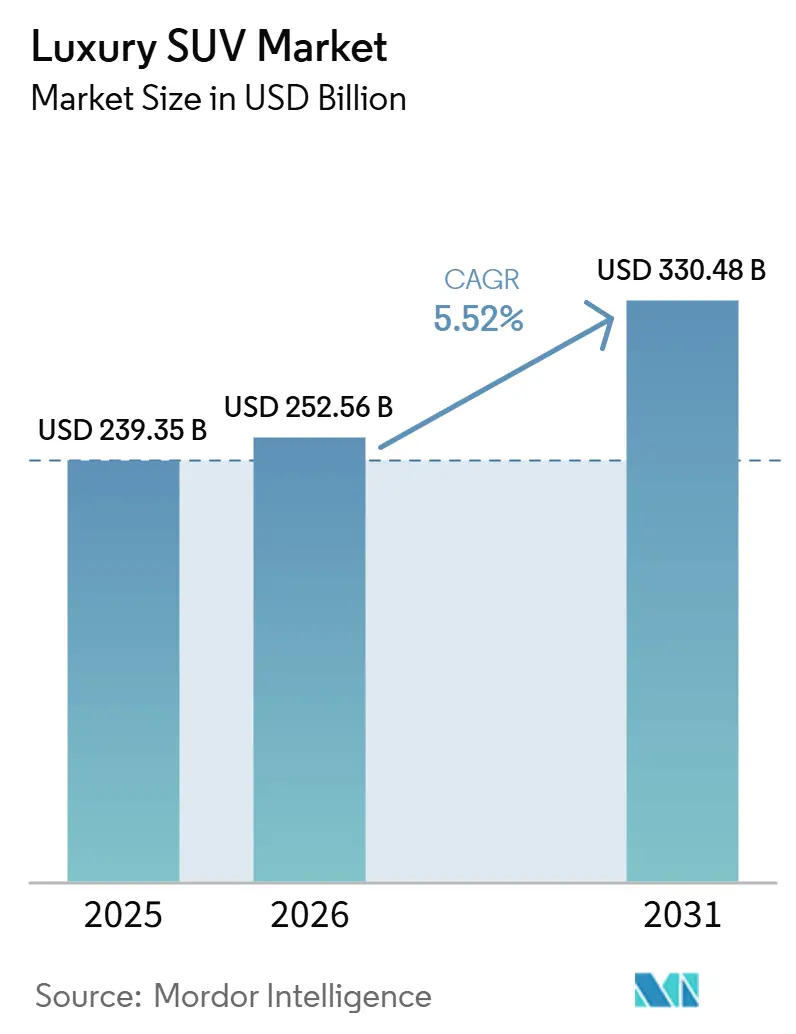
The luxury SUV market size is expected to increase from USD 239.35 billion in 2025 to USD 252.56 billion in 2026 and reach USD 330.48 billion by 2031, growing at a CAGR of 5.52% over 2026-2031. Healthy pricing power allows manufacturers to pass semiconductor and premium-material cost inflation on to affluent customers, while status signaling, generous cabin space, and ever-richer driver-assistance suites keep demand resilient. Electrification adds fresh excitement: battery-electric launches such as the 2026 Porsche Cayenne Turbo EV prove that zero-emission drivetrains can out-accelerate legacy V8s while satisfying emerging CO₂ rules. Regional dynamics are shifting as Asia-Pacific’s ultra-high-net-worth ranks expand and Europe grapples with stricter fleet-average targets. Competitive heat is rising because Chinese premium EV specialists and U.S. startups are matching German marques in software cadence, forcing incumbents to localize battery production, open over-the-air revenue streams, and defend the luxury SUV market on multiple fronts.
Key Report Takeaways
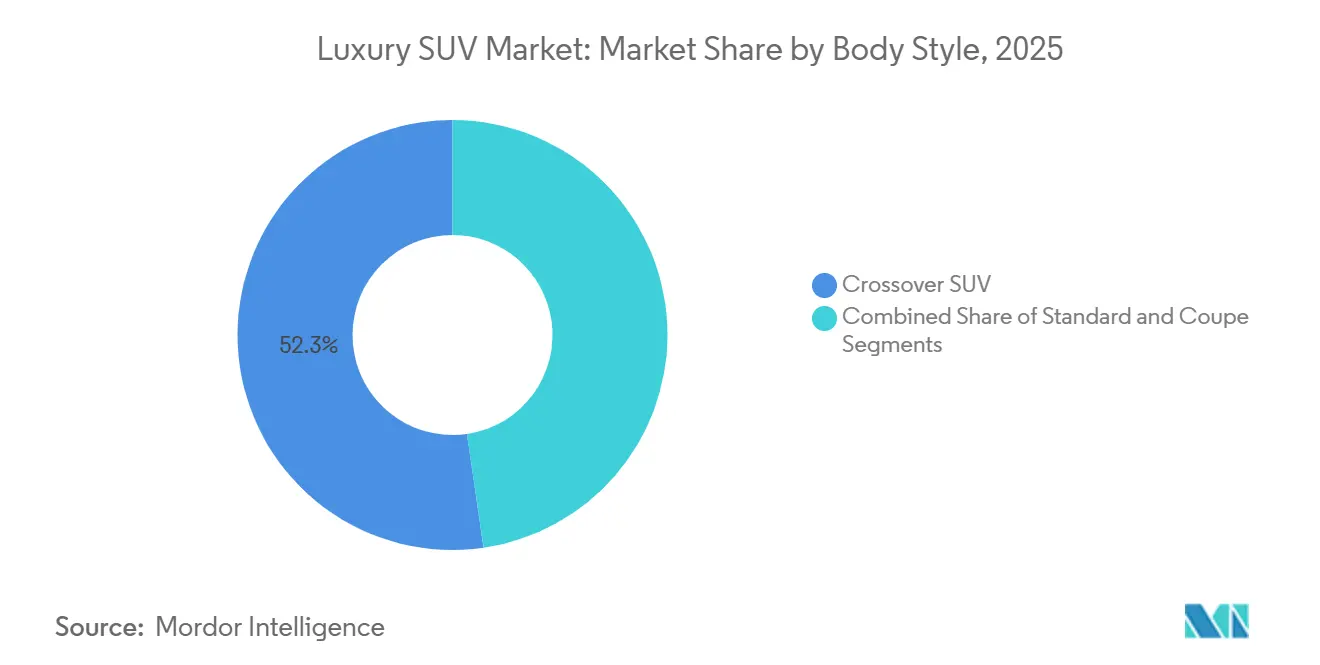
- By body style, crossover SUVs accounted for 52.31% of the luxury SUV market share in 2025; coupe SUVs post the fastest 11.82% CAGR through 2031.
- By fuel type, petrol accounted for 61.24% of the luxury SUV market in 2025, while battery-electric variants are forecast to grow at a 25.15% CAGR through 2031.
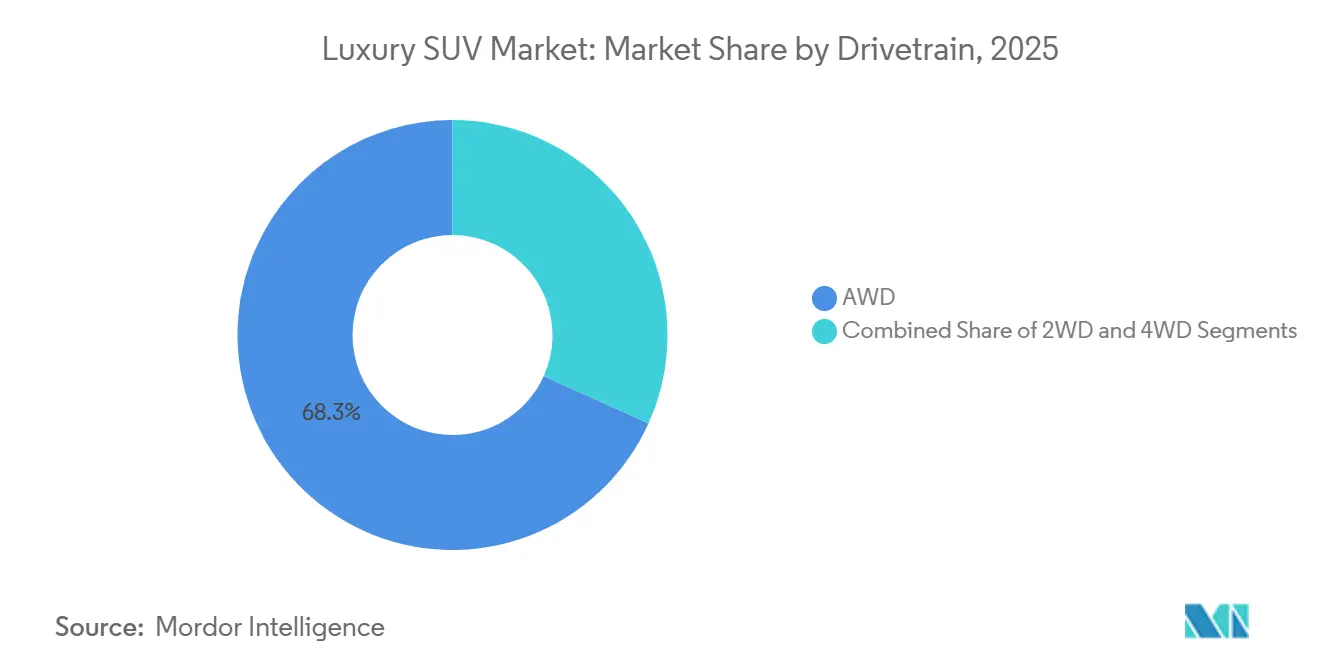
- By drivetrain, all-wheel drive held 68.27% of the luxury SUV market share in 2025 and is advancing at a 9.72% CAGR through 2031.
- By seating capacity, five-seat layouts accounted for 71.28% of the luxury SUV market in 2025; seven-seat models are poised for an 8.42% CAGR over 2026-2031.
- By geography, Europe dominated with a 32.13% slice in 2025, but Asia-Pacific is on track for a 10.62% CAGR, the fastest regional climb in the luxury SUV market.
Note: Market size and forecast figures in this report are generated using Mordor Intelligence’s proprietary estimation framework, updated with the latest available data and insights as of January 2026.
Market Trends and Insights
Drivers Impact Analysis of Luxury SUV Market*
| Driver | (~) % Impact on CAGR Forecast | Geographic Relevance | Impact Timeline |
|---|---|---|---|
| Rising HNWI and UHNWI Population | +2.1% | Global, with early gains in North America, Asia-Pacific core | Long term (≥ 4 years) |
| E-SUV Launches | +1.8% | Global, spill-over to Europe and China | Medium term (2-4 years) |
| SUV Body-Style Preference | +1.2% | North America and Europe, Asia-Pacific core | Long term (≥ 4 years) |
| AI-Led in-Car Personalization | +0.9% | Global, with early gains in North America, Europe | Medium term (2-4 years) |
| Compact/Crossover Sub-Segment Expansion | +0.7% | Global | Medium term (2-4 years) |
| Subscription-Based Access Models | +0.4% | Asia-Pacific core, spill-over to North America | Short term (≤ 2 years) |
| Source: Mordor Intelligence | |||
Rising HNWI and UHNWI Population Worldwide
The number of ultra-high-net-worth individuals (UHNWIs) is anticipated to increase significantly in the coming years. This growth expands the demographic able to afford high-value vehicles. Wealth accumulation is particularly pronounced in India and the Gulf states, where premium SUVs are both practical modes of transport and symbols of status. Features like tailored long-wheelbase variants and rear-seat massage functions—often adding high additional costs—foster loyalty among executives who prioritize comfort during business commutes. Manufacturers, recognizing this trend, prioritize rear-cabin features in their designs, mirroring private-jet layouts to boost revenue per unit. The link between UHNWI concentration and the growth of the luxury SUV market is most evident in regions with world-class roads and charging infrastructure. This trend explains the notable increase in premium SUV demand in Dubai.
Electrification Push Creating New Luxury E-SUV Launches
Luxury automakers are now showcasing battery-electric SUVs that were once mere concepts. Porsche's Cayenne Turbo EV, boasting a premium price tag and an impressive output, has begun accepting orders [1]“Cayenne Turbo EV World Premiere,”, Porsche AG, newsroom.porsche.com. Meanwhile, Audi's Q6 Sportback e-tron has arrived in Australia at a competitive starting price after currency conversion, positioning it favorably against similar compact models. With Europe aiming for a significant reduction in fleet-average CO₂ emissions, and China mandating plug-in hybrids with a minimum electric-only range to qualify for tax incentives, both regions are channeling R&D efforts toward fully battery-electric vehicles (BEVs). As luxury brands scale battery packs, they're balancing added weight with enhanced performance. Mercedes-Benz is extending its Level 3 Drive Pilot to the EQS SUV and EQE SUV, enabling up to 95 km/h on eligible highways in Germany and parts of the United States, seamlessly integrating autonomy while remaining committed to zero tailpipe emissions.
SUV Body-Style Preference Over Sedans Among Affluent Buyers
A YouGov study found that a significant share of potential luxury buyers preferred SUVs, while a smaller share opted for sedans[2]“Global Automotive Ownership Intent 2025,”, YouGov, business.yougov.com. In 2025, Lexus capitalized on the trend, moving a significant 113,256 RX units off U.S. lots. Buyers are drawn to SUVs for their commanding view, versatile cargo space, and perceived safety. In response, automakers are investing in developing coupe-SUV derivatives, like the BMW X6 and Mercedes GLE Coupe, prioritizing a sporty design over traditional boxy practicality. The sub-segment's double-digit growth highlights the allure of image over function, bolstering the luxury SUV market even amidst softer macro conditions.
AI-Led In-Car Personalization and OTA Upgrades Boosting Loyalty
Mercedes S-Class vehicles will feature MB.OS, powered by an Azure-backed generative AI assistant. This assistant will engage in natural conversations, elucidate vehicle features, and provide on-demand message translations [3]Mercedes-Benz Group AG, “MB.OS Introduction,” group.mercedes-benz.com. Volvo integrated Google Gemini for voice control, and Lucid's DreamDrive enabled hands-free lane changes through an over-the-air (OTA) update. Such continuous software enhancements not only enrich the driving experience but also tether owners firmly to their brand ecosystems, with new features rolling out regularly—eliminating the need for showroom visits. Automakers are capitalizing on these upgrades, from added driver-assist modes to premium sound systems, by offering them through annual subscriptions. This strategy transforms the luxury SUV market into a recurring revenue stream, moving away from traditional one-time sales. Those who lag in AI advancements risk losing customers to Chinese brands that offer frequent OTA updates.
Restraints Impact Analysis of Luxury SUV Market*
| Restraint | (~) % Impact on CAGR Forecast | Geographic Relevance | Impact Timeline |
|---|---|---|---|
| High MSRP and Inflationary Cost | -1.4% | Global | Short term (≤ 2 years) |
| Stricter CO₂ / Luxury-Tax Regimes | -1.1% | Europe and China, spill-over to Global | Medium term (2-4 years) |
| Semiconductor and Material Supply Constraints | -0.8% | Global | Short term (≤ 2 years) |
| Cyber-Security Compliance | -0.3% | Global, with early impact in Europe | Medium term (2-4 years) |
| Source: Mordor Intelligence | |||
High MSRP and Inflationary Cost Pressures
Luxury SUV brands in the U.S. have been prioritizing margin protection, leading to significantly higher average transaction prices. Rising costs, fueled by surges in steel, aluminum, and lithium prices, have posed challenges, especially as automotive prices climbed. Both Ford and General Motors have warned that semiconductor surcharges could escalate in the coming model years. While affluent buyers tend to be less price-sensitive, they do have their limits. As a result of tight inventory and disciplined strategies among original equipment manufacturers (OEMs), incentives have decreased as a percentage of the average transaction price. This ongoing sticker-price inflation might push some aspirational buyers towards certified pre-owned vehicles, potentially stunting volume growth in the luxury SUV market.
Stricter CO₂ / Luxury-Tax Regimes in Europe and China
China reduced its new-energy-vehicle purchase-tax exemption, setting a cap and lowering the luxury-tax threshold, thereby increasing the retail prices of imported luxury SUVs. Europe's fleet-average CO₂ mandate targets significant reductions, leaving minimal room for combustion engines. Automakers unable to meet battery-electric SUV sales targets face penalties for exceeding emission limits, which can significantly impact profitability. As taxes increase and subsidies decline, established luxury brands face intense price competition from locally produced electric rivals, hindering the growth of the luxury SUV market.
*Our forecasts treat driver/restraint impacts as directional, not additive. The impact forecasts reflect baseline growth, mix effects, and variable interactions.
Luxury SUV Market Segment Analysis
By Body Style:
Crossover Dominance Drives Market EvolutionCrossover SUVs accounted for 52.31% of the luxury SUV market share in 2025, owing to their sedan-like ride quality and greater seating and cargo flexibility. Automakers exploit shared unibody platforms to quickly roll out multiple silhouettes, cutting development costs while broadening buyer choice. Coupe SUVs, though smaller in volume, post the fastest 11.82% CAGR as younger, wealthy drivers seek expressive design aligned with sports-car lineage. Traditional body-on-frame SUVs retain traction among buyers valuing towing muscle and rugged aesthetics, especially in North America.
Cost-efficient modular architectures enable brands such as Mercedes-Benz and BMW to launch conventional and electric crossovers on the same underpinnings, preserving margins and hastening time-to-market. Superior aerodynamics in crossover shells aid regulatory compliance by extending electric driving range and trimming fleet CO₂ averages. These tailwinds assure leadership crossovers in the luxury SUV market over the decade.


By Fuel Type:
Electric Surge Challenges Petrol DominancePetrol engines still represent 61.24% of the luxury SUV market in 2025, benefiting from established refueling networks and instant performance familiarity. Yet battery-electric SUVs expand at a blazing 25.15% CAGR as high-capacity packs deliver 400-mile ranges and as charging infrastructure scales worldwide. Hybrids act as strategic bridges in regions where full-EV charging remains sparse, while diesel fades under tightening emission rules.
European markets spearhead electric adoption, bolstered by regulatory incentives and a robust charging infrastructure. Meanwhile, North American and Asian markets trail, showcasing diverse adoption rates influenced by regional policies and the state of their infrastructure. Premium brands exploit simpler electric drivetrains to pack in advanced infotainment and ADAS functions. The shift helps OEMs avoid punitive taxes and meet more demanding fleet standards, making electric share of the luxury SUV market inevitable by 2031.
By Drivetrain:
AWD Systems Enhance Luxury PositioningAWD layouts captured 68.27% of the luxury SUV market size in 2025, and are forecast to climb at a 9.72% CAGR as affluent buyers equate permanent traction with safety, confidence, and high-performance pedigree. Torque-vectoring, air-suspension, and predictive damping now come bundled with AWD packages, delivering sure-footed cornering and refined ride quality in snow, gravel, or city traffic. Electric dual-motor setups replicate these benefits while removing driveshaft bulk, freeing cabin space, and trimming mechanical losses that can dampen efficiency. Luxury brands highlight these technical gains in marketing campaigns that frame AWD as an indispensable hallmark of modern prestige. As a result, consumers increasingly treat the technology as table stakes rather than an optional upgrade, locking in its revenue dominance for the forecast horizon.
RWD and FWD derivatives still serve mild-climate or entry-luxury price points, yet their slice of the luxury SUV market share contracts as AWD trickles down the trim ladder. Automakers justify the wider rollout by bundling traction systems with profitable appearance packs and software-enabled drive modes that deepen customer personalization. High-output models layer electronic locking differentials and rally-inspired launch control on top of standard AWD, reinforcing exclusivity for performance enthusiasts. Regulatory fuel-economy pressures also favor sophisticated torque management that balances grip with energy efficiency, making basic two-wheel-drive variants less compelling. Consequently, even value-oriented luxury buyers are migrating toward AWD as the default specification.
By Seating Capacity:
Family Dynamics Shape Configuration PreferencesFive-seat configurations led the luxury SUV market with 71.28% of the market share in 2025, as they combine city maneuverability with lounge-class rear comfort. Automakers lavish these cabins with ventilated massaging chairs, dual 5G infotainment screens, and scent-diffusion systems, elevating perceived luxury without the engineering complexity of a third row. Shorter wheelbases make parking and curb-side valet easier in dense urban centers, a priority for many HNWI households that cycle between multiple properties. The layout also supports larger cargo holds when seats fold flat, appealing to owners who split time between weekday commutes and weekend leisure activities. These attributes solidify the five-seater as the segment’s volume anchor through 2031.
Seven-seat formats, however, post an 8.42% CAGR as multi-generational travel and chauffeur-driven use cases gain popularity among wealthy families. Long-wheelbase EV platforms deliver flat floors that unlock generous third-row legroom, while captain’s chairs, rear-seat entertainment, and individual climate zones protect brand cachet. Demand is strongest in North America, the Middle East, and parts of Asia, where cultural norms favor group mobility and stature on the road. As charging infrastructure matures, electric seven-seat SUVs further expand choice, ensuring sustained growth in this higher-capacity niche.
Geography Analysis
Europe Luxury SUV Market
Europe retained 32.13% of the luxury SUV market share in 2025, anchored by storied marques, dense charging grids, and policy carrots that favor zero-emission premium models. Germany, the United Kingdom, and France dominate the showroom mix, with buyers eager to adopt cutting-edge ADAS and bespoke trim packages. The luxury SUV market size in the region also benefits from company-car taxation that increasingly rewards low-CO₂ fleets, steering corporate buyers into electric and plug-in hybrids. Though slower than Asia, near-term growth remains stable as replacement cycles shorten for tech-savvy owners.
APAC Luxury SUV Market
Asia-Pacific is the fastest-growing luxury SUV territory at a 10.62% CAGR. China leads volume gains under supportive NEV quotas, a swelling upper-middle class, and domestic premium challengers. India posts double-digit expansion as wealthy consumers prioritize automotive symbols of success, while Japan and South Korea maintain steady replacement demand tied to tech updates. Localized production by global brands helps mitigate tariffs and currency swings, further stoking unit growth across the region.
North America Luxury SUV Market
North America advances because of a deeply entrenched SUV culture and affluent consumers' preference for high-output powertrains and spacious interiors. As the number of High Net Worth Individuals (HNWIs) in the United States rises, so does the demand for premium trims, especially those enhanced by AI-driven personalization. Competitive leasing options, extended loan terms, and strong dealer networks are driving turnover in luxury SUVs. In a bid to seize federal incentives and protect their margins from import duties, manufacturers are increasingly localizing the assembly of battery-electric vehicles.

Competitive Landscape
The luxury SUV market demonstrates moderate concentration with established European and Japanese brands maintaining leadership through heritage, technology, and distribution advantages. Mercedes-Benz leads, followed by BMW, Audi, Jaguar Land Rover, and Lexus, collectively controlling the majority of sales. European incumbents leverage century-old craftsmanship reputations while accelerating portfolio electrification and Level-3 autonomy deployment. Brand equity, vertically integrated drivetrains, and dealer-network reach ensure scale advantages that latecomers struggle to match.
Strategic alliances and component sharing shape cost curves. BMW’s powertrain collaboration with Jaguar Land Rover lets both groups amortize R&D across greater volume, while Mercedes-Benz invests in proprietary software stacks to own the customer experience end-to-end. Chinese innovators and tech giants experiment with direct-to-consumer channels and subscription models, challenging the traditional franchise system and keeping incumbent pricing strategies in check.
White-space opportunities lie in ultra-luxury electric SUVs, software-as-a-service bundles, and urban subscription fleets. Players that integrate AI-based cockpit intelligence and seamless over-the-air commerce are poised to gain wallet share. Conversely, brands slow to electrify or to secure semiconductor supply risk ceding ground as buyers equate software prowess with modern luxury.
Luxury SUV Industry Leaders
Audi AG
BMW AG
Mercedes-Benz Group AG
Lexus (Toyota Motor Corp.)
Jaguar Land Rover Automotive PLC
- *Disclaimer: Major Players sorted in no particular order
Luxury SUV Market Companies Covered in this Report
- Mercedes-Benz Group AG
- BMW AG
- Audi AG
- Jaguar Land Rover Automotive PLC
- Lexus (Toyota Motor Corp.)
- Porsche AG
- Volvo Car AB
- Tesla Inc.
- General Motors Co. (Cadillac)
- Ford Motor Co. (Lincoln)
- Hyundai Motor Group (Genesis)
- Nissan Motor Co. Ltd. (Infiniti)
- Maserati S.p.A.
- Alfa Romeo (Stellantis)
- Rivian Automotive Inc.
- Lamborghini S.p.A.
- Rolls-Royce Motor Cars Ltd.
- Bentley Motors Ltd.
- Aston Martin Lagonda PLC
- Ferrari N.V.
- Honda Motor Co. Ltd. (Acura)

Recent Industry Developments in Luxury SUV Market
- July 2025: BYD’s luxury marque Yangwang confirmed a 2026 Europe entry after domestic success with its floating-capable U8 EREV SUV.
- July 2025: Mazda Motor Europe unveiled the all-new MAZDA CX-5 crossover SUV to strengthen its regional premium push.
- March 2025: Lexus introduced the all-electric Lexus RZ, centering development on driving pleasure, extended range, fast charging, and expressive design.


Global Luxury SUV Market Report Scope
The luxury SUV market report is segmented by body style (standard SUV, crossover SUV, and coupe SUV), fuel type (petrol, diesel, hybrid, and electric), drivetrain (2WD, 4WD, and AWD), seating capacity (5-seater and 7-seater), and geography (North America, South America, Europe, Asia-Pacific, and the Middle East and Africa). The market forecasts are provided in terms of value (USD) and volume (units).
| Standard SUV |
| Crossover SUV |
| Coupe SUV |
| Petrol |
| Diesel |
| Hybrid |
| Electric |
| 2WD |
| 4WD |
| AWD |
| 5-Seater |
| 7-Seater |
| North America | United States |
| Canada | |
| Rest of North America | |
| South America | Brazil |
| Argentina | |
| Rest of South America | |
| Europe | United Kingdom |
| Germany | |
| Spain | |
| Italy | |
| France | |
| Russia | |
| Rest of Europe | |
| Asia-Pacific | India |
| China | |
| Japan | |
| South Korea | |
| Rest of Asia-Pacific | |
| Middle East and Africa | United Arab Emirates |
| Saudi Arabia | |
| Turkey | |
| Egypt | |
| South Africa | |
| Rest of Middle East and Africa |
| By Body Style | Standard SUV | |
| Crossover SUV | ||
| Coupe SUV | ||
| By Fuel Type | Petrol | |
| Diesel | ||
| Hybrid | ||
| Electric | ||
| By Drivetrain | 2WD | |
| 4WD | ||
| AWD | ||
| By Seating Capacity | 5-Seater | |
| 7-Seater | ||
| By Geography | North America | United States |
| Canada | ||
| Rest of North America | ||
| South America | Brazil | |
| Argentina | ||
| Rest of South America | ||
| Europe | United Kingdom | |
| Germany | ||
| Spain | ||
| Italy | ||
| France | ||
| Russia | ||
| Rest of Europe | ||
| Asia-Pacific | India | |
| China | ||
| Japan | ||
| South Korea | ||
| Rest of Asia-Pacific | ||
| Middle East and Africa | United Arab Emirates | |
| Saudi Arabia | ||
| Turkey | ||
| Egypt | ||
| South Africa | ||
| Rest of Middle East and Africa | ||


Key Questions Answered in the Report
What is the current revenue size of the luxury SUV market?
The luxury SUV market size reached USD 239.35 billion in 2025.
What is the projected value of the luxury SUV market in 2031?
The luxury SUV market size is forecast to reach USD 330.48 billion by 2031.
How fast will battery-electric luxury SUVs grow between 2026 and 2031?
Battery-electric models are expected to post a 25.15% CAGR over the forecast period, the fastest rate among all powertrains.
Which body style holds the largest slice of global sales?
Crossovers led with 52.31% luxury SUV market share in 2025, well ahead of standard and coupe SUVs.
Why is Asia-Pacific considered the most promising region?
Rising ultra-high-net-worth populations in China and India drive a 10.62% regional CAGR, the highest worldwide.
Page last updated on:


 Your data is secure and never sold or shared.


