
Lithium-Ion Battery Safety Systems Market Size and Share
Market Overview
| Study Period | 2021 - 2031 |
|---|---|
| Market Size (2026) | USD 13.58 Billion |
| Market Size (2031) | USD 28.84 Billion |
| Growth Rate (2026 - 2031) | 16.26 % |
| Fastest Growing Market | Asia-Pacific |
| Largest Market | Asia-Pacific |
| Market Concentration | Medium |
Major Players *Disclaimer: Major Players sorted in no particular order Image © Mordor Intelligence. Reuse requires attribution under CC BY 4.0. | |
Lithium-Ion Battery Safety Systems Market Analysis by Mordor Intelligence
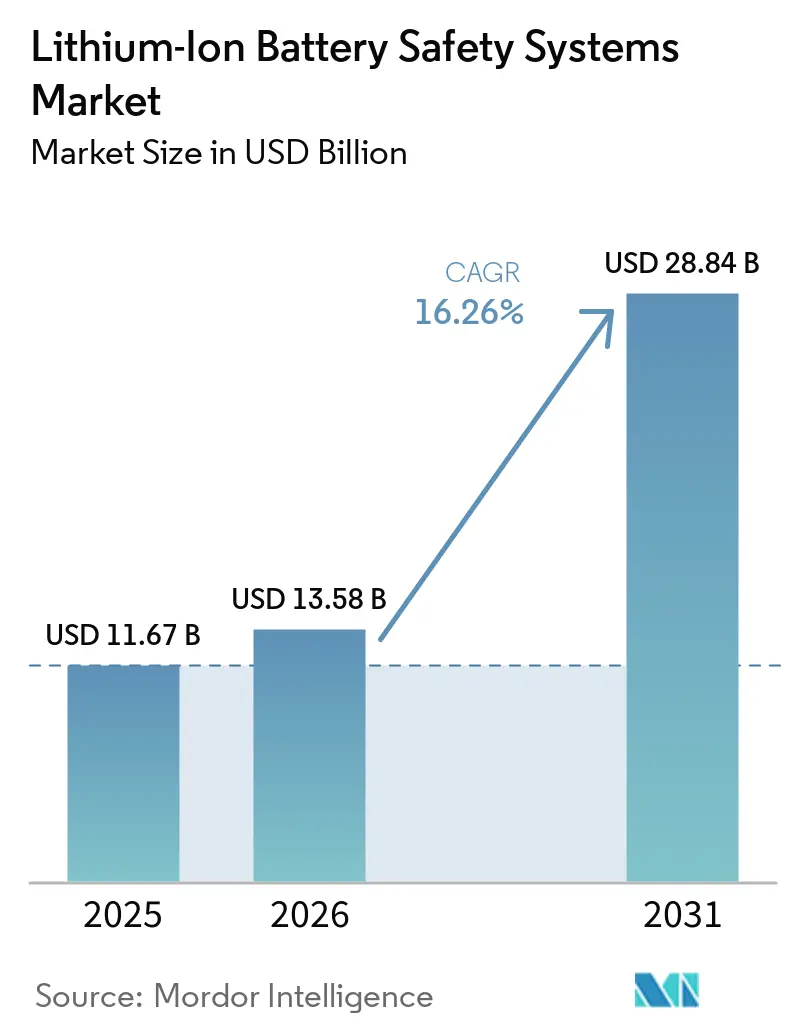
The Lithium-Ion Battery Safety Systems Market size was valued at USD 11.67 billion in 2025 and is estimated to grow from USD 13.58 billion in 2026 to reach USD 28.84 billion by 2031, at a CAGR of 16.26% during the forecast period (2026-2031). The lithium-ion battery safety systems market is expanding as electric vehicle production, grid-connected battery storage, and mandatory safety requirements increase the safety content installed in each battery system. Global electric vehicle battery deployment reached 1.2 TWh in 2025, nearly 30% above 2024 levels and more than 7 times the 2020 level, which broadened the installed base that requires monitoring, thermal control, and electrical protection. Battery prices fell 8% in 2025, but the lower cell cost supported spending on protection hardware and software rather than reducing safety requirements. The lithium-ion battery safety systems market also faces tighter qualification requirements, as suppliers increasingly need multi-chemistry designs and validated documentation for vehicle programs and energy storage projects. China’s new traction battery rules, along with updated international storage and transport requirements, are making certification a more important part of supplier selection.
Key Report Takeaways
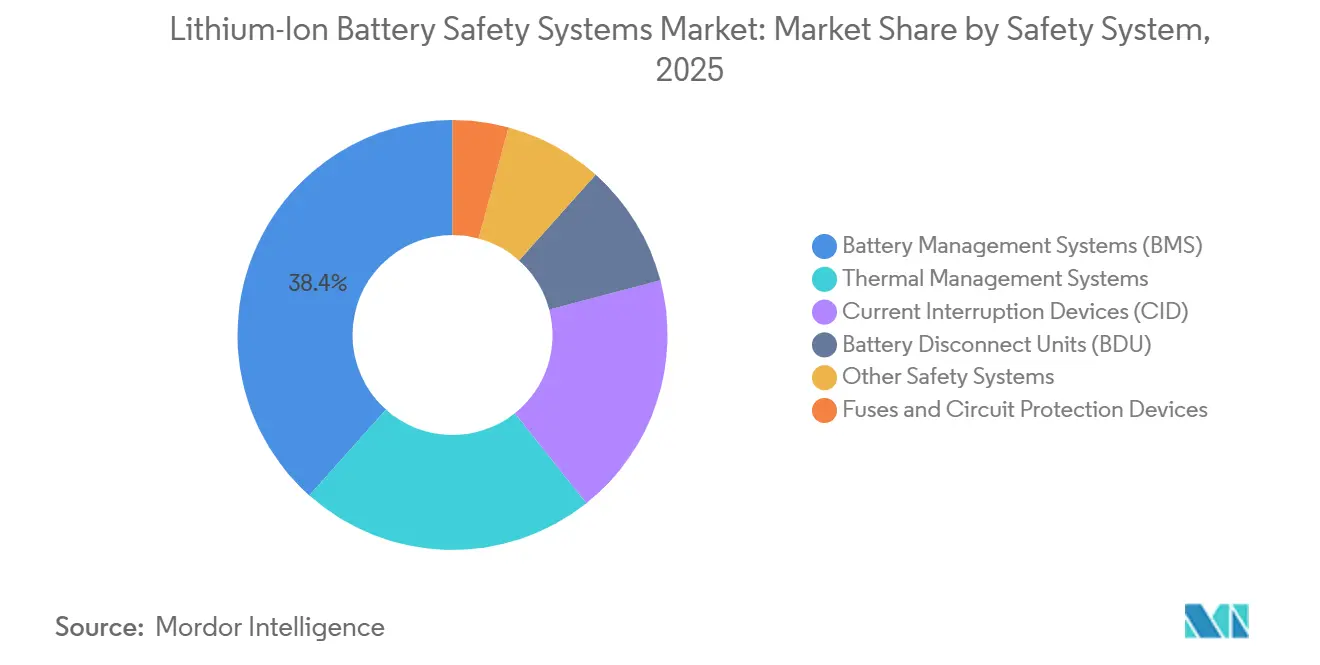
- By safety system, battery management systems held 38.4% of the lithium-ion battery safety systems market share in 2025, while thermal management systems are forecast to grow at a 17.2% CAGR through 2031.
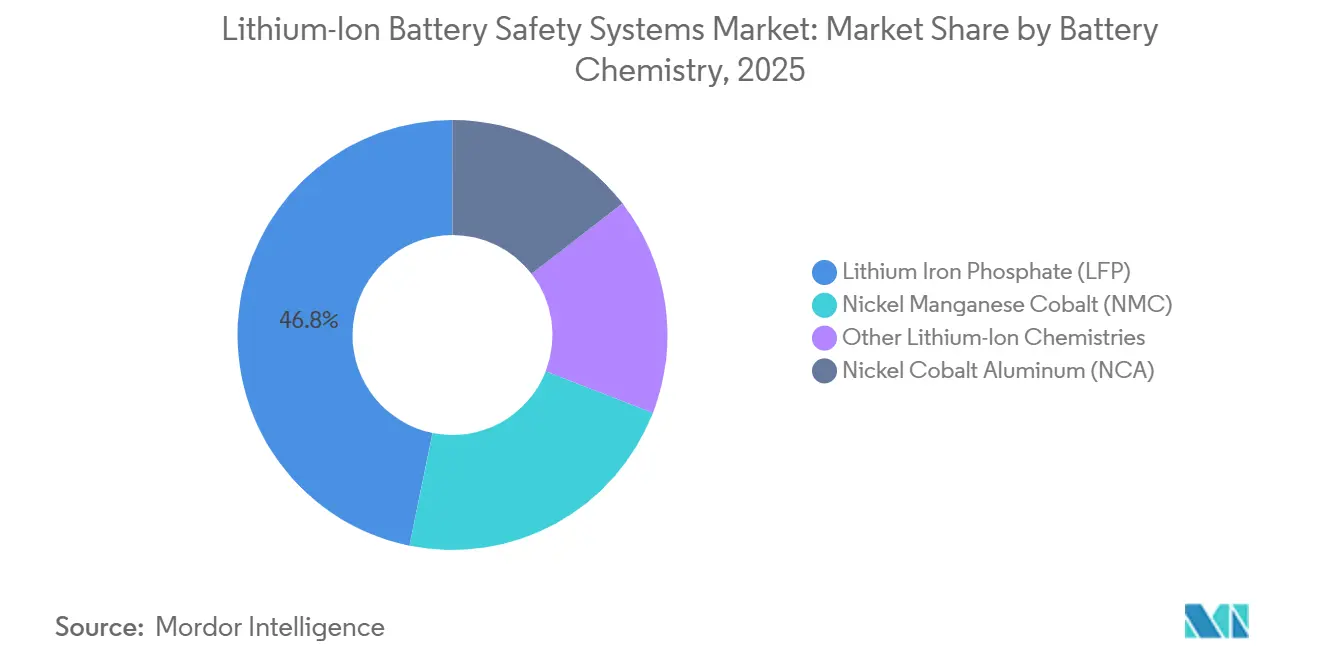
- By battery chemistry, LFP held 46.8% of the lithium-ion battery safety systems market share in 2025 and is forecast to expand at a 17.7% CAGR through 2031.
- By application, electric vehicles accounted for 58.2% of the lithium-ion battery safety systems market size in 2025, while energy storage systems are forecast to expand at an 18.4% CAGR through 2031.
- By geography, Asia-Pacific accounted for 55.6% of the lithium-ion battery safety systems market size in 2025, and is forecast to expand at a 18.6% CAGR through 2031.
Note: Market size and forecast figures in this report are generated using Mordor Intelligence’s proprietary estimation framework, updated with the latest available data and insights as of January 2026.
Market Trends and Insights
Drivers Impact Analysis of Lithium-Ion Battery Safety Systems Market*
| Driver | (~) % Impact on CAGR Forecast | Geographic Relevance | Impact Timeline |
|---|---|---|---|
| EV and E-Mobility Battery Pack Expansion | +4.80% | APAC core (China, South Korea, Japan), spill-over to Europe and North America | Short term (≤ 2 years) |
| Grid-Scale Storage Safety Upgrades | +3.20% | Global; concentrated in China, United States, and Western Europe | Medium term (2–4 years) |
| Fast-Charging and High-Voltage Pack Adoption | +2.40% | China, Europe, North America; 800V platform rollout markets | Short to medium term (≤ 3 years) |
| Stricter Battery Safety and Transport Compliance | +2.10% | Global; strongest near-term impact in China and North America, spill-over to ASEAN and MEA | Short to medium term (≤ 3 years) |
| Predictive Diagnostics and Real-Time Battery Health Monitoring | +1.80% | Global; most advanced adoption in South Korea, Japan, Germany | Medium to long term (2–5 years) |
| Wireless and Software-Defined Battery Safety Architectures | +1.30% | Europe, North America, China; software-defined vehicle OEM platforms | Long term (≥ 4 years) |
| Source: Mordor Intelligence | |||
EV and E-Mobility Battery Pack Expansion
Global electric vehicle battery deployment reached 1.2 TWh in 2025, with light-duty vehicles accounting for more than 85% of the volume. This scale makes automotive programs the principal demand base for battery monitoring and fault-response systems. The move toward 800V vehicle architectures increases voltage stress and thermal variation across cells. It requires tighter analog tolerances and faster fault responses than earlier 400V platforms. Texas Instruments introduced its 26-cell battery monitor with an integrated electrochemical impedance spectroscopy engine in June 2026, enabling cell-level detection of thermal-runaway risk and providing ISO 26262 ASIL-D certification. The lithium-ion battery safety systems market, therefore, favors suppliers that combine automotive functional safety compliance with predictive diagnostic capability.
Grid-Scale Storage Safety Upgrades
Global additions of battery energy storage capacity reached 108 GW in 2025, a 40% increase from 2024. LFP batteries accounted for nearly 90% of the new capacity, linking storage growth closely to chemistry-specific monitoring and cooling requirements. Large prismatic cells operating under changing ambient conditions create heat patterns that differ from those of automotive battery packs. Storage projects consequently need thermal control logic designed for stationary use, rather than adapted vehicle solutions. The Moss Landing fire in January 2025 led to the evacuation of 1,500 residents and highlighted the consequences of inadequate safety arrangements in large installations[1]. The lithium-ion battery safety systems market is benefiting as installation-level fire testing and hazard evaluation move earlier into energy storage project design.
Stricter Battery Safety and Transport Compliance
China’s GB38031-2025 standard took effect on July 1, 2026, and requires newly declared traction battery models to meet a no-fire and no-explosion requirement. The standard was implemented alongside GB18384-2025, which applies safety requirements at the vehicle level. China Daily reported that 78% of domestic battery makers already meet the new criteria, while 14% need 1-2 years of upgrades and 8% may not comply in the near term. The UN 38.3 eighth edition entered into force on January 1, 2025, and extended its scope to sodium-ion batteries while tightening state-of-charge requirements for lithium-ion cells transported by air. UL 9540A sixth edition, published in March 2026, added large-scale fire testing and explosion hazard evaluation for battery energy storage systems. The lithium-ion battery safety systems market gives an advantage to suppliers that already support these certification pathways.
Fast-Charging and High-Voltage Pack Adoption
Fast charging and high-voltage battery packs increase the thermal and electrical stresses placed on individual cells. Charging at 350 kW or more can create temperature differences of up to 8°C between cells connected to a common busbar. These conditions raise the importance of accurate voltage measurement and short fault-response times. They also increase demand for thermal management channels, current interruption devices, and high-voltage protection components. Littelfuse introduced TPSMB-L automotive TVS diodes for 800V electric vehicle BMS circuits in February 2025, with ISO 26262 ASIL-D functional safety compliance. The lithium-ion battery safety systems market is gaining more protection content per vehicle as these platforms enter broader production.
Restraints Impact Analysis of Lithium-Ion Battery Safety Systems Market*
| Restraint | (~) % Impact on CAGR Forecast | Geographic Relevance | Impact Timeline |
|---|---|---|---|
| High Integration and Validation Cost | -2.60% | Emerging markets (ASEAN, South Asia, MEA); mid-tier OEMs in China | Medium term (2–4 years) |
| Fragmented Global Safety Standards | -1.90% | Global; most pronounced in multi-chemistry ESS markets and regions transitioning chemistry mixes | Medium to long term (2–5 years) |
| Semiconductor and Sensor Supply Exposure | -1.40% | Global; most acute for European and North American BMS integrators dependent on TSMC-sourced BCD process nodes | Short to medium term (≤ 3 years) |
| Cybersecurity and Connected-BMS Liability Risk | -1.00% | Global; most acute in EU (NIS2/Cyber Resilience Act) and North America (ISO/SAE 21434) compliance jurisdictions | Long term (≥ 4 years) |
| Source: Mordor Intelligence | |||
High Integration Costs and Technical Complexity Constraining Adoption
Advanced safety systems, including multi-zone liquid cooling, wireless BMS, and integrated battery disconnect units, add 8-15% to total battery pack cost. This limits adoption among cost-sensitive vehicle makers and customers in emerging economies. In Southeast Asia and India, early two-wheeler and three-wheeler electrification programs often limit safety content to the regulatory minimum. A recall involving Chrysler Pacifica plug-in hybrid vehicles and LG Energy Solution cells demonstrated how cell or BMS specification weaknesses can create field consequences. Shared hardware platforms for thermal management and BMS functions can reduce costs, but they require research and development resources that smaller suppliers may not have. The lithium-ion battery safety systems market also carries certification costs across ISO 26262, IEC 62619, UN 38.3, and regional requirements.
Interoperability and Standardization Gaps Slowing Multi-Chemistry Deployment
The lithium-ion battery safety systems market covers LFP, NMC, NCA, and emerging sodium-ion chemistries. Each chemistry has different voltage windows, operating temperatures, and state-of-charge estimation requirements. CATL introduced a sodium-ion BMS at its April 2026 Tech Day with a redesigned state-of-charge algorithm and 20% higher overcharge state-of-charge tolerance than lithium-ion systems. Third-party BMS suppliers must adapt their products for each additional chemistry. Parallel compliance requirements under IEC 62133, IEC 62619, UL 9540, and GB38031 extend product development and market-entry timelines. This challenge is especially significant for energy storage integrators that deploy systems across several jurisdictions.
*Our forecasts treat driver/restraint impacts as directional, not additive. The impact forecasts reflect baseline growth, mix effects, and variable interactions.
Lithium-Ion Battery Safety Systems Market Segment Analysis
By Safety System:
BMS Leads, Thermal Management Reshapes the Competitive LandscapeBattery management systems held 38.4% of the lithium-ion battery safety systems market in 2025. They monitor cell voltage, current, temperature, state of health, and balancing functions across battery chemistries. They also provide the central control function for fault detection and response. BMS technology is moving from threshold-based protection toward systems that identify potential faults earlier. Chinese suppliers are using edge neural network integration to achieve state-of-charge estimation errors below ±1.5%. This capability is becoming more relevant for procurement requirements in LFP-heavy battery programs.
Thermal management systems are forecast to record a 17.2% CAGR through 2031. Faster charging, higher energy density, and expanding energy storage installations are increasing the heat load that these systems must manage. China published T/CQPRA 0173-2026 in 2026, setting technical requirements for battery thermal management in intelligent connected new-energy vehicles. Current interruption devices, battery disconnect units, and fuses protect against overcurrent, thermal, and short-circuit events. Mersen’s November 2025 selection by CATL for custom fuses and its July 2026 contracts with Ford and Leapmotor show the value of multi-customer qualification[2]. Other safety systems, including gas detection, pressure-relief equipment, and fire suppression integration, are gaining relevance because UL 9540A sixth edition expanded gas and explosion hazard evaluation.

By Battery Chemistry:
LFP Dominance Redefining Safety System Design RequirementsLFP accounted for 46.8% of the lithium-ion battery safety systems market size in 2025. It accounted for 81.2% of electric vehicle battery installations in China in 2025, where installed capacity increased 52.9% year over year. LFP was also used in nearly 90% of the 108 GW of global battery energy storage capacity added in 2025. Its flatter discharge voltage curve makes state-of-charge estimation more difficult than for NMC batteries. This raises the software and calibration requirements for BMS designs even as LFP cell prices fall. The lithium-ion battery safety systems market must therefore support safety designs that account for LFP-specific operating behavior.
LFP is also the fastest-growing chemistry, with a projected 17.7% CAGR through 2031. The LFP-NMC price gap exceeded 40% per kWh in 2025, supporting LFP adoption in energy storage, commercial vehicles, and cost-sensitive electric vehicle applications. NMC remains important in premium vehicles, aerospace, and certain defense uses where energy density is a key requirement. NCA remains concentrated among a small group of high-energy-density cell producers. Other battery chemistries include lithium manganese iron phosphate and sodium-ion, each of which requires changes to BMS algorithms and thermal control parameters. CATL invested RMB 22,146 million, equivalent to USD 3 billion, in research and development in 2025, 19% more than in 2024, indicating continued chemistry diversification[3].
By Application:
Electric Vehicles Anchor Demand While ESS Sets the Growth PaceElectric vehicles accounted for 58.2% of the lithium-ion battery safety systems market in 2025. Global battery deployment of 1.2 TWh in electric vehicles during 2025 supported this leading position. Safety content per vehicle is rising because 800V systems and ultra-fast charging require stronger monitoring and protection. Commercial electric vehicles with battery packs above 100 kWh also need more processing capacity and thermal control channels. These vehicle requirements support demand for higher-rated circuit protection equipment. The automotive application will remain central to the lithium-ion battery safety systems market as vehicle battery volumes grow.
Energy storage systems are forecast to grow at an 18.4% CAGR through 2031. Nuvation Energy’s G5 BMS supports battery stacks of up to 1,500V DC for multi-megawatt deployments and supports UL 1973 and UL 9540 certification[4]. Consumer electronics remain a high-volume application, although it uses compact systems with lower average selling prices. Industrial equipment, including forklifts, automated guided vehicles, and off-highway machinery, is adding battery safety requirements as it shifts from lead-acid batteries. Aerospace and defense is smaller in volume but supports premium safety components because of certification requirements under the 2025-2026 ICAO Technical Instructions and related FAA requirements. Marine battery systems are also expanding as short-sea shipping and ferry operators reduce reliance on diesel auxiliary systems.
Geography Analysis
APAC, Europe and Middle East Lithium-Ion Battery Safety Systems Market
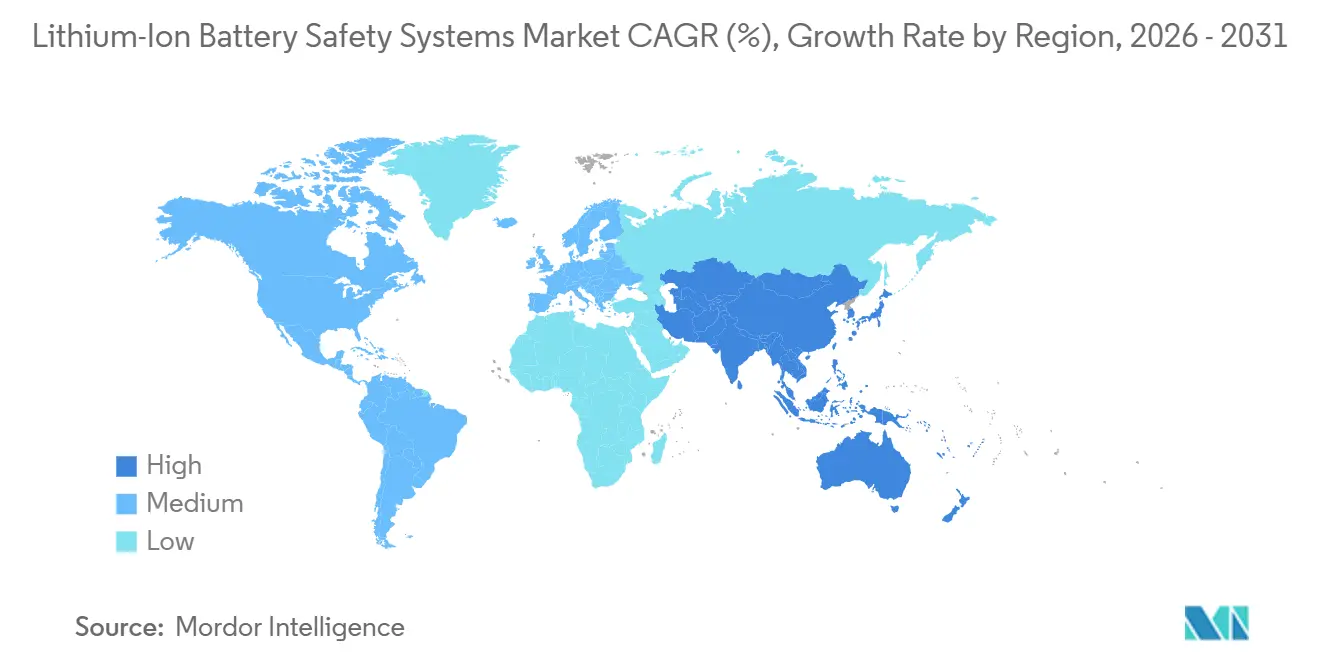
Asia-Pacific held 55.6% of global revenue in 2025 and is forecast to grow at an 18.6% CAGR through 2031. The region is both the largest production center and the largest demand center for lithium-ion battery systems. China accounted for 60% of global electric vehicle battery deployment and more than 80% of global lithium-ion manufacturing nameplate capacity. China’s GB38031-2025 rule came into effect in July 2026 and requires no fire or explosion in newly declared traction battery models. Regulators in the European Union, Southeast Asia, and the Middle East are reviewing the framework for potential alignment.
APAC Lithium-Ion Battery Safety Systems Market
Japan’s BMS value reached USD 590.9 million in 2025. Its renewable generation targets of 36-38% by 2030 and 50% by 2040 support battery storage deployment. India is expanding safety system demand through AIS-156 and AIS-038 Revision 2 thermal propagation testing requirements for electric two-wheelers and three-wheelers. South Korea remains important because battery manufacturers are investing in LFP, solid-state, and sodium-ion technologies. Samsung SDI announced a KRW 25 trillion investment plan, equivalent to USD 17.7 billion, for its Ulsan and Cheonan facilities through 2040. These investments broaden the chemistry profiles that regional safety suppliers must support.
The Americas and EMEA Lithium-Ion Battery Safety Systems Market
North America is the second-largest regional market in the lithium-ion battery safety systems market. Inflation Reduction Act incentives, NFPA 855 requirements, and UL 9540 compliance support demand for certified equipment in the United States. California’s 2026 Fire Code updates, following AB 1285, increase safety system requirements for battery energy storage installations. Ford, Nissan, and Chrysler battery recalls during 2026 also maintain scrutiny of battery validation practices. Europe ranks third, with Germany, France, and the United Kingdom supporting automotive BMS demand, while the EU Battery Regulation requires digital battery passports and state-of-health reporting. South America, the Middle East, and Africa remain earlier-stage areas, though Brazil, Chile, Saudi Arabia, and the United Arab Emirates are adding storage and battery-related project activity.
Competitive Landscape
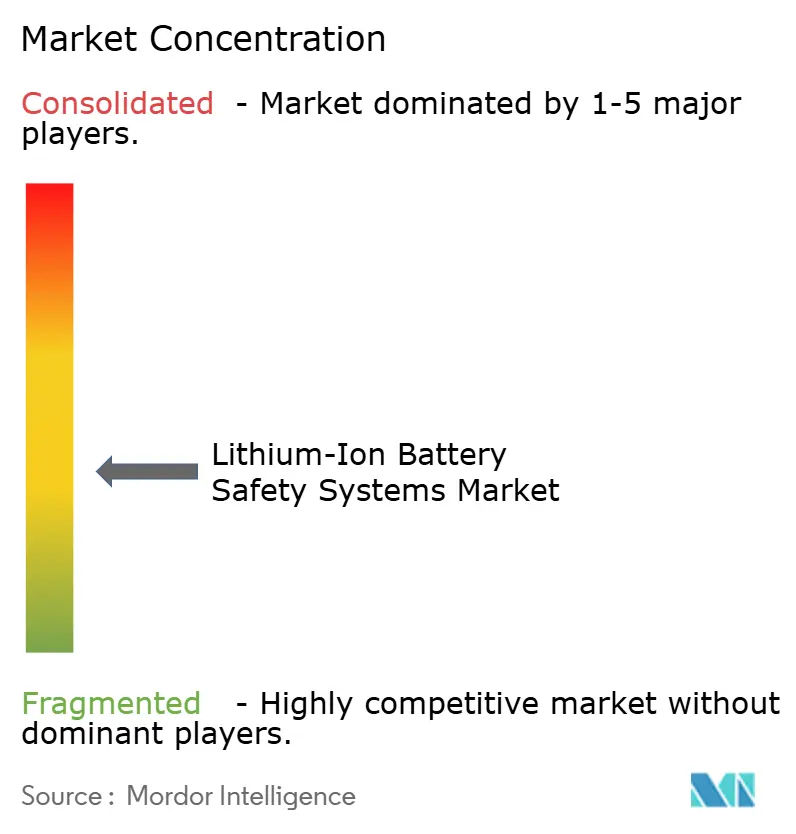
The lithium-ion battery safety systems market is moderately fragmented across BMS, thermal management, and circuit protection. DENSO, Valeo, Hanon Systems, MAHLE, and Robert Bosch benefit from long-standing vehicle manufacturer relationships and automotive functional safety capabilities. Their position in vehicle architecture development makes supplier replacement a multi-year process. Eaton, Littelfuse, and Mersen compete through electrical protection products that can be used across different battery chemistries and system architectures. Littelfuse agreed to acquire Basler Electric for USD 350 million in October 2025, expanding its electrical control and protection presence in grid, utility, and power-generation applications. BorgWarner expanded a series-production BMS program with a global original equipment manufacturer in February 2026 for B-segment and C-segment battery electric and plug-in hybrid vehicles from 2029.
Vertically integrated battery producers create a separate competitive dynamic in the lithium-ion battery safety systems market. Their access to cell-level data can improve state-of-charge estimation and degradation modeling. CATL’s RMB 22,146 million research and development investment in 2025 exceeded the combined research and development spending of South Korea’s 3 major battery companies by RMB 16 billion. This scale supports development across cell chemistry and associated safety controls. Dedicated BMS suppliers such as Lithium Balance and Nuvation Energy focus on high-voltage energy storage installations where automotive-origin platforms may not meet utility-scale requirements. Nuvation’s product range supports up to 1,500V DC configurations, reflecting this specialized requirement.
Suppliers are competing to provide systems that operate across LFP, NMC, and sodium-ion chemistries. AI-enabled predictive BMS functions, wireless cell monitoring, and battery passport data functions are increasing the role of software and compliance support. This creates demand for products that combine hardware protection with data handling and certification documentation. Ardian’s majority investment in Munich Electrification was intended to build a BMS platform spanning electric vehicles and energy storage applications. Valeo and Calyos signed a memorandum of understanding in June 2026 to develop passive two-phase cooling solutions for mobility and computing applications. The lithium-ion battery safety systems market has differentiated specialist positions rather than a single dominant vendor group.
Lithium-Ion Battery Safety Systems Industry Leaders
-
Contemporary Amperex Technology Co., Limited
-
BYD Company Limited
-
Eaton Corporation plc
-
Sensata Technologies, Inc.
-
TE Connectivity Ltd.
- *Disclaimer: Major Players sorted in no particular order
Lithium-Ion Battery Safety Systems Market Companies Covered in this Report
- Analog Devices Inc.
- BYD Company Limited
- Contemporary Amperex Technology Co., Limited
- Dana Incorporated
- DENSO Corporation
- Eaton Corporation plc
- Eberspächer Gruppe GmbH & Co. KG
- Hanon Systems Co., Ltd.
- Lithium Balance A/S
- Littelfuse, Inc.
- MAHLE GmbH
- Mersen
- Nuvation Energy
- NXP Semiconductors N.V.
- Robert Bosch GmbH
- Sensata Technologies, Inc.
- TE Connectivity Ltd.
- Texas Instruments Incorporated
- Valeo SE
Recent Industry Developments in Lithium-Ion Battery Safety Systems Market
- July 2026: Mersen was selected by Ford and Leapmotor to supply EV battery protection fuses, representing a combined potential cumulative revenue of EUR 10 million, equivalent to USD 11 million. Ford selected Mersen for a fuse integrated into a battery disconnect module for hybrid models in the United States. Leapmotor selected Mersen for battery-pack protection fuses. The dual contract reinforces Mersen's position as a cross-OEM supplier in high-voltage battery circuit protection.
- July 2026: China’s 2 mandatory national standards, GB38031-2025 for traction battery safety and GB18384-2025 for vehicle-level electric vehicle safety, entered into force simultaneously. The rules set strict requirements for China’s new-energy vehicle market and form a compliance framework under review by regulators in the European Union, Southeast Asia, and the Middle East.
- June 2026: Valeo and Calyos signed a Memorandum of Understanding to develop and industrialize passive two-phase Loop Heat Pipe cooling solutions for mobility and computing applications. The partnership combines Valeo’s production capability with Calyos’ passive cooling architecture.
- March 2026: UL 9540A sixth edition was published on March 13, 2026. It introduced large-scale fire testing, stronger explosion and gas hazard evaluation, and closer alignment with NFPA 855 and the International Fire Code.
Global Lithium-Ion Battery Safety Systems Market Report Scope
Lithium-ion battery safety systems are integrated hardware, software, and electro-mechanical components designed to monitor, protect, and control lithium-ion batteries, ensuring safe, reliable, and efficient operation throughout their lifecycle. These systems prevent hazardous conditions such as overcharging, over-discharging, overcurrent, short circuits, overheating, thermal runaway, and cell imbalance by continuously monitoring battery parameters and initiating protective actions when abnormal conditions are detected.
The Lithium-Ion Battery Safety Systems Market is segmented by safety system, battery chemistry, application, and geography. By safety system, the market is segmented into battery management systems (BMS), thermal management systems, current interruption devices (CID), battery disconnect units (BDU), fuses and circuit protection devices, and other safety systems. By battery chemistry, the market is segmented into lithium iron phosphate (LFP), nickel manganese cobalt (NMC), nickel cobalt aluminum (NCA), and other battery chemistries. By application, the market is segmented into electric vehicles (EVs), consumer electronics, energy storage systems (ESS), industrial equipment, aerospace and defense, marine, and other applications. The report also covers the market size and forecasts for the Lithium-Ion Battery Safety Systems Market across 26 countries in key regions. For each segment, the market sizing and forecasts have been provided on the basis of value (USD).
| Battery Management Systems (BMS) |
| Thermal Management Systems |
| Current Interruption Devices (CID) |
| Battery Disconnect Units (BDU) |
| Fuses and Circuit Protection Devices |
| Other Safety Systems |
| Lithium Iron Phosphate (LFP) |
| Nickel Manganese Cobalt (NMC) |
| Nickel Cobalt Aluminum (NCA) |
| Other Lithium-Ion Chemistries |
| Electric Vehicles |
| Consumer Electronics |
| Energy Storage Systems (ESS) |
| Industrial Equipment |
| Aerospace and Defense |
| Marine |
| Other Applications |
| North America | United States |
| Canada | |
| Mexico | |
| Europe | Germany |
| France | |
| Italy | |
| Spain | |
| United Kingdom | |
| Poland | |
| Russia | |
| Rest of Europe | |
| Asia-Pacific | China |
| India | |
| Japan | |
| South Korea | |
| Australia | |
| Indonesia | |
| Vietnam | |
| Thailand | |
| Rest of Asia-Pacific | |
| South America | Brazil |
| Argentina | |
| Chile | |
| Rest of South America | |
| Middle East and Africa | Saudi Arabia |
| United Arab Emirates | |
| Egypt | |
| South Africa | |
| Morocco | |
| Rest of Middle East and Africa |
| By Safety System | Battery Management Systems (BMS) | |
| Thermal Management Systems | ||
| Current Interruption Devices (CID) | ||
| Battery Disconnect Units (BDU) | ||
| Fuses and Circuit Protection Devices | ||
| Other Safety Systems | ||
| By Battery Chemistry | Lithium Iron Phosphate (LFP) | |
| Nickel Manganese Cobalt (NMC) | ||
| Nickel Cobalt Aluminum (NCA) | ||
| Other Lithium-Ion Chemistries | ||
| By Application | Electric Vehicles | |
| Consumer Electronics | ||
| Energy Storage Systems (ESS) | ||
| Industrial Equipment | ||
| Aerospace and Defense | ||
| Marine | ||
| Other Applications | ||
| By Geography | North America | United States |
| Canada | ||
| Mexico | ||
| Europe | Germany | |
| France | ||
| Italy | ||
| Spain | ||
| United Kingdom | ||
| Poland | ||
| Russia | ||
| Rest of Europe | ||
| Asia-Pacific | China | |
| India | ||
| Japan | ||
| South Korea | ||
| Australia | ||
| Indonesia | ||
| Vietnam | ||
| Thailand | ||
| Rest of Asia-Pacific | ||
| South America | Brazil | |
| Argentina | ||
| Chile | ||
| Rest of South America | ||
| Middle East and Africa | Saudi Arabia | |
| United Arab Emirates | ||
| Egypt | ||
| South Africa | ||
| Morocco | ||
| Rest of Middle East and Africa | ||
Key Questions Answered in the Report
What is the projected value of lithium-ion battery safety systems by 2031?
The sector is forecast to reach USD 28.84 billion by 2031, growing at a 16.26% CAGR from 2026.
Which safety system holds the largest share?
Battery management systems held 38.4% in 2025 because they monitor and control core pack conditions.
Why is thermal management growing quickly?
Thermal management systems are forecast to grow at a 17.2% CAGR as fast charging, larger battery packs, and energy storage create higher heat loads.
Which battery chemistry drives the strongest safety-system demand?
LFP held 46.8% in 2025 and is projected to grow at a 17.7% CAGR through 2031, supported by electric vehicle and storage deployments.
How does energy storage affect demand for safety equipment?
Energy storage systems are forecast to expand at an 18.4% CAGR, increasing the need for thermal control, fire testing, monitoring, and circuit protection.
Which region leads demand for lithium-ion battery safety systems?
Asia-Pacific led the lithium-ion battery safety systems market with 55.6% of global revenue in 2025 and is forecast to grow at an 18.6% CAGR through 2031, supported by battery production and electric vehicle deployment.