
Laryngoscope Market Size and Share
Market Overview
| Study Period | 2020 - 2031 |
|---|---|
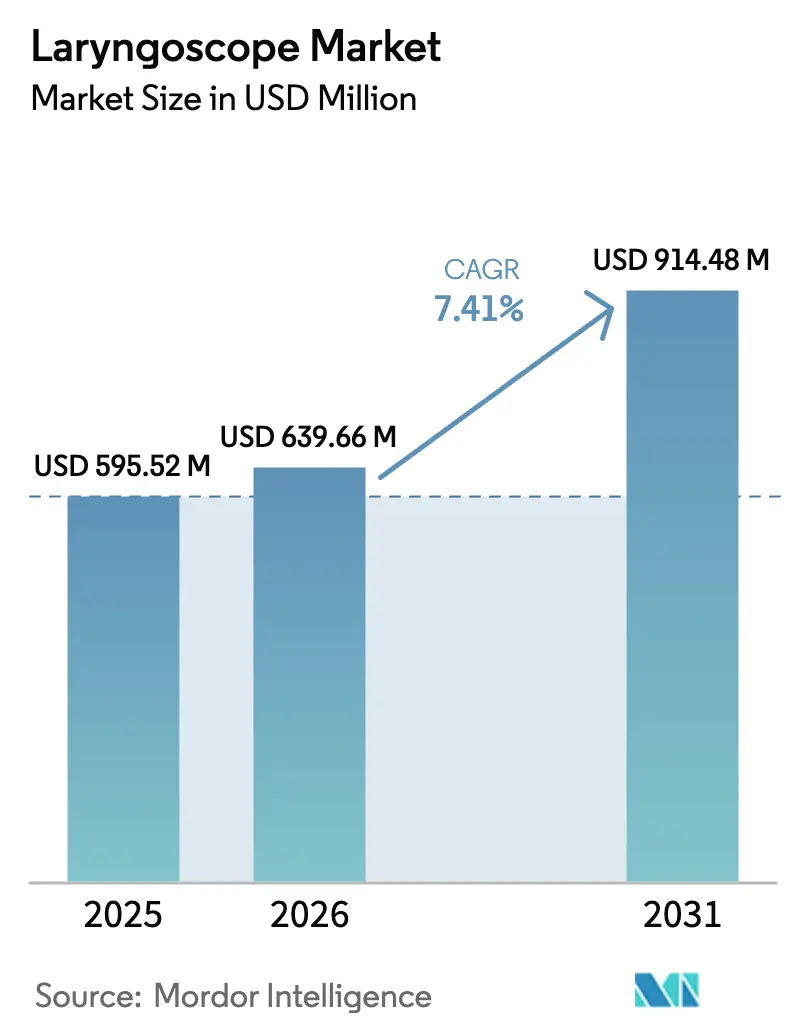
| Market Size (2026) | USD 639.66 Million |
| Market Size (2031) | USD 914.48 Million |
| Growth Rate (2026 - 2031) | 7.41 % |
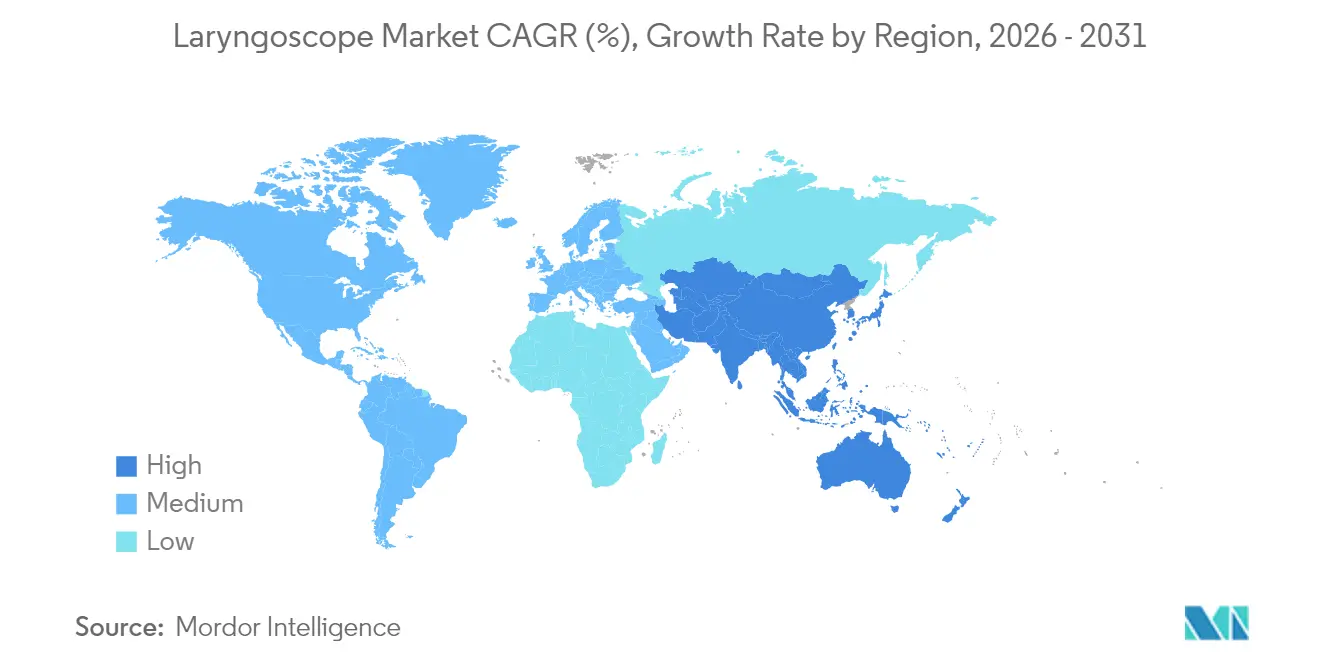
| Fastest Growing Market | Asia-Pacific |
| Largest Market | North America |
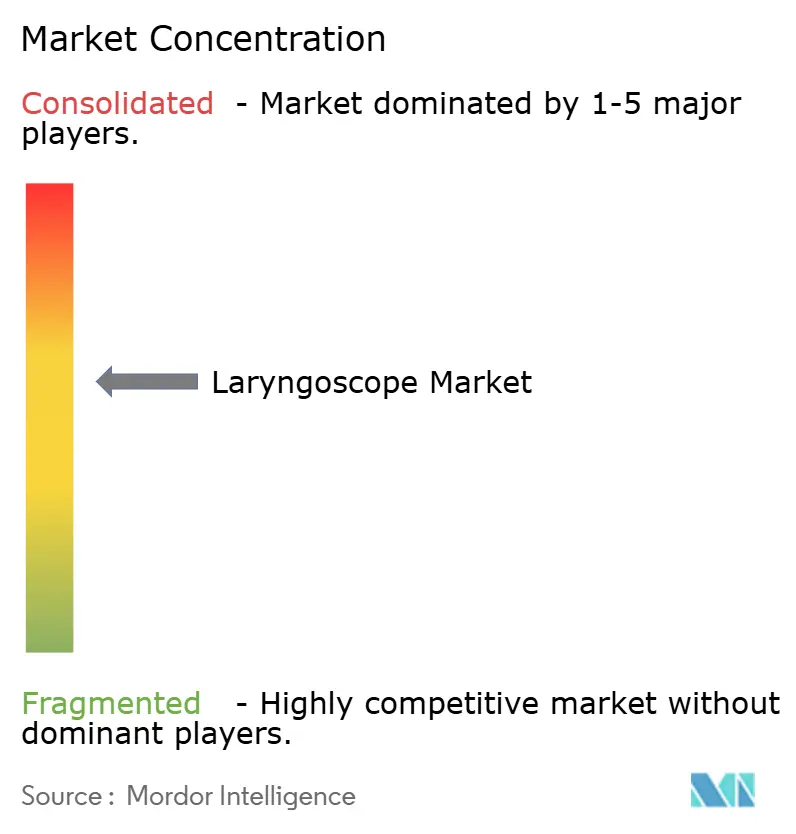
| Market Concentration | Medium |
Major Players *Disclaimer: Major Players sorted in no particular order Image © Mordor Intelligence. Reuse requires attribution under CC BY 4.0. | |
Laryngoscope Market Analysis by Mordor Intelligence
Global laryngoscope market size in 2026 is estimated at USD 639.66 million, growing from 2025 value of USD 595.52 million with 2031 projections showing USD 914.48 million, growing at 7.41% CAGR over 2026-2031. Rising procedure volumes, mandated video-assisted protocols, and AI-enabled guidance systems collectively push demand. Hospitals still dominate purchases, yet ambulatory surgical centers increasingly favor portable single-use units to streamline turnover times. North American clinicians continue to set adoption standards for video-CMOS platforms, but Asia-Pacific health systems now deliver the fastest incremental sales as aging populations swell airway-management caseloads. Supply chain vigilance around CMOS sensors and sterilization capacity remains critical, while environmental scrutiny drives manufacturers toward bio-based disposables and recycling programs.
Key Report Takeaways
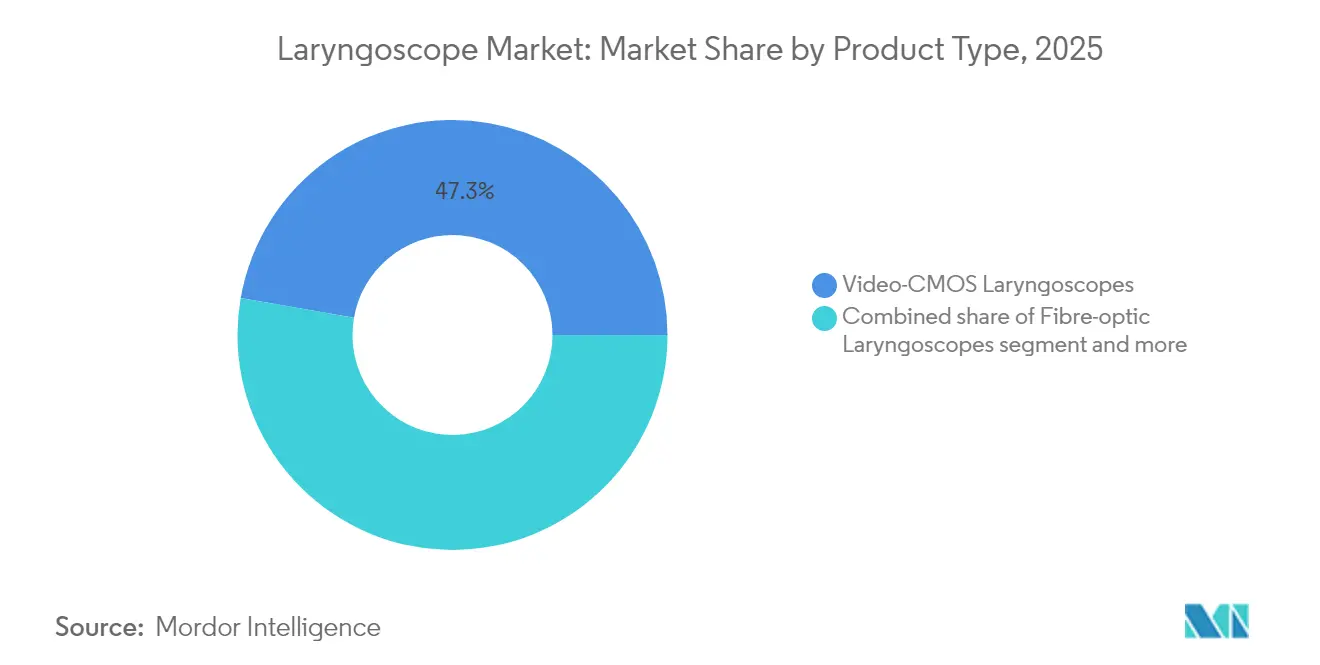
- By product type, video-CMOS laryngoscopes led with 47.25% of laryngoscope market share in 2025 and are forecast to expand at an 8.02% CAGR through 2031.
- By component, blades captured 43.85% share of the laryngoscope market size in 2025, whereas consumables and accessories are advancing at an 8.44% CAGR to 2031.
- By usability, reusable platforms accounted for 59.05% of the laryngoscope market share in 2025; disposable devices are projected to grow at an 8.28% CAGR to 2031.
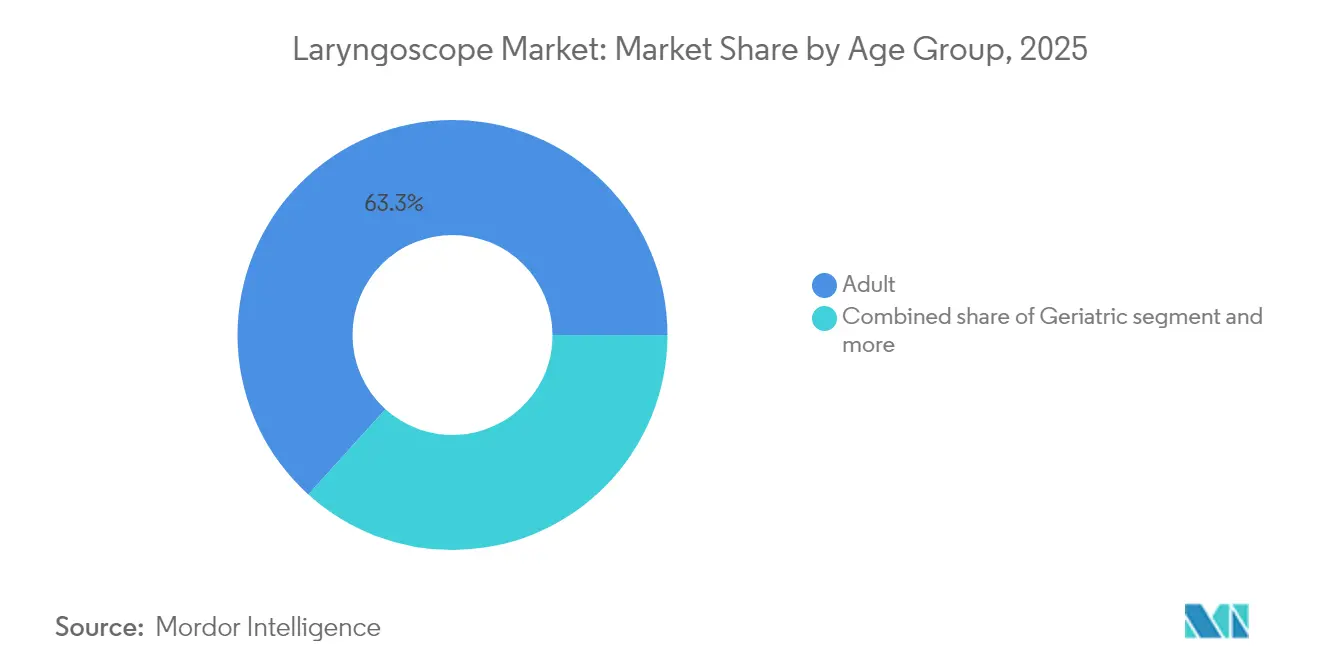
- By age group, adult patients represented 63.30% of laryngoscope market demand in 2025; neonatal and pediatric devices show an 8.20% CAGR through 2031.
- By end user, hospitals held 65.90% of the laryngoscope market size in 2025, whereas ambulatory surgical centers are moving ahead at a 9.07% CAGR to 2031.
- By geography, North America commanded 39.10% of the laryngoscope market size in 2025, whereas Asia-Pacific registers the top regional CAGR of 9.25% through 2031.
Note: Market size and forecast figures in this report are generated using Mordor Intelligence’s proprietary estimation framework, updated with the latest available data and insights as of 2026.
Market Trends and Insights
Drivers Impact Analysis of Laryngoscope Market*
| Driver | (~) % Impact on CAGR Forecast | Geographic Relevance | Impact Timeline |
|---|---|---|---|
| Rising prevalence of laryngeal disorders & airway-management procedures | +1.8% | Global, amplified in aging societies | Long term (≥ 4 years) |
| Technological advances in video & fiber-optic systems | +2.1% | North America & EU leadership, Asia-Pacific adoption accelerating | Medium term (2-4 years) |
| Shift toward single-use devices for infection control post-COVID-19 | +1.4% | Global, with strict mandates in developed markets | Short term (≤ 2 years) |
| AI-enabled real-time intubation guidance systems | +0.9% | North America & EU early adoption, Asia-Pacific following | Long term (≥ 4 years) |
| Mandatory video protocols in pre-hospital & military care | +0.6% | North America & EU regulatory mandates | Medium term (2-4 years) |
| Expansion of ambulatory surgical centers | +0.7% | North America leading, global diffusion underway | Medium term (2-4 years) |
| Source: Mordor Intelligence | |||
Rising Prevalence of Laryngeal Disorders & Airway-Management Procedures
Hoarseness after general anesthesia affected 11.77% of 104,720 patients reviewed in 2024, underscoring how common laryngoscopy-based follow-up has become. Direct procedural costs average USD 842 per diagnostic laryngoscopy, and ancillary expenses for consultations and therapy multiply the overall burden. Geriatric populations face higher dysphagia and malignancy risks, pushing clinicians toward early visualization strategies. High-speed videoendoscopy combined with AI now detects organic lesions with 93% accuracy, reshaping diagnostic protocols. These clinical realities sustain long-run demand for both reusable and single-use platforms across inpatient and outpatient settings.
Technological Advances in Video & Fiber-Optic Systems
Video laryngoscopy delivers 74% first-pass success in neonatal cases versus 45% for direct techniques, demonstrating clear performance advantages. Upgraded CMOS sensors bring brighter imaging and lower noise, while quick-connect battery handles cut setup times. Flexible fiber-optic scopes with slim profiles navigate irregular anatomies in ENT and trauma scenarios. Dual-view designs let operators keep traditional sight lines while capturing high-resolution video for documentation and teaching. Real-time AI overlays can mark epiglottis, vocal cords, and tracheal rings, supporting less-experienced practitioners and reducing complications.
Shift Toward Single-Use Devices for Infection Control Post-COVID-19
By 2024, 21.7% of hospitals had switched to disposable blades and 8.7% adopted single-use handles to curb cross-contamination. A life-cycle cost study shows per-use expenses of USD 171.82 for single-use rhinolaryngoscopes compared with USD 238.17 for reusable units when sterilization labor and capital are included. Eliminating reprocessing steps frees staff time and prevents delays in emergency departments and ASCs. Manufacturers now release bio-based plastic laryngoscopes such as Spectrum QC eco, which cuts carbon footprint by 74% while preserving single-use convenience.
AI-Enabled Real-Time Intubation Guidance Systems
Machine-learning models analyze airway images frame by frame, elevating endotracheal tube positioning accuracy from 73.6% to 77.4% and boosting critical misplacement detection to 89.0% . Experimental robotic arms guided by AI navigate through vocal cords autonomously, though mainstream use awaits clearer reimbursement and regulatory pathways. Early adopters report faster decision making in emergency rooms, and teaching hospitals leverage AI overlay recordings for resident education. Combined with high-speed video, stiffness mapping helps differentiate benign from malignant lesions with 83% accuracy, adding oncology value to airway imaging
Restraints Impact Analysis of Laryngoscope Market*
| Restraint | (~) % Impact on CAGR Forecast | Geographic Relevance | Impact Timeline |
|---|---|---|---|
| Device-related airway injuries & postoperative complications | -0.8% | Global, with higher litigation risk in developed markets | Short term (≤ 2 years) |
| High capital & maintenance cost of advanced systems | -1.2% | Emerging markets primarily, cost-sensitive segments | Medium term (2-4 years) |
| Environmental scrutiny on disposable device waste (ESG pressure) | -0.6% | EU & North America regulatory focus | Long term (≥ 4 years) |
| Supply-chain disruptions for CMOS image sensors | -0.9% | Global manufacturing, concentrated in Asia-Pacific | Short term (≤ 2 years) |
| Source: Mordor Intelligence | |||
Device-Related Airway Injuries & Postoperative Complications
Dental trauma, esophageal perforation, and laryngeal swelling continue to generate malpractice exposure. The FDA’s Class I recall of McGrath MAC video laryngoscopes because of battery explosion risk underscores how safety events can disrupt procurement patterns.[1]GlobalData Analysts, “FDA Designates Class I Recall of McGrath Mac Laryngoscopes,” Medical Device Network, medicaldevice-network.com Pediatric intubations carry additional hazards due to narrow airways and limited blade size availability, prompting stricter credentialing and simulation training. Video platforms do mitigate many risks by enhancing glottic visualization, yet equipment failures or misuse still drive litigation and insurance premiums. Hospital risk-management departments therefore weigh safety data heavily when approving capital requests.
High Capital & Maintenance Cost of Advanced Systems
Top-tier video platforms list between USD 15,000 and USD 25,000 while direct laryngoscopes cost USD 200-500. Annual maintenance—sensor calibration, software updates, screen repairs—can add 15% of purchase price. Low-volume rural centers struggle to justify the expense absent targeted funding or lease plans. Utilization-based leasing and pay-per-procedure models have emerged to spread costs, but reimbursement remains static in many markets. The economic calculus often tilts toward single-use blades atop reusable handles as a compromise between safety, affordability, and throughput.
*Our forecasts treat driver/restraint impacts as directional, not additive. The impact forecasts reflect baseline growth, mix effects, and variable interactions.
Laryngoscope Market Segment Analysis
By Product Type:
Video-CMOS Dominance AcceleratesVideo-CMOS systems held 47.25% of the laryngoscope market share in 2025 thanks to unparalleled visualization and digital integration. First-pass success gains of nearly 30 percentage points over direct techniques win adoption in trauma bays and neonatal ICUs. Direct Macintosh and Miller designs persist in resource-constrained settings for their familiarity and low cost. Fiber-optic scopes address ENT and anticipated difficult airways where flexibility is indispensable.
Video platforms are forecast to grow 8.02% annually to 2031 as health systems codify video intubation into guidelines. As adoption deepens, real-time AI overlays and cloud-based video archiving become standard. Clinicians value the ability to record procedures for quality improvement and medico-legal documentation. Meanwhile, research prototypes that blend rigid optics with embedded augmented-reality cues hint at the next performance leap.


By Component:
Blade Innovation Drives Consumables GrowthBlades accounted for 43.85% of the laryngoscope market size in 2025, reflecting their central role and frequent turnover. Metal and polymer edge designs now feature higher-intensity LED lighting and anti-fog coatings. Mac blades dominate adult surgery, while Miller variants are preferred for neonatal airways.
Consumables and accessories show an 8.44% CAGR, propelled by single-use adoption and modular clip-on sensors. Manufacturers pursue recurring revenue through proprietary blade cartridges and disposable light pipes. Hospitals readily approve these expenditures because unit cost is low relative to OR revenue and infection-control benefits are quantifiable.
By Usability:
Disposable Momentum Challenges Reusable EconomicsReusable platforms still commanded 59.05% of the laryngoscope market share in 2025 because high-volume centers achieve the lowest cost per use. Stainless steel handles withstand thousands of cycles and interface with a wide blade portfolio.
Disposable models, however, grow at 8.28% annually as COVID-19 shifted infection-risk calculus. Emergency departments appreciate grab-and-go convenience, while ASCs avoid sterilization queues that would slow rapid case turnover. Bio-based plastics and recycling take-back initiatives help reconcile environmental mandates with single-use practicality.
By Age Group:
Pediatric Specialization Drives InnovationAdults generated 63.30% of 2025 revenue, mirroring surgery volumes and emergency callouts. Device selection is broad, from classic Mac blades to dual-view video units.
Neonatal and pediatric segments pace at an 8.20% CAGR because miniaturized optics and gentle curvature blades now achieve 74% first-attempt success versus 45% for direct methods. Color-coded size matrices simplify stocking and reduce errors. Growing recognition of long-term airway trauma in infants encourages early adoption of high-definition video to minimize multiple passes.
By End User:
ASC Migration Reshapes Market DynamicsHospitals retained 65.90% market control in 2025 through broad procedural scope and capital budgets. Teaching centers standardize on video-CMOS for documentation, resident instruction, and audit trails.
Ambulatory surgical centers expand at 9.07% CAGR, fueled by outpatient procedure migration. Eight of ten U.S. outpatient surgeries now occur in ASCs, and leadership teams prefer compact, portable video units with single-use blades that support fast turnover. Leasing contracts align device costs with fluctuating case volumes.
Geography Analysis
North America Laryngoscope Market
North America held 39.10% of global revenue in 2025. EMS agencies mandate video-laryngoscopy kits on advanced life-support rigs, and hospitals integrate footage into electronic health records. FDA advisories on supply-chain and sterilization resilience shape purchasing decisions.Canada follows similar patterns, while Mexico’s public-hospital modernization drives mid-tier adoption.
APAC Laryngoscope Market
Asia-Pacific posts the highest growth at 9.25% CAGR. China funds broad device upgrades, pushing its medical-device market toward USD 210 billion by 2025. Japan’s super-aging society spurs higher per-capita intubation rates. India and Southeast Asia invest in secondary-care networks and medical tourism, prioritizing cost-efficient yet advanced video blades. Reusable-handle plus disposable-blade bundles resonate in these markets.
Europe Laryngoscope Market
Europe grows steadily under stringent waste-reduction and infection-prevention directives. Circular-economy regulations accelerate bio-based product rollouts. Germany and France equip ambulance fleets with compact video scopes, while the United Kingdom channels National Health Service funds toward AI-ready platforms. Emerging Central and Eastern European members tap EU cohesion funds to update ENT suites and anesthesia carts.

Regulatory Landscape
Laryngoscopes fall under established medical-device frameworks that affect product design controls, supplier qualification, and post-market obligations. In the United States, the FDA classifies laryngoscopes under 21 CFR pathways that include Class I categories for non-rigid laryngoscopes (product code CAL) and rigid laryngoscopes (product code CCW), with related visualization scopes such as nasopharyngoscopes in higher-risk classifications (for example, Class II under product code EQN). These classifications shape labeling, quality-system expectations, and the degree of premarket scrutiny, especially for video-enabled platforms that introduce electronics, batteries, and software features.
Standards recognition and regulator enforcement actions create near-term compliance anchors for global manufacturers. The FDA has recognized ISO 7376:2020 (including AMD1:2025) as a consensus standard for laryngoscopes with non-flexible blades, and the transition period for previous versions runs through December 19, 2027, which sets a defined window for documentation and design-history updates. Separately, FDA import alerts covering certain Olympus medical devices manufactured in Japan (as communicated in June 2025 letters to health care providers) highlight how quality-system findings can disrupt supply availability and procurement plans. Olympus publicly indicated remediation targeting completion by the end of its fiscal year ending March 31, 2026, reinforcing the market impact of sustained QSR compliance for multinational supply continuity.
Value Chain Analysis
The laryngoscope value chain runs from product conception and clinical validation to component sourcing (optics, CMOS sensors, LEDs, batteries, plastics/metals), final assembly and quality release, and distribution into hospital and ambulatory channels. Lifecycle support also matters, including training, repair, software updates, and warranty management. Video-CMOS systems add electronics and firmware layers, which increase dependence on qualified component suppliers and test/validation protocols. Disposable blades and single-use handles shift emphasis toward high-throughput molding, packaging, and sterilization capacity where applicable.
Supply resilience depends on cross-border logistics for electronics and precision parts, with Asia-Pacific playing a major role in upstream availability for image sensors and other electronic subassemblies. Because medical-device regulations require validated processes and approved supplier status, switching component sources is slower than in consumer electronics. To manage continuity, manufacturers often dual-source critical parts, hold safety stock, or integrate key subsystems (for example, batteries and imaging modules) when scale supports it. Downstream, hospitals and group purchasing organizations influence configuration choices, such as reusable platforms plus disposable blades versus fully single-use kits, based on total cost of ownership, infection-control policies, and reprocessing constraints. Service infrastructure and training therefore become a material part of vendor differentiation alongside hardware performance.
Competitive Landscape
The laryngoscope market exhibits moderate fragmentation, with leading vendors combining technological edge and strategic acquisitions to fortify positions. Medtronic leverages vertical integration in sensors and batteries to roll out high-lumen video handles that survive autoclave cycles. Ambu, the pioneer in single-use bronchoscopy, extends its model to single-use video laryngoscopes and secures multiyear framework deals with U.S. Veterans Health Administration. KARL STORZ closed its medi-G acquisition in February 2025, bringing precision milling expertise for pediatric blades in-house and widening supply-chain resilience.
Olympus partnered with Proximie in October 2024 to launch a device-agnostic digital-OR platform that streams HD laryngoscope feeds for remote proctoring and AI annotation. Clinicians can overlay guidance cues in real time, shortening learning curves and standardizing technique across multi-site health systems. Safety events intensify rivalry: the FDA’s Class I recall of McGrath MAC in September 2024 for battery explosion risk prompted rapid substitution by competitors touting safer lithium-iron-phosphate chemistries, and several systems won emergency procurement contracts as replacements.
Emerging disruptors attack sustainability and niche clinical gaps. Verathon introduced the Spectrum QC eco made from 80% bio-based plastic, claiming a 74% carbon-footprint cut without compromising rigidity or optical clarity. Start-ups such as Bath-based InovScope prototype 3-D-printed modular blades allowing custom curvature for cranio-facial anomalies, while Seoul’s Airmate integrates AI that predicts tube size based on live vocal-fold measurements. White-space opportunities surface in pediatric and military protocols, where blade miniaturization, ruggedization, and EMI-shielded electronics meet specialized standards. Regulators elevate cybersecurity requirements, compelling vendors to embed encryption chips that guard recorded airway videos. Collectively, these forces ensure that competitive dynamics hinge not only on optical performance but also on life-cycle sustainability, software sophistication, and post-sale training that clinicians now expect from partners in the evolving laryngoscope market.
Laryngoscope Industry Leaders
Medtronic plc
Olympus Corporation
Teleflex Incorporated
Baxter (Hill-Rom Co., Inc.)
Nihon Kohden Corporation
- *Disclaimer: Major Players sorted in no particular order
Laryngoscope Market Companies Covered in this Report
- Medtronic
- Ambu
- Karl Storz
- Verathon
- Teleflex
- Olympus
- Baxter (Hill-Rom Co., Inc.)
- Nihon Kohden
- Penlon Ltd (BPL Medical Technologies)
- Flexicare Medical
- Smiths Group
- Venner Medical International
- UE Medical Devices, Inc.
- Timesco Healthcare Ltd.
- Vivid Medical, Inc.
- Intersurgical Ltd.
- Clarus Medical

Market Opportunities and Future Outlook
Opportunity centers on upgrading airway visualization while simplifying workflow, training, and documentation. Medtronic's June 2026 launch of the McGRATH MAC+ video laryngoscope, which highlights enhanced visualization, retrospective recording, and a wireless rechargeable battery system, points to continued investment in features that fit teaching hospitals (procedure capture for education and quality review) and high-turnover acute settings (OR, ICU, ER, EMS). As health systems broaden video use, device-agnostic digital workflow and remote support also emerge as a commercialization lane. This is supported by Olympus partnering with Proximie in October 2024 to stream HD feeds for remote proctoring and AI annotation.
A second whitespace area sits at the intersection of infection control and sustainability. By 2024, a measurable share of hospitals had shifted to disposable blades and single-use handles, and manufacturers responded with bio-based single-use options such as Verathon's Spectrum QC eco (80% bio-based plastic, with a stated 74% carbon-footprint reduction). These product choices align with procurement scrutiny in Europe and North America around disposable waste. Supplier and compliance robustness also remains a differentiator. The FDA's 2024 Class I recall of McGrath MAC units (battery explosion risk) and the June 2025 FDA import alert actions impacting certain Olympus devices manufactured in Japan show that safety and quality events can quickly redirect purchasing toward vendors with validated batteries, stable sensor supply, and strong post-market surveillance and corrective-action execution.
Recent Industry Developments in Laryngoscope Market
- June 2026: The launch expands data-rich airway management options across settings. The launch of McGRATH MAC+ video laryngoscope with larger high-resolution screen, retrospective recording, and wireless rechargeable battery across OR/ICU/ER/EMS strengthens Medtronic’s airway portfolio and clinical data capabilities.
- June 2026: The collaboration links endoscopy visualization with ENT solutions to streamline workflows. The strategic collaboration with KARL STORZ integrates endoscopy visualization with Medtronic ENT solutions in the U.S. shifts procurement dynamics toward combined ecosystems and cross-vendor solutions.
- May 2026: The introduction expands single-use ENT instruments in North America. Olympus Corporation launches E-Steriscope single-use rhinolaryngoscopes in Canada diversifies Olympus portfolio and accelerates single-use adoption in the region.


Laryngoscope Market Report Scope and Research Methodology
Market Definition and Coverage
For this methodology, the market is defined as revenue earned from laryngoscopes and their related components that are used to visualize the larynx and support airway management in clinical settings, and then sold through standard healthcare purchasing channels across countries.
Scope exclusions: Excludes diagnostic laryngoscopy procedure fees and other airway devices that are not laryngoscopes.
Segments Covered in This Report
- By Product Type
- Direct (Macintosh / Miller) Laryngoscopes
- Fibre-optic Laryngoscopes
- Video-CMOS Laryngoscopes
- Rigid Indirect & Others
- By Component
- Blades
- Mac Blades
- Miller Blades
- Handles
- Consumables & Accessories
- Blades
- By Usability
- Disposable
- Reusable
- By Age Group
- Neonatal & Pediatric
- Adult
- Geriatric
- By End User
- Hospitals
- Clinics
- Ambulatory Surgical Centres (ASCs)
- Others
- By Geography
- North America
- United States
- Canada
- Mexico
- Europe
- Germany
- United Kingdom
- France
- Italy
- Spain
- Rest of Europe
- Asia-Pacific
- China
- Japan
- India
- Australia
- South Korea
- Rest of Asia-Pacific
- Middle East and Africa
- GCC
- South Africa
- Rest of Middle East and Africa
- South America
- Brazil
- Argentina
- Rest of South America
- North America
Data Sources, Market Sizing, and Validation
Desk Research
Desk research starts by building the demand picture and the regulatory and safety context for airway management and intubation, and then mapping how device types get adopted in hospitals and outpatient settings. We reviewed non-paywalled public sources such as CDC healthcare data, WHO health statistics, OECD health indicators, the World Bank population and aging data series, and FDA device databases (including safety communications and recalls) to understand usage signals that can influence replacement and upgrade cycles.
To connect demand signals to real spending, secondary work also included company filings, investor presentations, tender notices, and reputable clinical and association publications that discuss practice patterns and technology migration toward video use. Select paid databases that track company financials and news, patent activity, and shipment level trade flows were used to cross-check supplier exposure and to avoid double counting components sold with complete systems. The desk research sources listed here are illustrative, and many other public references were also used for validation and clarification during the analysis.
Primary Interviews and Surveys
Primary work was used to pressure test the sizing assumptions that are hard to confirm from public data, especially mix shifts between direct and video units, disposable penetration, and average selling price ranges by care setting. We spoke with a spread of respondents across manufacturers, distributors, clinicians, and procurement stakeholders across the Americas, EMEA, and APAC so regional practice norms and purchasing constraints could be reflected in the final model.
Distribution of primary research fieldwork respondents
| Company type | Respondent position | Region |
|---|---|---|
| Top tier: 31% | CXOs: 12% | APAC: 38% |
| Mid tier: 49% | Functional/Unit leaders: 40% | EMEA: 35% |
| Smaller Players: 20% | Managers: 48% | Americas: 27% |
Market-Sizing & Forecasting
Market sizing is built using a top-down structure where procedure intensity and care capacity indicators are used to reconstruct the addressable demand pool by region, which is then converted into unit demand and spending using adoption and replacement assumptions. We anchor the model on variables that interviewees could confirm with practical detail, and a few pleasantly simple checks are kept in place so the math stays explainable.
Key inputs used include the annual volume trend of surgical and emergency intubations, ICU and operating room capacity growth, the share of video laryngoscopy used in difficult airway protocols, disposable blade adoption for infection control, and typical replacement cycles for reusable handles and imaging stacks. For pricing, the model uses a banded ASP approach by product type and end user, with currency conversion handled consistently using the same timing convention across regions. Selective bottom-up approximations are then used to corroborate totals, such as sampled supplier revenue disclosures, channel partner checks on unit volumes, and a sanity check of blades and handles consumption versus estimated system installs.
Forecasting uses scenario analysis supported by light regression on procedure and capacity drivers, and then adjusted with primary feedback on procurement cycles and technology refresh timing. Where a bottom-up proxy is incomplete in smaller countries, gaps are filled using peer market ratios based on hospital infrastructure and income level, and then re-checked in the validation step before finalizing the series.
Data Validation & Update Cycle
Validation is done through repeated triangulation between model outputs and independent signals, and then through variance checks across regions, product types, and end users so totals do not drift away from plausible demand. Outliers are flagged when implied units per facility, blade consumption per intubation, or ASP progression looks inconsistent with what respondents described, and then the assumptions are revisited.
Before sign-off, the work is reviewed in multiple steps, first at the analyst level for arithmetic and logic, and then through a second pass focused on consistency across the time series. Reports are refreshed annually, with interim updates triggered by material events such as major regulatory changes, supply disruptions, and notable shifts in disposable adoption. Right before delivery, a fresh update pass is completed so clients receive the most current view available.
Mordor Intelligence's Laryngoscope Market Size Compared Against Other Published Estimates
Published market values for laryngoscopes can vary a lot because the scope lines are drawn differently, and because the same inputs like video adoption and disposable mix are not always treated the same way. Differences also come from base year choice, currency timing, and how often the model is refreshed after pricing or procurement patterns change.
Procedure service revenue and hospital intubation consumables that are not laryngoscope blades are common items that pull figures upward, and they can be hard to separate cleanly in public sources. In this study, those items sit outside Mordor Intelligence's scope, which keeps the total tied to device and component sales only, and then checked against install base and replacement behavior rather than broad airway spending.
Benchmark comparison
| Source | Market Size | Gaps in Research Methodology |
|---|---|---|
| Mordor Intelligence | USD 595.52 M (2025) | |
| Global Consultancy A | USD 1.10 B (2024) | Uses a broader device umbrella and can blend in adjacent ENT and airway visualization tools, which inflates the spend pool versus a laryngoscope-only revenue model. The base year and currency timing also differ, making the converted USD value less comparable. |
| Industry Publisher B | USD 387.40 M (2025) | Appears to rely on a narrower product definition and may undercount component revenue that is bundled through channels, especially blades and handles sold alongside systems. Limited visibility into disposable penetration and replacement cadence can also pull the estimate down. |
The table shows that the spread is mainly explained by what gets counted as in-scope revenue and how mix and pricing are carried forward year to year. By grounding the totals in procedure and capacity signals, and then cross-checking them with practical supplier and channel checks, the estimate stays traceable to clear variables that can be repeated when the market shifts.


Key Questions Answered in the Report
How fast is the laryngoscope market expected to grow between 2026 and 2031?
It is forecast to rise from USD 639.66 million in 2026 to USD 914.48 million in 2031, a 7.41% CAGR.
Which product type holds the largest share today?
Video-CMOS laryngoscopes lead with 47.25% laryngoscope market share in 2025.
Which region is expanding the fastest?
Asia-Pacific records a 9.25% CAGR through 2031 thanks to infrastructure investment and aging demographics.
What is driving adoption in ambulatory surgical centers?
Outpatient procedure migration favors portable single-use video scopes that cut sterilization delays and align with ASC throughput goals.
Page last updated on:


 Your data is secure and never sold or shared.


