
Landing Page Optimization Services Market Size and Share
Market Overview
| Study Period | 2020 - 2031 |
|---|---|
| Market Size (2026) | USD 2.68 Billion |
| Market Size (2031) | USD 5.19 Billion |
| Growth Rate (2026 - 2031) | 14.13 % |
| Fastest Growing Market | Asia-Pacific |
| Largest Market | North America |
| Market Concentration | Low |
Major Players *Disclaimer: Major Players sorted in no particular order Image © Mordor Intelligence. Reuse requires attribution under CC BY 4.0. | |
Landing Page Optimization Services Market Analysis by Mordor Intelligence
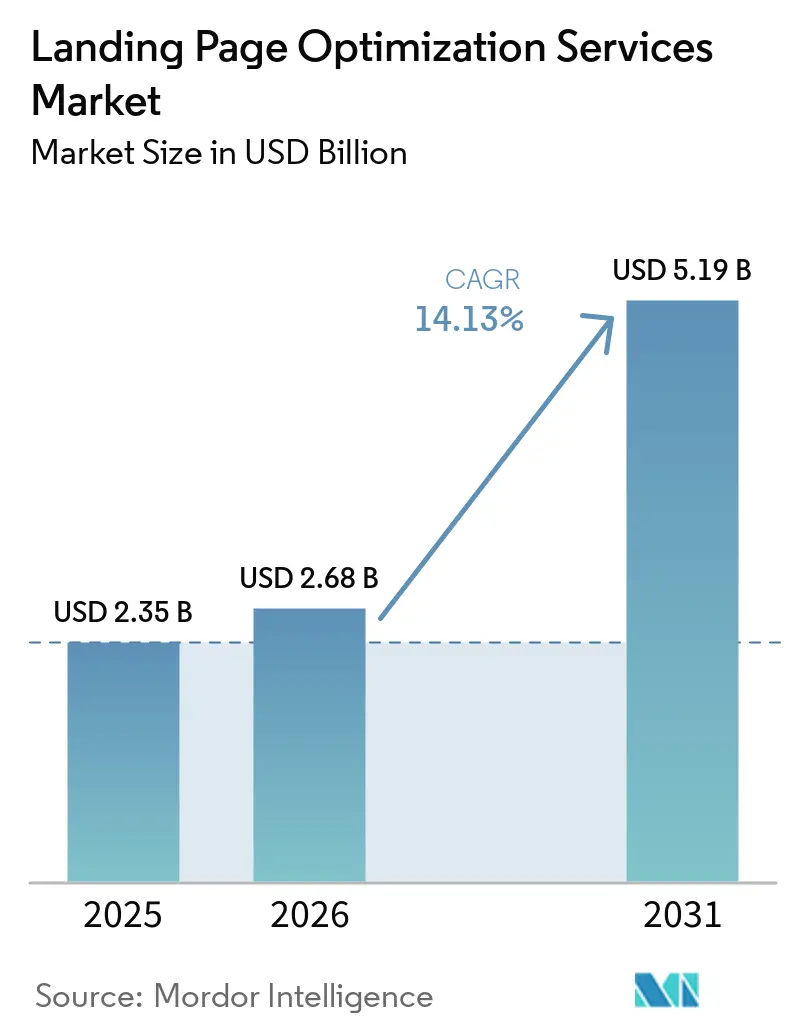
The Landing page optimization services market size was valued at USD 2.35 billion in 2025 and estimated to expand from USD 2.68 billion in 2026 to reach USD 5.19 billion by 2031, at a CAGR of 14.13% during the forecast period (2026-2031). Rising paid acquisition costs are making the value of each website visit more important for marketers, particularly where teams must show that further spending delivers a clear return. AI-enabled personalization is changing how providers design pages, create test variants, and adapt content to audience signals drawn from customer, product, and behavioral data. E-commerce, lead capture, and digital campaigns are expanding the number of situations where a dedicated page can affect commercial outcomes, from product promotion and event registration to high-intent service inquiries. The Landing page optimization services market benefits from a gap between the importance marketers place on post-click improvement and the resources they commit to it, giving the Landing page optimization services market an opening to offer connected design, testing, analytics, and implementation work rather than a limited page-building service. Competition is broad, and buyers can choose among specialist agencies, page-building platforms, experimentation suites, analytics providers, and integrated marketing platforms.
Key Report Takeaways
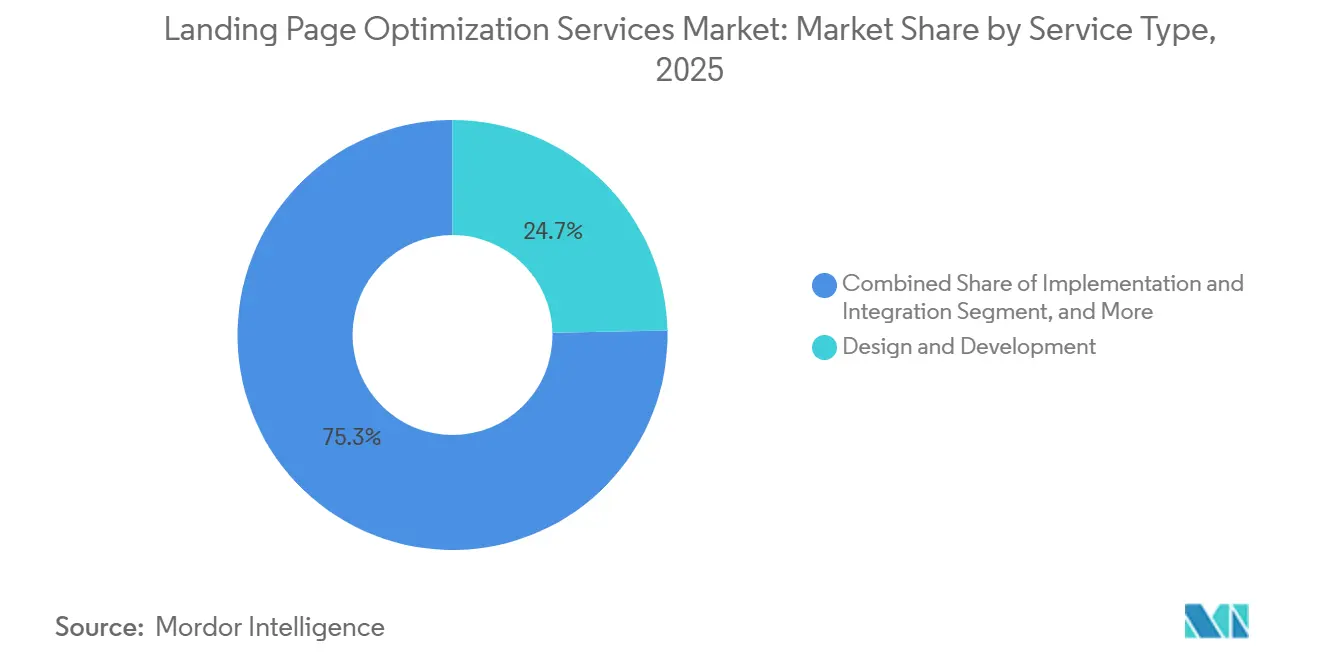
- By service type, Design and Development held 24.66% of the Landing page optimization services market share in 2025, while Optimization and Testing is projected to expand at a 14.46% CAGR through 2031.
- By application, Lead Generation accounted for 27.28% of the Landing page optimization services market size in 2025, while A/B Testing is projected to expand at a 14.77% CAGR through 2031.
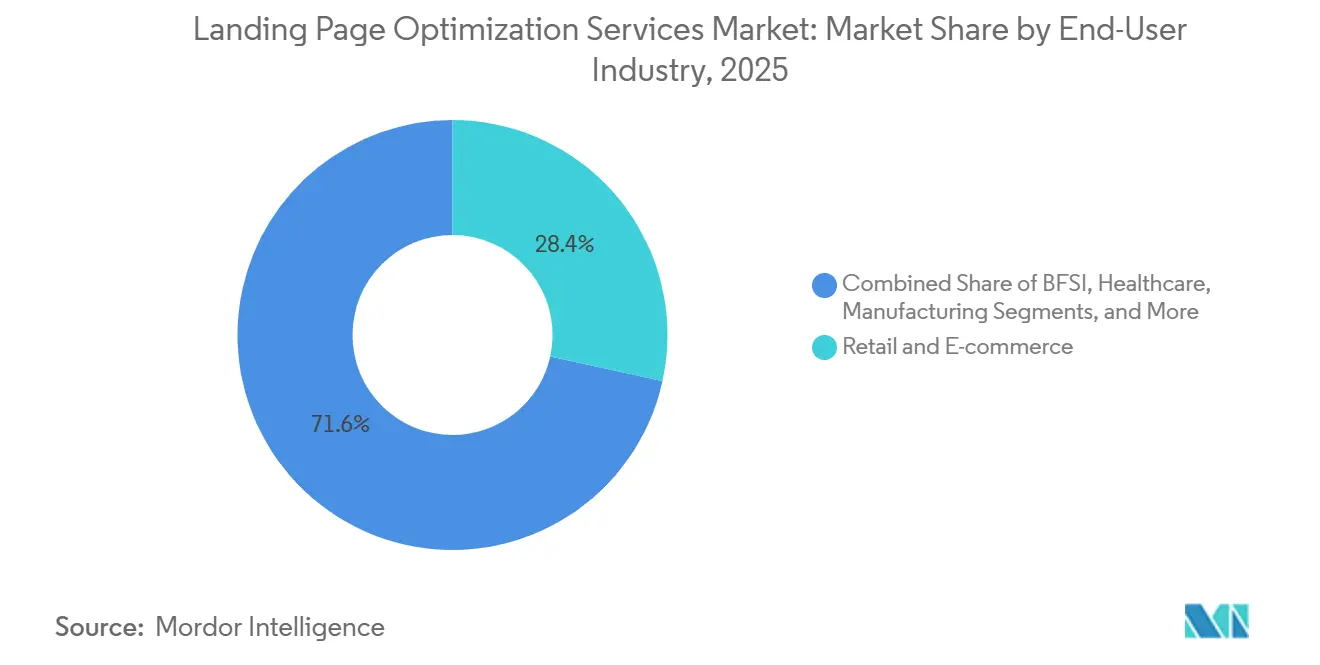
- By end-user industry, Retail and E-commerce held 28.44% share in 2025, while Healthcare is projected to expand at a 14.73% CAGR through 2031.
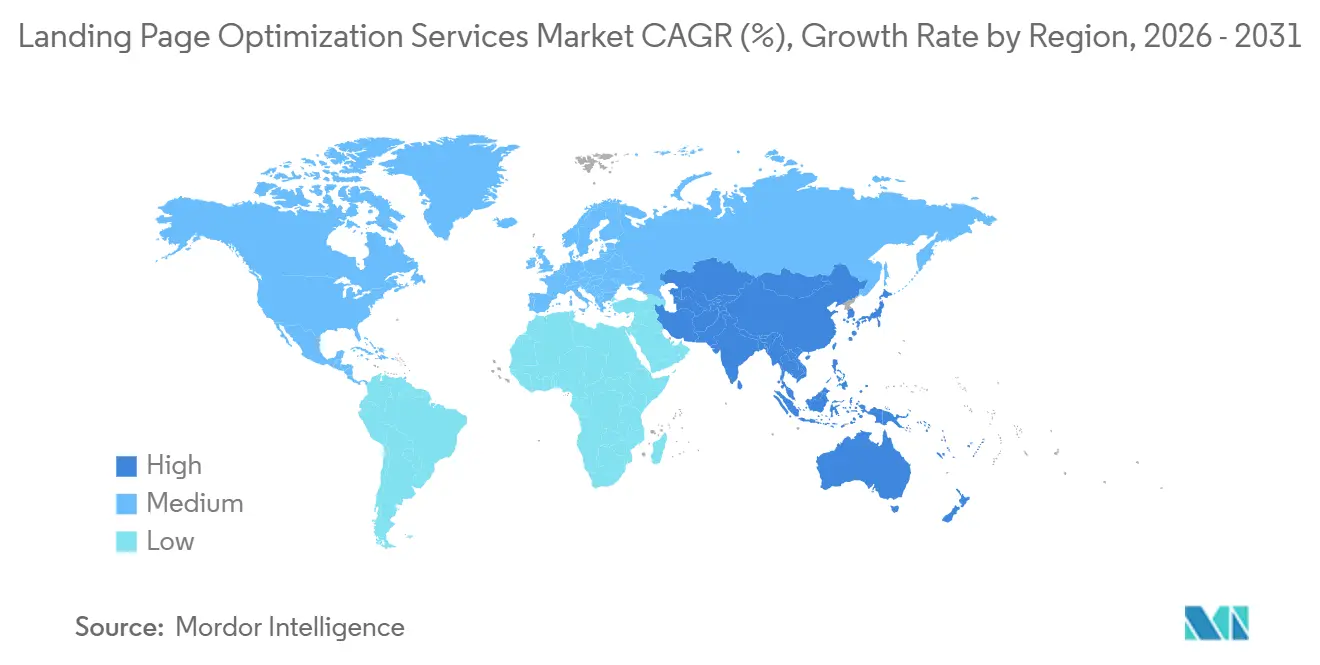
- By geography, North America held 36.63% share in 2025, while Asia-Pacific is projected to expand at a 14.94% CAGR through 2031.
Note: Market size and forecast figures in this report are generated using Mordor Intelligence’s proprietary estimation framework, updated with the latest available data and insights as of January 2026.
Market Trends and Insights
Drivers Impact Analysis of Landing Page Optimization Services Market*
| Driver | (~) % Impact on CAGR Forecast | Geographic Relevance | Impact Timeline |
|---|---|---|---|
| AI-Powered Personalization and Dynamic Routing | +3.2% | Global, led by North America and Europe | Short term (≤ 2 years) |
| Expanding E-Commerce and Lead-Generation Demand | +2.8% | Asia-Pacific core, spillover to South America and the Middle East and Africa | Medium term (2-4 years) |
| Rising Paid Acquisition ROI Pressure | +2.5% | Global | Short term (≤ 2 years) |
| AI Search Visibility and Citation Readiness | +2.1% | North America and Europe, early adoption in Asia-Pacific | Medium term (2-4 years) |
| Machine-Readable Landing Page Architecture | +1.5% | North America, with early gains in the United Kingdom and Germany | Long term (≥ 4 years) |
| Privacy-First Measurement and Server-Side Testing | +1.1% | EU-centered, expanding to India and North America | Medium term (2-4 years) |
| Source: Mordor Intelligence | |||
AI-Powered Personalization and Dynamic Routing
AI-assisted optimization is changing the operating model for the Landing page optimization services market. It allows teams to create page variants, match content to audiences, and use behavioral or CRM signals with less manual production work. The supplied research showed that adoption of AI-assisted A/B testing among mid-market brands increased significantly year over year. It also reported that AI-generated variants outperformed human-written controls in a higher share of head-to-head tests than in the previous period. Optimizely released Limitless Personalization, allowing teams to create tailored experiences from CRM history, product data, and behavioral signals. Providers that can combine page design, data connections, and testing are therefore better positioned to serve organizations that need more tailored experiences without large internal production teams.
Expanding E-Commerce and Lead-Generation Demand
E-commerce activity expands the number of paid campaigns that need focused post-click experiences. Retail and E-commerce held a leading end-user position, reflecting the direct link between conversion improvement and revenue from traffic that has already been acquired. The supplied research found that longer load times reduced conversions across Unbounce’s analysis. Lead Generation held the largest application share as business-to-business and direct-to-consumer marketers continued to prioritize proprietary intent data. The Landing page optimization services market has room to serve South America, the Middle East, and Africa, where digital advertising is increasing faster than specialist delivery capacity. Global providers can address this need when they adapt page design, language, campaign workflows, and measurement practices to local conditions.
Rising Paid Acquisition ROI Pressure
Higher paid media costs are encouraging marketers to look beyond audience targeting and ad creative. The supplied research cited Gartner’s CMO Spend Survey, which found that CMOs prioritized ROI as their primary budget metric and reported insufficient resources to execute their full strategy. It also cited an increase in average Google Search cost per click, with finance, legal, and enterprise software among the affected verticals. An Unbounce and Ascend2 survey found that paid media professionals viewed destination-page optimization as an effective way to improve returns, while fewer had invested in landing pages recently. This mismatch leaves a meaningful pool of work for the Landing page optimization services market. Buyers are likely to favor engagements that connect page improvements with campaign performance, attribution, and measurable commercial outcomes.
AI Search Visibility and Citation Readiness
AI-generated answers are changing how visitors discover and assess business content. The supplied research reported that HubSpot observed a 27% year-over-year decline in organic traffic for its customers alongside a tripling of AI referral traffic. This change broadens the work expected from landing page specialists because pages must support both conversion goals and machine-readable discovery. Structured data, clear content architecture, and metadata can become part of a page engagement when clients need greater visibility in AI-driven search journeys. Optimizely launched a full AEO platform in June 2026 with Conductor, combining AI traffic data, AEO intelligence, and automated analysis tools.[1] The Landing page optimization services market can benefit as providers add these requirements to conversion, content, and experimentation work.
Restraints Impact Analysis of Landing Page Optimization Services Market*
| Restraint | (~) % Impact on CAGR Forecast | Geographic Relevance | Impact Timeline |
|---|---|---|---|
| Limited Traffic for Statistically Reliable Testing | -2.3% | Global, most acute in South America, the Middle East and Africa, and smaller Asia-Pacific markets | Short term (≤ 2 years) |
| Shortage of CRO and Experimentation Talent | -2.0% | Global | Medium term (2-4 years) |
| Integration Friction Across Marketing Stacks | -1.6% | North America and Europe | Medium term (2-4 years) |
| Compliance Burden From Cookieless Measurement | -1.2% | EU-centered, expanding to India and North America | Medium term (2-4 years) |
| Source: Mordor Intelligence | |||
Limited Traffic for Statistically Reliable Testing
Analytics and Reporting helps clients assess post-launch page performance by tracking how channels, visitor behavior, form actions, and campaign messages influence business outcomes. Rising cookie rejection has increased demand for consent-compliant measurement, server-side tracking, and reporting methods that preserve useful audience signals despite reduced client-side visibility. Maintenance and Support creates recurring work as page performance shifts with audience mix, device use, seasonal campaigns, and competing offers, while ongoing testing helps providers retain performance history and refine future actions. Optimization and Testing is expected to expand steadily over the forecast period, supported by tools that connect behavior analytics with feature experimentation and encourage longer-term service relationships in the Landing page optimization services market. However, low traffic and limited testing activity can delay useful findings and weaken returns for smaller advertisers, requiring careful test design, targeted traffic allocation, and services that do not rely solely on high-volume experiments.
Shortage of CRO and Experimentation Talent
The shortage of conversion rate optimization and experimentation talent limits buyer readiness and provider capacity, as effective programs require statistical reasoning, technical delivery, audience insight, and coordination across marketing and product teams. Outsourcing can support clients that cannot build these capabilities internally, but providers also need qualified staff to deliver complex programs at scale. Campaign and Event Registration remains relevant for enterprise software, pharmaceutical, and professional services organizations, where optimized webinar and clinical-trial pages can improve registration quality and downstream outcomes. A/B Testing is expected to grow strongly as AI-generated variants reduce production effort and help teams test more messages and designs, while tools such as Optimizely’s Experimentation MCP server may make experimentation insights more accessible to marketers and support wider use of the Landing page optimization services market.
*Our forecasts treat driver/restraint impacts as directional, not additive. The impact forecasts reflect baseline growth, mix effects, and variable interactions.
Landing Page Optimization Services Market Segment Analysis
By Service Type:
Architecture and Testing Drive the Conversion StackDesign and Development retained a 24.66% share of the Landing page optimization services market in 2025. It provides the page structure that supports future testing, personalization, tracking, and content changes. A weak page architecture can limit the benefits of later experimentation because technical or design constraints remain in place. Consulting and Strategy services provide the upstream planning work that translates audience behavior, channel context, and campaign objectives into a clear page brief. They help clients decide which audience needs, messages, and conversion actions should receive priority. Implementation and Integration is becoming more important as organizations use more tools across customer relationship management, analytics, advertising, and personalization. Fragmented systems can create broken attribution, delayed data signals, and inconsistent page experiences. The Landing page optimization services industry, therefore, needs both creative and technical capabilities across the service stack.
Analytics and Reporting support clients who need to understand performance after a page is live. The supplied research stated that cookie rejection rates reached 60% by 2026, increasing the need for measurement frameworks that respect consent requirements while preserving useful signals. This supports demand for server-side tracking and reporting methods that can help organizations understand audience behavior despite lost client-side visibility. Maintenance and Support also provides a recurring source of work because page performance can change with audience mix, device use, seasonal campaigns, and competing offers. Buyers that continue testing can retain institutional knowledge and performance history over time. Optimization and Testing is projected to expand at a 14.46% CAGR from 2026 to 2031. VWO’s June 2026 update connected Behavior Analytics with Feature Experimentation by placing heatmaps and session recordings inside campaign reports.[2] This direction supports longer-term service relationships rather than one-time page redesigns.

By Application:
Lead Capture Leads, A/B Testing AcceleratesLead Generation commanded 27.28% of the Landing page optimization services market size in 2025. Dedicated capture pages allow B2B and direct-to-consumer marketers to turn campaign visits into identifiable first-party prospects. This application becomes more important as third-party cookies decline and organic click-through activity faces pressure from AI-generated answer formats. Page structure, form design, message relevance, and follow-up connections can all affect how many visitors become usable leads. Mobile Optimization is also important because mobile traffic represented more than 60% of visits in high-frequency healthcare and e-commerce categories in 2026. The supplied research found that mobile conversion rates were 8% below desktop averages. This difference creates a defined opportunity for providers that can improve page speed, form completion, layout, and calls to action for mobile users.
Campaign and Event Registration remains relevant for enterprise software, pharmaceutical, and professional services organizations. Webinar and clinical-trial pages can capture high-intent audiences and link registration activity with later pipeline outcomes. A/B Testing is projected to expand at a 14.77% CAGR from 2026 to 2031, making it the fastest-growing application in the Landing page optimization services market. AI-generated variants can reduce the production effort needed for each test and allow teams to explore more possible messages or designs. The supplied research also stated that the A/B testing market reached USD 1.08 billion in 2026 and is projected to reach USD 2.49 billion by 2035. Optimizely released an Experimentation MCP server in 2026 to connect AI clients, including Claude and GitHub Copilot, to experimentation data through natural-language queries. This may make experimentation findings more accessible to marketers without deep technical expertise.
By End-User Industry:
E-Commerce Anchors Volume, Healthcare Closes the GapRetail and E-commerce retained 28.44% of end-user spending in 2025. The category has a direct reason to invest because even a small improvement in conversion can create additional revenue from paid traffic already delivered to a page. Product pages, promotion pages, seasonal campaigns, and checkout-adjacent journeys all create ongoing demand for testing and page improvements. BFSI also represents a significant use case because credit, insurance, and investment products need high-trust lead generation journeys. Form design, compliance considerations, and clear content can affect whether potential customers complete an inquiry. Telecommunications, Media and Entertainment, Travel and Hospitality, Manufacturing, and Automotive create a diversified demand base for the Landing page optimization services market. Travel and Hospitality is especially tied to campaign pages where seasonal pricing windows and booking demand can make conversion changes commercially important.
Healthcare is projected to expand at a 14.73% CAGR from 2026 to 2031. The category combines demand for patient acquisition with requirements for sensitive tracking, consent-aware forms, and compliant data handling. The supplied research reported that optimized healthcare pages achieved 8-10% conversion rates against a 3-4% baseline for generic pages in 2026. Healthcare providers, clinics, and telehealth platforms need to balance page effectiveness with HIPAA-related requirements in the United States and similar data-protection obligations elsewhere. This broadens the scope of work to server-side analytics, consent design, and protected health information-aware tracking. Other End-User Industries include public sector, education, and healthcare-adjacent organizations that need better results from fixed communication budgets. Their needs reinforce that the Landing page optimization services industry serves both high-volume commercial programs and specialized information or registration journeys.
Geography Analysis
North America Landing Page Optimization Services Market
North America held 36.63% of the Landing page optimization services market share in 2025, supported by a dense base of enterprise digital advertisers, platform vendors, specialist conversion rate optimization agencies, and mature paid media programs. The United States anchors regional demand among technology, financial services, and healthcare advertisers that operate large paid search and paid social programs and need clearer returns from costly traffic. Canada adds demand from mid-market e-commerce and enterprise software companies that are expanding their digital acquisition programs and need better coordination between campaign traffic and on-page experiences. Mexico remains an emerging opportunity as consumer brands increase digital advertising activity and begin to move from occasional page changes toward more systematic testing and measurement practices. The supplied research cited a 2026 survey of 1,306 PPC professionals in which 55% struggled to measure true media incrementality, supporting demand for server-side attribution and first-party data services.
APAC Landing Page Optimization Services Market
Asia-Pacific is projected to expand at a 14.94% CAGR from 2026 to 2031, making it the fastest-growing regional area in the Landing page optimization services market. E-commerce growth, mobile-first browsing patterns, and deeper performance marketing investment across India, China, and Southeast Asia are widening the need for dedicated pages, localized experiences, and more reliable campaign measurement. India’s Digital Personal Data Protection Act took effect in phases through 2025 and 2026, adding legal and technical requirements to optimization programs that use visitor data, forms, and behavioral signals. China operates through a distinct optimization ecosystem shaped by WeChat-based commerce funnels and tools that global platforms access through local partnerships. South Korea, Japan, and Australia provide sophisticated demand from export-oriented consumer and industrial brands that run multinational pages around seasonal, campaign-specific, and performance targets.
EMEA and South America Landing Page Optimization Services Market
Europe holds a material position in the Landing page optimization services market, with Germany and the United Kingdom as primary demand anchors and with consent requirements shaping the regional service mix. Germany’s TTDSG requires prior opt-in for nonessential cookies, and the supplied research indicated that cookie rejection rates have risen substantially, reducing the observable audience for conventional client-side A/B tests. GDPR-compliant server-side experimentation can help organizations preserve useful measurement while meeting consent obligations, creating demand for providers with privacy-aware technical capabilities. South America, led by Brazil and Argentina, and the Middle East and Africa, including Saudi Arabia and the UAE, remain earlier-stage opportunities where advertising investment is developing faster than local optimization service capacity.
Competitive Landscape
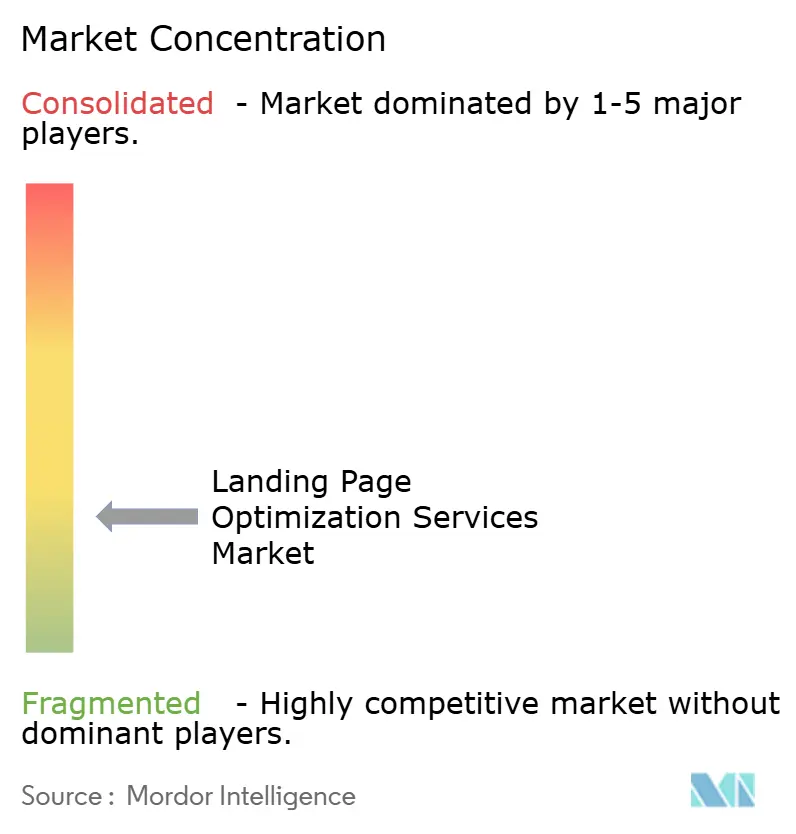
The Landing page optimization services market is moderately fragmented because buyers can choose among purpose-built landing page platforms, experimentation suites, all-in-one marketing platforms, behavioral analytics suppliers, and specialist conversion rate optimization agencies. Purpose-built providers include Unbounce, Instapage, Landingi, and Leadpages, while Optimizely and Wingify supply experimentation and personalization capabilities for more complex programs. HubSpot and GetResponse offer broader marketing environments, and Hotjar, FullStory, Crazy Egg, and UserTesting contribute behavioral analytics and session intelligence used in optimization workflows. Conversion Rate Experts, KlientBoost, Invesp, WebFX, and Single Grain represent specialist agencies that compete through statistical expertise, vertical knowledge, implementation skill, and the ability to connect page activity with business outcomes. This mix allows smaller clients to select focused tools while larger organizations can choose integrated systems that bring together page building, customer data, analytics, campaign management, and testing.
Wingify unified VWO and AB Tasty under a common brand in 2026 and moved the VWO application to app.wingify.com on June 13, 2026, combining mature experimentation and personalization capabilities on a shared product surface.[3] The combined offering is supported by the Wandz AI layer, which brings together AB Tasty’s Evi assistant and VWO’s Copilot for natural-language experiment generation and result analysis. VWO also released interconnected Behavior Analytics with Feature Experimentation in June 2026, placing heatmaps and session recordings inside campaign reports to shorten the path from behavioral observation to testing decisions. Optimizely extended its position into AI-search visibility through its June 2026 AEO partnership with Conductor, which combined AI traffic data, AEO intelligence, and automated analysis tools. These moves show how the Landing page optimization services market is being shaped by broader offerings that join discovery, personalization, experimentation, and analysis.
Instapage introduced an AI-Powered Marketing Platform in 2026 that combined AI Page Generation, AI Email Generation, and AI Collections, moving the company closer to full-funnel marketing platforms while retaining its conversion focus. Specialist agencies remain relevant in healthcare and financial services where buyers need statistical rigor, HIPAA-aware tracking, and compliance-sensitive form design that platform tools cannot fully automate. Landingi launched Orbit in July 2026, connecting its Lunar page generator and Solis analytics tool to third-party LLMs through an MCP server, after launching Lunar in 2025 to produce pages from text prompts. The Landing page optimization services market will remain competitive as AI-native workflows make more capabilities available in software while complex customer programs still require specialist implementation, interpretation, and governance.
Landing Page Optimization Services Industry Leaders
-
Unbounce Marketing Solutions Inc.
-
Instapage, Inc.
-
HubSpot, Inc.
-
Wingify Software Private Limited
-
Optimizely, Inc.
- *Disclaimer: Major Players sorted in no particular order
Landing Page Optimization Services Market Companies Covered in this Report
- Unbounce Marketing Solutions Inc.
- Instapage, Inc.
- HubSpot, Inc.
- Wingify Software Private Limited
- Optimizely, Inc.
- Leadpages, LLC
- GetResponse S.A.
- Landingi Sp. z o.o.
- Hotjar Limited
- Crazy Egg, Inc.
- Single Grain, LLC
- KlientBoost, LLC
- Conversion Rate Experts Limited
- Invesp, LLC
- WebFX, Inc.
- AdVenture Media Group, LLC
- Digital Silk, LLC
- FullStory, Inc.
- UserTesting, Inc.
Recent Industry Developments in Landing Page Optimization Services Market
- July 2026: Landingi launched Orbit, an MCP server that connects its Lunar AI landing page generator and Solis analytics tool directly to third-party LLMs, enabling landing page creation and campaign management from within AI-native agent workflows without switching platforms, positioning Landingi as infrastructure for AI-first marketing operations.
- July 2026: Wingify launched VWO AB Tasty Commerce, a unified platform consolidating product search, recommendations, and merchandising under a single catalog and shared AI layer, the flagship product integration following the 2026 VWO and AB Tasty merger and the most significant commerce-layer addition in the Wingify suite to date.
- June 2026: Optimizely launched its full AEO platform in partnership with Conductor, integrating log-based AI traffic data, GEO and AEO intelligence, and autonomous agents including the AEO Gap Finding Agent and Competitive AI Share of Voice Agent into a single enterprise platform, the first platform-level combination of AI search visibility intelligence with landing page experimentation at scale.
- June 2026: Optimizely released Limitless 1:1 Personalization within Optimizely Opal, enabling marketing and digital teams to deliver tailored landing page experiences to every customer at every stage of the journey at enterprise scale, with pages generated and continuously refreshed by an AI orchestration layer drawing from CRM history, product data, and behavioral signals.
Global Landing Page Optimization Services Market Report Scope
Landing Page Optimization Services Market refers to agencies and service providers that improve dedicated web pages to maximize conversions from paid, organic, email, and social traffic. It includes CRO strategy, UX and copy refinement, A/B testing, speed optimization, personalization, and analytics focused on turning visitors into leads, sales, or signups.
The Landing Page Optimization Services Market Report is Segmented by Service Type (Consulting and Strategy, Design and Development, Implementation and Integration, Optimization and Testing, Analytics and Reporting, and Maintenance and Support), Application (Lead Generation, Mobile Optimization, A/B Testing, and Campaign and Event Registration), End-User Industry (Retail and E-commerce, BFSI, Healthcare, Media and Entertainment, Telecommunications, Travel and Hospitality, Manufacturing, and Automotive), and Geography (North America, South America, Europe, Asia-Pacific, Middle East, and Africa). The Market Forecasts are Provided in Terms of Value (USD).
Segmentation Overview
| Consulting and Strategy |
| Design and Development |
| Implementation and Integration |
| Optimization and Testing |
| Analytics and Reporting |
| Maintenance and Support |
| Lead Generation |
| Mobile Optimization |
| A/B Testing |
| Campaign and Event Registration |
| Retail and E-commerce |
| BFSI |
| Healthcare |
| Media and Entertainment |
| Telecommunications |
| Travel and Hospitality |
| Manufacturing |
| Automotive |
| Other End-User Industries |
| North America | United States |
| Canada | |
| Mexico | |
| South America | Brazil |
| Argentina | |
| Chile | |
| Rest of South America | |
| Europe | Germany |
| United Kingdom | |
| France | |
| Italy | |
| Spain | |
| Rest of Europe | |
| Asia-Pacific | China |
| Japan | |
| India | |
| South Korea | |
| Australia | |
| Rest of Asia-Pacific | |
| Middle East | Saudi Arabia |
| United Arab Emirates | |
| Qatar | |
| Rest of Middle East | |
| Africa | South Africa |
| Egypt | |
| Nigeria | |
| Rest of Africa |
| By Service Type | Consulting and Strategy | |
| Design and Development | ||
| Implementation and Integration | ||
| Optimization and Testing | ||
| Analytics and Reporting | ||
| Maintenance and Support | ||
| By Application | Lead Generation | |
| Mobile Optimization | ||
| A/B Testing | ||
| Campaign and Event Registration | ||
| By End-User Industry | Retail and E-commerce | |
| BFSI | ||
| Healthcare | ||
| Media and Entertainment | ||
| Telecommunications | ||
| Travel and Hospitality | ||
| Manufacturing | ||
| Automotive | ||
| Other End-User Industries | ||
| By Geography | North America | United States |
| Canada | ||
| Mexico | ||
| South America | Brazil | |
| Argentina | ||
| Chile | ||
| Rest of South America | ||
| Europe | Germany | |
| United Kingdom | ||
| France | ||
| Italy | ||
| Spain | ||
| Rest of Europe | ||
| Asia-Pacific | China | |
| Japan | ||
| India | ||
| South Korea | ||
| Australia | ||
| Rest of Asia-Pacific | ||
| Middle East | Saudi Arabia | |
| United Arab Emirates | ||
| Qatar | ||
| Rest of Middle East | ||
| Africa | South Africa | |
| Egypt | ||
| Nigeria | ||
| Rest of Africa | ||
Key Questions Answered in the Report
What is the size of the Landing page optimization services market?
The Landing page optimization services market was estimated at USD 2.68 billion in 2026 and is forecast to reach USD 5.19 billion by 2031, at a 14.13% CAGR.
Which service type leads landing page optimization services?
Design and Development led service-type spending with a 24.66% share in 2025 because page architecture supports later testing, tracking, and personalization.
Which application is expected to expand fastest through 2031?
A/B Testing is expected to expand at a 14.77% CAGR from 2026 to 2031 as AI can reduce the effort required to create and assess variants.
Which end-user sector creates the largest demand for landing page optimization?
Retail and E-commerce held a 28.44% share in 2025 because conversion gains can increase revenue from traffic that companies have already acquired.
Why are AI tools affecting landing page optimization services?
AI tools support tailored pages, variant generation, behavioral analysis, and AI-search visibility work, expanding the range of activities providers can offer.
Which region is expected to expand fastest?
Asia-Pacific is expected to expand at a 14.94% CAGR through 2031, supported by e-commerce activity, mobile-first behavior, and performance marketing investment.