
Laboratory Proficiency Testing Market Size and Share
Market Overview
| Study Period | 2020 - 2031 |
|---|---|
| Market Size (2026) | USD 1.68 Billion |
| Market Size (2031) | USD 2.26 Billion |
| Growth Rate (2026 - 2031) | 6.18 % |
| Fastest Growing Market | Asia Pacific |
| Largest Market | North America |
| Market Concentration | Medium |
Major Players *Disclaimer: Major Players sorted in no particular order Image © Mordor Intelligence. Reuse requires attribution under CC BY 4.0. | |
Laboratory Proficiency Testing Market Analysis by Mordor Intelligence
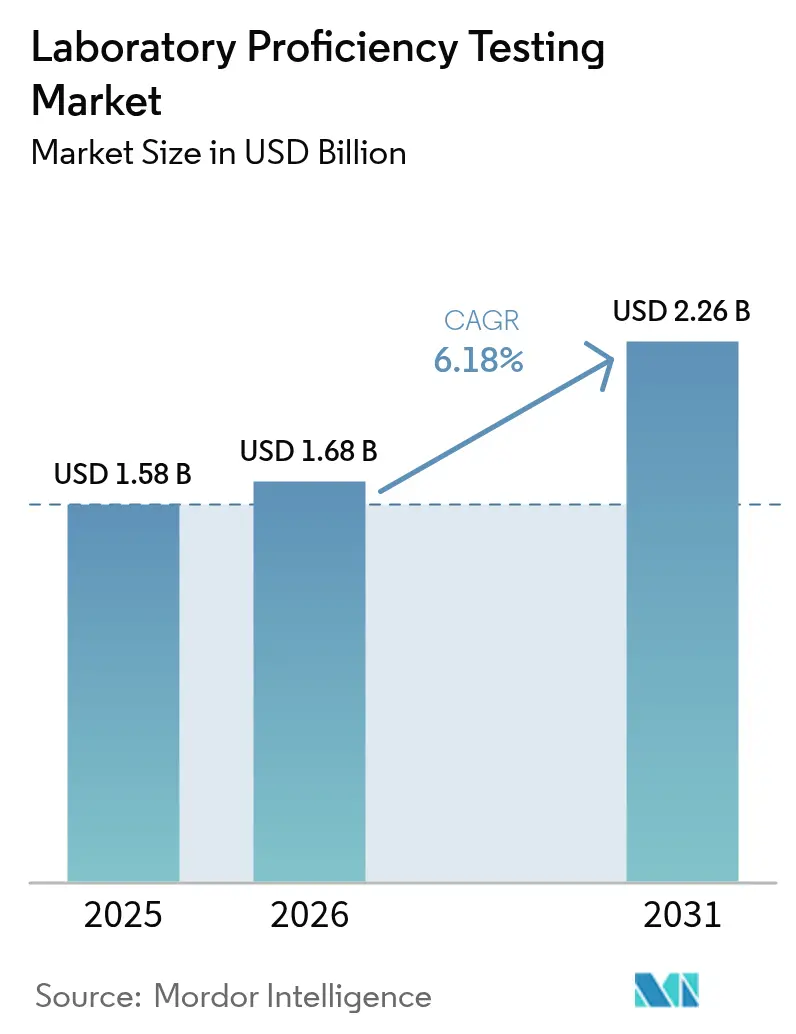
The laboratory proficiency testing market size is expected to grow from USD 1.58 billion in 2025 to USD 1.68 billion in 2026 and is forecast to reach USD 2.26 billion by 2031 at 6.18% CAGR over 2026-2031. This trajectory reflects a shift from compliance-only participation toward strategic quality differentiation as regulators tighten analytical performance criteria and as laboratories deploy more advanced molecular and cell-based assays. Revised CLIA grading for blood alcohol and blood lead testing that took effect in January 2025 has already raised precision expectations across North American clinical laboratories [1]. Food-, water- and environmental-testing laboratories face parallel pressures under the FDA’s LAAF program and the EPA’s new PFAS methods, accelerating demand for validated external quality assessment[2] Provider preferences continue to tilt toward vendor-neutral schemes, while digital platforms begin to streamline result analytics—signals that the laboratory proficiency testing market is becoming an operational performance lever rather than a regulatory obligation.
Key Report Takeaways
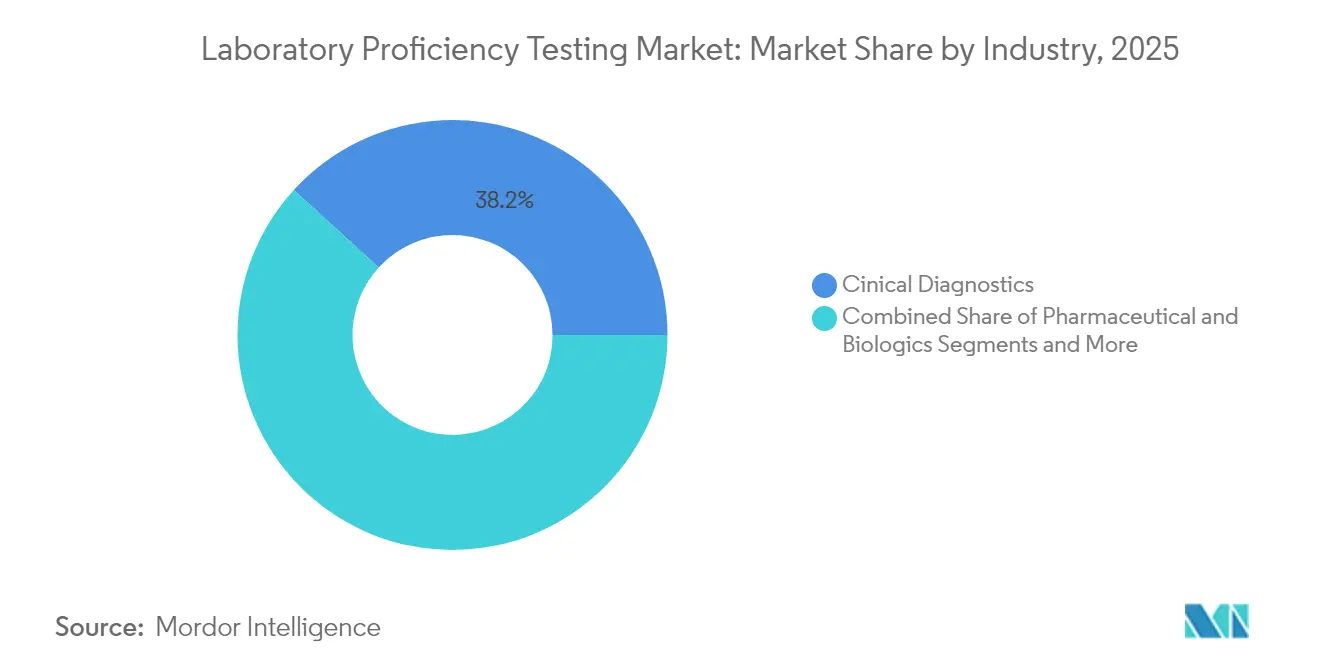
- By industry, Clinical Diagnostics led with 38.21% of laboratory proficiency testing market share in 2025; Pharmaceutical & Biologics is forecast to grow at 7.32% CAGR to 2031.
- By technology, Cell Culture-based Assays accounted for 27.10% share of the laboratory proficiency testing market size in 2025, while PCR & Molecular Methods are advancing at a 6.94% CAGR through 2031.
- By provider type, Independent/Third-party Providers held 54.02% of laboratory proficiency testing market share in 2025 and are expanding at an 7.78% CAGR through 2031.
- By geography, North America commanded 41.98% revenue share in 2025, whereas Asia-Pacific is projected to record the fastest 7.96% CAGR to 2031.
Note: Market size and forecast figures in this report are generated using Mordor Intelligence’s proprietary estimation framework, updated with the latest available data and insights as of 2026.
Global Laboratory Proficiency Testing Market Trends and Insights
Drivers Impact Analysis*
| Driver | (~) % Impact on CAGR Forecast | Geographic Relevance | Impact Timeline |
|---|---|---|---|
| Stricter ISO/IEC 17025 & 17043 accreditation mandates | +1.8% | Global, with early adoption in North America & EU | Medium term (2-4 years) |
| Growing clinical diagnostics volume amid chronic disease burden | +1.5% | Global, concentrated in developed markets | Long term (≥ 4 years) |
| Tightening food & water-safety regulations worldwide | +1.2% | Global, with regulatory leadership in North America | Short term (≤ 2 years) |
| Biologics manufacturing boom demanding validated analytical methods | +1.0% | North America & EU core, expansion to APAC | Medium term (2-4 years) |
| Legalization of cannabis & psychedelics spurring niche PT schemes | +0.6% | North America, selective EU markets | Short term (≤ 2 years) |
| Rise of remote/at-home testing creating digital PT opportunities | +0.4% | Global, technology-enabled markets | Long term (≥ 4 years) |
| Source: Mordor Intelligence | |||
Stricter ISO/IEC 17025 & 17043 Accreditation Mandates
Global alignment toward ISO/IEC 17025:2017 and the 2023 update of ISO/IEC 17043 pushes laboratories to demonstrate quantitative competence instead of procedural compliance. Hong Kong’s HKAS adopted the new 17043 criteria in November 2024, while Canada’s Standards Council enforced parallel upgrades in May 2024. Accreditation bodies may suspend non-conforming labs, spurring consolidation and increasing demand for statistically robust external quality assessment. As ISO convergence expands to emerging markets, the laboratory proficiency testing market gains momentum through mandatory participation clauses tied to accreditation renewals.
Growing Clinical Diagnostics Volume Amid Chronic Disease Burden
Rising incidence of diabetes, cardiovascular disease and oncology testing has increased the average test menu per U.S. laboratory and extended participation to next-generation sequencing panels. CLIA rules obligate all moderate- and high-complexity labs to enroll in approved programs, and CMS authorized new cytology schemes for 2025. Large networks such as Quest Diagnostics reported USD 9.3 billion revenue in 2023, highlighting how scale multiplies proficiency testing subscriptions across multiple sites. The laboratory proficiency testing market therefore scales directly with diagnostic volume, particularly where advanced molecular assays require tailored external quality assessment.
Tightening Food & Water-Safety Regulations Worldwide
The FDA declared adequate capacity for mycotoxin testing under its LAAF program in June 2024, converting voluntary schemes into mandatory accreditation checkpoints. Parallel EPA PFAS rules issued in April 2024 oblige environmental labs to verify method competency before result acceptance . Under the Safe Drinking Water Act, drinking-water surveillance permits expedited methods for PFAS and chlorine as of January 2025, provided laboratories document ongoing proficiency. These developments transform the laboratory proficiency testing market into a non-discretionary spend across the agri-food and environmental sectors.
Biologics Manufacturing Boom Demanding Validated Analytical Methods
As monoclonal antibodies, cell therapies and gene vectors expand, regulators require proof of assay equivalence across global sites. FDA guidance on analytical procedures stresses potency, purity and identity benchmarks that are frequently demonstrated through external proficiency rounds. Labcorp contributed testing to 90% of FDA approvals in 2023, evidencing demand for harmonized quality data across large networks. The laboratory proficiency testing market is thus integral to biologics lifecycle management, tying analytical validation directly to GMP compliance.
Restraints Impact Analysis*
| Restraint | (~) % Impact on CAGR Forecast | Geographic Relevance | Impact Timeline |
|---|---|---|---|
| High subscription costs for small & mid-size laboratories | -0.8% | Global, acute in emerging markets | Short term (≤ 2 years) |
| Sample logistics & stability hurdles in emerging regions | -0.6% | APAC, Latin America, MEA | Medium term (2-4 years) |
| Consolidation-driven discontinuation of key PT programs | -0.4% | North America & EU | Short term (≤ 2 years) |
| Data-privacy rules limiting inter-lab data sharing analytics | -0.3% | EU, expanding globally | Long term (≥ 4 years) |
| Source: Mordor Intelligence | |||
High Subscription Costs for Small & Mid-Size Laboratories
Independent studies by the Association of Public Health Laboratories indicate that annual proficiency testing outlays can exceed 3% of gross revenue for low-volume labs, constraining participation particularly in developing economies. The termination of the USP scheme in August 2023 raised switching costs, underscoring how market exits can inflate pricing pressure on smaller facilities .
Sample Logistics & Stability Hurdles in Emerging Regions
Cold-chain gaps, customs delays and limited courier networks jeopardize sample integrity in parts of Africa, South-East Asia and Latin America. Programs often need to reship materials, extending turnaround and elevating costs; APHL surveys rank stability failures among the top three user complaints. These challenges temper immediate addressable demand in high-growth geographies despite favorable regulatory trends
*Our forecasts treat driver/restraint impacts as directional, not additive. The impact forecasts reflect baseline growth, mix effects, and variable interactions.
Segment Analysis
By Industry: Clinical Diagnostics Dominates While Pharma Accelerates
Clinical Diagnostics held 38.21% of laboratory proficiency testing market share in 2025 as CLIA mandates coupled with rising chronic disease testing volumes sustained program enrollment. Laboratories routinely parcel the laboratory proficiency testing market size for hematology, chemistry and infectious disease panels across multiple providers, reinforcing predictable renewal revenue. Meanwhile, Pharmaceutical & Biologics posted the quickest 7.32% CAGR, propelled by stringent analytical method validation in monoclonal antibody potency and mRNA vaccine release.
The laboratory proficiency testing industry is also witnessing consistent microbiology uptake driven by dual demand from food safety and clinical bacteriology labs. Cosmetics & Personal Care inquiries grew after the FDA’s MoCRA enforcement date in July 2024, prompting new schemes for heavy metals and microbial challenge. Cannabis and psychedelics testing rounds widened the application base, indicating that differentiated external quality assessment can precede formal regulatory edicts in emerging niches.

By Technology: Cell Culture Keeps Lead but Molecular Surges
Cell Culture-based Assays accounted for 27.10% of the laboratory proficiency testing market size in 2025, reflecting continued biologics potency testing and viral clearance confirmation. Yet PCR & Molecular Methods are set to outpace, expanding at 6.94% CAGR as precision oncology, pathogen genomics and wastewater-based epidemiology demand nucleic-acid accuracy benchmarking.
Chromatography and mass spectrometry rounds maintain core relevance for pharmaceutical impurity profiling and PFAS quantitation, while spectrophotometry serves routine clinical chemistry programs at scale. The laboratory proficiency testing industry increasingly integrates digital data exchange—especially for sequencing files—improving peer-comparison analytics and expanding scheme value beyond simple pass/fail metrics.
By Provider Type: Independent Providers Define Objectivity
Independent/Third-party Providers controlled 54.02% of laboratory proficiency testing market share in 2025, translating the laboratory proficiency testing market into a neutral arbiter of analytical competence across platforms. Their 7.78% growth rate reflects customer preference to decouple quality oversight from instrument vendors.
Manufacturer-affiliated schemes retain significance for highly specialized hardware but face skepticism over objectivity, while government or accreditation-body programs focus on public-health missions such as water quality and newborn screening. Several independents now bundle workflow analytics dashboards, offering laboratories real-time performance trending that enhances internal quality management systems.

Geography Analysis
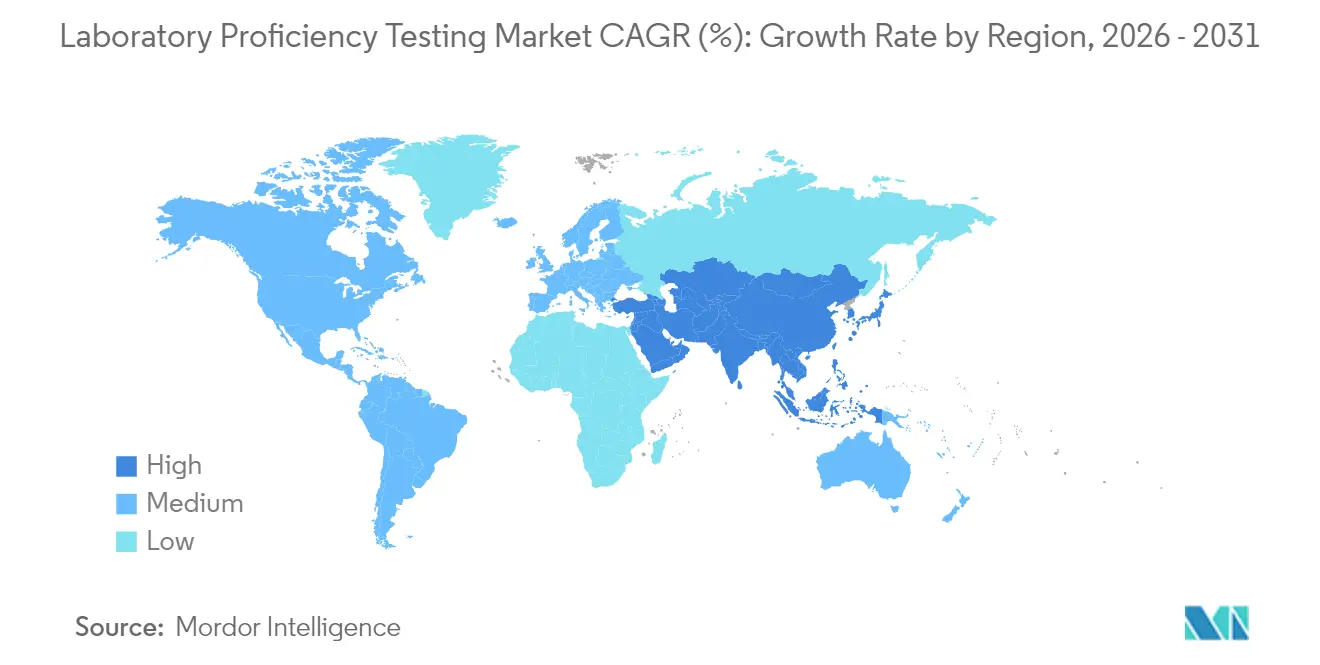
North America generated 41.98% of 2025 revenues, anchored by CLIA-based compulsory enrollment of more than 260,000 U.S. laboratories and by Canada’s harmonized accreditation system. The region’s laboratory proficiency testing market also benefits from niche demand in cannabis testing as state-level legalization continues. Consolidation among commercial super-networks such as Labcorp and BioReference supports volume robustness even as unit pricing comes under negotiation.
Asia-Pacific records the fastest 7.96% CAGR to 2031, reflecting China’s CNAS accreditation requirements, Japan’s Food Sanitation Act testing obligations and India’s expanding bio-manufacturing corridor. APAC mutual recognition arrangements further enlarge cross-border acceptance, lowering redundant test costs and raising adoption of sophisticated external quality controls. Logistics constraints remain a drag in parts of South-East Asia, yet digital reporting platforms partially offset physical distribution gaps.
Europe sustains mature albeit steady growth under EN ISO/IEC 17025 implementation and evolving monographs such as the European Pharmacopoeia’s cannabis flower inclusion in July 2024. Brexit complexities marginally elevate administrative overhead but have not dampened the laboratory proficiency testing market given maintained mutual recognition agreements. Latin America and the Middle East & Africa represent long-term upside once cold-chain and customs bottlenecks resolve, with regional governments already signaling alignment with ISO norms.
Regulatory Landscape
Laboratory proficiency testing requirements are increasingly tied to accreditation and medical-laboratory oversight frameworks that reference ISO/IEC 17043 for provider competence and impartiality. In the United States, CMS administers CLIA proficiency testing requirements under 42 CFR Part 493 (Subpart H), and updated CLIA proficiency testing regulations (CMS-3355-F) took effect in July 2024, reinforcing mandated enrollment and performance evaluation for moderate- and high-complexity testing.
Outside the United States, national accreditation bodies are formalizing transitions to ISO/IEC 17043:2023, which lifts compliance expectations for providers seeking scheme acceptance in accreditation assessments. For example, the Standards Council of Canada set a May 2026 transition deadline tied to ISO/IEC 17043:2023 implementation, while the WHO links participation in external quality assessment and proficiency testing to eligibility within certain laboratory networks, making ongoing PT participation a practical requirement for program recognition and procurement-aligned laboratory designation.
Competitive Landscape
The laboratory proficiency testing market is moderately concentrated; technical barriers, accreditation approvals and logistical infrastructure deter rapid entrant turnover. Independent providers leverage vendor-neutral credibility, while instrumentation companies integrate schemes to reinforce aftermarket services. Eurofins' purchases of ViraCor-IBT (May 2024) and Infinity Laboratories (February 2025) showcase horizontal additions that extend infectious-disease and materials science expertise.
Strategic themes include digitalization—cloud portals now autoload analytic results into QC dashboards—and white-space expansion into psychedelics, at-home sample kits and AI-assisted histopathology. U.S. Department of Defense environmental testing standards updated in December 2023 require proficiency testing participation for contract eligibility, establishing baseline demand. Vendor differentiation increasingly hinges on turnaround speed, statistical depth and multi-matrix portfolio breadth rather than price alone.
Consolidation continues: Labcorp announced three asset deals between September 2024 and May 2025, strengthening oncology and women's-health coverage. Providers without global logistics networks may exit niche schemes, potentially curbing market choice yet improving cross-round comparability where dominant players standardize metrics.
Laboratory Proficiency Testing Industry Leaders
-
Bio-Rad Laboratories, Inc.,
-
FAPAS
-
LGC Limited
-
Merck KGaA
-
Trilogy Analytical Laboratory
- *Disclaimer: Major Players sorted in no particular order

Market Opportunities and Future Outlook
The shift to ISO/IEC 17043:2023 creates a near-term window for accredited, vendor-neutral schemes that can meet tighter expectations around impartiality, documentation, and risk management across clinical, food, and industrial testing. CAPs June 2026 reaccreditation to the ISO/IEC 17043:2023 edition also points to continued upgrades in provider governance and delivery models, while raising the bar for smaller or regional PT operators that need internationally recognized accreditation to remain specified in laboratory quality systems.
Advanced molecular and advanced-therapy test menus are adding further PT/EQA design requirements where commutable materials, digital result files, and method-specific peer grouping influence how schemes are structured. Labqualitys February 2026 launch of EQA pilot schemes, including Candida auris nucleic acid detection and NGS for somatic tumors, supports the case for proficiency assessment in high-complexity assays. In Germany, Rili-BAEK-aligned 2026 program publications and the extended transition period for selected Rili-BAEK Table B1-1 requirements through May 2028 continue to support scheme development tied to national quality directives rather than one-time compliance cycles.
Recent Industry Developments
- May 2026: Merck announced a five-year agreement to act as the sole analytical and biosafety release testing provider for Genetix Biotherapeutics FDA-approved gene therapies. The deal strengthens Mercks position in high-complexity testing workflows that depend on validated quality systems, reinforcing demand for rigorous external performance benchmarking across advanced modalities.
- January 2026: LGC Limited released its 2026 LGC AXIO Proficiency Testing schemes and expanded access to programs spanning clinical, food, and industrial testing. By integrating industrial proficiency testing into the AXIO platform with enhanced portal reporting, LGC increased the value of proficiency testing as an ongoing performance analytics tool rather than a periodic compliance exercise.
- October 2024: Bio-Rad Laboratories launched its External Quality Assurance Services (EQAS) Specialty Immunoassay (SPIA) program, consolidating 13 specialty analytes under ISO/IEC 17043 accreditation. The bundled approach simplifies enrollment for laboratories running specialized panels and supports more standardized peer comparison across sites and instrument environments.
Research Methodology Framework and Report Scope
Market Definition and Coverage
This market covers the revenues earned from organized, external laboratory proficiency testing programs where providers send test items to laboratories, collect results, and score performance through statistical comparison to confirm analytical competence across common testing disciplines.
Scope exclusions: Internal round-robin checks run inside a single organization for R&D, instrument trials, or informal quality exercises are excluded when there is no independent, commercial provider involved.
Segmentation Overview
- By Industry
- Clinical Diagnostics
- Microbiology
- Pharmaceutical & Biologics
- Food & Animal Feed
- Water & Environmental
- Commercial Beverages
- Cosmetics & Personal Care
- Others
- By Technology
- Chromatography
- Spectrophotometry
- Immunoassays
- PCR & Molecular Methods
- Cell Culture-based Assays
- Other Emerging Techniques
- By Provider Type
- Independent / Third-party Providers
- Instrument-Manufacturer Programs
- Government & Accreditation-body Schemes
- By Geography
- North America
- United States
- Canada
- Mexico
- Europe
- United Kingdom
- Germany
- France
- Italy
- Spain
- Rest of Europe
- Asia-Pacific
- China
- India
- Japan
- South Korea
- Australia
- Rest of Asia-Pacific
- South America
- Brazil
- Argentina
- Rest of South America
- Middle East and Africa
- GCC
- South Africa
- Rest of Middle East and Africa
- North America
Data Sources, Market Sizing, and Validation
Desk Research
Desk work starts by building the rulebook of what proficiency testing means in practice, and how programs are typically priced and delivered. Public and official sources, such as ISO publications (for ISO/IEC 17043 and related guidance), CLIA resources and CMS materials for clinical lab quality programs, FDA pages for regulated testing contexts, and accreditation-body guidance such as ILAC documents, help keep definitions aligned with how laboratories are assessed.
We also use sources such as government lab guidance portals, trade association pages, peer reviewed journal articles on external quality assessment design, and public documents from proficiency testing scheme operators and accreditors. Company annual reports, investor presentations, and reputable press coverage are used to understand provider mix, geographic footprint, and program expansion themes. When needed, we complement this with paid subscriptions for company financials and news screening, patent checks, and an import export shipment level database for select test material categories. These desk research sources are illustrative only, and many other references are reviewed for data collection, validation, and clarification.
Primary Interviews and Surveys
Primary work is used to verify which lab types buy external proficiency testing, how often schemes are run, and what drives pricing for different disciplines. We speak with scheme operators, laboratory quality managers, accreditation stakeholders, and distributor or channel participants across APAC, EMEA, and the Americas, so assumptions from desk research can be checked and then tightened.
Distribution of primary research fieldwork respondents
| Company type | Respondent position | Region |
|---|---|---|
| Top tier: 37% | CXOs: 14% | APAC: 46% |
| Mid tier: 46% | Functional/Unit leaders: 42% | EMEA: 35% |
| Smaller Players: 17% | Managers: 44% | Americas: 19% |
Market-Sizing & Forecasting
Sizing is built using a top-down approach where the demand pool is reconstructed from lab quality compliance needs and testing activity across major disciplines, and then filtered by the share that is met through paid, external proficiency testing schemes. To keep the outcome realistic, totals are corroborated with selective bottom-up approximations, such as sampled scheme calendars by discipline, a check on typical participants per round, and simple ASP x volume calculations for commonly purchased programs.
Key inputs used in the model include the number of accredited and applicant laboratories by region, typical proficiency testing frequency (for example, per analyte or per discipline per year), participation rates for regulated testing areas, the mix of program types (independent third party, government or accreditation body schemes, and instrument-linked programs), and observed price ranges for rounds and subscriptions. When a bottom-up check has gaps, missing cells are handled with conservative proxy values taken from adjacent disciplines or similar accreditation contexts, and then re-validated through follow-up expert checks.
For the forecast, scenario analysis is used so demand can move with realistic changes in accreditation adoption, regulatory enforcement intensity, and lab network expansion, and then translated into revenue using expected pricing progression. Assumptions are tuned using what practitioners expect for program cadence, cross border participation, and the pace at which newer testing areas adopt external quality assessment.
Data Validation & Update Cycle
Validation is done through multiple checks so the final number is not driven by one single input. Outputs are compared with independent signals, such as accredited lab counts, publicly visible scheme volumes, and observed pricing bands, and then variance points are reviewed before sign-off.
If a large mismatch appears, we re-check definitions, rerun currency conversions for the relevant year, and re-contact selected experts to confirm whether a structural shift has occurred. Reports are refreshed annually, and interim updates are done when material events occur, such as major policy changes, large program expansions, or notable shifts in lab accreditation patterns. Before delivery, an analyst performs a fresh pass so clients receive the most current view.
Mordor Intelligence's Laboratory Proficiency Testing Market Size Versus Other Published Estimates
Published market sizes for laboratory proficiency testing often look different even when the topic name is the same. In most cases, the spread comes from how each study treats adjacent services, what year is used as the base, and how pricing and participation are converted into revenue.
Key gap drivers are usually scope boundaries and the activity signals used to estimate demand. Some estimates bundle calibration, broader lab testing services, or internal round-robin activities into the same pool, while others may only count ISO 17025 oriented programs or use fixed exchange rates that do not match the stated base year. Differences can also come from whether the model uses program frequency and participant counts as the main volume driver, or whether it leans more on high level lab counts without checking how often schemes actually run.
Benchmark comparison
| Source | Market Size | Gaps in Research Methodology |
|---|---|---|
| Mordor Intelligence | USD 1.58 B (2025) | |
| Global Consultancy A | USD 1.50 B (2024) | Uses an earlier base year and tends to apply fixed FX timing, and the scope appears to be narrower on program types, which can miss government or instrument-linked schemes in some regions. |
| Industry Research Publisher B | USD 1.46 B (2024) | Anchors sizing on a 2024 starting point and emphasizes a limited set of end uses, with limited clarity on whether internal quality rounds and adjacent quality services are excluded consistently. |
The table shows a one-year timing shift and a small scope spread, and in Mordor Intelligence's model, revenue is counted only for paid external proficiency testing schemes while internal round-robin exercises are left out even if they support quality management. By tying volume to scheme cadence, participant pools, and realistic pricing bands, the final market value stays traceable to practical lab behavior rather than broad labels.
Key Questions Answered in the Report
What is driving growth in the laboratory proficiency testing market after 2026?
Stricter ISO accreditation, expanding clinical diagnostics volumes and the rollout of new food- and water-safety regulations are lifting global demand, resulting in a projected 6.18% CAGR over 2026-2031.
Which industry segment is expanding the fastest?
Pharmaceutical & Biologics is forecast to grow at 7.32% CAGR as biologics manufacturing and method validation intensify external quality assessment requirements.
How large is the North American share of the laboratory proficiency testing market?
North America contributed 41.98% of global revenue in 2025, supported by mandatory CLIA participation and FDA, EPA program demands.
Why are independent proficiency testing providers gaining share?
Laboratories prefer vendor-neutral programs to avoid perceived conflicts of interest and to access broader multi-platform benchmarking.