
Global Laboratory Centrifuge Market Size and Share
Market Overview
| Study Period | 2020 - 2031 |
|---|---|
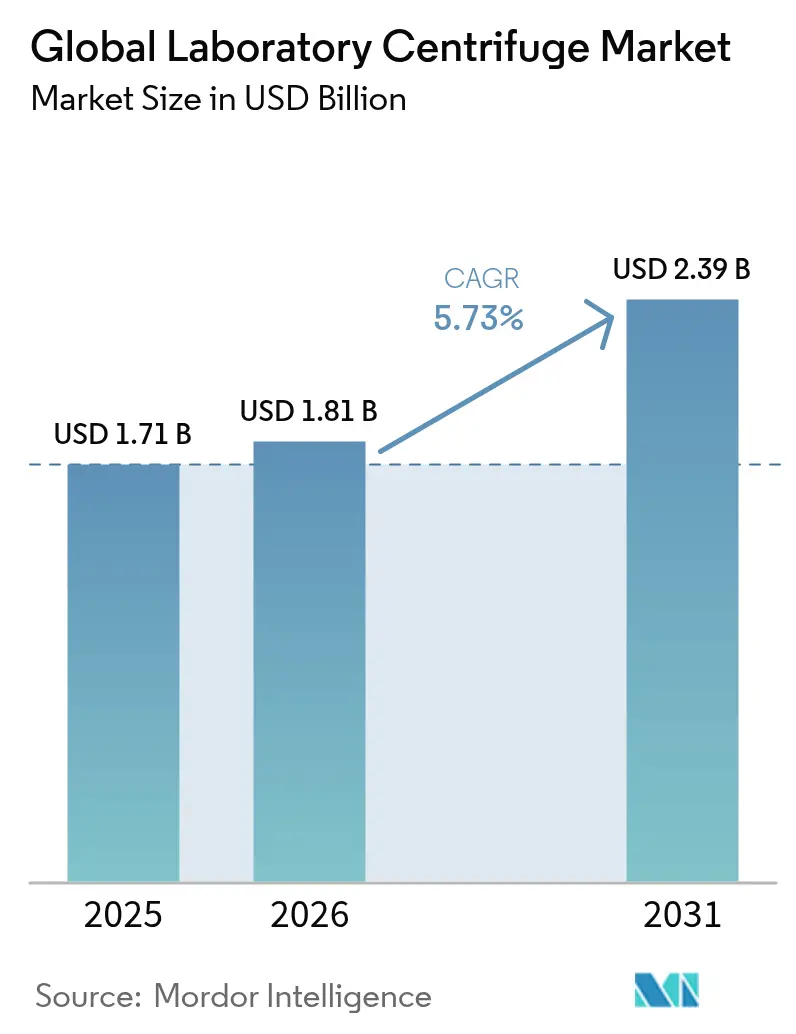
| Market Size (2026) | USD 1.81 Billion |
| Market Size (2031) | USD 2.39 Billion |
| Growth Rate (2026 - 2031) | 5.73 % |
| Fastest Growing Market | Asia Pacific |
| Largest Market | North America |
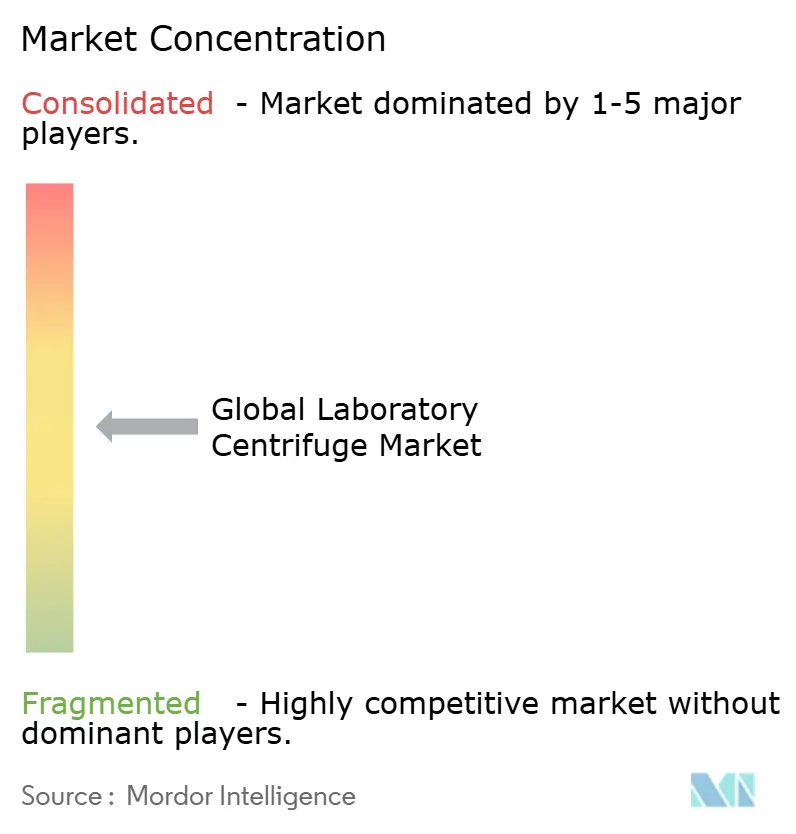
| Market Concentration | Medium |
Major Players *Disclaimer: Major Players sorted in no particular order Image © Mordor Intelligence. Reuse requires attribution under CC BY 4.0. | |
Global Laboratory Centrifuge Market Analysis by Mordor Intelligence
The laboratory centrifuge market size was valued at USD 1.71 billion in 2025 and estimated to grow from USD 1.81 billion in 2026 to reach USD 2.39 billion by 2031, at a CAGR of 5.73% during the forecast period (2026-2031). Vigorous demand from cell and gene therapy manufacturing, recovery in bioprocessing activity, and the push to automate diagnostic workflows anchor this expansion. Players enlarge capacity for viral-vector purification and integrate robotics to reduce manual touchpoints, while sustainability mandates spur adoption of energy-efficient refrigerated systems. North America holds the largest revenue base, yet Asia-Pacific logs the quickest gains as China and India channel public policy and capital into domestic medical-device production. These factors together reinforce the strategic relevance of the laboratory centrifuge market across precision medicine, academic research, and decentralized testing networks.
Key Report Takeaways
- By product type, equipment commanded 76.12% revenue share of the laboratory centrifuge market in 2025; accessories are forecast to post a 7.04% CAGR through 2031.
- By model type, benchtop systems led with 61.30% share in 2025, whereas floor-standing units are set to grow at 6.49% CAGR to 2031.
- By intended use, clinical applications accounted for 52.25% of the laboratory centrifuge market share in 2025, while pre-clinical research is projected to expand at a 6.28% CAGR.
- By application, diagnostics held 36.90% of revenue in 2025; cellomics is expected to record the highest 7.29% CAGR through 2031.
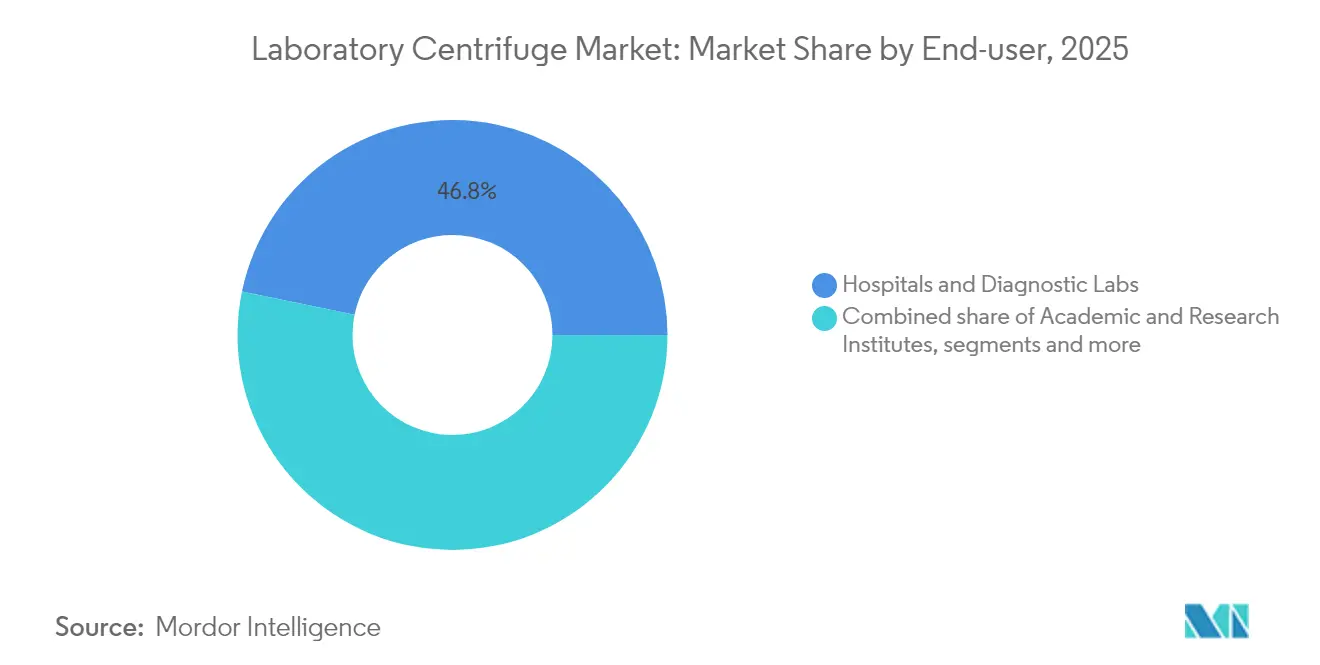
- By end-user, hospitals and diagnostic labs captured 46.75% of 2025 revenue, but biotech and pharma companies are poised for a 6.8% CAGR.
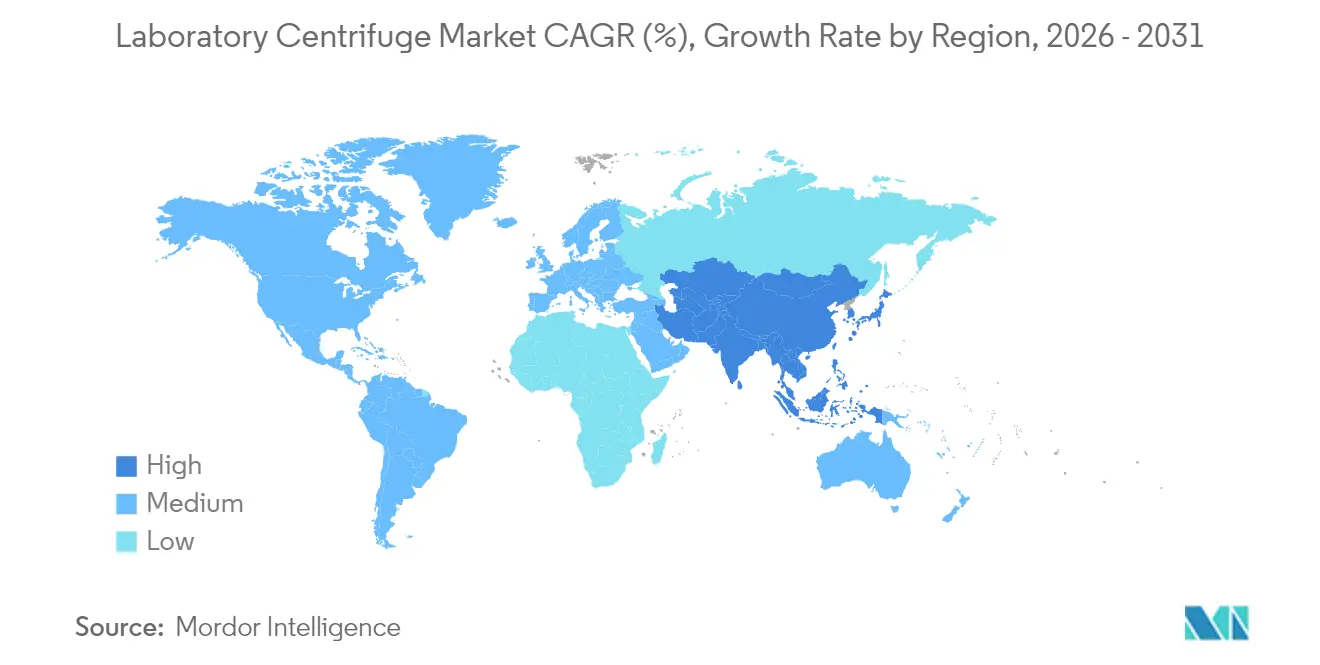
- By geography, North America led with 36.10% share in 2025, while Asia-Pacific is forecast to accelerate at a 7.68% CAGR.
Note: Market size and forecast figures in this report are generated using Mordor Intelligence’s proprietary estimation framework, updated with the latest available data and insights as of 2026.
Market Trends and Insights
Drivers Impact Analysis of Global Laboratory Centrifuge Market*
| Driver | (~) % Impact on CAGR Forecast | Geographic Relevance | Impact Timeline |
|---|---|---|---|
| High prevalence of chronic & infectious diseases | +1.2% | Global; highest concentration in aging populations of North America & Europe | Medium term (2-4 years) |
| Rising R&D spending in biopharma & life sciences | +1.5% | North America & Europe core; expanding to APAC | Long term (≥ 4 years) |
| Technological advances in high-throughput & refrigerated systems | +0.9% | Global; early adoption in developed markets | Short term (≤ 2 years) |
| Expansion of decentralised/near-patient diagnostic labs | +0.8% | APAC core; spill-over to MEA and Latin America | Medium term (2-4 years) |
| Viral-vector demand for cell & gene therapy manufacturing | +1.1% | North America & EU; expanding to APAC manufacturing hubs | Long term (≥ 4 years) |
| Rotor-refurbishment & circular-economy revenue streams | +0.4% | Global; emphasis on cost-conscious emerging markets | Medium term (2-4 years) |
| Source: Mordor Intelligence | |||
High Prevalence of Chronic & Infectious Diseases
Diagnostic laboratories rely on centrifugation to separate plasma and isolate pathogens for biomarkers that guide diabetes, cardiovascular, and cancer management. Safety-bucket designs now meet WHO tuberculosis protocols that call for sealed operation to reduce aerosol risk. Aging populations in the United States and Western Europe keep specimen volumes high, while novel infection outbreaks spur health systems to deploy portable centrifuges in frontline clinics. These conditions collectively maintain baseline demand across the laboratory centrifuge market.
Rising R&D Spending in Biopharma & Life Sciences
Drug-discovery programs adopt advanced separation workflows for protein purification, extracellular-vesicle isolation, and viral-vector production. The EVics system shows how tandem tangential-flow filtration overcomes legacy ultracentrifuge bottlenecks by processing up to 1 L while preserving biomolecule integrity. Contract research organizations equip new automated platforms to keep pace with sponsor projects, further expanding the laboratory centrifuge market.
Technological Advances in High-Throughput & Refrigerated Systems
Manufacturers prioritize energy savings, rotor durability, and run-time reductions. Beckman Coulter’s OptiMATE Gradient Maker cuts purification cycles by 75% for viral-vector workflows. Carbon-fiber rotors lighten load weight and curb power draw, meeting institutional sustainability metrics. Programmable refrigeration safeguards thermolabile samples and links to laboratory information systems, embedding modern centrifuges inside broader automation ecosystems.
Viral-Vector Demand for Cell & Gene Therapy Manufacturing
Thermo Fisher’s CTS Rotea counter-flow system recovers more than 95% of target cells at volumes up to 20 L, underscoring how continuous-flow centrifugation resolves commercial-scale vector needs. Single-use designs eliminate cross-contamination between lots, trimming cleaning validation costs in GMP settings. With over 2,000 cell and gene therapy trials now under way, viral-vector purification remains a growth pillar of the laboratory centrifuge market.
Restraints Impact Analysis of Global Laboratory Centrifuge Market*
| Restraint | (~) % Impact on CAGR Forecast | Geographic Relevance | Impact Timeline |
|---|---|---|---|
| High upfront capital cost of advanced systems | -0.7% | Global; greater impact in emerging markets | Short term (≤ 2 years) |
| Long equipment lifespans slowing replacement sales | -0.5% | Developed markets with established laboratory infrastructure | Long term (≥ 4 years) |
| Growth of outsourced centrifugation services | -0.3% | North America & Europe; expanding to APAC | Medium term (2-4 years) |
| Tightening biosafety & noise-emission regulations | -0.4% | Global; stricter enforcement in developed markets | Medium term (2-4 years) |
| Source: Mordor Intelligence | |||
High Upfront Capital Cost of Advanced Systems
Fully-equipped ultracentrifuges often exceed USD 100,000, restricting adoption by small laboratories. A USD 2 billion global secondary-equipment channel now supplies refurbished units with vendor warranties, offering affordable entry points. Leasing and rental plans further spread out expenditure, yet budget constraints persist, especially in Latin America and parts of Southeast Asia.
Tightening Biosafety & Noise-Emission Regulations
The United States imposed export controls on select centrifuges in January 2025, reflecting dual-use concerns.[1]Bureau of Industry and Security, “Controls on Certain Laboratory Equipment and Related Technology To Address Dual Use Concerns About Biotechnology,” federalregister.gov OSHA and CDC guidelines specify containment cups and sound-pressure limits that elevate compliance costs. Vendors now add automated lid interlocks, aerosol-tight seals, and acoustic insulation, but higher safety specifications raise list prices and lengthen procurement cycles.
*Our forecasts treat driver/restraint impacts as directional, not additive. The impact forecasts reflect baseline growth, mix effects, and variable interactions.
Global Laboratory Centrifuge Market Segment Analysis
By Product Type:
Equipment Dominance Drives Accessories InnovationEquipment represented 76.12% of 2025 revenue, confirming users’ primary focus on platform procurement within the laboratory centrifuge market. Ultracentrifuges reach speeds above 100,000 rpm, supporting protein and virus separation for biologics research. Microcentrifuges remain staples of routine assays, while multipurpose units cater to institutions needing rotor flexibility. The laboratory centrifuge market size for accessories is smaller but displays faster momentum as laboratories replace tubes, bottles, and rotor seals after repeated sterilization cycles. Carbon-fiber rotors, lighter yet corrosion-resistant, now enter service contracts that guarantee load balancing and fatigue inspection.
The accessories segment grows at 7.04% CAGR because consumables are replaced more frequently than hardware. Fixed-angle and swinging-bucket formats account for most aftermarket demand, backed by vendor programs that bundle rotor upgrades with calibration services. As high-throughput screens expand, laboratories secure bulk lots of single-use tubes to avoid cross-contamination. Manufacturers thus bank on recurring sales that complement initial hardware margins, reinforcing the resilience of the laboratory centrifuge market.


By Model Type:
Benchtop Systems Balance Performance and Space EfficiencyBenchtop units held 61.30% revenue in 2025, favored for daily diagnostic and academic protocols that handle volumes under 500 mL. Their compact footprint aligns with space-limited benches, and recent firmware updates add touch-screen controls plus QR-code maintenance logs. In contrast, floor-standing models realise a 6.49% CAGR by accommodating bags and bottles needed for upstream bioprocess harvests. Programmable ramps and vibration dampers meet GMP validation rules, which lifts their appeal for contract manufacturers.
The laboratory centrifuge market benefits as institutions deploy mixed fleets: benchtops for stat tests, floor units for batch purification. Integration with robotic arms enables unmanned loading, turning traditional floor systems into automated work cells. Vendors now offer hybrid service plans that remotely track rotor cycles across both model lines, minimising downtime while retaining operator familiarity.
By Intended Use:
Clinical Applications Drive Volume While Research Accelerates InnovationClinical laboratories generated 52.25% of revenue in 2025, highlighting centrifugation’s irreplaceable role in blood‐chemistry, coagulation, and urinalysis workflows. Hospitals value resilient designs, redundant safety locks, and global service coverage. Conversely, the pre-clinical research segment’s 6.28% CAGR shows how biotech start-ups and academia seek higher g-force ranges and programmable gradients to explore novel biomarkers.
These divergent needs push suppliers to maintain dual product lines. Research models add data export and temperature mapping, while clinical versions emphasise cycle repeatability under strict accreditation. Both segments underpin the broader laboratory centrifuge market by committing to recurring rotor inspection contracts that protect accreditation status.
By Application:
Diagnostics Leadership Faces Cellomics ChallengeDiagnostics held 36.90% of 2025 revenue, cementing its status as the laboratory centrifuge market cornerstone. Typical protocols include plasma separation for metabolic panels and pathogen pelleting for PCR. Cellomics now grows at 7.29% CAGR because single-cell analytics and CAR-T workflow steps need gentle yet precise spin profiles.
Proteomics and genomics groups modernise ultracentrifuges to enrich organelles and nucleic acids before mass spectrometry or sequencing. Meanwhile, microbiology labs depend on sealed-bucket designs to avoid aerosol exposure. Each application tier extends the serviceable base for calibration and rotor balancing, ensuring consistent expansion of the laboratory centrifuge market.
By End-user:
Hospitals Lead While Biotech AcceleratesHospitals and diagnostic labs owned 46.75% of revenue in 2025, reflecting frequent sample turnover and compliance-driven purchasing cycles. They value warranties that cover weekend callouts and guaranteed spare-part stocks. Biotech and pharma companies grow 6.8% CAGR as gene-therapy pipelines scale, demanding single-use, closed-system centrifuges.
Academic consortia invest in shared core facilities, enabling smaller labs to access ultracentrifugation without full ownership, which broadens the reach of the laboratory centrifuge market. Contract research organisations purchase robotic-ready models to speed client screening campaigns, creating a lively secondary rental channel for midlife units.
By Automation Level:
Manual Systems Persist Despite Automation MomentumManual and conventional designs constituted 39.70% of 2025 revenue as many clinics still trust hand-loaded spinning for CBC routines. These devices offer intuitive knobs, minimal sensors, and low maintenance costs that suit budget-restricted sites. Fully automated systems, however, rise at 7.18% CAGR as robotics address staffing shortages and reproducibility targets.
ABB and Mettler-Toledo integrate pick-and-place arms that feed racks directly into refrigerated chambers. Vendors also link centrifuge cycle data to laboratory information management systems, supporting electronic audit trails vital for GMP. The layering of AI-based predictive maintenance nudges the laboratory centrifuge market toward service-oriented revenue models.
Geography Analysis
North America Laboratory Centrifuge Market
North America retained 36.10% of 2025 revenue, anchored by the United States’ dense cluster of pharmaceutical headquarters, National Institutes of Health grants, and a robust contract manufacturing base. Canada complements with public health labs and a growing biologics ecosystem, while Mexico benefits from near-shoring of medical-device assembly. Federal incentives for advanced manufacturing further stimulate orders for GMP-graded centrifuges that feed into local cell-therapy plants. Laboratories also respond to OSHA and CDC safety directives, prompting upgrades to aerosol-tight lids and acoustic dampening, which sustains the laboratory centrifuge market.
APAC Laboratory Centrifuge Market
Asia-Pacific posts the fastest 7.68% CAGR. China’s medical-equipment sector reached USD 179 billion in 2024, featuring 138,000 device patents, and state policy favours domestic sourcing.India’s National Medical Devices Policy targets USD 50 billion turnover by 2030 and simplifies regulatory pathways, encouraging multinational and local firms to invest in centrifuge assembly lines. Japan, South Korea, and Australia expand clinical-trial networks that demand high-throughput centrifugation, reinforcing the laboratory centrifuge market across the region.
Europe Laboratory Centrifuge Market
Europe shows steady growth paced by Germany’s export-oriented device makers, the United Kingdom’s biotech clusters, and France’s hospital modernisation programs. EU directives on eco-design and medical-device regulation encourage adoption of energy-efficient rotors and comprehensive validation records. Sustainability-focused hospitals favor models with 70% lower power draw, aligning procurement with green public-purchasing policies. Collectively, these initiatives keep European demand consistent while opening niches for circular-economy refurbishment services that extend the lifecycle of centrifuge fleets.

Regulatory Landscape
Laboratory centrifuges that are marketed for general clinical or laboratory use fall under established safety and quality compliance frameworks, with classification shaping premarket burden. In the United States, clinical or diagnostic-use centrifuges are commonly treated as Class I devices under FDA regulation 21 CFR 862.2050 and are generally exempt from 510(k) premarket notification. OSHA and CDC guidance continues to influence procurement specifications for containment cups, aerosol-tight operation, and noise controls in routine lab environments.
In Europe, the applicable pathway depends on intended-use labeling. General laboratory centrifuges are typically outside IVDR scope unless promoted for a specific in vitro diagnostic purpose, while MDR expectations affect technical documentation and risk management for electrically powered laboratory equipment. In June 2026, the European Commission updated harmonised standards under MDR and IVDR via Commission Implementing Decisions (EU) 2026/1231 and (EU) 2026/1313 (including EN ISO 10993-1:2025), reinforcing documentation discipline for manufacturers selling into regulated clinical settings. Trade policy also has entered compliance planning, with the US BIS export controls introduced in January 2025 for select centrifuges reflecting dual-use considerations and adding screening and distribution obligations for global suppliers.
Value Chain Analysis
The laboratory centrifuge value chain begins with precision inputs, including brushless DC motors, control electronics, refrigeration subsystems, and rotor materials such as aluminum alloys and carbon-fiber composites. It then moves through design validation, manufacturing and assembly, and quality-system documentation that supports commercialization across multiple markets. OEMs typically pair instrument builds with recurring aftermarket demand for rotors, buckets, tubes, seals, and calibration services, with digital maintenance logs and rotor-life tracking increasingly used to meet accreditation and GMP audit expectations.
Distribution is handled through direct sales to large hospitals, diagnostic networks, and biopharma manufacturers, along with authorized dealers and service partners that manage installation qualification, preventive maintenance, and parts logistics. Lead times and availability are sensitive to specialized component supply (notably motors and custom rotor alloys) and to compliance cycles that can extend time-to-market across jurisdictions. Manufacturers respond by diversifying supplier geography and holding strategic inventories of critical components. Trade and logistics disruption, including tariff-driven cost shocks in the United States, has increased the importance of regional service hubs and in-country support for uptime-critical clinical and bioprocess users. In April 2026, the CLC adopted the technical revision prEN IEC 61010-2-020:2024, sharpening expectations around containment, safety testing, and documentation for electrical laboratory centrifuges.
Competitive Landscape
Market consolidation remains moderate as leading firms pursue scale in bioprocess purification. Thermo Fisher Scientific will acquire Solventum’s Purification & Filtration unit for USD 4.1 billion, expecting USD 125 million operating synergies by year five.[3]Thermo Fisher Scientific, “Thermo Fisher Scientific to Acquire Solventum's Purification and Filtration Business,” ir.thermofisher.com This transaction broadens Thermo Fisher’s one-stop offering from cell harvest to downstream filtration, bolstering its grip on the laboratory centrifuge market. Beckman Coulter, Eppendorf, and Danaher’s Cytiva division defend share via incremental rotor upgrades and cloud-connected service dashboards.
Automation partnerships reshape competitive positioning. BD teamed with Biosero to mesh flow-cytometer queues with robotic load-unload sequences, demonstrating the appeal of integrated workflows over stand-alone instruments. ABB’s collaboration with Mettler-Toledo on flexible lab cells places industrial robotics inside academic laboratories, pressuring traditional centrifuge makers to supply robot-friendly lids and plate carriers. New entrants concentrate on portable, battery-powered devices for field diagnostics, serving humanitarian missions and veterinary clinics.
Differentiation hinges on after-sales coverage, compliance documentation, and sustainability features. Vendors promote rotor-exchange programs, traceable maintenance logs, and software updates that unlock new acceleration profiles without hardware swaps. Those capabilities shape purchasing criteria for high-value accounts, ensuring that service depth, not only catalog breadth, steers share within the laboratory centrifuge market.
Global Laboratory Centrifuge Industry Leaders
Thermo Fisher Scientific Inc
Andreas Hettich GmbH & Co. KG
HERMLE Labortechnik GmbH
Danaher Corporation (Beckman Coulter, Inc.)
Qiagen NV
- *Disclaimer: Major Players sorted in no particular order
Global Laboratory Centrifuge Market Companies Covered in this Report
- Thermo Fisher Scientific
- Danaher Corp. (Beckman Coulter)
- Eppendorf
- Andreas Hettich
- Sigma Laborzentrifugen
- HERMLE Labortechnik
- Kubota Corp.
- NuAire Inc.
- Sartorius
- QIAGEN
- Labnics Equipment
- Esco Life Sciences
- KeraJet / Khera Instruments (Pvt Ltd)
- BT Lab Systems
- LabMedica (Scheuermann)
- Centrisys/CNP LLC
- Alfa Laval AB
- Becton, Dickinson & Co. (BD)

Market Opportunities and Future Outlook
Sustainability-driven redesign is opening whitespace in refrigerated and high-speed systems, where regulatory pressure is overlapping with product roadmaps. The European Commission issued Implementing Regulation (EU) 2024/2729, creating an exemption window from 1 January 2025 to 31 December 2028 for placing laboratory centrifuges containing fluorinated greenhouse gases with GWP of 150 or more on the market. The US EPA also finalized changes that extend the compliance deadline for manufacturing or importing certain refrigerated laboratory centrifuges and shakers with high-GWP limits to 1 January 2028. Together, these updates push suppliers to accelerate natural-refrigerant platforms and to strengthen retrofit, service, and replacement programs that help laboratories meet procurement sustainability requirements while preserving temperature-control performance.
Automation-ready centrifugation is another opportunity area as diagnostics and biopharma labs standardize robotics, audit trails, and connectivity across workflows. Expansion of local commercial infrastructure in Asia supports this shift, including Tecan establishing direct sales and specialist lab automation service operations in India in May 2026, which raises the bar for installation, integration, and field service around complex automated work cells. Standardization activity is also tightening the design and documentation baseline for differentiated offerings, and the CLC adoption of the technical revision prEN IEC 61010-2-020:2024 in April 2026 tightens expectations around containment, safety testing, and documentation for electrical laboratory centrifuges. This favors vendors that can bundle compliance packages with integration kits for LIMS and robotic load-unload.
Recent Industry Developments in Global Laboratory Centrifuge Market
- May 2026: Tecan opened direct sales and specialist lab automation service operations in India, expanding local capability for installation, integration, and field service around automated work cells. The move increases regional support for diagnostics and biopharma labs.
- April 2025: Beckman Coulter Life Sciences launched the OptiMATE Gradient Maker, automating density-gradient preparation and cutting ultracentrifuge preparation time by 75%. The release also reinforces demand for integrated accessories and automation-adjacent tools around ultracentrifuge fleets.
- June 2024: Beckman Coulter launched the Biomek Echo One System, integrating acoustic liquid handling to accelerate next-generation sequencing library preparation. Faster upstream sample prep increases throughput pressure on downstream separation steps, supporting demand for benchtop centrifuges and compatible consumables in molecular diagnostics and genomics labs.


Global Laboratory Centrifuge Market Report Scope and Research Methodology
Market Definition and Coverage
This market includes revenues from laboratory centrifuges used to separate biological or chemical samples in research, clinical diagnostics, and bioprocess workflows, covering both benchtop and floor-standing systems and the essential rotors, tubes, and buckets sold with them.
Scope exclusions: Industrial and large-capacity process centrifuges used for plant-scale separation in sectors like mining, wastewater, and food processing are not counted.
Segments Covered in This Report
- By Product Type
- Equipment
- Microcentrifuges
- Ultracentrifuges
- Multipurpose/General-purpose
- Accessories
- Tubes & Bottles
- Rotors (fixed-angle, swinging-bucket)
- Buckets/Plates/Consumables
- Equipment
- By Model Type
- Benchtop
- Floor-standing
- By Intended Use
- Clinical
- Pre-clinical/Research
- General Purpose
- By Application
- Microbiology
- Cellomics
- Proteomics
- Genomics
- Diagnostics
- By End-user
- Hospitals & Diagnostic Labs
- Academic & Research Institutes
- Biotech & Pharma Companies
- Contract Testing / CROs
- By Automation Level
- Manual / Conventional
- Semi-automated
- Fully-automated / Robotic
- By Geography
- North America
- United States
- Canada
- Mexico
- Europe
- Germany
- United Kingdom
- France
- Italy
- Spain
- Rest of Europe
- Asia-Pacific
- China
- Japan
- India
- Australia
- South Korea
- Rest of Asia-Pacific
- Middle East and Africa
- GCC
- South Africa
- Rest of Middle East and Africa
- South America
- Brazil
- Argentina
- Rest of South America
- North America
Data Sources, Market Sizing, and Validation
Desk Research
Desk research was used to set clear boundaries, assemble a list of demand signals, and avoid mixing lab instruments with industrial separation equipment. We referenced public sources such as US FDA databases and guidance pages for lab testing and diagnostics, US CDC publications that discuss testing volumes and lab readiness, OECD and World Bank health and R&D indicators, and World Customs Organization style HS-based trade statistics published by customs agencies for relevant instrument categories.
To convert those signals into model inputs, we also used company annual reports, investor decks, and product catalogs to understand typical configurations (refrigerated vs non-refrigerated, benchtop vs floor-standing) and replacement patterns. Patent databases and peer-reviewed articles were used as additional cross-checks on technology direction, including higher throughput, automation-friendly designs, and rotor compatibility trends. A paid subscription for company financials and another for shipment-level trade data were used selectively for cross-checks, not as the only foundation. These desk sources are not exhaustive, and multiple other public references were used to collect, validate, and clarify the final dataset.
Primary Interviews and Surveys
Primary research focused on validating price bands, purchasing triggers, and how demand tracks with diagnostic volumes and biopharma lab activity. We spoke with manufacturers, distributors, lab managers, procurement teams, and service partners across major regions, so assumptions on utilization, replacement, and accessory attach rates could be checked and adjusted using firsthand procurement and service experience.
Distribution of primary research fieldwork respondents
| Company type | Respondent position | Region |
|---|---|---|
| Top tier: 31% | CXOs: 19% | APAC: 49% |
| Mid tier: 49% | Functional/Unit leaders: 28% | EMEA: 30% |
| Smaller Players: 20% | Managers: 53% | Americas: 21% |
Market-Sizing & Forecasting
Sizing starts with a top-down build that reconstructs demand from the active lab base and its testing and research intensity, then converts that into expected unit needs and average selling prices by equipment class. The model uses inputs such as the installed base of clinical and research labs, diagnostic testing volumes, biopharma and academic R&D spending direction, the share of workflows needing refrigerated separation, and typical replacement and upgrade cycles.
After the first cut, selective bottom-up checks are used to keep totals realistic, including sampled channel feedback on annual unit movements and a price x volume sanity check by major equipment types and key regions. Where country-level data gaps exist, we apply proxy indicators (lab count and spend intensity) and then re-check the implied units per lab with interview feedback so outliers can be corrected.
For forecasting, scenario analysis is used so growth is anchored to a limited set of drivers that experts consistently cited, including diagnostic throughput, automation adoption in labs, and bioprocess scale-up needs. The final trajectory is adjusted for expected ASP movement from feature upgrades and energy-efficient refrigerated designs, with those shifts validated through primary pricing discussions.
Data Validation & Update Cycle
Validation is done in layers so the final numbers remain tied to observable signals. We compare model output against independent checkpoints such as trade trends for relevant lab-instrument categories, reported lab capex patterns, and the implied unit demand per lab, and we review any large variance before sign-off.
A second analyst review is used to re-check definitions, math, and the logic behind key assumptions like accessory attachment and replacement timing. The report is refreshed annually, and if a material event affects demand or pricing, we run an interim update and re-contact selected experts. Before delivery, a new scan is completed so clients receive the latest updated view based on the most recent public releases.
Mordor Intelligence's Laboratory Centrifuge Market Estimate Compared With Other Published Estimates
Published market sizes for laboratory centrifuges often differ because the scope boundary can shift, and because pricing and accessory treatment are not consistent across studies. Timing also contributes, including the base year, currency timing used for conversion, and how quickly each publisher updates assumptions after changes in demand.
Cross-check signals like trade movement in relevant lab-instrument categories, the implied units-per-lab from interview feedback, and observed ASP bands for benchtop and floor-standing systems anchor Mordor Intelligence to a defined lab-use demand pool that includes essential rotors, tubes, and buckets but excludes industrial process centrifuges. When another estimate mixes in adjacent equipment classes, or uses a different base year and growth window, the final number can change even if the underlying need for sample separation is similar.
Benchmark comparison
| Source | Market Size | Gaps in Research Methodology |
|---|---|---|
| Mordor Intelligence | USD 1.81 B (2026) | |
| Global Consultancy A | USD 1.82 B (2024) | Uses a different base year and forecast window, and the scope language suggests broader inclusion of equipment and accessories, which can shift ASP and attachment assumptions versus a strict essential-accessory boundary. |
| Industry Publisher B | USD 1.70 B (2024) | Represents an earlier-year snapshot with different adoption and pricing assumptions, and may apply a more conservative unit-per-lab penetration for refrigerated and higher-speed systems, lowering the starting value. |
Taken together, the spread is mainly explained by timing and what gets counted around the core centrifuge system. By tying totals back to observable lab activity signals and pressure-testing the implied volumes and prices with interviews, we keep a practical line of sight from assumptions to the final market size.


Key Questions Answered in the Report
What is the current value of the laboratory centrifuge market?
The market is valued at USD 1.81 billion in 2026 and is forecast to reach USD 2.39 billion by 2031.
Which region is growing the fastest in the laboratory centrifuge market?
Asia-Pacific records the highest 7.68% CAGR to 2031 thanks to large-scale healthcare investments in China and India.
Why are accessories growing quicker than equipment?
Tubes, rotors, and seals are consumables that need regular replacement, pushing accessories to a 7.04% CAGR while equipment fleets last many years.
How is automation influencing centrifuge purchases?
Fully automated systems are expanding at 7.18% CAGR as laboratories address staff shortages and demand reproducible results with minimal manual handling.
Which application segment offers the best growth opportunity?
Cellomics leads with a 7.29% CAGR, driven by single-cell analysis and cell-therapy workflows that require gentle yet precise centrifugation.
Page last updated on:


 Your data is secure and never sold or shared.


