
Konjac Market Size and Share
Market Overview
| Study Period | 2021 - 2031 |
|---|---|
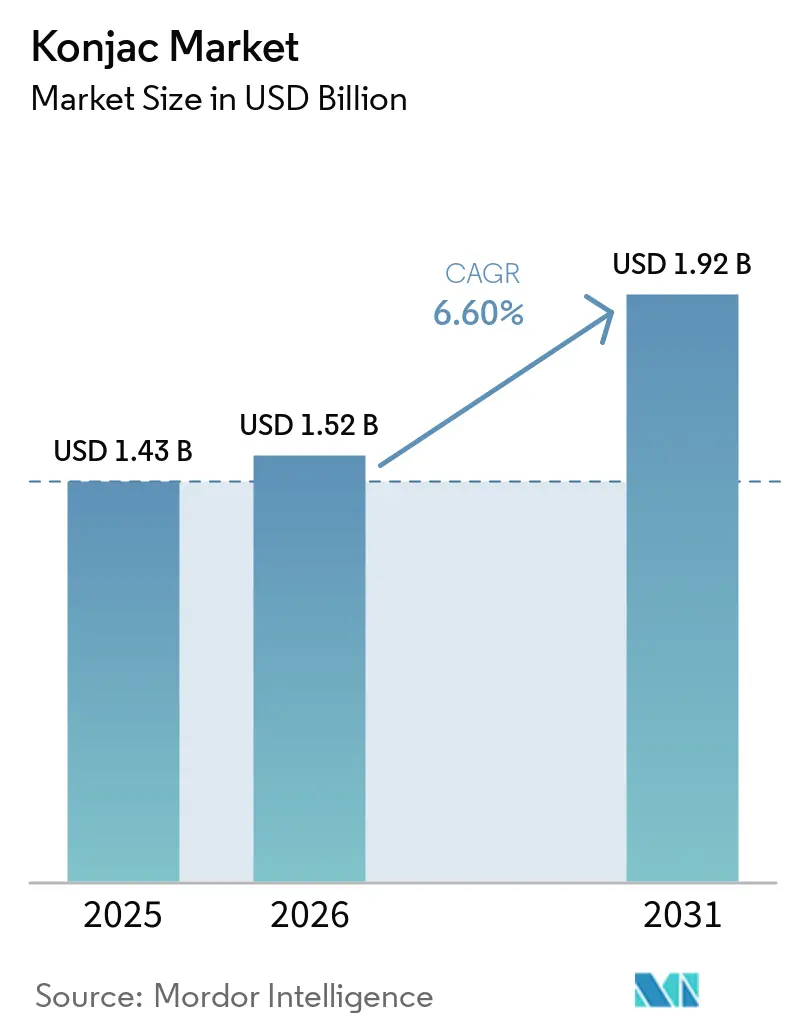
| Market Size (2026) | USD 1.52 Billion |
| Market Size (2031) | USD 1.92 Billion |
| Growth Rate (2026 - 2031) | 6.60 % |
| Fastest Growing Market | North America |
| Largest Market | Asia-Pacific |
| Market Concentration | Medium |
Major Players
*Disclaimer: Major Players sorted in no particular order Image © Mordor Intelligence. Reuse requires attribution under CC BY 4.0. |
|
Konjac Market Analysis by Mordor Intelligence
The konjac market size is expected to increase from USD 1.43 billion in 2025 to USD 1.52 billion in 2026 and reach USD 1.92 billion by 2031, growing at a CAGR of 6.60% over 2026-2031. Demand is supported by food reformulation, dietary supplements, and pharmaceutical excipients that use konjac glucomannan (KGM) as soluble fiber and a plant-based hydrocolloid. KGM can thicken, gel, and stabilize products, allowing formulators to use it across multiple recipe components rather than for a single purpose. Public health policy in China, recognized health-claim pathways in the United States and Europe, and product development in low-calorie foods support wider adoption. Higher-value pharmaceutical applications are expanding faster than food-grade uses, shifting attention toward purity, traceability, and formulation performance. Supply remains sensitive to cultivation conditions and to consumer familiarity with traditional konjac formats outside Asia.
Key Report Takeaways
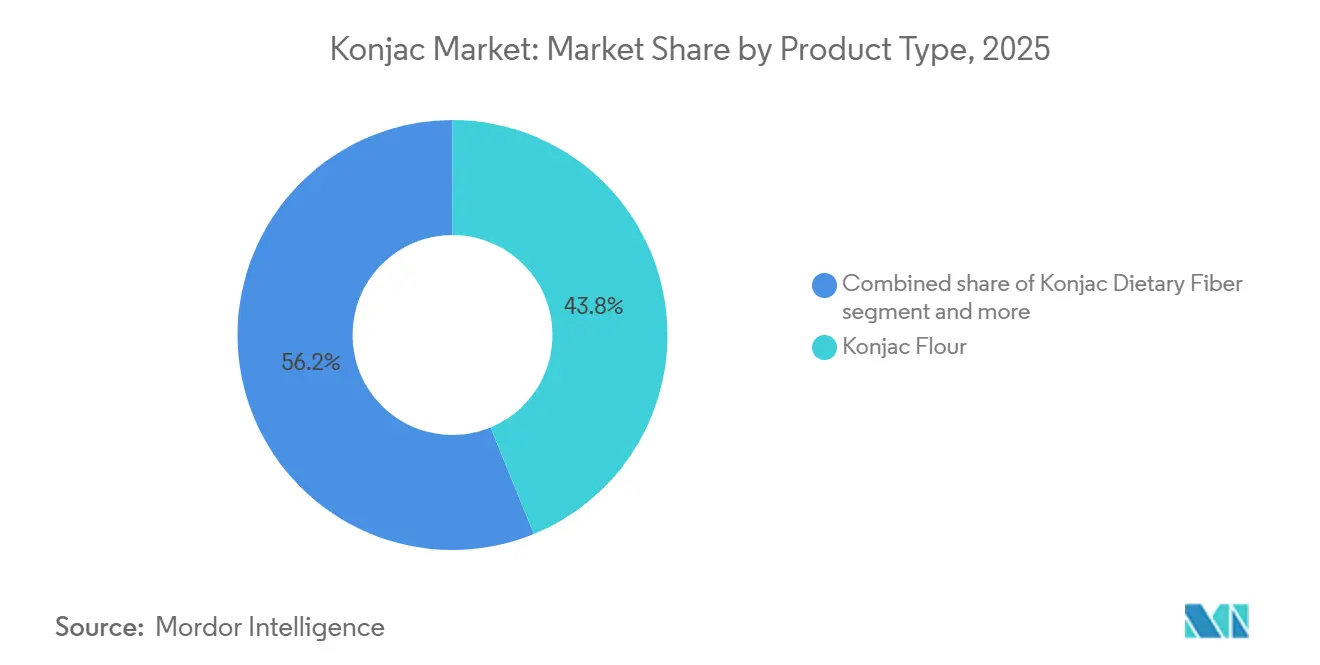
- By product type, konjac flour held the largest share in 2025 at 43.81%, while konjac dietary fiber is projected to record the fastest CAGR at 8.83% through 2031.
- By grade, food grade held 71.31% of the market share in 2025, while pharmaceutical grade is projected to expand at a CAGR of 9.56% through 2031.
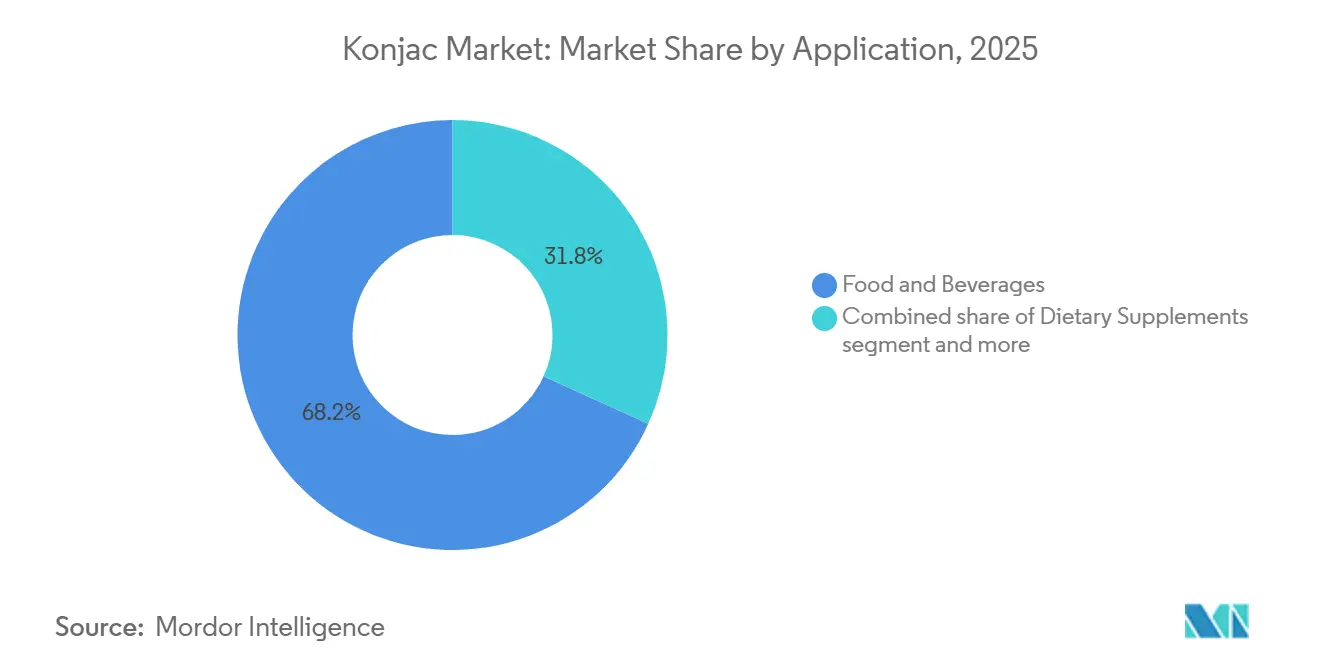
- By application, food and beverages accounted for 68.23% of the konjac market size in 2025, while dietary supplements are projected to grow at a CAGR of 8.95% through 2031.
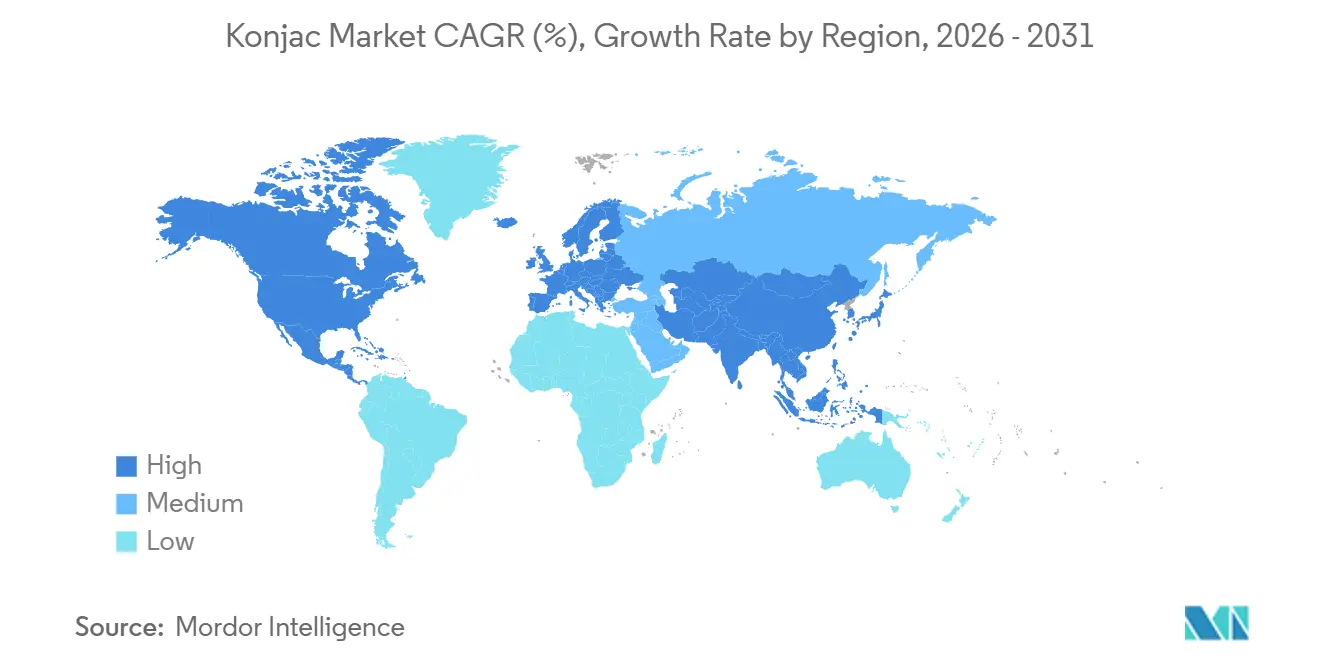
- By geography, Asia-Pacific held 45.68% of the market share in 2025, while North America is projected to record the fastest regional CAGR at 9.08% through 2031.
Note: Market size and forecast figures in this report are generated using Mordor Intelligence’s proprietary estimation framework, updated with the latest available data and insights as of January 2026.
Market Trends and Insights
Drivers Impact Analysis of Konjac Market*
| Driver | (~) % Impact on CAGR Forecast | Geographic Relevance | Impact Timeline |
|---|---|---|---|
| Rising demand for low-calorie and high-fiber foods | +2.0% | Global | Short term (≤ 2 years) |
| Expansion of plant-based, vegan, gluten-free, and ketogenic diets | +1.4% | North America and Europe; rapid adoption in urban Asia-Pacific | Medium term (2–4 years) |
| Expansion of functional foods and dietary supplements | +1.1% | Global, with accelerated growth in North America and Asia-Pacific | Medium term (2–4 years) |
| Increasing use of konjac as a clean-label hydrocolloid | +0.8% | North America and European Union; early adoption in Southeast Asia | Medium term (2–4 years) |
| Versatile functional properties in food formulation | +0.6% | Global | Short term (≤ 2 years) |
| Expansion of konjac cultivation and processing capacity in Asia | +0.4% | Asia-Pacific core, spillover to global supply chains | Long term (≥ 4 years) |
| Source: Mordor Intelligence | |||
Rising demand for low-calorie and high-fiber foods
Growing consumer preference for foods that support calorie control and dietary fiber intake is creating favorable conditions for the konjac market, as konjac-based foods offer a low-calorie, fiber-rich alternative to conventional carbohydrate-heavy products. This trend is reflected in the 2025 IFIC Food & Health Survey, where 16% of Americans identified "low calorie" as a criterion for defining a healthy food, while 28% identified "good source of fiber" as a criterion [1]Source: International Food Information Council (IFIC), "2025 IFIC Food & Health Survey", ific.org. As consumers increasingly seek products that help manage calorie intake while providing functional nutritional benefits, demand is expanding for konjac noodles, konjac rice, glucomannan supplements, and other fiber-enriched products. The ingredient's high glucomannan content and ability to provide bulk and satiety with relatively few calories strengthen its appeal in weight management, low-carbohydrate, and digestive wellness applications, supporting broader adoption of konjac across food and supplement categories.
Expansion of plant-based, vegan, gluten-free, and ketogenic diets
The growing adoption of plant-based, vegan, gluten-free, and ketogenic dietary patterns is creating new consumption opportunities for konjac, particularly through konjac noodles, rice substitutes, pasta, and other low-carbohydrate food products. This opportunity is especially relevant in India, where The Vegan Society, citing Statista data, reports that almost 25% of the population identified as vegetarian and 9% as vegan, giving India one of the largest shares of non-meat consumers in the world[2]Source: THE VEGAN SCHOOL, "Veganism in India: A Historical and Cultural Perspective", theveganschool.org. As consumers increasingly seek plant-derived, gluten-free, and low-carbohydrate alternatives, konjac's plant-based composition, high glucomannan-fiber content, and suitability for low-calorie and keto-oriented formulations make it an attractive ingredient for healthier food products. This expanding dietary landscape is supporting the development and adoption of konjac-based noodles, rice, pasta, and other functional food products across both established and emerging markets.
Expansion of functional foods and dietary supplements
Growing consumer interest in digestive wellness, weight management, satiety, and natural dietary fiber is expanding the use of konjac and glucomannan beyond traditional foods into functional foods and dietary supplements. Manufacturers are incorporating konjac into fiber supplements, capsules, functional foods, and weight-management formulations. Its thickening, gelling, and soluble fiber properties also support broader food applications. As consumers increasingly seek convenient products that offer both nutritional and functional benefits, these expanding applications are driving additional demand for konjac-derived ingredients and broadening its addressable market beyond conventional konjac noodles and traditional foods.
Increasing use of konjac as a clean-label hydrocolloid
Growing consumer preference for clean-label, recognizable, and minimally processed ingredients is encouraging food manufacturers to adopt plant-derived hydrocolloids that provide functionality while supporting simpler product positioning. This trend is reflected in Gen Z and Millennials' willingness to pay 20–30% more for products carrying claims such as organic, natural, high protein, and no artificial ingredients. Claims such as "simple ingredients," "short ingredient list," and "traceable sourcing" have also gained importance in purchase decisions (Ingredion) [3]Source: Ingredion, "Less mystery, more meaning: Clean labels win consumer preference", ingredion.com. This shift is creating opportunities for konjac flour and glucomannan as plant-based hydrocolloids that provide thickening, gelling, stabilizing, water-binding, and texture-enhancing functionality across food formulations. As manufacturers seek alternatives that align with clean-label and natural positioning while maintaining desired texture and formulation performance, the use of konjac as a functional ingredient is expected to expand across noodles, sauces, dairy alternatives, meat alternatives, bakery products, and other functional foods.
Restraints Impact Analysis of Konjac Market*
| Restraint | (~) % Impact on CAGR Forecast | Geographic Relevance | Impact Timeline |
|---|---|---|---|
| Seasonal raw-material variability and supply concentration | -0.5% | Global, with acute exposure in Asia-Pcific supply chains | Short term (≤ 2 years) |
| Limited consumer awareness outside Asia | -0.4% | North America, Europe, South America, Middle East and Africa | Medium term (2–4 years) |
| Competition from alternative low-calorie and functional ingredients and hydrocolloids | -0.3% | Global | Medium term (2–4 years) |
| Regulatory restrictions on health and weight-management claims | -0.2% | North America and European Union | Long term (≥ 4 years) |
| Source: Mordor Intelligence | |||
Seasonal raw-material variability and supply concentration
The konjac market faces supply constraints due to the concentration of Amorphophallus konjac production in specific Asian cultivation regions, particularly China, and the crop's dependence on seasonal growing and harvesting cycles. Variations in weather, cultivation conditions, and crop yields can affect both the availability and quality of konjac tubers. Research indicates that glucomannan content can vary substantially depending on growing location and cultivation conditions. This geographic concentration means that localized climate events or agricultural disruptions can rapidly affect raw material availability, processing volumes, and procurement costs for downstream manufacturers. Additionally, the seasonal nature of tuber harvesting limits producers' ability to respond quickly to sudden increases in demand, making inventory management and long-term sourcing agreements critical. This supply uncertainty can affect price stability, production planning, quality consistency, and manufacturers' ability to maintain uninterrupted supplies of konjac flour and glucomannan.
Limited consumer awareness outside Asia
Limited familiarity with konjac and its functional benefits restrains market expansion, particularly in Western markets where konjac is not a common food ingredient. While konjac has an established presence in countries such as China and Japan, consumers in North America and Europe have limited understanding of its uses, nutritional properties, and preparation methods, reducing their willingness to try konjac-based products. (Fortune Business Insights) This lack of awareness increases the need for consumer education, product demonstrations, targeted marketing, and clearer labeling, raising customer-acquisition costs for brands. In addition, unfamiliar textures and the perception of konjac as a niche or specialty ingredient further slow mainstream adoption, limiting market penetration beyond established Asian markets. (6wresearch.com)
*Our forecasts treat driver/restraint impacts as directional, not additive. The impact forecasts reflect baseline growth, mix effects, and variable interactions.
Konjac Market Segment Analysis
By Product Type:
Konjac Flour Leads While Dietary Fiber Expands FastestKonjac flour accounted for 43.81% of the market value in 2025, making it the largest product category. It is the primary industrial input used for thickening, gelling, and texturizing foods such as noodles and dairy alternatives. Its ability to form stable gels and modify texture at relatively low concentrations makes it a preferred ingredient among food manufacturers. The segment supports the broader konjac market by providing a versatile form for food manufacturers. Hubei Yizhi Konjac Biotechnology reported 85 core technology patents, with its product portfolio centered on hydrocolloids, functional foods, cosmetics, and biomaterials.
Konjac dietary fiber is projected to grow at an 8.83% CAGR through 2031, the highest rate among all product types. This growth is supported by clinical research on konjac glucomannan (KGM) and the use of fiber-related claims in supplement and functional food positioning. Consumer awareness of digestive health and weight management has further reinforced demand for fiber-enriched products. A 2025 review linked KGM supplementation with reductions in body weight and body mass index across the studies assessed. Sponge products continue to serve consumers seeking biodegradable skincare tools, while snacks and jellies offer additional routes to everyday consumption, broadening the appeal of konjac dietary fiber beyond traditional supplement formats.


By Grade:
Food Grade Provides the Base While Pharmaceutical Grade Grows FasterFood grade accounted for 71.31% of market value in 2025 and remained the revenue base of the konjac market. Its large share reflects the prominence of bulk food applications worldwide. Food-grade flour supports noodles, processed foods, dairy alternatives, and other products requiring texture or fiber. Its functional properties, including water retention, gel formation, and dietary fiber content, make it suitable across a wide range of food manufacturing processes. The U.S. Department of Agriculture National Organic Program has considered konjac flour for use as an allowed nonorganic ingredient in certified organic products, which further supports its adoption in health-oriented food categories.
Pharmaceutical grade is projected to grow at a 9.56% CAGR through 2031, the highest rate among the grade categories. Research published in 2025 described KGM-based aerogel formulations for drug delivery and reported controlled release behavior in tested systems. This points to growing interest in konjac-derived materials as functional excipients in advanced drug delivery platforms. Pharmaceutical-grade material requires higher glucomannan content, tighter molecular-weight control, and stronger batch traceability. These specifications create a higher entry threshold than food grade and support the segment's use in high-value applications where performance documentation is required. The combination of stricter quality requirements and expanding research activity is expected to sustain the segment's above-average growth rate through the forecast period.
By Application:
Food and Beverages Lead While Dietary Supplements Grow FastestFood and beverages accounted for 68.23% of the 2025 konjac market size, making it the largest application segment. The category includes noodles, pasta, meat alternatives, dairy alternatives, and other processed foods. Shirataki-style noodles represent a major volume use, and product formats continue to expand. In May 2024, Miracle Noodle introduced Egg White Noodles in vermicelli and spaghetti formats, combining konjac with egg white to target protein-conscious consumers.
Dietary supplements are projected to record an 8.95% CAGR through 2031, outpacing other applications. The category benefits from established regulatory pathways for glucomannan as dietary fiber in the United States and from authorized European claims under stated conditions. This provides brands a clearer basis for product labeling related to weight management and normal blood cholesterol levels. Pharmaceuticals are also expanding as controlled-release applications develop. Cosmetics and personal care maintain demand for konjac sponge products among consumers seeking biodegradable skincare tools.
Geography Analysis
APAC Konjac Market
Asia-Pacific held 45.68% of the konjac market share in 2025 and remained the center of production and consumption. China accounted for more than 60% of global raw konjac supply, with cultivation concentrated in Yunnan, Guizhou, Hubei, and Sichuan. Japan contributes sophisticated processing and premium konnyaku and shirataki production. Japan External Trade Organization materials identify Gunma as a major konjac production area in Japan.
North America and Europe Konjac Market
North America is projected to grow at a 9.08% CAGR through 2031, making it the fastest-growing region in the konjac market. Demand in the United States is supported by keto, vegan, and weight-management food preferences. Product innovation in noodles, jelly products, and supplements is making konjac more accessible in familiar retail formats. Mexico presents an additional regional opportunity for fiber-enriched and low-calorie products. Europe has a distinct demand base, where approved glucomannan health claims support supplement and functional food launches under defined conditions.
MEA and South America Konjac Market
South America is an emerging opportunity area, led by Brazil and Argentina, for health-oriented food and supplement products. Consumer awareness of fiber intake and obesity prevention supports interest in the region, though konjac adoption remains at an early stage. The Middle East and Africa also show low per-capita awareness and limited familiarity with konjac and its cooking properties. Fresh products face cold-chain and logistics constraints in both regions. Capsule and powder supplements present lower adoption barriers than fresh or traditional food products. Asian suppliers are beginning to explore export partnerships in these markets, suggesting that supplements may establish demand before food formats reach broader scale.

Competitive Landscape
The konjac market has a moderately fragmented structure, with no single company holding decisive pricing power across the full value chain. Chinese processors, including Hubei Yizhi Konjac Biotechnology, Baoji Konjac Chemical, Green Fresh Group, Shanghai Brilliant Gum, and Hubei Konson Konjac Gum, supply raw materials and bulk ingredients. These companies compete on production scale, price, quality control, and formulation capability. Hubei Yizhi has been publicly listed on China's Beijing Stock Exchange since February 2023, according to its corporate materials.
Consumer-facing companies include Miracle Noodle in the United States, Slendier in Australia, and NAH Foods in the United Kingdom. These companies compete through product formats, retail coverage, and health-oriented brand positioning rather than bulk ingredient purity. A potential gap remains for branded, application-specific ingredients that offer documented performance to manufacturers in Europe and North America.
Product diversification is also visible among consumer brands. Miracle Noodle's May 2024 Egg White Noodles combined konjac with egg white to appeal to protein-conscious consumers. Brands are also using zero-sugar jellies, collagen-konjac snacks, and other formats to reach consumers who may not purchase conventional shirataki products. Procurement requirements for certificates of analysis, declarations of origin, and traceability are increasingly relevant to buyers. Companies that provide these records can compete more effectively in applications where quality assurance is as important as price. The konjac market remains fragmented, but stricter documentation requirements and specialized applications can strengthen the position of capable processors.
Konjac Industry Leaders
-
Hubei Yizhi Konjac Biotechnology Co., Ltd.
-
Baoji Konjac Chemical Co., Ltd.
-
Green Fresh (Group) Co., Ltd.
-
Shanghai Brilliant Gum Co., Ltd.
-
NAH Foods Ltd.
- *Disclaimer: Major Players sorted in no particular order

Konjac Market Companies Covered in this Report
- Hubei Yizhi Konjac Biotechnology Co., Ltd.
- Baoji Konjac Chemical Co., Ltd.
- Green Fresh (Group) Co., Ltd.
- Shanghai Brilliant Gum Co., Ltd.
- NAH Foods Ltd.
- Miracle Noodle Inc.
- NOW Health Group, Inc.
- Slendier
- The Konjac Sponge Company Ltd.
- FMC Corporation
- Jellice Co., Ltd.
- Ishibashiya Co., Ltd.
- Andi-Johnson Group
- Hubei Konson Konjac Gum Co., Ltd.
- Hubei Jianshi Konjac Industry Development Co., Ltd.
- Henan Xin Industry Co., Ltd.
- Fujian Shengong Food Co., Ltd.
- Hubei Yikangyuan Konjac Biotechnology Co., Ltd.
- Better Than Foods Co., Ltd.
- Zeroodle USA
- Konjac Foods Ltd.
- House Foods Corporation
- Matsutani Chemical Industry Co., Ltd.
- Zhejiang Shangfang Biotechnology Co., Ltd.
- Kowa India Pvt Ltd

Recent Industry Developments in Konjac Market
- August 2025: NINZIA raised JPY 100 million in Pre-Series A funding. The company stated that the funds would be used to accelerate scientific and nutritional testing of its konjac ingredients, material-property and texture engineering, and the establishment of a mass-production system. The company also planned to expand its products and technologies into North America and ASEAN.
- March 2025: Shaanxi Ankang Konjac Biotechnology expanded its ingredient manufacturing capabilities by launching a multi-purpose konjac gum and glucomannan production project in Ankang, Shaanxi. The project has an expected annual processing capacity exceeding 1,000 tons, strengthening the company's position in value-added konjac ingredients.
- November 2024: Wushan County in Chongqing established a 67-hectare konjac cultivation base and 3.3 hectares of standardized greenhouses for high-quality seed breeding. The initiative incorporates technology for variety selection and improved cultivation practices. In its first year, the base reported average yields exceeding 66,100 pounds per hectare.


Global Konjac Market Report Scope
| Konjac Flour |
| Konjac Gum / Glucomannan |
| Konjac Dietary Fiber |
| Konjac Sponge |
| Other Konjac Products |
| Food |
| Pharmaceutical |
| Food and Beverages | Noodles and pasta |
| Meat alternatives | |
| Dairy alternatives | |
| Other applications | |
| Pharmaceuticals | |
| Cosmetics and Personal Care | |
| Dietary Supplements |
| North America | United States |
| Mexico | |
| Rest of North America | |
| Europe | United Kingdom |
| Germany | |
| France | |
| Italy | |
| Spain | |
| Netherlands | |
| Rest of Europe | |
| Asia-Pacific | China |
| Japan | |
| India | |
| Thailand | |
| Singapore | |
| Indonesia | |
| South Korea | |
| Australia | |
| New Zealand | |
| Rest of Asia-Pacific | |
| South America | Brazil |
| Argentina | |
| Rest of South America | |
| Middle East and Africa |
| By Product Type | Konjac Flour | |
| Konjac Gum / Glucomannan | ||
| Konjac Dietary Fiber | ||
| Konjac Sponge | ||
| Other Konjac Products | ||
| By Grade | Food | |
| Pharmaceutical | ||
| By Application | Food and Beverages | Noodles and pasta |
| Meat alternatives | ||
| Dairy alternatives | ||
| Other applications | ||
| Pharmaceuticals | ||
| Cosmetics and Personal Care | ||
| Dietary Supplements | ||
| Geography | North America | United States |
| Mexico | ||
| Rest of North America | ||
| Europe | United Kingdom | |
| Germany | ||
| France | ||
| Italy | ||
| Spain | ||
| Netherlands | ||
| Rest of Europe | ||
| Asia-Pacific | China | |
| Japan | ||
| India | ||
| Thailand | ||
| Singapore | ||
| Indonesia | ||
| South Korea | ||
| Australia | ||
| New Zealand | ||
| Rest of Asia-Pacific | ||
| South America | Brazil | |
| Argentina | ||
| Rest of South America | ||
| Middle East and Africa | ||


Key Questions Answered in the Report
Which konjac product category is the largest?
Konjac flour held the largest product-type share at 43.81% in 2025. It is widely used as an industrial input for food texture and structure.
Which konjac application is growing fastest?
Dietary supplements are projected to grow at an 8.95% CAGR through 2031.
Why is pharmaceutical-grade konjac important?
Pharmaceutical grade is projected to expand at a 9.56% CAGR through 2031.
Which region has the strongest growth outlook for konjac?
North America is projected to grow at a 9.08% CAGR through 2031.
Page last updated on:


 Your data is secure and never sold or shared.


