
Market Overview
| Study Period | 2021 - 2031 |
|---|---|
| Forecast Data Period | 2026 - 2031 |
| Base Year Market Size (2025) | USD 9.49 Billion |
| Market Size (2026) | USD 9.93 Billion |
| Market Size (2031) | USD 12.45 Billion |
| Growth Rate (2026 - 2031) | 4.62 % |
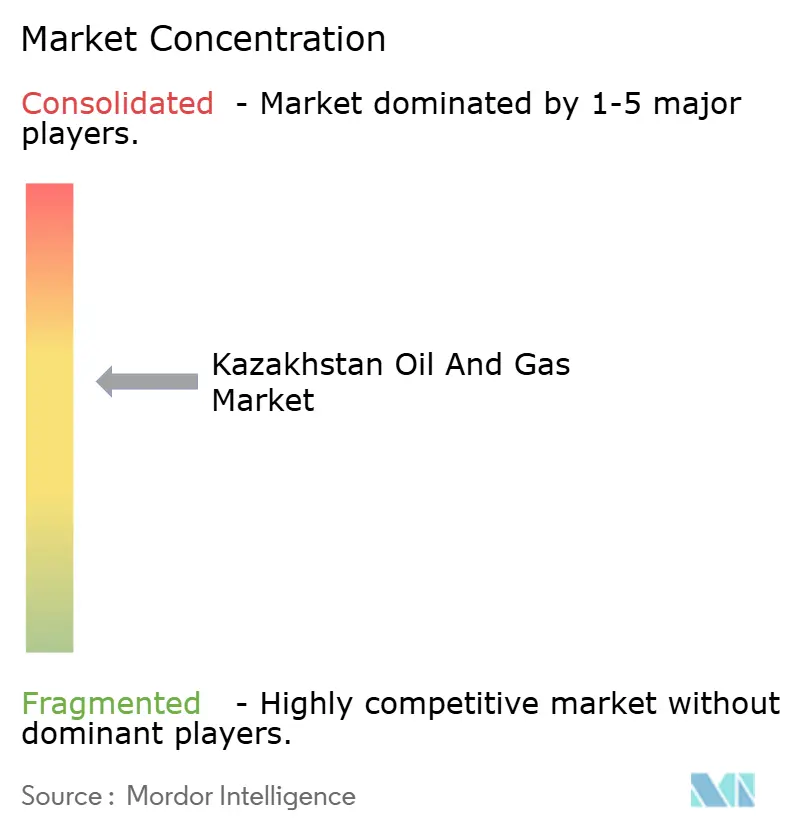
| Market Concentration | Medium |
Major Players *Disclaimer: Major Players sorted in no particular order Image © Mordor Intelligence. Reuse requires attribution under CC BY 4.0. | |
Kazakhstan Oil And Gas Market Analysis by Mordor Intelligence
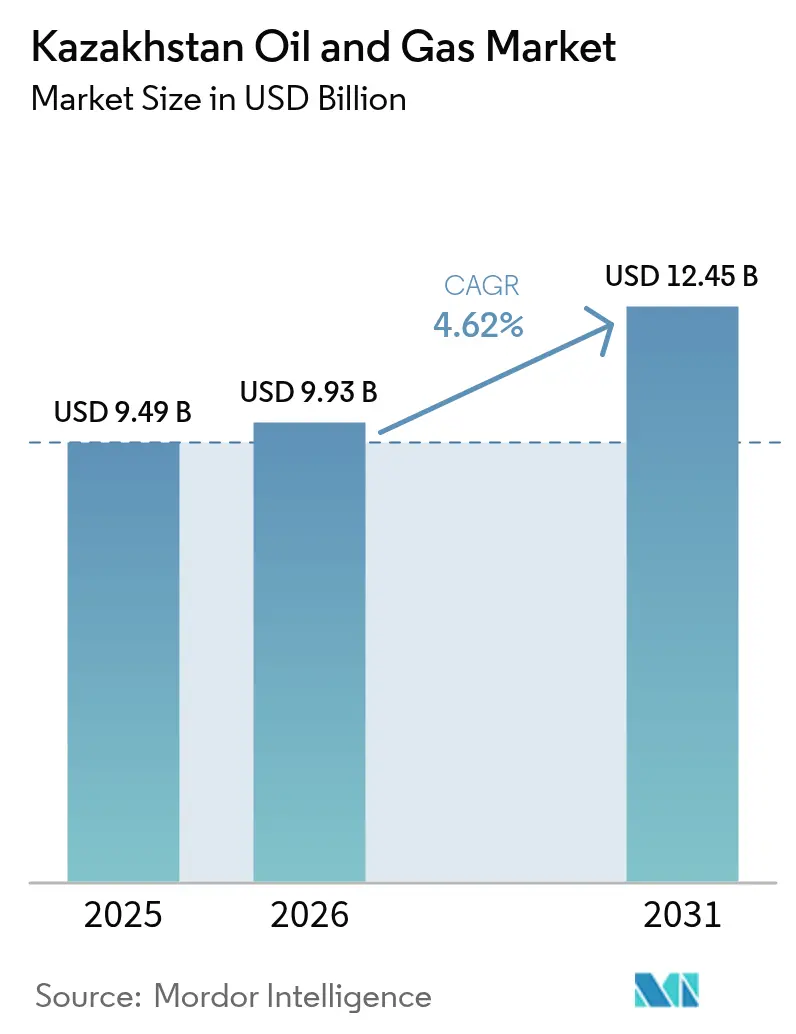
Kazakhstan Oil And Gas market size in 2026 is estimated at USD 9.93 billion, growing from 2025 value of USD 9.49 billion with 2031 projections showing USD 12.45 billion, growing at 4.62% CAGR over 2026-2031.
This steady expansion reflects Kazakhstan’s role as Central Asia’s leading hydrocarbon producer, its substantial proven reserves, and ongoing foreign investment in major field developments. Diversified export pipelines, government-backed capacity-expansion programs, and the deployment of digital oilfield and enhanced recovery technologies sustain growth even as OPEC+ quotas and European Union carbon regulations evolve. Upstream operations remain the largest revenue generator, while midstream infrastructure upgrades post the fastest growth. Offshore Caspian Sea projects and large-scale construction contracts drive service demand, reinforcing the country’s transition from a pure upstream player to an integrated energy hub.
Key Report Takeaways
- By sector, upstream held 67.90% of the Kazakhstan oil and gas market share in 2025, whereas midstream is forecast to expand at an 7.74% CAGR through 2031.
- By location, offshore projects accounted for 84.25% of Kazakhstan's oil and gas market size in 2025 and are expected to lead with a 5.63% CAGR through 2031.
- By service, construction accounted for 50.85% of Kazakhstan's oil and gas market size in 2025 and is projected to grow at a 5.78% CAGR over the same period.
Note: Market size and forecast figures in this report are generated using Mordor Intelligence’s proprietary estimation framework, updated with the latest available data and insights as of 2026.
Kazakhstan Oil And Gas Market Trends and Insights
Drivers Impact Analysis*
| Driver | (~) % Impact on CAGR Forecast | Geographic Relevance | Impact Timeline |
|---|---|---|---|
| Abundant proven oil & gas reserves | +1.2% | Atyrau and Mangystau regions | Long term (≥ 4 years) |
| Foreign investment in mega-fields | +0.8% | Caspian Sea offshore, Atyrau | Medium term (2-4 years) |
| Government plan to triple refining capacity | +0.7% | Nationwide, focus on Atyrau and Shymkent refineries | Long term (≥ 4 years) |
| Export-route diversification | +0.6% | Trans-Caspian corridors toward European markets | Medium term (2-4 years) |
| Digital oilfield & EOR deployment | +0.5% | Mature onshore fields in Mangystau | Short term (≤ 2 years) |
| Rising EU demand for CPC blend | +0.4% | Export flows to European Union | Short term (≤ 2 years) |
| Source: Mordor Intelligence | |||
Abundant Proven Oil & Gas Reserves
Kazakhstan holds more than 30 billion barrels of proven oil reserves, concentrated in the Caspian Basin, which provides the country with long-term supply security and leverage in export negotiations.[1] Kashagan alone contains close to 13 billion barrels of recoverable oil, keeping the resource base competitive with other global offshore plays. Ongoing government-led seismic surveys continue to identify new structural opportunities, while updated licensing terms under the Ministry of Energy encourage staged development that aligns production profiles with infrastructure capacity. Enhanced oil recovery trials in mature Mangystau fields are already boosting output and extending field life, underscoring the commercial attractiveness of the reserves. The scale of these resources enables Kazakhstan to secure multi-decade supply contracts with refiners across Europe and Asia, thereby reinforcing Kazakhstan's oil and gas market as a reliable growth platform.
Foreign Investment in Mega-Fields (Tengiz, Kashagan)
International operators are anchoring the Kazakhstan oil and gas market through multi-billion-dollar commitments that involve adding new production trains and introducing cutting-edge sour-gas handling technology. Chevron’s USD 45 billion Future Growth Project at Tengiz is slated to add 260,000 barrels per day of new capacity by 2025, integrating sulfur recovery units that lower carbon intensity.[2] ExxonMobil maintains capital programs in Kashagan despite high-pressure, high-sulfur challenges, reflecting confidence in offshore economics. Joint-venture structures with KazMunayGas facilitate technology transfer and local workforce development, while preserving state control over resources. These projects stimulate demand for fabrication yards, pipeline extensions, and power generation upgrades, resulting in spillover benefits across the broader Kazakhstan oil and gas market.
Government Push to Triple Refining & Petrochemicals Capacity
Kazakhstan's downstream strategy aims to transform the country from a crude exporter into a diversified producer of refined fuels and petrochemical feedstocks. The Ministry of Energy aims to triple refining throughput by 2030, supported by over USD 10 billion in plant upgrades and greenfield complexes. The Atyrau refinery's modernization has already installed hydrocracking and catalytic reforming units, which raise gasoline quality and reduce sulfur emissions. Partnerships, such as the 2024 cooperation agreement between MOL Group and KazMunayGas, emphasize technology sharing to achieve polymer-grade ethylene and propylene output. As these projects ramp up, Kazakhstan secures higher-margin export opportunities and reduces its reliance on imported gasoline and petrochemicals, thereby elevating the resilience of the Kazakhstan oil and gas market to crude-price swings.
Diversification of Export Routes (Middle Corridor, BTC)
Alternative transit corridors lessen geopolitical and operational risk for Kazakhstani producers. The Middle Corridor connects the Caspian Sea to the Baku-Tbilisi-Ceyhan (BTC) pipeline and onward to Mediterranean ports, offering up to 1.2 million barrels per day of non-Russian export capacity by 2025.[3] Bilateral agreements with Azerbaijan and Georgia grant favorable tariffs and streamline customs procedures, improving netbacks relative to traditional routes. Meanwhile, incremental upgrades on the Caspian Pipeline Consortium (CPC) system sustain flexibility during maintenance or political disruptions. This network diversification enhances the Kazakhstan oil and gas market’s access to European refiners seeking non-Russian crude, thereby directly supporting revenue stability.
Restraints Impact Analysis*
| Restraint | (~) % Impact on CAGR Forecast | Geographic Relevance | Impact Timeline |
|---|---|---|---|
| Crude-price volatility | -0.8% | Global market exposure, affects all production regions | Short term (≤ 2 years) |
| OPEC+ production quotas | -0.6% | National production limits, affects major fields | Medium term (2-4 years) |
| Aging midstream infrastructure bottlenecks | -0.5% | National pipeline network, concentrated in Atyrau region | Medium term (2-4 years) |
| EU carbon-border taxes on high-emission crude | -0.4% | Export-oriented, European market focus | Long term (≥ 4 years) |
| Source: Mordor Intelligence | |||
Crude-Price Volatility
Kazakhstan’s fiscal revenues and investment pipelines remain sensitive to Brent price swings, especially when the price is below USD 60 per barrel, as offshore operating margins shrink. Production costs average USD 35–40 per barrel in mature onshore fields and USD 50–55 in complex offshore projects. Although the National Fund cushions short-term revenue gaps, prolonged downturns defer drilling schedules, compress exploration budgets, and raise financing costs. Currency fluctuations between the tenge and the U.S. dollar complicate debt servicing on dollar-denominated borrowings. While major IOCs hedge exposures, smaller domestic firms often lack sophisticated risk-management tools, amplifying cash-flow stress across the Kazakhstan oil and gas market.
OPEC+ Production Quotas
Kazakhstan's 2024 OPEC+ ceiling of 1.468 million barrels per day curtails output at Tengiz and Kashagan, limiting the pace at which new trains can ramp up. Compliance audits impose reporting burdens and create seasonal production cuts that clash with equipment-maintenance cycles. The quota framework forces the Ministry of Energy to balance domestic revenue objectives against commitments to global supply management. Nevertheless, alignment with OPEC+ stabilizes international prices and underpins long-term cooperation with strategic investors, thereby preserving the attractiveness of Kazakhstan's oil and gas market.
*Our forecasts treat driver/restraint impacts as directional, not additive. The impact forecasts reflect baseline growth, mix effects, and variable interactions.
Segment Analysis
By Sector: Upstream Dominance Drives Market Leadership
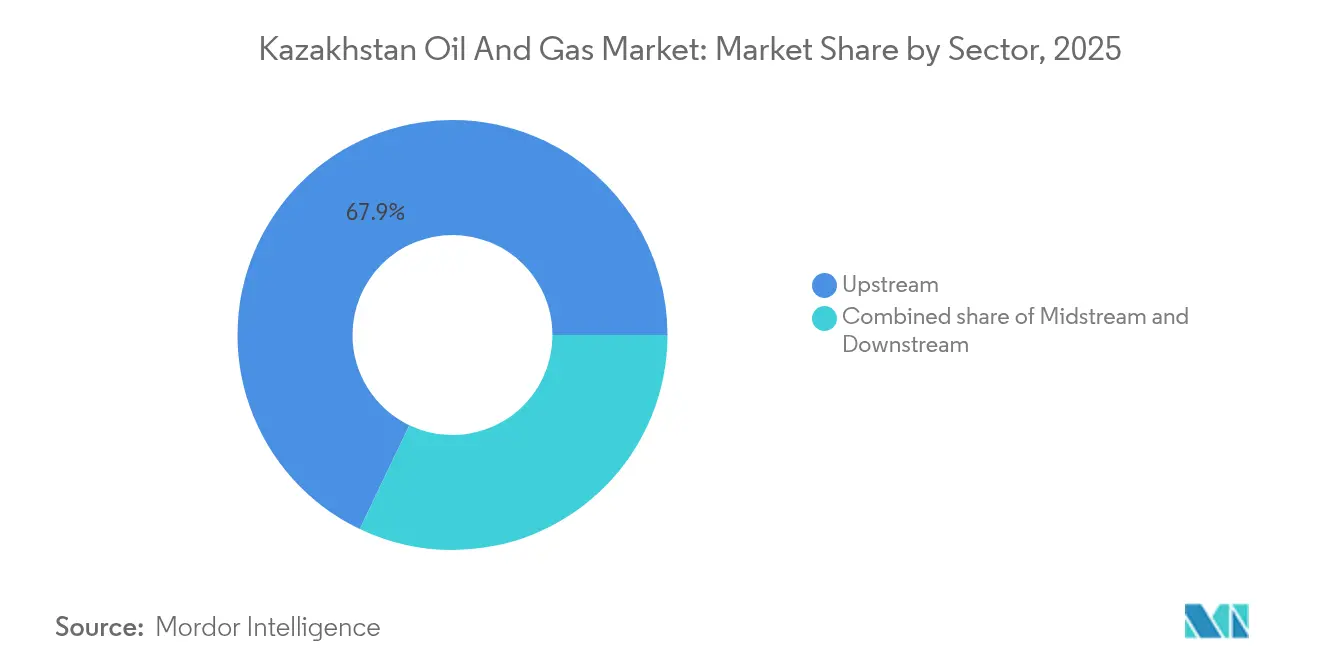
Upstream activities accounted for 67.90% of Kazakhstan's oil and gas market size in 2025, reflecting the country's reliance on crude and gas extraction for export earnings. The upstream segment is underpinned by mega-field expansions at Tengiz and the ongoing optimization of Kashagan, which utilize advanced gas-injection and sulfur-recovery systems to drive production growth. Digital twins and real-time reservoir-modeling platforms reduce unplanned downtime and enhance well productivity. Over the forecast horizon, upstream remains a cash-flow engine; however, the 7.74% CAGR expected in midstream illustrates a shift in capital toward pipelines, gas processing, and storage as export corridors widen.
Investor appetite for integrated value chains accelerates the convergence of upstream and pipeline ownership. KazMunayGas leverages stakes in both producing assets and the CPC system, exploiting economies of scale and negotiating power on transit tariffs. Midstream's rapid expansion encompasses compressor-station upgrades and branch lines that feed petrochemical feedstock streams, dovetailing with downstream diversification mandates. By 2031, the Kazakhstan oil and gas market is poised to feature a more balanced revenue mix, although upstream will continue to anchor earnings thanks to its high-margin contributions.

By Location: Offshore Projects Shape Market Dynamics
Offshore ventures accounted for 84.25% of Kazakhstan's oil and gas market share in 2025 and are projected to grow at a 5.63% CAGR through 2031. Capital commitments in the North Caspian keep Kashagan Phase 2 on schedule, with the addition of subsea compression units that mitigate reservoir pressure declines. Discoveries in Block Zhenis and partnerships with CNOOC inject fresh momentum into exploration, while FPSO vessels under evaluation could unlock previously uneconomic deepwater clusters. Elevated service intensity drives higher day rates for offshore rigs and subsea contractors, fueling construction segment growth.
Onshore fields, although smaller in relative market share, continue to serve as laboratories for enhanced recovery. Operators in Mangystau deploy nanofluid injectants and digitized flow-monitoring systems to extract remaining barrels at lower carbon intensity. The spread of these technologies protects baseline production and limits decline rates, keeping onshore assets an important stability factor for the Kazakhstan oil and gas market.
By Service: Construction Leads Infrastructure Development
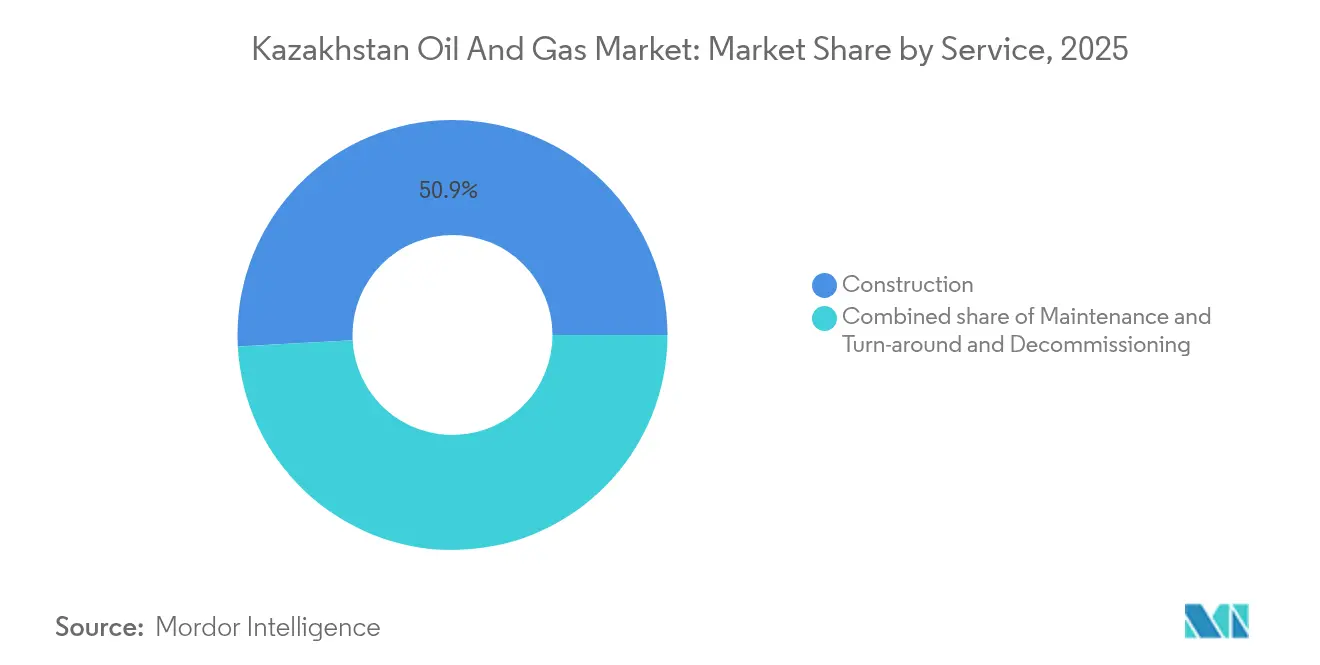
Construction services accounted for 50.85% of total revenue in 2025, driven by multibillion-dollar projects such as the Tengiz surface facilities, refinery revamps, and petrochemical complexes. The segment is projected to grow at a 5.78% CAGR to 2031. Contractors adopt modular fabrication and digital progress-tracking software that compresses project timelines and controls costs. Sinopec’s polyethylene plant near Atyrau and Lukoil’s Caspian platforms are current marquee jobs generating demand for heavy-lift vessels and specialized welding services.
Maintenance, repair, and overhaul complement construction as Kazakhstan’s asset base ages. ISO-aligned inspection regimes and stricter environmental audits lead to increased spending on corrosion control and integrity management. Decommissioning remains nascent but is expected to increase after 2030, as first-generation projects wind down. Collectively, these trends secure a robust pipeline for domestic and international service firms across the Kazakhstan oil and gas market.
Geography Analysis
Kazakhstan's continental expanse overlays multiple hydrocarbon basins, but the Caspian Sea coast represents the epicenter of upstream investment owing to giant reservoirs at Kashagan, Tengiz, and Karachaganak. Atyrau and Mangystau concentrate drilling, fabrication yards, and export terminals, giving these western provinces the lion's share of sector jobs and related infrastructure. Pipeline corridors radiate westward to the Black Sea and Mediterranean through CPC and BTC, and eastward via the Kazakhstan-China route, affording optionality that few landlocked producers enjoy.
Central and eastern regions host auxiliary gas-processing and petrochemical facilities, benefiting from government inducements to distribute economic activity beyond the oil-rich west. The upgrades at Shymkent refinery and ancillary polypropylene projects illustrate the shift. In the north, proximity to Russian rail networks supports the trade in condensate and LPG, while southern routes toward Uzbekistan and Kyrgyzstan handle the rising regional demand for motor fuels.
Environmental stewardship shapes geographic strategy. Caspian Sea operations adhere to strict spill-prevention protocols mandated by the Committee for Environmental Regulation, which require the use of double-hulled shuttle tankers and rapid-response equipment. Inland basins apply stringent groundwater protection standards to fracturing fluids and produced water disposal. As Kazakhstan pursues carbon-neutral growth by 2060, regional authorities are prioritizing the integration of renewable power into oilfield microgrids, particularly in wind-rich Aktobe province. These measures strike a balance between resource extraction and ecological safeguards, thereby reinforcing the long-term viability of Kazakhstan's oil and gas market.
Regulatory Landscape
Kazakhstan's oil and gas activities are governed primarily by the Code of the Republic of Kazakhstan on Subsoil and Subsoil Use, with the Ministry of Energy acting as the competent authority for subsoil use rights, contract compliance, and sector policy implementation. In December 2025, Law No. 249-VIII introduced amendments to the subsoil framework, including provisions tied to a Unified State Management System for the Fuel and Energy Complex, with specified provisions taking effect from January 1, 2026, strengthening the state's move toward more centralized and digitalized oversight of sector reporting and compliance.
From January 2026, the operating environment also reflected newly implemented rules and procedures affecting how operators execute obligations and procure goods and services. Government Decree No. 979 (adopted in November 2025 and implemented in January 2026) set updated rules for subsoil users to fulfill certain tax obligations in kind through hydrocarbon volumes, while Ministry of Energy Order No. 536-n/q (December 2025) updated procurement rules for subsoil users and their contractors, reinforcing local-content and process requirements across major projects. In transport and infrastructure, tariff oversight for pipeline transportation remains under the Committee for Regulation of Natural Monopolies (Ministry of National Economy), and safety and technical standards are overseen by the Committee of State Energy Supervision and Control under the Ministry of Energy, which shapes the compliance burden for upstream and midstream operators.
Competitive Landscape
KazMunayGas dominates the domestic stage through its majority stakes in key upstream, midstream, and refining assets; however, international majors supply capital, technology, and off-take agreements that define project economics. Joint-venture structures—such as Tengizchevroil (Chevron, 50%; KazMunayGas, 20%) and North Caspian Operating Company (TotalEnergies, ExxonMobil, Shell, CNPC, INPEX, KazMunayGas)—illustrate collaborative models that reconcile state control with foreign expertise. Market power centers on access to mega-fields, export pipelines, and downstream value-addition capacity.
Chinese state-owned enterprises expand aggressively. CNPC increases production via incremental stake acquisitions, while Sinopec’s petrochemical projects align with Belt and Road financing, heightening competition in downstream margins. European players, such as TotalEnergies and MOL Group, are pivoting into petrochemicals to diversify their cash flows and hedge against shifts in crude demand. Technology differentiators include digital twins, subsea multiphase pumps, and carbon capture pilots. Patent filings related to advanced EOR and subsea tie-backs increased in 2024, indicating sustained R&D investment.
Regulatory oversight under the Ministry of Energy and environmental regulators enforces ISO-aligned standards, raising the bar for new entrants. Local-content thresholds of 30–50% on major builds create growth pathways for domestic engineering firms, although capital-intensive requirements also pose barriers for smaller players. Overall, the Kazakhstan oil and gas market exhibits moderate concentration, with the top five groups controlling a large portion of production and pipeline capacity, yet still leaving niches open for specialized service providers.
Kazakhstan Oil And Gas Industry Leaders
-
National Company JSC (KazMunayGas)
-
Chevron Corporation
-
ExxonMobil Corporation
-
TotalEnergies SE
-
PJSC Lukoil Oil Company
- *Disclaimer: Major Players sorted in no particular order
Market Opportunities and Future Outlook
Near-term whitespace concentrates around gas processing, sour-gas handling, and the associated midstream buildout needed to convert raw gas into marketable volumes and reduce flaring constraints at mega-fields. In June 2026, Hyundai Engineering signed a contract to build a gas processing plant at Karachaganak designed to process up to 5 billion cubic meters of raw gas annually. In parallel, a Chinese consortium (China National Chemical Engineering Sixth Construction Company and China Wuhuan Engineering) was appointed as the EPC contractor for a Kashagan gas processing plant with 2.5 billion cubic meters per year capacity. Together, these projects widen demand for engineering, construction, compression, and treatment equipment across upstream-adjacent processing, and they also support a broader addressable market for integrity management, turnaround services, and digital monitoring once facilities enter operations.
Pipeline capacity additions and system reinforcement form a second opportunity cluster, tied to domestic gas balancing and industrial demand centers. In July 2026, QazaqGaz placed a second USD 500 million bond tranche to finance construction of the second line of the Beineu-Bozoi-Shymkent gas pipeline, a 1,452 km expansion scheduled for completion in December 2026, supporting long-haul transmission from western supply to central and southern regions. On the upstream side, government and national-company programs to broaden the resource base, including plans to develop 30 new oil and gas fields and incremental drilling programs in mature provinces such as Mangystau, keep the contracting pipeline active for drilling, well services, and brownfield optimization, especially where enhanced recovery and digital oilfield tools are used to stabilize output and improve operating efficiency.
Recent Industry Developments
- July 2026: QazaqGaz raised USD 500 million via a second bond tranche to finance construction of the second line of the Beineu-Bozoi-Shymkent gas pipeline. The funding supports acceleration of a major transmission expansion that links western gas supply with demand centers in central and southern Kazakhstan, reinforcing the midstream buildout theme in the country.
- June 2026: Hyundai Engineering signed a contract to build a gas processing plant at the Karachaganak field with capacity to process up to 5 billion cubic meters of raw gas annually. The award advances Kazakhstan's effort to increase domestic gas processing capability at a key producing asset, expanding the scope for EPC, equipment supply, and long-term operations and maintenance services.
- November 2024: MOL Group and KazMunayGas signed a comprehensive cooperation agreement covering refining, petrochemicals, and retail, including USD 500 million in joint investments over five years. The collaboration supports downstream and petrochemical upgrading priorities and creates additional pull-through demand for feedstock logistics and refinery modernization services.
Research Methodology Framework and Report Scope
Market Definition and Coverage
For this report, the Kazakhstan oil and gas market is sized as the value generated from upstream, midstream, and downstream activities within the country, based on spending and revenue linked to hydrocarbons production, transport, processing, and related services.
Scope exclusions: We exclude non-hydrocarbon mining, power generation, and purely retail fuel trade that is not tied to upstream, midstream, or downstream operating activity.
Segmentation Overview
- By Sector
- Upstream
- Midstream
- Downstream
- By Location
- Onshore
- Offshore
- By Service
- Construction
- Maintenance and Turn-around
- Decommissioning
Data Sources, Market Sizing, and Validation
Desk Research
Desk research was used to set the factual backbone of the market model and to avoid building assumptions in a vacuum. We relied on public energy balances, production and trade series, and official economic statistics to create consistent starting points, and then we aligned them to the report scope.
Common source types included official statistics and energy publications such as the Kazakhstan national statistics agency, IEA datasets and reports, OPEC and BP style energy statistics, customs and trade data portals, and public filings and presentations from operators and pipeline or refining entities. To cross-check company-level directionality and project timelines, we also used paid subscriptions for company financials and news, plus patent databases where technology change was relevant. These sources are not exhaustive, and we referenced other public materials during data collection, validation, and clarification steps.
Primary Interviews and Surveys
We use expert interviews and surveys with producers, transport operators, refiners, service providers, regulators, and distributors in Kazakhstan. Their input helps verify production plans, pipeline utilization, refinery throughput, gas processing, pricing assumptions, and gaps in public records before the final model review.
Distribution of primary research fieldwork respondents
| Company type | Respondent position |
|---|---|
| Top tier: 30% | CXOs: 15% |
| Mid tier: 45% | Functional/Unit leaders: 30% |
| Smaller Players: 25% | Managers: 55% |
Market-Sizing & Forecasting
Sizing starts with a top-down build where production and trade data reconstruct the national hydrocarbons activity pool, which is then translated into value using observed price markers and sector-specific cost and revenue shares. Results are then corroborated with selective bottom-up approximations, such as sampling project and service spend, checking pipeline and terminal throughput economics, and using refining runs and product yield proxies to sanity-check downstream value.
Inputs used in the model included crude oil and natural gas production volumes, export and import balances, pipeline throughput and storage utilization signals, refinery capacity and run rates, and price movements for crude and gas (in USD terms) that influence realized revenue and service spend. Where data was incomplete for certain service lines, gaps were handled by applying conservative penetration and intensity factors that we confirmed during interviews and then bounded with macro checks like sector share in GDP and historical investment cycles.
For forecasting, we applied scenario analysis around a base case that reflects expected project timing, regulatory and fiscal continuity, and infrastructure availability, and then used short-run smoothing where volatility is driven by price swings rather than physical volume. Assumptions are kept explicit so clients can see how changes in output, throughput, or realized pricing would move the market size.
Data Validation & Update Cycle
Triangulation was done by comparing the modeled market totals against independent signals like production trends, trade direction, refinery operating patterns, and investment news flow, and then checking for year-to-year jumps that did not match known events. If variances showed up, analysts revisited the input series, re-checked conversion steps, and, when needed, re-contacted industry respondents to confirm whether the change was structural or temporary.
Before sign-off, the model and write-up go through multi-step internal review so calculation logic, units, and currency timing stay consistent. The report is refreshed annually, and interim updates are made when material events occur, such as major project sanctions, pipeline disruptions, or policy shifts. Right before delivery, a final pass is completed so the output reflects the latest available public data and verified developments.
Mordor Intelligence's Kazakhstan Oil and Gas Market Size Compared With Other Published Estimates
Market size numbers for Kazakhstan oil and gas can vary across publications, even when the titles appear similar. The gaps usually come from what activities are counted as part of the market, the year and currency timing used, and how price and volume are translated into value.
By tracking production, throughput, and realized pricing linkages, Mordor Intelligence keeps the estimate tied to in-country upstream, midstream, and downstream activity value, rather than blending in broader energy spending or downstream retail value that can inflate totals. Differences also show up when some sources start from national oil and gas GDP contribution, apply broad multipliers, or carry forward one base year without re-checking project timing, which shifts the market level even if the growth rate appears similar.
Benchmark comparison
| Source | Market Size | Gaps in Research Methodology |
|---|---|---|
| Mordor Intelligence | USD 9.49 B (2025) | |
| Industry Publisher A | USD 37.00 B (2023) | Uses a much broader value base that likely blends national oil and gas value contribution and wider revenue pools, which can include downstream retail and non-operating value elements beyond the activity-based scope used here. |
| Industry Publisher B | USD 51.00 B (2031) | Reports a forecast endpoint without a directly comparable base-year boundary, and the implied build appears to carry a larger value pool forward, which can overstate totals if price escalation and scope are not separated from physical activity changes. |
The comparison mainly shows that scope discipline and conversion logic drive the spread more than small differences in growth assumptions. When the value is anchored to measurable production, transport, and processing activity, and then checked through interviews and public signals, the end result is easier to reproduce and to update as conditions change.
Key Questions Answered in the Report
What is the forecast size of the Kazakhstan oil and gas market by 2031?
The Kazakhstan oil and gas market is projected to reach USD 12.45 billion by 2031, growing at a 4.62% CAGR from 2026 to 2031..
Which segment is expanding the fastest within Kazakhstan's energy value chain?
Midstream infrastructure - pipelines, storage, and gas processing - is expected to grow at an 7.74% CAGR through 2031.
Why are offshore projects crucial for Kazakhstan's future output?
Offshore Caspian fields supply 84.25% of current activity and will lead growth due to large reserves and ongoing Phase 2 expansions.
How is Kazakhstan reducing reliance on Russian transit routes?
The Middle Corridor and upgrades to the BTC and CPC pipelines add 1.2 million barrels per day of non-Russian export capacity.
What role do foreign companies play in Kazakhstan's energy sector?
International majors such as Chevron, ExxonMobil, and TotalEnergies provide capital and technology via joint ventures, accelerating mega-field development and downstream diversification.
How is the government fostering downstream growth?
The Ministry of Energy targets tripling refining capacity with more than USD 10 billion in upgrades and new petrochemical complexes, supported by partnerships like the 2024 MOL Group deal.