
Market Overview
| Study Period | 2020 - 2031 |
|---|---|
| Forecast Data Period | 2026 - 2031 |
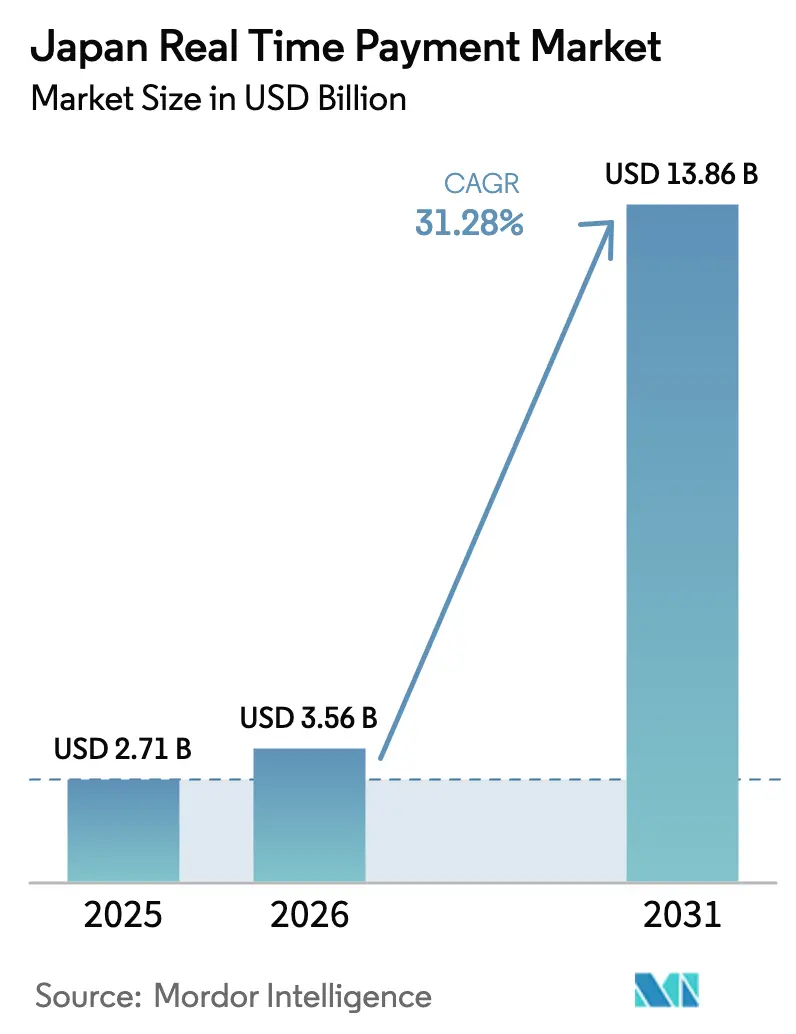
| Base Year Market Size (2025) | USD 2.71 Billion |
| Market Size (2026) | USD 3.56 Billion |
| Market Size (2031) | USD 13.86 Billion |
| Growth Rate (2026 - 2031) | 31.28 % |
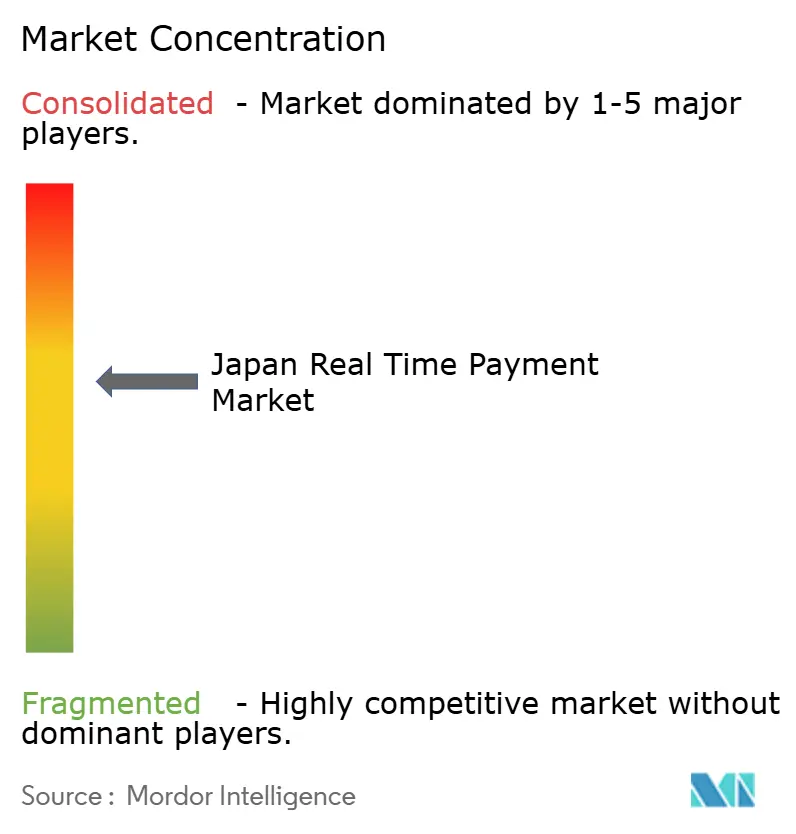
| Market Concentration | Medium |
Major Players *Disclaimer: Major Players sorted in no particular order Image © Mordor Intelligence. Reuse requires attribution under CC BY 4.0. | |
Japan Real Time Payment Market Analysis by Mordor Intelligence
The Japan real time payment market size was valued at USD 2.71 billion in 2025 and estimated to grow from USD 3.56 billion in 2026 to reach USD 13.86 billion by 2031, at a CAGR of 31.28% during the forecast period (2026-2031). Three structural forces are accelerating this growth: the government’s JPY 100 trillion cashless vision that subsidizes point-of-sale hardware, the November 2025 ISO 20022 cutover of BOJ-NET and Zengin RT-Net, and a super-app rivalry led by PayPay, LINE Pay, and Rakuten Pay. Rapid 5G coverage, which reached 96.6% of the population by late 2024, underpins low-latency authentication, while the Zengin More Time System’s 24/7 settlement window pulls corporate liquidity flows onto instant rails. Merchant interchange caps compress processor margins, yet embedded-finance bundles keep QR acceptance attractive for small retailers despite thin economics. Bank of Japan CBDC pilots and cross-border ISO 20022 linkages with Singapore and Thailand signal a future in which real-time rails extend beyond domestic boundaries.[1]
Key Report Takeaways
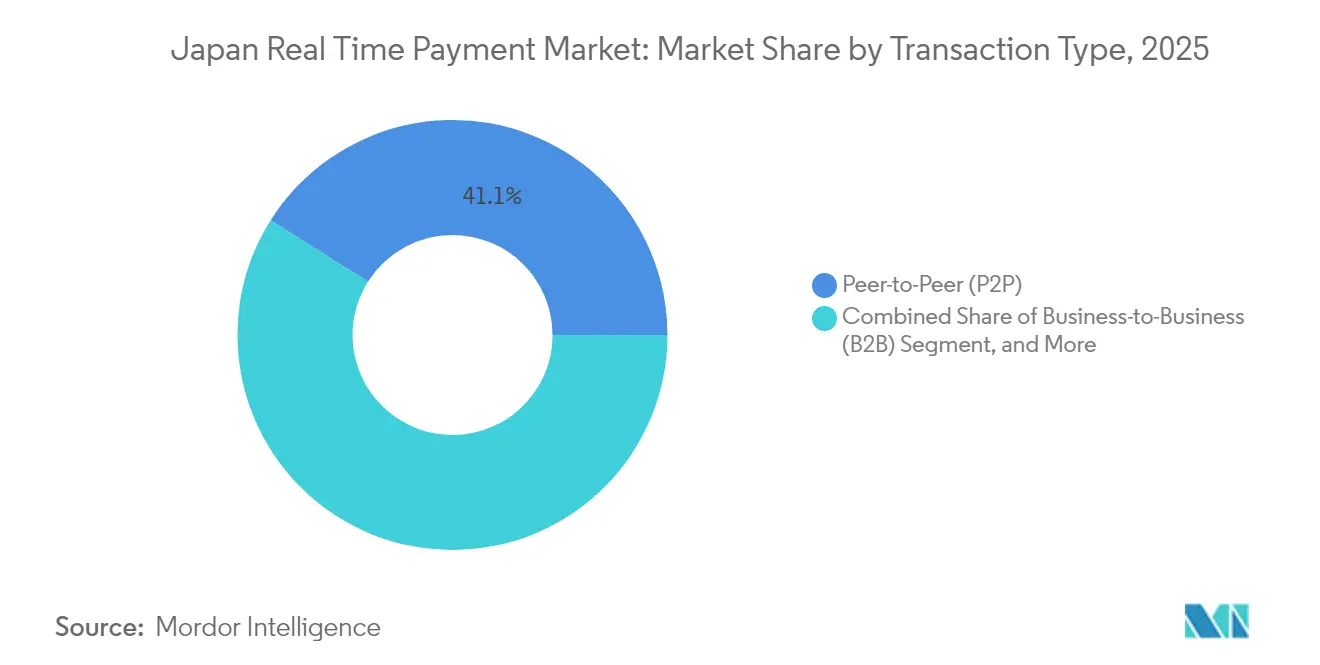
- By transaction type, peer-to-peer transfers captured 41.05% of the Japan real time payment market share in 2025, while business-to-business flows are forecast to grow at a 32.60% CAGR through 2031.
- By enterprise size, small and medium-sized enterprises held 46.10% of the Japan real time payment market share in 2025, whereas micro-businesses are projected to expand at a 32.95% CAGR to 2031.
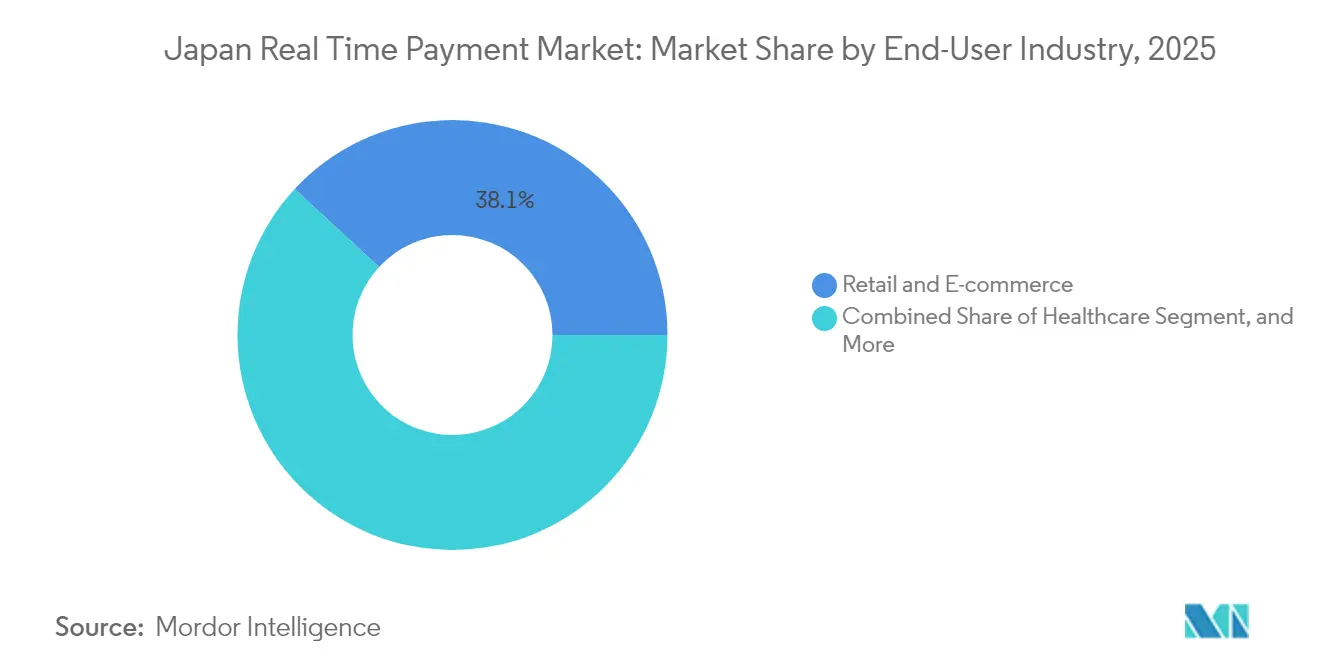
- By end-user industry, retail and e-commerce led with 38.12% of the Japan real time payment market share in 2025; transportation and mobility is set to advance at a 32.50% CAGR through 2031.
- By technology rail, mobile-wallet overlays commanded 52.05% of the Japan real time payment market size in 2025, yet API and ISO 20022 push payments are expected to post a 33.10% CAGR between 2026 and 2031.
Note: Market size and forecast figures in this report are generated using Mordor Intelligence’s proprietary estimation framework, updated with the latest available data and insights as of 2026.
Japan Real Time Payment Market Trends and Insights
Drivers Impact Analysis*
| Driver | (~) % Impact on CAGR Forecast | Geographic Relevance | Impact Timeline |
|---|---|---|---|
| Rising smartphone penetration and 5G roll-out | +6.2% | National, with early gains in Tokyo, Osaka, Nagoya metro areas | Short term (≤ 2 years) |
| Government JPY 100 trillion cashless vision and subsidy schemes | +7.8% | National, concentrated in SME-dense prefectures | Medium term (2-4 years) |
| Migration to ISO 20022 real-time rails (RT-Net upgrade) | +5.4% | National, cross-border spillover to ASEAN corridors | Medium term (2-4 years) |
| E-commerce checkout abandonment pressure on merchants | +4.1% | National, e-commerce hubs in Kanto and Kansai regions | Short term (≤ 2 years) |
| Corporate treasury demand for intraday liquidity | +5.9% | National, multinational treasury centers in Tokyo | Long term (≥ 4 years) |
| Super-app ecosystems (LINE Pay / PayPay) race for users | +8.2% | National, urban youth and commuter segments | Short term (≤ 2 years) |
| Source: Mordor Intelligence | |||
Rising Smartphone Penetration and 5G Roll-Out
Japan’s 5G footprint covers nearly the entire population, enabling sub-10-millisecond payment authentication and smoother in-app checkout experiences. Enhanced connectivity shifts fraud detection from overnight batch scoring to real-time behavioral analytics, reducing false declines and encouraging cash-centric users to adopt mobile wallets. Amazon Web Services is investing USD 15 billion in local data centers by 2027, guaranteeing low-latency API calls that keep real-time gateways responsive.[2] Despite these gains, households in mountainous Tohoku prefectures still experience network blind spots, prolonging cash reliance among older residents. The continued rollout of rural micro-cell towers and simplified wallet interfaces for seniors remains critical to closing the urban–rural adoption gap.
Government JPY 100 Trillion Cashless Vision and Subsidy Schemes
The Ministry of Economy, Trade and Industry subsidizes up to 75% of terminal costs for retailers earning under JPY 10 million, accelerating merchant enablement in convenience-store and hospitality segments.[3] A cross-ministry API framework launched in 2024 connects My Number Card identity verification to payment rails, trimming wallet KYC from three days to minutes. Prefectural cashback campaigns have temporarily lifted QR volumes by 40%, though sunset dates raise sustainability concerns. The Financial GIF now mandates real-time settlement for public-utility bills by April 2026, embedding push payments into monthly household routines. Execution risk lingers, as some municipal billing systems still process fixed-field data formats that cannot parse ISO 20022 tags.
Migration to ISO 20022 Real-Time Rails (RT-Net Upgrade)
BOJ-NET and Zengin transitioned to ISO 20022 messaging in November 2025, enabling the use of structured remittance data and end-to-end identifiers that eliminate the need for manual invoice matching for corporates. Early adopters report a 30% reduction in settlement costs on high-volume payables. Fintechs now initiate transfers via secure APIs instead of screen scraping, thereby reducing the risk of credential theft and accelerating open banking innovation. Cross-border pilot corridors to Singapore and Thailand cut remittance fees by 40%, yet foreign-exchange spreads still deter small-ticket transfers. Domestic SMEs with legacy accounting packages face integration challenges, which slow down universal straight-through processing.
E-Commerce Checkout Abandonment Pressure on Merchants
Manual entry of card details pushes Japan’s cart abandonment rate toward 70%, a pain point that can be resolved when bank-credential APIs prefill checkout fields. Rakuten Ichiba’s one-click checkout has lowered abandonment by almost one-fifth, recovering significant gross merchandise value. PayPay’s mini-app plug-ins cut redirect drop-offs by double-digit percentage points, boosting merchant conversion rates. Live-commerce streams gain traction because instant push payments prevent buyer remorse during flash sales. Nevertheless, the absence of card-style chargeback rights in push-payment schemes fuels consumer complaints when goods are not delivered, prompting regulators to explore the use of mandatory escrow for high-value transactions.
Restraints Impact Analysis*
| Restraint | (~) % Impact on CAGR Forecast | Geographic Relevance | Impact Timeline |
|---|---|---|---|
| High share of small-value cash transactions in rural Japan | -3.7% | Rural prefectures (Tohoku, Shikoku, Hokkaido) | Medium term (2-4 years) |
| Merchant interchange caps limit economics for PSPs | -2.9% | National, acute in low-density retail zones | Long term (≥ 4 years) |
| Cyber-fraud surge in push payments (APP scams) | -4.2% | National, elderly and first-time digital-payment users | Short term (≤ 2 years) |
| Fragmented QR code standards slowing ubiquity | -3.1% | National, merchant adoption bottleneck | Medium term (2-4 years) |
| Source: Mordor Intelligence | |||
High Share of Small-Value Cash Transactions in Rural Japan
Coins and notes still account for 55% of convenience-store purchases outside major metropolitan areas, reflecting patchy network coverage and a cultural preference for tangible money among residents aged 65 and above. My Number Card readers have yet to penetrate mom-and-pop shops, as the costs of firmware exceed the perceived benefits. Depopulation reduces daily sales, making terminal support unprofitable for processors unless it is bundled with higher-margin services. Until offline QR codes or voice-activated prompts reach mass deployment, cash will remain dominant for sub-JPY 1,000 tickets in sparsely populated districts.
Merchant Interchange Caps Limit Economics for PSPs
QR discount rates benchmarked against 3.25% credit-card caps leave processors with roughly 40–60 basis-point net revenue after network fees and fraud reserves. Super-apps can cross-subsidize through advertising, but mono-line acquirers serving rural merchants struggle to break even. GMO Payment Gateway disclosed that many countryside accounts operate at a loss unless bundled with e-commerce hosting. Surcharging is prohibited, so merchants cannot steer to cheaper rails, keeping card networks entrenched even as real-time alternatives proliferate.
*Our forecasts treat driver/restraint impacts as directional, not additive. The impact forecasts reflect baseline growth, mix effects, and variable interactions.
Segment Analysis
By Transaction Type: B2B Liquidity Optimization Drives Fastest Growth
B2B settlements are forecast to climb at a 32.60% CAGR, the quickest among transaction classes, as treasurers exploit the Zengin More Time System to sweep idle balances and automate payables using ISO 20022 references. Peer-to-peer transfers still led 2025 volume, holding 41.05% of Japan real time payment market share, energized by group-payment features in super-apps.
Corporate disbursements such as payroll and insurance claims are migrating from batch ACH to push payments, allowing employees and claimants to receive funds within minutes. Government-to-consumer flows remain nascent but will accelerate once real-time payouts of social-security benefits go live under the Digital Agency’s 2026 mandate. Straight-through reconciliation cuts back-office workload for conglomerates, yet smaller suppliers without ERP plug-ins must still match invoices manually.

By Enterprise Size: Micro-Businesses Leapfrog via Embedded Finance
Small and medium-sized enterprises held 46.10% of Japan real time payment market share in 2025 thanks to low-cost QR adoption. Embedded-finance suites now let even sole proprietors issue invoices and obtain short-term credit inside the same wallet, driving a forecast 32.95% CAGR for micro-business transactions.
Large corporates wield the highest average ticket values and negotiate direct Zengin connections that bypass overlay fees, but they are hampered by legacy accounting systems unable to read ISO 20022 tags. Rural micro-merchants remain hard to serve profitably under capped interchange, though bundling with buy-now-pay-later or loyalty marketing can improve unit economics.
By End-User Industry: Transportation Leads on Account-Based Ticketing
Retail and e-commerce retained the largest 38.12% share in 2025 as super-apps embedded one-click pay buttons. Transportation and mobility, buoyed by JR East’s shift to account-based Suica, is projected to expand at a 32.50% CAGR.
Healthcare is digitizing co-pay collection via telemedicine portals, while utilities must accept real-time push payments by April 2026, onboarding 15 million households. Financial-services firms leverage instant rails for real-time loan disbursement and insurance payouts, compressing settlement windows from days to minutes.
By Technology Rail: API Push Payments Gain on Open Banking
Mobile-wallet overlays controlled 52.05% of 2025 payment-rail volume, but API and ISO 20022 push payments are set to grow at 33.10% CAGR as banks expose secure endpoints. ISO 20022 XML migration underpins straight-through corporate reconciliation and cross-border harmonization, drawing B2B flows from wire transfers.
QR-code overlays remain fragmented due to proprietary standards, while Zengin RT-Net continues to process high-value transfers with sub-10-second confirmations. A potential Bank of Japan CBDC could, in time, replace commercial-bank intermediation for retail transfers if pilots prove technically and commercially viable.
Geography Analysis
Mobile-wallet usage clusters along the Tokyo-Osaka-Nagoya corridor, which generated 61.73% of the national real-time volume in 2025, is driven by dense merchant networks and the headquarters of multinationals that fuel B2B flows. Tokyo’s Kanto region relies heavily on PayPay, whose 4.4 million merchant points saturate urban streetscapes. Kansai consumers exhibit above-average Rakuten Pay adoption, thanks to the firm’s Osaka roots and local retail alliances. In contrast, Fukuoka’s fintech sandbox status has spurred QR volumes in Kyushu, with cashback pilots lifting adoption by 40%.
Rural prefectures lag behind as limited cell coverage and aging demographics sustain cash dominance, with coins and notes used in 55% of convenience store purchases. Terminal subsidies covering 75% of hardware costs have yet to overcome low transaction density in depopulating municipalities. My Number Card penetration hit 70% nationally in 2024, yet card-reader scarcity confines digital ID-based payments to major supermarkets and transit hubs.
Cross-border ISO 20022 linkages reduce remittance fees by 40% for the 2.9 million foreign workers in Japan, but these corridors still account for under 2% of the total volume. The 2025 Osaka-Kansai Expo is expected to catalyze wallet usage among inbound tourists, creating a demonstration effect that could encourage lagging regions to upgrade their acceptance infrastructure.
Regulatory Landscape
Japan's real-time payments ecosystem is primarily regulated by the Financial Services Agency (FSA) under the Payment Services Act (PSA), covering funds transfer service providers and clearing-related activities, while the Bank of Japan (BOJ) runs BOJ-NET for large-value RTGS and settles net positions generated by private-sector clearing arrangements. A key market-shaping milestone came in November 2025, when BOJ-NET and Zengin RT-Net migrated to ISO 20022, tightening operational and data requirements for participating banks and payment intermediaries and improving structured remittance-data handling for compliance and reconciliation.
In 2026, the amended PSA moved from rulemaking into operational enforcement for cross-border payment-related activities. The FSA issued implementing rules via Cabinet Office Ordinance No. 51 and Cabinet Order No. 172 on May 22, 2026, and the 2025 PSA amendments entered full effect on June 13, 2026, including provisions affecting cross-border collection agency services and the framework for stablecoins (Electronic Payment Instruments). Oversight also extends to wallet-led ecosystems, with METI administering the Act on Improving Transparency and Fairness of Digital Platforms (Transparency Act) for designated digital platform providers, and the Japan Fair Trade Commission probe launched in 2024 examining bundling practices across digital ecosystems.
Value Chain Analysis
Japan real-time payments flow from payer initiation (bank channels and super-app wallets) through authentication and screening, then routing to clearing and settlement on national infrastructure. The Zengin System acts as the core domestic retail interbank transfer infrastructure, while BOJ-NET provides RTGS for large-value payments (JPY 100 million or more) and settles net positions generated by other systems. Participants include banks and non-bank funds transfer service providers governed by the Payment Services Act, alongside processors, gateway platforms, and switching services that connect merchants and wallets; the Payments Japan Association-linked JPQR initiatives add another layer focused on QR interoperability.
Key enabling layers include merchant acceptance (QR and POS terminals subsidized under the government's cashless programs), cloud and edge infrastructure for low-latency processing, and fraud and identity services connected to digital ID initiatives, such as My Number-linked verification programs referenced in the report context. A notable point of chain expansion is the widening of functional participation beyond deposit-taking institutions: in May 2025, NETSTARS completed Type II Funds Transfer Service Provider registration and was designated as a switching system operator for JPQR Global, showing how specialist switch operators can sit between wallets/merchants and bank rails. Bottlenecks remain tied to standards fragmentation in QR, legacy enterprise accounting and ERP integration for ISO 20022 structured data, and the economics of serving low-density rural merchants under capped pricing models.
Competitive Landscape
PayPay leads with an estimated 35–40% share of mobile-wallet volume, followed by LINE Pay at 20–25%, and Rakuten Pay at 15–18%. Meanwhile, megabanks Mitsubishi UFJ, Sumitomo Mitsui, and Mizuho control the underlying Zengin rails without owning consumer-facing front ends. Each super-app pursues ecosystem lock-in: PayPay bundles ride-hailing and securities trading; LINE Pay embeds payments into messenger-based social flows; Rakuten Pay ties loyalty points across a vast retail network. Fintech challengers Kyash and Smartpay target micro-merchants with instant settlement and buy-now-pay-later overlays, cutting time-to-funds from days to seconds.
NTT DATA’s Anser-BX platform achieved sub-50-millisecond initiation latency by deploying edge nodes in 12 prefectures, enabling real-time inventory reservation for flash-sale e-commerce. Regulatory deadlines under the revised Payment Services Act require Confirmation-of-Payee by December 2025, favoring incumbents with deep KYC repositories and raising entry barriers. The Bank of Japan’s CBDC pilot, now involving 64 firms, explores offline-payment cryptography that could disrupt existing PSP revenue streams if the central bank eventually issues wallets directly to consumers.
A Japan Fair Trade Commission probe launched in 2024 examines whether bundling financial services with messaging or e-commerce forecloses competition in adjacent markets such as credit scoring or insurance distribution. Industry observers expect remedies such as mandatory API access for rival wallets rather than structural separation, but supervisory scrutiny may temper cross-promotion practices.
Japan Real Time Payment Industry Leaders
-
ACI Worldwide
-
FIS Global
-
Fiserv, Inc.
-
PayPal Holdings, Inc.
-
Mastercard Incorporated
- *Disclaimer: Major Players sorted in no particular order
Market Opportunities and Future Outlook
Regulatory and infrastructure programs in 2026-2030 define actionable whitespace for vendors that can operationalize compliance, interoperability, and new forms of money on instant rails. The amended Payment Services Act entering full effect on June 13, 2026 formalizes stablecoins as Electronic Payment Instruments and tightens rules around cross-border payment-related activities, creating demand for regulated issuance, custody, screening, and reporting capabilities that can integrate into real-time settlement flows. On the innovation side, the FSA launched the Payment Innovation Project (PIP) in April 2026 to accelerate development and demonstration experiments for advanced payment technologies, including interbank settlements for tokenized deposits, giving banks, infrastructure providers, and fintechs a supervisory pathway to test token-based settlement models.
Infrastructure modernization also supports ISO 20022-native products for corporates and PSPs, including treasury reconciliation, request-to-pay style experiences, and API-driven account-to-account checkout, as Japan's core rails move toward 24/7 operating patterns. Zengin-Net has advanced a roadmap for a New Settlement System targeting a 2030 launch and set up a Next-Generation Funds Settlement System Preparatory Office in 2026, with a Go/No-Go decision on final construction scheduled within fiscal year 2026, which anchors medium-term procurement and integration work around messaging, liquidity management, resilience, and participant connectivity. In parallel, the Bank of Japan continues its CBDC Pilot Program and reorganized CBDC Forum work into three discussion groups as of 2026, supporting market activity in offline payment cryptography, tokenization, and back-end interoperability components that can be reused across bank money, tokenized deposits, and regulated stablecoin models.
Recent Industry Developments
- May 2026: Zengin-Net established a Next-Generation Funds Settlement System Preparatory Office to coordinate requirements for a new settlement system targeted for 2030, and it set a Go/No-Go decision on final construction within Japan's fiscal year 2026. This accelerates industry alignment around architecture, participant connectivity, and operational resilience for 24/7 settlement. It also signals a transition from incremental upgrades toward a rebuild path that affects banks, PSPs, and vendors building ISO 20022-native and tokenization-ready capabilities.
- March 2026: FIS announced that Mizuho Financial Group selected the FIS Balance Sheet Manager to support compliance with revised domestic accounting standards in Japan aligning with IFRS 9. The selection highlights how regulatory and reporting change is shaping bank modernization budgets that often combine risk, treasury, and payments-data upgrades. It also underscores demand for systems that can ingest richer transaction data from modernized payment rails and translate it into audit-ready reporting and controls.
- May 2025: NETSTARS completed registration as a Type II Funds Transfer Service Provider and was designated by the Payments Japan Association as a switching system operator for JPQR Global. NETSTARS' onboarding supports the switching layer needed to scale QR-based acceptance and improve interoperability across wallet ecosystems. It also expands the set of non-bank infrastructure participants that can help connect merchants and wallets into bank account-to-account payment flows.
Research Methodology Framework and Report Scope
Market Definition and Coverage
This market covers the value generated from real time payment transactions in Japan, where funds move and settle quickly through instant payment rails and overlays used by consumers, businesses, and public entities.
Scope exclusions: We exclude delayed settlement transfers, card network payments that do not use real time push rails, and cash based transactions.
Segmentation Overview
- By Transaction Type
- Peer-to-Peer (P2P)
- Peer-to-Business (P2B)
- Business-to-Business (B2B)
- Business-to-Consumer (B2C)
- Government-to-Consumer (G2C)
- By Enterprise Size
- Large Enterprises
- Small and Medium-sized Enterprises (SMEs)
- Micro-businesses
- By End-User Industry
- Retail and E-commerce
- Banking, Financial Services and Insurance (BFSI)
- Healthcare
- Transportation and Mobility
- Government and Public Utilities
- Other End-User Industries
- By Technology / Payment Rail
- Zengin RT-Net (Bank Account-to-Account)
- QR-Code Overlay Services
- Mobile Wallet Overlay (e.g., PayPay, LINE Pay)
- API / ISO 20022 Push Payments
Data Sources, Market Sizing, and Validation
Desk Research
Desk research started with a clear view of how instant transfers move in Japan, and then we mapped that to measurable demand signals. Public references such as Bank of Japan payment and settlement statistics, Japan government open data releases, Financial Services Agency publications, and Bank for International Settlements payment system notes were used to anchor transaction behavior and infrastructure context. We also used sources such as academic papers on faster payments adoption, and industry association materials that describe operating rules and standards for domestic transfers.
On the commercial side, we reviewed annual reports, investor presentations, and press releases from key ecosystem participants to understand product rollouts, pricing cues, and adoption priorities by user group. Where a numeric gap existed, a paid subscription for company financials and intelligence and a paid patent database were used to confirm corporate activity levels and technology direction. These sources are illustrative, and we also checked a wider set of public and paid references to collect data, validate assumptions, and clarify definitions.
Primary Interviews and Surveys
Primary work was used to pressure test how real time payment usage is evolving across common transaction types and rails in Japan, and how pricing and take rates vary by channel and customer size. We spoke with a mix of payment operations leaders, product owners, and commercial managers across banks, payment processors, wallet and QR ecosystem participants, and enterprise users to confirm volumes, typical fee structures, and adoption blockers. For a Japan only market, coverage focused on domestic use cases and regulation led constraints, and then the inputs were cross checked across respondent groups so the assumptions did not rely on any single viewpoint.
Distribution of primary research fieldwork respondents
| Company type | Respondent position |
|---|---|
| Top tier: 25% | CXOs: 12% |
| Mid tier: 57% | Functional/Unit leaders: 33% |
| Smaller Players: 18% | Managers: 55% |
Market-Sizing & Forecasting
The core sizing logic uses a top down build that reconstructs the real time payment value pool from transaction type activity and rail level adoption in Japan, and then it is aligned to realistic monetization layers. To keep the result practical, we corroborated it with selective bottom up checks, such as sampling average fees and take rates by channel, and then applying them to validated volume bands for key use cases.
Key inputs included transaction mix across P2P, P2B, B2B, B2C, and G2C flows, adoption by enterprise size, the spread of QR code and wallet overlays, the role of Zengin RT Net and API based push payments, and average value per transaction trends for faster transfers. When a segment had limited disclosure, the gap was handled using proxy ratios from similar use cases, and then adjusted after interviews to match how providers actually price and recognize revenue.
For forecasting, scenario analysis was used because adoption and pricing are influenced by policy direction, rollout timing, and merchant acceptance economics. Each scenario was tied to a small set of drivers that interviewees could validate, such as digital wallet penetration, merchant onboarding pace, and shifts in bank fee policies, and then the final forecast was selected as the most repeatable mid case outcome.
Data Validation & Update Cycle
Validation was done through multiple checks so one data stream could not over steer the output. We compared modeled results against independent signals like rail level activity patterns, published system statistics, and implied revenue ranges from public financial disclosures, and then outliers were reviewed and recalculated before internal sign off. When a major variance was observed, follow up calls were triggered to re confirm the assumption that drove the jump, such as a fee change or a rail level usage shift.
The report is refreshed annually, and interim adjustments are made when material events occur, such as regulatory changes, major product launches, or pricing resets that can move take rates. Before delivery, we do a fresh pass on key inputs and recent news so the view reflects the latest information rather than an older snapshot.
Mordor Intelligence's Japan Real Time Payment Market Size Measured Against Other Published Estimates
Published numbers for Japan real time payments can look far apart because each publisher draws the boundary in a different place and then uses different conversion, fee, and timing assumptions. Differences also show up when one estimate is based on payment volume value moving through rails, while another is based on revenue captured by providers.
The biggest gap drivers tend to be what is counted as real time, how transaction value is translated into market value, and whether QR and wallet overlays are treated as part of the same pool or as separate categories. Some estimates also apply aggressive adoption curves without checking them against rail level activity, and currency conversion timing can shift the USD view when yen moves within the year.
Benchmark comparison
| Source | Market Size | Gaps in Research Methodology |
|---|---|---|
| Mordor Intelligence | USD 2.71 B (2025) | |
| Industry Association A | USD 3.40 B (2025) | Often uses broader inclusion of digital wallet and QR related payment revenues that are not strictly tied to real time push settlement, and it can blend payment acceptance services into the total. |
| Global Consultancy B | USD 2.10 B (2025) | Typically applies conservative take rate assumptions and may limit scope to bank led instant transfer rails, which can under count overlay led monetization in merchant and consumer use cases. |
The table shows a spread that mainly comes from what gets included around overlays and how value is monetized, and in Mordor Intelligence's model the market is counted only when the transaction is settled through real time rails (with QR and wallet counted as overlays when they ride those rails), which reduces double counting and keeps the sizing traceable to clear drivers.
Key Questions Answered in the Report
What is the current value of the Japan real time payment market?
The market is valued at USD 3.56 billion in 2026 and is projected to reach USD 13.86 billion by 2031.
Which segment is growing fastest within Japan’s instant-settlement ecosystem?
Business-to-business payments are forecast to rise at a 32.60% CAGR as treasurers leverage 24/7 liquidity.
How many users does PayPay have in Japan?
PayPay surpassed 65 million registered users in October 2024, processing roughly 1.2 billion transactions each month.
What regulatory milestone supports cross-border interoperability?
The November 2025 migration of BOJ-NET and Zengin RT-Net to ISO 20022 structured messages enables seamless international reconciliation.
Why do rural prefectures still favor cash?
Patchy network coverage, aging demographics, and thin merchant economics keep coins and notes dominant for small-ticket purchases outside major metros.