
Market Overview
| Study Period | 2018 - 2031 |
|---|---|
| Forecast Data Period | 2026 - 2031 |
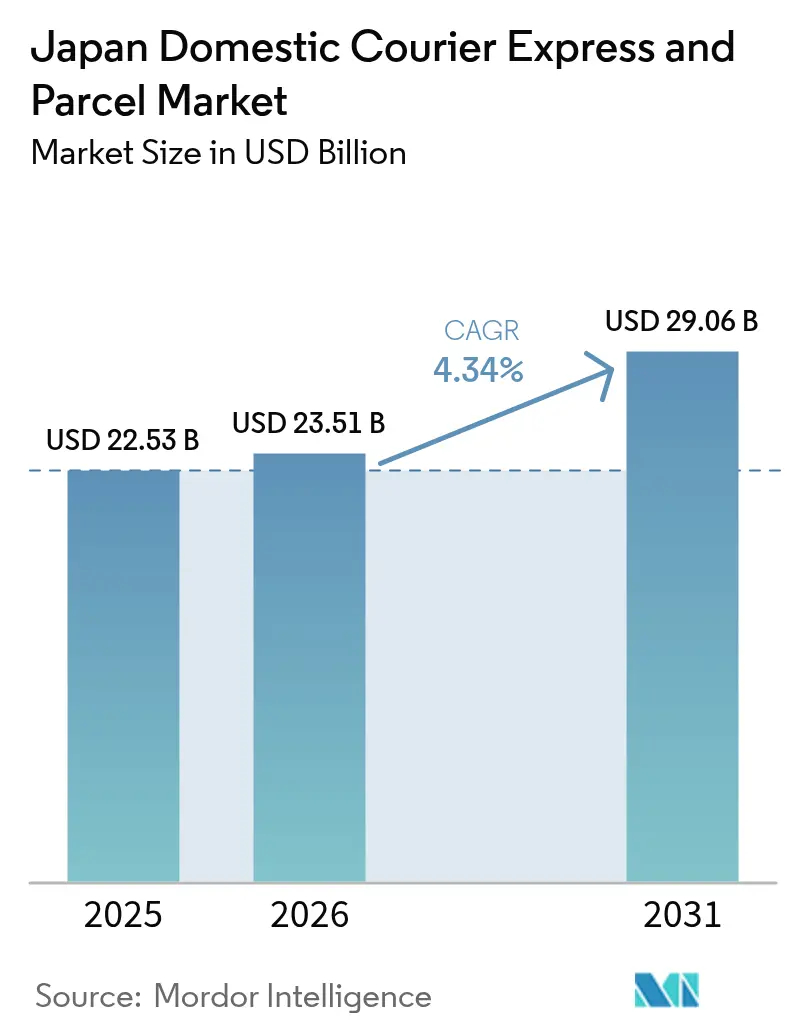
| Base Year Market Size (2025) | USD 22.53 Billion |
| Market Size (2026) | USD 23.51 Billion |
| Market Size (2031) | USD 29.06 Billion |
| Growth Rate (2026 - 2031) | 4.34 % |
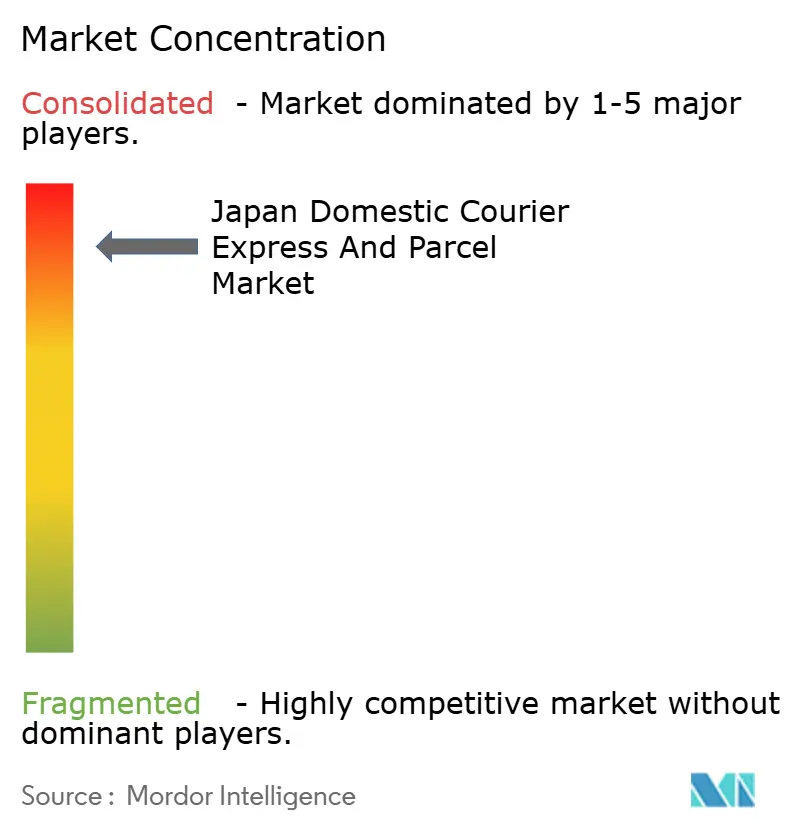
| Market Concentration | High |
Major Players *Disclaimer: Major Players sorted in no particular order Image © Mordor Intelligence. Reuse requires attribution under CC BY 4.0. | |
Japan Domestic Courier Express And Parcel Market Analysis by Mordor Intelligence
The Japan Domestic Courier Express And Parcel Market size was valued at USD 22.53 billion in 2025 and estimated to grow from USD 23.51 billion in 2026 to reach USD 29.06 billion by 2031, at a CAGR of 4.34% during the forecast period (2026-2031). Steady e-commerce demand, demographic aging, and tighter service-level expectations underpin this trajectory. Carriers offset slowing volume growth through premium, value-added services and targeted surcharges that lift revenue per shipment. Structural driver shortages caused by the 2024 overtime cap motivate accelerated automation, electric-vehicle rollouts, and micro-hub networks that lift fleet productivity. Heightened environmental regulation and voluntary net-zero pledges also push operators to modernize assets while differentiating on sustainable delivery credentials. Competitive pressure from gig-economy platforms remains intense, yet established firms retain an edge through nationwide coverage, convenience-store alliances, and trusted handling of regulated goods.
Key Report Takeaways
- By speed of delivery, non-express services held 75.40% of the Japan domestic courier market share in 2025; express services are projected to grow the fastest at a 4.98% CAGR between 2026-2031.
- By shipment weight, light weight shipments accounted for 72.10% of the Japan domestic courier market size in 2025, but medium weight shipments are forecast to expand at 4.45% CAGR between 2026-2031.
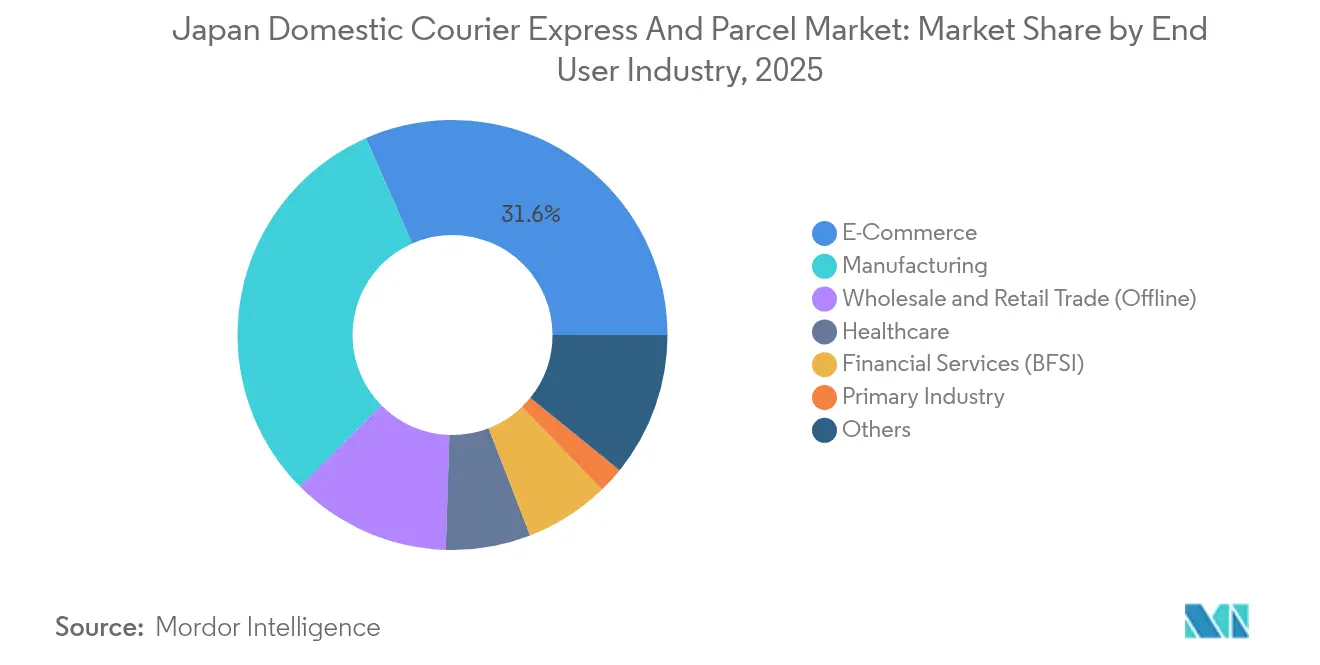
- By end user industry, E-Commerce commanded 31.60% revenue share in 2025, while manufacturing is expected to record the highest segment CAGR at 4.55% between 2026-2031.
- By model, the business-to-consumer (B2C) segment represented 42.95% of the Japan domestic courier market share in 2025; the business-to-business (B2B) segment is predicted to advance at 5.60% CAGR between 2026-2031.
- By mode of transport, road transport retained 49.10% revenue in 2025, whereas air transport is projected to post a 4.96% CAGR between 2026-2031.
Note: Market size and forecast figures in this report are generated using Mordor Intelligence’s proprietary estimation framework, updated with the latest available data and insights as of 2026.
Japan Domestic Courier Express And Parcel Market Trends and Insights
Drivers Impact Analysis*
| Driver | (~) % Impact on CAGR Forecast | Geographic Relevance | Impact Timeline |
|---|---|---|---|
| Rapid growth in B2C parcel volumes driven by E-commerce purchases | +1.2% | National, Tokyo–Osaka corridor | Short term (≤ 2 years) |
| Accelerating adoption of same-day delivery services and quick-commerce models | +0.8% | Major cities | Medium term (2-4 years) |
| Increasing deployment of electric and alternative-fuel vehicles reduces operating costs and emissions | +0.6% | Nationwide metro first | Long term (≥ 4 years) |
| Ageing population drives higher demand for home healthcare parcel deliveries | +0.7% | Nationwide, rural skew | Medium term (2-4 years) |
| Expanding convenience-store pickup and drop-off networks improve delivery efficiency | +0.5% | Nationwide | Short term (≤ 2 years) |
| Rising cross-border small-parcel inflows via Narita and Kansai airports feed domestic deliveries | +0.4% | Airport hinterlands | Medium term (2-4 years) |
| Source: Mordor Intelligence | |||
Rapid Growth in Business-to-Consumer (B2C) Parcel Volumes Driven by E-Commerce Purchases
E-commerce gross merchandise value (GMV) rose from USD 176.50 billion in 2024 to USD 201.40 billion in 2025, pushing the Japan domestic courier market toward denser residential delivery rounds[1]. Smaller, more frequent orders reduce average parcel weight and strain hub capacity, prompting the rapid rollout of micro-sortation facilities inside urban boundaries. Cross-border marketplaces such as Temu add customs-clearance complexity that established carriers monetize through brokerage fees. Food and beverage online sales climbed to USD 48.46 billion in 2025, stimulating chilled-parcel lanes that command premium tariffs yet require additional handling infrastructure. Live-streaming flash sales create unpredictable peaks, leading operators to blend gig-worker fleets with fixed resources for surge coverage. Large platforms, notably Amazon Japan and Rakuten, wield buying leverage that compresses headline rates, so couriers emphasise service reliability and flexible delivery windows.
Accelerating Adoption of Same-Day Delivery Services and Quick-Commerce Models
Same-day fulfillment has shifted from an optional feature to a baseline expectation, as 7-Eleven’s 7NOW service targets USD 1 billion sales through 20,000 outlets in 2025. Quick-commerce dark stores support 20-minute urban drop-offs, bypassing regional depots and placing inventory within five kilometers of consumers. Lawson and Uber Eats introduced sidewalk robots carrying 30 kg payloads on fixed routes, mitigating labor limits during peak shifts. Tele-pharmacy pilots in Osaka enable patients to receive prescriptions the same day, blending medical compliance with express logistics. Artificial-intelligence route engines shrink arrival windows from forty to ten minutes, improving asset utilization without proportional headcount growth. However, only 10% of shoppers select express tiers, and willingness to pay offsets higher cost per stop, preserving margins in premium subsegments.
Increasing Deployment of Electric and Alternative-Fuel Vehicles Reduces Operating Costs and Emissions
Yamato obtained approval to mass-produce conversion kits that electrify existing light trucks at one-third the price of new EVs[2]. SBS Holdings already runs 72 electric vans and plans 20 more in 2025, demonstrating fleet-wide scalability. Diesel averaged USD 1.11 per liter in 2024, elevating the cost advantage of stable-priced electricity. Refrigerated EV trucks supplied by Konoike Transport for Aeon stores prove cold-chain viability over 120 km routes. FamilyMart’s machine-learning dispatcher cut CO₂ by 12.8% versus 2017 baselines through smarter route sequencing. A new sustainable aviation fuel agreement between Sagawa Express and DHL lowers the greenhouse-gas intensity of express air consignments by 10%[3].
Ageing Population Drives Higher Demand for Home Healthcare Parcel Deliveries
Citizens aged 65 or above will reach 29% of Japan’s population in 2025, spurring growth in prescription and device shipments that require temperature control and chain-of-custody proof. Market value for healthcare delivery services is projected at JPY 1.76 billion (USD 0.012 billion) in 2025. Drone lanes piloted by Alfresa move medicine to remote clinics, reducing lead times during disaster events. Same-day pharmacy-to-home integrations in metropolitan areas bundle tele-consultation with last-mile fulfillment, creating combined service revenue streams. Declines in postal mail create capacity gaps that private couriers now fill for rural medical replenishment. Long-term care reforms anchor stable contract volumes, making healthcare a defensive growth pocket within the Japan domestic courier market.
Restraints Impact Analysis*
| Restraint | (~) % Impact on CAGR Forecast | Geographic Relevance | Impact Timeline |
|---|---|---|---|
| Labor shortages intensified by overtime cap inflate delivery costs | -1.1% | Nationwide, rural acute | Short term (≤ 2 years) |
| Introduction of urban congestion pricing increases per-parcel surcharges in major cities | -0.4% | Tokyo, Osaka, Nagoya | Medium term (2-4 years) |
| Price competition from gig-economy couriers erodes margins in same-day segment | -0.6% | Dense urban districts | Medium term (2-4 years) |
| Delayed regulatory approvals for drones and sidewalk robots postpone automation savings | -0.3% | Pilot test areas | Long term (≥ 4 years) |
| Source: Mordor Intelligence | |||
Labor Shortages Intensified by Overtime Cap Inflate Delivery Costs
Japan’s 2024 rule capping truck-driver overtime at 960 hours triggers immediate productivity loss, with 30% of firms still reporting non-compliance after twelve months[4]. Surveys show 46.8% of shippers pay higher freight rates, while 41.2% cannot secure enough drivers, pushing wages up and raising per-parcel expenditure. Small haulers possess limited capacity to absorb surcharges due to scale limitations. Enforcement strength rose in 2025 when regulators revoked licenses for 2,500 Japan Post vehicles following health-check lapses, signaling tougher industry policing. Government draft guidelines on subcontractor remuneration may lift baseline freight tariffs, squeezing margins for operators tied to fixed-price e-commerce contracts.
Price Competition From Gig-Economy Couriers Erodes Margins in Same-Day Segment
App-based networks such as Uber Direct and Amazon Flex mobilize flexible driver pools that undercut conventional pricing, especially on short urban hops. Lawson stores integrate with Uber robots, blending autonomous hardware and gig riders to maintain low overheads. AnyCarry’s platform extends similar cost structures to corporate accounts, challenging traditional rate cards. Established carriers thus confront a margin squeeze, balancing service reliability against customers’ appetite for lower fees. New-entrant claims of “logistics that never refuse” set fresh service benchmarks that raise consumer expectations. Pending legislation on gig-worker status could alter the cost hierarchy, yet uncertainty persists over enforcement timelines and benefit obligations.
*Our forecasts treat driver/restraint impacts as directional, not additive. The impact forecasts reflect baseline growth, mix effects, and variable interactions.
Segment Analysis
By End User Industry: Manufacturing Ups the Growth Pace
Manufacturing climbs fastest at a 4.55% CAGR (2026-2031) as smart-factory rollouts shrink batch sizes and raise shipment frequency. Direct-to-plant supply contracts require tight delivery windows and real-time visibility. Carriers integrate API feeds with shop-floor systems, embedding themselves into replenishment cycles. The e-commerce sector stays the largest at 31.60% share of 2025 revenue, driven by sustained uptake of digital shopping and cross-border marketplace transactions.
Healthcare gains strategic importance despite small absolute volume. Regulatory tracking and cold-chain mandates support premium rates that cushion overall yields for operators with certified facilities. Financial services and legal firms continue to use secure courier hand-offs for critical documents, though absolute growth remains modest. Retailers with legacy store networks adopt ship-from-store schemes, blurring lines between pure digital and bricks-plus-clicks fulfillment.

By Speed of Delivery: Express Services Expand on Premium Demand
Express services generated the fastest sub-segment growth, advancing at 4.98% CAGR between 2026-2031. Although Non-Express retains revenue leadership with 75.40% share in 2025, mounting customer preference for guaranteed delivery windows fuels express lane upgrades across the Japan domestic courier market. Same-day and next-day expectations once associated exclusively with premium tiers are migrating toward mainstream offerings as omnichannel retailers race to match instant-gratification benchmarks. Investments in autonomous sidewalk robots and AI routing compress transit times at competitive cost, reshaping the boundary between classic Express and standard parcels.
Express carriers leverage value-added options, temperature control, secure ID verification, and late-night slots to justify pricing premiums. The restrained competitive set limits price erosion and sustains above-average yields. Meanwhile, Non-Express networks innovate via parcel lockers, neighborhood pick-up counters, and data-driven load pooling that shorten actual arrival times without formal service-level upgrades. Over the forecast period, carriers are expected to calibrate service menus that align price points with finely segmented delivery urgency, preserving revenue diversity within the Japan domestic courier market.
By Model: Business-to-Business (B2B) Shipments Gather Momentum
The business-to-business (B2B) sub-segment outpaces the market at a 5.60% CAGR between 2026-2031, mirroring lean-inventory moves and the growth of small-batch supplier relationships. Predictable order cycles enable route consolidation that boosts vehicle fill and reduces delivery cost per kg. Unified dashboards give corporate clients continuous status feeds, embedding courier performance into procurement metrics.
Business-to-consumer (B2C) maintains leadership at 42.95% revenue share in 2025, but faces rising service-quality expectations coupled with price resistance. Subscription commerce and automatic replenishment services may temper growth variability by smoothing volume peaks. Consumer-to-consumer (C2C) remains a steady avenue for recommerce and peer-to-peer exchanges, benefiting from platform-provided labels and simplified returns.
By Shipment Weight: Medium Weight Shipments Rebound
Light weight shipments (less than 5 Kg) dominate the Japan domestic courier market size, securing 72.10% revenue share in 2025, a direct outcome of online retail’s cadence of small-basket orders. Profitability pressures arise as cubic-volume revenue lags handling frequency growth. Electric-conversion light trucks help reclaim margin by cutting propulsion and maintenance costs. The medium weight shipments band between 5 kg and 31.5 kg posts a 4.45% CAGR between 2026-2031, powered by manufacturers shipping components direct to plant lines and SMEs executing drop-shipment models.
Industrial digitalization encourages higher-value parcelization, with on-demand spare-part dispatch replacing pallet moves. Carriers that equip depots for forklift-assisted parcel lanes and deploy weight-profiling sorters tap this rebound. Heavy shipments above 31.5 kg remain niche yet stable, serving construction and capital-equipment after-sales. Specialized handling competency and lift-gate fleets preserve competitive insulation for providers that commit to safety and compliance.

By Mode of Transport: Air Cargo Expands Within a Road-Heavy Network
Road transport captured 49.10% of 2025 revenue, reflecting Japan’s dense expressway grid and the flexibility of truck-based last-mile. Nevertheless, the 4.34% Japan domestic courier market CAGR (2026-2031), combined with driver scarcity, accelerates modal diversification. Domestic air consignments rise at 4.96% CAGR (2026-2031) as Narita and Kansai airport expansions elevate belly-hold capacity and shorten cut-off times for overnight lanes.
Rail and coastal shipping stay limited to niche applications owing to transload requirements. Looking forward, government trials of conveyor-belt freight corridors and highway platooning could realign modal economics by reducing dependency on human drivers, reshaping long-haul portions of the Japan domestic courier market.
Geography Analysis
Metropolitan prefectures stretching from Tokyo through Kanagawa, Aichi, and Osaka concentrate the lion’s share of parcel origin and destination flows, underpinning route density that supports advanced automation rollouts. Same-day delivery demand thrives here, assisted by dense convenience-store networks and multi-tenant micro-fulfilment nodes. Urban congestion schemes proposed for central Tokyo may levy access fees that raise per-stop costs, nudging carriers toward sidewalk robots and bicycle couriers for inner-city hops.
Second-tier regional cities such as Fukuoka and Sapporo exhibit rising online retail penetration but present softer density, requiring hybrid drop-off options to maintain economics. Rural prefectures face sharper demographic aging, with healthcare deliveries and government document logistics forming core demand in these zones. Drone trials over mountainous terrain aim to compensate for long road detours and limited driver availability, promising to extend service coverage without continuous human presence.
International gateway regions enjoy spill-over parcel inflows from inbound cross-border e-commerce. Cargo-friendly customs regimes at Narita and Kansai accelerate domestic transfer, making surrounding prefectures attractive for sortation investment. Climate initiatives influence routing strategy nationwide; FamilyMart’s 12.8% CO₂ drop arose from algorithms calibrated to specific regional traffic patterns, suggesting further gains by localizing route logics.
Regulatory Landscape
Japan has tightened oversight of domestic logistics operations through a combination of labor, competition, and sector-specific policies that affect parcel networks. April 2024 enforcement of truck-driver overtime limits (960 hours annually) has raised compliance expectations across carriers and subcontractors, and MLIT has increased supervision through dedicated inspection activity, including the Truck G-Men program, focused on fair trading practices and working conditions in logistics.
Policy focus broadened in 2026 from carrier-only compliance to shared supply chain responsibility. The Cabinet approved the Comprehensive Physical Distribution Policy Outline (FY2026-FY2030) on March 31, 2026, with logistics DX, standardization (including pallets), and sustainability framed as national priorities. The revised logistics efficiency framework entered a second phase in April 2026, adding governance requirements such as appointing logistics management officers (CLO) for in-scope entities. Competition policy also moved closer to day-to-day operations as the Japan Fair Trade Commission advanced public comment procedures in March 2026 for amendments addressing burdens including cargo handling and truck waiting time. Separately, Japan Post faced heightened compliance pressure after the June 2025 revocation of permits for 2,500 vehicles linked to health-check lapses.
Value Chain Analysis
Japan domestic CEP services run through an end-to-end chain covering parcel induction (merchant and consumer drop-off, pickup at homes and offices, and convenience-store counters), trunk transport (predominantly road, with selective domestic air for time-critical lanes), and hub-and-spoke sorting centered on major metro areas such as Tokyo, Nagoya, and Osaka. First-mile aggregation is shaped by e-commerce order fragmentation and returns, while midstream processing depends on high-throughput sort centers, linehaul scheduling, and subcontracted trucking capacity. Last-mile handoff is carried out through home delivery, staffed pickup points, and lockers that reduce redelivery friction.
Transport labor and facility turnaround time are key constraints, since overtime limits and stricter enforcement raise the cost of delays and unproductive waiting. This has pushed greater cross-company collaboration in long-haul and linehaul operations among large incumbents, including arrangements linking Japan Post and Seino Transportation in broader logistics partnerships, alongside higher investment in hub automation. Government infrastructure planning also intersects with the value chain through the Autoflow Road concept for automated cargo movement on the Tokyo-Osaka corridor, reinforcing long-haul productivity and reliability as a lever alongside depot automation and micro-hub proximity in dense urban districts.
Competitive Landscape
Three incumbents, Yamato Holdings, Sagawa Express (SG Holdings), and Japan Post Group, anchor the Japan domestic courier industry by virtue of nationwide depots, branded fleets, and customer trust. Their combined coverage secures enterprise accounts and regulated-goods contracts. Yet, regulatory scrutiny tightened when authorities revoked 2,500 Japan Post vehicle permits in June 2025, demonstrating reputational risk tied to compliance lapses.
Incumbents invest heavily in electrification and robotics to stabilize cost bases. Yamato’s conversion-kit approval yields capital-light fleet renewal, while Sagawa pairs with DHL on sustainable aviation fuel to differentiate international offerings. Medium-sized challengers pursue specialization, medical, temperature-controlled, or reverse logistics to build defensible niches. Gig-economy aggregators disrupt pricing in high-density urban districts by mobilizing flexible labor and autonomous rigs. anyCarry, Uber Direct, and Amazon Flex extend capacity without owning trucks, accelerating price discovery toward variable on-demand tariffs. Small local carriers grapple with rising compliance and technology investment thresholds, prompting partnerships or acquisitions by scale-seeking networks.
Convenience-store alliances form a critical competitive lever. 7-Eleven, Lawson, and FamilyMart integrate pick-up counters and micro-fulfillment space, offering exclusive access to tens of thousands of storefronts. Carriers unable to secure such tie-ups risk higher last-mile costs and weaker consumer brand presence. Over the forecast horizon, inorganic consolidation and technology joint ventures are set to redraw market shares as players strive to attain the scale needed to invest in electrification, AI, and automation.
Japan Domestic Courier Express And Parcel Industry Leaders
-
Yamato Holdings Co., Ltd.
-
SG Holdings Co., Ltd. (Sagawa Express)
-
Japan Post Holdings Co., Ltd.
-
Nippon Express Holdings
-
Seino Holdings Co., Ltd.
- *Disclaimer: Major Players sorted in no particular order
Market Opportunities and Future Outlook
Urban mega-hubs and integrated sorting bases are emerging as a response to post-2024 labor constraints, consolidating transport, sorting, and contract-logistics functions in locations that improve route density and reduce handling touches. Yamato Transport opened an integrated business solutions base in Shinonome (Koto-ku, Tokyo) in April 2026 with about 59,500 square meters and began launching operational functions sequentially from June 2026, expanding capacity and service options for high-frequency B2C and time-window deliveries across the capital region. SG Holdings also advanced Kanto network efficiency, with Sagawa Express commencing full-scale operation of its Kanto Hub Center in Koto-ku, Tokyo in July 2026, reinforcing hub-led productivity as a competitive lever for incumbents.
Policy-driven standardization and shipper accountability create opportunities in orchestration services, data integration, and compliance-enabled offerings beyond transport. The Cabinet-approved Comprehensive Physical Distribution Policy Outline (FY2026-FY2030) and the April 2026 phase-in of requirements such as appointing logistics management officers (CLO) for certain entities encourage shippers and carriers to formalize planning, slotting, and documentation. That, in turn, supports demand for visibility tools and value-added services designed to reduce waiting time and off-contract work. Medium-term infrastructure initiatives such as the government-led Autoflow Road project, with testing targeted for fiscal 2027 or 2028, further support business cases to redesign linehaul networks around fewer, more automated handoffs and to shift some long-distance movements into standardized, technology-assisted corridors.
Recent Industry Developments
- July 2026: Sagawa Express commenced full-scale operation of its Kanto Hub Center in Koto-ku, Tokyo. The new hub is designed to improve loading efficiency and optimize regional transport flows in the Kanto area, supporting tighter cut-off times and higher throughput within road-heavy parcel networks.
- June 2025: Japan Post Holdings faced cancellation of permits for 2,500 vehicles after issues tied to driver health-check procedures were identified. The action disrupted parts of nationwide capacity and raised compliance costs and oversight intensity for large operators and their fleet management processes.
- September 2024: Nippon Express Holdings launched the NX Universal Harmonious Work Warehouse pilot that integrates mobility robots to mitigate labor shortages. The initiative signaled continued investment in warehouse automation to protect service levels as the industry adjusts to tighter labor availability and productivity constraints.
Research Methodology Framework and Report Scope
Market Definition and Coverage
For this report, the market covers paid domestic courier, express, and parcel services inside Japan, from pickup through linehaul and final delivery, for documents and small parcels moved on scheduled networks.
Scope exclusions: International (cross-border) courier and parcel movements under export or import waybills are excluded from this sizing.
Segmentation Overview
- Speed of Delivery
- Express
- Non-Express
- Shipment Weight
- Heavy Weight Shipments
- Light Weight Shipments
- Medium Weight Shipments
- End User Industry
- E-Commerce
- Financial Services (BFSI)
- Healthcare
- Manufacturing
- Primary Industry
- Wholesale and Retail Trade (Offline)
- Others
- Model
- Business-to-Business (B2B)
- Business-to-Consumer (B2C)
- Consumer-to-Consumer (C2C)
- Mode of Transport
- Road
- Air
- Others
Data Sources, Market Sizing, and Validation
Desk Research
We started with desk research to lock the market boundary and to collect the public indicators that move domestic parcel demand in Japan. Sources used include official and non-paywalled statistics and publications such as Japan Post and other operator disclosures, the Ministry of Land, Infrastructure, Transport and Tourism (MLIT) transport logistics statistics, Statistics Bureau of Japan household and retail indicators, Japan Customs trade summaries to separate domestic from cross-border flows, and Bank of Japan macro series for inflation and business activity.
Next, the model inputs were cross-checked against company filings, investor presentations, association and infrastructure operator updates (for airports and road networks), and reputed press coverage of capacity, labor, and delivery fee changes. We also used paid database subscriptions for company financials and intelligence, news and financials, and selected contract and tender tracking to confirm major network investments and outsourcing cycles. The list above is illustrative only, and many other public and paid sources were also used during data collection, validation, and clarification.
Primary Interviews and Surveys
Primary work was used to confirm how revenue is recognized in domestic CEP, how pricing changes flow into realized yields, and where volume is shifting across B2C, C2C, and B2B lanes. We spoke with carrier executives, regional operations leaders, last-mile managers, major shipper logistics teams, and channel partners, and then used their inputs to tighten service-mix assumptions, surcharge adoption assumptions, and network utilization patterns across Japan.
Distribution of primary research fieldwork respondents
| Company type | Respondent position |
|---|---|
| Top tier: 34% | CXOs: 18% |
| Mid tier: 44% | Functional/Unit leaders: 34% |
| Smaller Players: 22% | Managers: 48% |
Market-Sizing & Forecasting
Sizing was built using a top-down and bottom-up logic, where domestic shipment and delivery activity was first reconstructed from Japan-specific transport and operator statistics and then translated into market value using pricing and surcharge assumptions. To keep the totals realistic, selective bottom-up checks were used, such as rolling up sampled carrier revenue disclosures, using ASP (yield) x estimated parcel volumes for key lanes, and validating shares through shipper and channel checks.
Key inputs used in the model include domestic parcel volume trends, redelivery and reattempt patterns, changes in average delivery charge and fuel or peak surcharges, e-commerce order intensity and returns behavior, labor and capacity constraints that affect service levels, and modal mix between road and domestic air shuttle for time-definite services. When one input was not directly visible, proxy series were used, for example household consumption and retail shipments, and then the implied values were adjusted using interview feedback so the results stayed explainable.
Forecasts were generated using scenario analysis supported by time-series smoothing on the most stable drivers, and then reviewed against expected pricing actions, wage pressure, and network productivity programs described by respondents. Where evidence was mixed, assumptions were kept conservative, and the decision rules were documented so the model can be refreshed each year with the same steps.
Data Validation & Update Cycle
We validated the outputs by comparing the implied revenue per parcel and growth rates against independent signals, including operator disclosures, macro demand indicators, and observed pricing announcements. Any large variances triggered a second pass on the volume and yield build, followed by re-contact with selected respondents when a gap was driven by a scope or timing mismatch.
Before sign-off, the work goes through multi-step analyst review checks that look for abnormal jumps, inconsistent unit economics, and mismatched year definitions. The report is refreshed annually, and interim updates are made when material events occur, such as major tariff revisions, regulatory shifts, or sudden capacity constraints. Right before delivery, a final data sweep is completed so clients receive an updated view.
Mordor Intelligence's Japan Domestic Courier Express and Parcel Market Sizing Compared With Other Published Estimates
Published market values for Japan domestic CEP can differ because not everyone counts the same services, and the pricing logic used to convert parcels into revenue is often handled differently. Differences also show up when a study mixes domestic and cross-border flows, or when it uses a different year for currency conversion and price escalation.
Domestic operator revenue disclosures and Japan transport activity series are the evidence checks that keep Mordor Intelligence anchored to the Japan-only CEP value pool, where international waybills and broader last-mile service add-ons are not automatically included unless they match the defined domestic CEP scope.
Benchmark comparison
| Source | Market Size | Gaps in Research Methodology |
|---|---|---|
| Mordor Intelligence | USD 22.53 B (2025) | |
| Industry Association A | USD 26.10 B (2024) | Often quoted in local currency and then converted at a different average FX rate, and it may blend domestic parcel charges with adjacent last-mile service fees, which lifts the value versus a strict CEP-only boundary. |
| Regional Consultancy B | USD 29.10 B (2024) | Uses an earlier base year and may apply a higher assumed yield per parcel by treating surcharge pass-through and premium delivery mix as uniform across lanes, which can overstate revenue when service mix is uneven. |
Taken together, the spread is mainly explained by where each publisher draws the line between domestic CEP revenues and adjacent delivery-related services, and by how price per shipment is progressed across years. Our approach stays repeatable by anchoring to observable domestic activity signals, then translating them into value using documented yield and surcharge assumptions that are rechecked through interviews each refresh.
Key Questions Answered in the Report
What is the current size of the Japan domestic courier market?
The market is valued at USD 23.51 billion in 2026 and is projected to grow to USD 29.06 billion by 2031.
How fast is the Japan domestic courier market expected to grow?
It is forecast to register a 4.34% CAGR from 2026 to 2031.
Which segment is growing the quickest within the Japan domestic courier market?
Express delivery services lead growth with a projected 4.98% CAGR between 2026-2031.
How are labor shortages being addressed by courier companies?
Carriers accelerate automation, deploy electric vehicles, and add autonomous robots to boost productivity while reducing reliance on human drivers.
Why is healthcare delivery a strategic focus?
Japan’s aging population and expanding tele-medicine adoption create specialized, higher-margin shipment demand for pharmaceuticals and medical equipment.
What role do convenience stores play in courier logistics?
Over 55,000 convenience stores act as pick-up and drop-off points and micro-fulfillment hubs, improving last-mile efficiency and consumer accessibility.