
Market Overview
| Study Period | 2021 - 2032 |
|---|---|
| Forecast Data Period | 2027 - 2032 |
| Base Year Market Size (2026) | USD 3.47 Billion |
| Market Size (2027) | USD 3.65 Billion |
| Market Size (2032) | USD 4.65 Billion |
| Growth Rate (2027 - 2032) | 4.98 % |
| Market Concentration | Medium |
Major Players *Disclaimer: Major Players sorted in no particular order Image © Mordor Intelligence. Reuse requires attribution under CC BY 4.0. | |
Japan Diabetes Drugs Market Analysis by Mordor Intelligence
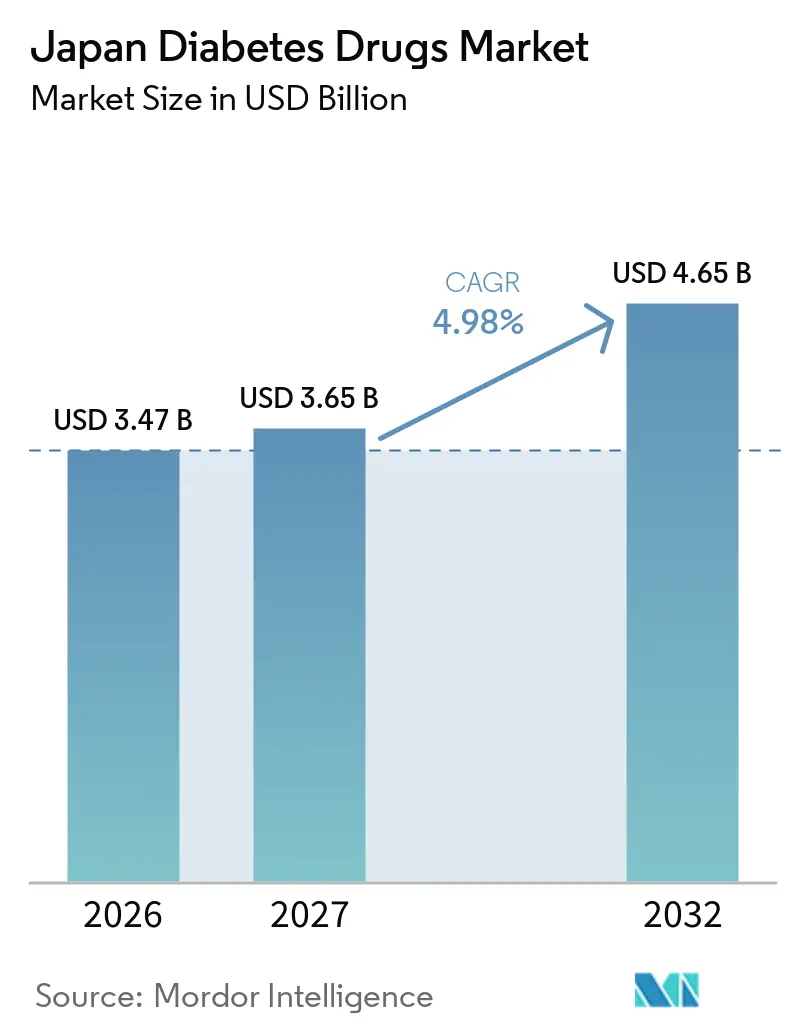
The Japan Diabetes Drugs Market size is expected to increase from USD 3.47 billion in 2026 to USD 3.65 billion in 2027 and reach USD 4.65 billion by 2032, growing at a CAGR of 4.98% over 2027-2032.
While Type 1 diabetes is caused by an immune system malfunction, Type 2 diabetes is linked to leading a sedentary lifestyle, which results in the development of inherent resistance to insulin. Hence, Type 1 diabetes can be characterized as insulin-requiring, while Type 2 diabetes can be characterized as insulin-dependent diabetes.
Japan has one of the largest elderly populations in the world which is more susceptible to the onset of type 2 diabetes. As Japan's population continues to age, the prevalence of diabetes increases as well. The monitoring and management of blood glucose levels are on the rise, to avoid negative consequences, such as cardiovascular diseases, kidney disorders, and many other conditions.
The prevalence of diabetes is increasing among the population, especially the elderly population, owing to unhealthy diets, obese population, and sedentary lifestyles. Various studies were conducted to assess the prescription patterns of oral antidiabetic drugs in Japanese patients with type 2 diabetes.
Therefore, owing to the aforementioned factors the studied market is anticipated to witness growth over the analysis period.
Note: Market numbers in this report are based on Mordor Intelligence's proprietary estimation framework, which combines nine months of actuals with Q4 projections for base year 2026.
Japan Diabetes Drugs Market Trends and Insights
The oral anti-diabetic drugs segment holds the highest market share in the Japan Diabetes Drugs Market in the current year
Oral Anti-Diabetic Drugs are available internationally and are recommended for use when escalation of treatment for type 2 diabetes is required along with lifestyle management. Oral agents are typically the first medications used in treating type 2 diabetes due to their wide range of efficacy, safety, and mechanisms of action.
The dominance of oral anti-diabetic drugs in Japan is strongly supported by the country's treatment preferences and aging population. Japan has historically been one of the largest markets for DPP-4 inhibitors, as these therapies have demonstrated favorable efficacy and safety profiles among East Asian patients and are widely prescribed in clinical practice. In addition, the growing proportion of elderly diabetic patients has increased demand for oral therapies that can effectively manage blood glucose levels while minimizing the risk of hypoglycemia. Consequently, the widespread use of DPP-4 inhibitors, SGLT-2 inhibitors, and combination therapies continues to support the strong market position of the oral anti-diabetic drugs segment in Japan.
The prevalence of diabetes is growing among all ages in Japan, which can be attributed to the growing obese population, unhealthy diets, and sedentary lifestyles. Diabetes mellitus is of wide concern with its high prevalence, resulting in increased financial burdens for clinical systems, individuals, and governments.
The Japanese healthcare system includes a few disease management programs conducted by the Japan Association for Diabetes Education and Care. Japan is one of the regional leaders in Asia-Pacific in terms of diabetic public health policies. The country promotes public awareness and embraces preventive policies focusing on lifestyle and dietary adjustments, which can lessen the likelihood of adult-onset diabetes.
Owing to the above factors, the market will likely continue to grow.
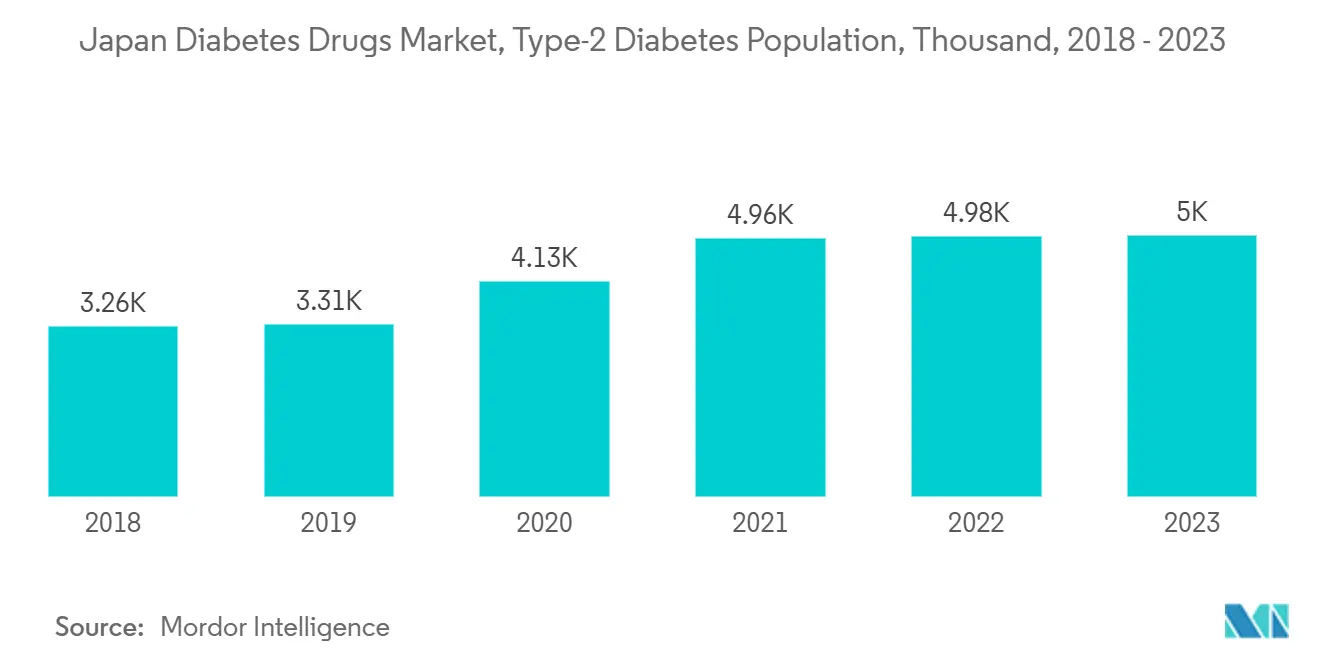
Sodium-glucose cotransport -2 (SGLT-2) inhibitor segment is expected to register the highest CAGR in the Japan Diabetes Drugs Market over the forecast period
SGLT-2 inhibitors, also called gliflozins, are a medicine class used to lower high blood glucose levels in people with type 2 diabetes. SGLT-2 inhibitors act independently of beta-cell function in the pancreas.
SGLT-2 drugs significantly manage cardiovascular risk factors, including blood pressure, cardiac function, and anti-inflammatory activity.SGLT-2 inhibitors are effective at lowering hemoglobin A1c levels and improving weight loss. They include a low risk of hypoglycemia and are usually well tolerated.
The high prevalence of type 2 diabetes is associated with a significant economic burden. The costs of diabetes are increased in patients with co-morbidities such as hypertension and hyperlipidemia and in patients who develop complications.
Costs increase with an increasing number of complications. Well-organized medical insurance systems cover all medical fees for diabetes mellitus, and people with diabetes can visit doctors freely in Japan. Such advantages helped the increased adoption of these products in the Japanese market.
Competitive Landscape
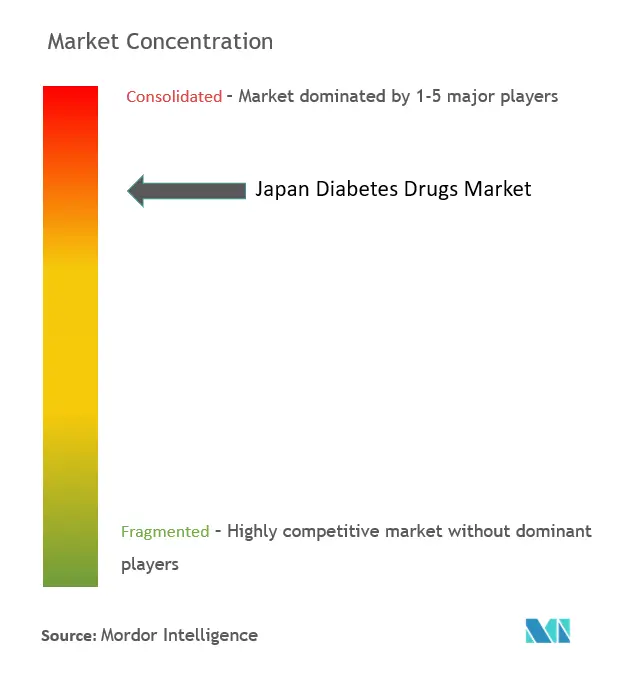
The Japan Diabetes Drugs Market is consolidated, with major manufacturers, namely Eli Lilly, Sanofi, Novo Nordisk, AstraZeneca, and other generic players, holding a presence in the region. A major share of the market is held by manufacturers concomitant with strategy-based M&A operations and constantly entering the market to generate new revenue streams and boost existing ones.
Japan Diabetes Drugs Industry Leaders
-
Takeda
-
AstraZeneca
-
Boehringer Ingelheim
-
Novo Nordisk A/S
-
Sanofi Aventis
- *Disclaimer: Major Players sorted in no particular order
Recent Industry Developments
- March 2023: Health2Sync developed the latest version of the Health2Sync App that integrates insulin data from Mallya Cap (insulin cartridge) developed by Biocorp and commercialized in Japan by Novo Nordisk.
- September 2022: Japan's health ministry approved Eli Lilly's diabetes drug Mounjaro (tirzepatide). Mitsubishi Tanabe Pharma Corporation distributes and sells Mounjaro in Japan according to its sales collaboration agreement with Eli Lilly Japan, signed in July 2022. The drug is administered in Japan using ATEOS, a single-use autoinjector device.
Japan Diabetes Drugs Market Report Scope
Diabetes Drugs are used to manage diabetes mellitus by lowering the glucose level in the blood. The Japan Diabetes Drugs Market is segmented into insulin drugs, oral anti-diabetic drugs, non-insulin injectable drugs, and combination drugs. The report offers the value (in USD) and volume (in units) for the above segments.
Insulins
| Basal or Long Acting Insulins |
| Bolus or Fast Acting Insulins |
| Traditional Human Insulins |
| Biosimilar Insulins |
Oral Anti-diabetic drugs
| Biguanides |
| Alpha-Glucosidase Inhibitors |
| Dopamine D2 receptor agonist |
| SGLT-2 inhibitors |
| DPP-4 inhibitors |
| Sulfonylureas |
| Meglitinides |
Non-Insulin Injectable drugs
| GLP-1 receptor agonists |
| Amylin Analogue |
Combination drugs
| Insulin combinations |
| Oral Combinations |
| Insulins | Basal or Long Acting Insulins |
| Bolus or Fast Acting Insulins | |
| Traditional Human Insulins | |
| Biosimilar Insulins | |
| Oral Anti-diabetic drugs | Biguanides |
| Alpha-Glucosidase Inhibitors | |
| Dopamine D2 receptor agonist | |
| SGLT-2 inhibitors | |
| DPP-4 inhibitors | |
| Sulfonylureas | |
| Meglitinides | |
| Non-Insulin Injectable drugs | GLP-1 receptor agonists |
| Amylin Analogue | |
| Combination drugs | Insulin combinations |
| Oral Combinations |
Key Questions Answered in the Report
How big is the Japan Diabetes Drugs Market?
The Japan Diabetes Drugs Market size is expected to reach USD 3.47 billion in 2026 and grow at a CAGR of 4.98% to reach USD 4.65 billion by 2032.
What is the Japan Diabetes Drugs Market size in 2027?
In 2027, the Japan Diabetes Drugs Market size is expected to reach USD 3.65 billion.
Who are the key players in Japan Diabetes Drugs Market?
Takeda, AstraZeneca, Boehringer Ingelheim, Novo Nordisk A/S and Sanofi Aventis are the major companies operating in the Japan Diabetes Drugs Market.
What years does this Japan Diabetes Drugs Market cover, and what was the market size in 2025?
In 2025, the Japan Diabetes Drugs Market size was estimated at USD 3.31 billion. The report covers the Japan Diabetes Drugs Market historical market size for years: 2021, 2022, 2023, 2024, 2025, and 2026. The report also forecasts the Japan Diabetes Drugs Market size for years: 2027, 2028, 2029, 2030, 2031, and 2032.