
Market Overview
| Study Period | 2020 - 2031 |
|---|---|
| Forecast Data Period | 2026 - 2031 |
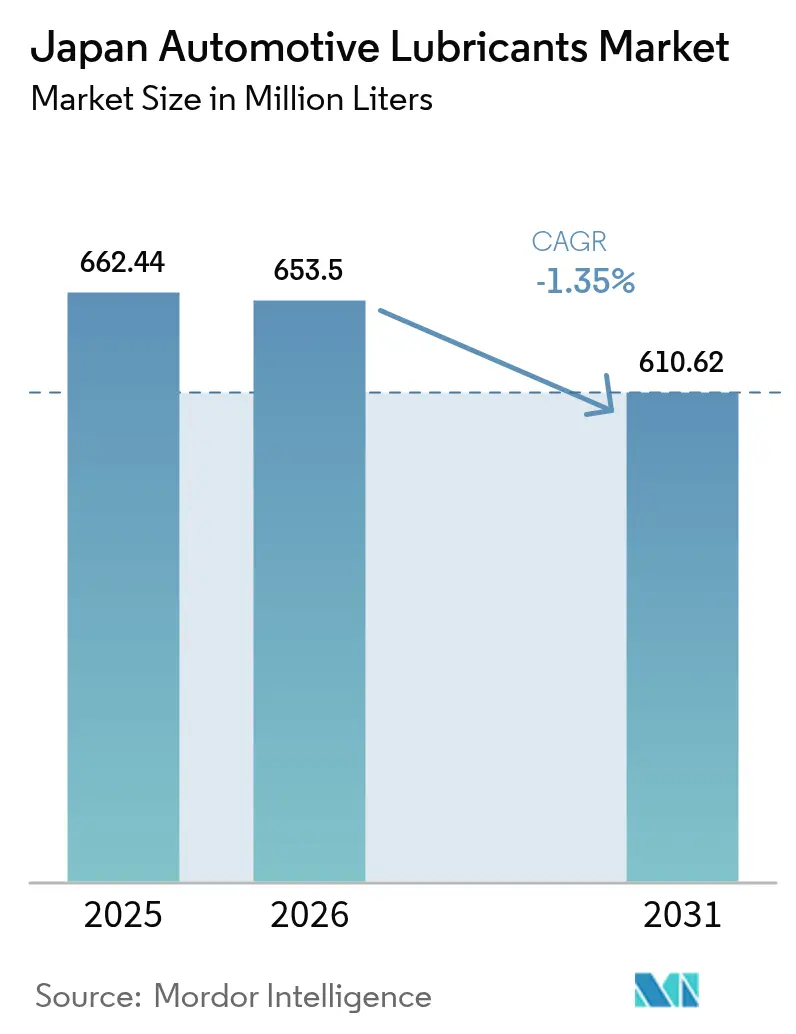
| Base Year Market Size (2025) | 662.44 Million liters |
| Market Volume (2026) | 653.5 Million liters |
| Market Volume (2031) | 610.62 Million liters |
| Growth Rate (2026 - 2031) | -1.35 % |
| Market Concentration | Medium |
Major Players *Disclaimer: Major Players sorted in no particular order Image © Mordor Intelligence. Reuse requires attribution under CC BY 4.0. | |
Japan Automotive Lubricants Market Analysis by Mordor Intelligence
Japan Automotive Lubricants Market size in 2026 is estimated at 653.5 million liters, growing from 2025 value of 662.44 million liters with 2031 projections showing 610.62 million liters, growing at -1.35% CAGR over 2026-2031. The contraction reflects rapid electrification, stringent Corporate Average Fuel Economy targets, and the industry-leading OEM-genuine oil penetration that concentrates demand in premium but thinner viscosity grades. Low-viscosity formulations, such as 0W-8 and 0W-12, continue to gain market share because they deliver fuel efficiency gains, creating a technology moat for domestic refiners that control integrated base-oil production. Commercial fleets, on the other hand, deploy remote oil-condition monitoring to stretch drain intervals, partially offsetting volume loss while reinforcing the value proposition of higher-margin synthetics.
Key Report Takeaways
- By product type, automotive engine oil led with a 61.62% share of Japan's automotive lubricants market in 2025; automatic transmission fluids recorded the highest projected CAGR of -1.23% through 2031.
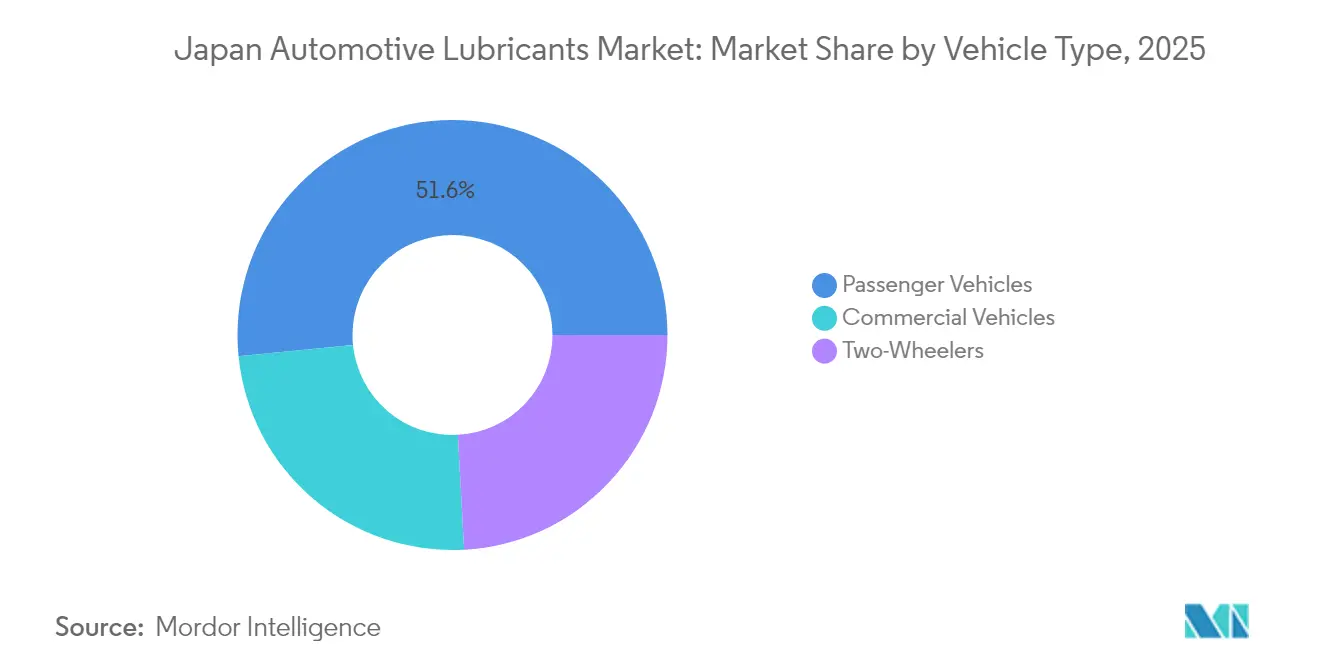
- By vehicle type, passenger vehicles accounted for a 51.58% share of the Japanese automotive lubricants market size in 2025, while commercial vehicles were projected to have the highest CAGR at -1.08% through 2031.
Note: Market size and forecast figures in this report are generated using Mordor Intelligence’s proprietary estimation framework, updated with the latest available data and insights as of 2026.
Japan Automotive Lubricants Market Trends and Insights
Drivers Impact Analysis*
| Drivers | (~) % Impact on CAGR Forecast | Geographic Relevance | Impact Timeline |
|---|---|---|---|
| High OEM-genuine oil penetration | +0.8% | Nationwide, strongest in urban centers | Medium term (2-4 years) |
| Regulatory shift to low-viscosity, fuel-efficient oils | +0.5% | Nationwide | Long term (≥ 4 years) |
| Mature but aging vehicle parc | +0.4% | Nationwide, rural skew | Medium term (2-4 years) |
| Growth of synthetic and bio-based blends | +0.3% | Nationwide | Long term (≥ 4 years) |
| Remote oil-condition monitoring adoption | +0.2% | Commercial-vehicle clusters | Medium term (2-4 years) |
| Source: Mordor Intelligence | |||
High OEM-Genuine Oil Penetration Sustains Premium-Grade Demand
OEM-genuine oil penetration surpasses the global average of 45%, enabling automakers and refiners to maintain premium pricing power despite the shrinking base of internal-combustion vehicles. Dealer-controlled maintenance schedules ensure routine lubricant replacement and keep genuine labels embedded in consumer habits. Toyota, Honda, and Nissan exploit this captive channel to mandate advanced synthetics that command higher margins than mineral oils. The legally mandated Shaken inspection obliges drivers to use certified workshops, reinforcing OEM channel dominance. As a result, premium-grade demand softens more slowly than total volume, helping the Japanese automotive lubricants market maintain a stable profit pool even as liters decline. Independent workshops respond by stocking value-branded synthetics to retain customers migrating out of warranty.
Regulatory Shift to Low-Viscosity, Fuel-Efficient Oils
Japan’s 2030 CAFE target of 25.4 km/L pushes refiners to deliver oils as thin as 0W-8, a grade that lowers hydrodynamic drag compared with 5W-30. Domestic players leverage integrated supply chains to customize Group III+ and Group IV base-oil blends that meet JASO GLV-1 and GLV-2 benchmarks at scale, whereas importers incur costs associated with formula redesign. Production expenses increase, yet OEMs willingly pass these premiums on to consumers because validated fuel-efficiency gains help them meet their fleet-average targets. The Japan automotive lubricants market, therefore, skews toward synthetics and ultra-low viscosities, widening the technology gap between incumbents and late-entry suppliers. Over the forecast horizon, viscosity downgrading is expected to reduce aggregate demand but simultaneously raise average selling prices, thereby tempering revenue erosion.
Mature but Aging Vehicle Parc Maintains Aftermarket Volumes
The average vehicle age reached 13.2 years in 2024, the highest among developed economies, creating a sizable pool of high-mileage engines that require more frequent oil changes[1]. Economic stagnation and demographic shifts delay replacement purchases, extending maintenance cycles for legacy ICE models. Service intervals for older engines remain at 10,000–12,000 kilometers, which is well below the 15,000–25,000-kilometer thresholds typical in North America, thereby preserving aftermarket throughput. Independent workshops cater to this segment with conventional and high-mileage mineral formulations, whereas OEM service centers focus on synthetics for newer fleets. The coexistence of old and new platforms enables suppliers to maintain a broad range of SKUs, thereby buffering revenue as total volumes decline. Regulatory checks on tailpipe emissions for older vehicles further anchor lubricant demand by mandating compliant formulations that maintain catalytic converter efficiency.
Growth of Synthetic and Bio-Based Blends for Carbon Reduction
Japan’s carbon-neutrality pledge for 2050 accelerates the adoption of synthetics that extend drain intervals and cut lifecycle emissions by up to 30%. ENEOS and Idemitsu have earmarked funds for bio-refinery upgrades to produce ester-based stocks derived from vegetable oils, targeting fleets that report sustainability metrics to shippers and investors. Incentives in the Green Growth Strategy—including tax credits and accelerated depreciation—encourage fleets to trial bio-lubes, opening a premium niche within the shrinking volume base. These dynamics help the Japan automotive lubricants market pivot toward lower-carbon value propositions, partially substituting margin for scale.
Restraints Impact Analysis*
| Restraints | (~) % Impact on CAGR Forecast | Geographic Relevance | Impact Timeline |
|---|---|---|---|
| Rapid EV/hybrid uptake curbs ICE-oil volumes | -2.1% | Metropolitan clusters | Short term (≤ 2 years) |
| Volatile base-oil feedstock costs | -0.8% | Import-dependent regions | Medium term (2-4 years) |
| Counterfeit lubricants on e-commerce | -0.3% | Nationwide | Short term (≤ 2 years) |
| Source: Mordor Intelligence | |||
Rapid EV/Hybrid Uptake Curbs ICE-Oil Volumes
Electrified vehicles captured a significant share of new sales in 2024, cutting engine running time and lubricant consumption per unit. Battery electric platforms eliminate the need for engine oil. The government’s 2035 ban on new ICE-only passenger cars accelerates the downward trajectory. ENEOS projects gasoline demand to fall by 50% by 2040, implying a direct correlation with engine oil erosion. While hybrid transmissions still require specialized fluids, the overall decline in liters is faster than the contraction of the vehicle stock. Suppliers respond by reallocating capital toward industrial and marine lubricants to hedge exposure. For the Japan automotive lubricants market, electrification remains the single largest headwind, outweighing all incremental drivers combined.
Volatile Base-Oil Feedstock Costs Pressure Margins
Domestic refinery closures, including ENEOS’s Wakayama shutdown, push import dependency for base oils, exposing manufacturers to swings in Group I price benchmarks. Smaller blenders without term contracts face cash-flow strain when prices spike, narrowing gross margins. Currency fluctuations compound volatility because purchases are dollar-denominated while sales accrue in yen. To manage risk, large refiners extend supply agreements with South Korean and Singaporean producers, whereas independents increasingly rely on spot volumes. Despite price pressures, the Japan automotive lubricants market sustains a premium positioning, but margin compression incentivizes further consolidation.
*Our forecasts treat driver/restraint impacts as directional, not additive. The impact forecasts reflect baseline growth, mix effects, and variable interactions.
Segment Analysis
By Product Type: Engine-Oil Dominance Amid Viscosity Evolution
Automotive engine oil retained 61.62% of Japan's automotive lubricants market share in 2025, underscoring its centrality to ICE maintenance. Yet the segment’s negative CAGR mirrors the systemic shift toward electrified drivetrains. Within the category, 0W-8 and 0W-12 account for the fastest growth as OEM manuals specify these grades to satisfy fuel-economy tests. Japan's automotive lubricants market size for automatic transmission fluids is forecast to decline at a modest -1.23% CAGR, as hybrid powertrains and continuously variable transmissions require specialized ATFs for electric-motor lubrication and thermal management. Manual transmission fluids and power-steering fluids shrink more quickly due to the rise of CVTs and electric steering systems. Brake fluids remain steady because EVs still employ hydraulic braking circuits.
Elevated technical barriers in ultra-low viscosity formulations favor refiners with Group III+ upgrading units, enabling ENEOS and Idemitsu to supply OEM-approved 0W-8 at volume. As drain intervals extend, suppliers embed value by bundling oil-analysis services and warranty extensions. Greases hold niche relevance in wheel bearings and chassis components for both ICE and EV platforms, moderating the overall decline. The shaken inspection protocol enforces replacement cycles, ensuring that the Japanese automotive lubricants market maintains calibrated demand for every fluid family, even under pressure from electrification.


By Vehicle Type: Commercial Resilience Offsets Passenger Declines
Passenger vehicles comprised 51.58% of Japan's automotive lubricants market size in 2025; however, their lubricant consumption is projected to contract at the fastest rate, as urban EV uptake outpaces that in rural regions. BEV and PHEV penetration increased in new registrations, slashing engine oil liters per car. Conversely, commercial vehicles post the mildest decline at -1.08% CAGR as fleet electrification lags due to payload penalties and charging constraints. Heavy trucks, buses, and construction machinery retain large crankcase volumes, partially offsetting the decline in passenger car sales. Two-wheelers add stability; motorcycles require high-shear-stability oils, which are changed every 3,000-5,000 kilometers, and electrification remains nascent outside food-delivery fleets.
Remote oil-condition monitoring is gaining traction among trucking and heavy-equipment operators, enabling them to defer changes, yet the high base volumes keep the segment attractive. Stricter NOx and particulate matter rules for diesel engines mandate low-ash formulations to protect after-treatment systems, thereby boosting the adoption of synthetic fuels. This resilience provides a buffer for the Japan automotive lubricants market, giving suppliers a platform to transition toward next-generation fluids while managing volume attrition.
Geography Analysis
Japan's automotive lubricants market demand is concentrated along the Pacific industrial corridor, which stretches from Fukuoka through Osaka and Nagoya to the Tokyo-Yokohama cluster, where automotive manufacturing density is highest. These metro regions also exhibit the fastest electrification rates, which suppress engine oil volumes but catalyze demand for hybrid-specific transmission fluids. Rural prefectures, such as Hokkaido and Tohoku, maintain higher ICE dependency because sparse charging infrastructure extends the adoption timelines. Consequently, the Japan automotive lubricants market size for conventional 10W-30 grades persists in these areas, supporting independent distributors.
Petroleum product demand nationwide has declined since 1999 and is forecast to continue declining by 2030, prompting refiners to rationalize their coastal plants and consolidate distribution depots. ENEOS leverages its refineries in Chiba and Mizushima, linked to a nationwide network of over 10,000 service stations, to maintain its dominance despite shrinking volumes. Imports account for a major portion of the base-oil supply, mostly arriving at Yokohama and Kobe, then being transported inland by tank truck or coastal tanker. Geopolitical disruptions or refinery turnarounds in Singapore or South Korea, therefore, ripple quickly across Japanese inventories, prompting refiners to maintain safety stocks equivalent to 45 days of demand.
Demographic patterns further shape regional lubricant consumption. Aging populations in rural prefectures delay vehicle replacement, extending the service life of high-mileage ICE cars that require shorter drain intervals. In contrast, urban households tend to adopt newer hybrid or BEV models, which reduces engine oil consumption but increases demand for coolant and e-axle fluids. These geographic asymmetries compel suppliers to tailor their channel strategies-premium synthetics and dealer bundling in cities, and conventional oils and retail packs in rural markets-ensuring the Japanese automotive lubricants market remains segment-diverse even as aggregate volume softens.
Regulatory Landscape
Japan automotive lubricant formulations fall under mandatory chemical-substance governance via the Chemical Substances Control Law (CSCL). The law requires notification and assessment for new chemical substances before manufacture or import, with METI working alongside the Ministry of Health, Labour and Welfare and the Ministry of the Environment. For certain regulated substances, export-related compliance can also apply under METI-administered trade control rules (Export Trade Control Order under the Foreign Exchange and Foreign Trade Act), which can constrain the cross-border movement of selected chemical inputs used in lubricant additive packages.
Fitment and fuel-economy claims are further shaped by Japan-specific standards and industry panels used by OEMs and service channels. The JASO Engine Oil Standards Implementation Panel manages the gasoline engine oil standard JASO M 364:2024, while Japanese Industrial Standards such as JIS K 2215 (internal combustion engine lubricating oils) and JIS K 2010 (automotive engine oil viscosity classification) set test and classification baselines that support consistent quality claims across OEM and aftermarket channels.
Value Chain Analysis
Japan automotive lubricants are sourced from base oils and additives, then blended and packaged before approval/testing and distribution across OEM/dealer service, independent workshops, fleets, and retail and e-commerce. Upstream exposure is shaped by Japan's high import dependence for crude and base oils. Incumbents with integrated refining and Group III+ capabilities have an advantage in supplying ultra-low viscosity grades specified by domestic OEMs. Technical validation and approvals are reinforced by bodies such as JALOS and the JSAE Fuel and Lubricant Committee, alongside the JASO Engine Oil Standards Implementation Panel (supported by the Petroleum Association of Japan and JAMA), which collectively affect product qualification and market access.
Midstream, large domestic players blend and package in Japan and align product planning to OEM genuine-oil programs. Smaller blenders face tighter sensitivity to spot pricing and foreign-exchange movements for imported inputs. Downstream, dealer networks anchor premium genuine oils, while commercial fleets increasingly add oil-condition monitoring services that shift value toward higher-margin synthetics and analytics. E-commerce growth also raises brand-protection needs, including authentication and tighter distributor governance, as product diversion and counterfeits become more visible.
Competitive Landscape
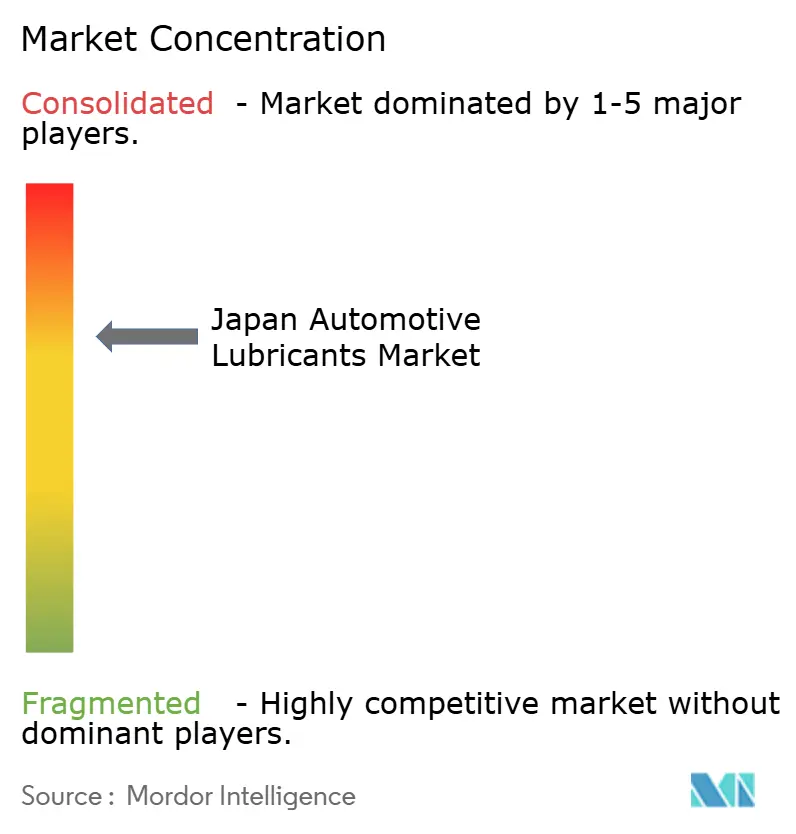
The market is moderately concentrated. Global majors carve out premium niches through Japan-specific synthetic lines and factory-fill agreements with luxury OEMs. Market consolidation has accelerated; ENEOS shuttered its Wakayama refinery in 2024 and plans to phase out Yokohama lubricant production by 2028, optimizing remaining sites to run higher-value Group III+ streams. Strategic differentiation centers on technology and sustainability. Domestic champions invest in research and development for GLV-grade formulations and bio-based esters, positioning themselves as indispensable partners for OEMs in achieving CAFE compliance. Global players respond with co-engineered e-transmission fluids and battery-thermal-management solutions. Niche specialists FUCHS and Motul target motorsport and high-performance segments, where price sensitivity is minimal. Digital services, including cloud-based oil analytics and QR-code authentication, emerge as table stakes for brand protection and fleet engagement. Competitive rivalry is intense but disciplined; capacity rationalization aligns supply with shrinking demand, averting price wars. However, the proliferation of counterfeit goods on e-commerce platforms pressures brand equity and necessitates joint enforcement initiatives. Overall, the Japan automotive lubricants market balances volume contraction against value-creation levers such as synthetics, services, and sustainability, sustaining profitability for players that pivot quickly.
Japan Automotive Lubricants Industry Leaders
-
ENEOS Corporation
-
Idemitsu Kosan Co. Ltd
-
Exxon Mobil Corporation
-
Shell plc
-
BP p.l.c.
- *Disclaimer: Major Players sorted in no particular order
Market Opportunities and Future Outlook
The strongest whitespace is in fluids engineered for electrified powertrains and ultra-low viscosity operation, where Japan-specific standard evolution and OEM co-development raise barriers for late entrants. The March 2024 revision of JASO M 364 added the GLV-2 classification, and the JASO Engine Oil Standards Implementation Panel also closed new reporting under the older JASO M 355:2021 standard after March 31, 2025. This shifts claim sets and reformulation work toward updated requirements, supporting opportunities for suppliers that can qualify 0W-8/0W-12 and hybrid/EV-adjacent driveline fluids while maintaining wear protection, oxidation control, and compatibility with after-treatment systems.
Evidence of active innovation is visible in named programs and product work that translates into near-term commercialization space for additives and specialized fluids. ENEOS has highlighted materials-informatics-driven development for EV battery immersion-cooling oils, and in May 2025 Toyota and ENEOS published research on an ultra-low viscosity transaxle fluid reporting a 1.2% fuel-economy improvement under WLTC mode, which reflects OEM demand for efficiency-focused formulations. Additive-led opportunities are also emerging: in July 2025 Sanyo Chemical announced an anti-wear polymer (ACLUBE NS-100) positioned for EV e-axle drive units to enable lower-viscosity fluids, creating a route for additive suppliers and blenders to differentiate within a contracting engine-oil volume base.
Recent Industry Developments
- May 2026: ENEOS announced the signing of share purchase agreements to acquire Chevron's downstream fuels and lubricants marketing businesses across Singapore, Malaysia, the Philippines, Australia, Vietnam, and Indonesia for about USD 2.17 billion. The deal expands ENEOS's regional lubricants footprint and adds marketing scale outside Japan, supporting a shift toward overseas demand pools as domestic automotive lubricant liters contract.
- August 2025: ENEOS signed a letter of intent to supply E10 low-carbon gasoline blended with domestically produced cellulose-based ethanol for the 2026 Super Formula season. While centered on fuels, the program points to broader decarbonization and biomass supply-chain capabilities that also support plant-derived base oils and lower-carbon lubricant positioning in Japan.
- October 2024: ENEOS developed and launched a product-specific carbon footprint calculation system for its lubricant and grease products. This added a measurable framework for customers and channel partners comparing lower-carbon alternatives, sharpening differentiation around verified sustainability attributes.
Research Methodology Framework and Report Scope
Market Definition and Coverage
This market is defined as lubricants used to operate and protect on-road vehicles in Japan, counted at the point of sale into the automotive end-use. It includes fluids and greases used in routine service and maintenance across the vehicle parc.
Scope exclusions: Industrial lubricants, marine and aviation lubricants, and non-automotive process oils are excluded even if they are sold by the same suppliers.
Segmentation Overview
- By Product Type
- Automotive Engine Oil
- 0W-XX
- 5W-XX
- 10W-XX
- 15W-XX
- Monogrades
- Other Grades
- Manual Transmission Fluids (MTF)
- Automatic Transmission Fluids (ATF)
- Brake Fluids
- Automotive Greases
- Other Product Types (Power Steering Fluid etc.)
- Automotive Engine Oil
- By Vehicle Type
- Passenger Vehicles
- Commercial Vehicles
- Two-Wheelers
Data Sources, Market Sizing, and Validation
Desk Research
Desk work starts by mapping the demand pool that actually consumes automotive lubricants in Japan, and then checking it against the public data trail that exists. We typically lean on sources such as METI statistical releases, MLIT vehicle and transport statistics, the Japan Automobile Manufacturers Association (JAMA), and the Japan Automobile Inspection and Registration Information Association (AIRIA) for vehicle parc signals that influence oil change volumes.
To translate activity into lubricant demand, inputs like new vehicle registrations, in-use vehicle stock, typical drain intervals, and shift toward low-viscosity and synthetic formulations were reviewed using sources such as government publications, peer-reviewed lubrication studies, customs and trade statistics, and reputable press coverage. Company filings, investor decks, and product technical sheets were also used to confirm product definitions and how the aftermarket is served, and a paid subscription for lubricant-specific market information was used only as a cross-check on pricing and product mix. These named sources are illustrative, and many other references were used to collect data, validate assumptions, and clarify the research.
Primary Interviews and Surveys
Primary work was used to pressure-test our demand assumptions, especially where public data is not granular enough for service intervals and product mix in Japan. We spoke with participants across the value chain such as blenders, distributors, service networks, and fleet maintenance stakeholders so that gap areas like OEM genuine oil share, synthetic penetration, and drain interval shifts could be resolved with practical input.
Distribution of primary research fieldwork respondents
| Company type | Respondent position |
|---|---|
| Top tier: 30% | CXOs: 14% |
| Mid tier: 51% | Functional/Unit leaders: 33% |
| Smaller Players: 19% | Managers: 53% |
Market-Sizing & Forecasting
Sizing is built by linking vehicle activity to lubricant consumption so the numbers stay connected to real usage in Japan. We use a top-down and bottom-up combination, where the main build starts from the vehicle parc and service behavior, and then gets checked with selective supply-side and channel math before totals are finalized.
On the top-down side, vehicle registrations and in-use stock are translated into lubricant demand using practical inputs such as average annual mileage, oil change frequency, drain interval trends, and the split between passenger and commercial service patterns. Product mix assumptions also matter in this market, so we factor in indicators like the shift to low-viscosity grades, the rise of synthetics, and how electrification reduces certain fluid volumes but does not remove all maintenance needs.
For cross-checking, we corroborate the totals with bottom-up approximations such as sampled average selling prices by product type, distributor and workshop sell-through views, and supplier revenue direction where disclosures allow. Where gaps exist, conservative ranges are used and then narrowed based on repeated interview feedback. Forecasts were developed using scenario analysis tied to variables like vehicle parc trajectory, EV penetration pace, drain interval extension, and expected pricing and mix progression that respondents considered realistic for the next cycle.
Data Validation & Update Cycle
Validation is handled through multiple checks so that one noisy input does not distort the outcome. We compare model outputs against independent signals such as registration trends, trade movements for base oils and finished lubricants, and the direction of workshop servicing activity, and then outliers are reviewed and corrected with documented logic.
Before sign-off, the dataset and assumptions go through a multi-step analyst review, and follow-up outreach is triggered when a key variable moves outside the expected range (for example, a sharp change in drain intervals or pricing). Reports are refreshed annually, with interim updates when material events occur, and a fresh final pass is completed before delivery so clients receive the most current view available.
Mordor Intelligence's Japan Automotive Lubricants Market Size Compared With Other Published Estimates
Published market sizes for Japan automotive lubricants can look different because the scope and the unit of measurement are not always aligned. Common gaps come from mixing retail value with ex-works revenue, counting different product groups, or applying global service interval assumptions that do not match how Japan's vehicle maintenance actually works.
Key differences usually come from whether estimates include only automotive engine oils or also count transmission and gear oils, greases, and other fluids, and whether volumes are converted to value using a stable price-mix model or a single average price. Timing also matters, because base year choice and currency conversion windows can shift the reported USD number even when underlying liters are similar.
Benchmark comparison
| Source | Market Size | Gaps in Research Methodology |
|---|---|---|
| Mordor Intelligence | USD 3.29 B (2025) | |
| Industry Association A | USD 2.71 B (2025) | Often stays closer to reported shipments and tends to undercount aftermarket mix uplift by using broad average pricing and limited coverage of greases and smaller fluid categories. |
| Trade Journal B | USD 3.95 B (2025) | Usually pushes value higher by applying aggressive synthetic share and price progression, and may include adjacent non-automotive lubricant volumes sold through overlapping channels. |
Vehicle parc indicators and service interval checks, supported by interview-confirmed mix and pricing logic, are the evidence points that keep Mordor Intelligence tied to what is actually consumed in Japan rather than what is implied by a single pricing shortcut. Looking across the table, the spread is mainly explained by product boundary choices and how liters are translated into USD, which is why using transparent variables makes the estimate easier to replicate and update.
Key Questions Answered in the Report
What is the projected volume of automotive lubricants consumed in Japan by 2031?
Consumption is forecast to decline to 610.62 million liters by 2031, reflecting a negative CAGR of -1.35% from 2026 levels.
Which product category is shrinking the slowest?
Automatic transmission fluids are declining at only -1.23% CAGR because hybrid powertrains still require specialized ATF formulations.
Why are low-viscosity grades like 0W-8 growing in Japan?
Stringent fuel-economy rules and JASO GLV standards push automakers to specify ultra-low viscosities that trim engine friction by up to 3%.
What technology trend helps fleets reduce lubricant use?
Remote oil-condition monitoring extends drain intervals by 30–50% while cutting unplanned maintenance, especially in heavy-duty trucks and construction equipment.