
Market Overview
| Study Period | 2020 - 2031 |
|---|---|
| Forecast Data Period | 2026 - 2031 |
| Base Year Market Size (2025) | USD 294.93 Million |
| Market Size (2026) | USD 335.28 Million |
| Market Size (2031) | USD 636.54 Million |
| Growth Rate (2026 - 2031) | 13.68 % |
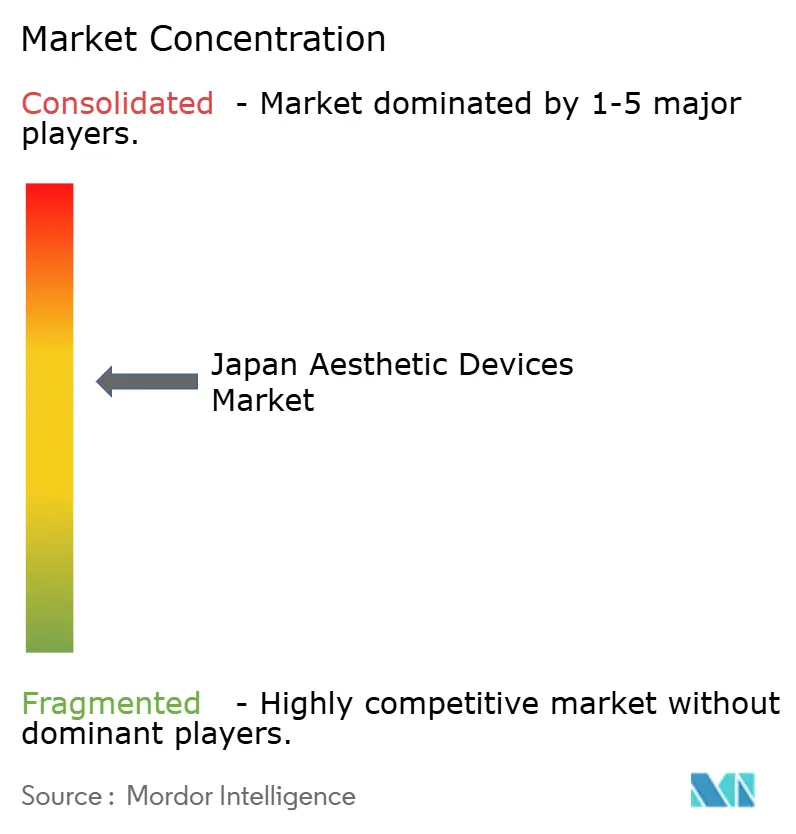
| Market Concentration | Medium |
Major Players *Disclaimer: Major Players sorted in no particular order Image © Mordor Intelligence. Reuse requires attribution under CC BY 4.0. | |
Japan Aesthetic Devices Market Analysis by Mordor Intelligence
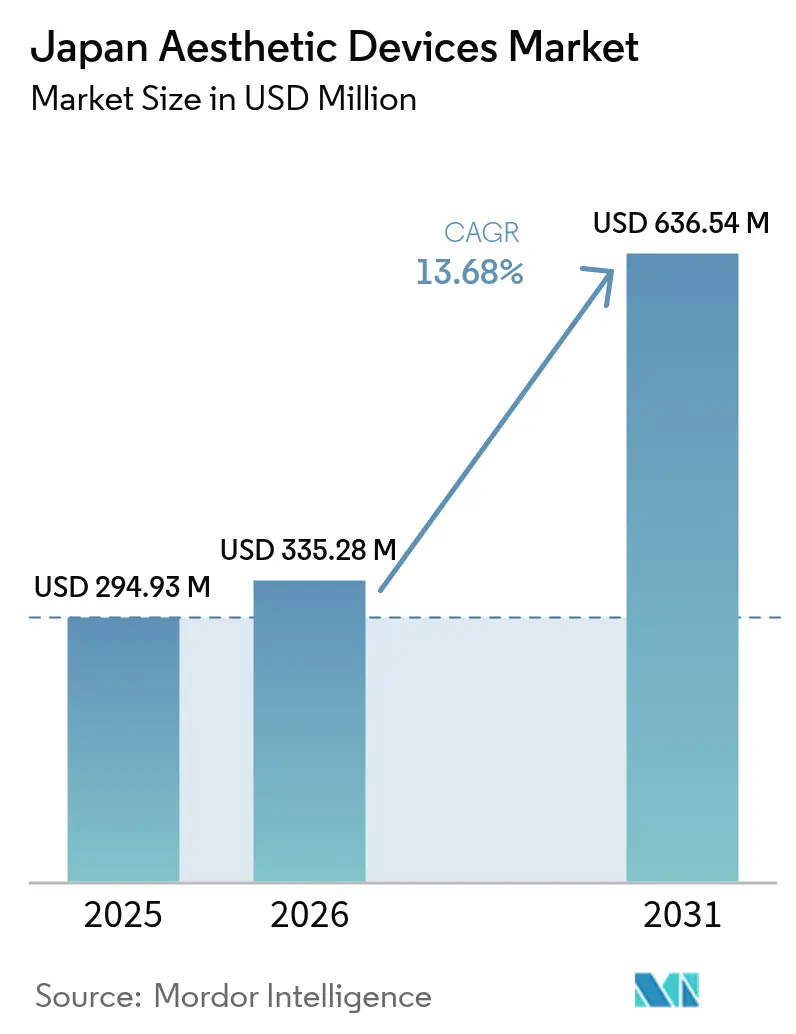
The Japan Aesthetic Devices market size is expected to grow from USD 294.93 million in 2025 to USD 335.28 million in 2026 and is forecast to reach USD 636.54 million by 2031 at 13.68% CAGR over 2026-2031.
Rising discretionary spending among older consumers, faster regulatory approvals for artificial-intelligence (AI) enabled hardware, and a clear shift toward minimally invasive energy-based platforms underpin this trajectory. The Japan aesthetic devices market also benefits from domestic loyalty: 65% of consumers who once traveled overseas now choose local providers for safety and convenience. Tight PFAS regulations that take effect in 2025 raise material compliance costs, yet companies that align early gain a competitive edge. Continuous technology convergence particularly radiofrequency (RF) systems that pair with LED and electrical-muscle-stimulation (EMS) modules expands treatment versatility and clinic revenue per device.
Key Report Takeaways
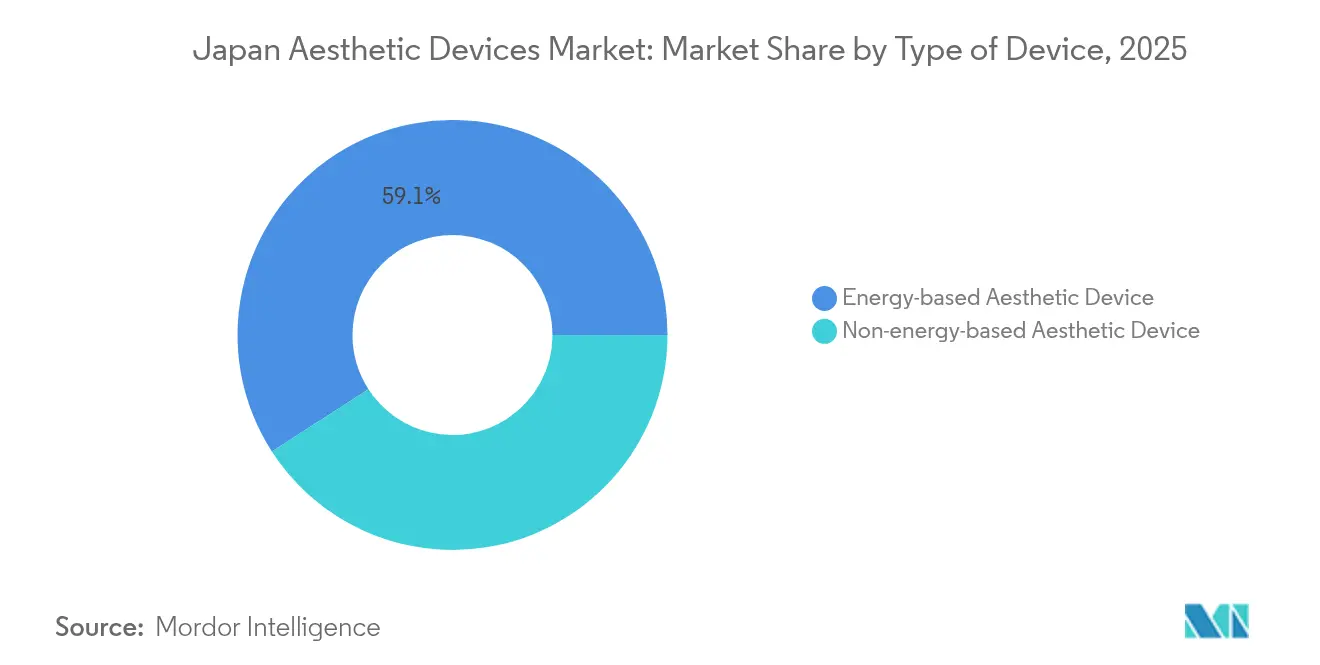
- By type of device, energy-based platforms led with 59.12% of Japan aesthetic devices market share in 2025, while RF-based systems posted the fastest 17.85% CAGR through 2031.
- By application, skin resurfacing and tightening accounted for 31.74% of the Japan aesthetic devices market size in 2025; body-contouring procedures are projected to accelerate at a 16.27% CAGR between 2026 and 2031.
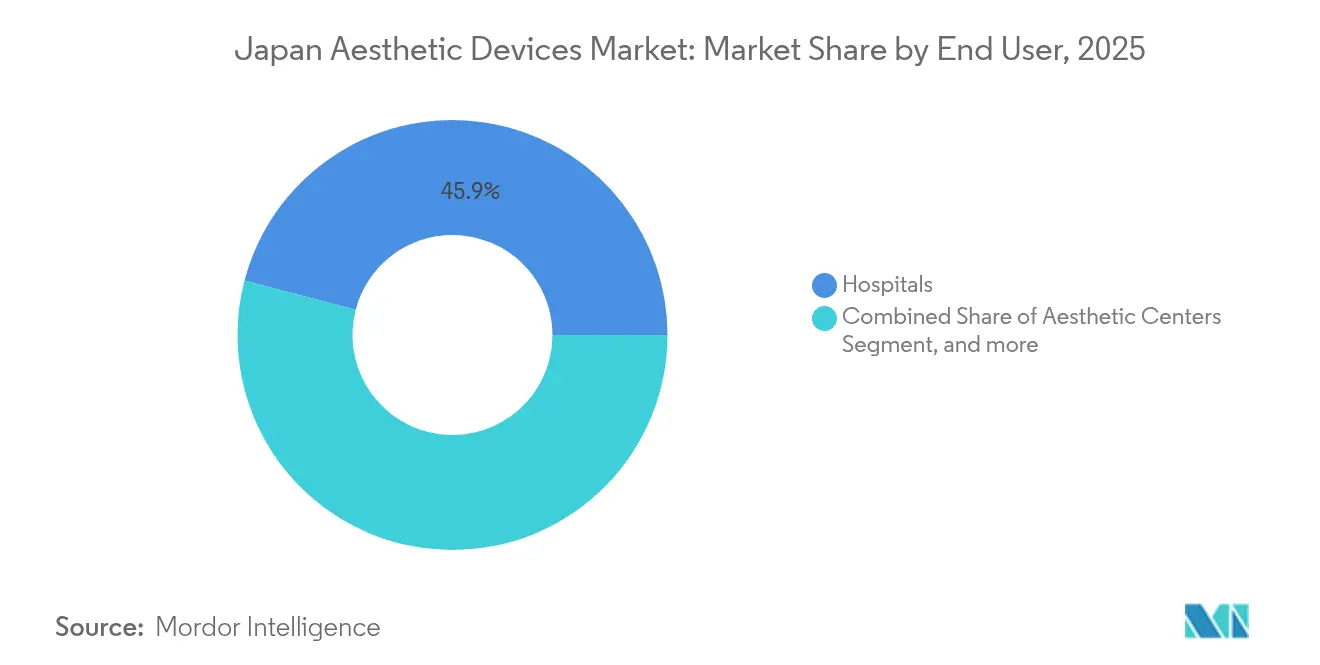
- By end user, hospitals commanded 45.92% revenue share in 2025, whereas aesthetic centers are set to expand at a 18.92% CAGR to 2031.
Note: Market size and forecast figures in this report are generated using Mordor Intelligence’s proprietary estimation framework, updated with the latest available data and insights as of 2026.
Japan Aesthetic Devices Market Trends and Insights
Drivers Impact Analysis*
| Driver | (~) % Impact on CAGR Forecast | Geographic Relevance | Impact Timeline |
|---|---|---|---|
| Aging Population Driving Anti-Aging Demand | +3.2% | National, with concentration in Tokyo, Osaka, Nagoya metropolitan areas | Long term (≥ 4 years) |
| Rising Adoption of Minimally & Non-Invasive Devices | +2.8% | National, with higher penetration in urban centers | Medium term (2-4 years) |
| Technological Breakthroughs in Energy-Based Platforms | +2.1% | Global influence with Japan-specific adaptations | Medium term (2-4 years) |
| Tele-Aesthetic Platforms & Home-Use Device Ecosystem | +1.9% | National, with rural area emphasis | Short term (≤ 2 years) |
| PMDA Fast-Track for AI-Assisted Aesthetic Devices | +1.4% | National regulatory framework | Medium term (2-4 years) |
| Medical-Stay Visa Spurring Inbound Aesthetic Tourism | +1.1% | Major cities with international airports | Long term (≥ 4 years) |
| Source: Mordor Intelligence | |||
Aging Population Driving Anti-Aging Demand
Japan’s super-aged demographic structure intensifies demand for rejuvenation treatments, and anti-aging spending is projected to exceed USD 3 billion annually by 2028.[1] The worker-to-senior ratio falls to 2.4:1 by 2025, concentrating purchasing power among older adults who readily pay for premium procedures. Companies funnel R&D budgets into senolytic-based equipment that targets cellular senescence, positioning the Japan aesthetic devices market as a proving ground for longevity-oriented devices. Male participation rises: men in their 40s represent 31% of aesthetic patients seeking laser hair removal and skin maintenance. As research pivots from appearance to health-span extension, device makers partner with pharmaceutical firms to co-develop platforms that marry cosmetic and preventive benefits.
Rising Adoption of Minimally & Non-Invasive Devices
More than 80% of potential patients now prioritize safety and downtime over cost when choosing procedures, and home-use gadgets already reside in 16% of households. The best-selling domestic brands combine RF, EMS, and LED in palm-sized tools that mirror clinic-grade efficacy. Clinical evidence backs the shift: monopolar RF boosts dermal elasticity with no adverse events in controlled trials.[2] Updated PMDA quality-management-system guidelines that harmonize with ISO 13485:2016 reduce red-tape hurdles for incremental device upgrades, allowing manufacturers to refresh popular models annually without re-inventing the approval wheel.
Technological Breakthroughs in Energy-Based Platforms
Next-generation RF applicators deploy AI algorithms to modulate thermal output in milliseconds, improving predictability across diverse skin phototypes. Lumenis’s OptiLIFT platform realized a 75% reduction in lid laxity during peer-reviewed trials. Academic engineers now prototype metamaterial waveguide antennas that elevate tissue temperature 35.4°C at 80 W, expanding noninvasive body-sculpting options.[3]InMode Japan secured class-II certification for its Optimus Lumecca xenon-light system, signaling regulator confidence in multi-modal chassis. Such advances sustain the premium that energy-based hardware commands in the Japan aesthetic devices market.
Tele-Aesthetic Platforms & Home-Use Device Ecosystem
Physician shortages outside major metros motivate providers to embed video-consult modules and remote-parameter-locking software directly inside device firmware. V-Cube targets 500 tele-consultation booths nationwide by 2026, creating a physical anchor for follow-up visits in shopping malls and rail stations. Subscription-model e-commerce portals ship treatment-specific consumables on auto-replenishment cycles, improving compliance and post-procedure outcomes. Celebrity endorsements push LED masks priced at JPY 55,000 (USD 371) into mainstream retail. These digital bridges widen the Tamagotchi-like “care loop” that bonds user, clinician, and device, helping the Japan aesthetic devices market reach rural and time-poor demographics.
Restraints Impact Analysis*
| Restraint | (~) % Impact on CAGR Forecast | Geographic Relevance | Impact Timeline |
|---|---|---|---|
| Stringent Safety Rules & Limited Reimbursement | -2.1% | National regulatory framework | Long term (≥ 4 years) |
| High Capex / Opex for Smaller Clinics | -1.8% | Regional, affecting rural and suburban markets | Medium term (2-4 years) |
| Dermatologist Shortages Outside Metro Areas | -1.4% | Rural and suburban regions, excluding Tokyo-Osaka corridor | Medium term (2-4 years) |
| Sustainability Scrutiny on Single-Use Consumables | -1.1% | National, with stricter enforcement in metropolitan areas | Short term (≤ 2 years) |
| Source: Mordor Intelligence | |||
Stringent Safety Rules & Limited Reimbursement
Mandatory PFAS tracking from January 2025 forces manufacturers to audit supply chains and re-engineer coatings, elevating bill-of-materials cost. Reimbursement schedules exclude elective aesthetics, so patients self-finance, dampening uptake among price-sensitive groups. PMDA reviews, though faster than a decade ago, still lag the United States, extending lead times for global releases. Every five years, companies must renew quality-system approval, adding paperwork heft.
High Capex / Opex for Smaller Clinics
Top-tier lasers list between JPY 10–50 million (USD 67,000–333,000), not counting disposables or annual service contracts. Staffing costs climb as aesthetic nurses job-hop to metropolitan chains offering better pay, leaving rural facilities understaffed and unprofitable. A record 126 dental clinics declared bankruptcy in 2024, illustrating the structural fragility of small, procedure-based practices. Without financing support, independent operators defer upgrades, widening the technology gap that ultimately limits the Japan aesthetic devices market’s geographic penetration.
*Our forecasts treat driver/restraint impacts as directional, not additive. The impact forecasts reflect baseline growth, mix effects, and variable interactions.
Segment Analysis
By Type of Device: Energy-Based Dominance Drives Innovation
Energy-based equipment owns 59.12% of Japan aesthetic devices market share in 2025, and RF-centric units deliver an 17.85% CAGR through 2031. Shiseido’s Quick Facial Trainer exemplifies next-step integration, layering EMS over interference-waveforms to stimulate deep musculature while minimizing epidermal irritation. Laser arrays still command premium prices; Shirono Clinic installed the Stella M22 platform with six swappable filters for dermatologist-tailored pigmentation sessions. Ultrasound-RF hybrids reduced average waist circumference by 3.83 cm in randomized trials.
Non-energy devices, syringe-based fillers, and neurotoxins retain physician loyalty for wrinkle relaxation, yet lack the cross-selling potential of smart console systems. PMDA’s flexible quality-management updates accelerate roll-outs of firmware-driven feature sets, giving energy-device makers an innovation flywheel. As AI analytics gain traction, console dashboards will push outcome data to cloud portals, allowing vendors to upsell algorithm subscriptions, reinforcing long-term revenue capture inside the Japanese aesthetic devices market.

By Application: Body Contouring Emerges as Growth Leader
Skin resurfacing and tightening contributed 31.74% to Japan aesthetic devices market size in 2025, but body-contouring procedures capitalizing on non-invasive RF and ultrasound are rising at 16.27% CAGR to 2031. Controlled studies confirm combined-energy treatments melt adipose layers while sparing dermal structures, meeting patient demand for subtle silhouette refinement without downtime. Facial rejuvenation remains steady; clinics now tout painless, needle-free plasma delivery that penetrates 6.5 mm, deepening collagen remodeling.
Consumer curiosity widens to intimate wellness, where vaginal-laser platforms like Timewalker II Intima address functional and aesthetic outcomes. Hair-removal units migrate from clinic to living room, riding the 16% household penetration of home IPL devices, and feeding a pre-procedure “try-before-clinic” funnel that ultimately lifts professional bookings. Overall, multi-application workstations that toggle between face, body, and specialty probes dominate purchasing decisions in the Japan aesthetic devices market.
By End User: Aesthetic Centers Accelerate Market Transformation
Hospitals held a 45.92% slice of revenue in 2025, leveraging surgical-backup credibility. Yet specialized aesthetic centers, scaling at 18.92% CAGR, outpace broader medical facilities by offering concierge-style experience and rapid device turnover. Chains such as SBC Medical Group extended footprints to Hiratsuka and Kobe, adapting Korean hybrid protocols for Japanese skin phenotypes.
Home settings register outsized buzz thanks to LED masks and microcurrent rollers that mimick clinic outputs. Subscription models for consumables cement recurring revenue, letting manufacturers harvest data on usage patterns that inform next-gen design. Workforce-training alliances, like the Japan Aesthetic Medical Society summer school, funnel new graduates into boutique centers, reinforcing a staffing ecosystem that propels the Japan aesthetic devices market into decentralized care modalities.
Geography Analysis
Tokyo, Osaka, and Nagoya anchor spend, fueled by dense clinic networks and affluent, beauty-savvy clients. Ginza alone houses dozens of flagship laser suites that cater to inbound Chinese visitors seeking stem-cell facelifts. Secondary cities gain traction through chain expansion; SBC’s Hiratsuka branch, Kanagawa’s first, captures suburban commuters who once traveled to Shonan or Yokohama. Teleconsult booths roll out across rail hubs, letting rural residents receive pre-screening, then travel for single-day treatments, smoothing regional demand curves.
Demographic reality older populations in countryside prefectures boosts the utility of at-home solutions where clinics shutter from physician retirements. V-Cube’s tele-clinic pods bridge gaps by enabling virtual follow-ups tied to mail-order consumables. Local governments court growth via tax incentives for clinic startups; Osaka leverages the 2025 Expo as a showcase for AI skincare kiosks developed by Momotani Juntenkan and university researchers.
Uniform PMDA oversight means product labeling and adverse-event reporting remain consistent nationwide, though prefectural reimbursement pilot schemes for postoperative pain relief devices create patchwork adoption speeds. Ultimately, hub-and-spoke provider models, plus robust e-commerce fulfilment, ensure the Japan aesthetic devices market reaches both cosmopolitan and remote populations across its archipelago.
Regulatory Landscape
Japan regulates aesthetic devices under the Act on Securing Quality, Efficacy and Safety of Products Including Pharmaceuticals and Medical Devices (PMD Act). The Ministry of Health, Labour and Welfare (MHLW) serves as the administrative authority, while the Pharmaceuticals and Medical Devices Agency (PMDA) conducts scientific review and post-market safety oversight. Devices are classified into four risk tiers (Class I to IV); many energy-based aesthetic platforms fall into Class II pathways where conformity assessment via Registered Certification Bodies is common, while higher-risk configurations require MHLW approval. A Japan-based Marketing Authorization Holder (MAH) is responsible for filings and vigilance.
Recent policy actions add new compliance workstreams alongside approvals. In April 2025, MHLW issued a notification requiring MAHs to implement cybersecurity risk assessments for legacy medical devices marketed before 31 March 2024, including Software Bill of Materials (SBOM) and end-of-life disclosures, which can affect connected consoles and software-enabled upgrades in aesthetic systems. In May 2025, amendments to the PMD Act were enacted to strengthen product safety accountability, with phased implementation through May 2027. In March 2026, MHLW Notification No. 0331-20 set procedures for priority reviews during supply shortages, including regulatory reliance on U.S. FDA authorizations for devices with Japanese predicates, which can alter timelines for overseas manufacturers and Japan distribution partners during constrained supply periods.
Competitive Landscape
Consolidation accelerates: Hahn & Company merged Cynosure and Lutronic in April 2024, forming Cynosure Lutronic Inc. and instantly commanding a broad laser portfolio. Incumbents respond by bundling hardware sales with cloud analytics that optimize pulse-width presets per clinic. InMode, armed with Optimus Lumecca’s thermal-therapy certification, leverages cross-selling into vascular-lesion practices. Domestic conglomerates such as Shiseido incubate device lines that complement topical skincare, fostering closed-loop ecosystems that multiply customer lifetime value.
Start-ups compete via direct-to-consumer LED and microcurrent hardware, with some surpassing 350,000 unit sales in under two years. These entrants often partner with pop culture icons, bypassing clinical channels to seed brand equity. However, PMDA class-II pathways impose manufacturing-site audits, filtering out under-capitalized newcomers. Strategic R&D alliances proliferate: optical-component makers team with AI software firms to co-develop predictive-maintenance dashboards, slashing device downtime for high-volume centers.
Japan Aesthetic Devices Industry Leaders
-
Bausch Health Companies Inc. (Solta Medical, Inc.)
-
Cutera Inc.
-
Venus Concept
-
Lumenis Ltd.
-
AbbVie (Allergan)
- *Disclaimer: Major Players sorted in no particular order
Market Opportunities and Future Outlook
Opportunities in Japan aesthetic devices are tied to faster iteration cycles in software-enabled systems and the expanding mix of clinic and home-use care pathways. PMDA pathways for Software as a Medical Device (SaMD), along with the report context on PMDA fast-track for AI-assisted aesthetic devices, creates whitespace for vendors that package energy-based consoles with algorithm updates, remote parameter controls, and post-market transparency artifacts such as SBOM and end-of-life disclosures reinforced by MHLW cybersecurity guidance for legacy devices issued in April 2025. This favors suppliers that can sustain annual refreshes of RF, LED, and EMS combinations without restarting full hardware programs, and it supports subscription models for cloud analytics and consumables that align with the market shift toward minimally and non-invasive procedures.
A second opportunity is in domestic supply-chain localization and capacity modernization, aimed at demand concentrated in metropolitan corridors while improving reach into secondary cities. In August 2024, Kaneka completed construction of its Tomatoh Manufacturing Site in Hokkaido, a smart factory using robotics and automated production for medical devices, signaling investment momentum that supports Japan-based sourcing, quality control, and lead-time performance for device makers and contract manufacturers. Combined with the report context on tele-aesthetic platforms and physical tele-consultation booths extending access outside major metros, vendors that offer scalable training, service coverage, and compliant connected-device lifecycle support have a clearer route to expand the installed base beyond flagship urban clinics.
Recent Industry Developments
- March 2026: MHLW issued Notification No. 0331-20, setting procedures for priority reviews of certain medical devices during supply shortages and allowing reliance on U.S. FDA authorizations where Japanese predicates exist. This can compress time-to-market for imported systems and components when supply constraints emerge, which is relevant for globally sourced energy-based aesthetic platforms that rely on timely replacement parts and upgrades.
- July 2025: InMode Japan received Class II certification for the Optimus Lumecca xenon-light therapy system. The clearance supports broader commercialization of multi-modal light-based platforms and strengthens vendor positioning with clinics that prioritize certified claims around circulation and pain mitigation features.
- July 2024: Cutera and its Japanese subsidiary, Cutera KK, entered into an exclusive partnership with L’Oreal Japan to promote, market, sell, and distribute select SkinCeuticals products to medical and physician-led clinics in Japan. The agreement, announced with a three-year initial term and renewal options, deepens clinic channel coverage by bundling premium skincare distribution with an established medical aesthetics network.
Research Methodology Framework and Report Scope
Market Definition and Coverage
For this study, the Japan aesthetic devices market covers revenue generated from devices used for cosmetic and medical-aesthetic procedures in Japan, across clinical and home-use settings, counted at the point of device sale.
Scope exclusions: We exclude topical products, skincare consumables, and procedure service revenue that is billed by clinics.
Segmentation Overview
- By Type of Device
- Energy-based Aesthetic Device
- Laser-based Aesthetic Device
- Radiofrequency-based Aesthetic Device
- Light-based Aesthetic Device
- Ultrasound Aesthetic Device
- Other Energy-based Aesthetic Devices
- Non-energy-based Aesthetic Device
- Botulinum Toxin
- Dermal Fillers & Threads
- Microdermabrasion
- Implants
- Other Non-energy-based Aesthetic Devices
- Energy-based Aesthetic Device
- By Application
- Skin Resurfacing & Tightening
- Body Contouring & Cellulite Reduction
- Facial Aesthetic Procedures
- Hair Removal
- Breast Augmentation
- Other Applications
- By End User
- Hospitals
- Aesthetic Centers
- Home Settings
Data Sources, Market Sizing, and Validation
Desk Research
Desk work starts with building the demand context for aesthetic procedures in Japan, and then mapping how devices typically enter the market and get used. We relied on public, non-paywalled references such as Japan government health statistics, customs trade tables, medical device regulatory and safety notices, peer-reviewed dermatology and plastic surgery journals, and association publications on aesthetic procedures.
After that, we used company annual reports, investor presentations, press releases, and reputable news coverage to understand product launches, pricing direction, and channel moves. A paid subscription for company financials and news intelligence helped us standardize reported revenues and flag ownership changes, while a patent database was used to sanity-check technology direction in energy-based systems. These are illustrative sources, and many additional public references were also used for data collection, validation, and clarification.
Primary Interviews and Surveys
Primary work was used to confirm which device categories are actively purchased in Japan, how pricing is changing, and how utilization differs across hospitals, aesthetic centers, and home settings. We spoke with a mix of distributors, clinic operators, procurement staff, and technical specialists so assumptions from desk work could be corrected, and then rechecked across major parts of the country.
Feedback from interviews also helped separate replacement demand from new installations, and it was used to cross-verify the timing of regulatory or reimbursement related shifts that can move yearly demand.
Distribution of primary research fieldwork respondents
| Company type | Respondent position |
|---|---|
| Top tier: 25% | CXOs: 19% |
| Mid tier: 55% | Functional/Unit leaders: 31% |
| Smaller Players: 20% | Managers: 50% |
Market-Sizing & Forecasting
Sizing was built using a top-down approach where procedure volumes, device penetration by procedure, and replacement cycles are used to reconstruct annual device demand in Japan, which is then translated into value using average selling price ranges. To keep the totals realistic, results were corroborated with selective bottom-up approximations such as sample supplier revenue roll-ups, distributor channel checks, and ASP times estimated unit shipments for a few high-visibility device groups.
Key inputs that moved the model (illustrative) included the mix of energy-based versus non-energy devices, clinic adoption of minimally invasive procedures, equipment replacement timing, the share of home-use devices in personal care spend, and imported device flow signals from trade statistics. Where bottom-up visibility was weak, gaps were handled by applying conservative adoption bands that were reviewed with interviewees and stress-tested against procedure growth.
For forecasting, we leaned on scenario analysis, since demand is sensitive to procedure sentiment, pricing pressure, and technology refresh cycles. Assumptions for growth were adjusted with expert views on how quickly clinics expand capacity and how fast new device platforms diffuse into routine practice.
Data Validation & Update Cycle
Before numbers are finalized, estimates are triangulated across multiple angles, including procedure trends, trade and shipment signals, and financial disclosures that can indicate pricing or mix shifts. Outliers are investigated, and when a variance is not explainable by a known market event, the underlying assumptions are revised and, if needed, interview follow-ups are triggered.
A multi-step internal review is completed before sign-off so modeling choices are consistent across years and categories. Reports are refreshed annually, and interim updates are made when material events occur, such as sharp currency moves, major regulatory changes, or notable product recalls. Right before delivery, a final analyst pass is done so the client receives the most current view available.
Mordor Intelligence's Japan Aesthetic Devices Market Size Versus Other Published Estimates
It is normal to see different market sizes for Japan aesthetic devices because each publisher draws the market boundary in its own way, and then uses different pricing and timing assumptions. The year chosen as the starting point, and whether the estimate tracks devices sold into clinics versus a wider beauty and wellness universe, also changes the final number.
By tracking procedure-linked device demand and refreshing conversion rates and ASP bands with checks from Mordor Intelligence interviews, the market total is kept tied to device sales in Japan rather than service revenue or adjacent consumer categories.
Benchmark comparison
| Source | Market Size | Gaps in Research Methodology |
|---|---|---|
| Mordor Intelligence | USD 294.93 M (2025) | |
| Global Consultancy A | USD 1.03 B (2025) | Often uses a broader scope that can bundle procedure categories like breast augmentation and facial aesthetics into one total, and it may apply higher blended ASPs across energy and non-energy devices without isolating Japan-only shipment mix. |
| Regional Consultancy B | USD 2.40 B (2024) | Uses a different base year and scenario-style sizing that can include wider end-user coverage and adjacent wellness demand, which inflates the device pool when compared with a procedure and replacement-cycle anchored device-only model. |
The spread mainly comes from scope and pricing treatment, not from arithmetic differences. When the device boundary is kept tight, and assumptions like replacement timing and ASP movement are checked against real buying behavior, the result is easier to explain and to reproduce year over year.
Key Questions Answered in the Report
How large is the Japan aesthetic devices market in 2026?
The Japan aesthetic devices market size is USD 335.28 million in 2026 and is forecast to grow at 13.68% CAGR through 2031.
Which device category holds the largest share?
Energy-based platforms dominate with 59.12% Japan aesthetic devices market share in 2025, led by RF-centric systems.
What is the fastest-growing application segment?
Body-contouring procedures, powered by combined ultrasound-RF technology, advance at a 16.27% CAGR from 2026 to 2031.
Where is demand the strongest geographically?
Tokyo, Osaka, and Nagoya metropolitan areas lead spending, though suburban and rural growth rises via tele-aesthetic platforms.
How do new PFAS regulations affect manufacturers?
Starting January 2025, device makers must audit and limit PFAS usage, increasing material costs but encouraging safer formulations.
What recent merger reshaped the competitive landscape?
Hahn & Company’s merger of Cynosure and Lutronic in 2024 created Cynosure Lutronic Inc., strengthening its laser technology portfolio.