
IV Flush Syringe Market Size and Share
Market Overview
| Study Period | 2020 - 2031 |
|---|---|
| Market Size (2026) | USD 465.84 Million |
| Market Size (2031) | USD 615.72 Million |
| Growth Rate (2026 - 2031) | 5.74 % |
| Fastest Growing Market | Asia-Pacific |
| Largest Market | North America |
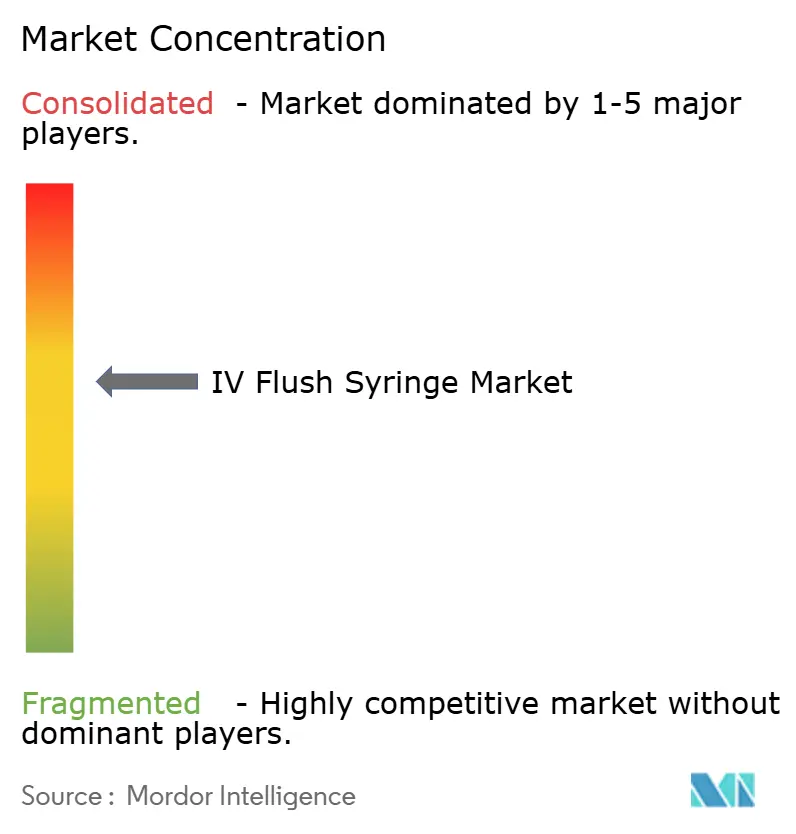
| Market Concentration | Medium |
Major Players *Disclaimer: Major Players sorted in no particular order Image © Mordor Intelligence. Reuse requires attribution under CC BY 4.0. | |
IV Flush Syringe Market Analysis by Mordor Intelligence
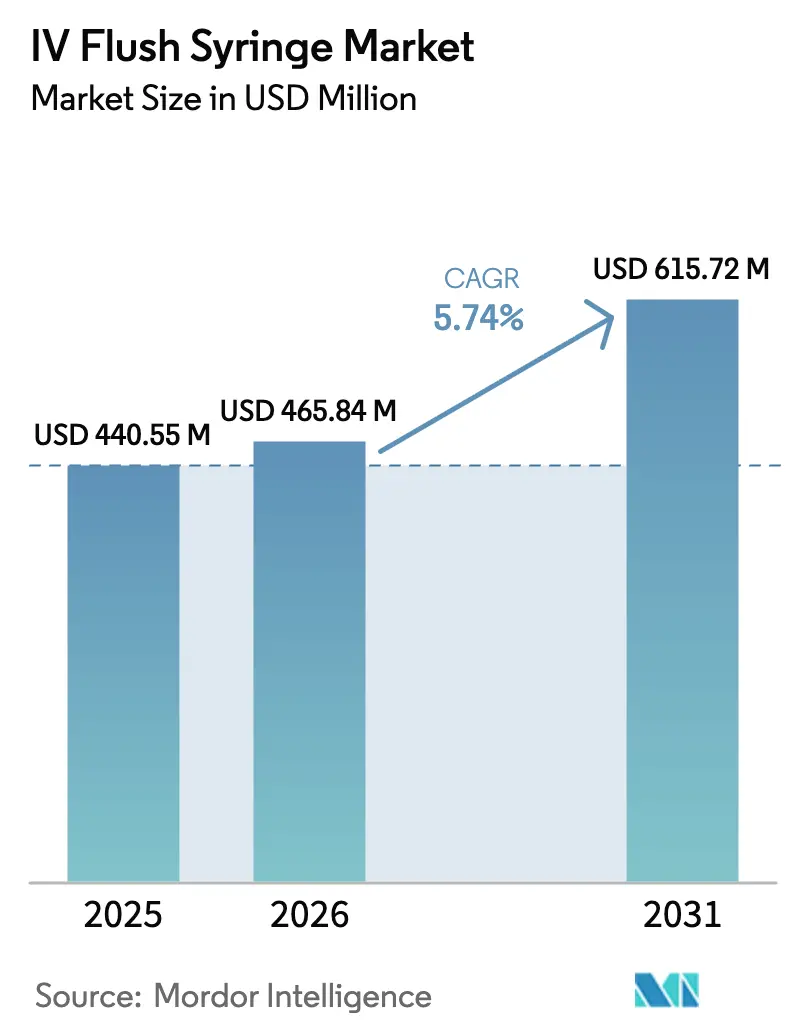
The IV flush syringe market size is expected to grow from USD 440.55 million in 2025 to USD 465.84 million in 2026 and is forecast to reach USD 615.72 million by 2031 at 5.74% CAGR over 2026-2031. Adoption continues to accelerate despite the 2024 supply-chain shock that exposed the risks of concentrated manufacturing. Healthcare providers responded by tightening inventory controls and favoring standardized pre-filled options, a shift that has already improved compliance with infection-control protocols. Demand is also supported by chronic-disease prevalence, wider home-infusion reimbursement, and broader regulatory convergence that smooths market entry for validated products. At the same time, manufacturers face intensified scrutiny after a series of Class I recalls, prompting large capital outlays for quality-system upgrades.
Key Report Takeaways
- By product, saline IV flush syringes led with 81.70% revenue share in 2025, while heparin IV flush syringes are advancing at a 6.36% CAGR to 2031.
- By volume, 10 mL units captured 61.85% of the IV flush syringe market share in 2025; 3 mL formats are projected to grow at 6.47% CAGR.
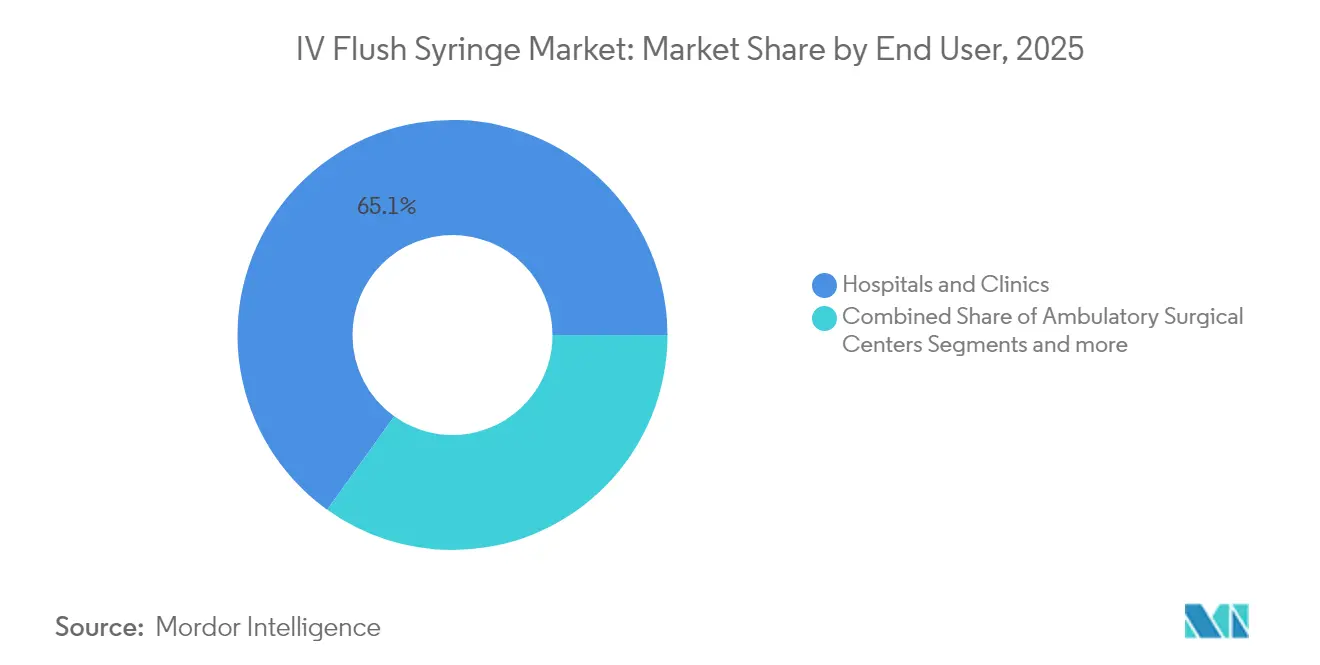
- By end-user, hospitals and clinics held 65.10% of the IV flush syringe market size in 2025; home-care settings record the highest projected CAGR at 6.51% through 2031.
- By patient age group, adults accounted for 60.74% of market revenue in 2025, while the geriatric segment is expected to expand at 6.41% CAGR.
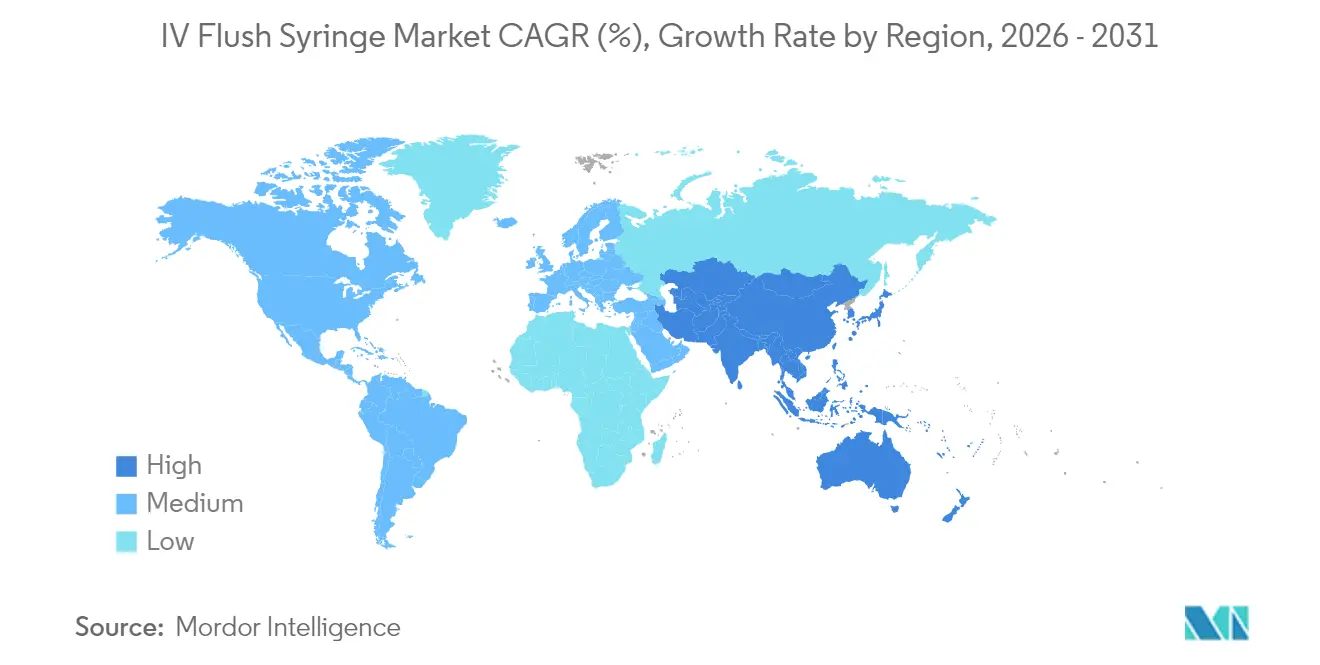
- By geography, North America commanded 41.05% of revenue in 2025; Asia-Pacific is forecast to post the fastest regional CAGR at 6.61% to 2031.
Note: Market size and forecast figures in this report are generated using Mordor Intelligence’s proprietary estimation framework, updated with the latest available data and insights as of 2026.
Global IV Flush Syringe Market Trends and Insights
Drivers Impact Analysis*
| Driver | (~) % Impact on CAGR Forecast | Geographic Relevance | Impact Timeline |
|---|---|---|---|
| Rise in awareness & global guidelines for single-use flush syringes | +1.2% | Global, with early adoption in North America & EU | Medium term (2-4 years) |
| Rising incidence of chronic & infectious diseases driving IV therapy | +1.8% | Global, concentrated in aging populations | Long term (≥ 4 years) |
| Rapid switch to pre-filled flush formats to curb CLABSI and save nursing time | +1.5% | North America & EU core, expanding to APAC | Short term (≤ 2 years) |
| Expansion of home-infusion & outpatient care settings | +0.9% | North America lead, APAC emerging markets following | Medium term (2-4 years) |
| Growing focus on sterility and safety features | +0.7% | Global, with premium adoption in developed markets | Medium term (2-4 years) |
| Real-time supply-chain platforms enabling just-in-time sterile inventory | +0.5% | North America & EU primary, selective APAC adoption | Long term (≥ 4 years) |
| Source: Mordor Intelligence | |||
Rise in Awareness & Global Guidelines for Single-Use Flush Syringes
Updated infection-control directives call for single-patient flush devices to eliminate cross-contamination. The 2024 CDC guidance on central-line care placed pre-filled saline syringes at the center of CLABSI-prevention bundles [1]. European regulators embedded similar requirements in the Medical Device Regulation, pushing hospitals toward validated supplies. Manufacturers that combine flush and hub disinfection in one unit, such as BD’s PosiFlush SafeScrub, now enjoy preferential tender status. Consistent rules across regions lower administrative costs for multinational hospital chains. As a result, the IV flush syringe market is benefiting from synchronized demand curves rather than region-specific spikes.
Rising Incidence of Chronic & Infectious Diseases Driving IV Therapy
The aging world population raises long-term catheter use, which in turn boosts flush-syringe volume. Diabetes, cancer, and cardiovascular conditions demand maintenance of patent lines for repeated infusions, increasing daily flushing frequency. Medicare’s 2025 expansion of the home-infusion benefit cuts patient out-of-pocket costs, supporting durable demand in the United States. Similar schemes in Japan and South Korea now cover professional nursing visits, expanding product throughput outside hospitals. Persistent infection-control vigilance keeps saline the default, yet specialty heparin formulations are gaining share in oncology suites where thrombosis risk is high.
Rapid Switch to Pre-Filled Formats to Curb CLABSI and Save Nursing Time
Staff shortages intensified after the pandemic, and hospitals now seek workflow tools that reduce manual draws. Clinical studies from B. Braun show pre-filled units shave nearly four minutes off each flush cycle while cutting preparation errors by 54% [2]. The productivity gain allows facilities to redeploy scarce nurses toward higher-acuity tasks. Automation is extending further through RFID-tagged syringes that report stock levels in real time and lock expirations into electronic health-record alerts. These features lower waste and provide audit trails during FDA inspections, supporting premiums on quality-assured lines. The IV flush syringe market therefore moves steadily toward intelligent, ready-to-administer products.
Expansion of Home-Infusion & Outpatient Care Settings
Payers are steering low-acuity infusions away from inpatient wards to cut costs. Proposed US legislation, the Preserving Patient Access to Home Infusion Act, would widen reimbursement, potentially shifting thousands of catheter days into private residences. Ambulatory surgery centers are following suit, negotiating bundled deals for flush kits that arrive alongside custom procedure packs. Telehealth platforms now integrate connected syringes that alert nurses when patency checks are overdue, increasing caregiver confidence. Asia-Pacific governments back similar decentralization to meet rural-care gaps, fueling double-digit volume growth of small-size syringes appropriate for self-administration.
Restraints Impact Analysis*
| Restraint | (~) % Impact on CAGR Forecast | Geographic Relevance | Impact Timeline |
|---|---|---|---|
| Stringent FDA/EMA scrutiny & spike in product recalls | -0.8% | North America & EU primary, global spillover effects | Short term (≤ 2 years) |
| Limited nurse training on negative-pressure flushing technique | -0.4% | Global, more pronounced in emerging markets | Medium term (2-4 years) |
| Saline API shortages in US & EU causing intermittent supply gaps | -0.6% | North America & EU core, limited APAC impact | Medium term (2-4 years) |
| Low awareness and adoption in developing regions | -0.5% | APAC emerging markets, MEA, Latin America | Long term (≥ 4 years) |
| Source: Mordor Intelligence | |||
Stringent FDA and EMA Scrutiny with Spike in Product Recalls
Multiple Class I recalls between 2024 and 2025 exposed defects ranging from syringe-pump incompatibility to particulate contamination. The FDA now requests expanded human-factors data and longer real-time aging studies before clearance [3]. Europe’s postmarket surveillance rules raise reporting overhead, prompting small suppliers to exit. Established firms respond with enterprise-wide quality-management upgrades, slowing new product timelines but solidifying brand trust. Although the stricter climate constrains near-term supply, it also sets a higher entry bar that protects incumbents once compliance costs are absorbed.
Saline API Shortages in US & EU Causing Intermittent Supply Gaps
Storm damage at a major Baxter facility in 2024 demonstrated the fragility of single-site production, removing a majority of US saline capacity overnight. Hospitals rationed IV solutions and postponed elective surgeries. Regulators issued temporary import waivers, yet freight bottlenecks limited relief. Manufacturers now invest in distributed plants and dual-sourcing agreements to guard against similar shocks. In the interim, patchy input availability still disrupts production plans, forcing buyers to hold more safety stock and dampening market growth until redundant capacity comes online.
*Our forecasts treat driver/restraint impacts as directional, not additive. The impact forecasts reflect baseline growth, mix effects, and variable interactions.
Segment Analysis
By Product: Saline Dominance Faces Heparin Innovation
Saline syringes captured 81.70% of the IV flush syringe market in 2025 thanks to universal protocol alignment and competitive pricing. Clinicians regard normal saline as the safest default for most peripheral and central lines, a stance codified in multiple infection-control guidelines. However, specialty therapy growth is tilting incremental volume toward anticoagulant variants. Heparin syringes exhibit the fastest 6.36% CAGR as oncology centers rely on extended patency for implanted ports. Combination formats that hold saline and heparin in adjacent chambers let caregivers tailor flush regimens while minimizing waste.
Heparin uptake also benefits from rising use of peripherally inserted central catheters in ambulatory settings. Evidence suggests timely anticoagulant flushing reduces device replacement frequency, cutting total cost of care despite higher unit pricing. The regulatory environment remains exacting due to systemic anticoagulation risk, yet large suppliers with pharmacovigilance infrastructure win approvals and capture emerging share. Consequently, product-line breadth has become a differentiator, reinforcing consolidation trends within the IV flush syringe market.


By Volume Capacity: 10 mL Leadership Challenged by Pediatric Demand
The 10 mL category held 61.85% of the IV flush syringe market size in 2025, mirroring adult catheter flushing guidelines that recommend larger volumes for full lumen clearance. Hospitals value reduced procedure counts, so bulk purchasing favors this volume for central-line routines. Nevertheless, 3 mL formats post a 6.47% CAGR, propelled by pediatric and home-infusion use where smaller fluid loads are critical. Parents administering therapy at home appreciate manageable plunger resistance and minimal liquid waste.
Product developers respond with ergonomic grips and color-coded barrels that distinguish pediatric doses. Intermediate 5 mL syringes maintain relevance for mid-bore catheters, yet the fastest expansion remains at the low end. Smart pump integration now requires precise barrel geometry recognition, encouraging manufacturers to align dimensions across capacities in order to streamline device libraries and lower training time. These design harmonizations tighten customer lock-in and support long-term revenue visibility within the IV flush syringe market.
By End-User: Hospital Dominance Yields to Home-Care Innovation
Hospitals and clinics represented 65.10% of revenue in 2025, underscoring their role as the primary site for complex IV therapy. Procurement teams negotiate multi-year contracts that bundle flush kits with catheters and pumps, giving incumbents scale advantages. Rising staffing pressures, however, compel earlier patient discharge, and home-care entities now post the fastest 6.51% CAGR. The broadened US reimbursement that took effect in 2025 reimburses nursing visits and supplies, boosting adoption.
Home-infusion growth requires intuitive packaging, tamper-evident seals, and clear labeling that supports caregivers with varied skill levels. Vendors are piloting telemetric caps that confirm dose delivery and transmit data to virtual-care platforms. Ambulatory surgery centers, classed under the “Others” segment, also expand bulk ordering of pre-filled flush products to synchronize postoperative protocols. The diversification of care locations therefore spreads risk and broadens the demand base for the IV flush syringe market.
By Patient Age Group: Adult Market Stability Meets Geriatric Growth
Adults delivered 60.74% of sales in 2025, reflecting stable utilization across emergency, surgical, and chronic-care pathways. Usage intensity is highest in oncology and autoimmune infusion clinics. In contrast, the geriatric segment records the strongest 6.41% CAGR because older populations experience higher catheter-related complication rates and require longer treatment duration. Clinicians increasingly adopt flush devices with larger finger flanges and low-force plungers to accommodate diminished hand strength.
Pediatric demand remains consistent but specialized, emphasizing weight-based flush volumes and minimal dead-space syringes to avert fluid overload. Manufacturers supply distinct labeling to prevent errors during rapid code handoffs. Expanded caregiver education programs reinforce correct negative-pressure technique, reducing occlusion events. Collectively, these age-specific adaptations enlarge total addressable volume and sustain growth momentum for the IV flush syringe market.
Geography Analysis
North America contributed 41.05% of global revenue in 2025, supported by robust hospital infrastructure, broad insurance coverage, and rigorous safety mandates. The 2024 saline shortage accelerated substitution toward pre-filled flushes that optimize stock and reduce waste, reinforcing domestic demand. US regulatory vigilance prompts suppliers to maintain real-time traceability, a capability that commands pricing premiums. Canada mirrors these standards, while Mexico’s public-health investment upgrades infusion protocols in tertiary centers.
Europe presents a mature yet opportunity-rich environment. Implementation of the Medical Device Regulation in 2025 harmonized reporting and accelerated mutual recognition, simplifying cross-border procurement. Sustainability directives encourage lighter barrels and recyclable packaging, steering incremental innovation. Continued emphasis on infection-prevention targets sustains steady purchasing, and digital inventory platforms adopted by leading hospital trusts further standardize flush volumes.
Asia-Pacific records the fastest 6.61% CAGR and steadily raises its share of the IV flush syringe market. Health-system expansion and insurance reform in China and India unlock new patient cohorts. Japan’s super-aged society drives home-infusion uptake, while South Korea’s health-tech ecosystem spurs early adoption of connected syringes. Regulatory convergence under the APEC framework cuts dossier review times and encourages technology transfer partnerships, enabling local facilities to scale output faster. Government incentives for domestic medical-device production reduce import reliance and lower landed costs, further accelerating regional uptake.
Regulatory Landscape
In the United States, IV flush syringes are regulated as Class II devices under 21 CFR 880.5200, typically reviewed through the FDA 510(k) pathway with requirements covering design controls, labeling, and quality systems. FDA focus on syringe performance and safety is supported by recognized consensus standards, including ISO 7886-1:2017 for sterile single-use hypodermic syringes, alongside luer-related standards used to support interoperability and leakage performance in technical files.
In Europe, the Regulation (EU) 2017/745 (MDR) tightens conformity assessment expectations for prefilled flush syringes that are often treated as integral combination products. This approach relies on a Notified Body-led review against Annex I General Safety and Performance Requirements (GSPRs) and includes expanded post-market surveillance duties. Product-level clearances also indicate ongoing market access activity; for example, in December 2025 the FDA granted 510(k) clearance (K250884) for the 0.9% Sodium Chloride Injection, USP, BD PosiFlush SP Syringe, reinforcing continued use of established regulatory pathways for validated prefilled flush platforms.
Competitive Landscape
The IV flush syringe market remains moderately consolidated, with economies of scale, regulatory sophistication, and branded credibility separating leaders from niche suppliers. BD fortified its portfolio by absorbing Edwards Lifesciences’ Critical Care unit in 2024, adding smart-pump connectivity that dovetails with its PosiFlush suite. The planned 2025 spin-off of diagnostics will allow BD to direct more capital toward medication-delivery growth. B. Braun secured FDA clearance for its DUPLEX dual-chamber system, offering combined therapy and flush delivery in one sterile unit.
ICU Medical teamed with Otsuka Pharmaceutical Factory in a USD 200 million venture that establishes a distributed network able to produce 1.4 billion IV units yearly, mitigating regional supply shocks. Cardinal Health retains scale in distribution, yet recent syringe recalls underscore the cost of compliance lapses. Quality-assurance investments, including expanded automated vision systems, are restoring confidence. Smaller regional players focus on private-label production for group purchasing organizations but face higher per-unit regulatory overhead, nudging the competitive center toward the top five firms.
Technology differentiation now extends beyond sterility into data analytics. RFID-enabled barrels, near-field communication chips, and color-changing hubs that verify antiseptic contact time gain acceptance in North America and Western Europe. Suppliers with patent estates covering these features negotiate multiyear preferred-supplier agreements. In Asia-Pacific, joint ventures that transfer know-how and satisfy localization quotas open fresh volume channels, allowing incumbent multinationals to reinforce share while adhering to local content rules. Consolidation momentum is therefore likely to continue through the forecast horizon.
IV Flush Syringe Industry Leaders
-
BD (Becton, Dickinson and Company)
-
B. Braun Melsungen AG
-
Cardinal Health
-
Nipro Corporation
-
Medline Industries, LP
- *Disclaimer: Major Players sorted in no particular order
Market Opportunities and Future Outlook
Supply continuity and localized manufacturing capacity remain key whitespace as providers and group purchasing structures respond to recent allocation and recall events by favoring standardized, ready-to-use flush formats. BD's August 2025 commitment of USD 35 million to expand prefilled flush syringe output at its Columbus, Nebraska site is one near-term example of that shift. ICU Medical's joint venture with Otsuka Pharmaceutical Factory, which targets 1.4 billion IV units per year, also aligns with hospital expectations for reliable, high-volume replenishment.
Procurement centralization is creating clearer entry points for manufacturers that can support broad formularies and consistent quality documentation across 3 mL, 5 mL, and 10 mL configurations. Amsino's January 2026 supply agreement with ampiezza (a Vizient aggregation group), covering contracted pricing for pre-filled flush syringes across a large multi-health-system footprint, shows how aggregation groups are shaping access routes and contract structures. On the product and compliance side, continuing alignment to FDA guidance for syringe-type 510(k) submissions and recognized standards (including ISO 7886 and luer-interface expectations) supports design harmonization, human-factors evidence, and traceability features that can reduce audit burden for hospital customers.
Recent Industry Developments
- January 2026: Amsino International entered into a supply agreement with ampiezza (a Vizient aggregation group) for its portfolio of pre-filled flush syringes, with contracted pricing effective from December 1, 2025. The agreement broadens access across a large set of participating health systems and increases the role of aggregation-group contracting in channel strategy.
- November 2025: Amsino International announced a strategic agreement to become the exclusive supplier of flush syringes for the Mount Sinai Health System, covering key configurations such as 3 mL and 10 mL. The exclusivity structure strengthens demand visibility and raises the competitive bar for suppliers seeking placement in large IDNs.
- August 2025: BD announced a USD 35 million investment to expand prefilled flush syringe manufacturing at its Columbus, Nebraska facility, including plans to add jobs and increase output of PosiFlush units. The expansion targets U.S. supply resilience and supports higher-volume fulfillment for hospital and clinic customers.
Research Methodology Framework and Report Scope
Market Definition and Coverage
For this study, the IV flush syringe market covers sterile, single-use syringes that come pre-filled (typically 0.9% saline or low-dose heparin) and are used to flush and lock vascular access lines after medication or infusion use across care settings.
Scope exclusions: It excludes syringes intended for drug delivery, reconstitution diluent syringes, and reusable irrigation syringes.
Segmentation Overview
- By Product
- Saline IV flush syringes
- Heparin IV flush syringes
- By Volume Capacity
- 3 mL
- 5 mL
- 10 mL
- Others
- By End-User
- Hospitals and Clinics
- Ambulatory Surgical Centers
- Home-care Settings
- Others
- By Patient Age Group
- Adults
- Pediatric
- Geriatric
- By Geography
- North America
- United States
- Canada
- Mexico
- Europe
- Germany
- United Kingdom
- France
- Italy
- Spain
- Rest of Europe
- Asia-Pacific
- China
- Japan
- India
- Australia
- South Korea
- Rest of Asia-Pacific
- Middle East and Africa
- GCC
- South Africa
- Rest of Middle East and Africa
- South America
- Brazil
- Argentina
- Rest of South America
- North America
Data Sources, Market Sizing, and Validation
Desk Research
Desk research helped us build the starting structure of the market and check what is happening in regulation, clinical practice, and utilization of vascular access devices. Public sources, such as the US FDA for recalls and safety notices, the US CDC for infection prevention guidance, CMS for care setting and procedure statistics, and WHO for broader patient safety and injection guidance, were used to anchor the context.
We also reviewed materials such as peer-reviewed journals on vascular access maintenance, medical device standards bodies for sterilization and labeling requirements, and hospital purchasing and tender notices that hint at pack sizes and product preferences. On the commercial side, we used company filings, investor presentations, and reputable press releases to understand product portfolios and expansion plans. Where needed, we referenced paid subscriptions for company financials and patent databases to track manufacturing scale signals and product feature trends. These are illustrative examples only, and many other public and paid sources were also consulted to collect, validate, and clarify data points.
Primary Interviews and Surveys
Primary work was used to turn the desk inputs into a usable market model, especially for pricing ranges, adoption by care setting, and expected changes in heparin versus saline usage patterns. We spoke with a mix of manufacturers, distributors, hospital procurement staff, nurses involved in line care, and clinical educators, and then we revisited a subset of contacts when responses did not align with observed utilization signals.
Because this is a global market, interviews were balanced across major demand regions so regional practice differences, such as flush protocol preference and packaging requirements, could be reflected in the final assumptions.
Distribution of primary research fieldwork respondents
| Company type | Respondent position | Region |
|---|---|---|
| Top tier: 27% | CXOs: 19% | APAC: 43% |
| Mid tier: 53% | Functional/Unit leaders: 38% | EMEA: 35% |
| Smaller Players: 20% | Managers: 43% | Americas: 22% |
Market-Sizing & Forecasting
We sized the market using a top-down build that starts from vascular access line activity and the typical flush frequency per line-day, which is then converted into yearly syringe demand by volume class and care setting. To keep the estimates grounded, results were cross-checked with selective bottom-up approximations, such as sampled average selling price (ASP) ranges multiplied by implied unit volumes from channel checks, followed by adjustments where gaps were clearly explained by stocking practices.
A few of the key inputs used in the model include the installed use of peripheral and central lines, hospital and ambulatory procedure volumes that drive line starts, average flushes per line per day based on protocol patterns, mix shifts between saline and heparin pre-filled options, and ASP movements tied to packaging, safety features, and supply tightness. When a data series was not directly observable by country, we used proxy relationships from similar health systems and then validated the directional result with local interviews before locking the assumption.
For forecasting, scenario analysis was applied because adoption and protocol choices can shift unevenly across regions and care settings. Growth cases were built around variables that respondents consistently pointed to, including standardization of pre-filled supplies, infection prevention compliance, inventory control tightening, and manufacturing normalization after supply disruptions.
Data Validation & Update Cycle
Checks were applied at multiple steps so the final numbers do not rely on a single data stream. We compared model outputs with independent signals like reported recall activity, tender activity, and observed shifts in care delivery toward ambulatory and home settings, and then investigated outliers that did not fit the narrative.
Before sign-off, the assumptions and calculations are reviewed by another analyst, and any large variances trigger a re-contact with interviewees to confirm whether the difference is real or caused by a definition mismatch. Reports are refreshed annually, with interim updates when there are material events, such as major recalls, regulatory changes, or supply disruptions. Right before delivery, a final pass is done so clients receive the latest updated view.
Mordor Intelligence's Iv Flush Syringe Market Estimate Compared With Other Published Estimates
It is common to see different published market sizes for IV flush syringes, even when everyone is looking at the same clinical need. Most of the spread usually comes from how each source defines the product boundary, selects the base year, and treats pricing and volume conversion assumptions.
In this market, the biggest gap drivers tend to be whether adjacent syringe uses are counted, how saline versus heparin pre-filled syringes are handled, and whether the estimate assumes higher flush frequency across all care settings without checking protocol variation. Currency timing can also move the number, especially when a study converts pricing using a single historical rate and then applies the same ASP progression for the full forecast window.
Benchmark comparison
| Source | Market Size | Gaps in Research Methodology |
|---|---|---|
| Mordor Intelligence | USD 465.84 M (2026) | |
| Trade Journal A | USD 579.00 M (2024) | Uses a broader definition closer to prefilled flush syringes overall, which can pull in adjacent products and older-year volumes, and it appears to apply a single global ASP without clear care-setting or volume-size adjustments. |
| Regional Consultancy B | USD 482.00 M (2025) | Starts from a base year that is closer to a conservative stocking-driven demand view and does not clearly separate saline versus heparin mix changes, which can understate shifts in unit consumption and average pricing. |
The table shows that scope and base-year choices can change the total more than small math differences. When flush-only, single-use, pre-filled syringes are counted and the flush frequency and ASPs are checked by setting and volume band, the estimate becomes easier to trace and reproduce, which is the approach applied by Mordor Intelligence.
Key Questions Answered in the Report
What is the current size of the IV flush syringe market?
The IV flush syringe market is valued at USD 465.84 million in 2026.
How fast is the IV flush syringe market expected to grow?
From 2026 to 2031 the market is projected to expand at a 5.74% CAGR.
Which product type dominates the IV flush syringe market?
Saline syringes dominated with an 81.70% revenue share in 2025.
Why are 3 mL syringes gaining popularity?
They post the fastest 6.47% CAGR because pediatric and home-infusion protocols often prefer smaller flush volumes for safety and comfort.
Which region will grow the quickest through 2031?
Asia-Pacific is forecast to record the highest regional CAGR at 6.61% as healthcare infrastructure and regulatory convergence improve access.