
Market Overview
| Study Period | 2020 - 2031 |
|---|---|
| Forecast Data Period | 2026 - 2031 |
| Base Year Market Size (2025) | USD 84.55 Billion |
| Market Size (2026) | USD 89.33 Billion |
| Market Size (2031) | USD 117.57 Billion |
| Growth Rate (2026 - 2031) | 5.65 % |
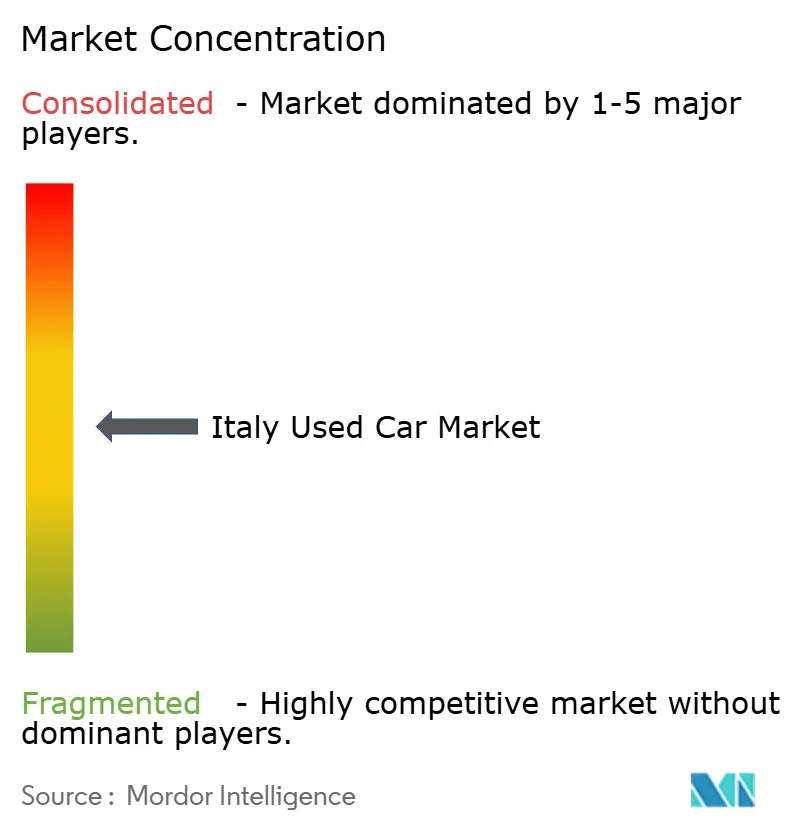
| Market Concentration | Medium |
Major Players *Disclaimer: Major Players sorted in no particular order Image © Mordor Intelligence. Reuse requires attribution under CC BY 4.0. | |
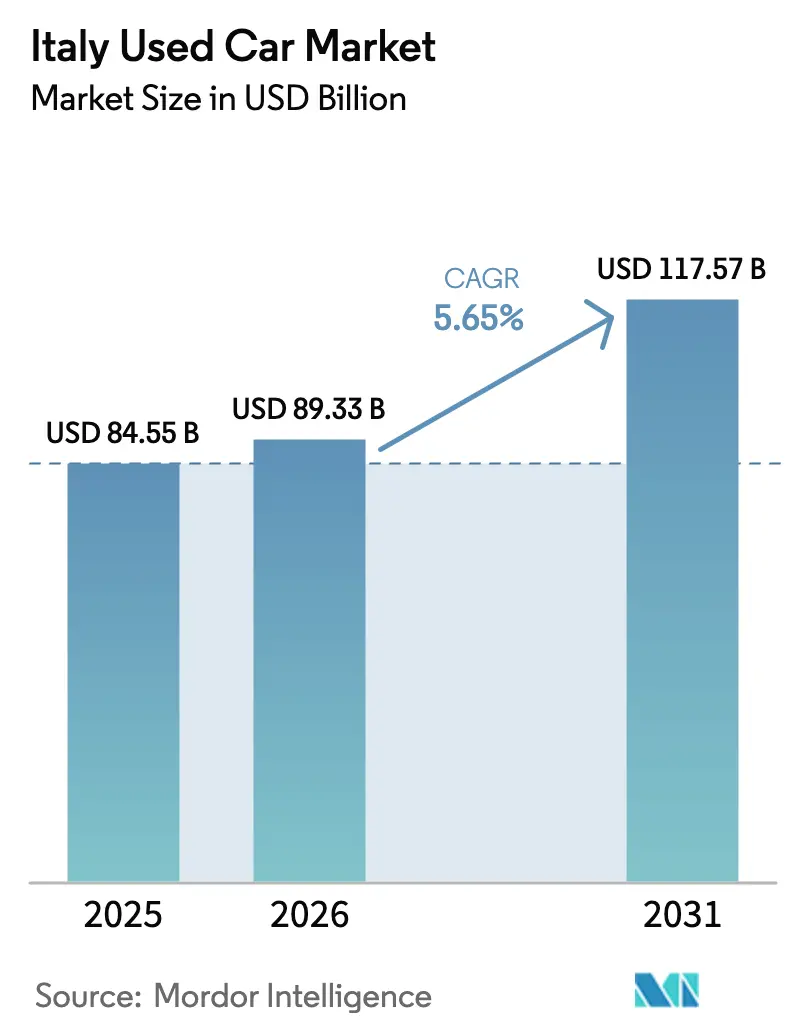
Italy Used Car Market Analysis by Mordor Intelligence
Italy used car market size in 2026 is estimated at USD 89.33 billion, growing from 2025 value of USD 84.55 billion with 2031 projections showing USD 117.57 billion, growing at 5.65% CAGR over 2026-2031. Consumer migration from rising new-car prices, the country’s 12.8-year average fleet age, and the availability of off-lease inventory set the tone for sustained growth. Strong online engagement, led by platforms that generate more than 2 billion annual searches, is widening geographic reach and easing price discovery. Regulatory pressure on older diesel vehicles, coupled with Stellantis' production shifts toward premium segments, is tightening supply in certain categories and underpinning residual values. Increasing adoption of certified-pre-owned programs and telematics-based scoring mechanisms is elevating buyer confidence and stimulating repeat purchases across the Italy used car market coming years.
Key Report Takeaways
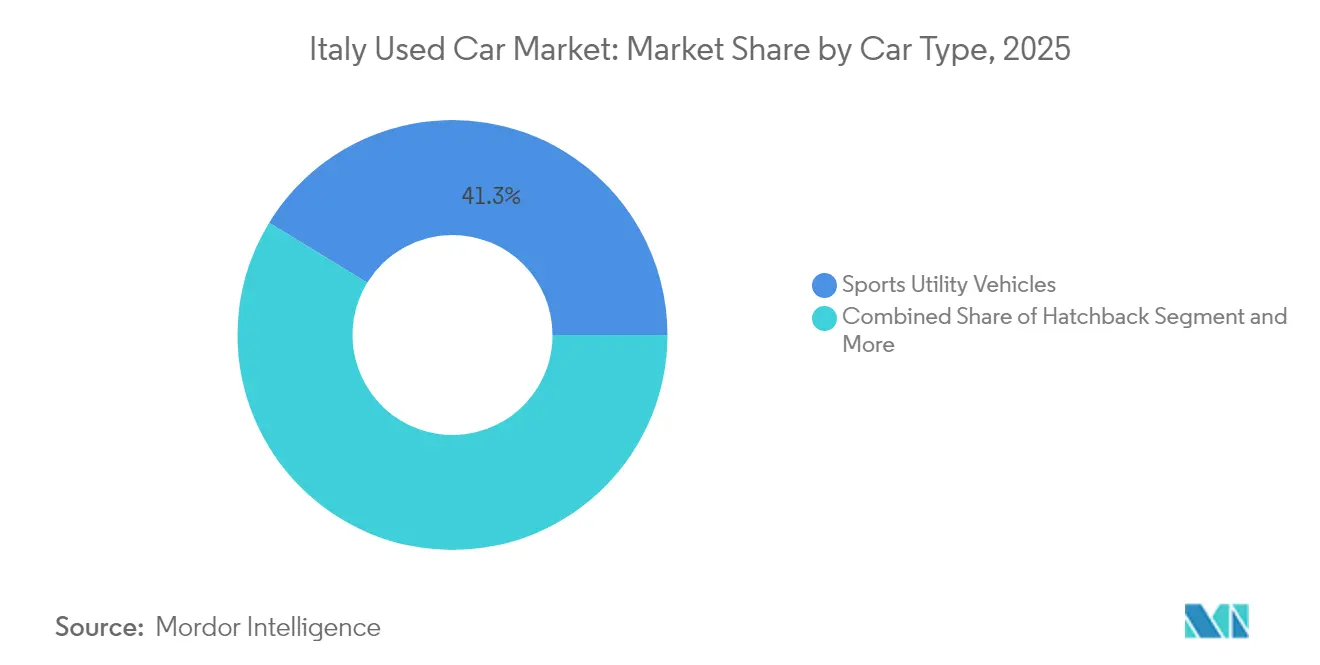
- By car type, SUVs led with 41.25% revenue share in 2025; SUVs are forecast to grow at a 7.12% CAGR to 2031.
- By propulsion, ICE vehicles held 84.10% of the Italy used car market share in 2025, while BEVs are projected to expand at a 17.54% CAGR through 2031.
- By vendor type, unorganized dealers accounted for 62.30% share of the Italy used car market size in 2025; organized dealers record the highest projected CAGR at 7.20% through 2031.
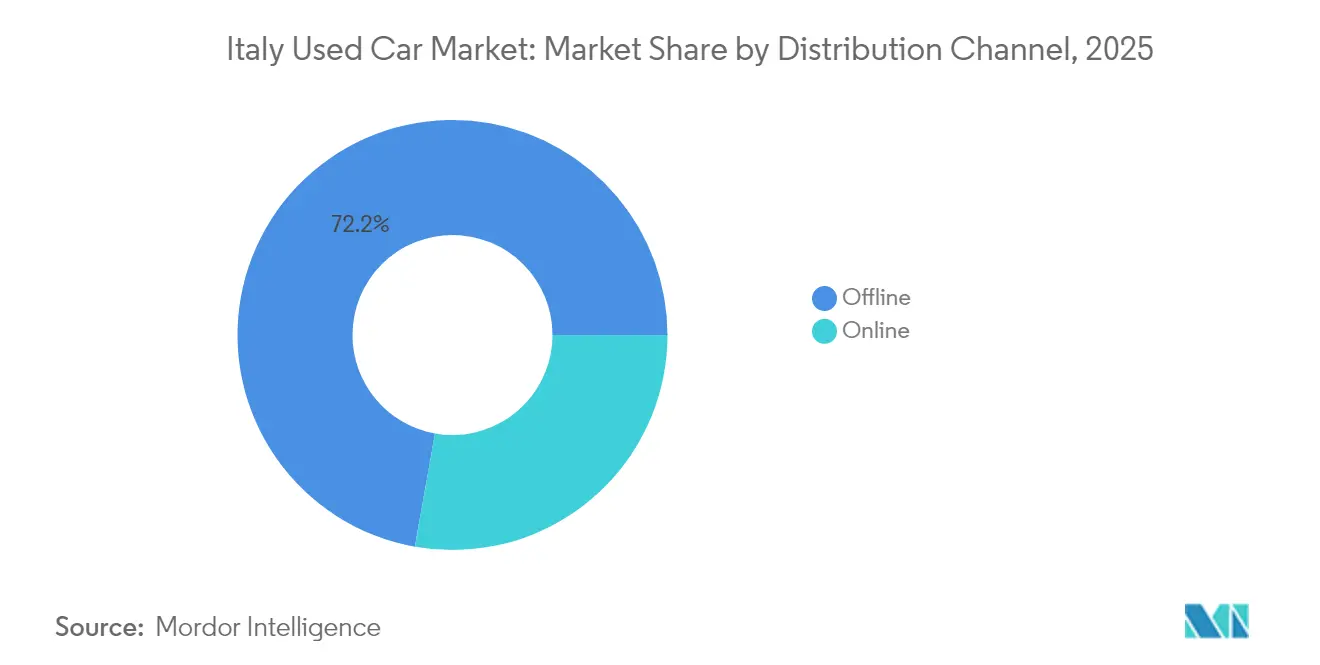
- By distribution channel, offline outlets captured 72.20% of the Italy used car market size in 2025; online channels grow fastest at 14.45% CAGR to 2031.
- By vehicle age, the 4-6 years bracket held 30.60% share of the Italy used car market size in 2025, while the 0-3 years bracket grows fastest at 4.78% CAGR to 2031.
Note: Market size and forecast figures in this report are generated using Mordor Intelligence’s proprietary estimation framework, updated with the latest available data and insights as of 2026.
Italy Used Car Market Trends and Insights
Drivers Impact Analysis*
| Driver | (~) % Impact on CAGR Forecast | Geographic Relevance | Impact Timeline |
|---|---|---|---|
| New-Car Price Inflation Shifts Demand | +1.2% | National, with stronger impact in northern industrial regions | Short term (≤ 2 years) |
| Online Used-Car Platforms Proliferate | +0.8% | National, with higher penetration in urban centers | Medium term (2-4 years) |
| OEM CPO Programs Expand | +0.6% | National, concentrated in major metropolitan areas | Medium term (2-4 years) |
| Off-Lease Returns Boost Supply | +0.9% | Northern Italy, particularly Lombardy and Veneto | Short term (≤ 2 years) |
| Eco Trade-Ins Add ICE Stock | +0.4% | National, with regional variations based on local policies | Long term (≥ 4 years) |
| Telematics Scores Build Buyer Trust | +0.3% | Urban centers initially, expanding to national coverage | Long term (≥ 4 years) |
| Source: Mordor Intelligence | |||
Rising New-Car Prices Shift Demand to Used
The ratio of used-to-new registrations climbed in early 2025 as OEMs prioritized higher-margin models, pricing many households out of factory-fresh vehicles [1]. This redirected demand favors Euro 6 petrol and mild-hybrid cars listed between EUR 9,000 and EUR 15,000, a price corridor where inventory remains fluid. The shift has been strongest in Lombardy and Piedmont, regions hit hardest by 2025 diesel restrictions, and is expected to sustain headline growth in the Italy used car market into 2026.
Proliferation of Online Used-Car Platforms
Digital marketplaces deliver national exposure previously unavailable to local dealers, with one leading portal counting of million users in 2024. Click-to-lead conversion tools, embedded financing calculators, and verified seller ratings compress transaction times while raising transparency. Urban millennials, the cohort most comfortable with digital buying, are extending the Italy used car market beyond regional boundaries, hastening price convergence among northern and southern provinces[2].
Expansion of OEM Certified-Pre-Owned Programs
Programs such as SPOTICAR and Toyota Plus combine 100-point inspections with 12-month warranties to ease reliability concerns around hybrids and BEVs. Factory-grade diagnostic equipment and software updates give OEM stores an edge in marketing late-model electrified vehicles, and the certification badge commands a premium that organized dealers readily capture. The trend supports value retention and repeats purchases, particularly in metropolitan areas where warranty coverage mitigates commuter range anxiety[3].
Surging Off-Lease Returns Fuel Supply
Corporate fleets returning 36- to 48-month-old vehicles are replenishing dealer lots with documented service histories. Leasing companies concentrated in Lombardy and Veneto are feeding a steady stream of sub-50,000-km units, balancing the supply shortfall caused by the 37% production decline at Italian factories in 2024. This supply is especially relevant for the Italy used car market because it maintains quality standards while satisfying demand for near-new inventory.
Restraints Impact Analysis*
| Restraint | (~) % Impact on CAGR Forecast | Geographic Relevance | Impact Timeline |
|---|---|---|---|
| Sparse Vehicle-History Databases | -0.5% | National, with greater impact in fragmented dealer networks | Medium term (2-4 years) |
| Low-Emission Zones Deter Old Diesels | -0.8% | Northern Italy, particularly Milan, Turin, and major urban centers | Short term (≤ 2 years) |
| Quality Stock Exports Eastward | -0.4% | National, with concentration in border regions | Medium term (2-4 years) |
| Reconditioning Costs Rise on Labor Gaps | -0.6% | National, with acute impact in industrial regions | Long term (≥ 4 years) |
| Source: Mordor Intelligence | |||
Limited Standardized Vehicle-History Databases
Italy relies on piecemeal service records instead of a unified national title registry, leaving gaps that erode buyer confidence during purely online transactions. Insurtech tools using AI image recognition to validate exterior damage are emerging, yet mass adoption hinges on regulatory harmonization and dealer cooperation mdpi.com. Until that occurs, cautious shoppers may restrict budgets or select certified stock only, modestly capping expansion in the Italy used car market.
Low-Emission Zones Discourage Older Diesel Purchases
From October 2025, Euro 5 diesels face weekday bans across four northern regions, affecting more than 1 million vehicles. Dealers must reposition restricted stock to less-regulated territories or accept steeper markdowns, a logistical shuffle that elevates holding costs and limits segment turnover. The same policy, however, stimulates demand for compliant Euro 6 units and BEVs, reinforcing the age and powertrain tilt already underway in the Italy used car market.
*Our forecasts treat driver/restraint impacts as directional, not additive. The impact forecasts reflect baseline growth, mix effects, and variable interactions.
Segment Analysis
By Car Type: Sport Utility Vehicles Dominates The Market
SUVs Drive Premium Positioning SUVs generated 41.25% of total 2025 sales and are forecast to advance at a 7.12% CAGR, retaining the top perch in the Italy used car market. Compact crossovers such as the Jeep Avenger benefit from urban practicality while matching lifestyle aspirations for ground clearance and perceived safety.
Hatchbacks, represented by the Fiat Panda’s remain crucial for budget-oriented shoppers yet cede share to SUVs that narrow the efficiency gap. On the premium end, Maserati and Alfa Romeo vehicles fall victim to volatile production flows but uphold Italy’s performance heritage, supporting a small high-margin niche. Meanwhile, MPVs cater to larger families but confront SUV cannibalization, reinforcing the two-tier demand curve that defines car-type preferences across the Italy used car market.

By Propulsion: Electric Surge Challenges ICE Dominance
Electric Surge Challenges ICE Dominance ICE units delivered 84.10% of 2025 transactions, yet BEVs post a 17.54% forecast CAGR that outpaces every other powertrain. Hybrids leverage Stellantis leadership, adding electric operating capability without range concerns and winning urban commuters constrained by low-emission zones.Residual-value stabilization, expanded charging infrastructure, and extended battery warranties reduce ownership risk. LPG and CNG stay relevant among cost-conscious rural drivers but face infrastructure erosion, gradually compressing their footprint within the broader Italy used car market.
By Vendor Type: Unorganized Vendor Dominates The Market
Unorganized operators captured 62.30% revenue in 2025, yet organized chains are scaling at 7.20% CAGR by rolling out omnichannel interfaces, captive financing, and reconditioning hubs that small dealers struggle to match. Formal groups negotiate bulk sourcing from auctions and off-lease feeders, creating inventory velocity and consistency. Independents still flourish where personal rapport overrides brand uniformity, particularly in small towns where cultural familiarity matters.Regulatory compliance on consumer protection, digital invoicing, and emissions disclosure nudges the landscape toward professionalization. As organized entities digest smaller rivals, the Italy used car market experiences a gradual but noticeable shift to franchised showrooms and data-driven pricing engines that optimize turnover.
By Distribution Channel: Offline Channel Surges
Digital Acceleration Continues Physical dealerships held 72.20% revenue in 2025, revealing the lasting need for tactile evaluation before purchase. However, online channels are compounding at 14.45% per year, and their influence on buyer research exceeds their share of final transactions. Virtual walk-around videos, instantaneous valuation tools, and end-to-end financing modules redefine consumer expectations. Click-and-collect models that blend internet discovery with brick-and-mortar delivery are emerging as the default pathway.Seasoned buyers who previously dismissed digital listings now rely on them for price benchmarking, while first-time millennial purchasers are confident in completing deals remotely. This dual behavior compresses pricing spreads and improves liquidity, reinforcing transparency across the Italy used car market.
By Vehicle Age: 4-6 Years Vehicles Dominated The Market
Newer Models Command Premium Vehicles aged 4-6 years accounted for 30.60% of 2025 turnover, balancing affordability and contemporary features. Meanwhile, the 0-3 year slice is expanding at 4.78% CAGR as price inflation in the new-car arena steers affluent shoppers to near-new stock that offers factory warranty remnants. Units older than 10 years face rising operational limitations in metropolitan low-emission zones, forcing dealers to pivot inventories toward compliant regions or adopt cross-border sales strategies.Italy’s 12.8-year average fleet age leaves latent replacement demand, yet regulatory frameworks accelerate churn at the younger end of the spectrum. Dealers that stock Euro 6 petrol and mild-hybrid vehicles in the 25,000-to-60,000-km range enjoy the fastest turnover and the most resilient margins within the Italy used car market.
Geography Analysis
Northern regions command the highest transaction values because industrial wages enable buyers to absorb near-new prices. Lombardy, Piedmont, Veneto, and Emilia-Romagna jointly face Euro 5 diesel bans that displace more than 1 million vehicles, forcing accelerated trade-ins or migrations to rural provinces. Higher BEV penetration in these regions drives a budding secondary battery-electric segment that aligns with local charging density.Central Italy balances performance and practicality.
Rome’s metropolitan zone, lacking the most stringent low-emission rules, supports brisk demand for both Euro 6 diesels and hybrids, creating a diversified inventory mix. Dealers here benefit from tourist-driven seasonality that prompts short leasing cycles and early fleet disposals, enriching late-model stock flows into the Italy used car market.Southern regions prioritize durability and fuel economy over advanced tech and thus gravitate to LPG, CNG, and older petrol vehicles.
Lower average income extends replacement intervals, but the availability of de-registered northern diesels at discounted prices keeps volumes steady. Limited charging infrastructure tempers BEV adoption for now, yet falling battery prices could unlock incremental demand and progressively level regional disparities.
Regulatory Landscape
Italy’s used-car market operates under a mix of EU vehicle rules and national administrative requirements. Vehicle registration and conformity processes are managed by the Ministero delle infrastrutture e dei trasporti (MIT), including procedures linked to EU Regulation 2018/858 (such as end-of-series handling), which affects how vehicles are placed and transferred within the market and how dealers document stock.
At the retail and compliance layer, used-vehicle trading activities are governed by the Testo Unico delle Leggi di Pubblica Sicurezza (T.U.L.P.S.), notably Article 126, which requires notification and registration of trade operations at the local level. Environmental obligations also shape remarketing and disposal: the Ministero dell’ambiente e della sicurezza energetica (MASE) oversees the End-of-Life Vehicles framework aligned with Directive 2000/53/EC, reinforcing responsibilities across manufacturers, dealers, and recovery operators and influencing take-back, documentation, and recycling pathways. In parallel, the Ministero delle imprese e del made in Italy (MIMIT) administers programs such as the National Automotive Fund to support investment projects tied to the transition toward sustainable and smart mobility, with downstream relevance for used-vehicle availability, reconditioning standards, and electrified-vehicle handling.
Value Chain Analysis
The Italy used-car value chain starts with supply creation from trade-ins, end-of-lease and fleet defleeting, OEM and leasing remarketing channels, and consumer-to-consumer listings that are increasingly intermediated by digital platforms. Inventory then flows into appraisal and pricing (often supported by platform data), followed by reconditioning, quality control, and documentation checks that reduce buyer uncertainty where standardized vehicle-history records can be fragmented.
Reconditioning capacity has become a key operational node as organized players industrialize refurbishment and logistics to support faster turnover and more consistent vehicle condition for online-to-offline sales. AUTO1 Group’s refurbishment center in Patrica is an example of this infrastructure layer, combining inspection, repairs, and outbound logistics to feed platform-driven retail and wholesale distribution. Downstream, vehicles are remarketed through a hybrid of physical dealerships, branded certified-pre-owned networks, and online marketplaces, with financing and warranty products increasingly bundled to raise conversion and trust. Industry bodies such as ANFIA (representing a broad automotive supply chain) and UNRAE (representing foreign vehicle manufacturers and the distribution sector) also remain relevant institutional touchpoints for broader ecosystem coordination.
Competitive Landscape
Italy’s used-vehicle arena remains moderately fragmented even as organized chains grow. SPOTICAR, backed by Stellantis, anchors the branded OEM segment through warranties and manufacturer-grade reconditioning. AutoScout24 complements OEM websites by offering cross-border listings, while Arval and LeasePlan remarket off-lease stock via wholesaling platforms that interface directly with dealer management systems.
Independent sellers harness personal networks and word-of-mouth credibility, a hallmark of Italian retail culture that larger entities find hard to replicate. Technology adoption is the fault line: AI-assisted damage recognition and automated pricing algorithms reside mostly with the top 20 organizers. Partnerships between mid-tier dealers and financial institutions embed insurance and maintenance bundles, raising barriers to entry. As consolidation gains pace, the Italy used car market inches toward a structure where five to seven national groups will likely dominate urban centers, with regional independents occupying value niches.
First-mover investments in vehicle-history integration could determine future competitive advantage. Firms that mesh telematics scores with certified-pre-owned warranties will differentiate readiness for online-only transactions, particularly important as digital natives swell the buyer base. International capital may accelerate this convergence, yet cultural nuances and complex zoning laws favor incumbents who already master local regulation.
Italy Used Car Industry Leaders
-
AUTO1 Group
-
Arval Service Lease Italia SpA
-
Ayvens Group (ALD Automotive Italia)
-
brumbrum SpA
-
BCA Italia srl
- *Disclaimer: Major Players sorted in no particular order
Market Opportunities and Future Outlook
White space remains in scalable trust-building and transaction enablement, especially where buyers seek stronger condition assurance than fragmented records can provide. Third-party certification and standardized inspection pathways create room for organized remarketing models that help dealers defend margins while reducing disputes and returns. Arval’s AutoCert by RINA initiative is one example of independent verification used to improve confidence and liquidity in professional channels.
The market also shows room for deeper vertical integration around reconditioning, financing, and omnichannel fulfillment as online discovery accelerates. AUTO1 Group’s operating footprint in Italy (including Noicompriamoauto.it and Autohero) and its Patrica refurbishment center (120,000 square meters, capacity around 25,000 cars per year) illustrate how industrial-scale refurbishment can support faster listing cycles, more consistent quality, and broader geographic reach. AUTO1’s dealer-focused financing tools, such as AUTO1 Financing introduced in Italy in June 2026, also point to an active push to reduce working-capital friction for dealers and increase inventory velocity. Electrified used-vehicle workflows (battery state-of-health checks, warranty products, and transparent grading) remain another operational gap to address as secondary BEV volumes build in higher-penetration northern regions and organized channels expand certified offers.
Recent Industry Developments
- July 2026: Ayvens reports that the used car market in Italy grew approximately 11 percent since 2023, with the company focusing on certified and reconditioned vehicles to meet dealer demand. The growth signal points to rising demand and inventory optimization across the sector. Ayvens' emphasis on certified reconditioning supports dealer readiness and price stability.
- May 2026: AUTO1 Group reports record Q1 2026 results across metrics. The results reflect robust activity and pricing dynamics in Italy's used-car ecosystem via a major remanufacturer/retailer. The momentum indicates sustained channel strength and price discovery leverage for online platforms in Italy.
- May 2026: Arval launches Re-Lease used car offerings for its preferred network with certified maintenance and inspection. The new offering directly affects used car supply quality and asset turnover. It aims to improve dealer confidence and liquidity through certified reconditioning and warranty-like services.
Research Methodology Framework and Report Scope
Market Definition and Coverage
For this study, the Italy used car market is defined as the value of completed resale transactions of previously owned passenger cars within Italy, across organized dealers and informal sellers, captured across online and offline channels.
Scope exclusions: New vehicle sales, motorcycles, heavy commercial vehicles, and after-sales services like repairs, spare parts, and insurance are excluded from the market value.
Segmentation Overview
- By Car Type
- Hatchback
- Sedan
- SUV
- MPV
- Luxury & Sports
- By Propulsion
- Internal Combustion Engine (Petrol/Diesel)
- Hybrid
- Electric
- LPG/CNG
- By Vendor Type
- Organized
- Unorganized
- By Distribution Channel
- Online
- Offline
- By Vehicle Age
- 0-3 Years
- 4-6 Years
- 7-10 Years
- More than 10 Years
Data Sources, Market Sizing, and Validation
Desk Research
Desk work starts with building a clean view of how big the used car activity is in Italy and how it is shifting by fuel and vehicle age. We used public sources such as Italy vehicle registration and transfer statistics, national statistical releases, EU-level transport and emissions publications, and customs trade databases for vehicle flows where applicable.
To support pricing and mix assumptions, we also reviewed association and regulator publications, tracked macro indicators (inflation, consumer credit trends, and interest rates), and reviewed credible press coverage that monitors used car demand and policy changes. Where needed, we complemented this with paid subscriptions for company financials and intelligence, news and financials, and automotive car sales datasets to cross-check dealer scale, channel mix, and timing of market movements. The sources mentioned above are illustrative and not exhaustive, and other public documents and datasets were also used for data collection, validation, and research clarification.
Primary Interviews and Surveys
Primary work was used to pressure-test the desk assumptions, especially on transaction pricing, share of dealer versus private sales, and how online listings translate into completed deals. We spoke with a mix of dealer groups, independent retailers, online intermediaries, financing and warranty partners, and industry observers, then reconciled the feedback with Italy-wide demand signals.
Coverage was kept Italy-specific, but voices were balanced across the north, center, and south so the model does not overfit to a single regional pattern.
Distribution of primary research fieldwork respondents
| Company type | Respondent position |
|---|---|
| Top tier: 31% | CXOs: 16% |
| Mid tier: 53% | Functional/Unit leaders: 26% |
| Smaller Players: 16% | Managers: 58% |
Market-Sizing & Forecasting
Sizing starts with a top-down and bottom-up approach where annual ownership transfers are reconstructed from registration and transfer data, and then translated into value using average transacted prices by age bands and powertrain. To keep the estimate realistic, we adjust for the typical share of dealer-mediated sales versus private sales and then align channel splits to observed online versus offline activity.
The model uses practical inputs, such as total used car transfer volumes, average fleet age, fuel mix shifts (ICE, hybrid, EV, LPG/CNG), the share of 0-3, 4-6, and older vehicles, and financing availability indicators that influence ticket size. Results are then cross-checked with selective bottom-up approximations, including dealer revenue scale checks, sampled price points by body type, and channel checks on listing-to-sale conversion. Where data gaps exist, we use conservative ranges that are later tightened through interviews.
For the forecast, scenario analysis is applied and anchored to a short list of drivers that experts agreed matter most, such as new car affordability, interest rate direction, supply of off-lease vehicles, and expected policy pressure on older diesel cars in cities. We keep assumptions in nominal USD terms consistent by applying a transparent currency conversion approach and then reviewing whether the implied price progression aligns with what market participants expect.
Data Validation & Update Cycle
Validation is done in layers so single-source bias does not drive the final number. We compare model outputs against independent signals like transfer-to-new sales ratios, observed price trend direction, and dealer channel shares, then investigate any large variances before sign-off.
A second analyst review is used to re-check formulas, units, and timing, and we re-contact sources when a key assumption changes or when a result appears out of line with market behavior. Reports are refreshed annually, with interim updates when material events occur, and a final pre-delivery pass is completed so clients receive the latest updated view.
Mordor Intelligence's Italy Used Car Market Size Versus Other Published Estimates
Published market numbers for used cars in Italy often do not match because the scope line is drawn differently and the price logic is not always comparable. Differences also come from which transaction types are counted, whether values are reported in nominal or inflation-adjusted terms, and how quickly assumptions are refreshed after big pricing swings.
The main gap drivers here are whether private-party transfers are counted at the same value as dealer sales, whether light commercial vehicles are mixed in with passenger cars, and whether forecasts assume a sharp re-rating of used car prices. Currency timing can also widen the spread when EUR to USD moves across the base year.
Benchmark comparison
| Source | Market Size | Gaps in Research Methodology |
|---|---|---|
| Mordor Intelligence | USD 84.55 B (2025) | |
| Regional Consultancy A | USD 98.53 B (2026) | Uses a broader vehicle universe in its narrative (including light commercial vehicles) and applies a faster value expansion path into the out-years, which lifts the 2026 level versus a passenger-car-only focus. |
| Industry Publisher B | USD 95.60 B (2022) | Reports an older-year value and appears to rely on generalized price levels with limited adjustment for vehicle-age mix and the dealer versus private transaction split, which can inflate totals when market conditions normalize. |
Overall, the table shows that the spread is mostly explained by what is counted as a used car transaction and how pricing is carried forward between years, and these choices can change the value more than volumes do. By keeping the value build tied to transfer volumes and age-based transaction pricing, and excluding light commercial vehicles from the total, the result stays consistent with the defined market in Mordor Intelligence.
Key Questions Answered in the Report
What is the current value of the Italy used car market?
The Italy used car market stood at USD 89.33 billion in 2026 and is projected to reach USD 117.57 billion by 2031.
Which vehicle type dominates sales?
SUVs led 2025 turnover with 41.25% share and are forecast to grow at 7.12% CAGR during 2026-2031 period.
How fast are online channels growing?
Online platforms are set to expand at a 14.45% CAGR through 2031, outpacing offline growth but still relying on hybrid fulfillment.
Which propulsion segment is growing fastest?
Battery-electric vehicles show a 17.54% forecast CAGR, the highest among all powertrains, driven by affordable new-model launches and maturing charging networks.