
Italy Self-Monitoring Blood Glucose Devices Market Size and Share
Market Overview
| Study Period | 2021 - 2032 |
|---|---|
| Forecast Data Period | 2027 - 2032 |
| Historical Data Period | 2021 - 2025 |
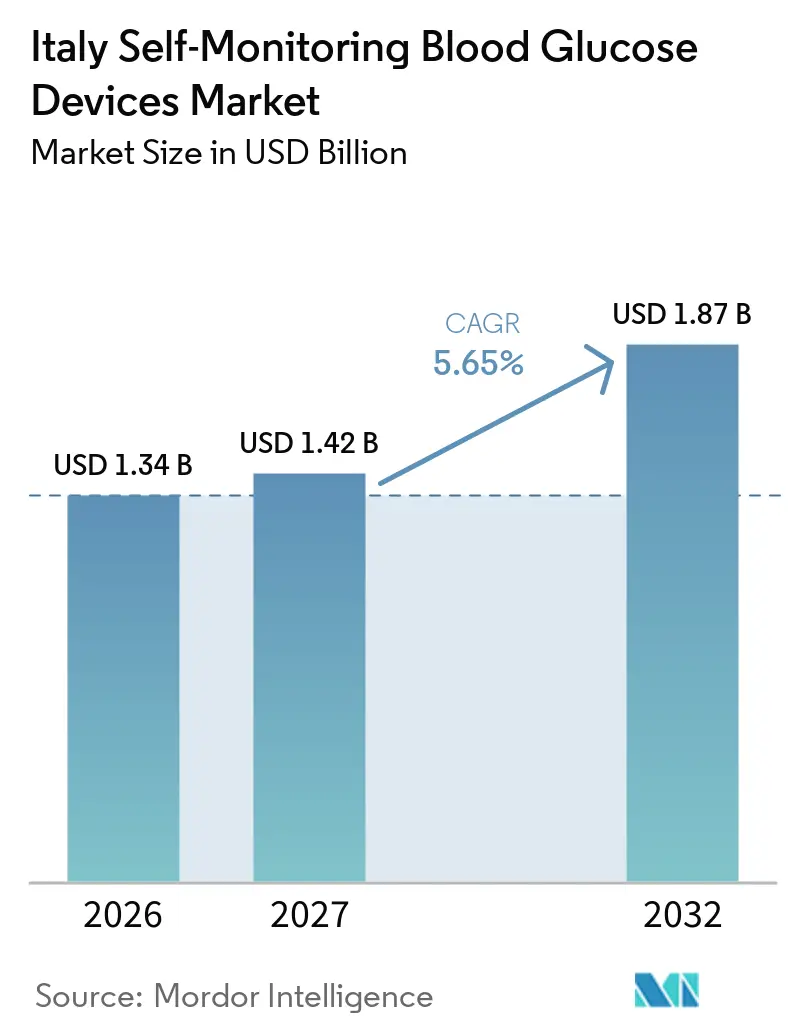
| Base Year Market Size (2026) | USD 1.34 Billion |
| Market Size (2027) | USD 1.42 Billion |
| Market Size (2032) | USD 1.87 Billion |
| Growth Rate (2027 - 2032) | 5.65 % |
Major Players *Disclaimer: Major Players sorted in no particular order Image © Mordor Intelligence. Reuse requires attribution under CC BY 4.0. | |
Italy Self-Monitoring Blood Glucose Devices Market Analysis by Mordor Intelligence
The Italy Self-Monitoring Blood Glucose Devices Market size was valued at USD 1.34 billion in 2026 and is estimated to grow from USD 1.42 billion in 2027 to reach USD 1.87 billion by 2032, at a CAGR of 5.65% during the forecast period (2027-2032).
The first year since its inception, the COVID-19 pandemic was responsible for premature deaths, particularly among older individuals. Italy was the first country in Europe affected by COVID-19. Italy was among the countries with the highest mortality rates. Most people who died of COVID-19 were affected by the co-occurrence of two or more chronic conditions in the same individual. Several studies confirmed that chronic diseases like diabetes were associated with adverse outcomes in COVID-19 patients. The pandemic highlighted opportunities for continuing and expanding innovations in the delivery of diabetes care through virtual consultations between healthcare providers and people with diabetes and the use of diabetes technology. Routine diabetes management was essential to mitigate the risk of adverse health outcomes and severe COVID-19 in diabetes patients; however, the pandemic contributed to disruptions in diabetes management.
Regular blood glucose monitoring helps patients understand their glucose patterns and make informed decisions regarding diet, exercise, medication adherence, and other lifestyle habits. These readings offer timely feedback that enables patients and healthcare providers to identify and address unfavorable changes in glucose control. Prolonged high blood glucose levels among people with diabetes may result in serious long-term complications, including kidney disease, nerve damage, and vision-related disorders. Consistent and accurate monitoring supports the prompt management of abnormal glucose levels, helping reduce the risk of diabetes-related complications and improve treatment outcomes.
Advanced technologies, including digital health applications, are strengthening diabetes self-management by presenting blood glucose data in a clear and consolidated format. These applications can also integrate information on insulin administration, meals and snacks, and physical activity, allowing users to better understand the factors influencing their glucose levels. Such tools can reduce the overall disease burden and support more effective diabetes care. Furthermore, the integration of blood glucose monitoring systems with insulin dose calculators, automated insulin titration software, and remote coaching services provides additional support for patients with poorly controlled diabetes. These developments can improve critical clinical outcomes, encourage greater patient engagement, and support the growth prospects of the market over the coming years.
Note: Market numbers in this report are based on Mordor Intelligence's proprietary estimation framework, which combines nine months of actuals with Q4 projections for base year 2026.
Italy Self-Monitoring Blood Glucose Devices Market Trends and Insights
Rising Diabetes Prevalence in Italy
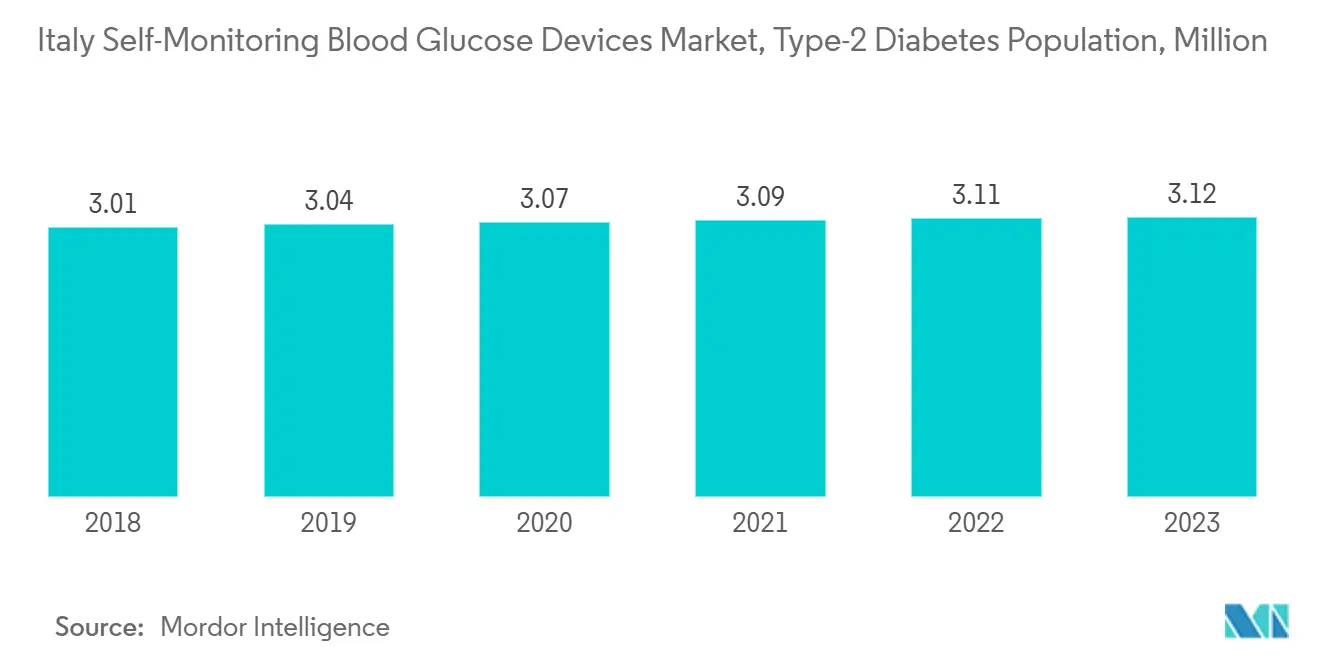
The diabetes population in Italy is expected to grow by about 0.57% over the forecast period.
According to the International Diabetes Federation's reports, the prevalence of diabetes in adults in Italy was approximately 9.9%. The Italian health system is highly decentralized, with most administrative and organizational powers held by the regions. The National Diabetes Plan defines priorities and provides guidelines to improve the quality of diabetes care with a patient-centered focus. Regional and local authorities are responsible for its implementation, which varies among the 20 regions. Government policies play a critical role in improving the quality and safety of healthcare in a country at almost all levels of authority-state and local. Policy, systems, and environmental changes are essential elements of a long-term plan to prevent chronic diseases like diabetes.
Self-monitoring of blood glucose is an essential practice for many individuals managing diabetes. Regular blood glucose measurements enable patients and healthcare providers to make informed adjustments to diet, physical activity, insulin therapy, and medication regimens to maintain blood sugar levels within the target range. Technological advancements have improved modern glucometers, which use highly sensitive test strips and sensors to provide accurate readings that closely align with laboratory results. In the Italy self-monitoring blood glucose devices market, the increasing prevalence of diabetes and growing awareness of routine glucose monitoring support demand for these devices. The availability of advanced, user-friendly glucometers further enables patients to manage their condition more effectively at home.
The Italian National Healthcare Service (NHS) is ensuring universal coverage for all citizens. People living with diabetes have access, with no out-of-pocket expenditure, to all the medicines, devices, and medical services they need. Overall, Italy has a well-developed system of diabetes care, with numerous diabetes centers throughout the country and free treatment at the point of delivery.
Therefore, the studied market is anticipated to witness growth over the analysis period due to rising prevalence and the aforementioned factors.
The Test Strips Segment holds the highest market share in the current year
The test strip segment held the highest market share of about 80% in the current year.
Blood glucose test strips are single-use, disposable components that play a critical role in blood glucose monitoring. After a user applies a blood sample to the strip, glucose in the blood reacts with glucose oxidase, generating gluconic acid. The glucose meter sends an electrical current through the strip, which contains conductive terminals that facilitate current measurement. The amount of gluconic acid produced alters the electrical current between these terminals. Using this change in current, the meter's algorithm determines the user's blood glucose concentration. This electrochemical process enables users to obtain rapid blood glucose readings for routine diabetes management.
The test strip segment is anticipated to expand its market share more rapidly than the glucose meter segment, primarily because of its higher frequency of use. Consumers generally purchase glucometers once, while they must regularly replenish test strips because each strip can only be used for a single test. Although a typical glucose meter has a lifespan of six months to three years and represents a one-time expense during that period, test strips create an ongoing cost for users. The recurring need for test strips supports repeat purchases and generates consistent demand within the blood glucose monitoring market. Consequently, the higher consumption rate of test strips is likely to support their stronger market share growth compared with glucose meters.
Italian law regulates the clinical care of people with diabetes and creates a framework involving medical organizations, prevention programs, personnel training, and legal protection. The National Health Program is structured into essential levels of assistance that can be defined differently in the various regions. The National Health Program is structured into LEAs (essential levels of assistance). LEAs define all the medical assistance modalities offered by the INHS to citizens, with or without partial contributions based on a patient's income. Such reimbursement policies and the aforementioned factors are expected to drive the market over the forecast period.
Competitive Landscape
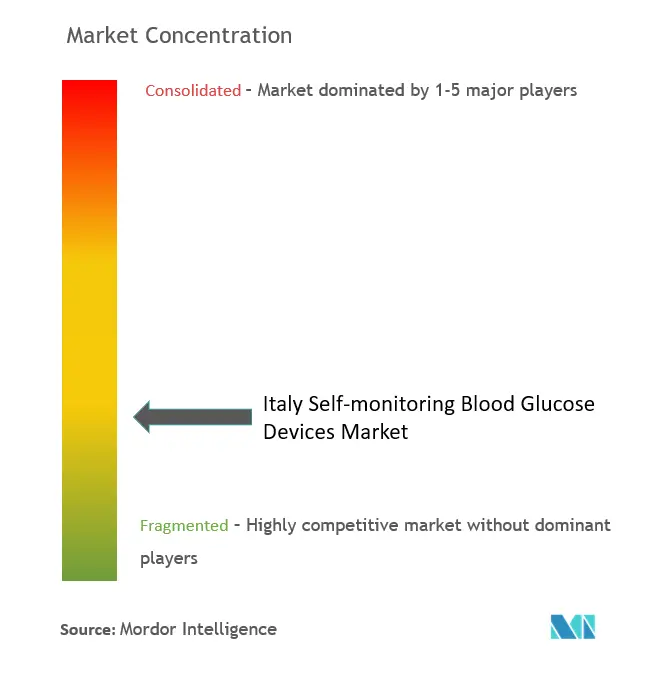
The Italian self-monitoring blood glucose device market is fragmented, with few significant and other generic players. Manufacturers like Abbott, LifeScan, Roche, Ascensia, etc. occupy a major share.
Italy Self-Monitoring Blood Glucose Devices Industry Leaders
-
Roche Diabetes Care
-
Abbott Diabetes Care
-
Ascensia Diabetes Care
-
Sinocare
-
LifeScan
- *Disclaimer: Major Players sorted in no particular order
Market Opportunities and Future Outlook
Opportunities in Italy self-monitoring blood glucose devices are increasingly shaped by regional pathways that broaden access to advanced monitoring and formalize prescribing and follow-up. Regional measures such as Veneto's DGR of April 8, 2025 expanded reimbursement eligibility for continuous and flash glucose monitoring to Type 2 diabetes patients on intensive insulin therapy. This can redistribute monitoring volumes between traditional SMBG routines and sensor-led workflows while still sustaining SMBG demand in titration, confirmation testing, and care settings not covered by CGM criteria.
On the technology and procurement side, Health Technology Assessment work by AGENAS and the Ministry of Health that compares CGM and SMBG performance can create room for manufacturers to bundle meters, strips, connectivity, and clinical decision support into demonstrable care pathways, rather than focusing only on unit pricing. At the same time, digital dematerialized prescribing and monitoring processes being implemented in some regions support tighter adherence tracking and could favor connected SMBG solutions and interoperable platforms from major suppliers active in Italy (Abbott, Roche, LifeScan, and Ascensia). Adoption can be further reinforced where diabetes centers and regional health systems prioritize integration with broader services such as remote coaching, insulin titration software, and digital logs.
Recent Industry Developments
- June 2026: Abbott Diabetes Care obtained CE marking for Libre Duo and Libre Duo 10 Day combined glucose and ketone monitoring technology with European launches planned. The development supports Italian CGM adoption pathways and strengthens the reimbursement case for integrated monitoring tools. It expands Abbott's footprint in the Italian CGM market through an enhanced product offering.
- May 2026: Abbott Diabetes Care obtained Libre Duo CE marking with European launches planned. The milestone opens market access for a combined glucose and ketone monitoring solution in Italy. The development broadens the company portfolio for diabetes management in the Italian market.
- April 2026: Roche Diabetes Care launched Accu-Chek SmartGuide in Italy, a CGM system with AI enabled predictive glucose management. The introduction signals a shift toward AI driven CGM solutions in Italy. It accelerates adoption of predictive CGM and strengthens care pathways for diabetes management.
Research Methodology Framework and Report Scope
Market Definition and Coverage
This market covers revenues generated in Italy from self-monitoring blood glucose (SMBG) devices used for capillary blood glucose checks at home or in everyday care, including the core consumables that are needed to complete a test.
Scope exclusions: Excludes continuous glucose monitoring systems, insulin delivery devices, and professional lab based glucose testing.
Segmentation Overview
- Component
- Glucometer Devices
- Test Strips
- Lancets
Data Sources, Market Sizing, and Validation
Desk Research
Desk research is used to build the starting structure of the market and to set realistic ranges for demand and pricing before we speak with industry participants. We rely on public health and epidemiology sources to understand the diabetes pool in Italy and likely testing intensity, such as the International Diabetes Federation (IDF) Diabetes Atlas, OECD health statistics, and World Health Organization (WHO) data where applicable.
To understand supply and access conditions, we also review sources such as Italian Ministry of Health publications, European Commission and Eurostat datasets (including health and trade tables where relevant), and peer reviewed clinical and health economics literature that discusses SMBG usage patterns and outcomes. Company filings, investor presentations, press releases, and reputable media are used to track product launches, portfolio changes, and reimbursement or tender related signals. In addition, paid subscriptions for company financials and intelligence, patent databases, and shipment level import export data are used selectively to cross check directionally important inputs. These desk research sources are illustrative, and many additional public and paid references were also used for data collection, validation, and clarification.
Primary Interviews and Surveys
Primary work is used to convert the desk view into a realistic market model for Italy, mainly by checking usage behavior and pricing logic across channels. We validate assumptions through interviews and surveys with distributors, pharmacy and tender facing stakeholders, clinicians, diabetes educators, and operations and commercial managers who see volumes and mix changes over time.
Distribution of primary research fieldwork respondents
| Company type | Respondent position |
|---|---|
| Top tier: 29% | CXOs: 14% |
| Mid tier: 51% | Functional/Unit leaders: 40% |
| Smaller Players: 20% | Managers: 46% |
Market-Sizing & Forecasting
Sizing starts with a demand pool build in Italy that links the diagnosed diabetes population to SMBG usage, and then converts that into unit needs for meters, test strips, and lancets. We use top-down logic by reconstructing expected consumption from treated cohort sizes and typical testing frequency, and then translating units into value using observed price bands by channel.
To keep the total grounded, results are corroborated with selective bottom-up checks, such as sampled average selling price times volume by component, distributor channel checks, and cross checks against publicly visible procurement and reimbursement signals. Inputs that matter most in this market include the insulin treated share versus non insulin treated users, strips per patient per year (which shifts with guideline adherence and patient education), replacement cycle for meters, channel mix between retail pharmacy and public procurement, and price dispersion between branded and value offerings.
For forecasting, scenario analysis is used so growth can be traced to a few explainable drivers, followed by a light time series check using exponential smoothing on component level revenues where historical signals are stable. When bottom-up datapoints are missing for smaller pockets, conservative ranges are applied and then adjusted only after primary respondents confirm that the implied volumes and prices are reasonable.
Data Validation & Update Cycle
Validation is done through triangulation across independent signals so one dataset does not decide the outcome on its own. We compare model outputs with sanity checks like implied strips per patient, implied average device prices by channel, and year over year shifts that should align with policy and access changes, and then anomalies are reviewed before sign-off.
A multi step internal review is followed so assumptions, formulas, and outputs are checked by more than one analyst, and re-contact is triggered when a variance cannot be explained by a clear market event or documentation. Reports are refreshed annually, with interim updates when material changes occur, and a final pre-delivery review is performed so clients receive the latest updated view.
Mordor Intelligence's Italy Self Monitoring Blood Glucose Devices Market Size Measured Against Other Published Estimates
Published values for Italy SMBG devices can differ even when they look like they are talking about the same space, because the boundary between SMBG and adjacent glucose monitoring categories is not always treated the same way. Differences in how test strip consumption is modeled, and whether public reimbursement dynamics are reflected in pricing, also move the final number.
By tracking component level unit demand and refreshing price and mix assumptions using Italy specific reimbursement and channel checks, Mordor Intelligence keeps the estimate centered on SMBG meters plus the recurring consumables rather than bundling in adjacent monitoring technologies or broader diabetes device revenues.
Benchmark comparison
| Source | Market Size | Gaps in Research Methodology |
|---|---|---|
| Mordor Intelligence | USD 1.27 B (2025) | |
| Industry Portal A | USD 0.65 B (2024) | Often presented as a broader blood glucose monitoring snapshot for an earlier year, which can undercount recurring strip demand or apply blended pricing that reflects only select channels. |
| Research Publisher B | USD 0.00 B (2025) | The published value appears to use an inconsistent unit scale and may not correctly convert million versus billion, which can materially distort the market size when reported in USD. |
The table shows that the spread is mainly explained by scope control and basic normalization steps like unit scale, year alignment, and channel pricing. When meters are sized together with strip and lancet pull through, and when reimbursement driven price levels are reflected, the total becomes more repeatable and easier to audit over time.
Key Questions Answered in the Report
How big is the Italy Self-Monitoring Blood Glucose Devices Market?
The Italy Self-Monitoring Blood Glucose Devices Market size is expected to reach USD 1.42 billion in 2027 and grow at a CAGR of 5.65% to reach USD 1.87 billion by 2032.
What is the current Italy Self-Monitoring Blood Glucose Devices Market size?
In 2026, the Italy Self-Monitoring Blood Glucose Devices Market size is expected to reach USD 1.34 billion.
Who are the key players in Italy Self-Monitoring Blood Glucose Devices Market?
Roche Diabetes Care, Abbott Diabetes Care, Ascensia Diabetes Care, Sinocare and LifeScan are the major companies operating in the Italy Self-Monitoring Blood Glucose Devices Market.
What years does this Italy Self-Monitoring Blood Glucose Devices Market cover, and what was the market size in 2025?
In 2025, the Italy Self-Monitoring Blood Glucose Devices Market size was estimated at USD 1.27 billion. The report covers the Italy Self-Monitoring Blood Glucose Devices Market historical market size for years: 2021, 2022, 2023, 2024, and 2025. The report also forecasts the Italy Self-Monitoring Blood Glucose Devices Market size for years: 2027, 2028, 2029, 2030, 2031, and 2032.