Market Overview
| Study Period | 2020 - 2031 |
|---|---|
| Forecast Data Period | 2026 - 2031 |
| Base Year Market Size (2025) | USD 14.51 Billion |
| Market Size (2026) | USD 15.45 Billion |
| Market Size (2031) | USD 21.09 Billion |
| Growth Rate (2026 - 2031) | 6.42% CAGR |
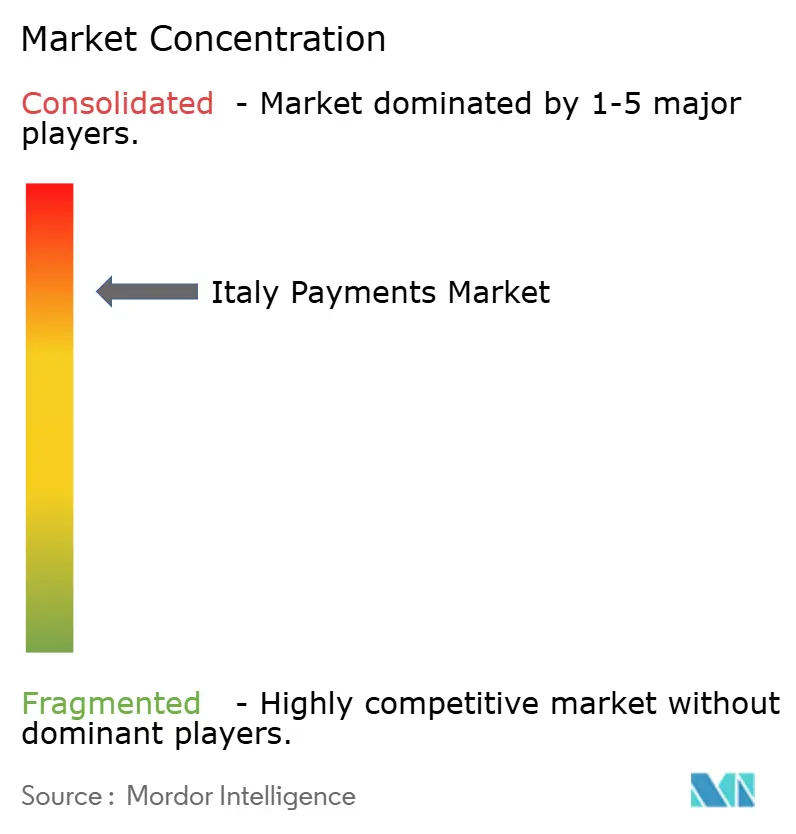
| Market Concentration | High |
Major Players *Disclaimer: Major Players sorted in no particular order Image © Mordor Intelligence. Reuse requires attribution under CC BY 4.0. | |
Italy Payments Market Analysis by Mordor Intelligence
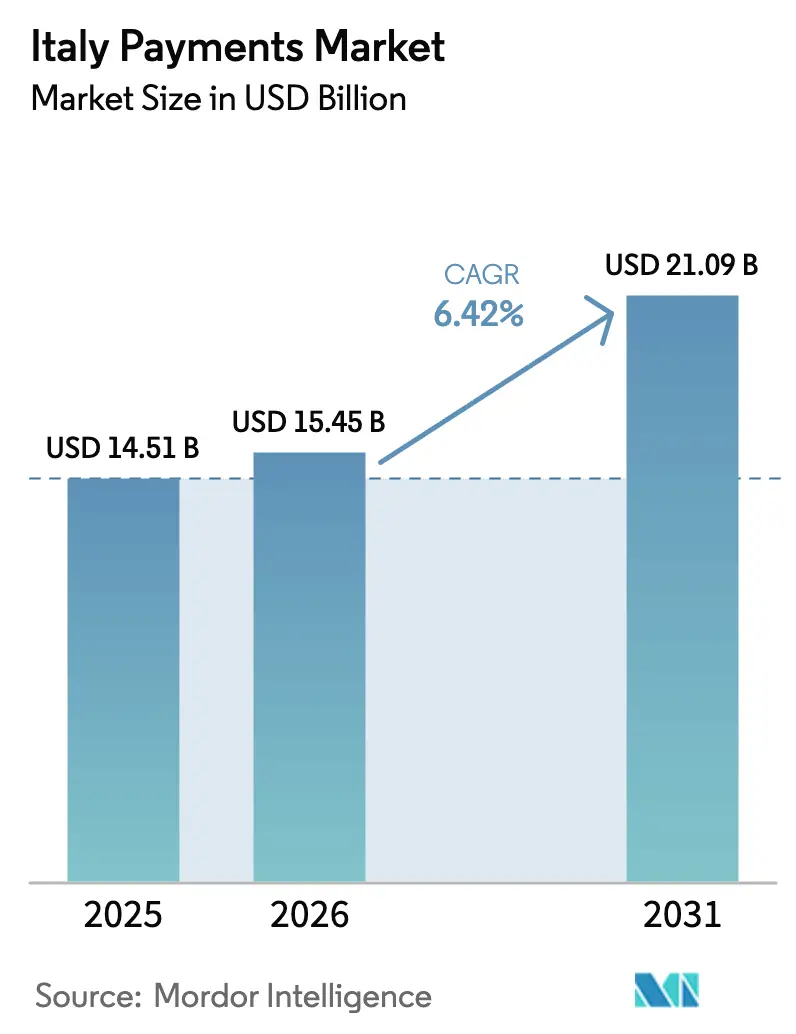
The Italy payments market size stands at USD 15.45 billion in 2026 and is projected to reach USD 21.09 billion by 2031, reflecting a 6.42% CAGR over the forecast period. A decisive pivot away from cash toward digital rails underpins this growth, supported by instant-payment mandates, point-of-sale tax incentives, and record tourism receipts. Contactless adoption has crossed the 70% threshold at physical checkouts, while e-commerce gateways embed one-click authentication, reducing cart abandonment risk. Merchant acquirers consolidate for scale, fintech gateways court developers with open APIs, and real-time account-to-account rails begin to erode legacy settlement delays. Countervailing forces persist - regional cash affinity, elevated micro-merchant fees, and demographic drag - but none are strong enough to derail the structural migration to cashless transacting.
Key Report Takeaways
- By mode of payment, debit cards led with 38.52% of the Italy payments market share in 2025, and digital wallets for online sales are forecast to expand at a 7.33% CAGR between 2026 and 2031.
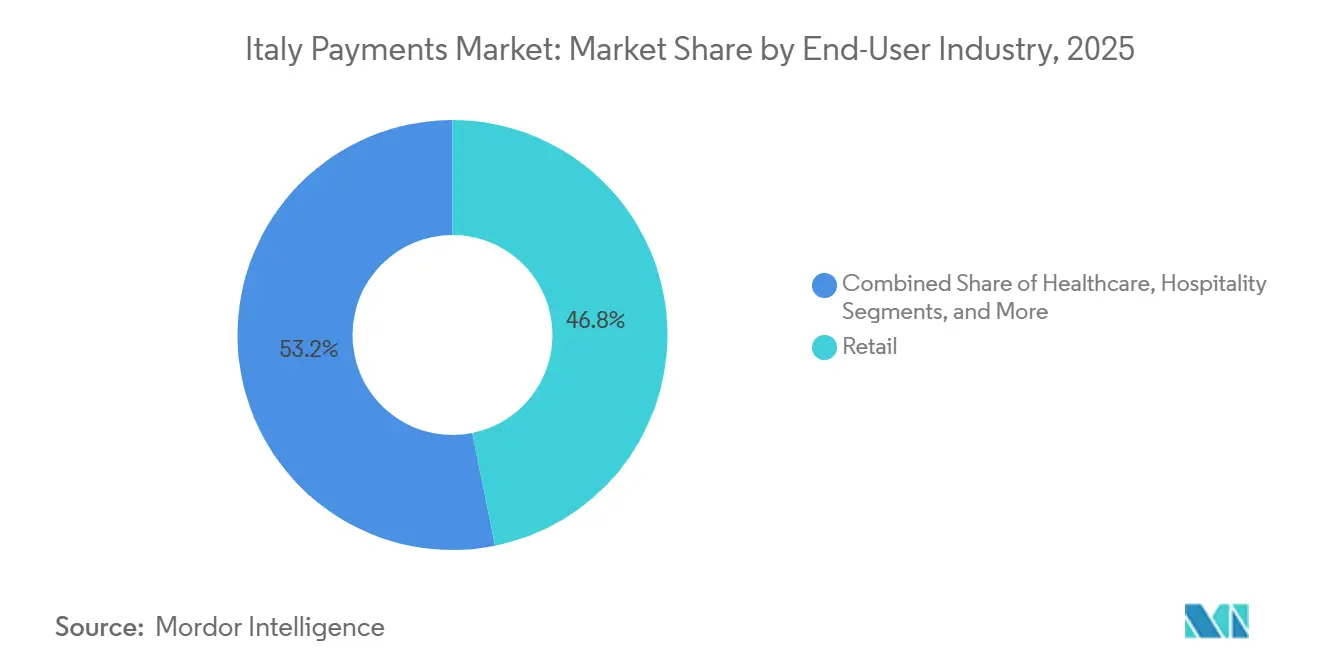
- By end-user industry, retail commanded 46.83% share of the Italy payments market size in 2025, and hospitality is projected to advance at a 7.66% CAGR from 2026 to 2031.
Note: Market size and forecast figures in this report are generated using Mordor Intelligence’s proprietary estimation framework, updated with the latest available data and insights as of January 2026.
Italy Payments Market Trends and Insights
Drivers Impact Analysis*
| Driver | (~) % Impact on CAGR Forecast | Geographic Relevance | Impact Timeline |
|---|---|---|---|
| E-commerce boom fuels card and wallet usage | +1.2% | Northern urban centers, national spillover | Medium term (2-4 years) |
| Tourism rebound lifts cross-border spend volumes | +1.0% | Rome, Venice, Florence, Amalfi Coast | Short term (≤ 2 years) |
| Instant-payment rails RT1 and TIPS gain merchant adoption | +0.9% | National, early uptake by large retailers | Medium term (2-4 years) |
| Growing use of Buy-Now-Pay-Later for luxury and fashion | +0.8% | Milan and Rome fashion districts | Short term (≤ 2 years) |
| Digital tax incentives for SMEs to install POS terminals | +0.7% | Southern regions and rural areas | Long term (≥ 4 years) |
| PSD2-driven open-banking APIs accelerate A2A payments | +0.6% | National, fintech platforms | Long term (≥ 4 years) |
| Source: Mordor Intelligence | |||
E-Commerce Boom Fuels Card and Wallet Usage
Online retail volumes rose sharply after pandemic lockdowns and have held those gains, normalizing contactless and mobile checkout habits. Debit card transactions climbed to 6.7 billion in 2024 as issuers raised contactless limits and merchants implemented tokenization that mitigates fraud.[1]Bank of Italy, “Payment Systems Report 2025,” bancaditalia.it Digital wallets, including PostePay, Satispay, Apple Pay, and Google Pay, will gain share through instant checkout and loyalty integration that resonates with demographics under 40. Strong Customer Authentication briefly injected friction when it launched, yet low-value and trusted-merchant exemptions quickly restored conversion rates.[2]European Central Bank, “Payment Statistics,” ecb.europa.eu Gateways now route payments through least-cost algorithms, occasionally favoring account-to-account rails when interchange savings justify the switch. The cumulative effect is rising electronic penetration in segments once dominated by cash-on-delivery.
Tourism Rebound Lifts Cross-Border Spend Volumes
Italy welcomed 134 million visitors in 2024, generating EUR 58.6 billion (USD 62.8 billion) in revenue.[3]ENIT, “Tourism Statistics 2024,” enit.it Travelers prefer card payments that avoid foreign-exchange cash hassles, driving volumes in hospitality, retail, and cultural attractions. Visa and Mastercard benefit disproportionately, capturing interchange on both issuing and acquiring sides. Tourist familiarity with tap-and-go norms accelerated contactless upgrades at merchant terminals, shortening queues at high-traffic sites. Acquirers responded with dynamic currency conversion and multi-currency settlement features, improving transparency and guest satisfaction.
Instant-Payment Rails RT1 and TIPS Gain Merchant Adoption
SEPA Instant regulation obliges providers to receive real-time credit transfers from January 2025 and to send them by October 2025. Italy’s RT1 and the pan-European TIPS infrastructure now settle in under 10 seconds, freeing merchants from the working-capital drag of T+1 card funding. Early pilots among supermarkets and hotel chains deploy QR codes or NFC triggers that initiate direct bank transfers. Although instant payments represented less than 5% of credit transfers in 2024, cost savings over percentage-based card fees make the rail compelling for high-value tickets, laying the groundwork for long-term displacement of cards.
Growing Use of Buy-Now-Pay-Later for Luxury and Fashion
BNPL volumes reached EUR 6.8 billion (USD 7.3 billion) in 2024, up 46% year on year. Providers such as Scalapay and Klarna split purchases into equal installments, funding zero-interest plans through merchant fees that merchants accept as a conversion lever. Younger shoppers prefer transparent repayment schedules to revolving credit, while luxury brands maintain price integrity without discounting. Regulators proposed affordability checks and clearer disclosures in 2025, yet merchant demand for larger baskets is expected to keep the model expanding.
Restraints Impact Analysis*
| Restraint | (~) % Impact on CAGR Forecast | Geographic Relevance | Impact Timeline |
|---|---|---|---|
| Persistently high cash affinity in Southern regions | -0.5% | Campania, Calabria, Sicily, Apulia | Long term (≥ 4 years) |
| Ageing population slows mobile-wallet penetration | -0.4% | National, 60+ demographic | Long term (≥ 4 years) |
| Elevated interchange and MDR fees for micro-merchants | -0.3% | National, small businesses | Medium term (2-4 years) |
| Tightened AML rules increase KYC onboarding friction | -0.2% | National, PSPs and fintechs | Short term (≤ 2 years) |
| Source: Mordor Intelligence | |||
Persistently High Cash Affinity in Southern Regions
Cultural norms, an informal economy, and sparse terminal density sustain cash use in Campania, Calabria, Sicily, and Apulia. Even after a 30% tax credit for point-of-sale hardware, micro-merchants cite fixed fees as prohibitive, maintaining cash preference despite security and reconciliation drawbacks. The North-South digital gap therefore remains wide, with Lombardy exceeding 50% digital share while many Southern provinces remain below 35%. Bridging this divide requires a mix of fiscal incentives, fee reform, and consumer education.
Ageing Population Slows Mobile-Wallet Penetration
Italy’s median age of 48 skews toward older cohorts that are hesitant to adopt smartphone-based authentication. While contactless cards achieve near-universal acceptance, wallets such as Satispay, Apple Pay, and Google Pay penetrate unevenly outside major metros. Issuers run education campaigns and simplified onboarding flows, yet biometric login and app navigation still deter segments over 60. As this cohort controls significant discretionary spend, slow wallet uptake tempers total electronic growth.
*Our forecasts treat driver/restraint impacts as directional, not additive. The impact forecasts reflect baseline growth, mix effects, and variable interactions.
Segment Analysis
By Mode of Payment: Debit Cards Anchor POS, Wallets Surge Online
Debit card payments held 38.52% of the Italy payments market share in 2025 as contactless tapping normalized checkout behavior. Regulatory interchange caps and merchant familiarity sustain this dominance, while credit cards remain indispensable for cross-border travel and high-ticket purchases. Account-to-account methods captured under 5% of transfers in 2024 due to limited acceptance, although SEPA Instant mandates promise faster scaling through 2031.
Digital wallets for online purchases are projected to post a 7.33% CAGR through 2031, signaling the highest velocity among channels. One-click authentication, biometric login, and loyalty integration cut abandonment, while gateway-level routing shifts volume toward cheaper rails. Cash usage erodes each year yet stays relevant for micro-transactions and in rural markets where fixed terminal fees deter merchants. If instant transfers gain consumer trust, card schemes may face margin pressure on large-basket retail, but entrenched debit convenience suggests coexistence rather than immediate displacement.


By End-User Industry: Retail Dominates, Hospitality Accelerates
Retail commanded 46.83% of the Italy payments market size in 2025, encompassing grocery, fashion, electronics, and pharmacies. Rising contactless limits and self-checkout kiosks keep growth positive despite maturity. Buy-Now-Pay-Later installments drive higher order values in fashion, while grocery chains deploy tokenized card files for unattended checkout lanes.
Hospitality is forecast to pace the field with a 7.66% CAGR between 2026 and 2031, buoyed by surging inbound tourism and merchants’ urgency to accept international cards. Hotels, restaurants, and tour operators integrate dynamic currency conversion and instant settlement to improve liquidity. Entertainment venues adopt QR-ticketing with embedded payments, while healthcare digitizes slowly due to public-sector reimbursement cycles and older patient demographics. Transportation and utilities modernize in pockets, contactless transit in Milan, online tax portals in Rome, but progress remains uneven, leaving substantial headroom for electronic expansion.
Geography Analysis
Northern regions such as Lombardy, Emilia-Romagna, and Piedmont approach Scandinavian electronic penetration, exceeding 50% digital share in 2024. Dense banking networks and higher GDP per capita fuel terminal deployment and card issuance. The Italy payments market size for these provinces is forecast to compound above the national average through 2031 as open banking and instant rails find receptive early adopters.
Central tourism hubs such as Rome, Florence, and Venice benefit from record visitor inflows that favor card transactions, compelling merchants to accept near-field communication, dynamic currency conversion, and multi-currency settlement. SEPA Instant cuts settlement to seconds, improving cash-flow management for high-velocity hospitality outlets. Concurrently, smartphone-based dongles extend acceptance to seasonal vendors who once operated cash-only stands.
Southern provinces lag, with digital share below 35% despite the national tax credit targeting small businesses. Lower affluence, cultural cash preference, and a sizable informal economy slow adoption. Nevertheless, mobile wallets like Satispay gain traction by offering peer-to-peer convenience, and acquirers court micro-merchants with flat-fee packages that neutralize per-transaction costs. Convergence remains a decade away, yet incremental gains continue as utility billers and municipal services migrate to online portals.
Regulatory Landscape
Italy payments regulation is set through EU frameworks, with domestic oversight led by Banca d'Italia. It covers payment systems and the licensing and supervision of payment institutions (IP) and electronic money institutions (IMEL). The EU Instant Payments Regulation (Regulation (EU) 2024/886), published in Italy's Gazzetta Ufficiale in February 2025, set mandatory milestones for SEPA Instant euro credit transfers, requiring reachability for receiving instant payments from January 9, 2025 and for sending by October 9, 2025. This sped up the shift toward real-time account-to-account settlement on rails such as TIPS and RT1.
Operational resilience and digital compliance requirements tightened further in 2026. In February 2026, Banca d'Italia updated supervisory provisions for IP and IMEL, incorporating DORA-aligned expectations and updated EBA guidance on IT and security risk management. The Ministry of Economy and Finance (MEF) also ran a June 2026 public consultation (concluding July 6, 2026) on a draft legislative decree to implement the EU ViDA package (Directive 2025/516/UE and related regulations). This raised readiness needs for digital reporting and VAT compliance among marketplaces, PSPs, and merchants connected to online payment flows.
Value Chain Analysis
Italy's payments value chain begins with merchant and consumer demand across POS and online channels, then runs through acceptance and orchestration layers such as merchant software, e-commerce platforms, and payment gateways. From there, transactions flow to acquiring PSPs and domestic and international schemes (Bancomat, Visa, Mastercard), with settlement handled through bank infrastructure and pan-European systems including TARGET Services and TIPS/RT1 for instant credit transfers. Risk and compliance functions (KYC, AML screening, fraud monitoring, Strong Customer Authentication flows) are embedded across issuing banks, acquirers, and fintech PSPs. Enabling layers such as tokenization, least-cost routing, and device-based NFC/contactless help drive conversion while reducing fraud exposure.
Value capture concentrates at scale acquirers and gateways, and at scheme rails, while operational bottlenecks often show up in merchant integration complexity and back-office visibility, particularly for SMEs and fragmented supply chains. The value chain is also moving toward embedded finance, reflected in Satispay's June 2026 move toward broader banking offerings (including Mastercard debit card capability) and in ECB-backed initiatives such as the July 2026 selection of PSPs for the digital euro pilot, including Italian participation via Intesa Sanpaolo/isybank. On acceptance, policy emphasis on mandatory electronic payment acceptance and the ongoing shift of consumer spend toward electronic instruments (45% of consumption in 2025) keeps POS terminal fleets, softPOS, and wallet-based acceptance central to distribution and servicing for micro-merchants and tourism-heavy verticals.
Competitive Landscape
Domestic champion Nexi maintains the largest acquiring footprint through long-standing bank partnerships, processing a plurality of in-store volumes. Worldline and Adyen expand by serving multinational retailers that require unified European acceptance, while Stripe and PayPal dominate developer-led online onboarding. Together, these five players captured most of the merchant volume in the Italy payments market in 2025, signaling high concentration.
Strategic themes include vertical integration, acquirers buying gateways and software vendors to capture more value, and real-time settlement enablement that differentiates on liquidity speed. Tokenization and biometric authentication mitigate fraud while preserving conversion, and acquirers bundle analytics and loyalty modules to deepen merchant stickiness.
Open banking, enabled under PSD2, remains below 5% of transfers, yet fintechs see white-space in payroll, bill pay, and high-value retail. BNPL specialist Scalapay processed EUR 6.8 billion (USD 7.3 billion) in transactions in 2024 and eyes point-of-sale expansion. Compliance overhead under strengthened AML directives favors incumbents with mature KYC infrastructure, raising barriers for smaller entrants.
Italy Payments Industry Leaders
PayPal Holdings, Inc.
Bancomat S.p.A. (Bancomat Pay)
Mastercard Europe S.A.
Amazon Payments, Inc. (Amazon Pay)
Visa Europe Limited
- *Disclaimer: Major Players sorted in no particular order

Market Opportunities and Future Outlook
Instant payments create near-term whitespace in retail and bill-pay use cases, where card acceptance costs and delayed settlement constrain merchant economics. Evidence of traction shows up in 2025, when instant transfers reached about 99.5 million transactions in Q4, close to 29% of total SEPA transfers in Italy, supported by the EU Instant Payments Regulation deadlines (receiving by January 2025 and sending by October 2025) that standardize reachability and speed. This creates opportunities for acquirers and gateways to package SEPA Instant acceptance at checkout (QR/NFC triggers, pay-by-bank buttons) together with reconciliation, dispute workflows, and fraud controls, especially for higher-ticket baskets where percentage-based MDR is most painful.
E-commerce scale and digital adoption also expand the addressable market for wallet-first and API-led checkout experiences. Italy recorded EUR 518 billion in digital payment value in 2025 (up 7% year on year), and e-commerce revenue was about EUR 90.6 billion in 2025 with internet penetration near 89.9%. This supports demand for tokenized credentials, one-click authentication, and orchestration across cards, wallets, and account-to-account rails. Further opportunity comes from sovereignty and interoperability initiatives that can alter routing options for P2P and commerce payments. Bancomat's 2026 push toward pan-European mobile payment interoperability with schemes like Bizum, Sibs-Mb Way, Vipps MobilePay, and EPI is one anchor, and DORA-aligned IT and security requirements also favor vendors offering compliance-ready infrastructure for PSPs and merchants.
Recent Industry Developments
- May 2026: Bancomat accelerated its digital payments strategy with a stronger focus on P2P services and an expanded partnership track that included BNL BNP Paribas. The move supports wider daily-use adoption beyond ATM and card heritage, while giving banks and merchants a domestic scheme pathway for mobile-first payments.
- October 2025: Mastercard and PayPal expanded their global partnership to integrate Mastercard Agent Pay with the PayPal wallet, targeting agentic commerce use cases. The announcement strengthens wallet-based checkout and control features that can be leveraged by Italian merchants selling online and to inbound tourists.
- July 2024: Nexi enabled Bancomat Pay transactions on Amazon.it, adding a domestic account-based payment option on a major e-commerce platform in Italy. This increased visibility and usability for Bancomat Pay in online checkout flows and supported competitive pressure on card-only tender mixes.


Research Methodology Framework and Report Scope
Market Definition and Coverage
For this study, the Italy payments market is defined as revenues linked to enabling and processing payment transactions in Italy across in-store and online channels, including card payments, account-to-account transfers, and wallet-based payments, as counted within the payment flow.
Scope exclusions: Cash as a medium of exchange is not sized as a stand-alone market, and banking products not directly tied to payment execution (such as lending and deposits) are kept out of scope.
Segmentation Overview
- By Mode of Payment
- Point of Sale
- Debit Card Payments
- Credit Card Payments
- Account-to-Account (A2A) Payments
- Digital Wallet
- Cash
- Other Point-of-Sale Payment Mode
- Online Sale
- Debit Card Payments
- Credit Card Payments
- Account-to-Account (A2A) Payments
- Digital Wallet
- Cash-on-Delivery
- Other Online Sales Payment Mode
- Point of Sale
- By End-User Industry
- Retail
- Entertainment
- Hospitality
- Healthcare
- Other End-User Industries
Data Sources, Market Sizing, and Validation
Desk Research
Desk research started with building a clean picture of how Italians and businesses pay, how fast volumes are shifting, and what rails are used most often in Italy. We relied on public sources such as Bank of Italy payment system statistics, ECB payments and cards indicators, Eurostat digital economy and household access data, and Italian Ministry of Economy and Finance updates on payments and invoicing initiatives. When cross-checking demand signals was needed, we also reviewed open publications from payments councils and trade bodies, plus reputable press coverage tied to regulatory and network changes.
Next, the model inputs were organized into a structure that can be audited, so we used company filings, annual reports, investor presentations, and merchant acquiring disclosures to sanity-check pricing and mix assumptions. We also used subscription databases for company financials and intelligence, and another one for patent and innovation tracking, mainly to verify product focus and timing rather than to force numbers into the model. These desk sources are illustrative, and other public documents and datasets were also used for data collection, validation, and research clarification.
Primary Interviews and Surveys
Primary work focused on confirming which payment modes are truly active in Italy and how pricing and take rates are moving across merchant types and channels. We spoke with merchant-side payments managers, acquirer and issuer-side practitioners, fintech operators, and consultants who track acceptance and payment flows across Italy. Inputs from these discussions were used to close gaps from desk research, validate volume-to-value assumptions, and pressure-test adoption timing for newer rails before totals were finalized.
Distribution of primary research fieldwork respondents
| Company type | Respondent position | Region |
|---|---|---|
| Top tier: 33% | CXOs: 12% | |
| Mid tier: 52% | Functional/Unit leaders: 42% | |
| Smaller Players: 15% | Managers: 46% |
Market-Sizing & Forecasting
The sizing starts from a top-down build where national payment activity is reconstructed through instrument mix and channel mix, and then converted into a revenue pool using realistic fee and take-rate ranges for each payment mode. To keep the math grounded, we used a limited set of repeatable fingerprints such as the share of card versus transfer activity, online versus in-store mix, adoption of digital wallets, the split of debit and credit usage at POS, and average fee movement as merchants shift to lower-cost rails.
Once the top line was produced, we corroborated it using selective bottom-up approximations, including sampled provider revenue disclosures, channel checks with merchants, and simple volume times average pricing estimates for the most visible rails. Where disclosure was incomplete, gaps were handled through peer-set ranges that were confirmed in interviews, followed by conservative normalization so totals stay consistent with observed transaction behavior.
For the forecast, scenario analysis was used because payments growth depends on a few practical drivers that can change with policy and merchant acceptance. Assumptions on wallet penetration, instant transfer usage, merchant acceptance expansion, and pricing compression were aligned to expert consensus, and then tested against the historical trajectory so short-term jumps do not get overstated.
Data Validation & Update Cycle
Validation was done in layers so the final number can be traced back to clear inputs. We compared outputs against independent signals (such as payment instrument shares, acceptance footprint trends, and reported activity shifts) and checked for year-to-year breaks that would not match how payment rails typically evolve. Any large variance triggered a re-check of the fee logic and a return to interview notes, and when needed, respondents were contacted again to clarify the assumption.
Before sign-off, the full workbook goes through a second analyst review focused on unit consistency, currency timing, and whether mix shifts are being double counted. Reports refresh annually, with interim updates when a material event changes pricing, regulation, or network access. Right before delivery, a final pass is completed so clients receive the latest updated view.
Mordor Intelligence's Italy Payments Market Size Versus Other Published Estimates
Published market sizes for Italy payments can look far apart because the word payments is used differently across studies, and because some models treat transaction value as market size while others size provider revenues. Differences also come from what is counted as in scope (cards only versus multi-rail), and whether the estimate includes cross-border activity and large-ticket transfers.
By tracking instrument-level mix shifts, pricing progression, and annual refresh inputs, Mordor Intelligence keeps the Italy payments total tied to service revenues generated within the country, instead of mixing in gross transaction value that inflates totals.
Benchmark comparison
| Source | Market Size | Gaps in Research Methodology |
|---|---|---|
| Mordor Intelligence | USD 14.51 B (2025) | |
| Global Consultancy A | USD 915.65 B (2025) | This estimate appears to reflect payment transaction value flowing through cards and payment instruments, which is a throughput measure and not comparable to a revenue-based market model. It can also embed B2B and high-value transfers, which expands the pool well beyond retail payment services. |
| Regional Consultancy B | USD 420.00 B (2024) | The scope likely centers on electronic payment value, using historical transaction totals as the main driver. It typically does not separate merchant acquiring and processing revenues from the underlying spend, and currency timing plus base-year choice (2024 versus 2025) can further widen the spread. |
The spread in the table mainly comes down to whether the study is sizing revenues earned for enabling payments or the much larger value of money moving through the system. Using clearly stated boundaries, simple pricing logic by rail, and repeatable checks on mix and adoption helps keep the result balanced and easier to reconcile with real-world payment behavior.


Key Questions Answered in the Report
How large is the Italy payments market in 2026?
The Italy payments market size is valued at USD 15.45 billion in 2026.
What is the expected CAGR for Italian payment transactions through 2031?
Aggregate transaction value is forecast to rise at a 6.42% CAGR between 2026 and 2031.
Which payment method is growing fastest online?
Digital wallets for online sales are projected to expand at a 7.33% CAGR over the forecast period.
Which end-user sector shows the strongest growth outlook?
Hospitality is expected to grow at a 7.66% CAGR from 2026 to 2031 due to record tourism inflows.
What infrastructure underpins real-time payments in Italy?
RT1 and TARGET Instant Payment Settlement process SEPA Instant transfers, settling funds in under 10 seconds.
Page last updated on: