
Market Overview
| Study Period | 2020 - 2031 |
|---|---|
| Forecast Data Period | 2026 - 2031 |
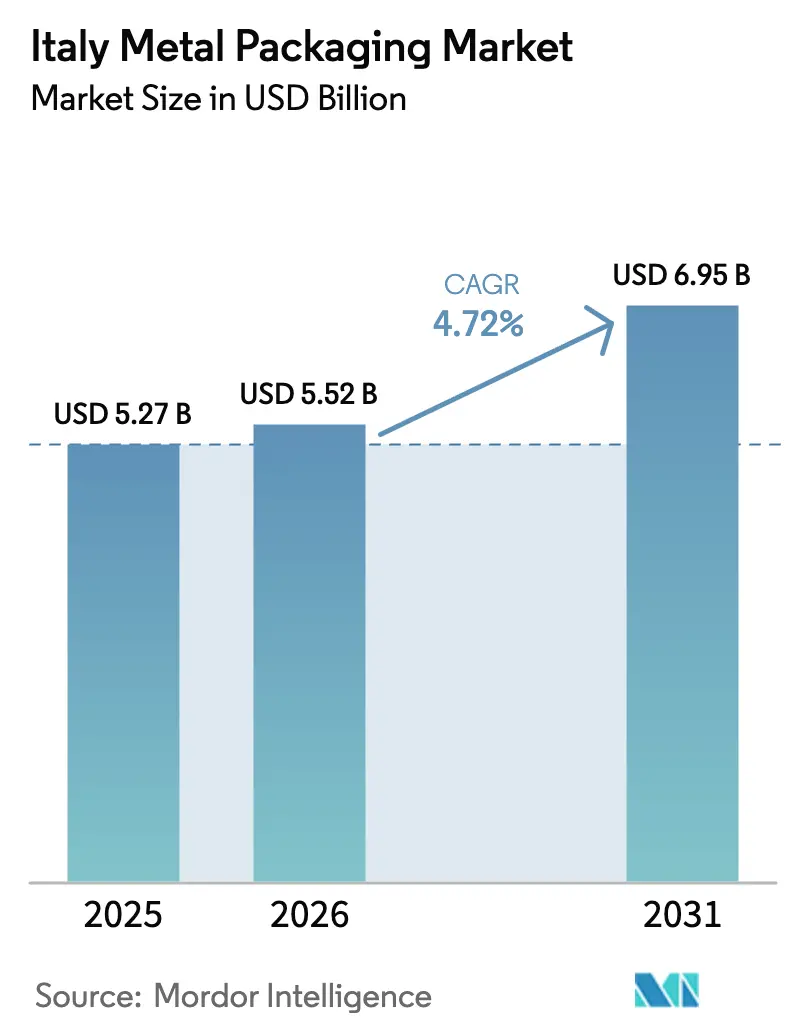
| Base Year Market Size (2025) | USD 5.27 Billion |
| Market Size (2026) | USD 5.52 Billion |
| Market Size (2031) | USD 6.95 Billion |
| Growth Rate (2026 - 2031) | 4.72 % |
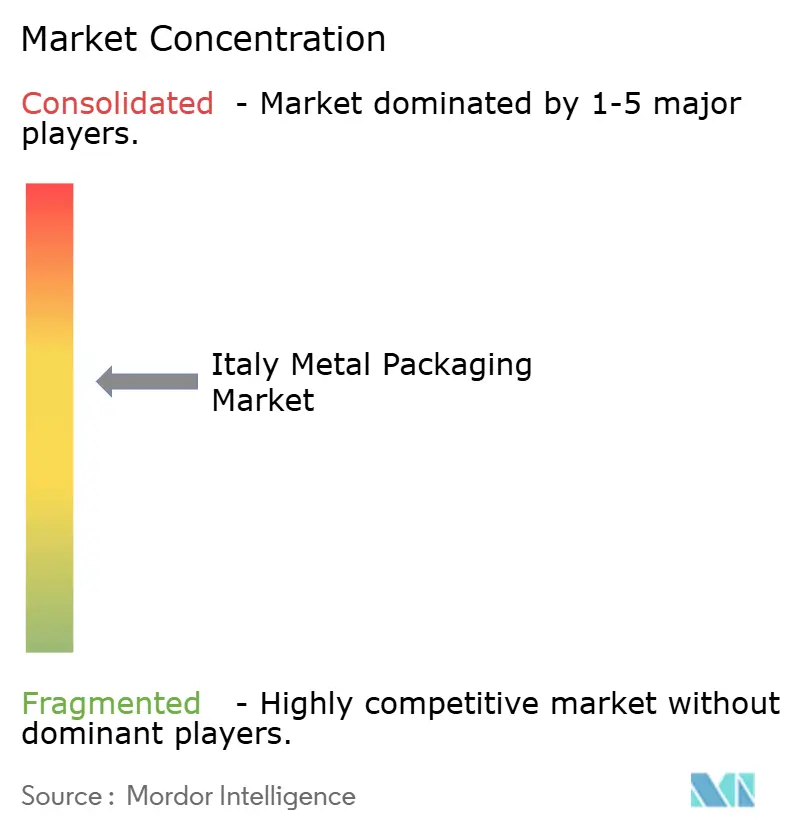
| Market Concentration | Medium |
Major Players *Disclaimer: Major Players sorted in no particular order Image © Mordor Intelligence. Reuse requires attribution under CC BY 4.0. | |
Italy Metal Packaging Market Analysis by Mordor Intelligence
The Italy metal packaging market size was valued at USD 5.27 billion in 2025 and estimated to grow from USD 5.52 billion in 2026 to reach USD 6.95 billion by 2031, at a CAGR of 4.72% during the forecast period (2026-2031). Sustained growth rests on the nation’s robust export-oriented food and beverage industries, tightening European recycling rules and steady adoption of advanced digital printing technologies. Aluminum keeps its dominance through lightweight, high-barrier performance, while steel gains momentum as industrial users seek durable bulk packaging. Domestic craft brewers and cosmetics producers encourage shorter production runs and premium decoration, allowing suppliers to charge higher margins. Simultaneously, raw material price swings and energy costs challenge competitiveness, pushing manufacturers toward secondary metal sourcing and energy-efficient processes.
Key Report Takeaways
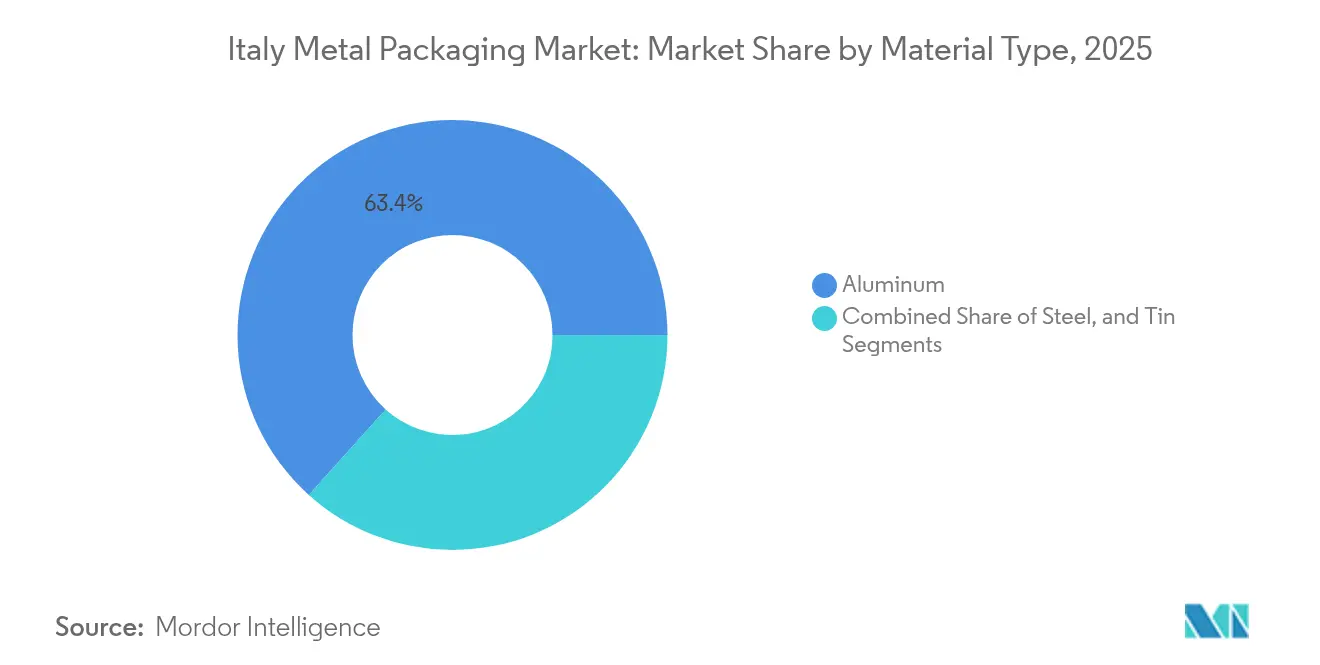
- By material type, aluminum commanded 63.35% of Italy metal packaging market share in 2025, whereas steel is projected to expand at a 5.63% CAGR through 2031.
- By product type, cans retained a 39.65% revenue share in 2025, while bulk containers are anticipated to grow at a 4.86% CAGR to 2031.
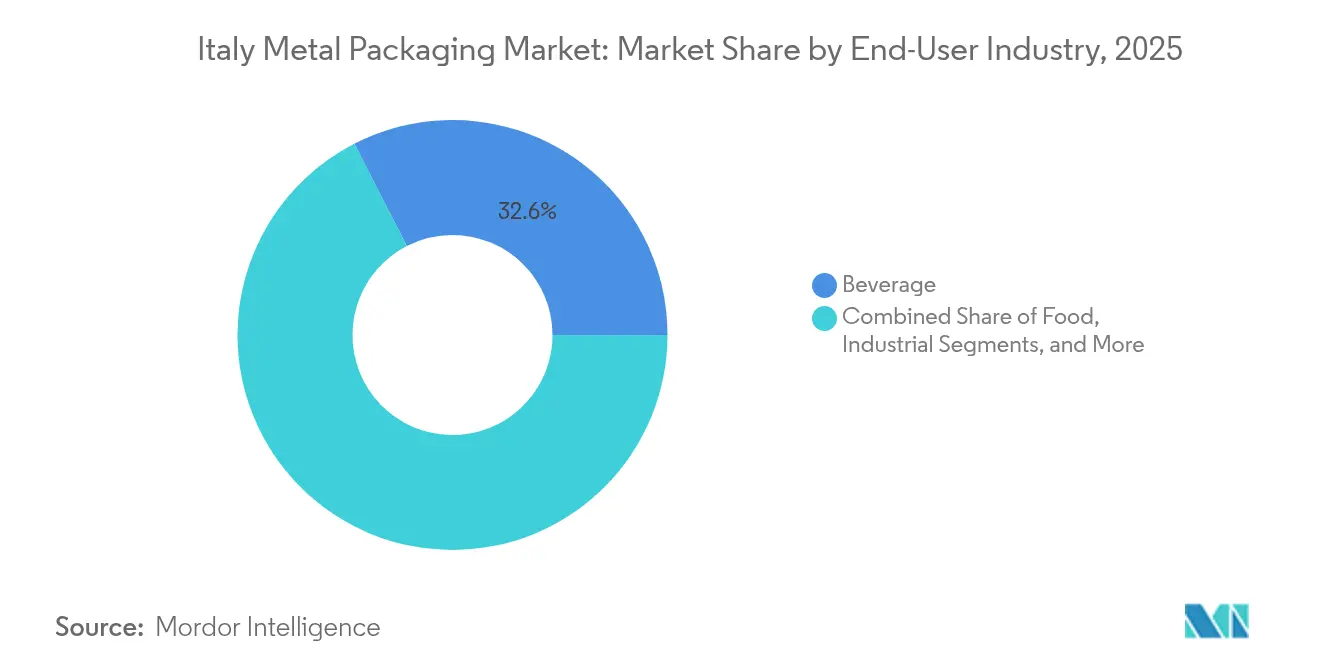
- By end-user industry, beverages led with 32.55% share of Italy metal packaging market size in 2025 and the industrial segment is advancing at a 5.55% CAGR through 2031.
- By coating type, epoxy phenolic accounted for 45.60% Italy metal packaging market share in 2025, whereas BPA-free systems are forecast to post a 5.78% CAGR to 2031.
Note: Market size and forecast figures in this report are generated using Mordor Intelligence’s proprietary estimation framework, updated with the latest available data and insights as of 2026.
Italy Metal Packaging Market Trends and Insights
Drivers Impact Analysis*
| Driver | (~) % Impact on CAGR Forecast | Geographic Relevance | Impact Timeline |
|---|---|---|---|
| Surge in Ready-to-Eat Food Consumption | +1.2% | National – Northern industrial corridors | Medium term (2-4 years) |
| Growing Craft Beverage Production in Italy | +0.9% | National – clusters in Lombardy, Veneto, Piedmont | Short term (≤ 2 years) |
| Mandatory EU Recycling Targets for Metal | +0.8% | EU-wide – compliance driven in Italy | Long term (≥ 4 years) |
| Rising Demand for Aerosol Personal-Care Products | +0.7% | National – export-oriented manufacturing | Medium term (2-4 years) |
| Advanced Digital Printing on Metal Packaging | +0.5% | Global – Italy technology adoption | Medium term (2-4 years) |
| Expansion of Italian Export-Oriented Gourmet Foods | +0.6% | National production – global distribution | Long term (≥ 4 years) |
| Source: Mordor Intelligence | |||
Surge in Ready-to-Eat Food Consumption
Ready-to-eat meals remain popular with urban households that value convenience and portion control. Frozen goods hit 1.02 million t and EUR 5.8 billion (USD 6.4 billion) turnover in 2024, while processed vegetable exports rose to EUR 2.5 billion (USD 2.7 billion). Metal cans ensure a long shelf life for these premium items, thereby protecting the brand's reputation in distant markets. E-commerce adds momentum because rigid cans withstand parcel handling better than flexible films. As Italian producers increasingly sell to regions with less-reliable logistics, barrier integrity becomes a non-negotiable purchase criterion. The trend also accelerates demand for smaller metal formats that suit single-person households.
Growing Craft Beverage Production in Italy
The country counted 1,326 craft breweries with 17.6 million hl output valued at EUR 10.2 billion (USD 11.2 billion) in 2024. Artisanal brewers overwhelmingly favor aluminum cans for light protection and shipping efficiency. Digital printing enables colorful graphics in low volumes, aligning with limited-edition releases. The craft spirits niche follows a similar path, placing small-batch gin or amaro in sleek metal bottles designed for export. Northern clusters benefit from proximity to can makers, shortening lead times. Because brand storytelling matters to independent brewers, suppliers offering rapid design changes gain a competitive edge.
Mandatory EU Recycling Targets for Metal
The Packaging and Packaging Waste Regulation pushes Italy toward a 90% metal recycling rate by 2030.[1]European Commission, “Packaging and Packaging Waste Regulation,” European Commission, ec.europa.eu Local recovery already stands near 85%, but meeting the goal calls for expanded collection schemes and eco-design adjustments such as lightweighting and mono-material structures. Infinite recyclability lets aluminum and steel outshine multilayer plastics in a circular economy narrative. Producers that integrate high post-consumer recycled content can access green financing incentives. The directive also tilts export competitiveness in favor of Italian suppliers who achieve compliance ahead of schedule, especially for premium food brands sold across Europe.
Rising Demand for Aerosol Personal-Care Products
Italian cosmetics revenue climbed to EUR 16.5 billion (USD 18.2 billion) in 2024 with exports near EUR 8.0 billion (USD 8.8 billion). Metal aerosol cans deliver controlled dispensing and long shelf life essential for high-end formulations. Lightweight aluminum reduces freight costs for Asia-bound shipments, boosting brand margins. Consumers also prefer metal because of higher recycling rates compared with plastic propellant containers. Technology upgrades in valves and actuators allow finer spray patterns, supporting premium positioning. Limited-run decorations, achievable via digital printing, further cement metal as the package of choice for luxury personal-care lines.
Restraints Impact Analysis*
| Restraint | (~) % Impact on CAGR Forecast | Geographic Relevance | Impact Timeline |
|---|---|---|---|
| Supply Volatility of Primary Aluminum | −0.8% | Global supply chains affecting Italian manufacturers | Short term (≤ 2 years) |
| Consumer Shift Toward Lightweight Plastics in Paints | −0.4% | National – industrial applications | Medium term (2-4 years) |
| Regulatory Uncertainty Around BPA Substitutes | −0.3% | EU-wide – Italy compliance requirements | Long term (≥ 4 years) |
| High Initial Capital for Metal Can Manufacturing | −0.5% | National – new market entrants | Long term (≥ 4 years) |
| Source: Mordor Intelligence | |||
Supply Volatility of Primary Aluminum
Primary aluminum prices swung 15-20% during 2024 amid energy shocks and geopolitical strains. Italy imports roughly 95% of its ingots, exposing converters to exchange-rate risk and freight surcharges. Although Hydro invested EUR 14.8 million (USD 16.3 million) to lift Atessa’s recycling capacity by 10,000 t yr⁻¹,[2]Hydro, “Hydro Invests EUR 14.8 Million in Atessa Recycling Facility,” Hydro, hydro.com food-grade scrap remains scarce. Producers hedge with long-term contracts yet still face margin compression. The volatility briefly prompts some buyers to consider steel or composite solutions for non-critical uses, tempering near-term growth in aluminum cans.
Consumer Shift Toward Lightweight Plastics in Paints
DIY paint buyers choose plastic pails for easy handling, cutting into metal demand in value ranges. While professional coatings still rely on steel for chemical resistance, mainstream emulsion paint makers increasingly offer polymer tubs that weigh less and lower logistics costs. Italian suppliers respond by designing thinner-wall steel cans fitted with ergonomic handles, attempting to retain share. Nevertheless, the convenience appeal of plastics in retail paint remains a headwind through the medium term.
*Our forecasts treat driver/restraint impacts as directional, not additive. The impact forecasts reflect baseline growth, mix effects, and variable interactions.
Segment Analysis
By Material Type: Aluminum Dominates as Steel Gains Industrial Traction
Aluminum held 63.35% Italy metal packaging market share in 2025, mirroring its entrenched role in beverages and shelf-stable foods. Steel, however, is poised for a 5.63% CAGR on the back of drum, pail, and IBC demand from automotive fluids, agrochemicals, and lubricants. Italy metal packaging market size, attributed to aluminum, is projected to approach USD 4.55 billion by 2031, while steel could surpass USD 2.05 billion. Aluminum’s growth stays tethered to increasing craft beer and energy drink production, but its high electricity intensity poses cost risks that favor closed-loop scrap systems. Steel benefits from Italy’s upstream coil capacity clustered around Lombardy, offering short lead times for industrial fillers.
Advanced coatings ensure both metals comply with EU food-contact regulations. BPA-free variants such as Accelshield 700 widen aluminum’s use in infant formula cans, whereas polyester-epoxy hybrids enable steel aerosol cans for solvent-heavy hair sprays. High recycled content targets-75% by 2030 for aluminum containers-encourage alloy optimization without sacrificing drawability. Simultaneously, lightweight steel designs using micro-alloying technologies lower gauge by up to 8%, helping industrial packers meet eco-tax thresholds. As procurement teams evaluate total cost of ownership, value propositions pivot on circularity credentials rather than upfront material price.


By Product Type: Bulk Containers Accelerate Beyond Core Can Formats
Cans retained 39.65% of the revenue in 2025 and remain the face of consumer-contact applications; yet, bulk containers are forecast to grow at a rate of 4.86% annually through 2031 as the export-heavy chemical and pharmaceutical industries scale. Within cans, sleek 250ml beverage formats are gaining favor among craft brewers seeking differentiation on crowded retail shelves. Meanwhile, Italy metal packaging market size generated by bulk containers could hit USD 1.14 billion by 2031, reflecting shifting industrial logistics. Rigid IBCs, tight-head drums, and large pails cater to the increasing volumes of lubricant blends associated with electric-vehicle part manufacturing.
Digital printing unlocks SKU proliferation for cans without prohibitive plate costs. Ball’s Dynamark platform, relaunched across EMEA, prints variable graphics at commercial speed, ideal for seasonal beer lines. Conversely, bulk container manufacturers focus on UN-certified designs, corrosion-resistant linings, and RFID tagging for supply chain transparency. Demand for aerosol cans also advances, buoyed by double-digit growth in sun-care sprays marketed to tourists in Southern Italy. Decorative tins for olive oil and confectionery maintain a small but stable niche, capitalizing on the nation’s gift-oriented gourmet culture.
By End-User Industry: Industrial Applications Emerge as Fastest Riser
Beverages represented 32.55% Italy metal packaging market share in 2025, yet the industrial segment’s 5.55% CAGR positions it as the leading growth engine. Automotive fluids, specialty chemicals, and process reagents lift orders for large-volume steel drums and pails. Italy’s manufacturing value added reached EUR 280 billion (USD 309 billion) in 2024, and industrial packagers increasingly specify tamper-proof closures and solvent-resistant linings. Italy metal packaging market size for industrial uses is likely to breach USD 1.64 billion by 2031.
Food remains a steady pillar, helped by rising exports of canned tomatoes, sauces, and legumes to North America and the Middle East. The pharmaceutical sub-segment leans on aluminum tubes and collapsible containers for topical ointments where sterility is paramount. Cosmetics, chasing premium positioning in Asia, order intricately decorated aerosols and metal jars that elevate shelf presence. As EU green deal policies reward circular packaging, metal’s recyclability strengthens procurement preferences across all sectors.
By Coating Type: BPA-Free Solutions Gain Speed Under Regulatory Spotlight
Epoxy phenolic systems delivered 45.60% revenue in 2025 owing to proven food safety and versatility, but BPA-free alternatives led growth at a 5.78% CAGR through 2031. Italy metal packaging industry moves swiftly to pre-empt future endocrine-disruptor restrictions. Italy metal packaging market size attributable to BPA-free coatings could approach USD 1.41 billion by 2031. Acrylic-silicone hybrids are favored in beverage ends that require flexibility, while waterborne polyesters help meet factory VOC caps.
R&D centers in Piedmont are working on tomato-pomace-derived resins that mimic traditional epoxy adhesion while eliminating bisphenol traces. Lighter coat weights save up to 1.5 g of metal per 330 ml can, trimming cost and carbon intensity. Coating suppliers train filler plants on line-speed adjustments necessary for new chemistries, ensuring seamless productivity. With the European Food Safety Authority poised to tighten specific migration limits, early adopters of validated BPA-free systems hold a marketing edge when exporting premium canned goods.
Geography Analysis
Northern Italy’s Lombardy, Veneto, and Piedmont account for nearly 70% of the country's production capacity, leveraging their proximity to automotive, chemical, and beverage hubs. These regions also host aluminum recyclers and coil coaters, creating a dense ecosystem of suppliers and technical laboratories. Central and Southern provinces contribute largely through agri-food processing, demanding robust cans for tomatoes, legumes, and seafood. Italy metal packaging market share tied to exports rose as food shipments reached EUR 47.4 billion (USD 52.1 billion) in 2024, underscoring packaging’s role in brand protection during maritime transit.
Cross-border logistics with Germany, France, and Switzerland provide a steady aftermarket for specialty drums and caps. Mediterranean sea lanes open routes to North Africa and the Middle East, where Italian olive oil and confectionery packed in decorative tins resonate with gift-giving traditions. Government incentives under the National Recovery and Resilience Plan channel EUR 2.1 billion (USD 2.3 billion) into recycling infrastructure and deposit-return pilots, further tipping the scales toward metal containers. Yet, elevated electricity prices relative to Scandinavia pressure electrolytic facilities, prompting renewed investments in rooftop solar at can plants in Emilia-Romagna.
Digital printing hubs in Veneto collaborate with German machinery builders, reinforcing Northern clusters as innovation testbeds. Meanwhile, small converters in Apulia focus on short-run tins for regional olive growers. The geographic dispersion cushions Italy metal packaging market from sector-specific downturns, enhancing resilience.
Regulatory Landscape
Italy regulates metal packaging primarily through the Environmental Consolidated Act, Legislative Decree No 152/2006 (as amended by Legislative Decree No 116/2020 and Decree No 213/2022), which sets out producer obligations for packaging waste management and related reporting. Under Article 219(5), environmental labeling is mandatory for all packaging placed on the Italian market, including identification of material composition based on Commission Decision 97/129/EC. The Ministry of Environment and Energy Security (MASE), in coordination with CONAI, issues operational guidance for compliant labeling.
At the EU level, the Packaging and Packaging Waste Regulation (PPWR) introduces harmonized recyclability criteria and high-quality recycling requirements, with implementation timelines referenced from August 2026 and national provisions continuing during the transition period (notably through at least August 2028). Extended Producer Responsibility is embedded in the regulatory setup, and the deadline for Member States to have EPR schemes established for all packaging is tied to 31 December 2024 in the amended framework of Directive 94/62/EC, reinforcing compliance pressure on Italian fillers and metal packaging converters serving food, beverage, and personal care value chains.
Value Chain Analysis
Italy's metal packaging value chain begins with upstream aluminum and steel supply, including secondary metal streams, and moves through coil or ingot processing, can and end manufacturing, coatings and decoration, and then to filling and brand owners across food, beverage, personal care aerosols, and industrial chemicals. Large converters and canmakers such as Ardagh, Ball, and Crown, along with closures specialists including Silgan, supply domestic fillers and exporters, while short-run and specialty formats are handled by local players serving niches like tins, closures, and premium decoration.
Downstream, compliance and circularity requirements guide operational handoffs. Italy's packaging system follows shared responsibility principles, with CONAI coordinating data collection and reporting flows to track recycling and recovery performance across operators. This structure links design choices, including material identification, mono-material solutions, and labeling, to collection and recycling outcomes, increasing the value of high-quality secondary raw material sourcing and traceable recovery streams for permanent materials like aluminum and steel.
Competitive Landscape
The landscape is moderately consolidated, with the top three multinationals plus two domestic specialists capturing roughly 50% of national revenue. Ardagh Metal Packaging operates two high-speed beverage can lines, integrated with on-site end production, which secures economies of scale. Ball Corporation exploits its Dynamark platform to serve craft brewers seeking distinctive designs without large inventories. Crown Holdings differentiates through lightweight DWI technology suited to energy drinks exported across Europe.
Italian champions Gruppo ASA and Tecnocap excel in custom tins and metal closures for gourmet and personal care brands. Recent M&A shows a pivot to higher-margin niches: Omnia Technologies spent EUR 280 million (USD 309 million) assembling a beverage equipment powerhouse that now cross-sells filling and labeling systems to canners. Trivium Packaging Italy specializes in metal bottles for premium spirits, utilizing proprietary shaping methods.
Players race to decarbonize. Joint procurement of renewable electricity and trials of hydrogen-fired furnaces aim to cut scope 1 emissions 30% by 2028. Collaboration with coating suppliers on water-based chemistries enables quicker line changeovers, supporting short-run business models. Given these dynamics, market power rests with firms balancing global scale and local agility.
Italy Metal Packaging Industry Leaders
Ardagh Metal Packaging Italy S.r.l.
Ball Beverage Packaging Italia S.r.l.
Crown Packaging Manufacturing UK Limited – Italian Operations
Silgan Holdings Inc.
Gruppo ASA S.p.A.
- *Disclaimer: Major Players sorted in no particular order

Market Opportunities and Future Outlook
Regulatory-driven circularity is creating opportunities for suppliers that can pair compliant packaging design with verified recycling performance. The PPWR timetable (referenced from August 2026) and Italy's environmental labeling requirements under MASE and CONAI guidance raise demand for packaging formats that are straightforward to sort and recycle, and for converters that can document material composition and end-of-life pathways. Deposit-return pilots and circular-economy funding in Italy also support programs aimed at improving can capture and feeding higher-quality scrap back into domestic supply chains.
Operational efficiency and decoration technology remain another opportunity area, particularly for beverage and personal care brands running more SKUs and seasonal promotions. Examples already visible in the market include Crown's work on high-quality print executions for promotional aluminum cans produced in Italy (Parma), and leading multinational canmakers emphasizing cost pass-through mechanisms and efficiency to navigate input-cost volatility. Given Italy's reliance on imported primary aluminum, investments and partnerships that expand reliable secondary metal availability and reduce energy intensity in canmaking and coating lines support competitiveness while meeting customer requirements for recycled content and premium shelf impact.
Recent Industry Developments
- April 2026: Ardagh Metal Packaging S.A. reaffirmed full year 2026 Adjusted EBITDA guidance of $750 to $775 million, citing contractual cost pass-through and moderate shipments growth. The update reinforces profitability expectations amid commodity volatility, guiding pricing and investment decisions in the Italy metal packaging segment.
- February 2026: Crown Holdings (Italy operations) announced a $550 million capital expenditure plan for 2026 supporting international expansions and upgrades, with no new capacity in North America. The plan shifts European focus toward efficiency and digital and inspection upgrades, reshaping competitive dynamics in Italy's packaging landscape.
- June 2025: Italian metal packaging makers (collective; specific firms not disclosed in detail) sustainability investments totaling EUR 450 million through 2027. The investments support decarbonization efforts and regulatory compliance in Italy, with potential to affect cost structures and technology adoption in the domestic market.


Research Methodology Framework and Report Scope
Market Definition and Coverage
For this methodology, the market covers the value of metal-based packaging sold into Italy for protecting, shipping, and selling products, where the pack is primarily made of metal and is used by commercial end users.
Scope exclusions: We exclude non-metal packaging formats, decorative metal goods that are not used as packaging, and internal returnable logistics assets that are not sold as packaging units.
Segmentation Overview
- By Material Type
- Aluminum
- Steel
- Tin
- By Product Type
- Cans
- Food Cans
- Beverage Cans
- Aerosol Cans
- Decorative Cans
- Bulk Containers
- Drums and Barrels
- Caps and Closures
- Other Product Types
- Cans
- By End-User Industry
- Food
- Beverage
- Paints, Coatings and Chemicals
- Pharmaceuticals and Healthcare
- Industrial
- Other End-user Industries
- By Coating Type
- Epoxy Phenolic
- Acrylic
- Polyester
- BPA-Free Alternatives
- Other Coating Types
Data Sources, Market Sizing, and Validation
Desk Research
Desk research was used to set the market boundaries, build a clean timeline, and anchor the model to observable Italy demand signals before assumptions were added. Public sources, such as Eurostat trade and industrial production series, the Italian National Institute of Statistics (ISTAT), European Commission packaging policy documents, and CONAI recycling and packaging publications, helped check directionality and recent inflections.
In parallel, we reviewed company annual reports, investor presentations, and press releases to understand capacity moves, pricing commentary, and where demand was strongest across food, beverage, and industrial uses. We also scanned patent and journal literature to judge the pace of coating changes, including BPA-free shifts, since these can affect average selling price and mix. Paid subscriptions were used selectively for structured company financials and for patent lookups when public records were fragmented. The sources listed here are illustrative, and many other references were used for data collection, validation, and clarification during the study.
Primary Interviews and Surveys
Primary inputs came from interviews and surveys with packaging converters, material suppliers, distributors, and large end users that purchase cans, closures, and industrial formats. These discussions were used to close gaps on realized pricing, mix shifts between aluminum and steel, utilization swings, and the timing of demand from food and beverage customers, then to stress-test the desk-based assumptions against what buyers and converters reported for Italy.
Distribution of primary research fieldwork respondents
| Company type | Respondent position |
|---|---|
| Top tier: 25% | CXOs: 12% |
| Mid tier: 59% | Functional/Unit leaders: 43% |
| Smaller Players: 16% | Managers: 45% |
Market-Sizing & Forecasting
Market sizing used a top-down and bottom-up combination, where the top-down view was reconstructed from Italy packaging demand pools and trade and production indicators, then validated through selective supplier and channel checks. Practically, we started from metal packaging consumption linked to key end uses and mapped it back to product formats that have distinct pricing and unit economics.
A few inputs drove the model: beverage can demand tied to drink output and seasonality, food can usage linked to processed food volumes, closures and caps demand aligned with glass and beverage filling lines, and industrial drums and bulk containers tied to chemical and industrial activity. Mix was further adjusted using signals on aluminum versus steel substitution, recycled-content adoption, and coating transitions that can move pricing even when unit volumes are stable. For forecasting, scenario analysis was applied so the base case could flex with raw material cost direction, recycling and compliance momentum, and end-market output expectations that were repeatedly revised in primary discussions.
Where bottom-up data was incomplete, gaps were handled with conservative penetration and share assumptions, kept only when they also matched the demand-side indicators. Totals were then tuned using sampled ASP (average selling price) times volume checks by format, which helped avoid over-counting when the same packaging is traded and converted within Italy.
Data Validation & Update Cycle
Validation was done in steps so that each assumption had at least one independent check before it shaped the final market value. We compared outputs against import-export direction, industrial production movements, and end-user output signals, then flagged outliers for follow-up before finalizing numbers.
When a major variance was found, the model was re-run with revised pricing or mix inputs, and respondents were re-contacted if the change could not be explained by public indicators. The report is refreshed annually, with interim updates when material events occur, such as sharp metal price changes, regulatory steps, or notable capacity shifts. Before delivery, a final analyst pass is completed so clients receive an updated view aligned to the latest available data cut.
Mordor Intelligence's Italy Metal Packaging Market Size Compared With Other Published Estimates
Published market sizes for Italy metal packaging can differ even when multiple studies are trying to measure the same industry, because exchange-rate timing, the price logic used for cans versus closures, and the point at which packaging is counted in the value chain do not align across sources.
In our work, refresh timing is treated as a real driver, because metal input costs and contract resets can shift average selling prices within a year, and that changes the value total even if volumes stay steady. This discipline is applied by Mordor Intelligence.
Benchmark comparison
| Source | Market Size | Gaps in Research Methodology |
|---|---|---|
| Mordor Intelligence | USD 5.27 B (2025) | |
| Industry Association A | USD 4.90 B (2025) | Often reflects producer-side revenue reported in local currency and may apply a single price level across formats, which can understate premium decorated cans and higher-value closures in a mixed market. |
| Trade Journal B | USD 5.85 B (2025) | May include adjacent metal components and broader packaging services, and can assume faster ASP pass-through from metal prices without validating lags from annual contracts and customer renegotiations. |
The spread in published values is mainly explained by how quickly prices are updated, which parts of the packaging chain are included, and whether mix is modeled by format rather than averaged. By keeping steps traceable to demand signals and by checking ASP timing against what buyers and converters report, the final number stays practical for planning and can be repeated with the same inputs next year.


Key Questions Answered in the Report
How large is the Italy metal packaging market in 2026?
The market is valued at USD 5.52 billion and is projected to reach USD 6.95 billion by 2031 at a 4.72% CAGR.
Which material leads demand in Italian metal packaging?
Aluminum dominates with 63.35% share in 2025, favored for lightweight beverage and food applications.
What sector will drive future growth beyond food and beverages?
Industrial applications such as chemicals, lubricants and automotive fluids are forecast to grow at 5.55% CAGR through 2031.
Why are BPA-free coatings gaining momentum in Italy?
EU rules and consumer preferences push converters toward BPA-free chemistries, growing this coating segment at 5.78% CAGR.
How are EU recycling targets influencing Italian converters?
PPWR mandates 90% metal recycling by 2030, prompting investments in lightweight design and high recycled content packages.
Which companies lead the competitive landscape?
Global majors Ardagh, Ball and Crown plus domestic specialists Gruppo ASA and Tecnocap collectively hold about 50% share.
Page last updated on:


 Your data is secure and never sold or shared.


