
Market Overview
| Study Period | 2020 - 2031 |
|---|---|
| Forecast Data Period | 2026 - 2031 |
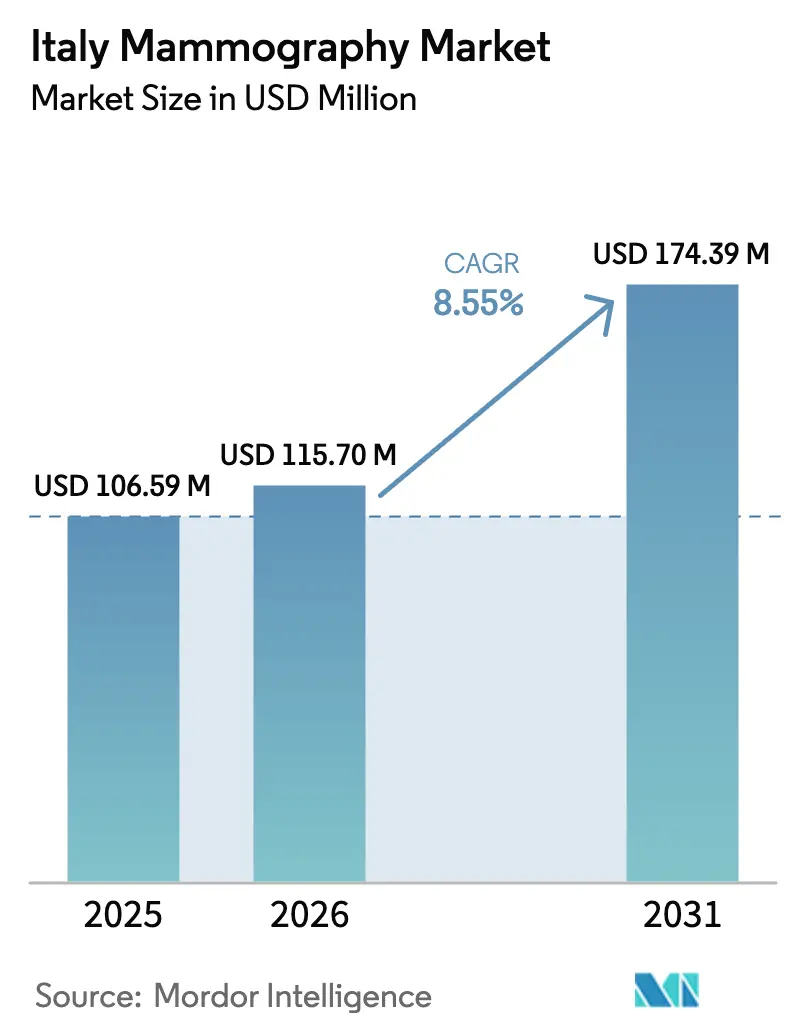
| Base Year Market Size (2025) | USD 106.59 Million |
| Market Size (2026) | USD 115.7 Million |
| Market Size (2031) | USD 174.39 Million |
| Growth Rate (2026 - 2031) | 8.55 % |
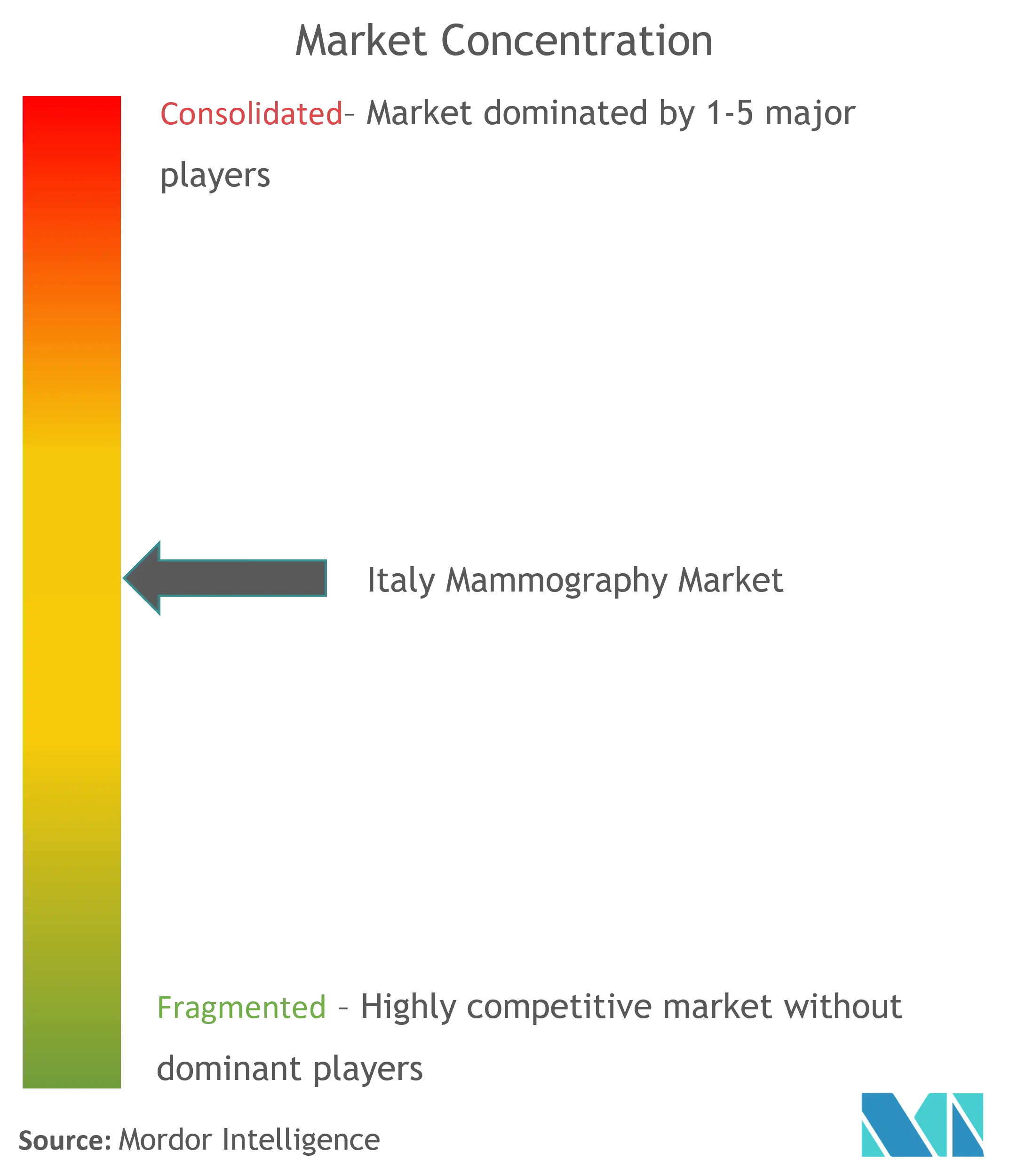
| Market Concentration | Medium |
Major Players *Disclaimer: Major Players sorted in no particular order Image © Mordor Intelligence. Reuse requires attribution under CC BY 4.0. | |
Italy Mammography Market Analysis by Mordor Intelligence
The Italy Mammography Market size was valued at USD 106.59 million in 2025 and estimated to grow from USD 115.7 million in 2026 to reach USD 174.39 million by 2031, at a CAGR of 8.55% during the forecast period (2026-2031). Growth reflects deepening demand for early-stage breast-cancer detection, accelerated equipment replacement cycles funded by the National Recovery and Resilience Plan (PNRR), and rapid adoption of AI-ready digital platforms. Escalating incidence—55,900 new cases in 2024—sustains screening volumes, while personalized risk-stratified protocols expand the addressable population. Competitive pressure centers on integrated hardware-software offerings, with multinationals and local manufacturers intensifying product differentiation through multimodal imaging, ergonomic designs, and embedded analytics. Decentralized care models and rising private reimbursement spur new opportunities for diagnostic centers, mobile units, and tele-radiology services, collectively reshaping provider economics and patient pathways.
Key Report Takeaways
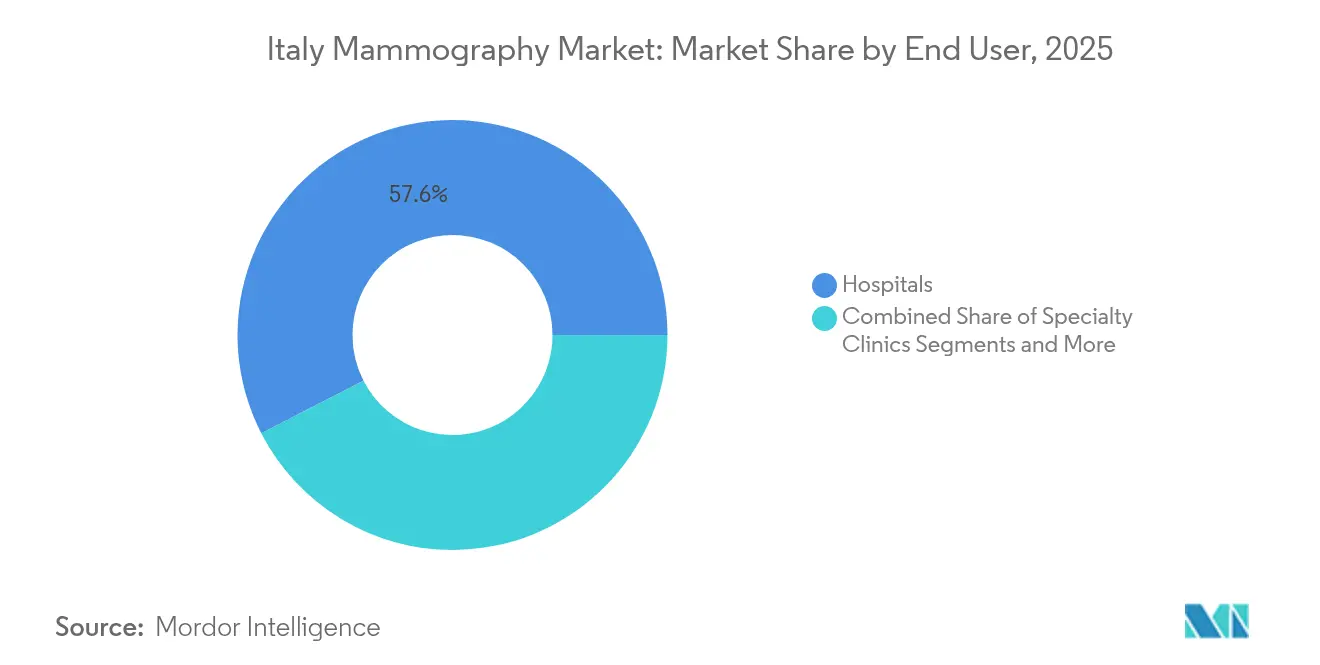
- By product type, Digital Systems led with 61.84% of Italy mammography market share in 2025; Breast Tomosynthesis is set to expand at a 8.98% CAGR to 2031.
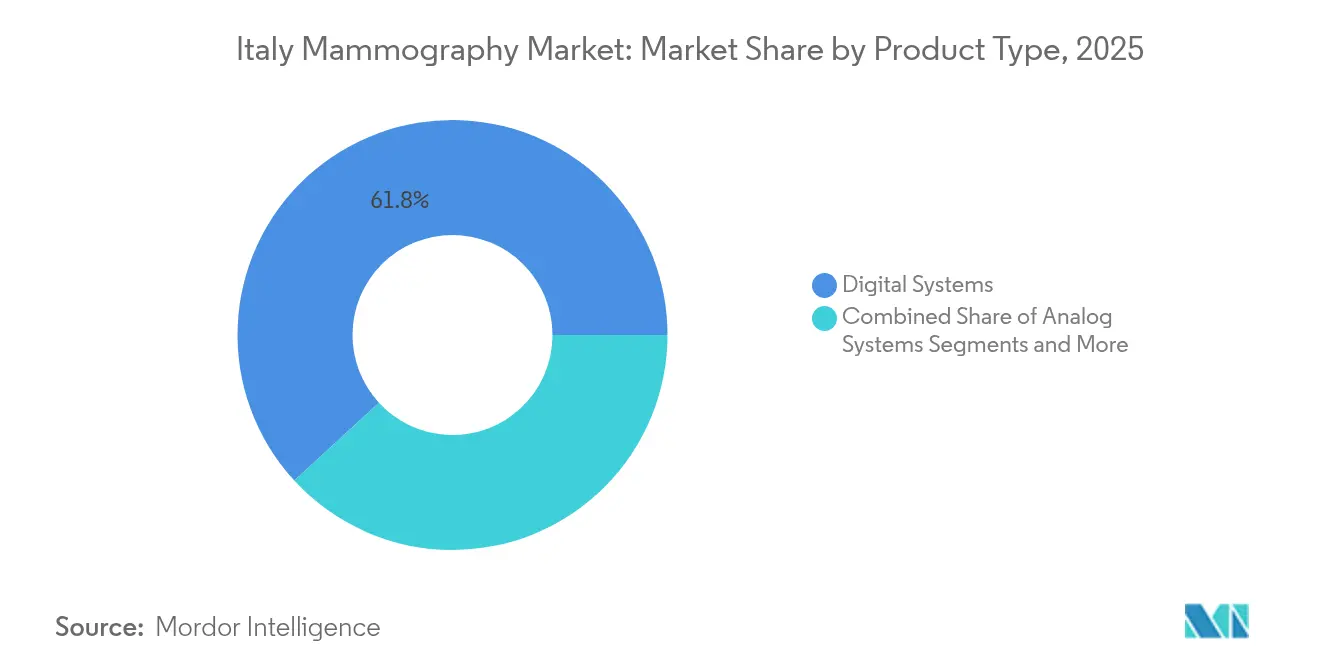
- By end user, hospitals accounted for 57.55% share of the Italy mammography market size in 2025, while diagnostic centers are advancing at a 9.05% CAGR through 2031.
Note: Market size and forecast figures in this report are generated using Mordor Intelligence’s proprietary estimation framework, updated with the latest available data and insights as of 2026.
Italy Mammography Market Trends and Insights
Drivers Impact Analysis*
| Driver | (~) % Impact on CAGR Forecast | Geographic Relevance | Impact Timeline |
|---|---|---|---|
| Growing Burden Of Breast Cancer Cases | +2.1% | National, with higher impact in Northern and Central Italy | Long term (≥ 4 years) |
| Technological Advancements | +1.8% | National, concentrated in major healthcare centers | Medium term (2-4 years) |
| Increasing Funding In Hospitals | +1.5% | National, with PNRR focus on underserved regions | Medium term (2-4 years) |
| Government-Funded National Screening Programs | +1.3% | National, with expansion to age groups 45-49 and 70-74 | Long term (≥ 4 years) |
| Expansion Of Mobile Mammography Units In Rural Italy | +0.9% | Southern Italy and rural areas | Short term (≤ 2 years) |
| Fast-Track Reimbursement For Genomic Screening Tests | +0.7% | National, with early adoption in Northern regions | Medium term (2-4 years) |
| Source: Mordor Intelligence | |||
Growing Burden of Breast Cancer Cases
Italy records 55,900 new breast-cancer diagnoses each year, and lifetime risk now stands at 1 in 8 women [1]. Early-stage detection offers 88% five-year survival, driving sustained utilization of the Italy mammography market. Incidence is higher in the North, yet better screening adherence keeps metastatic presentation at 5.1% versus 7.8% in the South. Ageing demographics intensify demand, as risk rises sharply after 50. Regional cancer registries underscore the urgency of structured screening to curb late presentation and trim treatment costs. The demographic and epidemiological realities translate into predictable equipment replacement cycles and consistent scan volumes across public and private sectors.
Technological Advancements
Digital breast tomosynthesis paired with synthetic 2-D reconstructions doubles detection rates versus conventional 2-D systems—8.1/1,000 versus 4.5/1,000 in the Verona Pilot Study. AI algorithms now surpass 90% sensitivity compared with 70-80% for manual reads. Hologic’s Genius AI Detection and GE HealthCare’s SmartMammo rolled out nationwide during 2024, while Campania’s Synergy-Net couples AI with 3-D tomosynthesis to enhance dense-breast assessment. Equipment vendors embed algorithms on-board, reducing latency and easing compliance with EU Medical Device Regulation (MDR) quality standards. These advances catalyze the transition from analog fleets and underpin the Italy mammography market’s digital premium.
Increasing Funding in Hospitals
The PNRR allocates EUR 15.63 billion to healthcare, including EUR 2.8 billion for hospital digitalization and 2,500 large medical devices. Marche completed full installation of new mammography units under Mission 6 by mid-2025. Overall digital-health spend rose 22% to EUR 2.2 billion in 2023. Upfront capital support accelerates replacement of legacy analog systems and drives bulk procurement of AI-ready platforms. Parallel expansions in private health-fund coverage and tariff revisions improve provider cash flows, reinforcing market momentum.
Government-Funded National Screening Programs
Italy’s organized program covers women aged 50-69 every two years, achieving 57.3% participation and detecting 6,537 invasive cancers in the most recent cycle. Regions now trial extensions to 45-49 and 70-74 age bands; Lombardy already implemented coverage from 45-74. The multicenter 60,000-participant study on optimal intervals will set future evidence-based cadence. Expansion addresses an estimated 2 million currently underserved women, reinforcing scan volumes for the Italy mammography market over the long term.
Expansion of Mobile Mammography Units in Rural Italy
Mobile fleets meet 40% of screening demand in certain southern provinces, bridging infrastructure gaps while cutting patient travel. Tuscany’s model saved EUR 95,000 and 35 tons of CO₂ per 59,000 inhabitants screened. PNRR prioritizes rural rollouts, and the Senologia al Centro initiative offers free prevention via mobile units. Vendors, notably IMS Giotto and Metaltronica, design compact, low-power devices to capture this emerging sub-segment of the Italy mammography market.
Fast-Track Reimbursement for Genomic Screening Tests
2024 reforms sped reimbursement for breast-cancer genomic panels, bolstering demand for comprehensive imaging-plus-biomarker pathways. Northern regions lead early adoption, bundling AI triage with molecular profiling to refine risk stratification. Integrated care models incentivize providers to invest in higher-spec mammography systems that support contrast enhancement and AI analytics, further enlarging the Italy mammography market opportunity.
Restraints Impact Analysis*
| Restraint | (~) % Impact on CAGR Forecast | Geographic Relevance | Impact Timeline |
|---|---|---|---|
| Radiation-Exposure Concerns Limiting Repeat Screening | -1.2% | National, with higher impact among educated populations | Long term (≥ 4 years) |
| Declining Reimbursement Tariffs For Mammography | -1.5% | National, with greater impact on private providers | Medium term (2-4 years) |
| Regional Workforce Shortages In Breast Imaging | -1.8% | Southern Italy and rural areas | Medium term (2-4 years) |
| EU Green-Equipment Mandates Raising Capex | -0.9% | National, concentrated in major healthcare centers | Short term (≤ 2 years) |
| Source: Mordor Intelligence | |||
Radiation-Exposure Concerns Limiting Repeat Screening
Educated women in Turin show lower adherence due to heightened radiation worries despite superior awareness. Tomosynthesis delivers higher doses than 2-D imaging but remains within EU safety thresholds[2]. AIRC emphasizes that benefits outweigh risks, yet communication gaps persist. Providers increasingly offer contrast-enhanced or low-dose protocols and deploy decision aids to reassure patients. Mitigating this restraint is pivotal for sustaining participation rates central to Italy mammography market growth.
Regional Workforce Shortages in Breast Imaging
Northern hospitals report 18.4% of staff on work restrictions; 56.1% involve nurses with mobility limits, squeezing mammography throughput. Radiologist scarcity is acute in the South, elongating wait lists and curbing program efficacy. AI support trims reading time by up to 91%, partially easing deficits. Mobile units and tele-radiology add capacity, but only 35% of specialists currently exploit telehealth fully, signaling a lingering operational constraint on the Italy mammography market.
*Our forecasts treat driver/restraint impacts as directional, not additive. The impact forecasts reflect baseline growth, mix effects, and variable interactions.
Segment Analysis
By Product Type: Digital Systems Drive Market Transformation
Digital Systems held 61.84% of Italy mammography market share in 2025, benefitting from PNRR-funded upgrades and embedded AI capabilities. Users cite sharper image resolution, lower repeat rates, and seamless integration with RIS/PACS. Analog fleets persist in cash-constrained rural settings but face accelerated obsolescence. EU MDR deadlines intensify digital adoption, shaping procurement preferences through 2031.
Breast Tomosynthesis contributes a 8.98% CAGR, buoyed by compelling evidence of superior detection in dense tissue. Hospitals spearhead uptake to enhance clinical accuracy, while diagnostic centers leverage tomosynthesis for competitive differentiation. Vendors integrate AI to automate lesion characterization, thereby expanding use cases and unlocking premium service tariffs tied to Italy mammography market size for advanced modalities. Multimodal innovations, such as Metaltronica’s Cybele platform that adds ultrasound and densitometry, illustrate convergence trends influencing future demand curves.

By End User: Hospitals Maintain Leadership While Diagnostic Centers Accelerate
Hospitals retained 57.55% share of the Italy mammography market size in 2025 owing to comprehensive oncology pathways and access to PNRR grants covering 2,500 devices. Their multidisciplinary environment facilitates rapid adoption of contrast-enhanced and AI-supported protocols, reinforcing leadership.
Diagnostic centers post the fastest 9.05% CAGR, powered by agile workflows and consumer preference for shorter waits. The December 2024 nomenclatore tariffario harmonized reimbursement, allowing stand-alone centers to price competitively. Partnerships such as Affidea-ScreenPoint enable AI deployment at scale. Mobile screening units complement brick-and-mortar facilities, penetrating rural markets and supporting risk-stratified screening initiatives, thereby broadening the Italy mammography market footprint among infrastructurally underserved populations.
Geography Analysis
Northern regions account for the bulk of Italy mammography market demand, boasting 90% screening adherence and earlier cancer detection. Robust hospital networks and higher disposable income underpin digital-system penetration. Metastatic presentation sits at 5.1% of cases, reflecting program effectiveness. Procurement trends favor AI-ready tomosynthesis, and private insurers aggressively reimburse advanced imaging, strengthening revenue visibility for vendors.
Central Italy shows mid-level uptake but pockets of rural shortfalls. Tuscany’s mobile initiatives trimmed travel expenditure by EUR 95,000 and carbon output by 35 tons, proving scalable for other provinces. Regional authorities integrate tele-radiology to extend subspecialist access, while Auxologico’s cross-regional presence in Lombardy and Piedmont showcases private-sector contribution to consistent service delivery.
Southern regions and islands trail with 60% adherence and 7.8% metastatic rates. PNRR funding prioritizes device deployment and 480 territorial operational centers to bolster primary care interfaces. Mobile fleets and public–private partnerships promise catch-up growth, positioning the South as the fastest-expanding sub-market within the overall Italy mammography market through 2031.
Regulatory Landscape
Mammography systems marketed in Italy fall under the EU Medical Device Regulation (MDR 2017/745), which requires CE marking and conformity assessment aligned to the applicable risk class, with national alignment reinforced through Italy Legislative Decrees No. 137/2022 and No. 138/2022. Beyond EU requirements, devices must be registered in the Italian Ministry of Health medical-device database (BD/RDM) before commercial placement, shaping launch sequencing, label and IFU localization, and post-market traceability obligations.
For extra-EU imports, Ministry of Health border and market surveillance activities (including USMAF checks) add a compliance step that affects distributor selection and documentation readiness. On the demand side, public procurement under PNRR Mission 6 has been channeled through centralized purchasing mechanisms, including Consip framework contracting for tomosynthesis-capable mammographs, which standardizes technical specifications and quality expectations across public buyers.
Value Chain Analysis
The Italy mammography value chain begins with global and domestic OEMs supplying digital mammography and tomosynthesis platforms, followed by Italian subsidiaries and distributors that handle installation, training, and lifecycle service. Market access depends on MDR compliance (CE marking) and national device registration in the Ministry of Health BD/RDM, while extra-EU import flows face additional oversight through Ministry of Health surveillance pathways.
Demand creation and purchasing are heavily influenced by public-sector tendering. Consip acts as a central procurement coordinator for major equipment buys and helps translate clinical requirements into standardized lots, with input from professional bodies such as SIRM and AIFM for technical expectations. Downstream, hospitals, diagnostic centers, and mobile screening operators depend on vendor field service, calibration, and Italian-language applications to sustain uptime and meet tender eligibility criteria, which elevates local service networks alongside hardware performance and software integration with RIS/PACS.
Competitive Landscape
Italy mammography market competition is moderately fragmented. Hologic, GE HealthCare, and Siemens Healthineers anchor share through wide portfolios, service contracts, and MDR-compliant pipelines. AI-centric specialists—ScreenPoint Medical, Lunit, iCAD—win hospital trials via superior algorithm sensitivity, often supplied as vendor-neutral plug-ins. Domestic firms IMS Giotto and Metaltronica leverage localized support and region-specific tenders; the latter’s Cybele multimodal release at ECR 2024 strengthens its niche.
Strategic collaborations dictate differentiation. Hologic’s alliance with Bayer delivers turnkey contrast-enhanced packages aligning imaging and injectable workflows. iCAD partnered with Koios to integrate multimodality AI, bridging mammography and ultrasound. Vendors increasingly bundle cloud analytics, software-as-a-service licenses, and flexible financing to align with PNRR procurement cycles, shaping future dynamics of the Italy mammography market.
Barriers stem from MDR certification costs and EU green-procurement directives that demand energy-efficient equipment, favoring capital-strong incumbents. Nonetheless, AI-software providers with lighter regulatory loads can scale rapidly via OEM integrations, injecting competitive tension across tiers.
Italy Mammography Industry Leaders
-
Koninklijke Philips NV
-
Fujifilm Holdings Corporation
-
Siemens Healthineers AG
-
Carestream Health Inc.
-
GE Healthcare
- *Disclaimer: Major Players sorted in no particular order
Market Opportunities and Future Outlook
PNRR-backed modernization continues to create whitespace for suppliers that can deliver tender-ready packages across tomosynthesis hardware, deployment services, and IT integration. A concrete lever is the Consip framework, which makes more than 170 tomosynthesis mammographs available for public administrations using PNRR funds, a setup that favors vendors with established local service coverage and the capability to meet standardized technical specifications.
Clinical workflow needs are also moving buyers toward higher-value configurations that combine advanced acquisition with decision support and interventional capability. Buyers increasingly specify features such as contrast-enhanced mammography (CEM) and biopsy-guided tomosynthesis, and regional hubs in Lombardy and Veneto show interest in higher-resolution digital detectors for early microcalcification detection, supporting premium upgrades beyond basic 2D replacement. In parallel, expansion of screening access through mobile units and tele-radiology points to opportunity in compact, lower-power systems and software layers designed to streamline reading and QA across distributed sites.
Recent Industry Developments
- July 2026: Health Triage S.p.A. completes a capital increase of 3 million euros from Vertis SGR and Health 1 to accelerate clinical adoption of BreastNegative AI screening triage system. The funding milestone accelerates clinical deployment of AI driven screening and triage in population health programs. The capital inflow strengthens domestic AI capabilities and supports scale in radiology workflows across Italy.
- December 2025: Philips released IM v15.1.0.0 in Italy for mammography workflows. The update enhances Italy mammography software usability and workflow efficiency. It strengthens Italy market support for AI enabled workflow enhancements and dose management features.
- July 2025: Philips IntelliSpace Radiology 4.7 documentation released, detailing mammography workstation requirements. The documentation improves mammography workflow interoperability with PACS and readers. It advances integrated imaging architecture aligned with Italian procurement cycles and hospital IT upgrades.
Research Methodology Framework and Report Scope
Market Definition and Coverage
For this study, the market covers mammography systems and related platform value sold and installed for breast imaging in Italy, across public and private care settings. It is measured as revenue generated from equipment and system upgrades used for screening and diagnostic mammography.
Scope exclusions: We exclude breast ultrasound, breast MRI, biopsy devices, general radiography systems, and standalone reading software that is not sold as part of a mammography system solution.
Segmentation Overview
- By Product Type
- Digital Systems
- Analog Systems
- Breast Tomosynthesis
- Other Product Types
- By End User
- Hospitals
- Specialty Clinics
- Diagnostic Centers
- Mobile Screening Units
Data Sources, Market Sizing, and Validation
Desk Research
Desk work starts with aligning the market boundary to how mammography is planned, funded, and delivered in Italy, since screening volumes and replacement cycles drive demand more than simple population counts. We refer to public health and statistics sources such as the Italian Ministry of Health publications, Istituto Superiore di Sanita updates, ISTAT demographic tables, and OECD health indicators to anchor the eligible screening population and aging trends. We also cross-check breast cancer burden and screening program signals using sources such as IARC and peer reviewed clinical literature.
To translate demand signals into an equipment value model, we review hospital procurement notes, regional tender announcements, and publicly available reimbursement and service guidance where it is disclosed. Company annual reports, investor decks, and product documentation are used to understand technology shifts like digital adoption and tomosynthesis attachment rates. Where available through subscription access, we also used a paid dataset for company financials and a paid database for tenders and contract tracking to validate procurement timing and major refresh waves. These desk sources are not exhaustive, and we used other public documents and references to clarify assumptions and validate calculations.
Primary Interviews and Surveys
Primary work focused on confirming what gets purchased and replaced in Italian facilities, and how quickly digital and tomosynthesis upgrades are being adopted in different regions. We spoke with clinical users and operational buyers in hospitals, diagnostic centers, and specialty clinics, and then checked pricing logic and service mix with supply side experts to close gaps left by desk sources.
Distribution of primary research fieldwork respondents
| Company type | Respondent position |
|---|---|
| Top tier: 28% | CXOs: 15% |
| Mid tier: 54% | Functional/Unit leaders: 34% |
| Smaller Players: 18% | Managers: 51% |
Market-Sizing & Forecasting
Sizing is built using both top-down and bottom-up checks, so the final number stays tied to realistic procedure demand and to how equipment is purchased. The top-down build starts from the Italy screening eligible cohort and expected participation, which is then converted into annual exam volumes and translated into required system capacity using practical throughput assumptions and utilization ranges. Once the implied installed base is formed, replacement timing is applied, and then new placements are added where capacity gaps appear.
To keep the model grounded, we use market fingerprints such as screening age bands and participation ranges, public versus private screening mix, installed base age profile and replacement cycles, digital versus analog mix, and the share of systems configured with breast tomosynthesis. Average selling prices are treated carefully, since tender based pricing and bundled configurations can move totals, so we use ranges validated in interviews and then apply them to unit demand estimates. Forecasts are developed using scenario analysis, where variables like screening program expansion, PNRR-linked equipment refresh, and adoption pace of advanced modalities are shifted within realistic bounds and then rechecked with expert consensus. When a bottom-up roll-up is incomplete, the gap is handled by applying coverage factors by end user type and by region, and then reconciling the result back to the capacity based demand picture.
Data Validation & Update Cycle
Validation is done by comparing the model outputs against independent signals such as tender activity patterns, reported screening volumes where available, and reasonable installed base implications based on throughput. Outliers are inspected, and if a price or unit assumption is driving an unusual jump, it is either corrected or held for re-check through follow-up calls. Before sign-off, the work goes through a multi-step analyst review so assumptions, formulas, and year-to-year transitions are checked for consistency.
The report is refreshed annually, and interim updates are made when material events occur, such as major funding announcements or sudden procurement delays. Before delivery, an analyst performs a fresh pass on key inputs so clients receive an updated view aligned with the latest public signals and interview feedback.
Mordor Intelligence's Italy Mammography Market Size Versus Other Published Estimates
Published market sizes for mammography in Italy can differ even when they look close at first glance, because teams often count different product boundaries and do not always time-align pricing and procurement cycles. Differences also show up when one estimate leans more on installed base value, while another is built around annual equipment sales and upgrades.
The spread usually comes from three practical choices, what gets counted as a system versus an accessory, how tender pricing is normalized across years, and whether public screening refresh waves are modeled as smooth growth or as step changes. The table helps show how a tighter equipment-only scope and a procurement-driven price logic can land at a different current-year total than estimates that fold in adjacent breast imaging items or use list prices for digital platforms.
Benchmark comparison
| Source | Market Size | Gaps in Research Methodology |
|---|---|---|
| Mordor Intelligence | USD 106.59 M (2025) | |
| Industry Association A | USD 121.00 M (2025) | This figure appears to include a wider breast imaging equipment basket and service-related add-ons, which can inflate the value beyond mammography system revenue captured in an equipment sales model. |
| Trade Journal B | USD 98.00 M (2025) | This estimate likely assumes slower replacement timing and applies more conservative tender price erosion, which can reduce the implied upgrade cycle value in years with active public procurement. |
The table shows that the biggest drivers are scope and how procurement pricing is treated, and in Mordor Intelligence's model the total is limited to mammography systems and upgrades sold for breast imaging, with tender-normalized ASPs used to avoid list-price inflation. With these choices made explicit, decision-makers can trace the number back to screening demand, capacity needs, and realistic replacement timing, and then reuse the same steps for sensitivity checks.
Key Questions Answered in the Report
How big is the Italy Mammography Market?
The Italy Mammography Market size is expected to reach USD 115.7 million in 2026 and grow at a CAGR of 8.55% to reach USD 174.39 million by 2031.
Which product segment is growing the quickest?
Breast tomosynthesis is advancing at a 8.98% CAGR due to superior detection in dense breast tissue.
Who are the key players in Italy Mammography Market?
Koninklijke Philips NV, Fujifilm Holdings Corporation, Siemens Healthineers AG, Carestream Health Inc. and GE Healthcare are the major companies operating in the Italy Mammography Market.
Why are diagnostic centers gaining share?
Streamlined workflows, shorter wait times, and harmonized reimbursement encourage patient migration toward specialized centers.