
Market Overview
| Study Period | 2020 - 2031 |
|---|---|
| Forecast Data Period | 2026 - 2031 |
| Base Year Market Size (2025) | USD 1.01 Billion |
| Market Size (2026) | USD 1.09 Billion |
| Market Size (2031) | USD 1.59 Billion |
| Growth Rate (2026 - 2031) | 7.83 % |
| Market Concentration | Medium |
Major Players *Disclaimer: Major Players sorted in no particular order Image © Mordor Intelligence. Reuse requires attribution under CC BY 4.0. | |
Italy Hospital Supplies Market Analysis by Mordor Intelligence
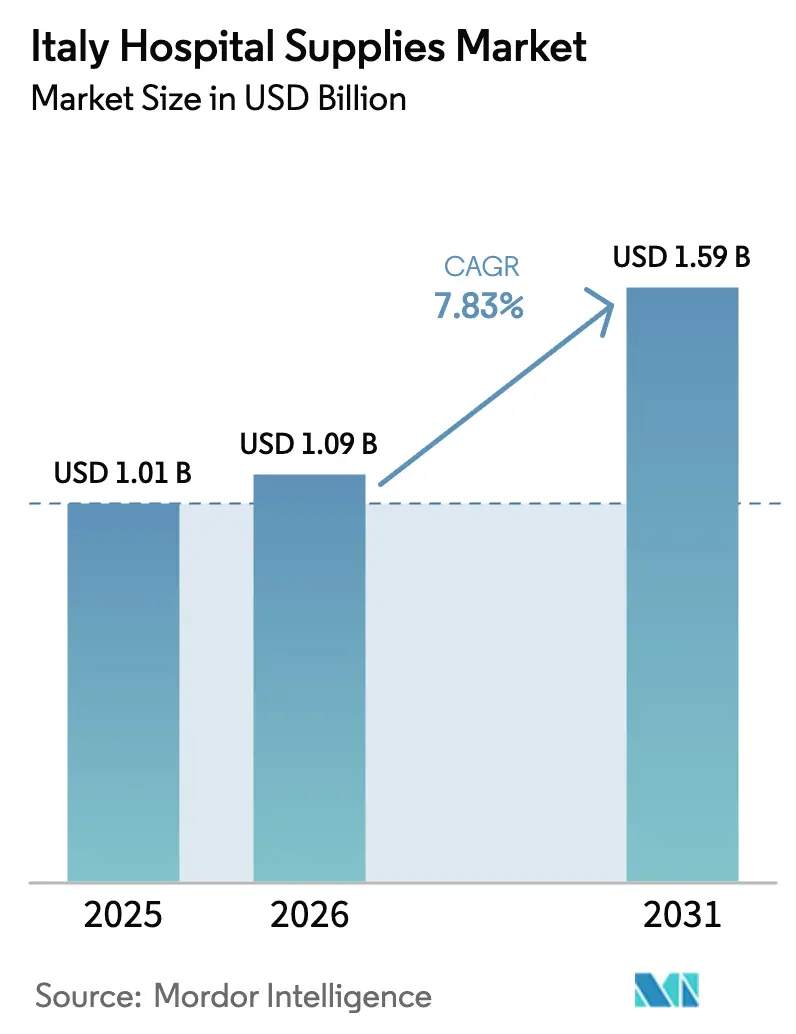
The Italy Hospital Supplies Market size was valued at USD 1.01 billion in 2025 and is estimated to grow from USD 1.09 billion in 2026 to reach USD 1.59 billion by 2031, at a CAGR of 7.83% during the forecast period (2026-2031).
The Italian hospital supplies market is undergoing a significant transformation, driven by rising demand for single-use consumables aimed at reducing hospital-acquired infections, alongside a substantial EUR 15.63 billion allocation under the PNRR Mission 6. Rapid digitalization of clinical workflows is further influencing procurement strategies. Hospitals are increasingly prioritizing large imaging and robotic surgical systems with workflow-automation features to address operational challenges, including a projected shortfall of 63,000 nurses. However, growth is constrained by regional payment delays of up to 120 days, MDR-related certification costs, and fragmented tendering processes in Southern regions. Vendors offering CONSIP-qualified portfolios and efficient e-commerce fulfillment capabilities are well-positioned to capitalize on the growing demand in this market.
Key Report Takeaways
- By product category, disposable hospital supplies led with 45.76% of the Italy hospital supplies market share in 2025. Operating Room Equipment is forecast to expand at an 8.43% CAGR through 2031.
- By end user, hospitals accounted for 63.76% of the Italy hospital supplies market in 2025. Ambulatory Surgical Centres are advancing at an 8.67% CAGR to 2031.
- By distribution channel, direct tender and bulk procurement accounted for 72.74% of 2025 orders in the Italy hospital supplies market. E-Commerce and GPO Platforms are growing at a 7.54% CAGR through 2031.
Note: Market size and forecast figures in this report are generated using Mordor Intelligence’s proprietary estimation framework, updated with the latest available data and insights as of January 2026.
Italy Hospital Supplies Market Trends and Insights
Drivers Impact Analysis*
| Driver | (~) % Impact on CAGR Forecast | Geographic Relevance | Impact Timeline |
|---|---|---|---|
| Government Recovery-Plan Capital Investments | +2.1% | National, highest in Campania, Sicily, Calabria | Medium term (2-4 years) |
| Expanding Chronic-Disease Burden | +1.8% | National, stronger in Lombardy, Veneto, Emilia-Romagna | Long term (≥ 4 years) |
| Rapid Digitalization of Hospital Infrastructure | +1.3% | National, early uptake in Lombardy, Lazio, Piedmont | Medium term (2-4 years) |
| Heightened Hospital-Infection Awareness | +1.0% | National, acute-care hospitals and ASCs | Short term (≤ 2 years) |
| Shift Toward Outpatient & Home-Care Models | +0.9% | National, accelerated in Milan, Rome, Turin, Naples | Short term (≤ 2 years) |
| Emergence of Value-Based Procurement Practices | +0.7% | National, pilot tenders in Northern regions | Medium term (2-4 years) |
| Source: Mordor Intelligence | |||
Expanding Chronic-Disease Burden
In 2022, 23.8% of Italy's population was aged 65 and above, a figure expected to reach 34% by 2050. This demographic trend ensures a stable demand for medical supplies such as syringes, glucose meters, and wound-care dressings[1]. Cardiovascular diseases, responsible for 31% of deaths, along with 40.9% of the population reporting at least one chronic condition, have led hospitals to adopt multi-year CONSIP frameworks for bulk procurement of patient-examination devices. The rising incidence of diabetes is driving repeat purchases of continuous glucose monitors, particularly those integrated with electronic health records. Between 2019 and 2021, mental health diagnoses for anxiety and depression increased by 19.8% and 17.3%, respectively, fueling demand for telepsychiatry kits that connect community facilities with tertiary care centers. Suppliers offering bundled chronic-care kits, which effectively reduce hospital readmissions, are gaining competitive advantages in value-based tenders across Italy's hospital supplies market.
Government Recovery-Plan Capital Investments
The PNRR earmarked EUR 15.63 billion (USD 17.19 billion) for health spending, including EUR 4.05 billion for hospital technology upgrades and EUR 1.67 billion for digital infrastructure[2]. Procurement targets encompass 3,100 CT, MRI, and angiography systems and 84 hospital seismic retrofits. Execution delays in 2024 require a sevenfold acceleration to meet 2026 milestones, compressing tender windows and favoring incumbents with CONSIP credentials. Southern regions receive disproportionate allocations, yet limited administrative capacity postpones approvals, intensifying a two-speed dynamic inside the Italy hospital supplies market.
Rapid Digitalization of Hospital Infrastructure
FSE 2.0 has 25.4 million patient consents, 6.5 million active users, and 139,000 physicians onboard, but only 28% of citizens accessed their records in 2024, underscoring interoperability gaps. PNRR funding channels EUR 1.67 billion into cloud data exchange, telemedicine, and IoT-enabled devices. Hospitals in Lombardy, Lazio, and Piedmont contract Philips, Siemens Healthineers, and GE Healthcare for connected imaging suites that transmit diagnostics into cloud dashboards. ISO 27001 and GDPR mandates raise entry barriers, shifting preference toward vendors with cyber-secure portfolios inside the Italy hospital supplies market.
Shift Toward Outpatient and Home-Care Models
Decree 77/2022 prescribes one community house for every 40,000-50,000 residents and shifts elective procedures into ambulatory centers. ASCs, expanding at 8.67% CAGR, now handle cataract and hernia operations in same-day models. Home-health programs absorb oxygen concentrators, infusion pumps, and remote monitoring kits reimbursed under telemedicine tariffs, stimulating e-commerce procurement. Centralized warehouses must now supply hundreds of micro-sites, a logistical realignment that leans on GPOs and just-in-time inventory solutions in the Italy hospital supplies market.
Restraints Impact Analysis*
| Restraint | (~) % Impact on CAGR Forecast | Geographic Relevance | Impact Timeline |
|---|---|---|---|
| Stringent Regulatory & Tender Compliance | −0.7% | National, heavier in Lazio and Campania | Medium term (2-4 years) |
| Healthcare Workforce Shortages | −0.6% | National, most acute in Southern regions | Short term (≤ 2 years) |
| Regional Budgetary Constraints | −0.5% | Calabria, Sicily, Molise, Basilicata | Long term (≥ 4 years) |
| Global Supply-Chain Vulnerabilities | −0.4% | National, highest risk for import-dependent disposables | Short term (≤ 2 years) |
| Source: Mordor Intelligence | |||
Stringent Regulatory and Tender Compliance
CONSIP handled EUR 28.3 billion in centralized procurement during 2024, yet 24-36-month framework contracts lock in pricing, squeezing margins when raw-material costs rise[3]. EU MDR imposes rigorous clinical-evaluation and UDI labeling duties, raising compliance costs by 20-30% for midsize producers. Fragmented tenders in Lazio and Campania extend award cycles by up to nine months, pressuring vendor cash flow. Multinationals absorb these hurdles with specialized regulatory teams, while smaller Italian manufacturers exit segments such as sterilization and mobility aids, subtly consolidating the Italy hospital supplies market.
Regional Budgetary Constraints
Per-capita health spending is EUR 2,300 in Lombardy but EUR 1,800-1,900 in Calabria and Sicily, reflecting chronic underfunding. Southern hospitals defer payments for 90-120 days, dissuading suppliers from high-value bids and confining purchases to commodity disposables. PNRR aims to close the gap, yet Southern regions had absorbed only 40% of allocated health funds by mid-2025 versus 65% uptake in the North. Budget rigidity also limits adoption of robotic surgery and AI diagnostics, maintaining a two-tier structure inside the Italy hospital supplies market.
*Our forecasts treat driver/restraint impacts as directional, not additive. The impact forecasts reflect baseline growth, mix effects, and variable interactions.
Segment Analysis
By Product: Disposables Anchor Infection-Control Protocols
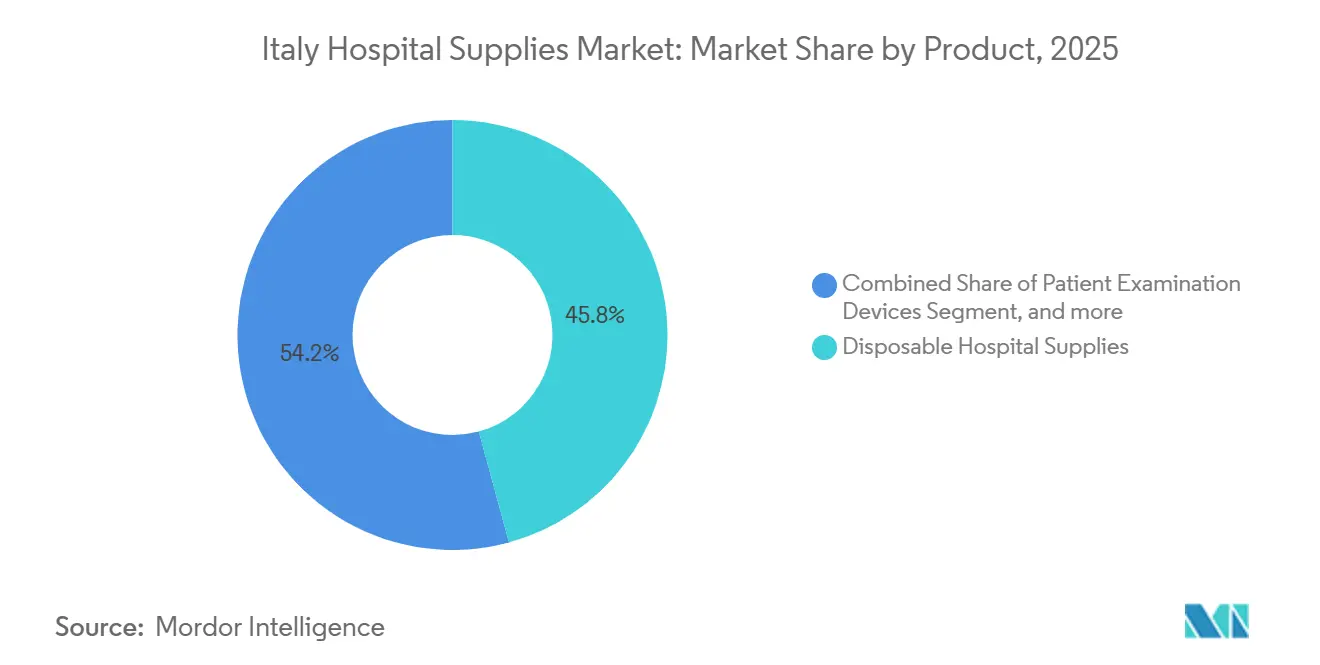
Disposable Hospital Supplies captured 45.76% of 2025 demand as 530,000 hospital-acquired infections and 34% MRSA prevalence forced single-use workflows. The Italy hospital supplies market for disposables is forecast to reach USD 21.7 billion by 2031, supported by antimicrobial-resistant strains, including 27% of Klebsiella pneumoniae strains that are carbapenem-resistant. Operating Room Equipment will post an 8.43% CAGR, fueled by EUR 4.05 billion in PNRR funds for 3,100 large devices and by surgeon preference for robotic-assisted platforms. Value-based tenders award points for lifecycle services and predictive maintenance, elevating the portfolios of B. Braun, Stryker, and Medtronic.
Patient Examination Devices cater to 40.9% of citizens with chronic conditions and integrate Bluetooth links to FSE 2.0 dashboards. Mobility Aids gain traction among the elderly, while Sterilization equipment upgrades focus on automated cycle-logging to satisfy MDR post-market audits. Syringe and needle demand remains steady, yet safety-engineered retractable designs see faster uptake, encouraged by EU Directive 2010/32/EU.

By End User: Hospitals Dominate, ASCs Surge
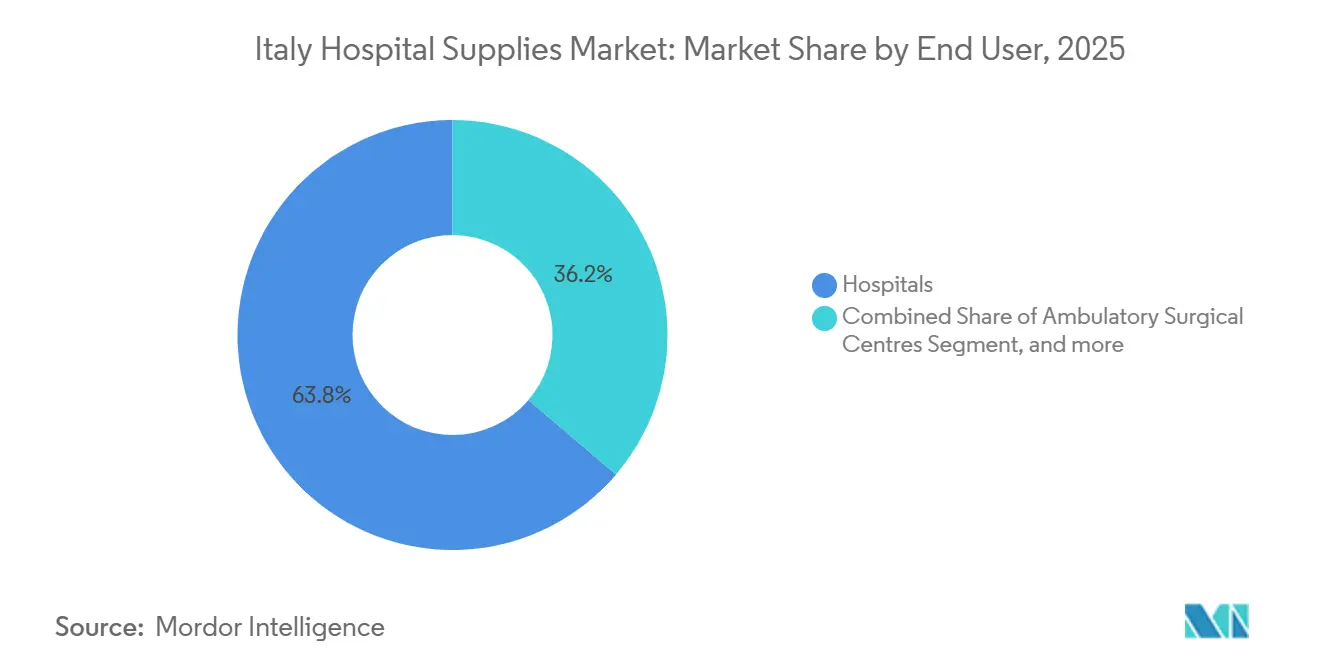
Hospitals held 63.76% of 2025 procurement, supported by 210,000 beds across 1,050 facilities. The Italy hospital supplies market share for hospitals is projected to decline marginally as Decree 77/2022 steers low-complexity cases toward ASCs, which are now expanding at a 8.67% CAGR. Nurse shortages delay elective procedures, pushing hospitals to automate anesthesia records and instrument tracking. Community Houses and Diagnostic Centres grow under the same reform, demanding portable ultrasound, ECG, and point-of-care testing units.
Home health settings absorb oxygen concentrators and wound care supplies under telemedicine reimbursements. Specialty Clinics, particularly orthopedic and oncology hubs, are pursuing robotic platforms to differentiate their private-pay services. Distributors must now service a patchwork of micro-sites, shifting truckload logistics toward parcel-level fulfillment—an operational pivot defining competition in the Italyhospital supplies market.
By Distribution Channel: Tenders Persist, Digital Platforms Emerge
Direct Tender and Bulk Procurement accounted for 72.74% of 2025 volumes, with CONSIP’s EUR 28.3 billion annual frameworks covering everything from gloves to CT scanners. The Italy hospital supplies market size handled through tenders will still exceed USD 30 billion by 2031, yet growth tilts toward digital platforms. Distributor sales cover private clinics and aftermarket service, shielding vendors from tender-based price ceilings. E-commerce and GPO portals grow at 7.54% CAGR as buyers log into MePA for small orders or join private GPOs that aggregate ASC demand. However, fixed-term framework agreements limit online penetration to non-tendered SKUs in the Italy hospital supplies market.
Regulatory Landscape
Italy regulates hospital supplies classified as medical devices under EU Regulation (EU) 2017/745 (MDR), with the Ministero della Salute as the competent authority and mandatory national registration through the BD/RDM database for devices placed on the Italian market. Oversight links into traceability and UDI obligations, and it intersects with public procurement routes, including framework-based purchasing through CONSIP, which shapes how suppliers organize compliance and tender documentation.
A notable 2026 update is the introduction of the Classificazione Italiana dei Dispositivi Medici (CID), which entered into force in January 2026 and replaced the prior national classification approach. This requires manufacturers and distributors to map their portfolios to the updated nomenclature. In late 2025, the Council of Ministers approved a bill to establish a national unique register for implantable medical devices, which should strengthen post-market monitoring and traceability expectations for implantables once the implementing measures define scope and operating rules.
Value Chain Analysis
The Italy hospital supplies value chain runs from raw materials and components (often imported for many disposables and high-tech systems) through manufacturing and assembly (with a large SME base alongside multinational plants), then into regulatory registration and conformity management, before moving into distribution and hospital delivery. A key gate is compliance and listing, including MDR-aligned documentation and BD/RDM registration, which can add time and cost for portfolio updates. This is especially relevant when tenders require precise coding, UDI and traceability readiness, and validated service capability for capital equipment.
Downstream, the chain is shaped by public procurement dominance. The public system accounts for most purchasing and is supported by multiple regional procurement centers, plus national aggregation via CONSIP, while MePA enables smaller, more frequent orders. Logistics and fulfillment are heavily outsourced, with specialized healthcare logistics providers acting as hubs between industry and hospitals. Bottlenecks also include fragmented data across hospital pharmacies and inconsistent inventory tracking, which increases the value of unit-level visibility (RFID/serialization) and vendor-managed inventory models, particularly in regions with longer payment cycles.
Competitive Landscape
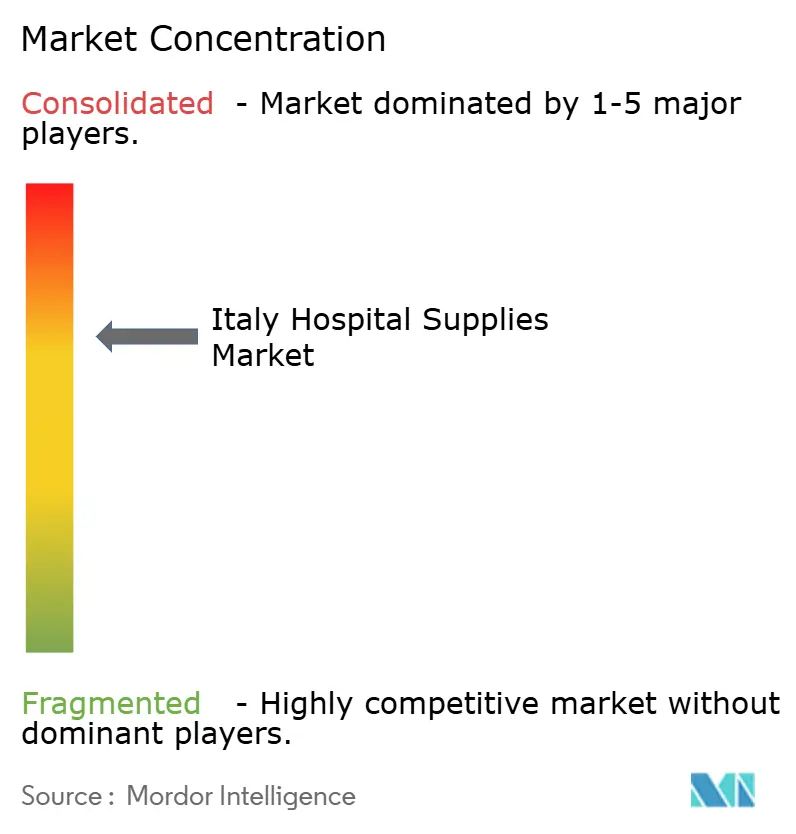
The Italy hospital supplies market is characterized by moderate fragmentation. Leading global players such as B. Braun, Baxter, Cardinal Health, Medtronic, Johnson & Johnson, and Stryker utilize value-based bundles and IoT telemetry to secure CONSIP lots. Companies like Philips, Siemens Healthineers, and GE Healthcare establish proprietary ecosystems within hospitals through cloud analytics and long-term service agreements. Local firms, including DE LAMA and Favero Health Projects, leverage shorter lead times and PNRR subsidies to win sterilization and furniture tenders, although expanding beyond regional markets remains a significant challenge.
Multinational companies address the 90-day payment delays prevalent in Southern markets by offering vendor-managed inventory and financing solutions. Smaller brands such as ConvaTec and Smith & Nephew concentrate on wound care and outpatient orthopedics, deploying clinical educators to improve tender scores by meeting training criteria. Additionally, EU MDR compliance has increased acquisition opportunities, as under-capitalized local manufacturers attract global players seeking expedited market entry.
Italy Hospital Supplies Industry Leaders
-
General Electric Company (GE Healthcare)
-
Invacare Corporation
-
DE LAMA S.P.A.
-
Althena Medical
-
Baxter International (Hill-Rom Services)
- *Disclaimer: Major Players sorted in no particular order
Market Opportunities and Future Outlook
A large, program-backed opportunity is tied to PNRR Mission 6 execution, including modernization of hospital technological and digital infrastructure and the planned procurement of around 3,100 large devices (CT, MRI, angiography) plus related workflow and service packages. This favors suppliers that pair equipment with cybersecurity-aligned connectivity (GDPR and ISO 27001 practices), interoperability into FSE 2.0 pathways, and lifecycle services that can score in value-based tenders. It also creates room for distributors and third-party service providers to support installation, uptime, and parts logistics across multiple regions and new care sites.
Another opportunity is the formalization of evidence-driven adoption routes through the National HTA Programme for Medical Devices (PNHTA-DM) 2026-2028, which entered its operational phase in January 2026 under Agenas. The program has a stated goal of producing 50 to 100 HTA assessments during 2026 on devices with high clinical, organizational, and economic impact. Agenas and CONSIP also advanced enabling procurement through a EUR 130 million open tender for strategic support to the program. Agenas opened a EUR 69.47 million tender in April 2026 to support regional telemedicine services, signaling demand for remote monitoring software and connected diagnostic devices that can be procured and deployed at scale across Italy.
Recent Industry Developments
- June 2026: Invacare launched the Aquatec Pure range of shower and hygiene solutions for homecare in Italy. The rollout expands its post-acute and home-care portfolio offered through Italian channels, aligning with the shift of care delivery away from hospitals and toward community and home settings.
- March 2026: GE HealthCare announced a leading industrial role in the five-year COMPASS consortium, co-funded under Horizon Europe with a reported EUR 50.5 million budget to advance precision cardio-oncology care across Europe. Participation strengthens GE HealthCare's R&D and clinical collaboration footprint and can support connected imaging, diagnostics, and digital workflow demand in Italy as hospitals modernize under national programs.
- October 2025: Italy, in partnership with the EU and Spain, delivered advanced medical equipment to six hospitals in Ethiopia to support healthcare capacity building. The initiative highlights government-linked medical equipment deployment activity and underscores the role of public-sector coordination in large-scale equipment sourcing and distribution.
Research Methodology Framework and Report Scope
Market Definition and Coverage
In this methodology, the Italy hospital supplies market covers the value of medical and surgical supplies and equipment routinely used in hospitals and care settings for diagnosis, treatment, and day to day clinical operations, where items are purchased as part of normal patient care workflows.
Scope exclusions: Large capital hospital construction projects and non-medical facility services are excluded from this market sizing.
Segmentation Overview
- By Product
- Patient Examination Devices
- Operating Room Equipment
- Mobility Aids & Transportation Equipment
- Sterilisation & Disinfectant Equipment
- Disposable Hospital Supplies
- Syringes & Needles
- Other Products
- By End User
- Ambulatory Surgical Centres
- Diagnostic Centres
- Home-Health-Care Settings
- Hospitals
- Specialty Clinics
- Other End Users
- By Distribution Channel
- Direct Tender / Bulk Procurement
- Distributor & Dealer Sales
- E-Commerce & GPO Platforms
Data Sources, Market Sizing, and Validation
Desk Research
Desk research was used to build the basic fact base on Italy healthcare delivery, procurement patterns, and import reliance for commonly used supplies. We typically start with public health system publications, then cross-check directionally with sources such as the Italian Ministry of Health, ISTAT, Eurostat health accounts, and OECD health statistics to anchor hospital activity and spending context.
To convert that context into supply demand signals, we also refer to trade and regulatory sources such as UN Comtrade and EU trade statistics. For regulated categories, we reference the European Medicines Agency where relevant, and we use peer reviewed clinical and infection control literature to indicate usage intensity for disposables. Company annual reports, investor presentations, and trusted press are then used to validate product mix shifts and pricing commentary, supported by paid subscriptions for company financials and intelligence, news and financials, and shipment-level import and export checks where needed. These examples are not exhaustive, and many other public sources were used for data collection, validation, and clarification.
Primary Interviews and Surveys
Primary work helped us stress test what desk sources cannot show clearly, especially tender pricing behavior, replacement cycles, and which product groups are gaining share inside Italian hospitals. We spoke with a mix of manufacturers, distributors, group purchasing and procurement professionals, and hospital department leaders across Italy, so assumptions on volumes, average selling prices, and channel shares could be checked and adjusted.
Distribution of primary research fieldwork respondents
| Company type | Respondent position |
|---|---|
| Top tier: 39% | CXOs: 17% |
| Mid tier: 42% | Functional/Unit leaders: 37% |
| Smaller Players: 19% | Managers: 46% |
Market-Sizing & Forecasting
Sizing starts from a top-down reconstruction, where hospital activity and procurement signals are translated into demand pools for frequently used supplies (for example, procedure volumes, inpatient and outpatient activity, and the typical supply intensity per case). Once that structure is in place, results are corroborated through selective bottom-up approximations, including sampled supplier revenue splits in Italy, channel checks with distributors, and a practical volume times ASP build for a few high-usage categories that is used to tune totals.
Inputs used in the model include tender and bulk procurement patterns, import dependence for key consumables, utilization trends in operating rooms and diagnostic pathways, infection prevention protocols that lift disposable usage, and observable price movement in frequently replenished items. Where data is patchy for smaller categories, we fill gaps using proxy indicators such as hospital bed capacity and department-level utilization, then validate the implied per facility spend with interview feedback.
For forecasting, scenario analysis is used so growth is not driven by a single assumption. Scenarios are tied to expected procedure recovery, public spending direction, and procurement cycle timing. When inputs move together, we keep them consistent by applying expert-confirmed ranges rather than forcing precision that the market does not support.
Data Validation & Update Cycle
Outputs are checked against independent signals such as the direction of healthcare expenditure, import trends for major supply groups, and the implied annual spend per hospital and per activity unit. When an outlier appears, it is reviewed for unit mistakes, currency timing, and potential double counting across channels, followed by a second analyst review before sign-off.
The report is refreshed annually, and interim updates are made when material events can change pricing or demand patterns, such as procurement rule changes or sudden shifts in utilization. Before delivery, a final pass is done so the numbers reflect the latest public releases and the most recent feedback gathered from primary contacts.
Mordor Intelligence's Italy Hospital Supplies Market Estimate Compared With Other Published Estimates
Published numbers for Italy hospital supplies can look far apart because the term is used loosely, and each publisher selects different product groups and care settings. Differences also show up when one study relies mainly on broad healthcare spending totals, while another builds from hospital usage patterns and maps those to replenished supply demand.
Pharmaceuticals and therapeutic drugs are kept outside Mordor Intelligence's scope here, which is one reason some larger published figures look inflated versus a hospital supplies only view. Gaps also come from how tender pricing is treated, whether home care and non-hospital consumption is fully counted, and if average prices are escalated with general inflation rather than category-level feedback and currency timing.
Benchmark comparison
| Source | Market Size | Gaps in Research Methodology |
|---|---|---|
| Mordor Intelligence | USD 1.01 B (2025) | |
| Global Consultancy A | USD 30.50 B (2024) | Uses a much broader basket that blends hospital supplies with wider healthcare equipment and consumables across hospitals, clinics, and other care sites, which expands the addressable value pool beyond hospital-linked replenishment demand. |
| Trade Journal B | USD 1.82 B (2024) | Narrowed to disposable hospital supplies only, which excludes durable equipment and several recurring device categories, and can also apply a different price basis by focusing on unit shipments and list prices instead of tender outcomes. |
The spread in the table mainly reflects scope width and what is treated as hospital-linked replenishment, rather than a simple disagreement on growth. By keeping category boundaries clear and validating key pricing and usage assumptions with procurement and channel inputs, the estimate stays traceable to practical drivers that can be checked and updated year to year.
Key Questions Answered in the Report
How large is the Italy Hospital Supplies market in 2026?
The Italy hospital supplies market size reached USD 34.62 billion in 2026.
What is the expected CAGR for hospital supplies sales in Italy through 2031?
Sales are projected to grow at a 6.53% CAGR between 2026 and 2031.
Which product segment leads spending?
Disposable hospital supplies led with 45.76% of sales in 2025.
Why are Ambulatory Surgical Centres growing quickly?
Decree 77/2022 shifts elective surgeries to outpatient settings, driving an 8.67% CAGR for ASC demand.
How is digital health influencing procurement?
FSE 2.0 and EUR 1.67 billion in PNRR digital funds are boosting demand for IoT-enabled devices that integrate with electronic health records.
What challenges affect smaller Italian manufacturers?
EU MDR compliance costs and fixed-price CONSIP frameworks compress margins and lengthen tender cycles.