
Market Overview
| Study Period | 2020 - 2031 |
|---|---|
| Forecast Data Period | 2026 - 2031 |
| Base Year Market Size (2025) | USD 6.70 Billion |
| Market Size (2026) | USD 7.22 Billion |
| Market Size (2031) | USD 10.49 Billion |
| Growth Rate (2026 - 2031) | 7.76 % |
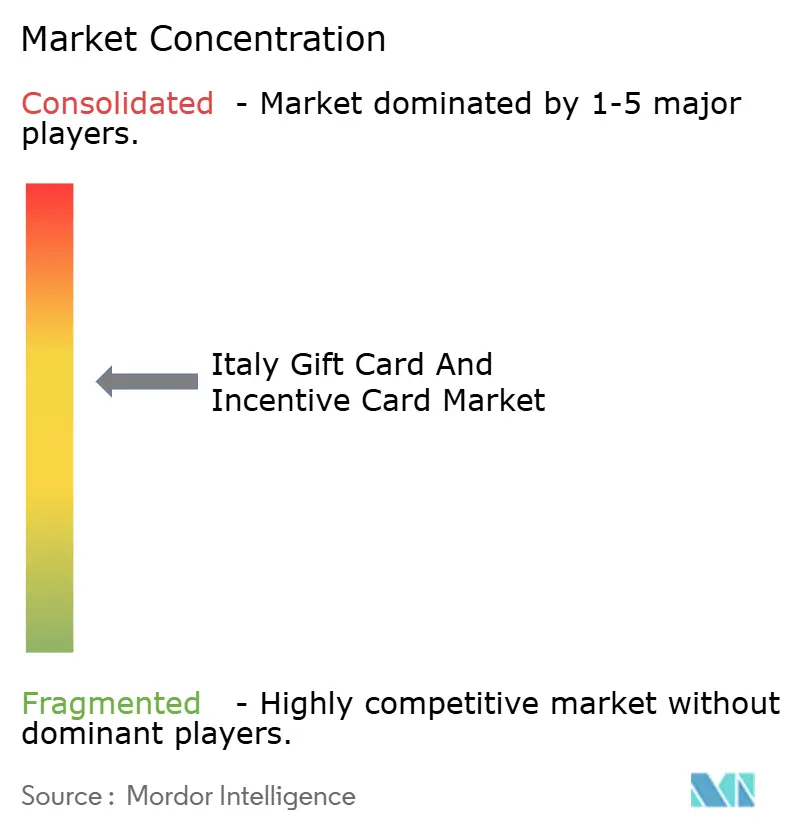
| Market Concentration | Medium |
Major Players *Disclaimer: Major Players sorted in no particular order Image © Mordor Intelligence. Reuse requires attribution under CC BY 4.0. | |
Italy Gift Card And Incentive Card Market Analysis by Mordor Intelligence
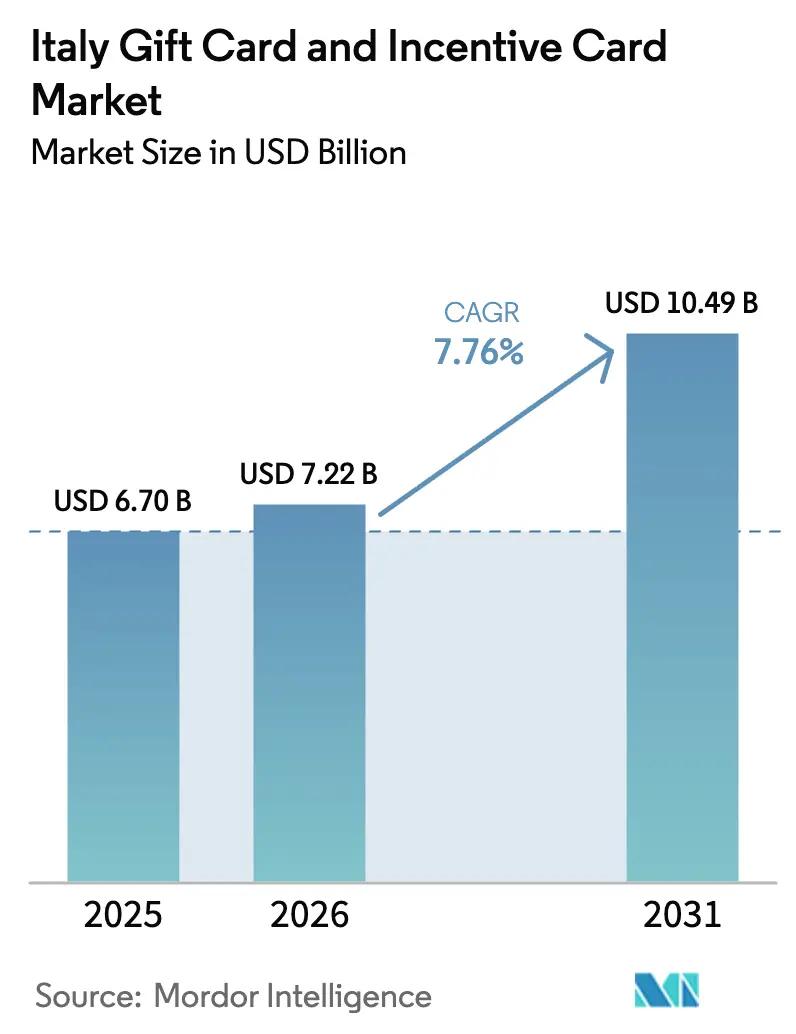
The Italy gift card and incentive card market size in 2026 is estimated at USD 7.22 billion, growing from 2025 value of USD 6.70 billion with 2031 projections showing USD 10.49 billion, growing at 7.76% CAGR over 2026-2031. Widespread contactless adoption—58% of point-of-sale card transactions—signals a decisive consumer shift toward digital payments. Regulatory support, including a 30% tax credit on electronic payment fees for smaller firms, lowers acceptance costs and encourages merchants to issue gift cards. Open-loop products grow fastest as Nexi’s EUR 220 million European Investment Bank loan accelerates multi-merchant acceptance. Meanwhile, Edenred’s EUR 464 million Italy revenue underscores robust B2B demand for employee incentives. Physical cards still dominate amid historically low banking trust, yet digital formats are expanding at double-digit rates as Satispay, PostePay, and other fintech platforms embed virtual cards in everyday apps.
Key Report Takeaways
- By card type, closed-loop captured 67.40% of the Italy gift card and incentive card market share in 2025, while open-loop is projected to expand at a 8.94% CAGR through 2031.
- By format, physical cards held 59.40% of the Italy gift card and incentive card market size in 2025; digital cards are pacing a 12.43% CAGR to 2031.
- By consumer type, individuals retained 68.90% of the 2025 share of the Italy gift card and incentive card market, whereas corporate programs are forecasted to rise at a 9.45% CAGR.
- By distribution channel, offline outlets accounted for 57.95% of the Italy gift card and incentive card market share in 2025; online channels are projected to grow at 11.55% CAGR.
- By industry of application, “Other Industries” led with 33.10% share of the Italy gift card and incentive card market, yet Health, Wellness & Beauty is advancing fastest at 9.92% CAGR.
Note: Market size and forecast figures in this report are generated using Mordor Intelligence’s proprietary estimation framework, updated with the latest available data and insights as of 2026.
Italy Gift Card And Incentive Card Market Trends and Insights
Drivers Impact Analysis*
| Driver | (~) % Impact on CAGR Forecast | Geographic Relevance | Impact Timeline |
|---|---|---|---|
| Surge in e-commerce & mobile payments adoption | +2.1% | National; strongest in northern cities | Medium term (2–4 years) |
| Corporate demand for employee incentives & loyalty tools | +1.8% | Milan, Rome, Turin hubs | Long term (≥ 4 years) |
| Regulatory push for cashless transactions & tax incentives | +1.4% | SME-heavy southern regions | Short term (≤ 2 years) |
| Growing popularity of digital/contactless gift cards | +1.2% | Youth segment nationwide | Medium term (2–4 years) |
| ESG-linked gift cards for sustainability-minded consumers | +0.8% | Northern metros | Long term (≥ 4 years) |
| Integration with BNPL & super-apps enabling micro-gifting | +0.5% | E-commerce platforms | Medium term (2–4 years) |
| Source: Mordor Intelligence | |||
Surge in e-commerce & mobile payments adoption
Mobile commerce already represents a significant share of total online sales, yet only a relatively small portion of in-store payments are mobile, exposing an untapped bridge for omnichannel gift cards. Digital wallets carry around 35% of online transaction value today and should reach 46% by 2027, making wallet-ready gift cards a natural fit. EU rules mandating instant payments by 2025 promise real-time corporate bulk issuance, while PostePay’s 7.2 million Evolution cards illustrate platform-led cross-selling. Cross-border shopping by around 50% of Italian consumers expands demand for multi-currency cards. Overall, omnichannel commerce acts as a flywheel for the Italy gift card and incentive card market.
Corporate demand for employee incentives & loyalty tools
Edenred’s EUR 464 million Italy revenue and its acquisition of IP Gruppo API’s energy card unit reveal the scale of B2B expansion. Pluxee’s 18.6% organic growth after spinning off from Sodexo highlights SME appetite for digital incentives. Epipoli’s partnerships with grocer Esselunga demonstrate the convergence of gift cards with loyalty data platforms. Italian tax treatment favors electronic benefits, and rising retention costs push firms to offer flexible rewards. As a result, corporate uptake lifts long-term growth for the Italy gift card and incentive card market.
Regulatory push for cashless transactions & tax incentives
A 30% tax credit on electronic fees effectively subsidizes small merchants that accept gift cards, easing entry barriers. Mandatory e-invoicing dovetails with digital card issuance for simpler back-office reconciliation. Contactless penetration reached 58% of card transactions following PSD2 and GDPR security frameworks, bolstering consumer trust. Antitrust oversight of the Nexi-SIA merger maintains pricing competition in processing services[1]. Lower interchange caps than the EU average reduce issuer costs, widening product margins and accelerating adoption.
Growing popularity of digital/contactless gift cards
Visa’s push-to-wallet tokenization lets virtual cards drop straight into Apple Pay or Google Pay, eliminating activation friction[2]. Satispay’s launch of in-app gift cards leverages its eight-million-user base during a 22% pandemic-era rise in digital payments. The European Payments Council urges stronger customer authentication, encouraging issuers to adopt biometric login and real-time monitoring. Local payment rails BANCOMAT Pay and PagoBANCOMAT now integrate with Amazon Italia, proving global merchants can adopt Italian-specific digital cards. Collectively, these trends draw younger demographics deeper into the Italy gift card and incentive card market.
Restraints Impact Analysis*
| Restraint | (~) % Impact on CAGR Forecast | Geographic Relevance | Impact Timeline |
|---|---|---|---|
| Rising fraud & cybersecurity concerns | −1.1% | Digital-first segments nationwide | Short term (≤ 2 years) |
| Stringent AML/KYC compliance costs | −0.9% | B2B, high-value issuers | Medium term (2–4 years) |
| Breakage liabilities as the closed-loop stock saturates | −0.7% | Mature retail programs | Long term (≥ 4 years) |
| Ageing populations are slower to adopt digital gifting | −0.6% | Rural south & islands | Long term (≥ 4 years) |
| Source: Mordor Intelligence | |||
Rising fraud & cybersecurity concerns
The European Payments Council cites escalating social-engineering attacks that force issuers to invest in AI-driven monitoring, inflating operating costs[3]. Authorized push-payment scams exploit the irreversibility of gift cards, eroding consumer confidence. Upcoming EU Payment Services Regulation debates liability allocation, creating strategic uncertainty. Smaller fintechs must buy outsourced security tools, squeezing margins, while larger processors like Nexi pour hundreds of millions into cyber defense. Persistent media coverage of data breaches slows the onboarding of new users in the Italy gift card and incentive card industry.
Stringent AML/KYC compliance costs for issuers
Overlapping GDPR and Digital Services Act rules mandate heavier data-protection procedures. Edenred expects a EUR 60 million EBITDA hit from Italy’s merchant-fee cap and related compliance upgrades. Antitrust scrutiny of mergers such as Nexi-SIA lengthens deal timelines and requires detailed reporting. Smaller issuers struggle with fixed-cost burdens, curbing product launches. Cross-border offerings must reconcile varied EU AML regimes, slowing the international scalability of the Italy gift card and incentive card market.
*Our forecasts treat driver/restraint impacts as directional, not additive. The impact forecasts reflect baseline growth, mix effects, and variable interactions.
Segment Analysis
By Card Type: Open-loop innovation challenges closed-loop tradition
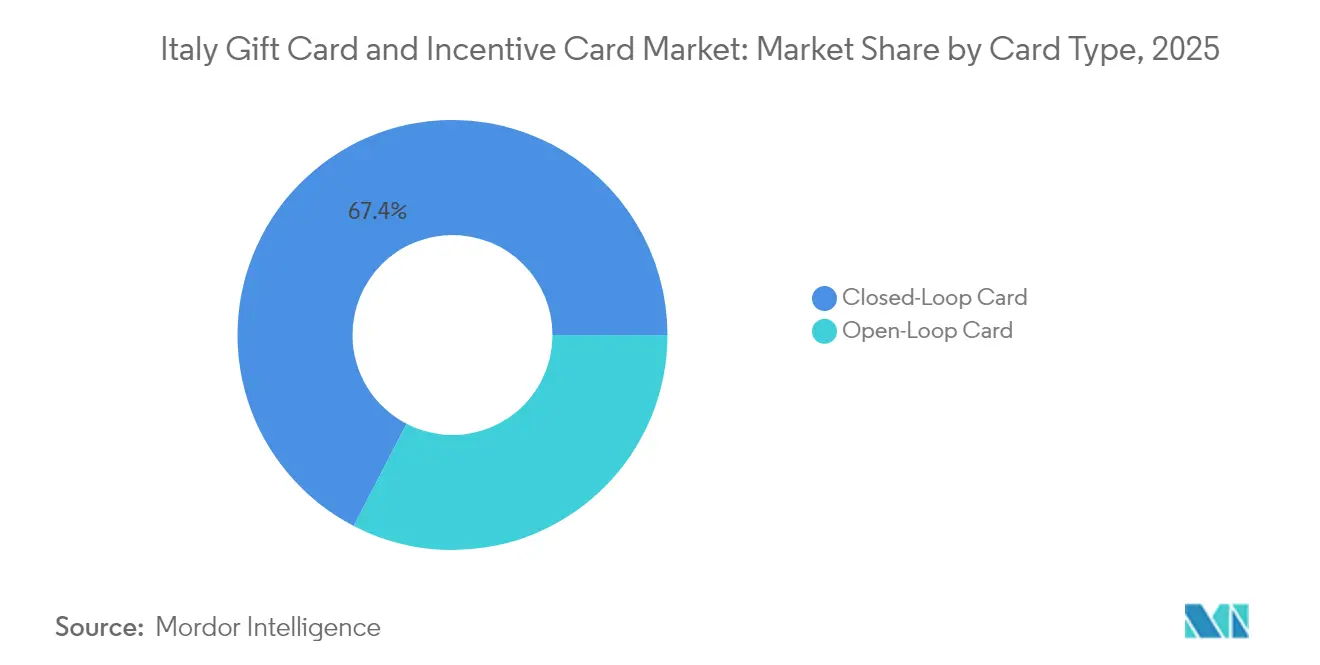
Closed-loop cards commanded 67.40% of the Italy gift card and incentive card market share in 2025 as retailers used them to lock customers into proprietary ecosystems. Their dominance secures data capture, boosts private-label margins, and funds tailored promotions. Carrefour’s aim to raise private-label penetration to 40% of food sales by 2026 shows how gift cards steer traffic to in-house brands. Epipoli and Esselunga’s loyalty partnership layers personalized offers on closed-loop wallets, broadening engagement.
Open-loop alternatives are projected to scale at a 8.94% CAGR through 2031, aided by BANCOMAT Pay’s integration on Amazon Italia and Visa’s token-push APIs. Nexi’s EUR 220 million EIB loan underwrites multi-merchant acceptance upgrades, lowering per-transaction friction. Lower interchange caps let issuers price competitively, while 50% cross-border shopper penetration makes universal cards attractive. As open-loop utility broadens, they are on track to trim the closed-loop share in the Italy gift card and incentive card market size over time.

By Format Type: Digital innovation transforms traditional gifting
Physical cards retained 59.40% of the Italy gift card and incentive card market share in 2025, bolstered by cultural affinity for tangible presents and Italy’s dense brick-and-mortar network. Eurocommercial Properties’ 24 Italian shopping centers exemplify locations where impulse gift-card racks thrive.
Yet digital versions are leaping ahead at 12.43% CAGR, powered by Satispay in-app issuance, Visa push-to-wallet flows, and ESG sentiment that favors plastic-free gifting. Epipoli’s MyGiftCardPlusGreen replaces PVC with virtual codes while aligning spend with eco-merchants. Retailers trim production and logistics costs, freeing capital for targeted promotions. Data-rich digital cards feed loyalty analytics, making them key to the future growth of the Italy gift card and incentive card market.
By Consumer Type: Corporate segment drives strategic growth
Individuals still represent 68.90% of transaction value, reflecting entrenched holiday and family gifting norms. However, corporate demand is climbing at a 9.45% CAGR as firms adopt cards for tax-advantaged benefits and reward schemes. Edenred’s takeover of IP Gruppo API’s energy card base brings 50,000 B2B clients, highlighting momentum.
Tax credits on electronic fees lower employers’ costs, and wellness-linked cards satisfy growing ESG and wellbeing mandates. Pluxee’s SME push illustrates white-space potential, especially for Italy’s 4 million small businesses. As corporate uptake accelerates, the Italy gift card and incentive card industry stands to rebalance toward B2B revenue streams.
By Distribution Channel: Omnichannel strategies bridge the physical-digital divide
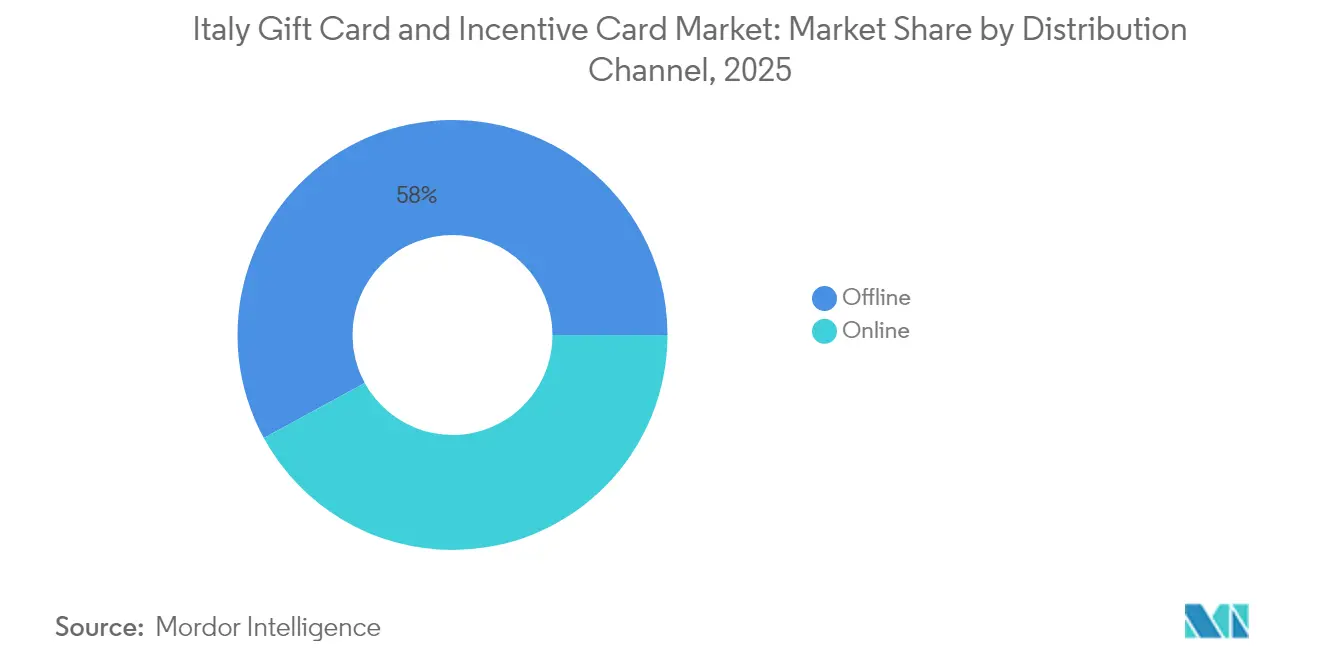
Offline outlets accounted for 57.95% of the Italy gift card and incentive card market share in 2025, thanks to widespread supermarket chains, newsstands, and malls that support instant gratification. Omnichannel leaders such as Carrefour embed QR-code vouchers redeemable both in-store and online, ensuring channel fluidity.
Online sales are expanding at 11.55% CAGR on the back of 50% cross-border e-commerce participation and rising mobile wallet penetration. Viva.com’s support for BANCOMAT Pay across merchant sites enables unified settlement flows. Reduced inventory needs, instant fulfillment, and data-driven upsells make digital malls cost-effective for issuers, positioning online as the growth engine for the Italy gift card and incentive card market.
By Industry of Application: Health & Wellness leads sector transformation
The other industry segment controlled 33.10% of the Italy gift card and incentive card market share in 2025, given the broad mix of automotive, home improvement, and services. Yet Health, Wellness & Beauty is racing ahead at 9.92% CAGR as consumers prioritize self-care post-pandemic. Klépierre’s clothing-for-card recycling taps into wellness and sustainability by incentivizing wardrobe decluttering.
Food & Beverage cards leverage Italy’s culinary culture, while electronics benefit from digital-device demand fueled by National Recovery Plan grants. ESG alignment remains a universal theme: Epipoli’s green vouchers and IKEA’s circularity workshops ensure that environmental consciousness permeates every vertical, solidifying diversified momentum within the Italy gift card and incentive card market size.
Geography Analysis
Northern regions dominate transaction value thanks to higher incomes, dense retail infrastructure, and advanced broadband. Lombardy, Veneto, and Emilia-Romagna host fintech clusters where Nexi’s innovation programs and EIB-backed projects flourish. Corporate headquarters in Milan, Rome, and Turin generate outsized B2B demand, evidenced by Edenred’s robust regional sales.
Southern Italy lags in digital adoption yet stands to benefit most from the 30% tax credit that offsets acceptance fees for small merchants. Here, physical cards bridge cash-centric cultures, while education campaigns aim to migrate users online. Tourist hotspots in Tuscany, Liguria, and Veneto provide seasonal spikes as travelers redeem airport and duty-free gift cards tied to Avolta’s retail footprint.
Cross-border dynamics matter: half of Italian shoppers buy from foreign sites, requiring multi-currency, open-loop solutions. EU instant-payment mandates will harmonize settlement nationwide, eroding regional gaps. As infrastructure equalizes, the Italy gift card and incentive card market should exhibit more balanced geographic dispersion while still anchored by the economic weight of the north.
Regulatory Landscape
In Italy, many gift cards and incentive cards are structured to qualify as limited-use payment instruments (strumenti a spendibilita limitata) under PSD2 implementation, as long as redemption is restricted to a defined merchant network or limited range of goods and services. Where programs operate as limited-network offerings, issuers with annual transaction volume above EUR 1 million face Bank of Italy notification and operational reporting obligations, which tends to push larger closed-loop and multi-merchant programs toward more formalized compliance and controls.
Tax treatment follows the EU voucher framework (Directive 2016/1065), which distinguishes single-purpose vouchers (VAT due at issuance) from multi-purpose vouchers (VAT due at redemption). This classification affects how issuers and merchants define redemption terms and settlement flows. On 3 February 2026, the Bank of Italy updated supervisory provisions for Payment Institutions and Electronic Money Institutions, aligning supervisory expectations with DORA-related ICT risk and operational resilience requirements for regulated entities in Italy.
Value Chain Analysis
The value chain begins with program sponsors and demand generators, including retailers for closed-loop cards, employers and corporate welfare platforms for incentive cards, and large online merchants. Issuance and orchestration are handled either in-house by large retailers or through specialized enablers and processors that run card creation, code generation, settlement, fraud controls, and program administration. Players such as Epipoli and Amilon support digital distribution and incentive workflows, while payment infrastructure providers such as Nexi enable acceptance and routing for open-loop use cases.
Distribution uses offline racks and point-of-sale activation in supermarkets, malls, and specialty stores, as well as online and in-app channels embedded in fintech and payment apps. Acceptance depends on acquirers, POS providers, and wallet or tokenization rails for digital formats, while redemption and reconciliation feed into merchants back-office systems, including e-invoicing workflows. Compliance overlays each step: limited-network programs that exceed the EUR 1 million reporting threshold require regulator notifications and reporting, and DORA-aligned operational resilience investments from January 2025 onward increase the need for secure code lifecycle management, monitoring, and incident response for digital-first issuers and platforms.
Competitive Landscape
Market concentration is moderate and tightening. Investcorp’s 2025 purchase of Epipoli marks renewed consolidation as private equity aggregates niche processors. Nexi and SIA’s earlier merger, under antitrust conditions, created a national champion that invests EUR 395 million annually in technology upgrades. Visa, Mastercard, and American Express continue to supply rails, but local fintechs such as Satispay and Viva.com win share through low-cost acquisition models.
Strategic differentiation pivots on ecosystems rather than card issuance alone. Edenred is bundling analytics and wellness content to offset the EUR 60 million EBITDA drag from interchange caps. Pluxee positions itself as an SME partner, layering fuel, meals, and wellness benefits into a single platform. Avolta leverages airport concessions to cross-sell travel gift cards with duty-free coupons, while Poste Italiane capitalizes on its 35 million-customer reach to launch bundled telecom-banking-gifting services.
Technology drives arms-race dynamics. Visa’s API suite allows instant wallet tokenization, while Nexi’s cloud migration reduces fraud-detection latency. ESG remains a branding battlefield: Epipoli’s green gift cards and Klépierre’s circular retail initiatives resonate with younger consumers. Competitive intensity will increase as interchange revenue compresses and players pivot to value-added services to protect margins inside the Italy gift card and incentive card market.
Italy Gift Card And Incentive Card Industry Leaders
-
Epipoli Group
-
Nexi Payments
-
PostePay
-
Edenred
-
Amazon.com
- *Disclaimer: Major Players sorted in no particular order
Market Opportunities and Future Outlook
There is room to make gift cards and incentive cards more wallet-native as regulation broadens how electronic payment acceptance is applied in practice. In June 2026, the Italian Parliament approved the Excise Duty Decree expanding the obligation to accept electronic money to include payment apps and digital wallets, including via smartphones and smartwatches. That expands near-term implementation work for issuers and processors, particularly to keep voucher redemption and open-loop gifting working smoothly in wallet and app-based checkout flows, which favors players that can standardize tokenized, push-to-wallet issuance and align redemption with merchant POS and e-commerce payment stacks.
Another avenue is modernization of rails and settlement models around regulated payment initiatives and pilots. In July 2026, the European Central Bank selected 36 payment service providers, including Italian participants, for the digital euro pilot testing phase, with operations beginning in the second half of 2027. This supports investment in programmable, resilient issuance and acceptance capabilities that can interoperate with new forms of digital money. In the existing market, B2B distribution is still a practical growth lever, supported by the scale of corporate demand referenced in the base narrative, including Edenred's EUR 464 million Italy revenue, and by issuer readiness on compliance and reporting. That combination can help expand multi-merchant programs while staying within Bank of Italy thresholds and VAT voucher classification requirements.
Recent Industry Developments
- June 2026: Nexi announced a partnership with Younited to integrate Younited Pay instant credit into Nexi's acceptance channels in Italy. The collaboration links merchant acquiring with pay-over-time capability, supporting higher-value checkout use cases where gift cards and incentive cards are often combined with other tender types.
- January 2026: Epipoli expanded its digital gifting portfolio with the launch of a Samsung digital gift card distributed through its network. The update strengthens Epipoli's catalog for consumer gifting and corporate incentive programs, reinforcing the role of specialist enablers in digital distribution.
- July 2024: Nexi partnered with Amazon.it to enable BANCOMAT Pay as a payment option for e-commerce purchases. Adding a domestic payment rail to a major online merchant checkout supports broader adoption of Italian payment methods, improving the pathway for open-loop and multi-merchant gifting to be spent online.
Research Methodology Framework and Report Scope
Market Definition and Coverage
This market covers the value of gift cards and incentive cards used in Italy, counting the loaded or redeemed amount that is ultimately spent on goods and services through these prepaid programs, across consumer gifting and corporate reward use cases.
Scope exclusions: We exclude general purpose prepaid and travel money products that are used like everyday payment accounts rather than gift or incentive instruments.
Segmentation Overview
- By Card Type
- Open-Loop Card
- Closed-Loop Card
- By Format Type
- Digital Card
- Physical Card
- By Consumer Type
- Individual (B2C)
- Corporate (B2B)
- By Distribution Channel
- Online
- Offline
- By Industry of Application
- Food and Beverages
- Health, Wellness, and Beauty
- Apparel, Footwear, and Accessories
- Consumer Electronics
- Other Industries
Data Sources, Market Sizing, and Validation
Desk Research
Desk research was used to set the factual base for how big the addressable payment and prepaid environment is in Italy, and where gift and incentive cards sit inside it. We relied on public sources such as the Bank of Italy and ECB payments statistics, Eurostat household consumption and retail indicators, and Italian government or tax authority publications that cover electronic payment adoption and incentives.
Alongside this, we reviewed company annual reports and investor presentations from issuers, processors, and program managers active in prepaid rewards, plus trade association updates and reputable business press to track program launches and channel shifts. To cross-check company direction and basic financial context, we also used a paid subscription focused on company financials and news intelligence, and a patent database to sanity-check themes like wallet linkage and digital delivery. These desk sources are not exhaustive, and many other public documents were also used to collect data, validate assumptions, and clarify open questions.
Primary Interviews and Surveys
Primary work focused on validating what portion of prepaid value in Italy is truly gift and incentive driven, and how that differs by channel and buyer type. We spoke with a mix of issuers, program managers, distributors, and large corporate buyers, and then we tested assumptions with payments ecosystem experts so gaps from public data could be handled in a practical way.
Distribution of primary research fieldwork respondents
| Company type | Respondent position |
|---|---|
| Top tier: 32% | CXOs: 14% |
| Mid tier: 53% | Functional/Unit leaders: 29% |
| Smaller Players: 15% | Managers: 57% |
Market-Sizing & Forecasting
Our sizing starts with a top-down build where national payments and consumer spending signals are used to reconstruct the gift and incentive card value pool in Italy, and then that pool is narrowed using adoption and usage rates confirmed in interviews. To keep this grounded, the totals are corroborated with selective bottom-up checks such as issuer and program manager revenue cues, sampled average load values multiplied by estimated issuance volumes, and channel level reasonableness checks from distributors.
Key inputs used in the model include the mix shift from physical to digital delivery, the share of open-loop versus closed-loop programs, corporate incentive budget trends, retail and e-commerce spending direction, and average load and breakage behavior (treated carefully so the same value is not counted twice). Where bottom-up information is incomplete, we scale from a representative set using coverage ratios that are reviewed with industry respondents, and then we adjust back to what macro demand can realistically support.
For forecasting, we primarily use scenario analysis because the market is sensitive to employer reward policies, retailer promotions, and digital wallet adoption, which can change faster than long-term payment averages. Scenarios are anchored on agreed forward views from experts on program digitization, corporate demand resilience, and regulation-led payment behavior, and they are then converted into yearly growth paths and tested against historical ranges.
Data Validation & Update Cycle
Validation is done through triangulation across desk signals and interview feedback, followed by variance checks at each step of the model so outliers can be explained rather than accepted. We compare implied per capita and per card metrics with independent payment and consumption indicators, and we also check that growth by channel remains consistent with what respondents describe as operationally feasible.
Before sign-off, the model is reviewed in multiple steps by another analyst to confirm calculations, assumptions, and currency treatment are consistent across years. The report is refreshed annually, and interim updates are made when material events occur, such as major regulatory changes or large program expansions. Right before delivery, a final pass is completed so clients receive the latest view available at that time.
Mordor Intelligence's Italy Gift Card and Incentive Card Market Estimate Compared With Other Published Estimates
Published market sizes for gift and incentive cards in Italy can look far apart because each publisher makes different calls on what counts as market value, and how they treat reloadable prepaid, wallet-linked balances, and breakage. The table shows a spread that is mainly driven by scope choices and by whether value is measured at issuance, at load, or at redemption.
The table points to the biggest gap coming from what is included around general purpose prepaid and cross-use payment products, where in Mordor Intelligence's model the market is limited to gift card and incentive card programs used for gifting and rewards, and it avoids counting everyday prepaid account spending that is not tied to these programs. Differences also show up when some estimates apply aggressive digital acceleration assumptions without rechecking average load size and redemption behavior, or when older FX timing and refresh cycles leave prior year baselines unchanged despite shifts in corporate incentive demand.
Benchmark comparison
| Source | Market Size | Gaps in Research Methodology |
|---|---|---|
| Mordor Intelligence | USD 6.70 B (2025) | |
| Industry Association A | USD 8.10 B (2025) | Often reflects a broader prepaid and voucher interpretation, where parts of general purpose prepaid and multi-use stored value can be blended into the total, which inflates the gift and incentive card-only pool. |
| Trade Journal B | USD 5.90 B (2024) | Uses a different base year and can lean on reported issuance value without fully adjusting for non-redeemed balances and shifting average load sizes, which can understate the comparable spend-linked market value. |
Across the three figures, the practical takeaway is that scope and value measurement timing drive most of the variance, more than arithmetic differences. By keeping assumptions tied to observable demand signals like spending direction, program mix, and load behavior, the estimate remains traceable to steps that can be repeated and stress-tested when conditions change.
Key Questions Answered in the Report
What is the current size of the Italy gift card and incentive card market?
The market stands at USD 7.22 billion in 2026 and is set to reach USD 10.49 billion by 2031 at a 7.76% CAGR.
Which card type is growing fastest?
Open-loop products show the strongest momentum with a projected 8.94% CAGR through 2031 as consumers seek multi-merchant flexibility.
Why are corporate gift cards gaining traction?
Italian firms leverage a 30% electronic-fee tax credit and appreciate gift cards as tax-efficient, flexible employee rewards, spurring a 9.45% CAGR in the corporate segment.
How important are digital gift cards in Italy?
Digital formats grow at 12.43% CAGR, driven by wallet integration, instant delivery, and sustainability preferences, though physical cards still dominate overall spend.
What are the main risks facing issuers?
Rising fraud, stricter AML/KYC obligations, and breakage liabilities on saturated closed-loop inventories weigh on margins and operational complexity.
Which regions present the biggest expansion opportunities?
Northern Italy leads in spending, but Southern regions offer significant upside as tax incentives and education efforts convert cash-oriented merchants to digital gift card acceptance.