
Market Overview
| Study Period | 2021 - 2031 |
|---|---|
| Forecast Data Period | 2026 - 2031 |
| Base Year Market Size (2025) | USD 305.56 Million |
| Market Size (2026) | USD 324.54 Million |
| Market Size (2031) | USD 438.43 Million |
| Growth Rate (2026 - 2031) | 6.21 % |
| Market Concentration | Medium |
Major Players *Disclaimer: Major Players sorted in no particular order Image © Mordor Intelligence. Reuse requires attribution under CC BY 4.0. | |
Italy Food Preservatives Market Analysis by Mordor Intelligence
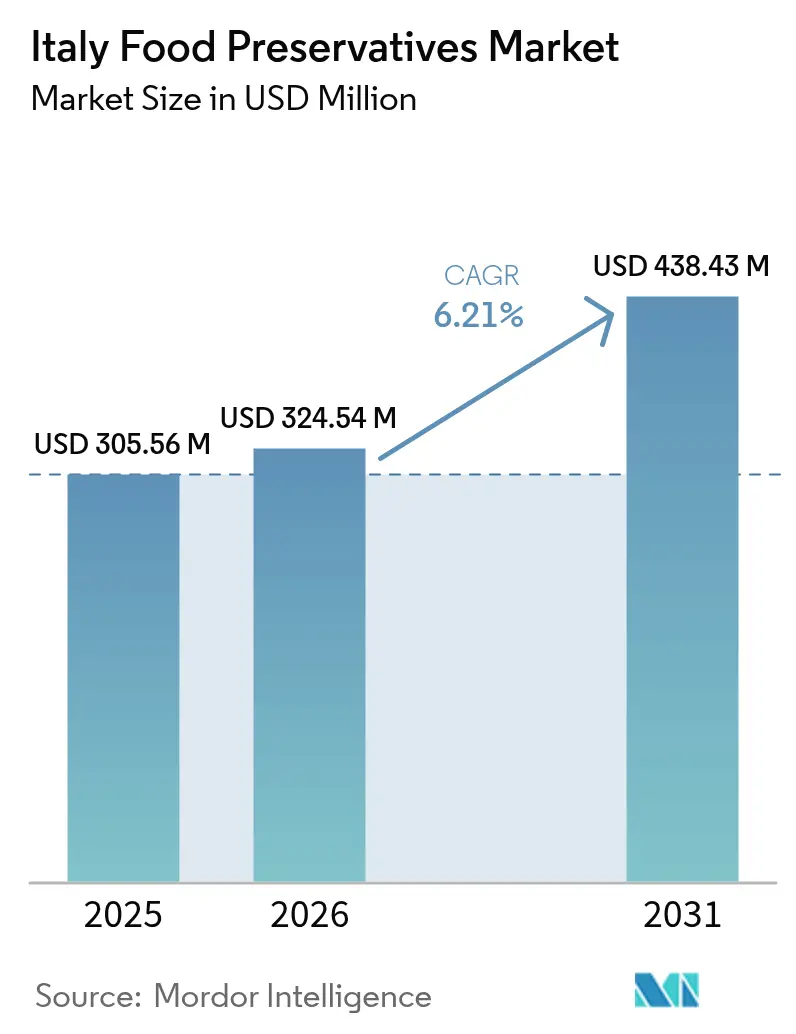
The Italy food preservatives market size was valued at USD 305.56 million in 2025 and estimated to grow from USD 324.54 million in 2026 to reach USD 438.43 million by 2031, at a CAGR of 6.21% during the forecast period (2026-2031). The market shows strongest growth in Northern Italy's industrial regions, driven by urban lifestyle patterns, expanding ready-meal production, and concentrated meat and seafood processing facilities requiring preservation solutions. The market adapts to evolving EU regulations, promoting natural preservative adoption while maintaining synthetic preservatives in mass-market products. Antimicrobial preservatives remain the primary choice for ensuring food safety, while antioxidants show rapid growth due to expansion in chilled meals and premium oil categories. The market structure features moderate consolidation, with international companies like Cargill, BASF, and Kerry competing with local specialists who focus on Mediterranean-sourced natural preservatives to meet clean-label requirements.
Key Report Takeaways
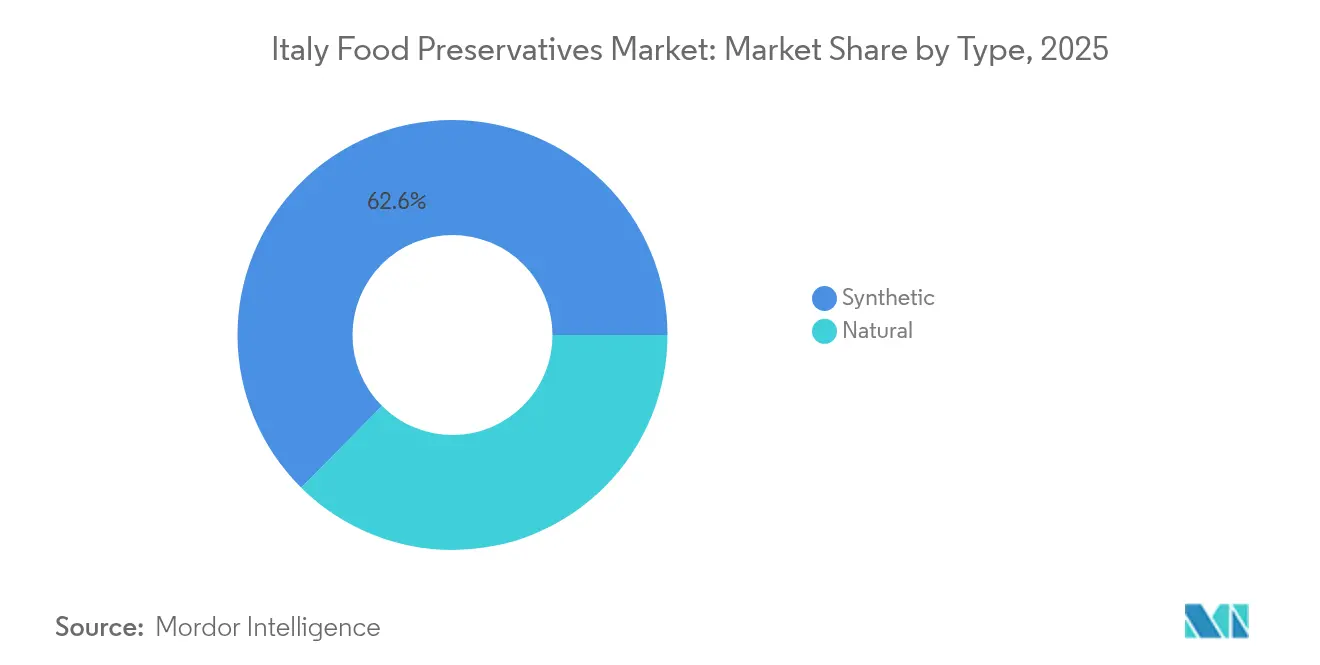
- By type, synthetic preservatives led with 62.58% of the Italy food preservatives market share in 2025, while the natural segment advances faster at CAGR 6.63%.
- By function, antimicrobials dominated with 56.35% revenue share in 2025; antioxidants record the highest 7.38% CAGR for 2026-2031 amid the rise of chilled ready meals.
- By form, dry/granular formats captured 60.89% of the Italy food preservatives market size in 2025, whereas liquid formats are projected to expand at CAGR 6.71%.
- By application, meat and poultry segment dominates applications with 30.12% share, while ready meals segment accelerates fastest at 7.1% CAGR.
Note: Market size and forecast figures in this report are generated using Mordor Intelligence’s proprietary estimation framework, updated with the latest available data and insights as of 2026.
Italy Food Preservatives Market Trends and Insights
Drivers Impact Analysis*
| Drivers | (~) % Impact on CAGR Forcast | Geographic Relevance | Impact Timeline |
|---|---|---|---|
| Wider acceptance of convenience foods products | +1.2% | North Italy dominant, gradual spread to Central and South | Medium term (2-4 years) |
| Innovation and product launches in preservative market | +0.8% | National, with early adoption in industrial centers of North Italy | Short term (≤ 2 years) |
| Rising demand for organic and natural-based products | +0.6% | National, with higher concentration in urban centers | Medium term (2-4 years) |
| Technological innovations driving food preservation market | +0.4% | North Italy, with gradual adoption in Central regions | Long term (≥ 4 years) |
| Expanding organic and clean label preservative adoption | +0.9% | National, with premium segments in North and Central Italy | Medium term (2-4 years) |
| Growth in meat and seafood processing sector | +0.7% | National, with concentration in Northern processing hubs | Short term (≤ 2 years) |
| Source: Mordor Intelligence | |||
Wider Acceptance of Convenience Foods Products
The Italian convenience food market is growing significantly, particularly in the northern regions, where urbanization and busy lifestyles drive demand for ready-to-eat products. Data from the Italian Ministry of Health's NutrInform Battery app shows increased consumption of pre-packaged foods, with notable growth in urban centers like Milan, Turin, and Bologna. This trend creates demand for preservatives that maintain food safety and extend shelf life while meeting clean-label requirements. Pre-packaged salad consumption increased by 22% in Northern Italy in 2024, compared to 8% in Southern regions, demonstrating regional differences in convenience food adoption[1]. The trend is expected to expand southward, presenting opportunities for preservative applications in regions traditionally focused on fresh food.
Innovation and Product Launches in Preservative Market
The Italian food preservatives market is undergoing transformation due to regulatory requirements and evolving consumer preferences. The Italian Ministry of Health's 2024-2025 monitoring report indicates that manufacturers submitted 28 new preservative formulations for regulatory approval in 2024, with 65% comprising natural or clean-label solutions. This shift reflects a broader industry trend toward sustainable and consumer-friendly preservation methods. The European Food Safety Authority's (EFSA) ongoing re-evaluation of food additives has intensified innovation as manufacturers develop alternative preservatives [2]. The assessment process includes comprehensive safety reviews and efficacy testing of both existing and new preservative compounds. EFSA's 2024 assessment of common preservatives has led to product reformulations, specifically for items containing sulfites and synthetic antioxidants. These changes have prompted food manufacturers to invest in research and development of novel preservation technologies while ensuring compliance with evolving regulatory standards.
Rising Demand for Organic and Natural-Based Products
The growth of Italy's organic market has significantly increased demand for natural preservatives that meet organic certification standards. Food and beverage manufacturers face the dual challenge of maintaining product safety and extending shelf life while adhering to strict organic regulations that restrict synthetic preservative use. This market shift has intensified research and development initiatives focused on identifying effective natural alternatives, particularly from plant and fruit extracts, that comply with organic certification requirements. Manufacturers are investing heavily in innovative preservation methods, including fermentation processes and bioactive compounds, while exploring sustainable plant-based solutions to ensure product longevity without compromising organic integrity. The emphasis on natural preservation methods has also created opportunities for ingredient suppliers specializing in organic-compliant preservation solutions.
Technological Innovations Driving Food Preservation Market
The Italian food preservation market is advancing through the integration of non-thermal processing, active packaging, and biopreservation technologies. Non-thermal processing methods, such as high-pressure processing and pulsed electric fields, maintain food quality while extending shelf life. Active packaging systems incorporate antimicrobial agents and oxygen scavengers to protect food products, while biopreservation utilizes natural compounds and beneficial microorganisms. These methods enhance traditional preservation techniques while complying with current food safety standards. The European Food Safety Authority reports increased applications for food preservation technologies that combine physical and biological methods, reducing the use of chemical preservatives without compromising safety standards. This shift toward natural preservation methods has resulted in a 30% reduction in synthetic preservative usage across Italian food manufacturers. This technological progression reflects Italy's focus on sustainable and efficient food preservation methods, in accordance with European food safety regulations, while meeting growing consumer demand for minimally processed foods.
Restraints Impact Analysis*
| Restraint | (~) % Impact on CAGR Forecast | Geographic Relevance | Impact Timeline |
|---|---|---|---|
| Regulations restricting preservative utilisation | -0.9% | Nationwide, stricter in the North | Short term (≤ 2 years) |
| Growing health awareness drives natural preference | -0.7% | Major urban centers | Medium term (2-4 years) |
| Shift toward fresh and minimally processed food | -0.8% | Central and South strongest | Medium term (2-4 years) |
| Rising demand for “additive-free” products | -0.6% | Premium and urban retail | Long term (≥ 4 years) |
| Source: Mordor Intelligence | |||
Regulations on Utilisation of Preservatives in Food Products
Italy's regulatory framework for food preservatives aligns with EU regulations while maintaining additional national provisions, creating compliance challenges for manufacturers. The Italian Ministry of Health's National Control Plan for food additives and flavorings 2025-2027 has strengthened the monitoring of preservative usage, with emphasis on sulfites, nitrates, and synthetic antioxidants. In 2024, official controls identified non-compliance issues with sulfur dioxide and sulfites in 12% of sampled products, leading to product recalls and financial penalties. These regulatory requirements present specific challenges for international companies entering the Italian market, as they must comply with both EU-wide and Italy-specific regulations.
Growing Health Awareness Increases Demand for Natural Preservatives
Italian consumers' growing health awareness is influencing the market to reduce or eliminate synthetic preservatives, particularly those associated with health concerns. According to a 2025 CENSIS report, 44.1% of Italians have encountered information about potential health risks linked to food additives, with 37% of consumers actively avoiding products containing specific preservatives [3]. The Italian Association for Cancer Research (AIRC) has raised concerns about nitrates and nitrites, which the International Agency for Research on Cancer (IARC) classifies as probable carcinogens. The maximum permissible amount in Italy is 150 mg/kg. This consumer awareness drives product reformulation efforts while presenting technical challenges, as natural alternatives often demonstrate lower effectiveness, limited application scope, and higher costs. For instance, replacing synthetic antioxidants like BHA and BHT with natural alternatives such as rosemary extract requires 2-3 times higher dosage levels to achieve similar shelf life extension, affecting both cost structures and product formulations.
*Our forecasts treat driver/restraint impacts as directional, not additive. The impact forecasts reflect baseline growth, mix effects, and variable interactions.
Segment Analysis
By Type: Synthetic Preservatives Dominate Despite Natural Growth
The Italian food preservatives market remains dominated by synthetic preservatives, which hold a 62.58% market share in 2025. This dominance stems from their cost-effectiveness, stability, and broad antimicrobial properties, with sorbates and benzoates being the primary choices in bakery products, beverages, and dairy items. The European Food Safety Authority's ongoing re-evaluation of food additives has created regulatory uncertainty, further highlighted by the Italian Ministry of Health's 2024 monitoring program, which found 12% of products containing sulfites exceeding permitted levels, leading to increased compliance costs for manufacturers.
Natural preservatives, currently at 37.42% market share, demonstrate strong growth potential with a 6.63% CAGR (2026-2031), surpassing overall market growth. Manufacturers are directing research and devlopment investments toward natural preservative development, anticipating stricter synthetic regulations. Local processors are exploring fermentation-derived lactates and vinegar blends that offer comparable antimicrobial effectiveness while minimizing taste impact. However, adoption in price-sensitive market segments remains limited due to inconsistent performance and higher costs.

By Function: Antimicrobials Safeguard Staples; Antioxidants Outpace
Antimicrobial preservatives hold a dominant 56.35% share in the Italian food preservatives market in 2025. This dominance reflects Italy's emphasis on microbiological safety in food products. The Italian Ministry of Health's National Control Plan for food additives 2025-2027 prioritizes monitoring antimicrobial preservatives, particularly in meat products, ready meals, and bakery items.
The antioxidants segment is projected to grow at a CAGR of 7.38% during 2026-2031. This growth stems from the Italian food industry's requirements for extended shelf life while maintaining nutritional value and sensory qualities. The Italian Ministry of Agriculture's Strategic Plan for Innovation and Research identifies antioxidants as a priority development area, with emphasis on natural antioxidants from agricultural by-products, supporting circular economy initiatives.
By Form: Dry Preservatives Maintain Market Leadership Despite Liquid Growth
Dry/granular preservatives account for 60.89% of the Italian preservatives market in 2025, maintaining their dominance due to stability advantages and compatibility with Italy's dry food production sectors. These preservatives exhibit lower degradation during storage compared to liquid forms, ensuring consistent efficacy throughout shelf life. The precise dosage control and extended shelf life of dry preservatives align with Italy's food manufacturing requirements across artisanal and industrial production scales.
Liquid preservatives are growing at 6.71% CAGR (2026-2031), primarily in beverage applications, sauces, and dairy products. The Italian Committee for Biosecurity, Biotechnology, and Life Sciences (CNBBSV) reports that liquid preservatives provide better homogeneous distribution and faster activation in high-moisture food systems where antimicrobial efficacy requires rapid dispersion. This growth corresponds with increasing demand for minimally processed foods that maintain fresh characteristics while ensuring safety and extended shelf life.

By Application: Ready Meals Accelerate under Urban Lifestyles
The meat and poultry segment commands the largest market share at 30.12% in 2025, driven by Italy's high consumption of processed meat products. The segment's prominence stems from the country's extensive production of cured meats, salami, and processed poultry products, which require advanced preservation systems to ensure food safety, maintain color stability, and preserve sensory qualities.
Ready meals are experiencing the highest growth rate at 7.1% CAGR (2026-2031). This growth is primarily attributed to evolving consumption patterns in Italy, especially in Northern regions where urban lifestyles increase demand for convenient, authentic Italian cuisine. Ready meals require specialized preservation solutions due to their multi-ingredient composition, necessitating comprehensive systems that maintain both food safety and quality throughout the product shelf life.
Geography Analysis
The Italian food preservatives market demonstrates distinct regional patterns influenced by local culinary traditions, industrial development, and consumer preferences. The northern regions of Lombardy, Piedmont, and Veneto account for the highest preservative consumption due to their concentrated food processing facilities and increased adoption of convenience foods.
Food manufacturers in these regions prioritize shelf-life extension while maintaining product quality, creating demand for both synthetic and natural preservatives. Northern Italy shows a strong preference for natural preservatives, particularly in traditional meat products like salami and prosciutto, with producers increasingly substituting synthetic nitrates and nitrites with natural alternatives.
While regional variations in Italy's food preservatives market continue, the gap between regions is reducing. Southern regions are gradually adopting convenience-oriented food consumption patterns, while Northern producers are implementing natural preservation methods in response to consumer demand for clean-label products.
Regulatory Landscape
Italy food preservatives operate under the EU-harmonized food additive framework, with the Ministero della Salute coordinating official controls across regions and local health units. Market access depends on the EU positive list under Regulation (EC) 1333/2008, with authorizations handled through the common procedure in Regulation (EC) 1331/2008 and scientific risk assessment by the European Food Safety Authority (EFSA).
For enforcement, the Piano nazionale di controllo ufficiale degli additivi e aromi alimentari 2025-2027 strengthens surveillance of preservative use and labeling through structured sampling and follow-up actions. Regulatory updates also require ongoing specification management, including Commission Regulation (EU) 2026/196 (adopted January 2026), which amends conditions and specifications affecting several hydrocolloids used in foods and creates transition timing pressures around changeovers and stock exhaustion within the compliance window.
Value Chain Analysis
The Italy food preservatives value chain begins with global and regional ingredient manufacturers and formulators, supplying synthetic and natural systems into Italian food processing. Processors are concentrated in industrial hubs in Northern Italy, applying preservatives to products such as meat and poultry, seafood, bakery, sauces, and ready meals, using dry/granular or liquid dosing. Distribution and retail then move the finished products to end consumers, supported by industry coordination through national associations such as Federalimentare, Unione Italiana Food, and Filiera Italia.
Quality assurance, traceability, and compliance sit across production and distribution, with HACCP-based food safety management embedded under EU Regulation 852/2004 and Italy-specific enforcement under the Ministry of Health control architecture. The Piano nazionale di controllo ufficiale degli additivi e aromi alimentari 2025-2027 structures official monitoring, while Border Control Posts and health offices, including UVAC and USMAF-SASN, manage entry controls for relevant inputs, making additive specification control and documentation readiness key operational checkpoints for suppliers.
Competitive Landscape
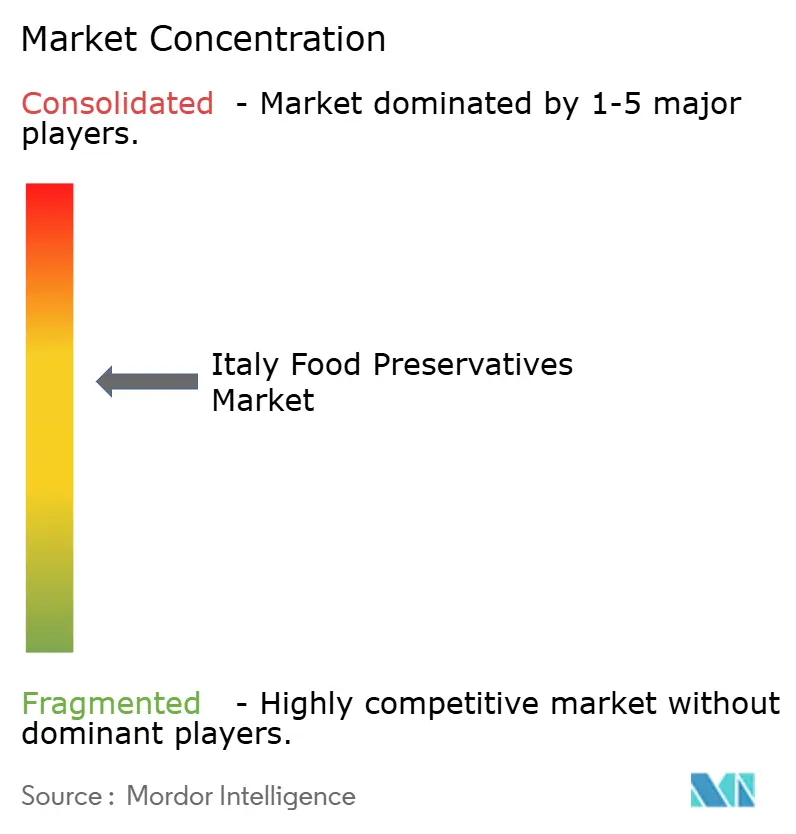
The Italian food preservatives market demonstrates moderate concentration, characterized by a diverse mix of global ingredient suppliers and local specialized companies. Market competition is significantly influenced by increasingly stringent regulatory requirements, rising consumer demand for natural preservation solutions, and the continuous challenge of balancing effective preservation with clean-label requirements. The market dynamics are further shaped by evolving food safety standards and changing consumer preferences towards minimally processed foods.
Global companies such as Cargill, BASF, and Kerry Group leverage their substantial research and development capabilities and extensive product portfolios to provide comprehensive preservation solutions across various food categories. These companies invest heavily in innovation to develop new preservation technologies and natural alternatives. In contrast, Italian companies have carved out specialized niches, particularly in developing natural preservatives derived from Mediterranean botanicals, capitalizing on local agricultural resources and traditional preservation knowledge.
The market increasingly emphasizes strategic partnerships between ingredient suppliers and food manufacturers, as preservative solutions evolve from standard additives to customized applications tailored to specific food products and processing conditions. This transformation reflects a complex market environment where preservative suppliers must simultaneously address multiple consumer concerns, including food safety, shelf life extension, clean label demands, and sustainability requirements. Companies that successfully balance these various demands while maintaining product effectiveness are better positioned to maintain and grow their market share.
Italy Food Preservatives Industry Leaders
-
Archer Daniels Midland Company
-
Cargill Incorporated
-
Foodchem International Corporation
-
International Flavors & Fragrances Inc.
-
Kerry Group plc
- *Disclaimer: Major Players sorted in no particular order
Market Opportunities and Future Outlook
Clean-label reformulation and the performance constraints faced in ready meals and processed meats are driving demand for natural antimicrobial and antioxidant systems that can preserve sensory quality at industrial scale. Adoption can be more challenging where higher natural dosages affect cost and flavor, but Italy’s innovation pathways in biopreservation and mild technologies provide multiple routes to scale these approaches. ONFOODS research projects on food-grade antimicrobial peptides, along with initiatives using waste extracts, fermentation, and mild processing, target shelf-life improvement while reducing additive load.
Investment activity in the ingredient sector also creates adjacent routes for preservative adoption across bakery, confectionery, plant-based, and gluten-free platforms. Nexture signing an agreement to acquire Sipral Padana (January 2026) supports semi-finished ingredient capabilities, while Cereal Docks agreeing to acquire 75% of Pasini Riso e Derivati (June 2026) expands plant-based and gluten-free ingredients. Together, these moves broaden the number of Italian processors and product formats where integrated preservation, taste, and texture systems can be deployed, and the 2025-2027 national control plan reinforces demand for suppliers that can provide compliant, documented preservative systems aligned with EU specifications and EFSA re-evaluation dynamics.
Recent Industry Developments
- June 2026: Cereal Docks signed an agreement to acquire 75% of Pasini Riso e Derivati, strengthening its position in plant-based and gluten-free ingredients. The transaction expands Italian ingredient production and application breadth in categories where shelf-life stabilization and oxidation control are critical, supporting broader pull-through for preservative systems across processed foods.
- July 2025: Kerry defended its Accel plant-based natural curing agent patent after a US Federal Court appeal confirmed the patent as valid and enforceable. The decision reinforces Kerry’s ability to commercialize proprietary natural curing and preservation approaches in meat applications, shaping competitive differentiation in clean-label antimicrobial systems.
- January 2024: Jungbunzlauer Suisse AG Basel received a newly introduced European Union approval for Trimagnesium Citrate Anhydrous as a food additive. The approval supports broader formulation flexibility for fortified foods and supplements, strengthening the role of compliant additive portfolios in serving Italian food manufacturers under the EU positive-list system.
Research Methodology Framework and Report Scope
Market Definition and Coverage
For this methodology, the Italy food preservatives market covers the value of preservatives sold for use in food and beverage processing in Italy, including natural and synthetic options used to slow spoilage and protect shelf life.
Scope exclusions: We exclude in-home preservation use, food processing equipment, and finished retail food product value, only the preservative ingredient value is counted.
Segmentation Overview
- By Type
- Synthetic
- Natural
- By Function
- Antimicrobial
- Antioxidants
- By Form
- Dry/Granular
- Liquid
- By Application
- Bakery and Confectionery
- Meat and Poultry
- Ready Meals
- Sweet and Savory Snacks
- Sauces and Dressings
- Edible Oils
- Other Applications
Data Sources, Market Sizing, and Validation
Desk Research
Desk research is used to build the first demand picture for preservatives used across Italy's packaged food and beverage output, and to understand what is allowed and commonly used in formulations. We referenced public and official sources such as Italian and EU food additive regulations and guidance, national statistical releases on food manufacturing output, trade statistics for relevant chemical and ingredient categories, and customs style import and export tables.
To tighten assumptions, we also reviewed peer reviewed food science journals on preservative usage patterns, trade association publications that discuss ingredient adoption, and company filings and investor presentations that describe Italy or Europe ingredient sales exposure. Where needed, paid subscriptions that cover company financials and intelligence, patent databases, and shipment level import and export data were used to sanity check supplier footprints and pricing direction. These desk sources are illustrative only, and many other references were reviewed for data collection, validation, and clarification.
Primary Interviews and Surveys
Primary work focused on validating what is being consumed by food manufacturers in Italy, and how buying behavior is changing between natural and synthetic options. We spoke with a mix of ingredient suppliers, distributors, food processors, and technical experts, and the conversations were used to confirm application shares, typical treat rates, and realistic price ranges by preservative function. Since this is a country level market, the fieldwork covered the main producing regions indirectly through nationwide supplier and buyer coverage.
Distribution of primary research fieldwork respondents
| Company type | Respondent position |
|---|---|
| Top tier: 33% | CXOs: 12% |
| Mid tier: 48% | Functional/Unit leaders: 30% |
| Smaller Players: 19% | Managers: 58% |
Market-Sizing & Forecasting
Sizing starts with a top-down build where Italy food production indicators and preservative adoption patterns are used to reconstruct the addressable demand pool, and then the value is derived using blended price assumptions. After that, we corroborate the total through selective bottom-up approximations, such as rolling up sampled supplier revenues tied to preservatives in Italy and checking ASP times volume for high usage applications. We then adjust the results when overlaps are detected.
Key model inputs include packaged food output trends, product mix shifts toward ready meals and bakery, the balance between antimicrobial preservatives and antioxidants, indicative treat rates by application, import reliance for certain ingredient groups, and observed price movement for common preservative chemistries and natural extracts. For forecasts, scenario analysis is used so the growth path reflects different adoption speeds for clean label reformulation, regulatory pressure on specific additives, and cost pass-through to food manufacturers. Where direct volume signals are weak, gaps are handled by anchoring on application level demand shares confirmed in interviews and then applying conservative price bands that are reviewed again during validation.
Data Validation & Update Cycle
Outputs are checked against independent signals such as import trends, food manufacturing growth, and supplier commentary on demand direction, and any large variance triggers a deeper review of assumptions. Before sign-off, numbers are tested for logical consistency across applications and functions, and we re-contact sources if pricing, treat rates, or adoption shares appear out of line.
The report is refreshed annually, and interim updates are done when material events occur, including regulatory changes or sharp raw material price swings. Right before delivery, an analyst performs a final pass to ensure the market size reflects the latest available public statistics and the newest insights captured through recent conversations.
Mordor Intelligence's Italy Food Preservatives Market Market Size Versus Other Published Estimates
Published estimates for Italy food preservatives can look far apart because teams are not always sizing the same scope, and timing choices can shift the value. The biggest differences usually come from what is counted as a preservative ingredient, whether the number is Italy-only sales or broader Europe allocations, and whether the estimate is anchored to production consumption or a narrower trade-flow view.
The main gap comes from whether natural extracts and multi-functional ingredients are counted only when they are sold and used primarily for preservation, which is how Mordor Intelligence treats the scope, instead of being fully included whenever they appear in a formulation or in broader food ingredient totals.
Benchmark comparison
| Source | Market Size | Gaps in Research Methodology |
|---|---|---|
| Mordor Intelligence | USD 305.56 M (2025) | |
| Industry Publisher A | USD 76.10 M (2025) | Uses a narrower definition that can undercount preservatives sold as part of broader ingredient blends, and it may apply conservative pricing bands that do not fully reflect Italy-specific industrial buying prices. |
| Consultancy B | USD 43.50 M (2024) | Anchored to an earlier base year and a smaller captured demand pool, and it can miss cross-application usage when the model relies more on limited category coverage rather than a full food manufacturing link. |
Looking across the three values, the spread is mainly explained by scope and year alignment, followed by how prices and inclusion rules are applied for natural and blended ingredients. By keeping the build tied to food manufacturing demand signals and then checking it with supplier side reality checks, the final figure stays traceable to clear steps that a client team can review and replicate.
Key Questions Answered in the Report
What is the projected value of the Italy food preservatives market by 2031?
The market is forecast to reach USD 438.43 million by 2031, expanding at a 6.21% CAGR.
Which preservative type grows fastest in Italy?
Natural preservatives register the highest 6.63% CAGR, driven by organic product expansion and clean-label demand.
Why are antioxidants in higher demand now?
Rising consumption of chilled ready meals and premium oils increases the need to curb oxidation without compromising nutrition, propelling antioxidants at a 7.38% CAGR.
How are regulations affecting synthetic preservatives?
Stricter EU-aligned Italian controls have raised compliance costs; 12% of surveyed products breached sulfite limits in 2024, spurring reformulation toward natural alternatives.