
Market Overview
| Study Period | 2020 - 2031 |
|---|---|
| Forecast Data Period | 2026 - 2031 |
| Base Year Market Size (2025) | USD 4.12 Billion |
| Market Size (2026) | USD 4.65 Billion |
| Market Size (2031) | USD 8.48 Billion |
| Growth Rate (2026 - 2031) | 12.78 % |
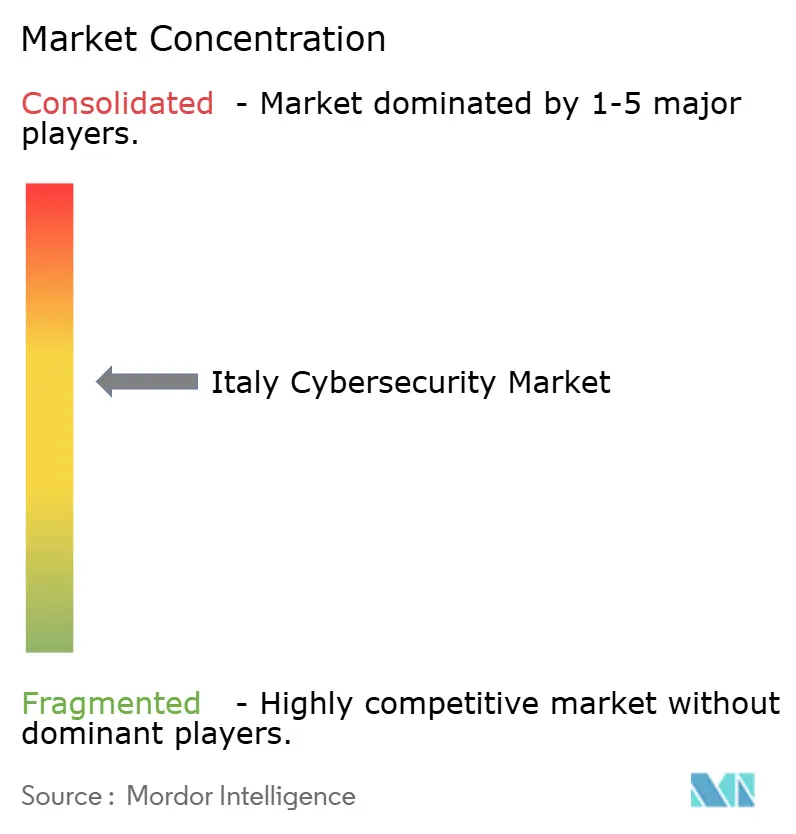
| Market Concentration | Medium |
Major Players *Disclaimer: Major Players sorted in no particular order Image © Mordor Intelligence. Reuse requires attribution under CC BY 4.0. | |
Italy Cybersecurity Market Analysis by Mordor Intelligence
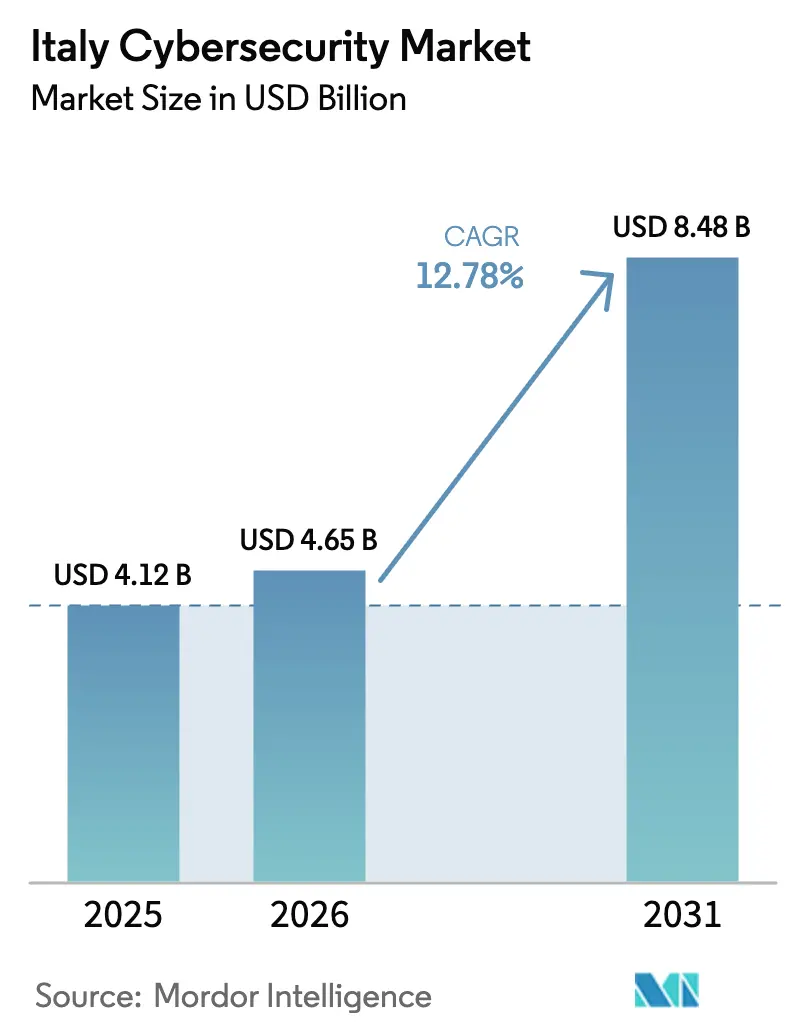
The Italy cybersecurity market size was valued at USD 4.12 billion in 2025 and estimated to grow from USD 4.65 billion in 2026 to reach USD 8.48 billion by 2031, at a CAGR of 12.78% during the forecast period (2026-2031). Growth is led by compulsory compliance with EU laws such as the NIS2 Directive and the Digital Operational Resilience Act, together with USD 2.2 billion in public funding dedicated to national cyber-perimeter programs. [1] Rising ransomware attacks on operational technology, fast cloud adoption in Milan and Turin, and quantum-resistant encryption pilots are reshaping corporate investment road maps. Board-level attention has intensified as the manufacturing sector absorbed 70% of all industrial ransomware incidents in Q4 2024. Large enterprises still dominate spend, yet soaring SME demand, a deepening talent crunch, and state incentives for “Made-in-Italy” platforms are realigning the competitive field.
Key Report Takeaways
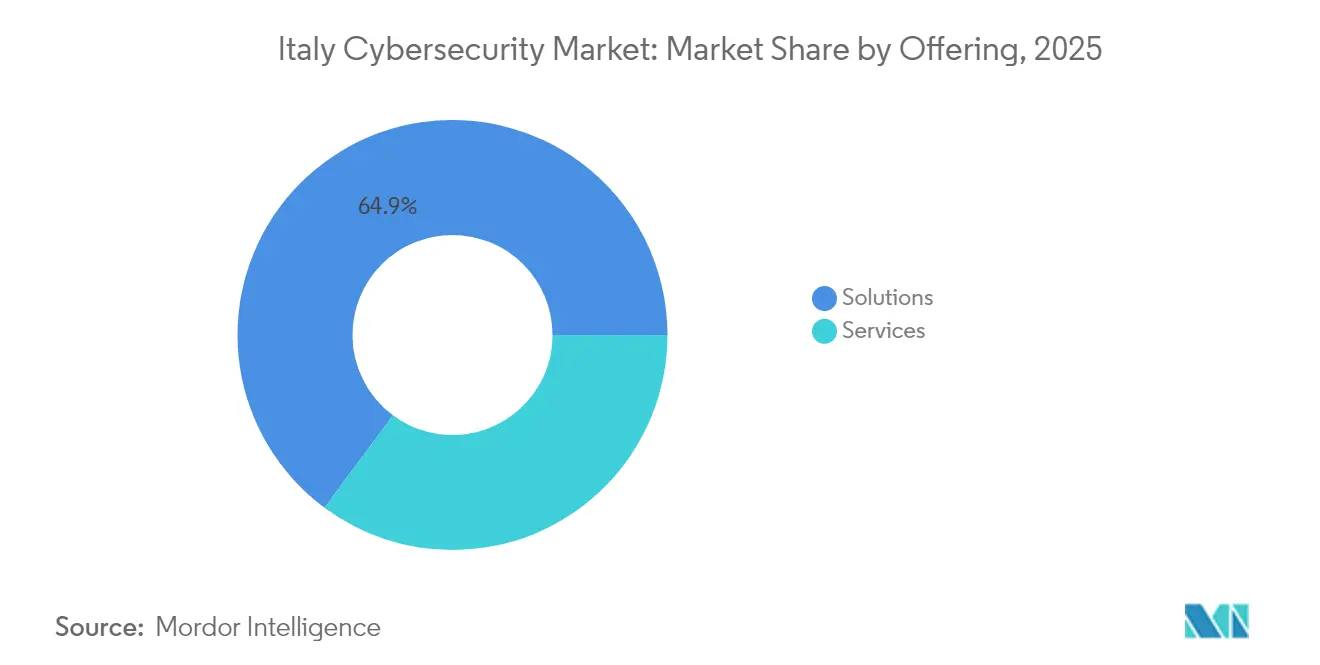
- By offering, solutions led with a 64.85% share in 2025, while services are forecast to grow at a 13.95% CAGR through 2031.
- By deployment mode, on-premise held 59.85% of Italy cybersecurity market share in 2025; cloud is projected to post an 17.55% CAGR to 2031.
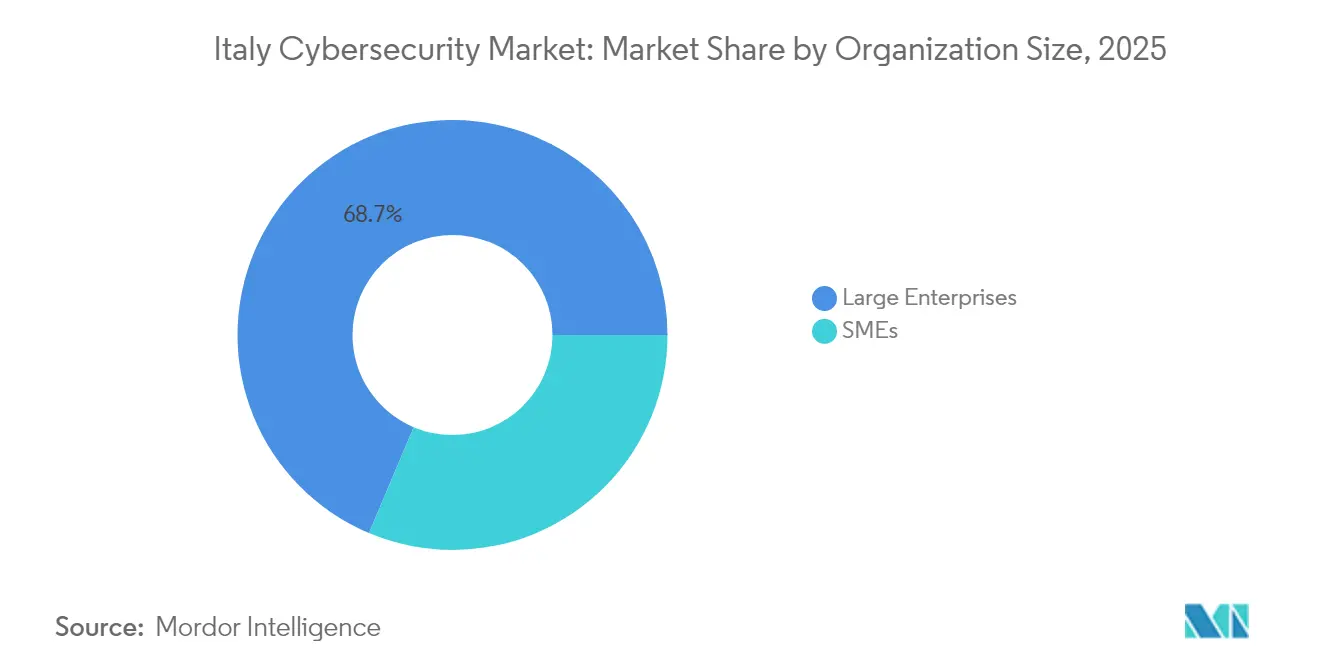
- By organization size, large enterprises commanded 68.65% of Italy cybersecurity market size in 2025; the SME segment is set to expand at 14.88% annually.
- By end user, BFSI led with 26.35% revenue share in 2025, while healthcare is advancing at a 15.92% CAGR to 2031.
Note: Market size and forecast figures in this report are generated using Mordor Intelligence’s proprietary estimation framework, updated with the latest available data and insights as of 2026.
Italy Cybersecurity Market Trends and Insights
Drivers Impact Analysis*
| Driver | (~) % Impact on CAGR Forecast | Geographic Relevance | Impact Timeline |
|---|---|---|---|
| Digital-first public-service mandates accelerating national cyber-perimeter programs | +3.50% | Rome, Milan, Turin | Medium term (2-4 years) |
| Surge in ransomware attacks targeting industrial automation networks | +2.80% | Po Valley corridor | Short term (≤ 2 years) |
| EU NIS2 and DORA compliance deadlines driving budget re-allocation | +4.20% | Milan, Rome | Medium term (2-4 years) |
| Cloud-native start-up boom requiring SaaS security posture management | +1.80% | Milan, Turin | Medium term (2-4 years) |
| Growth of OT/ICS installations in the energy corridor | +1.20% | Po Valley | Long term (≥ 4 years) |
| Increased government incentives for “Made-in-Italy” cyber platforms | +1.40% | Rome, Milan | Medium term (2-4 years) |
| Source: Mordor Intelligence | |||
Digital-First Public-Service Mandates Accelerating National Cyber-Perimeter Programs
Italy earmarked 27% of National Recovery and Resilience Plan resources for digital transition, including USD 2.2 billion for cybersecurity. The National Cybersecurity Agency now obliges essential service providers to meet strict perimeter controls, yet only 2% of public administrations currently comply. As municipal portals, welfare payments and national ID services move online, local authorities in Rome, Milan and Turin are upgrading identity management and zero-trust frameworks, often contracting managed security operators to compensate for in-house skill shortages.
Surge in Ransomware Attacks Targeting Italian Industrial Automation Networks
Manufacturing firms absorbed 70% of industrial ransomware incidents in Q4 2024, a shift from mere data theft to operational sabotage. During Q1 2025 alone, Europe logged 135 OT-focused breaches. Factories along the Po Valley are hardening PLCs, segmenting networks and rolling out AI-driven anomaly detection to avoid multi-day production shutdowns. Vendor demand for secure remote-maintenance gateways has reached record levels.
EU NIS2 and DORA Compliance Deadlines Driving Budget Re-allocation Toward Security Tooling
Legislative Decree 138/2024 extended NIS2 coverage to more than 100,000 Italian entities, with fines of up to EUR 10 million or 2% of turnover for gaps. DORA adds sector-specific controls for finance from January 2025. Boards are diverting technology budgets toward log retention, incident reporting automation and threat-intelligence feeds, and 89% of regulated firms expect to hire extra cyber staff. [2]
Cloud-Native Start-up Boom in Milan and Turin Intensifying Demand for SaaS Security Posture Management
TIM’s 2024 alliance with Oracle sparked accelerated multicloud adoption. Venture-backed firms in Milan’s Porta Nuova district and Turin’s innovation precinct scale on Kubernetes yet face GDPR transfer hurdles, prompting uptake of CSPM and CNAPP solutions that map misconfigurations across regions. Cybersecurity vacancies in these hubs are expected to rise 25% in 2025.
Restraints Impact Analysis*
| Restraint | (~) % Impact on CAGR Forecast | Geographic Relevance | Impact Timeline |
|---|---|---|---|
| Scarcity of Italian-speaking Cyber-Talent Raising MSSP Costs | -1.2% | National, with acute impact in Milan and Rome | Medium term (2-4 years) |
| Prevailing 'Security - Cost Center' Mind-set Within Mid-Market Manufacturing SMEs | -1.8% | National, with concentration in industrial regions | Medium term (2-4 years) |
| Fragmented Legacy Telco Infrastructure Hindering Zero-Trust Roll-outs | -0.8% | National, with emphasis on southern regions and rural areas | Long term (≥ 4 years) |
| Slow Migration from On-Prem HSMs in Highly Regulated BFSI Segment | -0.6% | Milan, Rome, and other financial centers | Medium term (2-4 years) |
| Source: Mordor Intelligence | |||
Scarcity of Italian-Speaking Cyber-Talent Raising MSSP Costs
Cybersecurity job postings fell 10% between 2022 and 2024 even as demand climbed, leaving 90% of organisations with skills gaps. Local-language SOC analysts command premiums, pushing smaller firms to delegate monitoring to managed security service providers headquartered in Milan and Rome.
Prevailing ‘Security - Cost Center’ Mind-set Within Mid-Market Manufacturing SMEs
OECD surveys show 18% of Italian SMEs operate without any cybersecurity protocols and only 18% are aware of available state aid. [3] Many family-owned factories reinsure lost production before they invest in threat prevention, stalling adoption of basic controls such as patching and MFA despite heightened exposure.
*Our forecasts treat driver/restraint impacts as directional, not additive. The impact forecasts reflect baseline growth, mix effects, and variable interactions.
Segment Analysis
By Offering: Services Outpace Solutions Growth
Solutions held 64.85% of Italy cybersecurity market share in 2025, led by network firewalls and identity platforms. Budget reallocations tied to NIS2 and DORA sustain robust refresh cycles among large banks and utilities. However, services are projected to record a 13.95% CAGR to 2031, eclipsing product growth as enterprises outsource SOC, penetration testing and incident response to mitigate the talent deficit. Managed detection and response platforms now bundle threat-hunting and regulatory reporting, creating sticky multi-year contracts. Italy cybersecurity market size for services is set to surpass USD 3.18 billion by 2031, aided by demand for 24/7 monitoring anchored in Italian language.
Italy cybersecurity market expands as consulting teams guide compliance mapping, architecture redesign and quantum-resilience pilots. Professional services revenues are rising fastest in Rome’s public-sector cluster, while MSSP uptake is highest in Milan’s financial quarter where tier-one banks off-load log correlation and digital-forensics workloads during merger integrations. Identity-as-a-Service and zero-trust assessments also gain traction among healthcare networks preparing for electronic health-record rollouts.

By Deployment Mode: Cloud Adoption Accelerates
On-premise solutions retained 59.85% of Italy cybersecurity market share in 2025, reflecting strong data-sovereignty preferences among critical infrastructure operators. Yet cloud-delivered controls are climbing at an 17.55% CAGR, driven by SaaS productivity suites, remote work, and rising comfort with EU-hosted hyperscale regions. As the Italy cybersecurity market size for cloud deployment surpasses USD 4.36 billion in 2031, demand concentrates on cloud-native SIEM, container runtime defense and policy-as-code automation that streamlines GDPR audits.
Hybrid architectures dominate transitional road maps: threat-intelligence lakes remain on-premise, while vulnerability scanning and backup encryption shift to SaaS. Cross-border data-transfer clauses under GDPR fuel interest in confidential computing and customer-managed keys. Vendors now bundle data-residency dashboards to win cautious public authorities migrating citizen portals to private-cloud nodes in Turin and Bologna.
By Organization Size: SMEs Close the Security Gap
Large enterprises commanded 68.65% of Italy cybersecurity market size in 2025 as banks, telecoms and energy majors maintained layered defenses spanning OT and IT estates. These firms pilot quantum-key-distribution links between data centers and embed AI-based attack-path mapping across dispersed subsidiaries. Compliance with DORA further widens tooling depth, from immutable backups to insider-risk analytics.
The SME segment, forecast to grow 14.88% annually, is unlocking fresh volume for unified threat management appliances and cloud-delivered endpoint security. Tax credits for digital upgrades and lower-priced MDR subscriptions are lowering barriers. Despite progress, only 2% of local authorities and many mid-market manufacturers have reached full framework alignment, highlighting a still-wide protection gap.
By End User: Healthcare Emerges as Growth Leader
BFSI retained a 26.35% revenue share in 2025, with banks accounting for 46% of finance-sector incidents. DORA mandates continuous penetration testing, creating lucrative niches for red-team providers and secure code-review consultancies. Banks deploying quantum-safe encryption report higher return on tangible equity, underlining cyber resilience as a profitability lever.
Healthcare is projected to expand at a 15.92% CAGR as telemedicine adoption swells. Italy cybersecurity market share in electronic medical-record hosting is rising swiftly after a ransomware breach triggered a EUR 25,000 GDPR (USD 29443.75) fine on a university hospital. Hospitals now prioritise privileged-access controls, network segmentation and immutable backups. Cloud-hosted imaging archives further lift demand for HIPAA-aligned CSPM tools.
Geography Analysis
Milan anchors the nation’s fintech and start-up scene. Eighty-two percent of European chief risk officers deem cyber risk their principal concern, pushing Milanese banks to triple spending on threat-intelligence feeds. With cybersecurity roles commanding up to EUR 74,000, the talent squeeze is acute, spurring heavy reliance on MSSPs. Cloud regions launched by hyperscalers draw SaaS vendors, further fuelling the Italy cybersecurity market in Lombardy.
The Po Valley industrial corridor, stretching from Turin to Venice, concentrates OT security deployments. Manufacturers are hardening PLCs and deploying deception grids after repeated ransomware shutdowns. SMEs there still treat security as overhead, explaining slower penetration of EDR and IAM. Regional innovation funds now offer grants covering up to 50% of pilot project costs, nudging family-owned factories toward zero-trust gateways and secure remote monitoring.
Rome remains the policy nucleus. The National Cybersecurity Agency coordinates sector CSIRTs and oversees annual registration of NIS2 entities. Public tenders for SOC-as-a-Service and citizen-ID authentication solutions keep local integrators busy. Yet only a fraction of ministries meet basic protocol benchmarks, highlighting the need for accelerated procurement cycles. Southern regions lag on connectivity, but targeted broadband rollouts under PNRR are beginning to level the field, opening space for tele-health security and municipal e-payment encryption.
Regulatory Landscape
Italy's cybersecurity regulatory framework is anchored by the National Cybersecurity Agency (Agenzia per la Cybersicurezza Nazionale, ACN), which oversees the national strategy and operational requirements for entities covered by the cyber perimeter and the NIS regime. Legislative Decree 138/2024 expanded NIS obligations in Italy to a very large population of entities, pairing broader coverage with material administrative exposure (including penalties referenced in the market context up to EUR 10 million or 2% of turnover) and accelerating board-level investment in incident reporting and control assurance.
ACN has continued to formalize requirements through implementing acts, including ACN Determination No. 379907 dated December 19, 2025, which sets technical measures and reporting obligations for NIS-covered entities. For newly included subjects added to the NIS list during 2026, ACN timelines require adoption of defined security measures by July 31, 2027, with incident notification obligations commencing January 1, 2027. Alongside compliance, ACN has promoted structured collaboration and threat intelligence exchange through initiatives including ISAC Italia, which supports multisector information sharing and contributes to demand for SOC tooling, threat intelligence feeds, and reporting automation.
Competitive Landscape
The competitive arena blends global brands and specialist Italian firms, with the top ten vendors controlling roughly 60% of overall revenue. Leonardo S.p.A. increased Cyber and Security Solutions turnover by 21% in Q1 2025 to EUR 168 million (USD 197.86 million), aided by sovereign SOC projects. Tinexta has rolled up niche providers to form a national cyber hub, driving cybersecurity sales up 33.4% in the quarter. Reply S.p.A. leverages generative-AI analytics to automate detection, posting an 8.9% revenue rise.
Strategic alliances shape differentiation. TIM’s subsidiary Telsy piloted quantum-key-distribution over existing fibre links, giving early-mover advantage in post-quantum security. Almaviva’s USD 335 million acquisition of Iteris added smart-mobility telemetry that feeds city-wide SOC dashboards. International players such as Palo Alto Networks and CrowdStrike compete on next-gen firewall refreshes and endpoint XDR, but localisation and in-country support remain decisive.
Italy Cybersecurity Industry Leaders
-
IBM Corporation
-
Cisco Systems Inc
-
Trend Micro Incorporated
-
Dell Technologies Inc.
-
Broadcom Inc. (Symantec)
- *Disclaimer: Major Players sorted in no particular order
Market Opportunities and Future Outlook
Public programs and compliance execution gaps create near-term whitespace in identity, logging, and managed operations for public administrations and newly covered NIS entities. The market context indicates that only a small share of public administrations currently meet perimeter controls, and NIS2 implementation has broadened the regulated base, pushing demand for packaged compliance mapping, continuous monitoring, and incident reporting automation delivered via MDR and SOC-as-a-Service. This is particularly relevant for municipalities and mid-market operators that cannot staff Italian-language SOC roles.
Opportunities are also tied to ACN-backed ecosystem building and workforce development that expand the domestic supplier pool and delivery capacity. ACN has funded the Cyber Innovation Network with EUR 12.5 million, including EUR 9 million for cybersecurity PhD support and EUR 2.25 million for startup development; a January 2026 public notice allocated EUR 2.25 million in non-repayable grants to 15 startups (up to EUR 150,000 each), supporting Made-in-Italy platforms in CNAPP/CSPM, threat intelligence, and sector-specific governance tooling. Parallel initiatives such as the Italian Cyber and Space Pole (PiCS), created by the AISES-SPES Academy and CNR, and ACN's agreement with Generation Italy to offer free cybersecurity training for 18-34 year olds, reinforce service demand that operationalizes controls across cloud and OT/ICS environments, including regulated verticals like finance and healthcare.
Recent Industry Developments
- June 2026: Cisco Systems Inc addressed critical-severity vulnerability in Cisco ISE and ISE-PIC with security updates to prevent remote unauthorized access. The patch protects key Italian network security deployments and reinforces post-quantum and zero-trust readiness in the Italian market.
- May 2026: Trend Micro Incorporated vulnerabilities addressed with security updates for Trend Micro Apex One and TrendAI Vision One. The update reduces risk exposure for Italian IT environments and supports continued uptake of Trend Micro managed and AI-backed security in the market.
- April 2026: IBM Corporation expanded its Rome managed security services perimeter to address local talent shortages, expanding Italy-based MSS offerings and security operations. The initiative strengthens IBM’s position in Italy’s MSS market and supports resilience in public and private sector cybersecurity.
Research Methodology Framework and Report Scope
Market Definition and Coverage
For this market, we measure the value of cybersecurity products and services purchased in Italy to prevent, detect, and respond to cyber threats across enterprises and public-sector users.
Scope exclusions: We exclude consumer antivirus-only spend, pure physical security systems, and general IT outsourcing that is not sold as a cybersecurity outcome.
Segmentation Overview
- By Offering
- Solutions
- Application Security
- Cloud Security
- Data Security
- Identity and Access Management
- Infrastructure Protection
- Integrated Risk Management
- Network Security Equipment
- Endpoint Security
- Other Solutions
- Services
- Professional Services
- Managed Services
- Solutions
- By Deployment Mode
- Cloud
- On-Premise
- By Organization Size
- SMEs
- Large Enterprises
- By End User
- BFSI
- Healthcare
- IT and Telecom
- Industrial and Defense
- Retail
- Energy and Utilities
- Manufacturing
- Others
Data Sources, Market Sizing, and Validation
Desk Research
Desk work starts with building the demand context for Italy, and then narrowing it to security-specific spend. We rely on public and official sources such as the Italian National Cybersecurity Agency (ACN) publications, Eurostat ICT usage and digital intensity indicators, EU documents tied to NIS2 and DORA, and OECD digital economy statistics to identify pressure points and adoption.
We also use trusted secondary material such as annual reports and investor presentations of relevant suppliers and managed service providers, cybersecurity incident and breach disclosures in reputed press, and procurement notices for government and regulated industries. To keep the revenue model practical, we additionally reference paid subscriptions for company financials and intelligence, and for broad news and financials trend tracking, which helps verify timelines and major contract activity. This list is not exhaustive, and many other public sources were used for data collection, validation, and clarification during the study.
Primary Interviews and Surveys
Primary work focuses on how buyers in Italy are actually budgeting and buying security, and what is changing year to year, which helps us stress-test assumptions from desk findings. We cover solution providers, channel partners, and service-focused firms, and we also speak with demand-side roles in regulated industries and large digital users to validate adoption pace and pricing movement.
Because the market is shaped by EU compliance and local procurement cycles, we probe for timing effects, renewal patterns, and how cloud security and managed detection are being bundled. Those inputs are then used to adjust model assumptions before final sign-off.
Distribution of primary research fieldwork respondents
| Company type | Respondent position |
|---|---|
| Top tier: 29% | CXOs: 15% |
| Mid tier: 55% | Functional/Unit leaders: 42% |
| Smaller Players: 16% | Managers: 43% |
Market-Sizing & Forecasting
Sizing is built using a top-down and bottom-up combination, where national IT and digital spend signals are first translated into a security demand pool for Italy, and then reconciled with supply-side checkpoints. In practice, the top-down path leans on security share of IT budgets by buyer type, compliance-driven uplift (including NIS2 and DORA preparedness), and sector mix effects, which are then cross-checked with a selective roll-up of supplier revenues and channel activity so the totals stay realistic.
Key model inputs include cloud adoption intensity, managed security penetration, incident and ransomware pressure reported by operators, public-sector program spend visibility, and average contract values for core security areas (such as endpoint, identity, and security operations). Where revenue coverage is incomplete in bottom-up checks, we fill gaps using sampled ASP ranges multiplied by estimated seat counts or protected assets, and then we re-test the implied per-employee security spend against what interviewees see in current budgets.
For forecasting, scenario analysis is applied with a base case that reflects expected compliance deadlines, renewal cycles, and ongoing migration to cloud and hybrid environments. Growth rates are adjusted using expert consensus on price progression, service mix shift toward managed offerings, and the timing of larger procurement waves that can move a single-year outcome.
Data Validation & Update Cycle
Validation is handled in layers so errors do not slip through. We compare model outputs against independent signals such as IT spending direction, disclosed security investment plans, and visible public procurement activity, and then variances are reviewed until they can be explained by scope or timing.
Anomaly checks are run at the year and category level, and any outsized jump triggers a re-check of inputs, currency conversions, and the implied ASP trend. Findings are reviewed by another analyst before sign-off, and contributors are re-contacted when assumptions change materially. Reports are refreshed annually, with interim updates for major regulatory shifts, large incidents, or policy funding changes, and a final pre-delivery pass is completed so clients receive the most current view.
Mordor Intelligence's Italy Cybersecurity Market Size Measured Against Other Published Estimates
Published values for Italy cybersecurity often do not line up because authors pick different cost buckets, base years, and currency handling. They also vary on whether services, training, and insurance are counted together. Differences become larger when the market is fast-moving, since renewals, compliance deadlines, and multi-year managed contracts can shift spend between years.
A common gap driver is refresh cadence, because using older price points for managed security and cloud security can understate current spending, while aggressive future price escalation can overstate it. Some estimates also mix end-user spend with supplier revenue, or include adjacent items like cyber insurance and awareness programs, which changes the total even before forecasting assumptions are applied. By re-checking currency timing and ASP progression close to publication and re-validating with Italy-focused interviews, Mordor Intelligence reduces drift that can come from stale exchange rates or outdated service mix assumptions.
Benchmark comparison
| Source | Market Size | Gaps in Research Methodology |
|---|---|---|
| Mordor Intelligence | USD 4.12 B (2025) | |
| Trade Journal A | USD 2.69 B (2024) | Reported in EUR as national cyber security spend and includes training and insurance, which is closer to end-user budget accounting and not aligned to a USD vendor revenue view or the 2025 base year. |
| Regional Consultancy B | USD 4.90 B (2024) | Combines cybersecurity with MSSP scope and uses a 2024 base year, which can lift totals by counting managed services more broadly and by applying different renewal timing and pricing assumptions. |
The spread is mainly explained by what gets counted and when it is counted, rather than a single disagreement on growth direction. When currency conversion timing, service mix, and base year are standardized, the remaining variance typically narrows, which makes the market path easier to compare across planning cycles.
Key Questions Answered in the Report
What is the current size of the Italy cybersecurity market?
The market is valued at USD 4.65 billion in 2026 and is projected to reach USD 8.48 billion by 2031.
Which segment is expanding fastest within the Italy cybersecurity market?
Services such as managed detection and response are growing at a 13.95% CAGR, the highest among all offerings.
How are EU regulations affecting Italian cybersecurity spending?
The NIS2 Directive and DORA impose mandatory controls and heavy fines, prompting many firms to reallocate budgets toward security tooling and staffing.
Why is healthcare the fastest-growing vertical?
Rapid digitalisation of patient records and a spike in ransomware incidents are pushing hospitals to scale cybersecurity budgets, resulting in a 15.92% forecast CAGR.
What challenges impede market growth?
A shortage of Italian-speaking cyber professionals and a persistent view of security as a cost among manufacturing SMEs are restraining the overall CAGR by nearly three percentage points.
Which regions in Italy show the strongest cybersecurity demand?
Milan leads with heavy BFSI investment, Po Valley focuses on OT security for manufacturing, and Rome drives public-sector procurement under national cyber-perimeter programs.