
Market Overview
| Study Period | 2020 - 2031 |
|---|---|
| Forecast Data Period | 2026 - 2031 |
| Base Year Market Size (2025) | USD 228.70 Billion |
| Market Size (2026) | USD 236.32 Billion |
| Market Size (2031) | USD 278.29 Billion |
| Growth Rate (2026 - 2031) | 3.33 % |
| Market Concentration | Medium |
Major Players
*Disclaimer: Major Players sorted in no particular order Image © Mordor Intelligence. Reuse requires attribution under CC BY 4.0. |
|
Italy Construction Market Analysis by Mordor Intelligence
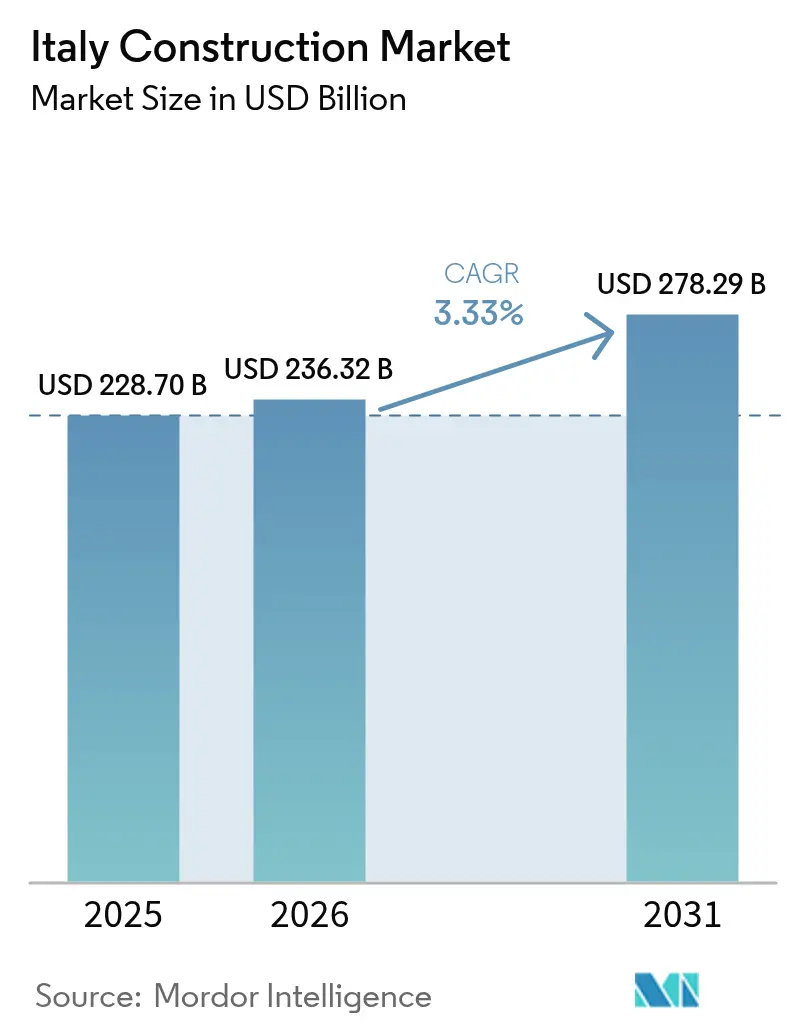
The Italy Construction Market size is expected to grow from USD 228.70 billion in 2025 to USD 236.32 billion in 2026 and is forecast to reach USD 278.29 billion by 2031 at 3.33% CAGR over 2026-2031. A surge in public infrastructure spending, large-scale energy-efficiency upgrades, and the rebound of private commercial investment are reshaping short-term demand patterns. Infrastructure work, from high-speed rail corridors to national grid enhancements, is expanding at a pace that outstrips overall growth, pulling specialist contractors and equipment suppliers into new regional clusters. Meanwhile, regulatory deadlines set by the Energy Performance of Buildings Directive (EPBD) are redirecting renovation strategies toward deep-retrofit packages, sparking innovation in materials and digital construction workflows. Companies able to blend traditional capabilities with modular techniques and data-driven project controls are capturing a widening share of contracts as clients demand shorter delivery times, lower carbon footprints, and rigorous cost certainty.[1]European Commission, “Economic forecast for Italy"
Key Report Takeaways
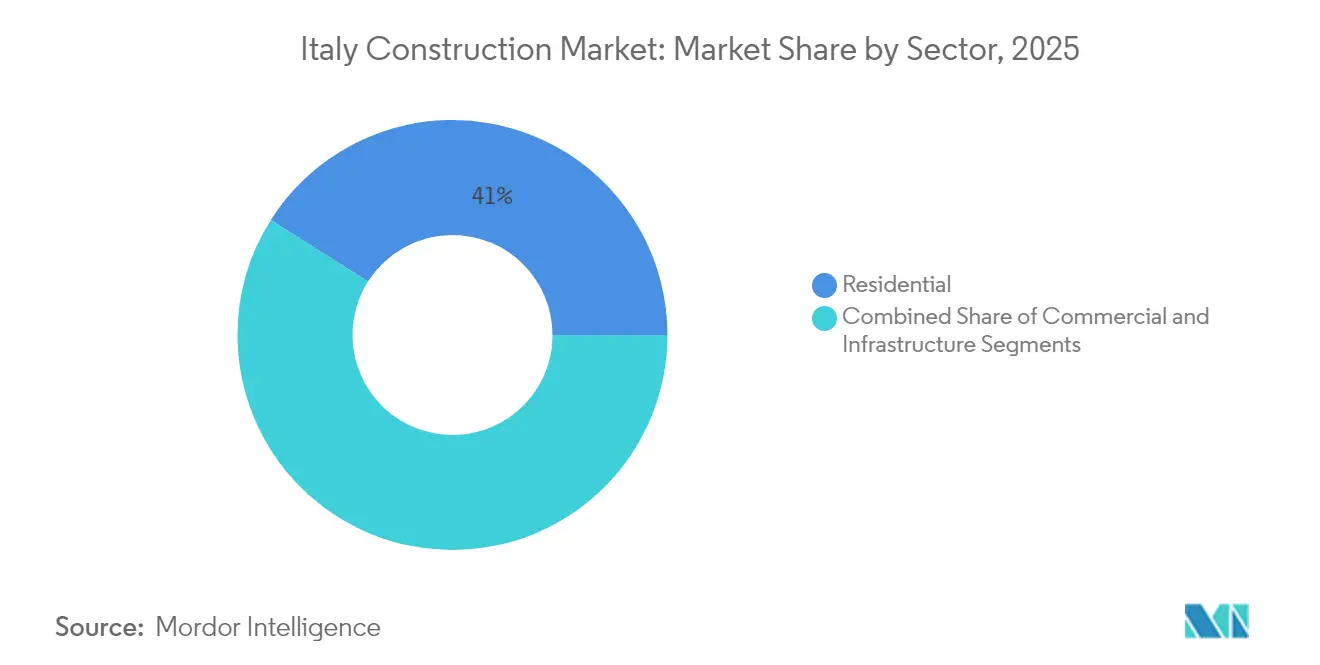
- By sector, Residential captured 41.02% of the Italy construction market share in 2025. Italy construction market size for residential is projected to grow at a 3.38% CAGR between 2026-2031.
- By construction type, New construction captured 54.62% of the Italy construction market share in 2025. Italy construction market size for new construction is projected to grow at 3.74% CAGR between 2026-2031.
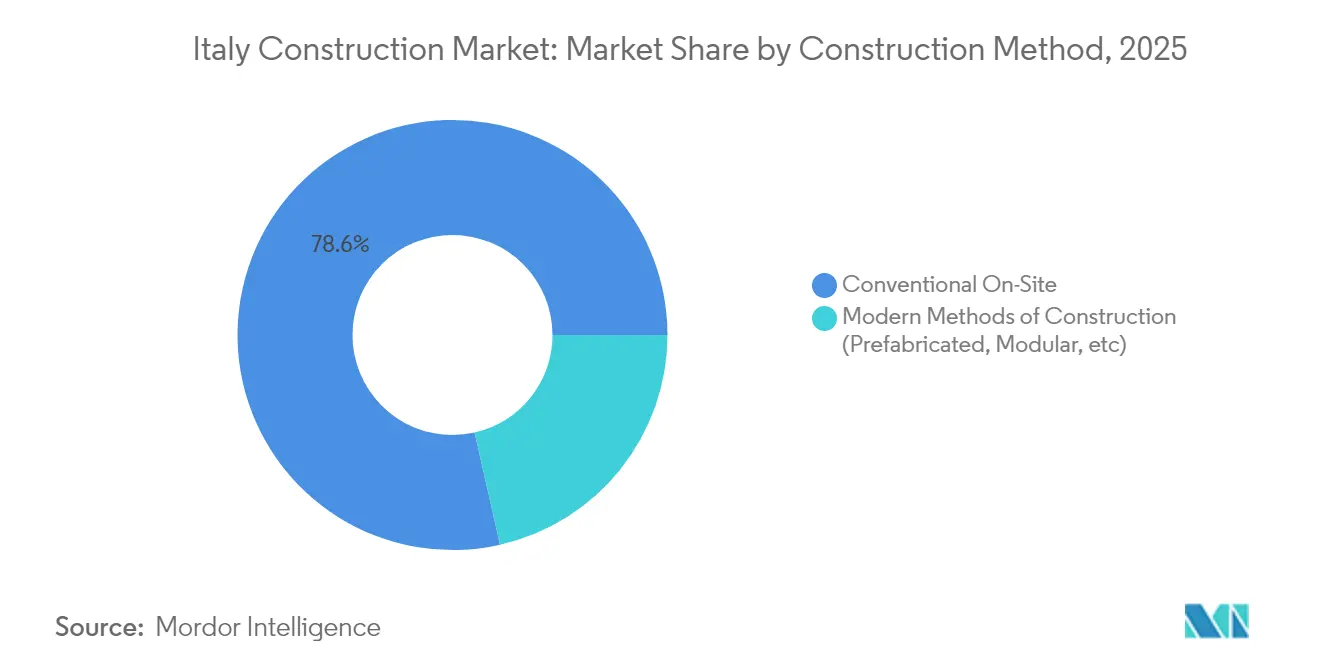
- By construction method, Conventional on-site techniques captured 78.55% of the Italy construction market share in 2025. Italy construction market size for conventional on-site techniques is projected to grow at 3.36% CAGR between 2026-2031.
- By investment source, Private capital captured 62.05% of the Italy construction market share in 2025. Italy construction market size for private capital is projected to grow at 4.14% CAGR between 2026-2031.
- By geography, Milan captured 26.22% of the Italy construction market share in 2025. Italy construction market size for Rest of Italy is projected to grow at 3.74% CAGR between 2026-2031.
Note: Market size and forecast figures in this report are generated using Mordor Intelligence’s proprietary estimation framework, updated with the latest available data and insights as of 2026.
Italy Construction Market Trends and Insights
Drivers Impact Analysis*
| Driver | (~) % Impact on CAGR Forecast | Geographic Relevance | Impact Timeline |
|---|---|---|---|
| Large-scale public infrastructure modernization | +1.2% | National, high in Southern Italy | Medium term (2-4 years) |
| Energy-efficiency driven deep-retrofit renovations | +0.9% | National, higher in North & Center | Long term (≥4 years) |
| High-speed rail & urban mobility expansion | +0.7% | National, focus on South & urban nodes | Medium term (2-4 years) |
| Utility-scale renewable energy construction | +0.5% | South & Islands | Short term (≤2 years) |
| Source: Mordor Intelligence | |||
Large-scale Public Infrastructure Modernization Under National and EU Stimulus Plans
Massive funding under the NRRP allocates USD 217 billion for 2021-2026, channeling USD 78 billion toward ecological transition and infrastructure upgrades. Public works spending rose 13.7% in 2024 as transport, water and digital projects broke ground, cushioning weakness in residential starts. Southern provinces, long constrained by connectivity gaps, posted construction growth of 0.9% in 2024 versus 0.7% in the North, illustrating how targeted outlays are recalibrating the Italy construction market. These projects, including the Brenner Base Tunnel and the Tyrrhenian Link, embed resilience standards that require advanced digital design and low-carbon materials. Contractors with integrated engineering, procurement and environmental compliance capabilities are winning multi-year frameworks that provide predictable backlog and technology transfer opportunities.
Structural Shift Toward Residential Energy Efficiency and Deep-Retrofit Renovations
The EPBD mandates every residential building reach energy class D by 2033, a target that affects nearly 60% of Italy’s housing stock currently labeled G or F. Lombardy and Piedmont alone would need USD 135 billion in upgrades, equal to 20.2% of regional GDP. Although the “Superbonus” scheme is being phased out, heightened consumer awareness and stricter resale requirements are propelling demand for heat-pump installations, triple glazing and smart metering. Specialized design-build firms that bundle energy modelling, subsidy advisory and performance guarantees are scaling rapidly, often in partnership with utilities and fintech platforms that tailor mortgage-linked retrofit loans.
Expansion of High-Speed Rail and Urban Mobility Networks for Sustainable Transport
Ferrovie dello Stato plans USD 215.6 billion of rail investment over the next decade, expanding capacity 20% and trimming Genoa-Milan travel to 1 hour. The Naples-Bari corridor demonstrates the broader multiplier: rural towns along the route are recording higher land values and ancillary construction contracts, pointing to spillovers into hospitality, retail and light industrial builds. Urban metros in Rome, Milan and Turin are synchronising extensions with last-mile electric bus fleets, opening tender packages that require rolling-stock depots, signaling systems and TOD (transit-oriented development) opportunities. This cluster of mobility projects is steering the Italy construction market toward integrated design and prefabricated viaduct segments that compress onsite schedules.
Accelerated Growth in Utility-Scale Renewable Energy Construction Projects
Battery-equipped solar farms and offshore wind arrays are scaling fast, led by a 354 MWp storage portfolio co-developed by Emeren Group and Nuveen Infrastructure slated for mid-2025 groundbreaking. Terna’s USD 26 billion grid plan allocates funds to connect renewable clusters via the Tyrrhenian and Adriatic Links.[2]Terna, “2025 Development Plan for the national electricity grid” EPC contractors with HVDC expertise and modular substation solutions are well positioned as utility clients prioritize rapid interconnection. Southern regions and the Islands supply optimal solar irradiance and wind speeds, making them epicenters for hybrid generation-storage complexes that require sizable civil works for foundations, access roads and port upgrades.
Restraints Impact Analysis*
| Restraint | (~) % Impact on CAGR Forecast | Geographic Relevance | Impact Timeline |
|---|---|---|---|
| Elevated input costs & supply chain disruptions | -0.7% | National, acute in North | Short term (≤2 years) |
| High interest rates reducing mortgage access | -0.5% | Urban centers nationwide | Medium term (2-4 years) |
| Source: Mordor Intelligence | |||
Elevated Construction Input Costs Due to Global Supply Chain Disruptions and Energy Prices
The Construction Cost Index hit multiyear peaks as steel, cement and bitumen prices surged, squeezing contractor margins. Northern regions, home to steel-intensive industrial builds, face steeper cost spikes. Firms are responding by stockpiling bulk materials, forging long-term supplier alliances and broadening recycled-content procurement to hedge volatility. Digital marketplaces offering live price feeds and AI-powered forecasting are gaining traction, allowing mid-tier builders to negotiate index-linked contracts and mitigate risk.
High Interest Rate Environment Reducing Mortgage Access and Private Residential Investment
Although the ECB has initiated cuts, cumulative rate hikes have already cooled housing permits, with developers in Milan and Rome shelving large projects amid weaker presales. Affordability gaps widen as wages lag home prices, pushing demand toward smaller units or co-living options. Developers are recalibrating pro-formas via modular designs and mixed-use schemes that unlock alternative revenue streams. Once rates normalise, the backlog of deferred household demand could trigger a supply crunch, placing upward pressure on construction capacity and land values.
*Our forecasts treat driver/restraint impacts as directional, not additive. The impact forecasts reflect baseline growth, mix effects, and variable interactions.
Segment Analysis
By Sector: Infrastructure Outpaces Traditional Segments
Infrastructure work generated the fastest growth, advancing at a 3.94% CAGR from 2026 to 2031 as rail corridors, grid links and water projects dominate procurement schedules. Terna’s USD 26 billion programme and Webuild’s high-speed rail packages illustrate how long-cycle assets are anchoring order books. The Italy construction market size for transportation alone is projected to climb steadily as EU corridors intersect domestic freight upgrades. Conversely, the residential segment—despite holding 41.02% of 2025 revenue—faces mixed signals; energy-efficient demand gains are countered by tapering tax credits. Commercial builds are bifurcated, with data centres and logistics sheds filling pipelines while traditional offices retrench.
Infrastructure contracts are structured around multi-stakeholder frameworks that require granular ESG reporting and digital twin integration, altering bid-evaluation priorities. Residential players emphasize net-zero ready designs, stimulating uptake of prefabricated façades and heat-pump systems. Commercial asset classes see investor scrutiny around embodied carbon, pushing contractors to validate material sourcing and lifecycle emissions. Collectively, these shifts ensure the Italy construction market remains sensitive to policy and capital-market requirements, steering growth toward sectors that marry resilience and digital performance.


By Construction Type: Renovation Gains Strategic Importance
New builds retained 54.62% of Italy construction market share in 2025 and are forecast to rise at 3.74% CAGR as high-profile schemes such as the Strait of Messina bridge (USD 15.3 billion) progress toward procurement. Visibility on long-duration public projects gives tier-one contractors revenue certainty, while private industrial and logistics builds secure pre-lease agreements that underpin financing.
Renovation commands 45.38% of spending and is evolving from reactive maintenance to strategic retrofits driven by EPBD deadlines. Deep-retrofit packages that achieve class D or better are gaining traction, supported by building-integrated photovoltaics and phase-change insulation panels. Energy-performance contracting models shift upfront capital risks onto ESCOs, widening market access for asset owners. This regulatory momentum places renovation at the heart of decarbonisation, reinforcing its value proposition within the Italy construction market.
By Construction Method: Modern Techniques Gain Momentum
Conventional on-site processes still accounted for 78.55% of 2025 output, underpinned by Italy’s intricate architectural heritage and bespoke civil works. This share, however, hides incremental gains in low-carbon concrete mixes, robotic rebar tying and drone-based site analytics that squeeze waste out of legacy workflows. Builders use BIM-driven clash detection to curtail rework, signalling an evolutionary path rather than wholesale disruption.
Modern methods of construction (MMC) are advancing at a 4.29% CAGR, propelled by the need to halve delivery times and address labour shortages. Modular classrooms, healthcare units and student housing lead adoption, often financed via performance-based PPP contracts. Digital design libraries, coupled with IoT sensors embedded in prefabricated modules, enable near-real-time commissioning, improving asset-handover quality. Successful pilots in Lombardy and Emilia-Romagna are reducing perceived quality stigma, clearing a pathway for wider MMC penetration within the Italy construction market.
By Investment Source: Private Capital Drives Market Dynamics
Private outlays represent 62.05% of Italy construction market size and are expected to grow at 4.14% CAGR to 2031, buoyed by data-centre pipelines such as AWS’s USD 1.2 billion expansion that underscores appetite for digital-economy assets. Logistics portfolios remain in favour as e-commerce penetration climbs, generating stable income streams for pension funds and sovereign wealth vehicles.
Public investment, 37.95% of spending, concentrates on transformative infrastructure. The Medium-Term Fiscal-Structural Plan shields capital budgets despite deficit pressures, relying on PPP structures to mobilise private liquidity. Italy’s proposed USD 227 billion facility that leverages USD 19 billion public funds typifies this blended-finance approach. Such mechanisms expand the Italy construction market’s investable universe, particularly for renewable energy transmission corridors and resilient transport nodes.
Geography Analysis
In 2025, Milan commands 26.22% of Italy's national construction activity, spearheading the country's urban redevelopment with initiatives like the Porta Romana Olympic Village and the MIND Milano Innovation District. The city is a magnet for institutional capital, especially in ESG-compliant commercial and residential assets. Its prime location enhances cross-border logistics, and the adaptive reuse of industrial sites is fast-tracking the creation of high-performance buildings with a focus on reduced embodied carbon.
Rome stands at the forefront of heritage-centric construction and infrastructure rejuvenation. The city's ambitious USD 2.32 billion (EUR 2 billion) Jubilee 2025 initiative is not only modernizing metro stations but also enhancing public spaces to better serve the influx of visitors. The restoration of Rome's classical buildings artfully marries seismic retrofitting with traditional conservation techniques, bolstered by advanced digital tools like scan-to-BIM. With land at a premium in the historic center, developers are turning to vertical expansions and sub-grade engineering to make the most of the urban landscape.
The rest of Italy is emerging as the most vibrant growth hub in the national construction arena, eyeing a projected CAGR of 3.74% from 2026 to 2031. Northern regions, especially Emilia-Romagna and Veneto, lead the charge in logistics and brownfield redevelopment. Central Italy thrives on cultural preservation and transport-related hospitality projects. In the South, initiatives like Special Economic Zones (SEZs) and funding from the National Recovery and Resilience Plan (NRRP) are catalyzing significant investments in industrial parks, ports, and renewable energy. Concurrently, Sicily and Sardinia are bolstering their tourism infrastructure and offshore wind projects, with a growing inclination towards modular construction to tackle seasonal workforce challenges and ferry logistics.
Regulatory Landscape
Italy’s construction activity is primarily governed by the Public Contracts Code (D.Lgs. 36/2023) for public works and services, with ongoing adjustments linked to Public Investment under the National Recovery and Resilience Plan (PNRR). In June 2026, the government enacted Decree-Law 26 June 2026, n. 107 (Decreto Infrastrutture), introducing urgent provisions for infrastructure and PNRR implementation, which affects tender structures, timelines, and execution requirements for publicly funded projects.
Technical and sustainability requirements continue to tighten. The Ministry of Environment and Energy Security updated the Minimum Environmental Criteria (CAM) for building works via Decree 24 November 2025, effective from February 2026, embedding environmental performance requirements into public procurement. Safety and technical rules also keep evolving, including the Ministerial Decree 20 June 2025 setting fire-prevention technical regulations for road tunnels outside the trans-European network. Italy is additionally adapting national rules to EU Regulation 2024/3110 on harmonized standards for construction products (replacing the framework under EU 305/2011), which raises the compliance bar for product documentation and conformity across construction supply chains.
Value Chain Analysis
Italy’s construction value chain covers project origination and financing (public administrations, PPP structures, banks, and institutional investors), planning and design (architectural and engineering consultancies), materials and equipment manufacturing (cement and aggregates, steel, ceramics, façade systems, MEP equipment, machinery), and execution by general contractors and specialist trades, followed by commissioning, facility management, and maintenance. The market remains highly fragmented, with around 47,000 active firms and microenterprises (under 10 employees) representing most participants, while tier-one contractors focus on large rail, road, and utilities packages and increasingly bundle ESG reporting and digital delivery capabilities for public tenders.
Schedule risk is most visible in labor availability and long-lead equipment procurement. Reported shortages for civil engineers, electricians, and welders, along with bottlenecks for items such as generators and cooling systems, can affect schedule certainty on complex industrial and infrastructure sites. The PNRR (2021-2026) concentrates public demand into a tight delivery window, pushing contractors to secure subcontractor capacity and upstream material supply earlier, and to adopt digital workflows to reduce rework. Italy’s export-oriented construction-related manufacturing base (notably marble, ceramics, construction machinery, and engineering services) supports specialized inputs, but procurement eligibility is increasingly shaped by compliance requirements, including CAM-aligned environmental specifications for publicly funded projects.
Competitive Landscape
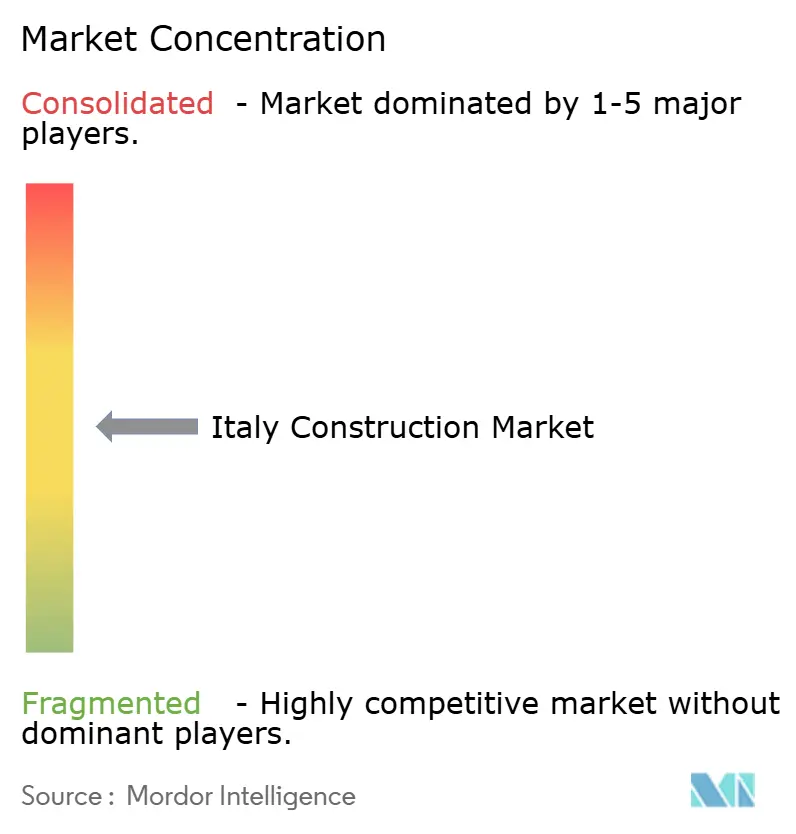
Industry concentration is moderate; a handful of national champions such as Webuild SpA, Saipem SpA and Astaldi SpA alongside thousands of niche contractors. Strategic consolidation is gathering pace as large players absorb specialist firms to deepen design-build-operate propositions; Webuild’s USD 567 million note issue funds a USD 72.6 billion backlog dominated by sustainable assets. Technology acquisitions are rising: Accenture’s purchase of the 450-person IQT Group expands engineering depth for net-zero projects, signalling non-traditional entrants’ influence.
Competitive differentiation pivots on digital prowess and ESG credentials. Contractors deploy drone photogrammetry, AI-led safety analytics and low-carbon material chains to secure premium margins in the Italy construction market. Public procurers increasingly assign weighted scores for carbon intensity and circular-economy plans, nudging firms toward recycled aggregates and bio-based insulation. Innovators such as the Italgas-I3P “NewGen Construction Site” programme showcase successful pilots using IoT wearables and predictive maintenance, highlighting collaboration across utilities, startups and academia.
White-space opportunities emerge in modular housing, energy-efficient retrofits and infrastructure maintenance. Mid-cap specialists with smart-sensor offerings win framework agreements for motorway condition monitoring, while finance providers deepen niche lines such as surety bonds; PIB Group’s purchase of Elleti Broker exemplifies insurance segment expansion aligned with construction surety demand. Against this backdrop, strong order backlogs and stable public pipelines underpin revenue visibility despite input-cost volatility.
Italy Construction Industry Leaders
-
Webuild SpA
-
Saipem SpA
-
Astaldi SpA
-
Salcef Group SpA
-
Maire Tecnimont SpA
- *Disclaimer: Major Players sorted in no particular order

Market Opportunities and Future Outlook
Public procurement is creating clear whitespace for contractors and consultants that can operationalize digital delivery and compliance-by-design. BIM requirements in public works now extend to new interventions above EUR 2 million (from January 1, 2025), and procurement behavior reflects the shift: the 9th OICE Report on Digitalization (March 2026) reported an 80.7% increase in BIM-related public tenders in 2025 versus 2024, with BIM used as a technical evaluation criterion in 67.1% of tenders. This supports opportunities across BIM authoring and coordination, digital tendering support, CDE implementation, and construction-phase controls (4D/5D), particularly for mobility and utility works under PNRR programs.
Renovation and MEP-heavy packages are being pulled forward by enforceable energy and environmental requirements rather than only tax incentives. New minimum energy performance requirements from the October 28, 2025 decree entered into force on June 3, 2026, tightening building envelope and systems criteria and mandating Building Automation and Control Systems (BACS) for non-residential buildings with thermal systems above 290 kW, which increases demand for integrated design-build capabilities across façade, HVAC, controls, and commissioning. In parallel, the updated CAM for construction (Decree 24 November 2025, effective February 2, 2026) increases the need for compliant material selection and site management practices in public works. On the new-build side, mega-project procurement and early works create additional addressable scope for civil works and supply chains, including the reactivated Sicily-to-mainland bridge project (over EUR 14 billion) scheduled to begin construction in 2026.
Recent Industry Developments
- June 2026: Saipem was awarded an offshore contract worth about USD 1 billion by Azule Energy for the Greater PAJ project off Angola. The award reinforces Saipem’s positioning in complex EPCI scopes, sustaining utilization of specialized engineering and installation capabilities that are also relevant to Mediterranean energy infrastructure execution.
- March 2026: Webuild signed the contract for Phase 1A of Lot 1 of Naples Metro Line 10 for about EUR 660 million. The signing converts a major urban mobility award into executable backlog and supports demand for tunneling, station works, and systems integration capacity in Italy’s public transport pipeline.
- January 2026: Webuild was awarded a EUR 776 million contract for the T1 section of Rome Metro Line C, with Webuild’s share at EUR 268 million. The project adds visibility to multi-year metro construction and supports specialist subcontracting demand across underground works, MEP, and digital construction management tools required on complex urban sites.


Research Methodology Framework and Report Scope
Market Definition and Coverage
For this report, the market covers the on-site value of construction work executed within Italy in a given year, spanning buildings, civil engineering, and major renovation activity that is contracted and delivered.
Scope exclusions: We exclude construction equipment sales, temporary site rentals, and transaction services tied to property deals (such as brokerage or notary fees).
Segmentation Overview
-
By Sector
-
Residential
- Apartments/Condominiums
- Villas/Landed Houses
-
Commercial
- Office
- Retail
- Industrial and Logistics
- Others
-
Infrastructure
- Transportation Infrastructure (Roadways, Railways, Airways, others)
- Energy & Utilities
- Others
-
Residential
-
By Construction Type
- New Construction
- Renovation
-
By Construction Method
- Conventional On-Site
- Modern Methods of Construction (Prefabricated, Modular, etc)
-
By Investment Source
- Public
- Private
-
By Region
- Milan
- Rome
- Turin
- Rest of Italy
Data Sources, Market Sizing, and Validation
Desk Research
Desk work starts with building a clean activity baseline for Italy, and then matching it to construction value. We review public series and definitions from sources such as ISTAT construction production indices, Eurostat construction output and permits, and the European Commission's macro outlook for Italy to anchor cycles and inflation effects.
To avoid mixing real estate services with construction execution, we also scan industry bodies and public documents such as ANCE updates, FIEC country statistics, the Italian public procurement portal and tender notices, and EU Recovery and Resilience plan disclosures for infrastructure timing. Company annual reports, investor decks, and reputable business press are used to understand order books, pricing pressure, and project mix. Where needed, we use a paid subscription for company financials and news selectively to validate large contractor revenue direction. These sources are illustrative, and we refer to additional public datasets and documents for data collection, cross-checking, and clarification.
Primary Interviews and Surveys
Primary work is used to pressure-test the desk model, especially where public data is delayed or reported in different units. We spoke with contractors, EPC and civil works specialists, material and services distributors, and project owners. We then checked assumptions across Italy-wide demand pockets such as housing upgrades, transport links, and utilities builds.
Distribution of primary research fieldwork respondents
| Company type | Respondent position |
|---|---|
| Top tier: 25% | CXOs: 14% |
| Mid tier: 55% | Functional/Unit leaders: 26% |
| Smaller Players: 20% | Managers: 60% |
Market-Sizing & Forecasting
Sizing is built using a top-down approach where national construction value is reconstructed from activity indicators and investment flow signals, and then allocated into construction execution that is actually delivered in Italy each year. Inputs used in the model include construction output trends, building permits and housing starts direction, public infrastructure tender awards and pipeline timing, renovation intensity (including energy-efficiency driven upgrades), and construction input cost movement that influences nominal value.
Once the top-line is formed, it is corroborated with selective bottom-up checks such as sampled contractor revenue-to-Italy exposure, project pipeline sanity checks, and volume times average value benchmarks for common work types. The results are then adjusted for gaps where smaller firms are under-reported in public disclosures. Forecasting is done mainly through scenario analysis, where macro conditions, public spending pace, and renovation policy continuity are varied. The final path is chosen after expert feedback confirms what is practical on the ground.
Data Validation & Update Cycle
Model outputs are cross-verified against independent signals like construction production direction, permit trends, tender momentum, and large project announcements, and then inconsistencies are investigated before sign-off. Outliers are reviewed in steps, first by the analyst building the model and then through an internal peer review that checks definitions, units, and currency timing.
Reports are refreshed annually, and interim checks are triggered when material events occur, such as sharp policy shifts on renovation incentives or major revisions to public investment schedules. Before delivery, we run a fresh pass of the dataset and assumptions so clients receive the latest updated view.
Mordor Intelligence's Italy Construction Market Estimate Compared With Other Published Estimates
It is normal to see different market values for Italy construction because publishers do not always use the same activity definition, pricing basis, and timing for what counts as construction. Differences also come from how renovation is treated, and from whether the number represents investment, total supply chain output, or only executed work.
Some published figures broaden the scope to the wider construction supply chain and related services, or they present total construction investment rather than delivered on-site work. In contrast, the figure from Mordor Intelligence is limited to the on-site value of building, civil engineering, and major renovation works completed within Italy, and it excludes equipment sales and property transaction services.
Benchmark comparison
| Source | Market Size | Gaps in Research Methodology |
|---|---|---|
| Mordor Intelligence | USD 228.70 B (2025) | |
| Industry Association A | USD 209.00 B (2024) | Often presented as total construction investment for the year, which can differ from executed work value due to timing of project progress, accounting cutoffs, and treatment of incentives for renovations. |
| Regional Consultancy B | USD 256.60 B (2025) | Tends to use a broader basket that may fold in adjacent services or cost items around construction delivery, and it may apply different price escalation and currency conversion timing for the base year. |
Across the three figures, the spread is mainly explained by what is being measured and when it is counted. When scope is kept to executed on-site construction and major renovations, and when pricing and currency timing are applied consistently, the result becomes easier to trace back to clear demand and activity signals.


Key Questions Answered in the Report
What is the current value of the Italy construction market?
The Italy construction market stands at USD 236.32 billion in 2026 and is forecast to reach USD 278.29 billion by 2031.
Which sector is growing the fastest within the market?
Infrastructure leads growth with a 3.94% CAGR for 2026-2031, buoyed by high-speed rail, grid upgrades and water projects.
How important are renovation projects under new energy rules?
Renovations hold 45.38% of spending in 2025 and are becoming mandatory as the EPBD pushes buildings to achieve at least class D by 2033.
What share of investment is private versus public?
Private capital accounts for 62.05% of 2025 revenue, while public spending remains crucial for large transport and energy works.
Which region is forecast to expand the quickest?
The rest of Italy is expected to post a 3.74% CAGR between 2026 and 2031, supported by Special Economic Zones and EU funding.
How are rising material costs affecting builders?
Elevated input prices reduce margins, prompting contractors to adopt recycled materials, long-term supply deals and digital procurement to manage cost volatility.
Page last updated on:


 Your data is secure and never sold or shared.


