
Market Overview
| Study Period | 2020 - 2031 |
|---|---|
| Forecast Data Period | 2026 - 2031 |
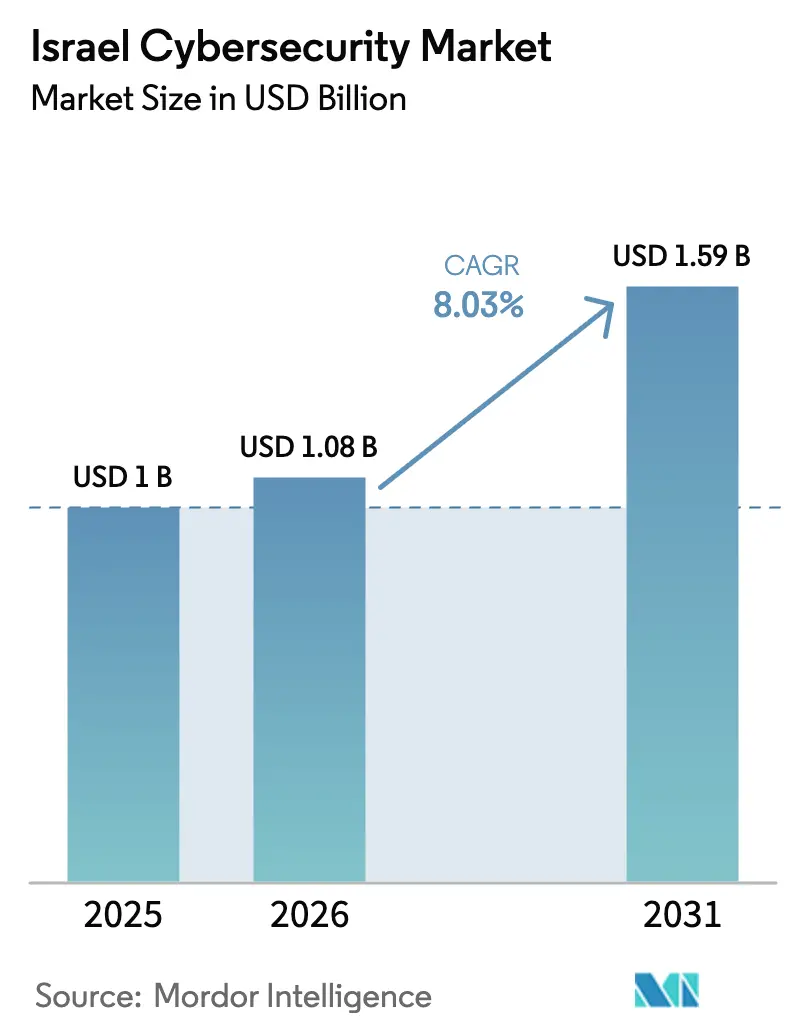
| Base Year Market Size (2025) | USD 1.0 Billion |
| Market Size (2026) | USD 1.08 Billion |
| Market Size (2031) | USD 1.59 Billion |
| Growth Rate (2026 - 2031) | 8.03% CAGR |
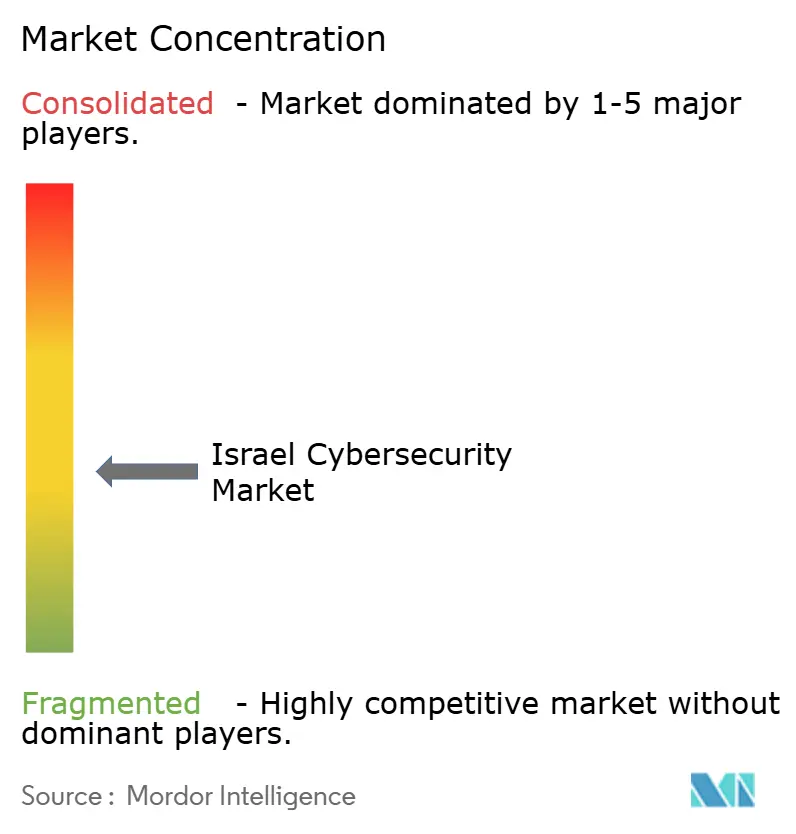
| Market Concentration | Medium |
Major Players *Disclaimer: Major Players sorted in no particular order Image © Mordor Intelligence. Reuse requires attribution under CC BY 4.0. | |
Israel Cybersecurity Market Analysis by Mordor Intelligence
The Israel cybersecurity market size is expected to grow from USD 1.0 billion in 2025 to USD 1.08 billion in 2026 and is forecast to reach USD 1.59 billion by 2031 at 8.03% CAGR over 2026-2031. The national ecosystem maintains momentum by fusing elite military talent, substantial venture funding, and strict regulatory mandates that consistently translate battlefield-grade innovations into commercial products. Nearly 38% of total Israeli tech investment flowed into cybersecurity during 2024, underscoring the sector’s role as an economic safety net when macro headwinds curtail other verticals. Mandatory compliance programs led by the National Cyber Directorate, rapid cloud adoption, and a surge of AI-driven analytics ensure sustained enterprise purchasing even as budgets tighten elsewhere. Escalating regional conflict further drives real-time threat-detection demand, while government R&D incentives accelerate translation of academic research into industrial platforms. Collectively, these forces keep the Israel cybersecurity market on a steeper growth trajectory than the broader local digital economy.
Key Report Takeaways
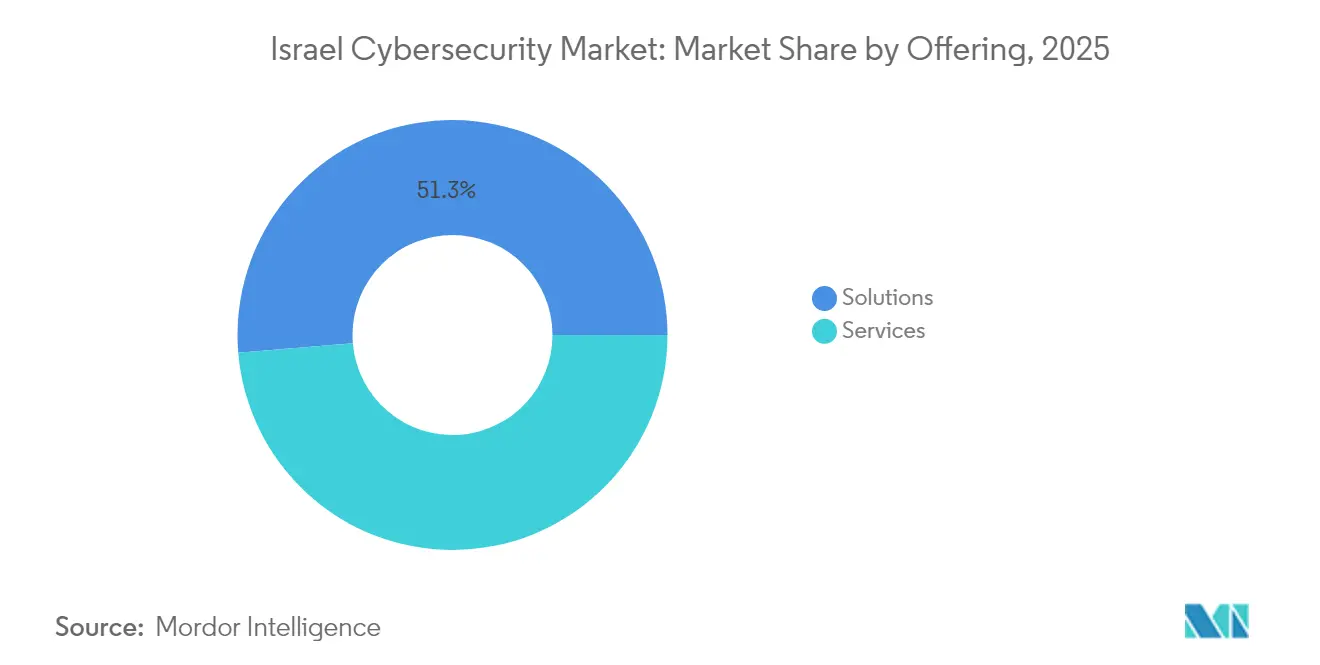
- By offering, solutions led with 51.32% revenue share of the Israel cybersecurity market in 2025, whereas services are forecast to grow at an 11.23% CAGR through 2031.
- By deployment mode, on-premise accounted for 60.45% of the Israel cybersecurity market share in 2025, yet cloud is advancing at a 14.62% CAGR to 2031.
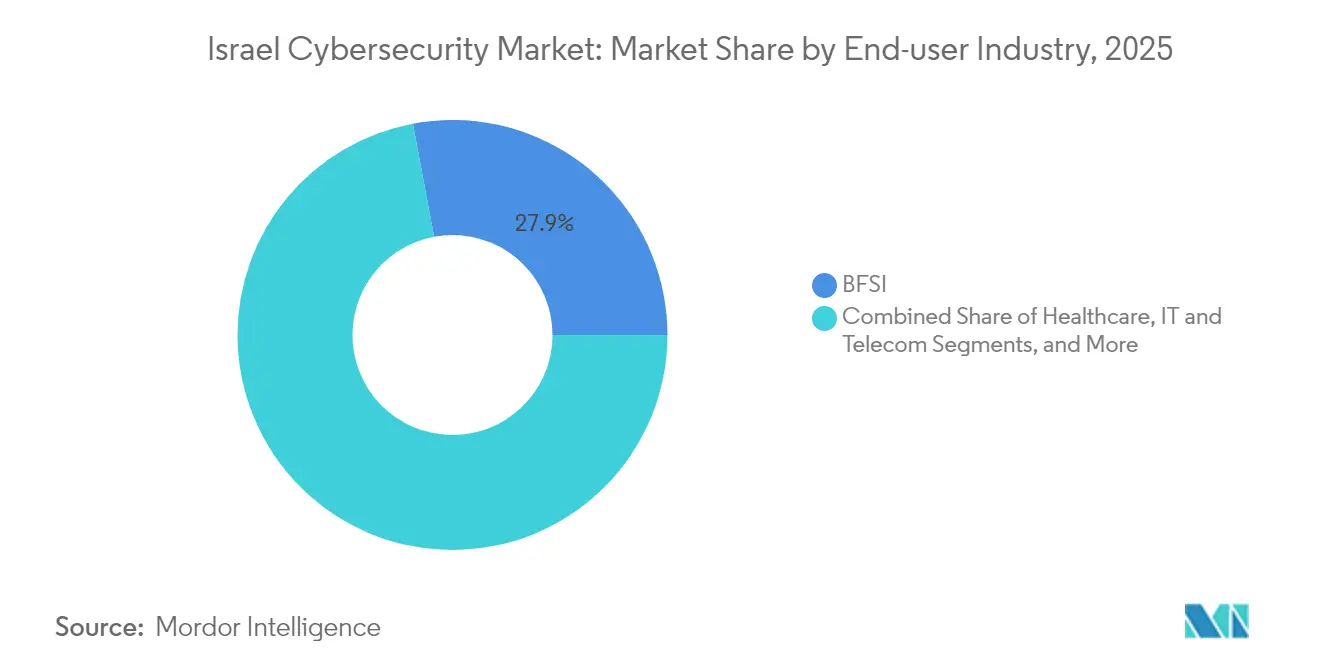
- By end-user industry, BFSI occupied 27.95% of 2025 revenue, whereas healthcare is poised to expand at an 8.14% CAGR through 2031.
- By end-user enterprise size, large enterprises held a dominant 70.55% share of the Israel cybersecurity market size in 2025 while SMEs represent the fastest-growing cohort at a 10.36% CAGR through 2031.
Note: Market size and forecast figures in this report are generated using Mordor Intelligence’s proprietary estimation framework, updated with the latest available data and insights as of 2026.
Israel Cybersecurity Market Trends and Insights
Drivers Impact Analysis*
| Driver | (~) % Impact on CAGR Forecast | Geographic Relevance | Impact Timeline |
|---|---|---|---|
| National Cyber Directorate compliance mandates | +1.9 | Nationwide (all critical-infrastructure sites) | Short term (≤ 2 years) |
| Vibrant start-up and venture funding | +1.6 | Tel Aviv–Herzliya start-up corridor | Medium term (2-4 years) |
| Rapid Enterprise Adoption of Cloud and IoT Platforms | +1.3 | Central District enterprise campuses | Medium term (2-4 years) |
| Geopolitical Tensions Driving Advanced Threat Activity | +1.0 | Northern and Southern border regions | Short term (≤ 2 years) |
| Export-Oriented Tech Sector’s Compliance Requirements | +0.8 | Greater Tel Aviv export hubs | Medium term (2-4 years) |
| Government R&D Incentives for Cyber Innovation | +0.7 | Beersheba CyberSpark and Jerusalem academic centers | Long term (≥ 4 years) |
| Source: Mordor Intelligence | |||
National Cyber Directorate Compliance Mandates
The National Cyber Directorate introduced sector-wide rules that require real-time threat sharing, standardized incident reporting, and continuous monitoring across government, BFSI, and critical-infrastructure operators, forcing organizations to modernize SIEM, SOAR, and identity platforms in compressed timeframes. Since October 2023, coordinated defenses have neutralized roughly 800 major attacks, validating the centrally managed “cyber dome” strategy and anchoring near-term spending surges.
Vibrant start-up and venture funding environment
Cybersecurity startups raised USD 4 billion in 2024 across 75 deals, more than doubling 2023 totals and equal to 38% of overall tech funding, with headline rounds for Wiz and Cyera. Serial entrepreneurs recycle know-how into fresh ventures, compressing go-to-market cycles and spawning niche products in CNAPP, API security, and industrial IoT defense.
Rapid Enterprise Adoption of Cloud and IoT Platforms
Cloud deployments already account for over half of national security spend and are climbing at double-digit CAGR as enterprises pivot toward SaaS, edge computing, and connected-device ecosystems. Check Point’s Infinity platform posted double-digit growth in these domains, reflecting an appetite for elastic, centrally managed defenses.
Geopolitical Tensions Driving Advanced Threat Activity
Regional conflict elevates Israel to a front-line laboratory where sophisticated, state-linked threat actors stress-test local defenses. Check Point recorded a 44% YoY jump in global attacks during 2024, and many vectors specifically targeted Israeli government and commercial assets [1]Grace McDougal, “Check Point Announces New CEO & Reports Strong Q2 2024,” checkpoint.com. This accelerates customer interest in automated response, air-gapped OT protections, and AI-driven anomaly detection.
Restraints Impact Analysis*
| Restraint | (~) % Impact on CAGR Forecast | Geographic Relevance | Impact Timeline |
|---|---|---|---|
| Severe cyber-talent shortage and wage inflation | −1.3 | Tel Aviv metropolitan labor pool | Medium term (2-4 years) |
| Tool sprawl and integration complexity | −0.7 | Nationwide enterprise SOCs | Short term (≤ 2 years) |
| SME budget constraints amid capital tightening | −0.4 | Peripheral cities and industrial parks | Short term (≤ 2 years) |
| Shekel volatility inflating imported hardware | −0.3 | Haifa tech-manufacturing corridor | Short term (≤ 2 years) |
| Source: Mordor Intelligence | |||
Severe cyber-talent shortage and wage inflation
Roughly 15% of local cybersecurity positions remain open; premium salaries run two-three times national tech averages, pressuring start-ups to expand offshore engineering hubs in Eastern Europe and Latin America. Distributed teams prolong release cycles and elevate operational risk, dampening sector growth prospects.
Tool sprawl and integration complexity
The average Israeli enterprise now manages more than 75 distinct security tools, complicating policy management and widening attack-surface blind spots. Vendors are pursuing acquisitions and platform roll-ups to streamline controls, but migration projects add near-term friction.
*Our forecasts treat driver/restraint impacts as directional, not additive. The impact forecasts reflect baseline growth, mix effects, and variable interactions.
Segment Analysis
By Offering: Solutions Hold Lead, Services Accelerate
Solutions captured 51.32% of 2025 revenue, as enterprises continued refreshing firewalls, endpoint detection, and data-protection suites. Spending emphasizes zero-trust network access, CNAPP, and advanced EDR where Israeli code heritage shines. Services, however, are projected to outpace solutions with an 11.23% CAGR through 2031, reflecting rising demand for managed detection, incident response, and continuous compliance monitoring.
Platform vendors now embed advisory and implementation services directly within subscription bundles, pushing hybrid revenue models. Incident-response retainer uptake increased sharply after the October 2023 attacks, as boards accepted the inevitability of compromise. Israeli consultancies leverage proximity to elite military units to offer red-team and threat-hunting engagements that global corporations seek for adversary simulation. This mix ensures services will gradually erode solution-only dominance while preserving vendor stickiness across the Israel cybersecurity market.


By Deployment Mode: Cloud Momentum Builds
On-premise deployment retained 60.45% share in 2025, driven by defense, energy, and payments workloads requiring deterministic latency and sovereignty controls. Yet cloud environments clock a 14.62% CAGR, adding the most absolute dollars through 2031. Large enterprises are increasingly adopting secure access service edge (SASE) and micro-segmentation to extend policy enforcement across multicloud estates.
Check Point’s CloudGuard Network Security reports 58% of its deployments among Fortune 1000 clients seeking consistent posture across AWS, Azure, and GCP. For Israeli SMEs, cloud-first security enables enterprise-grade defenses without hardware procurement, making OPEX-driven models attractive amid funding constraints. Consequently, hybrid orchestration layers—capable of toggling controls between data center and public cloud—have become a primary evaluation metric within vendor shortlists throughout the Israel cybersecurity market.
By End-user Industry: BFSI Leads, Healthcare Emerges
BFSI held 27.95% of 2025 revenue, retaining top spot due to stringent Bank-of-Israel guidance and evolving PSD2-style regulations. Fraud analytics, transaction monitoring, and machine-identity governance remain hot procurement areas. Healthcare, growing at an 8.14% CAGR, benefits from telemedicine adoption and new data-privacy obligations that compel encryption, asset-management, and PACS-security investments.
Industrial firms that manage critical infrastructure have also accelerated spending as the National Cyber Directorate enforces OT hardening standards. Vendors like Claroty leverage Israeli ICS research heritage to penetrate energy and water utilities. This sectoral diversification, underpinned by mandatory compliance and threat realism, sustains broad-based demand across the Israel cybersecurity market.
By End-user Enterprise Size: Large Enterprises Dominate, SMEs Gain Velocity
Large enterprises command 70.55% of 2025 spend, reflecting complex attack surfaces, regulatory audits, and budgetary heft. These organizations orchestrate multi-platform architectures spanning SIEM, SOAR, EDR, and threat-intel feeds, and increasingly pilot AI-assisted SOC automation. Yet SMEs record a 10.36% CAGR thanks to subscription bundles that disguise advanced detection under predictable monthly fees.
Israeli start-ups target this cohort with lightweight agents, automated policy templates, and outcome-based service-level agreements. For example, identity-security vendor CyberArk’s SaaS tier packages privileged session recording into an OpEx-friendly bundle, lowering entry barriers for mid-market finance and healthcare operators . This democratization broadens the customer base and supports long-term scale across the Israel cybersecurity market.
Geography Analysis
Tel Aviv continues to anchor roughly 70% of cybersecurity companies, benefitting from dense venture-capital networks, shared workspaces, and immediate adjacency to global banks’ innovation arms. The clustering enables rapid talent circulation and fosters informal knowledge exchange, propelling accelerated proof-of-concept cycles. Many multinationals locate regional R&D centers here, further enriching the talent pool and providing domestic start-ups with high-value acquisition pathways.
Beersheba, home to the CyberSpark campus, has become Israel’s industrial-cyber nexus. Military intelligence relocation to the Negev city seeded a crossover community where academic researchers, industrial-control vendors, and elite Unit 8200 veterans collaborate on OT anomaly detection. The government incentivizes southern expansion through tax breaks and grants, distributing economic activity and enhancing national resilience against concentrated physical attacks.
Jerusalem and Herzliya act as complementary micro-clusters. Jerusalem hosts encryption and quantum-security labs linked to Hebrew University, while Herzliya houses many early-stage SaaS start-ups targeting API and supply-chain security. Combined, these nodes create a geographically diversified innovation lattice that underwrites sustained export growth; Israeli vendors now direct more than 70% of revenue overseas, primarily to North America and Europe where regulatory similarity accelerates market entry.
Regulatory Landscape
Israel’s cybersecurity requirements are shaped by the Israel National Cyber Directorate (INCD) under the Prime Minister’s Office, with sector programs that push real-time threat sharing, standardized incident reporting, and continuous monitoring across government, BFSI, and critical infrastructure. A major 2026 anchor is the National Cyber Protection Law Draft Bill, 5786-2026, published in January 2026 and advanced through a first Knesset reading. The draft bill formalizes obligations for defined Essential Organizations (including communications, energy, healthcare, and water) and strengthens the INCD’s operational role, including managing the national CERT and a national security operations capability.
The draft bill also introduces clearer enforcement levers, including administrative fines cited up to NIS 300,000 (and referenced in some interpretations up to ILS 640,000) for non-compliance, along with potential criminal liability tied to refusal of emergency instructions. For compliance pathways, the proposal references recognized international frameworks such as NIST 800-53 and FedRAMP as mechanisms to demonstrate controls and, in certain cases, support exemptions from specific requirements. Together with Bank of Israel-driven security expectations for the BFSI sector, these developments keep regulatory compliance as a primary purchasing trigger for SIEM/SOAR modernization, identity controls, and continuous assurance services.
Value Chain Analysis
Israel’s cybersecurity value chain operates across a dual track. The national-strategic track is coordinated through bodies such as the INCD, the Ministry of Defense (including DDR&D), and the Israel Innovation Authority, translating national security priorities into requirements, pilots, and procurement patterns for critical infrastructure and government. The commercial-export track is led by globally scaled vendors and high-growth startups (for example, Check Point, CyberArk, SentinelOne, Wiz, Claroty, and Armis) that productize capabilities initially shaped by frontline threat exposure into enterprise offerings across cloud, identity, and OT security.
Upstream inputs are dominated by talent and research, with a workforce pipeline anchored in elite IDF units (including 8200, 81, 9900, and Talpiot) and university-linked labs. Midstream development and validation are reinforced by clusters such as CyberSpark in Beersheba, connecting industry with Ben-Gurion University and adjacent national-security footprints and accelerating test-to-deploy cycles for OT and critical-infrastructure defenses. Downstream routes-to-market combine direct enterprise sales, channel partners, and managed security providers, while platformization (moving from point tools to integrated stacks) and M&A are used to reduce integration friction for customers with large tool inventories and to improve cross-domain visibility across network, cloud, identity, and endpoint telemetry.
Competitive Landscape
The Israel cybersecurity market houses a layered mix of incumbents and insurgents. CyberArk leads identity security after integrating Venafi’s machine-identity controls into its privileged-access platform, positioning it to address both human and non-human credentials. Check Point maintains end-to-end coverage from network to cloud, forecasting AI-enabled revenue boosts for 2025 after beating Q4 2024 analyst expectations.
Start-ups such as Wiz, valued at USD 23 billion in discussions with Google, typify Israel’s ability to scale cloud-native platforms rapidly [3]Rohan Goswami, “Google in Talks to Acquire Wiz for USD 23 Billion,” cnbc.com. Their appetite for hyper-growth pushes incumbents toward acquisition sprees; Tenable’s USD 150 million Vulcan Cyber purchase and Bitsight’s USD 115 million Cybersixgill buy illustrate portfolio-gap filling aimed at retaining enterprise relevance. Smaller specialists like Radware (DDoS), Claroty (OT), and Cybereason (EDR) target defensible niches where unique telemetry or patented heuristics confer durable advantage.
Market dynamics favor consolidation as customers demand integrated dashboards and unified policy engines. Nevertheless, low entry barriers for software innovation sustain continuous churn, with roughly 30 new cybersecurity start-ups launching annually. As a result, the competitive landscape balances moderate concentration with high velocity, keeping vendor roadmaps in perpetual motion and encouraging global players to tap Israel’s R&D ecosystem for inorganic growth.
Israel Cybersecurity Industry Leaders
CyberArk Software Ltd.
Cisco Systems, Inc.
Fortinet, Inc.
Radware Ltd.
IBM Corporation
- *Disclaimer: Major Players sorted in no particular order

Market Opportunities and Future Outlook
A primary opportunity area is compliance-driven modernization tied to the National Cyber Protection Law Draft Bill, 5786-2026, and the INCD’s operational push for standardized incident reporting and continuous monitoring across Essential Organizations such as communications, energy, healthcare, and water. This expands whitespace for vendors that can package audit-ready control mapping, threat-sharing integrations, and always-on detection as managed services, particularly for operators that need to align to recognized baselines referenced in the proposal (for example, NIST 800-53 and FedRAMP) without building large internal compliance teams.
A second opportunity centers on consolidation and platform adoption around cloud-native and identity-centric security, given that Israeli buyers manage significant tool sprawl and seek unified policy engines across hybrid environments. Market evidence includes the breadth of the local innovation base (about 597 active cybersecurity companies in early 2026, including roughly 520 active startups as of Q1 2026) and continued capital formation (USD 8.27 billion raised across the ecosystem in 2025), which supports new product formation in AI security, CNAPP consolidation, and non-human identity governance. International partnership and go-to-market channels remain active through recurring industry synchronization points such as Cybertech Global Tel Aviv and the Israeli Pavilion at the RSA Conference, creating openings for co-sell motions and joint solution bundles targeted at regulated sectors and export-driven enterprises.
Recent Industry Developments
- May 2026: Cisco Systems completes acquisition of Astrix Security. The acquisition strengthens cloud-based identity and threat-protection portfolio for Cisco. The action enhances Cisco's handling of non-human identities and orchestration across environments.
- February 2026: Palo Alto Networks completes acquisition of CyberArk to secure the AI era. The move consolidates leadership in identity security and augments AI-driven defense capabilities for enterprises. This expands Palo Alto's enterprise platform with strong IAM integration.
- February 2025: CyberArk acquires Zilla Security. The deal expands identity governance and access management across its portfolio. It broadens governance capabilities and enables enterprise-scale IAM integration.


Research Methodology Framework and Report Scope
Market Definition and Coverage
For this methodology, the Israel cybersecurity market is the spending by organizations in Israel on tools and services that prevent, detect, respond to, and recover from cyber threats across IT environments, cloud workloads, endpoints, networks, and identities.
Scope exclusions: This sizing excludes general IT hardware refresh cycles and broad IT outsourcing that is not directly tied to cybersecurity delivery.
Segmentation Overview
- By Offering
- Solutions
- Application Security
- Cloud Security
- Data Security
- Identity and Access Management
- Infrastructure Protection
- Integrated Risk Management
- Network Security
- End-point Security
- Services
- Professional Services
- Managed Services
- Solutions
- By Deployment Mode
- Cloud
- On-Premise
- By End-user Industry
- BFSI
- Healthcare
- IT and Telecom
- Industrial and Defense
- Retail and E-commerce
- Energy and Utilities
- Manufacturing
- Others
- By End-user Enterprise Size
- Large Enterprises
- Small and Medium Enterprises (SMEs)
Data Sources, Market Sizing, and Validation
Desk Research
Desk work starts by setting a consistent perimeter around what counts as cybersecurity spending in Israel, and then pulling base indicators that can be tracked year to year. Public sources were used to anchor demand signals and context, including Israel National Cyber Directorate publications, the Bank of Israel macro indicators, Israel Central Bureau of Statistics series, ITU and OECD digital economy datasets, and World Bank reference series for cross-checks.
We also reviewed company annual reports, investor presentations, press releases, and credible reporting that describes major cyber incidents and compliance actions in Israel. In a few cases, paid databases were used only to speed up company financial screening, patents and IP scans, and news and financial tracking, which helped confirm product launch timing and shifts in buyer focus. The desk research sources listed here are not exhaustive, and additional public documents and datasets were used for data collection, validation, and clarification.
Primary Interviews and Surveys
Primary work focused on validating which security categories are actually being purchased in Israel and how budgets are shifting across cloud, identity, and managed services. We spoke with a mix of solution providers, service partners, and enterprise buyers across key verticals, then used follow-up questions to firm up adoption rates, typical contract shapes, and expected price movement assumptions over the forecast period.
Distribution of primary research fieldwork respondents
| Company type | Respondent position | Region |
|---|---|---|
| Top tier: 36% | CXOs: 20% | APAC: 43% |
| Mid tier: 43% | Functional/Unit leaders: 32% | EMEA: 34% |
| Smaller Players: 21% | Managers: 48% | Americas: 23% |
Market-Sizing & Forecasting
Sizing starts with a top-down build that reconstructs the Israel demand pool using a spend logic by buyer type and security needs, then layers in what portion of that spend goes specifically to cybersecurity solutions and services. To keep totals realistic, we corroborate the outcome with selective bottom-up checks, including sampling vendor revenue exposure to Israel, using channel feedback on deal volumes, and testing a simple ASP-by-seat or ASP-by-workload approach where it fits.
Key inputs in this market include cloud adoption pace in Israel, enterprise security budget allocation patterns, regulatory and compliance push (especially for critical services), incident pressure that accelerates refresh cycles, and the split between in-house delivery and managed security services. Where some categories do not disclose clean public volumes, gaps are handled through bounded assumptions agreed in interviews, and then stress-tested so no single variable drives the full outcome.
For forecasting, we mainly apply scenario analysis supported by short time-series smoothing on a few stable indicators, and then adjust using expectations around hiring constraints, cloud migration timing, and procurement cycles. When the main drivers align and the implied spend per organization stays within reasonable ranges, the final forecast is signed off.
Data Validation & Update Cycle
Validation is done by checking whether implied spend levels align with independent signals, including public cyber readiness efforts, cloud migration intensity, and reported incident trends. Outliers are reviewed in detail, and if a sudden jump is seen, assumptions are revisited and the relevant experts are re-contacted to confirm whether it is a real shift or a modeling artifact.
Before sign-off, the model and inputs are reviewed in multiple steps so calculation errors, double counting, and inconsistent definitions are removed. The report is refreshed annually, and interim updates are made when material events occur that can move budgets, such as major regulatory changes or large-scale incidents. Right before delivery, an analyst performs a fresh pass so clients receive the latest updated view.
Mordor Intelligence's Israel Cybersecurity Market Sizing Compared With Other Published Estimates
Published market sizes for Israel cybersecurity often differ because the scope boundary is not always consistent and because service revenue is sometimes counted differently from software revenue. Even when the same currency is used, differences in base year selection and how price changes are modeled can shift the final number.
The table shows a tight cluster around the USD 1.0 B level for 2024 to 2025, and the main spread typically comes from whether the estimate counts only domestic Israel spending or also includes Israel-headquartered vendor revenue booked abroad. In Mordor Intelligence's model, the total is built as Israel in-country demand across solutions and services, and adjacent IT work that is not security-specific is kept out, which can pull the value below approaches that mix in broader IT services or export-led revenue.
Benchmark comparison
| Source | Market Size | Gaps in Research Methodology |
|---|---|---|
| Mordor Intelligence | USD 1.00 B (2025) | |
| Industry Association A | USD 1.05 B (2024) | Often reflects current-year spending captured through member surveys, which can overweight large enterprises and may not fully normalize for currency timing or multi-year contract recognition. |
| Regional Consultancy B | USD 0.90 B (2024) | Tends to apply conservative adoption rates for cloud and managed security services, and may exclude parts of services revenue that are bundled into broader IT contracts. |
Across the three figures, the biggest drivers of differences are what is counted as Israel demand versus export-led revenue, and how services are treated when bundled with other IT work. By keeping the inputs tied to observable buyer-side indicators and then checking them through interviews and simple revenue sanity tests, the final number stays traceable to clear assumptions and repeatable steps.


Key Questions Answered in the Report
How large is the Israel cybersecurity market in 2026?
The Israel cybersecurity market size stands at USD 1.08 billion in 2026 and is projected to reach USD 1.59 billion by 2031 at an 8.03% CAGR.
Which segment grows fastest between 2026 and 2031?
Cloud deployment leads growth with a 14.62% CAGR as enterprises migrate workloads to multicloud and edge platforms.
Why is venture capital so concentrated in Israeli cybersecurity?
National defense expertise, repeat founders, and demonstrated export success attracted USD 4 billion in 2024 alone—38% of all Israeli tech funding.
What role does the National Cyber Directorate play?
The Directorate enforces real-time threat-sharing rules and standardized security controls across critical sectors, spurring immediate upgrades in SIEM, SOAR, and analytics platforms.
Page last updated on:






