
IoT Analytics Market Size and Share
Market Overview
| Study Period | 2020 - 2031 |
|---|---|
| Market Size (2026) | USD 49.36 Billion |
| Market Size (2031) | USD 131.12 Billion |
| Growth Rate (2026 - 2031) | 21.58 % |
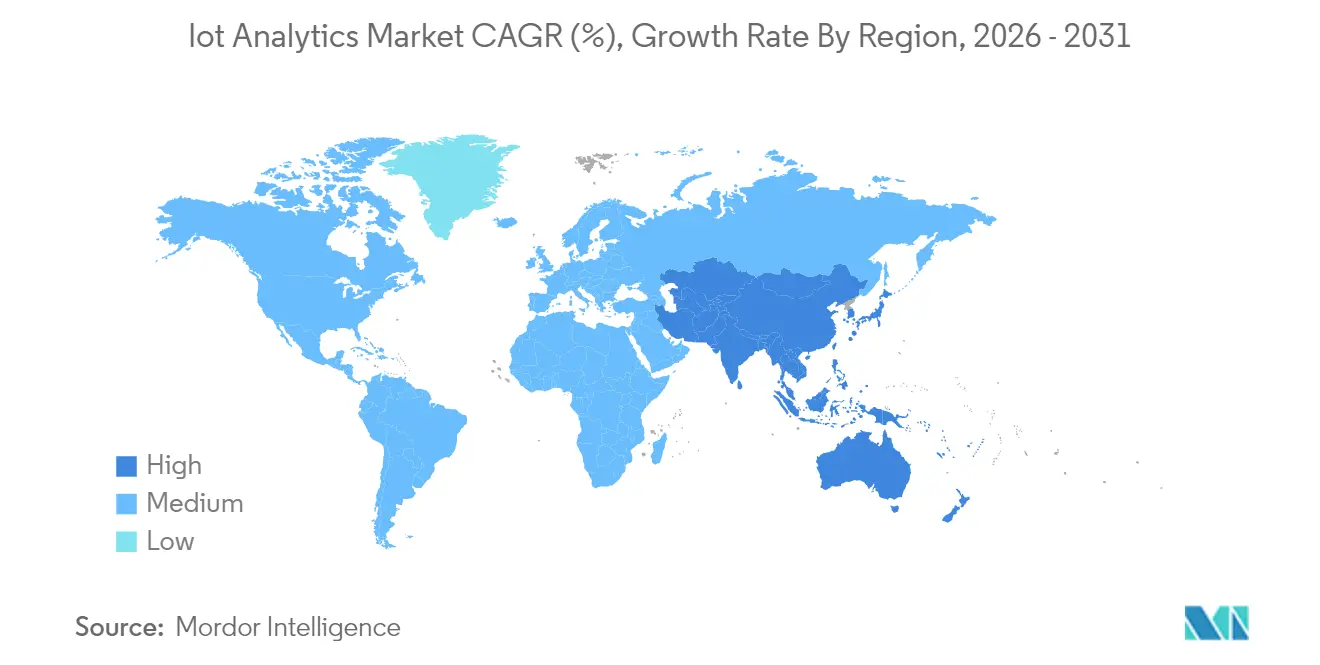
| Fastest Growing Market | Asia Pacific |
| Largest Market | Asia Pacific |
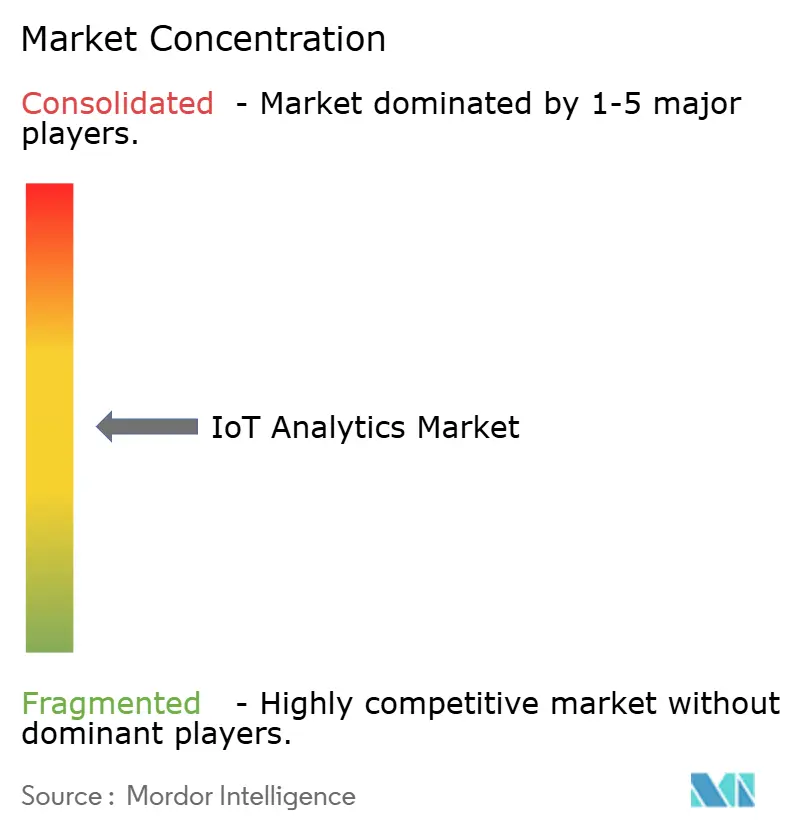
| Market Concentration | Medium |
Major Players *Disclaimer: Major Players sorted in no particular order Image © Mordor Intelligence. Reuse requires attribution under CC BY 4.0. | |
IoT Analytics Market Analysis by Mordor Intelligence
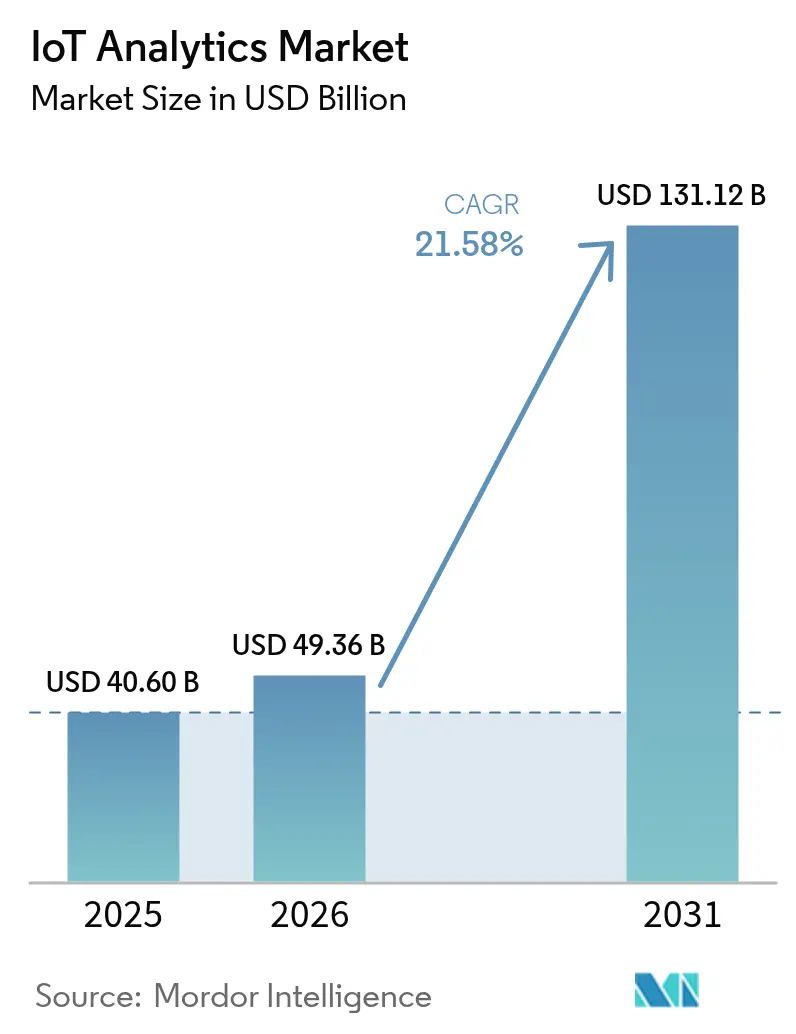
The IoT analytics market size was valued at USD 40.60 billion in 2025 and estimated to grow from USD 49.36 billion in 2026 to reach USD 131.12 billion by 2031, at a CAGR of 21.58% during the forecast period (2026-2031). Rapid device proliferation, edge–AI convergence, and enterprise digital-transformation programs underpin this expansion. Enterprises are moving analytic workloads closer to connected assets, reducing latency and bandwidth costs while improving operational decisions. Demand is reinforced by predictive-maintenance success stories in asset-intensive sectors and by sustainability mandates that call for continuous performance monitoring. Competitive intensity is strengthening as cloud hyperscalers, specialist vendors, and edge-platform providers leverage partnerships and acquisitions to secure ecosystem advantages.
Key Report Takeaways
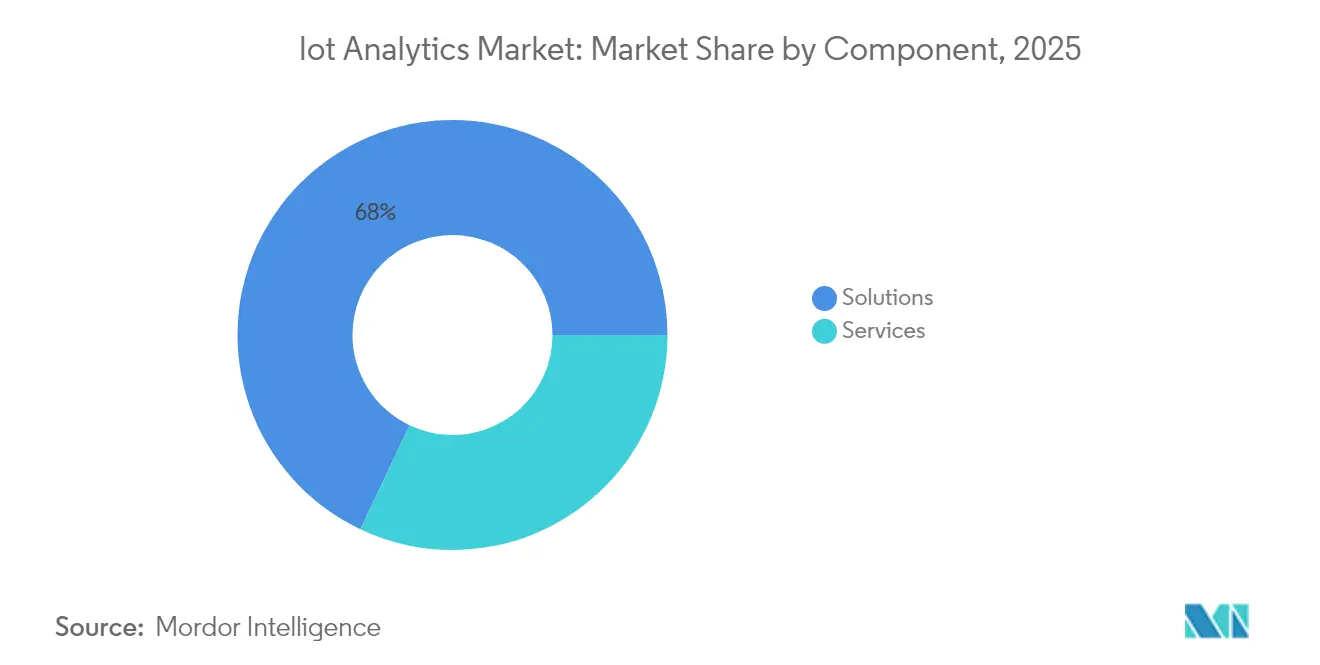
- By component, Solutions held 67.95% of IoT analytics market share in 2025; Services is projected to expand at a 23.12% CAGR through 2031.
- By deployment, on-premise dominated with 64.62% revenue share in 2025, while cloud deployment is advancing at a 23.30% CAGR to 2031.
- By organization size, Large Enterprises captured 71.28% share of the IoT analytics market size in 2025; Small and Medium Enterprises are growing fastest at 22.85% CAGR.
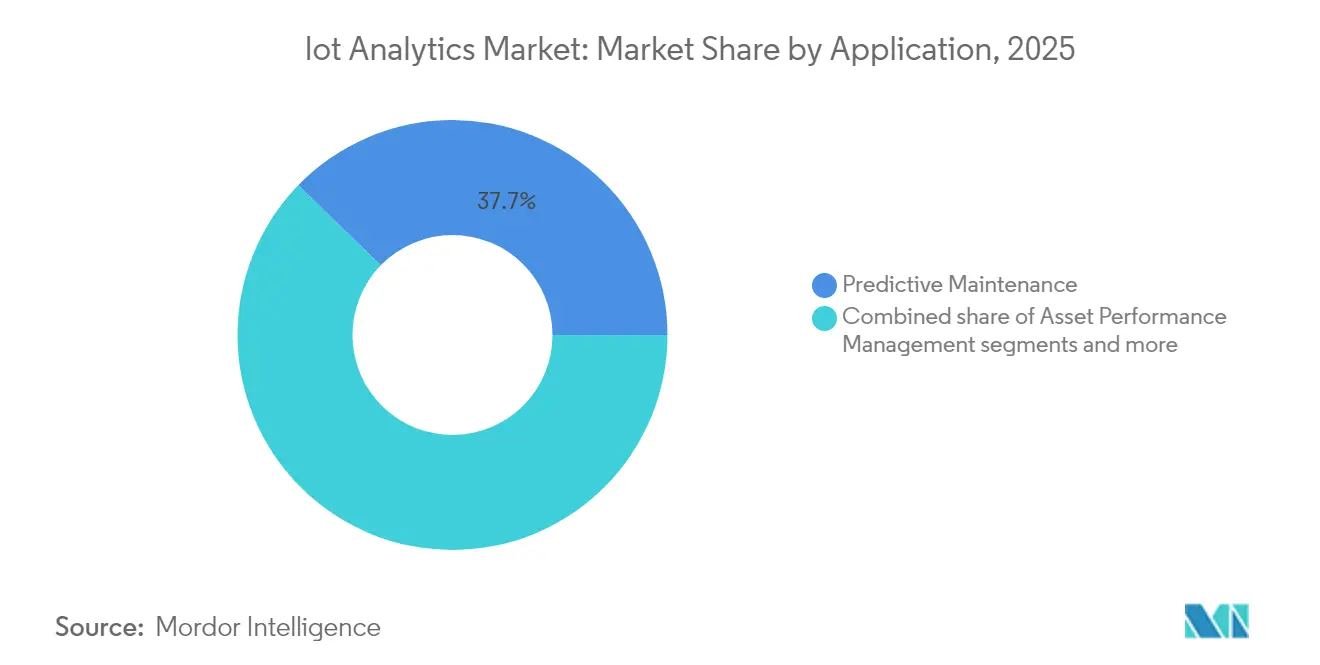
- By application, Predictive Maintenance accounted for 37.74% of the IoT analytics market size in 2025, whereas Asset Performance Management is rising at 22.15% CAGR.
- By end-user industry, Manufacturing led with 31.02% revenue share in 2025; Energy and Utilities is forecast to grow at 21.94% CAGR.
- By geography, Asia-Pacific commanded 35.86% of 2025 revenue and is expanding at a 22.84% CAGR through 2031.
Note: Market size and forecast figures in this report are generated using Mordor Intelligence’s proprietary estimation framework, updated with the latest available data and insights as of 2026.
Market Trends and Insights
Drivers Impact Analysis of IoT Analytics Market*
| Driver | (~) % Impact on CAGR Forecast | Geographic Relevance | Impact Timeline |
|---|---|---|---|
| Proliferation of IoT devices generating exabyte-scale data | +6.8% | Global, APAC leading | Medium term (2-4 years) |
| Cloud-native analytics platforms gaining enterprise acceptance | +4.2% | North America & Europe core | Short term (≤ 2 years) |
| Predictive-maintenance demand across asset-intensive industries | +3.9% | Global, manufacturing hubs | Medium term (2-4 years) |
| Edge-AI accelerators enabling sub-second analytics | +2.8% | Advanced economies first | Long term (≥ 4 years) |
| Enterprise data-fabric architectures unifying siloed streams | +2.1% | North America & EU | Medium term (2-4 years) |
| ESG-driven sustainability monitoring mandates | +1.4% | EU leading | Long term (≥ 4 years) |
| Source: Mordor Intelligence | |||
Proliferation of IoT Devices Generating Exabyte-Scale Data
Connected-device counts are rising sharply, with global IoT endpoints expected to produce more than 175 zettabytes of data annually by 2025. Plant-level sensor arrays already emit terabytes each day, forcing enterprises to deploy analytics engines at the edge to avoid cloud-backhaul delays. Manufacturers adopting this edge-first model record 30% higher operational efficiency versus cloud-only setups. The data surge spans structured telemetry, unstructured video, and log files, prompting investment in multimodal analytic frameworks that can handle diverse payloads concurrently.
Cloud-Native Analytics Platforms Gaining Enterprise Acceptance
Scalable, pay-as-you-go services such as Microsoft Azure IoT Operations allow firms to ingest billions of daily messages while cutting infrastructure outlays by up to 60%[1]. Zero-trust architectures and built-in threat analytics lessen security concerns, accelerating full-cloud adoption in manufacturing and logistics. Highly regulated verticals continue to blend cloud and local processing, but migration momentum remains strong as providers extend compliance toolkits.
Predictive-Maintenance Demand Across Asset-Intensive Industries
Machine-learning models trained on vibration, temperature, and acoustic signatures alert maintenance teams weeks before failure. Manufacturers cite 25–30% maintenance-cost reductions and 70% drops in unplanned stoppages. Utilities mirror these gains, saving millions in outage-prevention spend. Digital-twin simulations refine schedule optimization further, moving maintenance from time-based to condition-based protocols.
Edge-AI Accelerators Enabling Sub-Second Analytics
Purpose-built inference chips embedded in gateways slash response times from seconds to milliseconds. Half of global enterprises are projected to adopt edge computing by 2029 as quality-inspection, autonomous-vehicle, and smart-city scenarios require real-time reasoning. Local processing trims network traffic by 90% and ensures resilience when connectivity falters.
Restraints Impact Analysis of IoT Analytics Market*
| Restraint | (~) % Impact on CAGR Forecast | Geographic Relevance | Impact Timeline |
|---|---|---|---|
| Data-privacy and cross-border compliance complexity | -3.2% | EU GDPR leading | Short term (≤ 2 years) |
| Shortage of IoT data-science talent pool | -2.8% | Global, acute in emerging markets | Medium term (2-4 years) |
| Industrial-protocol fragmentation hindering interoperability | -1.9% | Manufacturing regions | Long term (≥ 4 years) |
| Rising telemetry bandwidth costs for high-frequency sensors | -1.1% | Areas lacking 5G | Medium term (2-4 years) |
| Source: Mordor Intelligence | |||
Data-Privacy and Cross-Border Compliance Complexity
GDPR imposes stringent consent, minimization, and localization rules; non-compliance can cost 4% of global turnover. Divergent national laws force firms to maintain multiple regional data stores, inflating project budgets by up to 25%. Real-time analytics crossing borders must incorporate policy-aware routing to satisfy sovereignty mandates, slowing enterprise rollouts.
Shortage of IoT Data-Science Talent Pool
Industry surveys reveal a 10-million-person gap in combined IoT and analytics expertise by 2027[2]. SMEs struggle to recruit, delaying projects or outsourcing to managed-service providers. Vendors respond with low-code tooling, yet complex industrial use cases still demand niche domain knowledge that remains scarce.
*Our forecasts treat driver/restraint impacts as directional, not additive. The impact forecasts reflect baseline growth, mix effects, and variable interactions.
IoT Analytics Market Segment Analysis
By Component:
Services Acceleration Outpaces Solutions GrowthSolutions continued to dominate, accounting for 67.95% revenue in 2025. The IoT analytics market size for solutions is forecast to increase steadily, yet the services category is set to expand faster at 23.12% CAGR as firms seek managed expertise. Professional services are in high demand for protocol mapping, edge-stack tuning, and multi-cloud integration.
The talent shortfall and rising architectural complexity make external partners attractive. Managed-service contracts often bundle software, infrastructure, and outcome-based SLAs, shifting risk to providers. Security-analytics sub-segments are buoyed by expanding attack surfaces tied to connected devices.

By Deployment:
Cloud Momentum Challenges On-Premise DominanceOn-premise installations held 64.62% share in 2025, reflecting control, latency, and regulatory needs. Yet cloud instances are growing at 23.30% CAGR as hyperscalers couple ingestion pipelines with serverless analytic engines. Hybrid designs route time-critical workloads to edge nodes while sending aggregated data to the cloud for batch AI.
Microsoft and Amazon lead with composable offerings, enabling enterprises to spin up digital twins and large-scale model training within minutes. Supply-chain volatility and energy-price swings underline the need for elastic compute, further pushing cloud uptake.
By Organization Size:
SME Adoption Accelerates Through DemocratizationLarge enterprises represented 71.28% of 2025 spending, but SMEs are posting the fastest 22.85% CAGR. Cloud subscriptions priced by device and message volume lower entry barriers, and sector-specific templates reduce configuration effort.
European manufacturers illustrate the shift, using low-code dashboards to visualize machine throughput and energy intensity without specialist programmers. However, resource limits still steer SMEs toward turnkey packages instead of complex bespoke stacks.
By Application:
Asset Performance Management Gains MomentumPredictive maintenance retained 37.74% share in 2025 and continues to anchor investment decisions. The IoT analytics market share for asset-performance management is smaller today yet expanding at 22.15% CAGR, reflecting growing emphasis on holistic lifecycle optimization.
Digital twins replicate asset behavior under variable loads, letting operators test interventions virtually. Energy-management suites help companies meet carbon-reduction targets, while supply-chain analytics improve fleet routing amid e-commerce surges.
By End-User Industry:
Energy Sector Transformation AcceleratesManufacturing led with 31.02% contribution in 2025, underpinned by Industry 4.0 initiatives. The IoT analytics market size serving energy and utilities is projected to climb fastest at 21.94% CAGR as grid-modernization and renewable-integration projects multiply.
Utilities deploy analytics to balance distributed generation, predict transformer failures, and optimize storage assets. Transportation players use telematics to reduce idle time and monitor driver safety, and healthcare providers expand remote-patient monitoring to ease hospital capacity strains.
Geography Analysis
APAC IoT Analytics Market
Asia-Pacific delivered 35.86% of 2025 revenue, benefiting from government programs such as “Made in China 2025” and India’s Smart Cities Mission. Regional CAGR of 22.84% underscores the scale of industrial digitization, 5G rollout, and edge-AI pilots. Chinese factories deploy vision-based quality control, while Indian municipalities apply sensor networks to manage waste and traffic.
North America IoT Analytics Market
North America follows closely, with mature cloud infrastructure and early AI adoption. Enterprises integrate streaming analytics with digital-operations centers, aided by robust venture funding and university research pipelines. The region remains a test-bed for autonomous-mobility and precision-agriculture projects.
Europe, LATAM and Middle East IoT Analytics Market
Europe posts steady growth as ESG compliance drives real-time emissions monitoring. Initiatives under the European Green Deal push utilities and manufacturers toward data-driven efficiency. Emerging markets in Latin America and the Middle East gain momentum as telecom operators extend NB-IoT and 5G coverage, enabling greenfield deployments in logistics, oil, and public safety.
Regulatory Landscape
IoT analytics deployments are increasingly shaped by product cybersecurity and data-governance requirements that affect what data can be collected, where it can be processed, and how long connected products must be supported. In the United Kingdom, the Product Security and Telecommunications Infrastructure (PSTI) regime came into force on 29 April 2024 via the PSTI regulations, setting minimum security requirements for consumer connected products. These requirements influence telemetry collection, update mechanisms, and vulnerability handling across connected-device fleets.
In the United States, the FCC Cybersecurity Labeling Program (U.S. Cyber Trust Mark) became effective on 29 August 2024, raising the bar for security assurances around connected products that feed analytics platforms. Security-by-design guidance continues to be refined through NIST, including the April 2026 release of NIST IR 8259r1 and the June 2026 initial public draft of NIST SP 800-213 Revision 1, which inform baseline controls and risk management practices that IoT analytics vendors and their device-manufacturer partners operationalize through identity, patching, and secure update pipelines. Australia also introduced mandatory smart-device security, with the Cyber Security (Security Standards for Smart Device) Rules 2025 commencing on 4 March 2026.
Value Chain Analysis
The IoT analytics value chain includes device OEMs and module suppliers, connectivity and edge-gateway providers, cloud and data-platform vendors, and systems integrators that implement ingestion, modeling, and operational workflows for end users. Data flows typically start in sensors, controllers, cameras, and telematics units, then move through gateways and network layers into streaming ingestion, storage, and ML pipelines, with outputs surfacing in dashboards and enterprise systems such as ERP and SCM. Integrators and managed-service providers tend to be especially prominent because deployments require protocol mapping, security hardening, and integration across OT data, logistics telemetry, and enterprise application data.
Recent ecosystem moves point to tighter coupling between analytics platforms and operational systems, rather than stand-alone IoT stacks. Oracle announced collaboration with Microsoft to integrate Oracle Fusion Cloud SCM with Azure IoT Operations and Microsoft Fabric to improve manufacturing visibility, reflecting demand for unified data models across production and supply-chain decisions. Partnerships such as Kinaxis with Databricks (for AI-powered supply chain orchestration) and KION with NVIDIA and Accenture (AI-powered robots and digital twins for warehouses) further support the shift toward digital-twin and AI layers that depend on high-quality, near-real-time IoT data. Hardware cycles also influence rollout timing, and 2024 saw steep declines among cellular IoT module vendors following prior overbuying, which can temporarily slow new device deployments even as software-led modernization continues.
Competitive Landscape
The IoT analytics market is moderately fragmented. Cloud hyperscalers—Microsoft, Amazon Web Services, IBM, and Google—bundle connectivity, storage, and advanced analytics. Their scale gives them pricing leverage and built-in AI services. Specialist vendors such as SAS, PTC, and Splunk differentiate with deep domain content and low-code model builders.
Strategic alliances accelerate innovation. Microsoft acquired CyberX to strengthen device-level security controls, while Planon’s purchase of Axonize enhances smart-building offerings. Vendors race to embed digital-twin frameworks and automated machine-learning pipelines, shortening time to insight for customers.
Emerging edge-platform providers target sub-second decision-making in robotics and autonomous transport. They promote containerized runtimes that operate on factory gateways and ruggedized servers. Market entrants focusing on vertical-specific use cases—agtech, med-tech, and municipal services—gain traction by solving regulatory and data-model challenges unique to those fields. Overall, competitive intensity is expected to rise as open-source analytics stacks mature and device makers embed onboard inference capabilities.
IoT Analytics Industry Leaders
-
Microsoft Corporation
-
Amazon Web Services, Inc.
-
Cisco Systems, Inc
-
Oracle Corporation
-
IBM Corporation
- *Disclaimer: Major Players sorted in no particular order
IoT Analytics Market Companies Covered in this Report
- Microsoft Corporation
- Amazon Web Services, Inc.
- IBM Corporation
- Google LLC
- Cisco Systems, Inc.
- Oracle Corporation
- SAP SE
- Dell Technologies Inc.
- The Hewlett Packard Enterprise Company
- Teradata Corporation
- Salesforce, Inc.
- Accenture plc
- PTC Inc.
- Hitachi Vantara LLC
- Cloudera, Inc.
- Software AG
- SAS Institute Inc.
- Splunk Inc.
- C3.ai, Inc.
- Uptake Technologies Inc.
- GE Digital
- QlikTech International AB
Market Opportunities and Future Outlook
Industrial edge analytics and edge-to-cloud data integration are creating whitespace for platforms that can deliver real-time decisions without heavy middleware, while still feeding enterprise AI and governance workflows. In June 2026, Siemens announced an edge-to-cloud integration with Databricks and FFT Produktionssysteme GmbH to connect production data directly to enterprise AI, reflecting buyer interest in simplifying ingestion and accelerating time-to-insight on factory data. For IoT analytics vendors, this supports demand for packaged connectors, governed data products, and streaming-to-lakehouse patterns that reduce integration effort for manufacturing, logistics, and utilities use cases.
Physical AI and on-device inference are also expanding the set of analytics workloads beyond monitoring, into closed-loop quality and maintenance operations. In July 2026, NTT DATA deployed a physical AI system with Hyster-Yale Materials Handling at a facility in Berea, Kentucky, using vision sensors and edge analytics to validate assembly steps in real time, highlighting a practical pathway for quality assurance and compliance workflows that depend on low-latency analytics at the edge. R&D programs such as Fraunhofer IMS starting the GenSATIOn-Edge project (April 2026) support the shift toward intelligent sensor systems running AI models directly on industrial edge devices. At the same time, cybersecurity compliance is increasingly a built-in design constraint and a commercial differentiator, with tighter device-security regimes such as the UK PSTI regime and evolving NIST IoT guidance increasing demand for analytics platforms that embed asset identity, vulnerability visibility, and secure update telemetry into operational dashboards.
Recent Industry Developments in IoT Analytics Market
- July 2026: AWS added enhanced AI workload protection and multicloud support for Microsoft Azure in AWS Security Hub. The update broadened centralized security telemetry and posture management across mixed cloud estates, a common deployment model for IoT analytics where streaming, storage, and ML services are distributed across providers.
- June 2026: Cisco unveiled Cisco Cloud Control, an agentic platform to operate and defend critical IT infrastructure, and introduced Cisco Multicloud Fabric to connect environments spanning AWS, Microsoft Azure, and Google Cloud. The launch strengthened infrastructure-layer controls that underpin secure, low-latency IoT data movement into analytics pipelines, especially for hybrid and multicloud architectures.
- June 2025: AWS launched managed integrations for AWS IoT Device Management, adding a catalog of pre-built cloud-to-cloud connectors and data model templates to simplify cross-device control. The move reduced onboarding friction across diverse device types and protocols, supporting faster normalization of IoT telemetry for downstream streaming analytics and ML workflows.
IoT Analytics Market Report Scope and Research Methodology
Market Definition and Coverage
For this study, the IoT analytics market is defined as revenue earned from software and related services used to ingest, process, analyze, and visualize data generated by connected devices, sensors, gateways, and controllers, across enterprise and public infrastructure use cases.
Scope exclusions: Consumer-only mobile app analytics and standalone BI tools that do not have native IoT data connectors are excluded from this market sizing.
Segments Covered in This Report
- By Component
- Solutions
- Network Management
- Security Analytics
- Real-time Streaming Analytics
- Data Management and Storage Analytics
- Visualization and Dashboard
- Services
- Professional Services
- Managed Services
- Solutions
- By Deployment
- On-premise
- Cloud
- By Organisation Size
- Large Enterprises
- Small and Medium Enterprises (SMEs)
- By Application
- Predictive Maintenance
- Asset Performance Management
- Energy Management
- Supply-Chain and Logistics Optimisation
- Other Applications
- By End-User Industry
- Manufacturing
- Energy and Utilities
- Transportation and Logistics
- Retail and E-Commerce
- Healthcare and Life Sciences
- Other End-User Industries
- By Geography
- North America
- United States
- Canada
- Mexico
- Europe
- Germany
- United Kingdom
- France
- Italy
- Spain
- Russia
- Rest of Europe
- Asia-Pacific
- China
- Japan
- India
- South Korea
- Australia and New Zealand
- Rest of Asia-Pacific
- South America
- Brazil
- Argentina
- Rest of South America
- Middle East and Africa
- Middle East
- Saudi Arabia
- United Arab Emirates
- Turkey
- Rest of Middle East
- Africa
- South Africa
- Nigeria
- Rest of Africa
- Middle East
- North America
Data Sources, Market Sizing, and Validation
Desk Research
Desk research was used to frame the demand pool and build realistic assumptions before we spoke to the market. We used public and official references such as the U.S. Census Bureau and BEA for macro spending signals, the ITU and OECD for connectivity and digital economy indicators, and standards bodies such as NIST and ISO publications to keep terminology consistent.
We also reviewed company filings, investor presentations, product documentation, developer notes, and reputable press coverage to understand packaging shifts like cloud subscriptions, usage-based pricing, and managed analytics services. Where available, we supplemented with paid subscriptions for company financials and intelligence, news and financials, and patent databases to confirm what is being commercialized and when. These examples are not exhaustive, and many other public sources were also used to collect, cross-check, and clarify data points.
Primary Interviews and Surveys
Primary work focused on interviews and structured surveys with analytics software providers, system integrators, cloud ecosystem partners, and enterprise buyers running connected operations. We tested what is actually purchased under IoT analytics budgets, how deployment mix is changing (cloud versus on-premises), and how pricing is moving with data volume, device counts, and SLA needs across APAC, EMEA, and the Americas.
Distribution of primary research fieldwork respondents
| Company type | Respondent position | Region |
|---|---|---|
| Top tier: 26% | CXOs: 16% | APAC: 37% |
| Mid tier: 55% | Functional/Unit leaders: 33% | EMEA: 37% |
| Smaller Players: 19% | Managers: 51% | Americas: 26% |
Market-Sizing & Forecasting
Market sizing used a top-down and bottom-up approach, where the top-down build starts from digital and software spend pools and then narrows them to IoT data driven analytics using adoption and deployment indicators. That narrowing was guided by practical signals such as connected device growth, cloud analytics usage patterns, edge analytics adoption in factories and utilities, and the share of analytics projects tied to streaming and time series data.
To keep totals grounded, selective bottom-up checks were added using sampled supplier revenues, channel discussions with integrators, and simple ASP times volume logic for common packaging, such as per device, per site, or per data throughput pricing. When vendor disclosures did not split IoT analytics cleanly from broader analytics portfolios, we handled the gap by applying validated allocation keys from interviews and product revenue mix clues, then stress-testing results against regional IT spending and connectivity trends.
For forecasting, we mainly used scenario analysis supported by a light multivariate regression, so growth is linked to drivers that move with the market, such as industrial automation investment, cloud migration rates, and data regulation impacts on hosting choices, along with enterprise rollout cycles. Assumptions were reviewed with practitioners so the final curve reflects how quickly pilots convert to scaled deployments and how fast pricing normalizes as volumes rise.
Data Validation & Update Cycle
Validation was done in multiple steps so that outliers did not slip into the final dataset. Model outputs were compared with independent signals such as connected device shipments, cloud infrastructure expansion, and reported software and services growth rates, then the largest variances were rechecked at the input level.
Before sign-off, findings were reviewed by another analyst to confirm definitions, unit consistency, currency treatment, and year alignment, followed by a final pass for any arithmetic or logic breaks. Reports are refreshed annually, and interim updates are triggered when material events occur, including major pricing changes, platform bundling shifts, or regulation-driven deployment changes. Right before delivery, we do a quick revalidation sweep so clients receive the most current view available.
Mordor Intelligence's IOT Analytics Market Estimate Compared With Other Published Estimates
It is common to see different IoT analytics market numbers across public studies, even when they use similar labels. The spread usually comes from what is counted as IoT analytics revenue, how cloud subscriptions and services are treated, and which year is used as the anchor for currency and inflation.
By tracking included offerings and refresh timing, Mordor Intelligence ties the model to software and managed services that directly process IoT device data, which keeps adjacent spend like generic BI from inflating totals and also avoids mixing in non-IoT mobile analytics.
Benchmark comparison
| Source | Market Size | Gaps in Research Methodology |
|---|---|---|
| Mordor Intelligence | USD 49.36 B (2026) | |
| Global Consultancy A | USD 42.22 B (2025) | Uses a different base year, and the page does not clearly separate IoT analytics from broader enterprise analytics bundles, which can shift what is counted and when currency is converted. |
| Industry Research House B | USD 44.41 B (2025) | Starts from a 2025 base and applies a longer forecast window, and its scope leans on segmented views that may treat services and software packaging differently across deployments. |
When these numbers are read side by side, the main takeaway is that small scope choices and year anchoring can create a visible gap in the reported market size. Our approach keeps the sizing traceable to clear revenue items, applies consistent currency timing, and then rechecks totals with supplier and buyer feedback so the estimate is repeatable and practical to defend.
Key Questions Answered in the Report
What is the projected value of the IoT analytics market by 2031?
The market is expected to reach USD 131.12 billion in 2031, expanding at a 21.58% CAGR.
Which region currently leads in IoT analytics adoption?
Asia-Pacific accounts for 35.86% of global revenue and is growing the fastest at a 22.84% CAGR.
Why are services outpacing solutions in growth?
Enterprises outsource analytics to specialist providers to overcome talent shortages, driving the services segment at a 23.12% CAGR.
How much can predictive-maintenance programs reduce equipment breakdowns?
Asset-intensive firms report 70% fewer unplanned stoppages after deploying IoT-driven predictive maintenance.
What security frameworks are encouraging cloud-native analytics adoption?
Zero-trust architectures and built-in threat analytics from providers such as Microsoft Azure are alleviating data-security concerns.
What is the main regulatory hurdle for global IoT analytics deployments?
GDPR-aligned data-sovereignty rules can raise project costs by up to 25% due to localization requirements.