
IO-Link System Market Size and Share
Market Overview
| Study Period | 2020 - 2031 |
|---|---|
| Market Size (2026) | USD 19.81 Billion |
| Market Size (2031) | USD 54.78 Billion |
| Growth Rate (2026 - 2031) | 22.54 % |
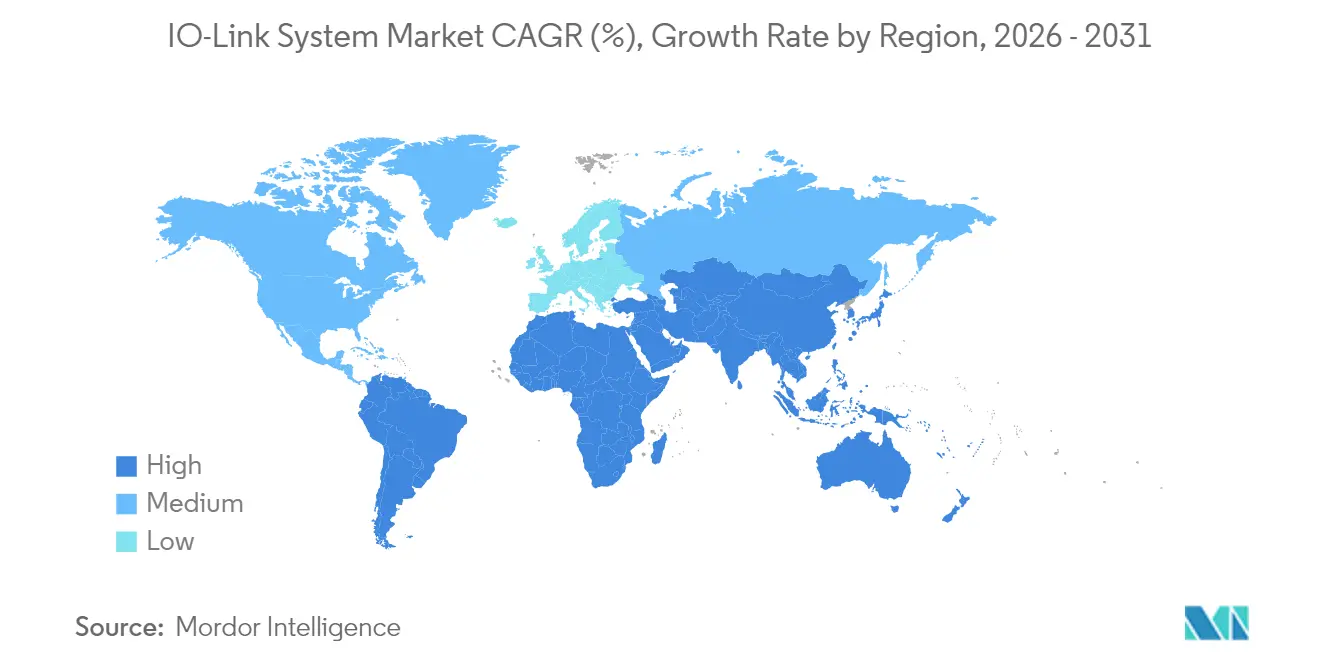
| Fastest Growing Market | Asia Pacific |
| Largest Market | Europe |
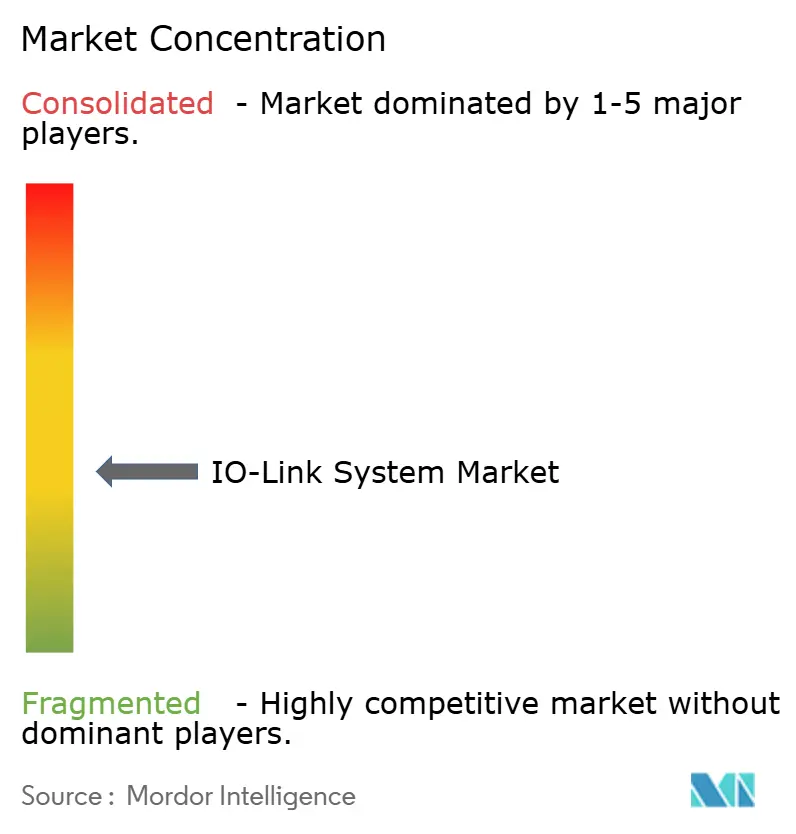
| Market Concentration | Medium |
Major Players *Disclaimer: Major Players sorted in no particular order Image © Mordor Intelligence. Reuse requires attribution under CC BY 4.0. | |
IO-Link System Market Analysis by Mordor Intelligence
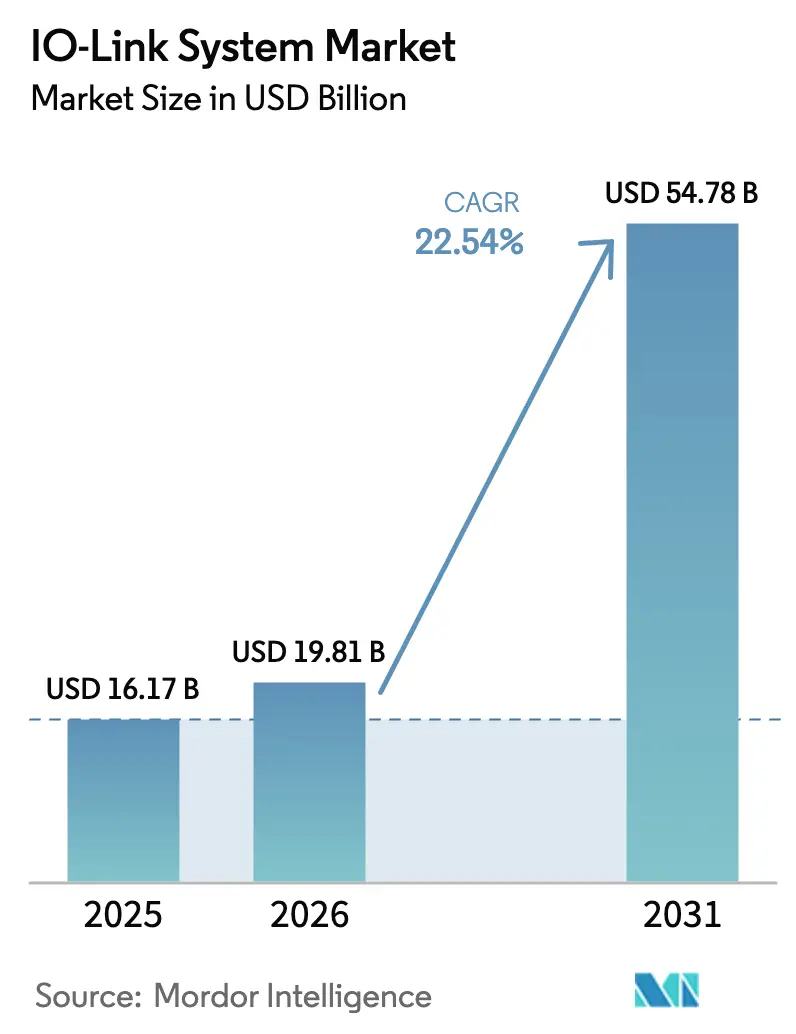
The IO-Link system market size is expected to grow from USD 16.17 billion in 2025 to USD 19.81 billion in 2026 and is forecast to reach USD 54.78 billion by 2031 at 22.54% CAGR over 2026-2031. This trajectory reflects a steady evolution from a point-to-point sensor protocol to a full ecosystem that embeds edge computing and real-time analytics at the field level. Standardization under IEC 61131-9 and the installation of 51.6 million IO-Link nodes worldwide in 2024 have improved interoperability and shortened commissioning cycles.[1] Adoption remains strongest where downtime is costly, such as German precision machining, North American automotive retrofits, and Nordic intralogistics facilities. Suppliers are integrating artificial intelligence into gateways that sit closer to machines, lowering latency and cutting cloud traffic volume. Consolidation among automation majors and long-range wireless collaborations indicate that comprehensive solution portfolios, not single products, will shape competitive advantage.
Key Report Takeaways
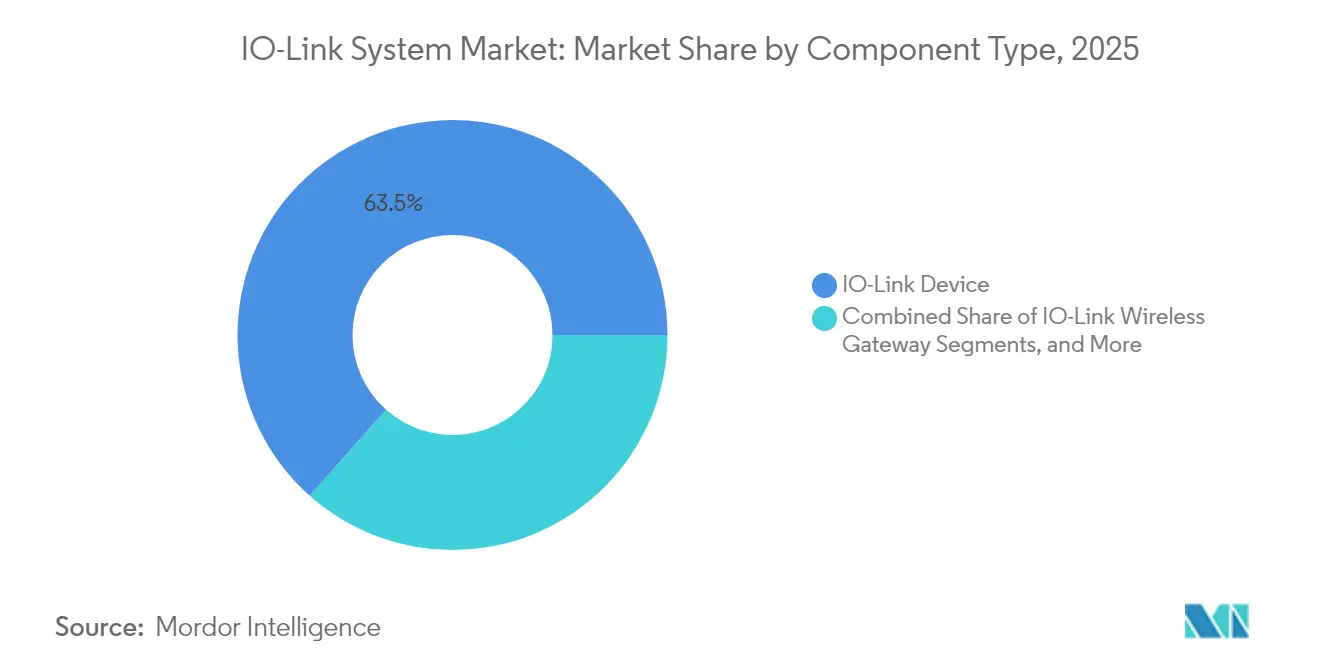
- By component type, IO-Link devices led with 63.45% revenue share in 2025, while the wireless gateway segment is on track for a 31.08% CAGR to 2031.
- By integration architecture, PLC-embedded modules accounted for 47.65% of the IO-Link system market size in 2025, whereas edge or cloud gateways will expand at 29.06% CAGR through 2031.
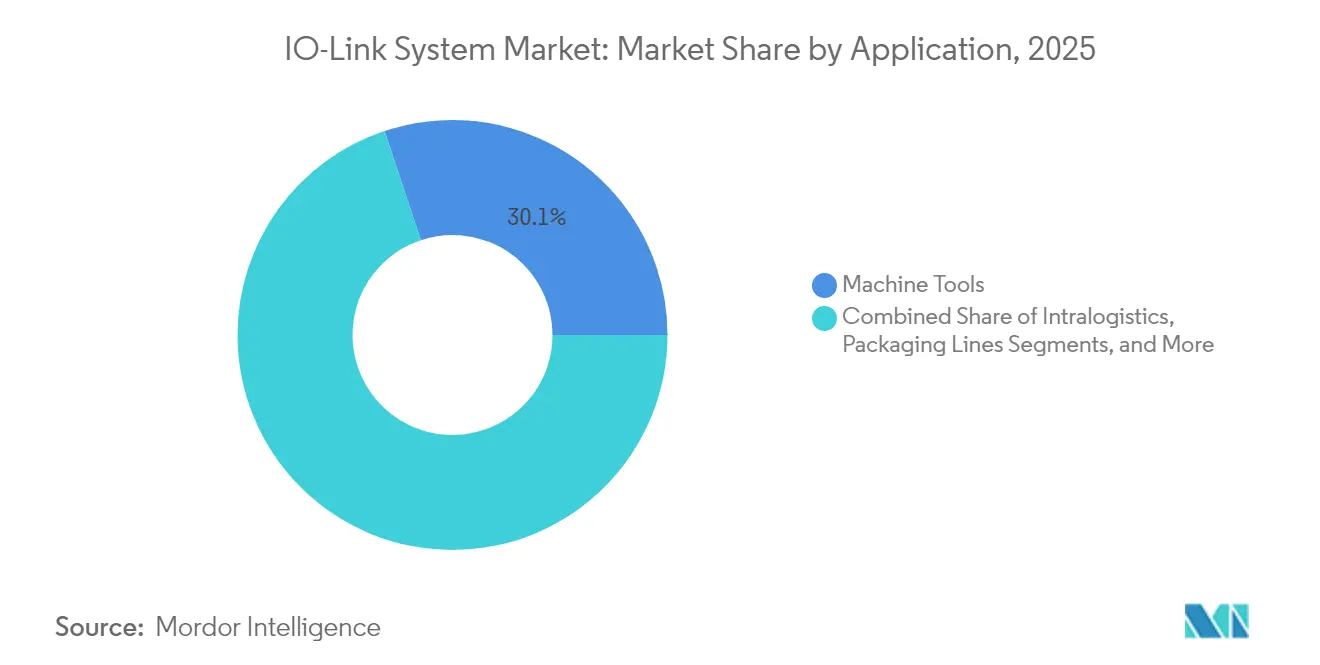
- By application, machine tools captured 30.12% of the IO-Link system market share in 2025, while intralogistics is projected to grow at 26.71% CAGR between 2026 and 2031.
- By end-user industry, discrete manufacturing held 67.85% share in 2025, whereas process manufacturing will post the fastest 27.72% CAGR to 2031.
- By region, Europe led with a 34.12% share in 2025; Asia-Pacific is set to register the highest 25.87% CAGR during the forecast period.
Note: Market size and forecast figures in this report are generated using Mordor Intelligence’s proprietary estimation framework, updated with the latest available data and insights as of 2026.
Market Trends and Insights
Drivers Impact Analysis of IO-Link System Market*
| Driver | (~) % Impact on CAGR Forecast | Geographic Relevance | Impact Timeline |
|---|---|---|---|
| Ramp-up of Industry 4.0 retrofitting projects in North American automotive plants | +5.5% | North America | Medium term (2-4 years) |
| High-speed IO-Link-SPE adoption in German machine-tool hubs | +4.4% | Europe | Medium term (2-4 years) |
| Smart-factory grants accelerating IO-Link uptake in South Korean SMEs | +3.7% | South Korea | Short term (≤ 2 years) |
| Data-rich sensor networks for continuous pharma manufacturing in Ireland | +4.2% | Europe | Medium term (2-4 years) |
| Predictive-maintenance-as-a-service boom in Nordic intralogistics warehouses | +3.0% | Nordic countries | Long term (≥ 4 years) |
| Source: Mordor Intelligence | |||
Ramp-up of Industry 4.0 retrofitting projects in North American automotive plants
Automotive producers replaced hard-wired sensors with IO-Link masters that interface directly with existing Wi-Fi, cutting cabinet footprints by 50% and trimming downtime by 30%. Wireless blocks also removed the need for new PLCs in selected stations, enabling payback periods of less than 18 months.
High-speed IO-Link-SPE adoption in German machine-tool hubs
Milling and turning centres now stream vibration, flow, and temperature data ten times faster than classic IO-Link while preserving cost advantages. Starrag reported shorter backup cycles and remote parameter changes that minimized unscheduled stoppages.
Smart-factory grants accelerating IO-Link uptake in South Korean SMEs
Government support that funds half of the implementation costs has broadened access among small manufacturers. Deployments with CoreTigo wireless links reduced CO₂ emissions and aligned with national sustainability targets.
Data-rich sensor networks for continuous pharma manufacturing in Ireland
Pharma plants shifted from batch to continuous processes and achieved 15% cost savings by pairing IO-Link with OPC UA for regulatory traceability.[2] Precision encoders ensured 0.1° accuracy at 12,000 RPM on high-speed packaging lines.
Restraints Impact Analysis of IO-Link System Market*
| Restraint | (~) % Impact on CAGR Forecast | Geographic Relevance | Impact Timeline |
|---|---|---|---|
| Cybersecurity certification gaps in US FDA-regulated facilities | −3.5% | North America | Medium term (2-4 years) |
| Price pressure from low-cost Chinese proprietary sensor buses | −2.8% | Global | Short term (≤ 2 years) |
| Space constraints in compact European packaging machines | −1.8% | Europe | Short term (≤ 2 years) |
| Shortage of IO-Link commissioning skills in ASEAN | −2.3% | Southeast Asia | Medium term (2-4 years) |
| Source: Mordor Intelligence | |||
Cybersecurity certification gaps in US FDA-regulated facilities
Pharma and medical device plants incurred 25-40% higher validation costs because no uniform standard exists for IO-Link security. Projects stretched by up to six months as teams created bespoke test protocols.
Price pressure from low-cost Chinese proprietary sensor buses
Alternate buses that cost 30-40% less than IO-Link captured share in price-sensitive applications, pushing established vendors to highlight total-cost savings and develop entry-level lines.
*Our forecasts treat driver/restraint impacts as directional, not additive. The impact forecasts reflect baseline growth, mix effects, and variable interactions.
IO-Link System Market Segment Analysis
By Component Type:
Wireless gateways redefine industrial connectivityThe IO-Link system market size for component sales remained dominated by devices, yet 63.45% of 2025 revenue derived from smart sensors that now bundle multiple measurements in a single housing. Wireless gateways posted a 31.08% CAGR outlook because they eliminate cable wear on rotating machinery and reduce installation labour. SICK’s model supports 16 nodes with dynamic frequency hopping that sustains data integrity in noisy plants.
Masters evolved toward higher channel densities. Turck released an 8-port IP69K module that also offers 16 configurable digital inputs for harsh food environments. Sensor hubs shrank footprints by 40%, enabling retrofits in confined cabinets. Safety versions that comply with IEC 61139-2 reached Performance Level e through Pilz modules. Phoenix Contact’s contactless couplers transmitted 18 W across a 7 mm air gap and 230.4 kbps data, cutting maintenance on pick-and-place heads.

By Integration Architecture:
Edge computing drives gateway innovationPLC-embedded modules delivered 47.65% of 2025 revenue, yet the IO-Link system market is pivoting toward decentralized intelligence. Edge or cloud gateways are forecast to compound at 29.06% as latency-critical analytics move closer to machines. Hilscher’s sensorEDGE FIELD hosts two container engines and pushes data directly to management software, reducing cloud round-trips.
Stand-alone point-to-point links still serve isolated critical loops. However, multi-protocol masters like IFM’s SolutionBlock now ship with onboard OPC UA, MQTT, and secure HTTPS for enterprise integration. NTP synchronization yields microsecond-level alignment, ensuring that time-stamped events correlate across disparate assets. Such capabilities encourage users to migrate toward modular gateways that can scale analytics workloads without plant-wide controller upgrades.
By Application:
Intralogistics emerges as the growth leaderThe intralogistics segment is projected to grow at a 26.71% CAGR, the highest within the IO-Link system market, owing to warehouse operators targeting IO-Link to enable flexible conveyors, automated storage, and robot shuttles. Wireless nodes collect vibration and temperature readings on constantly moving carriers, feeding predictive-maintenance dashboards that avoid fulfillment delays.
Machine tools remained the largest slice at 30.12% of 2025 revenue. High-speed data streams allow in-process measurement and adaptive control that preserve tight tolerances. Packaging lines shortened changeovers from 90 minutes to 30 minutes when Balluff’s guided format architecture let operators store recipes inside sensor memory. Assembly and test cells leveraged RFID read/write heads with IO-Link to secure traceability and secure password access.
By End-user Industry:
Process manufacturing accelerates adoptionProcess manufacturers are projected to lift spending at a 27.72% CAGR as regulators demand real-time traceability. Endress+Hauser rolled out hygienic IO-Link transmitters for CIP processes that withstand caustic wash-downs. The IO-Link system market size tied to food and beverage is expected to expand steadily as energy-efficient production lines replace legacy analog loops.
Discrete manufacturers still commanded 67.85% of 2025 revenue. Automotive plants installed IO-Link vibration nodes on body-in-white lines to reduce unplanned stoppages. Semiconductor fabs adopted chemical supply sensors with digital outputs that met strict purity requirements. A French bottling plant that runs 30,000 PET units per hour used IO-Link and AS-i to automate data capture and cut capex on field wiring.
Geography Analysis
Europe IO-Link System Market
Europe led the IO-Link system market with a 34.12% slice in 2025. German machining centres adopted IO-Link-SPE to transmit high-frequency vibration data that guides adaptive control, and Phoenix Contact advanced contactless couplers for rotating equipment. Italy and Switzerland followed through precision equipment exports, while the United Kingdom and France applied IO-Link to flexible packaging and automotive stamping.
APAC IO-Link System Market
Asia-Pacific is forecast to record a 25.87% CAGR through 2031 as China upgrades assembly plants and local sensor suppliers join the IO-Link Community. South Korean grants cover half of the project costs for SMEs, prompting network effects across tier-one supply chains. Japanese robotics integrators deploy IO-Link in high-mix lines that require fast tool change. India and several ASEAN economies are adopting the protocol despite commissioning skill shortages, supported by multinational investments that bundle training with equipment.
The Americas and GCC IO-Link System Market
North America maintained strong demand through retrofit programs in automotive assembly, where wireless masters cut downtime and cabinet space. FDA-regulated industries progressed cautiously because of cybersecurity certification gaps, yet suppliers began shipping pre-validated stacks to close compliance hurdles. Canada’s resource sector relied on IP69K hubs for mine and mill automation, while Mexico leveraged IO-Link within new automotive and electronics plants near the border. South America and the Middle East remain nascent, with Brazil and the Gulf Cooperation Council emphasizing diversified manufacturing that could lift regional adoption over the next decade.
Regulatory Landscape
IO-Link is defined under the IEC 61131-9:2022 standard (SDCI), which sets a common baseline for interoperable sensor and actuator connectivity across automation ecosystems. Governance and conformance are coordinated by the IO-Link Community, organized within Profibus Nutzerorganisation e.V. (PNO) in Karlsruhe, Germany. PNO maintains community rules that require manufacturer declarations of conformity and the use of the IODD (IO Device Description) format for device identification and parameterization.
Interoperability assurance is reinforced through the IO-Link Quality Center and the IODD-Finder device-registration workflow. Together, these validate implementations against the IO-Link Interface and System Specification (June 2024 package) and related quality requirements, including the IO-Link Product Quality Policy (March 2025 version). Because IO-Link is fieldbus-independent, compliance work often extends to higher-level network integration such as PROFINET/PROFIsafe and EtherNet/IP, so documentation, device-description management, and testing discipline remain central for regulated and downtime-sensitive deployments.
Value Chain Analysis
The IO-Link system value chain starts with silicon and embedded software that support IO-Link physical-layer and protocol functionality. It then moves through sensor and actuator manufacturers, IO-Link device makers, and IO-Link master suppliers that package port density, protection ratings, and diagnostics into deployable hardware. On the control side, PLC and fieldbus platform providers, along with gateway vendors, integrate IO-Link into wider architectures, while the standard keeps the approach fieldbus-independent for use across common industrial networks.
A dedicated software and interoperability layer sits around IODD creation, distribution, and lifecycle management, which supports commissioning, parameterization, and diagnostics at scale. The IO-Link Community (within PNO) manages specifications, licensing, and interoperability processes, while the IO-Link Quality Center and IODD-Finder support testing and registration. In practice, this links device suppliers, master vendors, and system integrators into a shared qualification and deployment workflow across a member ecosystem of more than 500 companies and tens of thousands of product solutions.
Competitive Landscape
More than 485 companies belonged to the IO-Link Community in 2024, yet consolidation advanced as majors purchased niche innovators to build end-to-end portfolios. Market leaders layered edge analytics, wireless, and cybersecurity features into product suites. CoreTigo secured alliances with Emerson to retrofit air treatment units and cut energy use in compressed-air networks. The mioty alliance partnered with the IO-Link Community to enable long-range sensor feeds while keeping the existing toolchain, broadening addressable applications.
Semiconductor vendors entered aggressively. Renesas launched a four-channel master IC that drives 500 mA per port, plus a dual-channel conditioner with an integrated stack, reducing board space for sensor makers. Phoenix Contact expanded the Axioline E remote I/O line with rugged IP69 modules that shorten installation time in wash-down zones. PULS integrated an IO-Link interface into power supplies, enabling remote diagnostics on critical voltage rails.
White-space opportunities revolve around cyber-secure stacks for FDA facilities, cost-adjusted variants to fight low-price Chinese buses, and miniaturized hubs for compact machines. Suppliers that merge several pain-point solutions—wireless, safety, analytics, and security—in a single platform are positioned to capture incremental share as buyers consolidate vendor lists.
IO-Link System Industry Leaders
-
Balluff GmbH
-
ifm electronic gmbh
-
Siemens AG
-
Pepperl + Fuchs SE
-
Turck Holding GmbH
- *Disclaimer: Major Players sorted in no particular order
IO-Link System Market Companies Covered in this Report
- Balluff GmbH
- ifm electronic gmbh
- Siemens AG
- Pepperl + Fuchs SE
- Turck Holding GmbH
- SICK AG
- Banner Engineering Corp.
- Omron Corporation
- KEYENCE Corporation
- Beckhoff Automation GmbH
- Weidmüller Interface GmbH
- Baumer Electric AG
- Leuze electronic GmbH
- Phoenix Contact GmbH
- WAGO Kontakttechnik GmbH
- Murrelektronik GmbH
- Bihl + Wiedemann GmbH
- Carlo Gavazzi Holding AG
- Festo SE & Co. KG
- Sensata Technologies Inc.
- Endress + Hauser Group
- Rockwell Automation Inc.
- Bosch Rexroth AG
- Schneider Electric SE
- Eaton Corporation plc
- Contrinex SA
Market Opportunities and Future Outlook
One clear opportunity is expanding wireless and cabinet-free architectures for dynamic assets, where wiring and mechanical wear become practical constraints. Balluff has positioned IO-Link Wireless as an enabler for cable-free sensor communication in harsh and dynamic environments, and its BNI00KW bridge architecture supports multi-device connectivity that fits conveyor-heavy and mobile-carrier workflows. Alongside this, decentralized IO-Link masters with IP67 ratings, including ifm electronic gmbh offerings (such as field-level multiprotocol masters positioned for scalable automation), support cabinet-free buildouts that reduce installation complexity and help retrofit programs move faster.
A second whitespace theme is the convergence of IO-Link with functional safety and multi-protocol data access, allowing a shared field infrastructure for both safety signaling and condition data. Pepperl+Fuchs has showcased fieldbus modules that combine functional safety (up to SIL 3 / PL e) with standard IO-Link, with northbound interfaces such as OPC UA and MQTT used for higher-level analytics and maintenance workflows. Integration also continues into adjacent equipment categories, for example Turck embedding IO-Link master functionality into motor-control form factors, which widens the bill-of-materials footprint beyond classical sensor blocks and supports more modular machine and conveyor designs.
Recent Industry Developments in IO-Link System Market
- July 2026: ifm electronic gmbh released the AL1602 multiprotocol-capable IO-Link master from the AutomationLine range for field-level industrial applications. The update extends IO-Link master capability with multiprotocol support, improving the path for faster integration at the field level.
- April 2026: ifm electronic gmbh launched IO-Link enabled LED strips with integrated bypass system and IP69K protection for industrial visualization. This expands IO-Link visualization components for harsh environments, adding rugged options for retrofit and new-install projects.
- March 2026: Balluff GmbH deployed IO-Link Wireless technology to support cable-free sensor communication in dynamic and harsh industrial environments. The release advances wireless IO-Link adoption in challenging settings, supporting flexible cable-free retrofits while reducing wiring costs in automation lines.
IO-Link System Market Report Scope and Research Methodology
Market Definition and Coverage
For this methodology, the market covers revenues generated from IO-Link system hardware and related system elements used to connect sensors and actuators with industrial control networks across major manufacturing and logistics environments.
Scope exclusions: It does not count broader automation controllers, generic industrial networking gear that is not IO-Link specific, or plant-wide software that is not required to run an IO-Link link.
Segments Covered in This Report
- By Component Type
- IO-Link Master
- IO-Link Device
- IO-Link Wireless Gateway
- Sensor / Actuator Hub
- By Integration Architecture
- Stand-alone Point-to-Point
- PLC-Embedded Module
- Edge / Cloud Gateway
- By Application
- Machine Tools
- Intralogistics
- Packaging Lines
- Assembly and Test Lines
- By End-user Industry
- Discrete Manufacturing
- Automotive
- Electronics and Semiconductor
- Machinery and Equipment
- Process Manufacturing
- Food and Beverage
- Pharmaceuticals
- Chemicals
- Discrete Manufacturing
- Geography
- North America
- United States
- Canada
- Mexico
- Europe
- Germany
- United Kingdom
- France
- Italy
- Rest of Europe
- Asia-Pacific
- China
- Japan
- South Korea
- ASEAN
- India
- Rest of Asia-Pacific
- South America
- Brazil
- Argentina
- Rest of South America
- Middle East and Africa
- Middle East
- GCC
- Turkey
- Rest of Middle East
- Africa
- South Africa
- Rest of Africa
- Middle East
- North America
Data Sources, Market Sizing, and Validation
Desk Research
Desk research is used to build the first market structure and to set realistic bounds for adoption by industry and region. We rely on official and public references such as IEC publications for IO-Link (IEC 61131-9), trade statistics from sources such as UN Comtrade, manufacturing output series from sources such as the World Bank and OECD, and industrial production indicators from sources such as national statistics offices.
It is then complemented with supply-side signals from public company filings, investor presentations, product catalogs, and reputable industrial press coverage that tracks new device releases and factory investments. Where available, paid subscriptions are used only for items such as company financials, news and financials, and patent databases to check timing of launches and the direction of device roadmaps. The desk sources listed here are illustrative, and many other sources were also reviewed to collect data points, validate assumptions, and clarify open questions.
Primary Interviews and Surveys
Primary work is used to pressure-test what we see in public information and to fill gaps that come up often in this market, such as typical IO-Link port counts, mix of masters versus devices, and regional pricing practices. We speak with a balanced mix of ecosystem participants (device makers, integration partners, distributors, and end-user engineering teams) across major manufacturing hubs, so the adoption signals are not shaped by a single country or vertical.
Distribution of primary research fieldwork respondents
| Company type | Respondent position | Region |
|---|---|---|
| Top tier: 35% | CXOs: 14% | APAC: 40% |
| Mid tier: 47% | Functional/Unit leaders: 41% | EMEA: 34% |
| Smaller Players: 18% | Managers: 45% | Americas: 26% |
Market-Sizing & Forecasting
Market sizing is built by first reconstructing the demand pool using manufacturing activity and automation spending signals, then translating it into likely IO-Link node and master deployments by application. The top-down approach starts from adoption rates in machine tools, intralogistics, and packaging, followed by device density assumptions (sensors or actuators per machine area) and typical master port configurations that are validated through interviews.
To keep the totals realistic, selective bottom-up checks are run using sampled price bands and shipment proxies across masters, devices, and accessories, and then compared back to the modeled volumes. In this market, key inputs include the installed base of automated equipment, new factory capex cycles, replacement and retrofit share, average selling price shifts by component type, and the pace of gateway adoption where edge connectivity is required. Forecasting is mainly done using scenario analysis, with a base case adjusted by regional manufacturing outlooks and primary feedback on order pipelines and lead times. Gaps in supplier coverage are handled with conservative ranges for smaller and private participants before final totals are normalized.
Data Validation & Update Cycle
Outputs are checked against independent signals so the result does not rely on a single data stream, and variances are investigated before sign-off. Modeled trends are compared with indicators such as industrial production direction, automation investment commentary, and visible shifts in component mix. When assumptions move outside expected ranges, we re-contact sources for clarification.
Before publication, the model goes through multi-step analyst reviews that include logic checks, currency consistency checks, and outlier screening by region and application. Reports are refreshed annually, and interim updates are made when material events change pricing, demand, or supply conditions. Just before delivery, a final pass is completed so the market view reflects the latest available information.
Mordor Intelligence's Io Link System Market Size Compared Against Other Published Estimates
Published market values for IO-Link systems can look far apart because the scope boundary is not always treated the same, and because price and volume assumptions move quickly in industrial automation. Differences also show up when one publisher uses an older exchange-rate window, or keeps average selling prices flat even when mix shifts toward higher value masters and gateways.
In our refresh cycle, quarterly currency timing checks and repeat validation calls are used to re-base ASP ladders for masters, devices, and accessories when the component mix changes. This is why the 2026 baseline in Mordor Intelligence does not line up with estimates that still lean on earlier-year pricing and one-time scenario settings.
Benchmark comparison
| Source | Market Size | Gaps in Research Methodology |
|---|---|---|
| Mordor Intelligence | USD 19.81 B (2026) | |
| Trade Journal A | USD 20.30 B (2026) | Often summarizes the protocol-level market and may apply a single blended ASP across components, which can overstate value when device-heavy deployments dominate and accessories are bundled differently. |
| Industry Bulletin B | USD 15.70 B (2024) | Uses an earlier base year and can fold wired and wireless discussions into one number with static exchange-rate treatment, which can undercount when later-year mix shifts toward higher value masters and gateways. |
The spread across the table is mainly explained by timing and what gets priced as a system versus a protocol footprint. By keeping the base year, currency window, and component-level ASP logic explicit, the resulting market size stays traceable to clear assumptions that can be rechecked and updated in a repeatable way.
Key Questions Answered in the Report
What is driving the rapid growth of the IO-Link system market?
Edge computing integration, wireless gateways, and strong government programs in Europe and Asia-Pacific are accelerating deployment, leading to a 22.54% CAGR forecast to 2031.
Which component contributes the most revenue today?
Smart IO-Link devices, including multi-parameter sensors, represented 63.45% of 2025 revenue, reflecting their foundational role in every installation.
How significant is wireless technology to future adoption?
Wireless gateways are projected at a 31.08% CAGR because they remove cabling limits on rotating or mobile equipment and enable easier retrofits in legacy plants.
Why is the pharmaceutical sector adopting IO-Link so quickly?
Continuous manufacturing requires precise, real-time data with full traceability, and IO-Link paired with OPC UA cuts production costs by 15% while meeting regulatory needs.
What challenges could slow market penetration?
Cyber-security certification gaps in FDA-regulated facilities and price competition from low-cost proprietary buses can raise costs or delay decisions, trimming forecast growth by up to 6.3%.