
Intravenous Solutions Market Size and Share
Market Overview
| Study Period | 2020 - 2031 |
|---|---|
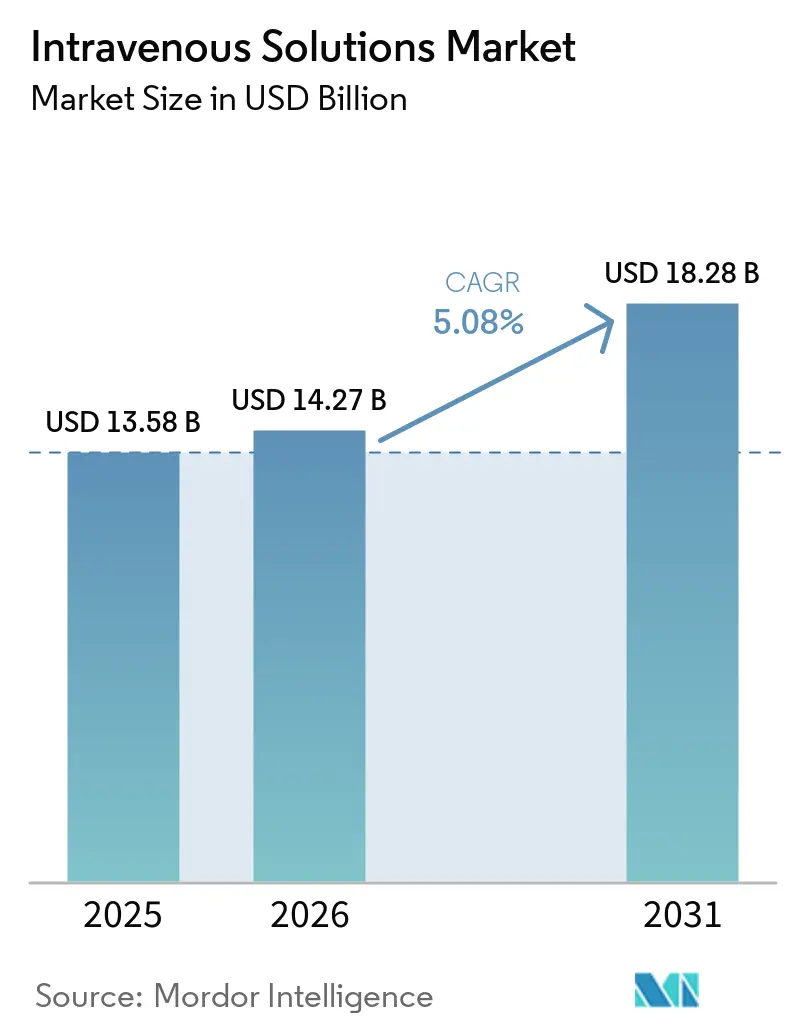
| Market Size (2026) | USD 14.27 Billion |
| Market Size (2031) | USD 18.28 Billion |
| Growth Rate (2026 - 2031) | 5.08 % |
| Fastest Growing Market | Asia Pacific |
| Largest Market | North America |
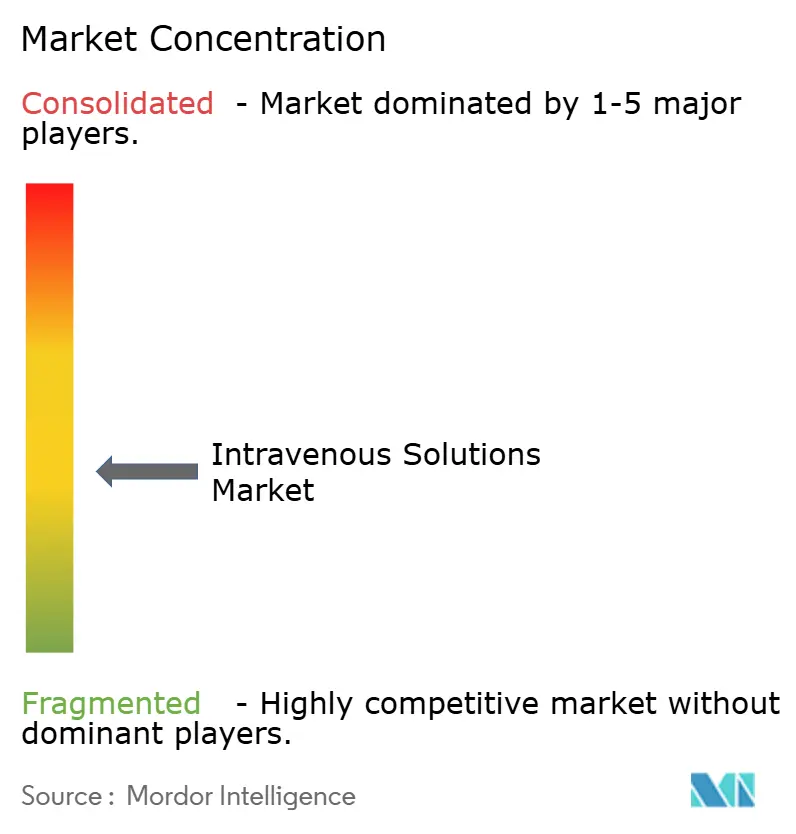
| Market Concentration | Medium |
Major Players *Disclaimer: Major Players sorted in no particular order Image © Mordor Intelligence. Reuse requires attribution under CC BY 4.0. | |
Intravenous Solutions Market Analysis by Mordor Intelligence
The Intravenous Solutions Market size was valued at USD 13.58 billion in 2025 and estimated to grow from USD 14.27 billion in 2026 to reach USD 18.28 billion by 2031, at a CAGR of 5.08% during the forecast period (2026-2031).
Growth stems from an accelerating shift toward precision-engineered formulations driven by artificial-intelligence dosing tools, rising surgical volumes, and a chronic-disease burden that intensifies demand for reliable parenteral therapies. Environmental legislation is hastening a transition away from PVC packaging, while government-backed onshoring initiatives seek to protect domestic supply after recent disaster-linked shortages. Leaders in the intravenous solutions market are therefore investing in vertically integrated manufacturing, AI-enabled nutritional platforms, and resilient logistics networks that can withstand climate and geopolitical shocks.
Key Report Takeaways
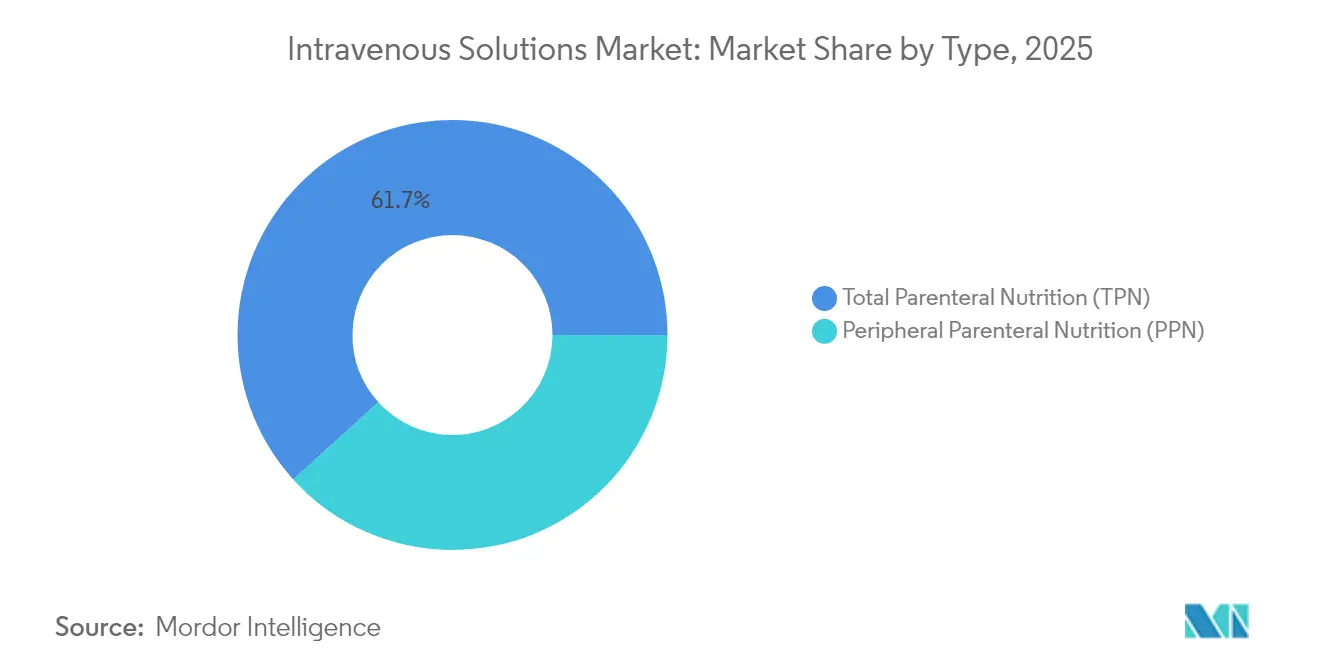
- By type, total parenteral nutrition (TPN) led with 61.72% of intravenous solutions market share in 2025, yet peripheral parenteral nutrition (PPN) is expanding at an 8.26% CAGR to 2031.
- By solution composition, saline solutions captured 52.60% of the intravenous solutions market in 2025, while lipid emulsions record the fastest 9.02% CAGR through 2031.
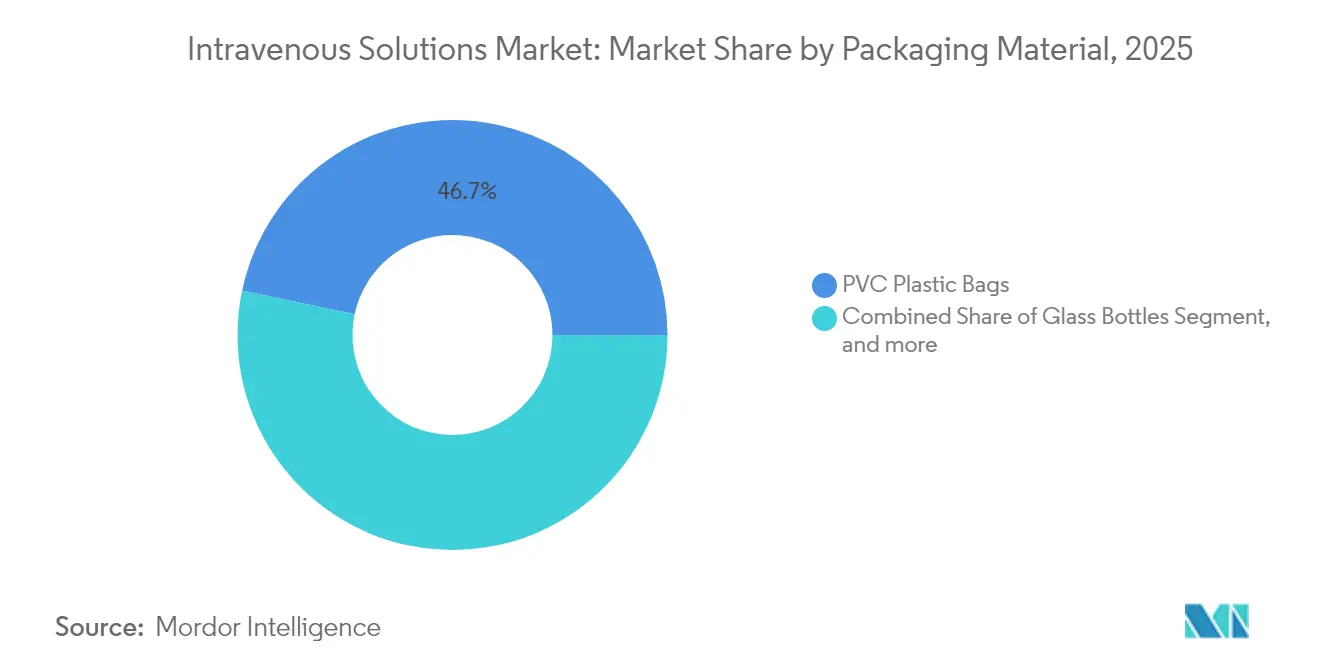
- By packaging material, non-PVC polyolefin formats are advancing at a 9.41% CAGR, whereas PVC bags still held 46.68% share of the intravenous solutions market in 2025.
- By end user, hospitals and clinics accounted for 68.55% revenue share in 2025; home-care settings show the highest 7.62% CAGR to 2031.
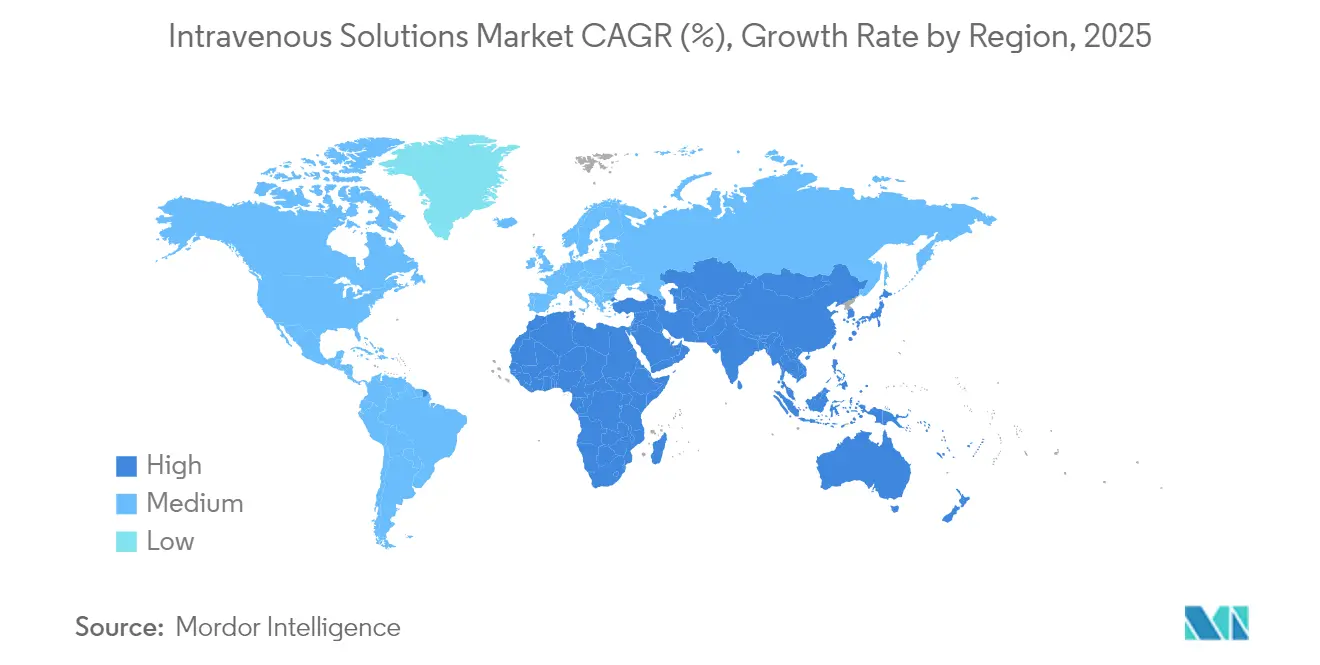
- By geography, North America commanded 39.35% share in 2025, but Asia-Pacific is forecast to grow at 6.93% CAGR through 2031.
Note: Market size and forecast figures in this report are generated using Mordor Intelligence’s proprietary estimation framework, updated with the latest available data and insights as of 2026.
Market Trends and Insights
Drivers Impact Analysis of Intravenous Solutions Market*
| Driver | (~) % Impact on CAGR Forecast | Geographic Relevance | Impact Timeline |
|---|---|---|---|
| Adoption of AI-enabled, personalized parenteral nutrition protocols | +1.2% | Global, early adoption in North America & EU | Medium term (2-4 years) |
| Steady rise in chronic disease prevalence | +0.8% | Global, pronounced in APAC | Long term (≥ 4 years) |
| Rapid growth of home-based and ambulatory care models | +0.9% | North America & EU leading, expanding to APAC | Short term (≤ 2 years) |
| Ageing population coupled with higher surgical volumes | +0.7% | Global, greatest in developed markets | Long term (≥ 4 years) |
| Emergence of stability-optimized large-volume parenterals | +0.6% | Global | Medium term (2-4 years) |
| Government-backed onshoring initiatives | +0.5% | North America, similar trends in EU | Short term (≤ 2 years) |
| Source: Mordor Intelligence | |||
Adoption of AI-Enabled, Personalized Parenteral Nutrition Protocols
AI-driven software now matches expert TPN orders with 94% concordance, while cutting dosing-error rates by 54%.[1] Hospitals processing tens of thousands of nutrition prescriptions annually save minutes per preparation, freeing pharmacy labor and lowering cost. Standardized yet individualized regimens enhance evidence-based compliance and safeguard metabolic outcomes across neonatal and adult ICUs. Scalability makes the approach attractive for resource-limited centers that lack full-time nutritionists. Consequently, clinical protocols are shifting from manual calculations toward algorithm-guided prescriptions, reinforcing demand for formulation flexibility in the intravenous solutions market.
Steady Rise in Chronic Disease Prevalence
In 2024, 76.4% of US adults reported at least one chronic ailment, driving recurrent hospitalizations that depend on parenteral hydration and nutrition.[2] Younger patients increasingly present with multimorbidity, extending lifetime exposure to IV therapy. Surgeons anticipate thoracolumbar fusion procedures to rise to 297,994 cases by 2040, creating larger perioperative fluid needs.[3] Hospitals therefore favor broad-spectrum IV platforms, including glucose IV solutions, capable of supporting multi-drug regimens, a trend that reinforces baseline growth in the intravenous solutions market
Rapid Growth of Home-Based and Ambulatory Care Models
Portable pumps, remote monitoring, and longer-shelf-life bags allow chemotherapy, antibiotics, and nutrition to shift outside hospitals. Pandemic experience validated clinical safety while reducing nosocomial infection risk. Manufacturers now formulate solutions for ambient stability and easy-to-use connectors, expanding addressable volumes within the intravenous solutions market. Payers also endorse the transition as it trims bed-day costs without sacrificing outcomes.
Ageing Population Coupled with Increased Surgical Volumes
Valve replacement, orthopedic, and oncologic procedures climb as median ages rise. Older patients with comorbidities require electrolyte-balanced, energy-dense fluids to expedite recovery and avoid renal stress. Forecasts indicate most candidates for major surgery will exhibit elevated BMI by 2030, complicating fluid distribution and necessitating customized macronutrient ratios. Precision blends positioned for geriatric physiology therefore secure heightened relevance, further broadening the intravenous solutions industry footprint.
Restraints Impact Analysis of Intravenous Solutions Market*
| Restraint | (~) % Impact on CAGR Forecast | Geographic Relevance | Impact Timeline |
|---|---|---|---|
| High compliance burden associated with GMP | -0.4% | Global, varying intensity | Medium term (2-4 years) |
| Ongoing supply-chain constraints | -0.3% | Global, acute in North America | Short term (≤ 2 years) |
| Environmental scrutiny of single-use IV plastics | -0.2% | North America & EU, expanding worldwide | Medium term (2-4 years) |
| Clinical shift toward subcutaneous and enteral routes | -0.3% | Global, faster in developed markets | Long term (≥ 4 years) |
| Source: Mordor Intelligence | |||
High Compliance Burden Associated With GMP
Revised EU Annex 1 now requires full contamination-control strategies and extensive barrier technology, raising capital thresholds for smaller firms. Validation of ready-to-use containers prolongs launch timelines by as much as 18 months, and documentation can consume 20% of development budgets. In emerging regions, diverging national rules oblige parallel audits, draining regulatory resources. These burdens deter new entrants and limit price competition, moderating growth in the intravenous solutions market.
Ongoing Supply-Chain Constraints
The Baxter North Cove shutdown proved that a single factory outage can force nationwide conservation protocols. Dependence on API imports from Asia leaves firms vulnerable to port closures and export bans. Stockpiles are difficult because typical shelf life remains below two years. Manufacturers therefore hold redundant inventory, inflating working capital, while hospitals scramble for substitutes that may not match formulation profiles. Such instability dampens short-term expansion in the intravenous solutions industry.
*Our forecasts treat driver/restraint impacts as directional, not additive. The impact forecasts reflect baseline growth, mix effects, and variable interactions.
Intravenous Solutions Market Segment Analysis
By Type:
TPN Sustains Leadership While PPN Gains MomentumTotal parenteral nutrition generated the largest revenue, equal to 61.72% of intravenous solutions market share in 2025. AI-guided calculators now tailor amino-acid, lipid, and electrolyte loads to metabolic markers, transforming TPN into a precision tool rather than a static recipe. Demand remains entrenched in neonatal and oncologic wards where gut function is compromised.
Peripheral Parenteral Nutrition, although accounting for a smaller base, is forecast to post the leading 8.26% CAGR. Home infusion programs favor PPN because peripheral lines avoid central-catheter infection risk and simplify nursing care. Multi-chamber PPN bags cut compounding errors, and stability-enhanced formulations extend hang times, supporting out-of-hospital uptake. The result is a steady re-balancing of volumes inside the intravenous solutions market as clinicians weigh risk, cost, and patient comfort.

By Solution Composition:
Lipid Emulsions Accelerate Beyond Saline StaplesSaline maintained a 52.60% revenue share in 2025, underscoring its ubiquity in resuscitation and dilution tasks. Nevertheless, omega-3 enriched lipid emulsions are advancing at 9.02% CAGR between 2026 and 2031. Composite products such as SMOFlipid curb hepatotoxicity and modulate inflammation, creating measurable survival benefits in ICU cohorts.
Protein hydrolysates, carbohydrate blends, and trace-element cocktails enjoy niche growth as evidence supports tighter nutrient control during sepsis and trauma recovery. Research into heat-stable protein carriers that remain bioactive after pasteurization may soon eliminate cold-chain dependence, opening frontier markets and reinforcing geographical diversity of the intravenous solutions market.
By Packaging Material:
Non-PVC Formats Push Sustainability AgendaPVC bags still dominate on a unit basis with market share of 46.68% in 2025, but non-PVC polyolefin containers are recording the highest 9.41% CAGR. California’s phase-out deadlines have already diverted USD 1.2 billion of capital toward re-tooling, and European tenders increasingly demand DEHP-free products.
Glass bottles and multilayer polypropylene vials cater to niche segments involving cytotoxics and biologics where material compatibility is paramount. Barrier-coated polyolefin films that slash water-vapor transmission extend shelf life for amino-acid solutions, adding resilience to the intravenous solutions market supply chain.
By End User:
Home Care Outpaces Institutional SettingsHospitals and clinics secured 68.55% revenue share in 2025, reflecting entrenched inpatient protocols. Yet the home-care sub-segment is expanding 7.62% annually, powered by payer incentives and patient preference for familiar surroundings. Portable smart pumps transmit data to telehealth centers, allowing real-time dose adjustment.
Ambulatory infusion suites occupy the middle ground by offering specialist staff without costly overnight stays. These hybrid models sustain broader access and propel the intravenous solutions market into community settings previously dominated by oral therapies.
Geography Analysis
North America Intravenous Solutions Market
North America retained the largest regional stake with 39.35% of 2025 revenue, backed by advanced hospital networks and early uptake of AI dosing software. Executive Order 14293 and parallel state incentives are now underwriting new sterile-fill facilities in the Midwest, dispersing risk away from hurricane-prone regions. High insurance penetration also supports premium pricing for innovative non-PVC bags, further boosting the region’s intravenous solutions market performance.
APAC Intravenous Solutions Market
Asia-Pacific displays the strongest momentum with a forecast 6.93% CAGR through 2031. China’s provincial tenders favor local capacity additions, while India leverages low-cost fill-finish labor for export contracts. Japan channels R&D subsidies into emulsions enriched with long-chain fatty acids that meet stringent geriatrics guidelines. Rising prevalence of diabetes and obesity in Southeast Asia likewise elevates demand for electrolyte-controlled solutions, making the region a critical growth engine for the intravenous solutions market.
Europe Intravenous Solutions Market
Europe shows steady expansion anchored in stringent quality rules that reward GMP compliance. Hospitals prioritize DEHP-free sourcing, accelerating non-PVC conversion and opening premium niches. Meanwhile, Eastern European contract manufacturers bid for supplemental production to backstop Western shortages. Collectively, these dynamics keep the intravenous solutions industry resilient despite environmental taxes and evolving pharmacopoeia standards.
Mordor Intelligence provides coverage of the intravenous solutions market across other key regional markets, including Europe, each with their regulatory frameworks and demand patterns.
Regulatory Landscape
Sterile intravenous solutions are regulated as drug products and are governed by stringent current Good Manufacturing Practice (cGMP) and aseptic processing expectations, such as US FDA requirements under 21 CFR Part 211 and FDA guidance for sterile drug products produced by aseptic processing. In Europe, EudraLex Volume 4 GMP requirements, including Annex 1 for sterile medicinal products, continue to set a high baseline for contamination control and facility qualification practices that impact both EU production and imported supply.
Recent regulatory and standards actions also shape compounding and validation practices that influence demand for ready-to-use, manufacturer-prepared IV solutions. In the United States, the USP General Chapter 797 revisions for sterile compounding (implemented in November 2023) increase operational requirements for compounding environments, training, and monitoring, while the FDA issued guidance in October 2024 to enable certain compounding activities by outsourcing facilities in response to IV solutions supply disruptions. In the EU, the EMA published a concept paper in January 2026 on revising GMP Annex 15 (Qualification and Validation), reinforcing the emphasis on robust validation packages and ongoing control strategies for sterile finished products.
Competitive Landscape
The three largest suppliers Baxter International, Fresenius Kabi, and B. Braun collectively command high share of global revenue, reflecting moderate concentration. Baxter couples IV fluids with infusion pumps to lock in system sales, while its 2024 rollout of 10 new injectables expanded hospital wallet share. Fresenius Kabi’s EUR 600 (USD 708.2) million biosimilar franchise lets it bundle biologics with supportive parenterals, differentiating its catalog. B. Braun’s USD 1.2 billion investment in non-DEHP production strengthens its appeal in sustainability-focused tenders.
Mid-tier players pursue partnerships to scale, exemplified by ICU Medical’s USD 200 million joint venture with Otsuka that yields 1.4 billion bags annually. Start-ups aim at AI-guided compounding services, seeking licensing deals with hospital pharmacies. Regulatory initiatives such as the FDA Advanced Manufacturing Technologies program further encourage continuous-manufacturing prototypes that promise shorter lead times and fewer sterility interventions. Competitive rivalry therefore hinges on capacity, compliance agility, and digital-health integration as firms contest share in the intravenous solutions market.
Intravenous Solutions Industry Leaders
-
B. Braun SE
-
ICU Medical Inc.
-
Ajinomoto Co., Inc.
-
Baxter International Inc.
-
Grifols S.A.
- *Disclaimer: Major Players sorted in no particular order
Intravenous Solutions Market Companies Covered in this Report
- Baxter
- B. Braun
- Fresenius
- Grifols
- ICU Medical
- Ajinomoto Co., Inc.
- Otsuka
- PHARMASYNTEZ JSC
- SGD Pharma
- Vifor Pharma Ltd.
- Hospira Inc. (Pfizer)
- JW Life Science Co., Ltd.
- Sichuan Kelun Pharmaceutical
- Terumo
- Aculife Healthcare Pvt. Ltd.
- SSY Group Limited
- Nipro
- Axa Parenterals Ltd.
- JMS Co., Ltd.
- Qilu Pharmaceutical Co., Ltd.
Market Opportunities and Future Outlook
Supply resilience and regional production have become actionable whitespace following recent shortage and allocation cycles, with manufacturers and governments funding new capacity and redundancy. The FDA's August 2025 announcement resolving the national shortage of sodium chloride 0.9% injection illustrates how rapidly demand and allocation dynamics can change once additional supply and operational recovery take hold, pushing suppliers to balance surge capacity with efficient steady-state operations. This creates room for multi-site sterile manufacturing strategies, higher automation in fill-finish, and more robust supplier qualification programs for container-closure components.
Sustainability-driven packaging conversion and non-DEHP portfolios create another clear commercialization lane, supported by major capex announcements tied to IV solutions infrastructure. In July 2026, Otsuka ICU Medical LLC disclosed an over USD 500 million expansion of IV solutions manufacturing in Austin, Texas, explicitly aligned to supply resiliency and support for non-DEHP products, while April 2026 capacity additions in Oman (Izz Pharma) and Egypt (Ateco Pharma) point to new regional hubs that address domestic security objectives and expand local availability. Alongside these supply-side moves, stricter sterile compounding expectations (for example, USP 797) and workflow pressure in hospitals reinforce demand for ready-to-use presentations and longer stability formats that reduce in-pharmacy manipulation and simplify administration across inpatient and home-care settings.
Recent Industry Developments in Intravenous Solutions Market
- July 2026: Otsuka ICU Medical LLC announced an over USD 500 million expansion of its IV solutions manufacturing footprint in Austin, Texas, including a new 500,000-square-foot facility and upgrades to an existing 700,000-square-foot plant. The investment targets higher regional supply resilience and supports scaling a non-DEHP IV solutions portfolio, aligning production assets with evolving hospital procurement and environmental requirements.
- March 2025: Mallinckrodt and Endo announced a merger to form a diversified pharmaceuticals company integrating sterile injectables and generics capabilities. The combination is positioned to consolidate manufacturing infrastructure and strengthen supply execution across hospital-facing sterile product categories that include IV-administered therapies.
- July 2024: Amneal Pharmaceuticals received US FDA approval for a new formulation of potassium phosphates in 0.9% sodium chloride injection in ready-to-use IV bags. The approval expands access to a sterile, premixed presentation that reduces compounding steps for clinicians and supports safer, faster administration in acute care settings.
Intravenous Solutions Market Report Scope and Research Methodology
Market Definition and Coverage
For this report, the intravenous solutions market covers sterile, chemically prepared fluids that are administered into a vein to maintain hydration, restore electrolyte balance, or provide nutrition when oral intake is limited.
Scope exclusions: We exclude IV administration devices and consumables (such as catheters, tubing sets, and pumps) and only size the solution fluids.
Segments Covered in This Report
- By Type
- Total Parenteral Nutrition (TPN)
- Peripheral Parenteral Nutrition (PPN)
- By Solution Composition
- Saline
- Carbohydrates
- Amino-acid & Protein Hydrolysates
- Lipid Emulsions
- Electrolytes, Vitamins & Trace Elements
- By Packaging Material
- Glass Bottles
- PVC Plastic Bags
- Non-PVC/Polyolefin Bags
- By End User
- Hospitals & Clinics
- Ambulatory Surgery & Infusion Centres
- Home-Care Settings
- By Geography
- North America
- United States
- Canada
- Mexico
- Europe
- Germany
- United Kingdom
- France
- Italy
- Spain
- Rest of Europe
- Asia-Pacific
- China
- Japan
- India
- Australia
- South Korea
- Rest of Asia-Pacific
- Middle East & Africa
- GCC
- South Africa
- Rest of Middle East & Africa
- South America
- Brazil
- Argentina
- Rest of South America
- North America
Data Sources, Market Sizing, and Validation
Desk Research
Desk research is used to map the main settings where IV solutions are used and to frame demand drivers that influence consumption over time. We rely on public health statistics and clinical guidance to understand when patients shift to IV support and how solution compositions are typically selected.
Key public sources used for grounding include, such as, the World Health Organization, the US CDC, the US FDA for safety and shortage-related communications, and the US National Library of Medicine for peer reviewed clinical literature on parenteral nutrition and inpatient hydration. We also review company annual reports, investor presentations, and reputable healthcare press to capture capacity additions, product mix shifts, and packaging changes. In addition, paid databases for company financials and patent filings are used selectively to fill gaps around revenue splits and formulation activity. The specific examples listed above are illustrative only, and many other public sources were also referred to for data collection, validation, and research clarification.
Primary Interviews and Surveys
Primary work focuses on validating how volumes move across hospitals, ambulatory centers, and home care, and how mix changes between saline, carbohydrate solutions, and vitamin and mineral blends. We speak with a balanced set of supply side and demand side stakeholders across APAC, EMEA, and the Americas so assumptions on utilization, pricing, and packaging mix can be stress tested before totals are finalized.
Distribution of primary research fieldwork respondents
| Company type | Respondent position | Region |
|---|---|---|
| Top tier: 30% | CXOs: 12% | APAC: 41% |
| Mid tier: 54% | Functional/Unit leaders: 37% | EMEA: 32% |
| Smaller Players: 16% | Managers: 51% | Americas: 27% |
Market-Sizing & Forecasting
Sizing is built using a top-down and bottom-up mix, where treated patient pools and care activity indicators are translated into IV solution demand, and then converted into value using an average price by solution composition and packaging type. Once the demand pool is set, it is split across major care settings and adjusted for mix so totals reflect common clinical use.
Inputs that commonly move the model include inpatient admissions and surgical procedure volumes, prevalence of conditions that lead to IV nutrition support, average length of stay patterns in acute care, share of parenteral nutrition within nutrition therapy, and shifts between glass and flexible packaging. These variables are checked against what interviewees report on utilization changes and price movement so the model does not rely on a single data series.
Forecasts are produced using scenario analysis supported by trend expectations for the key drivers, and the final growth path is kept consistent with repeated expert views by region. To keep estimates realistic when country level data is limited, conservative proxies based on comparable healthcare spend and hospital capacity are applied, and then revisited during review.
Data Validation & Update Cycle
Validation is done through cross checks between independent signals, such as whether implied per patient consumption aligns with clinical usage norms and whether regional totals track hospital activity and supply availability. Outliers are investigated by rechecking assumptions, reconciling unit conversions, and recontacting sources when the variance is material.
Each model pass goes through analyst review before sign off, with attention to year over year jumps that do not match known policy, shortage, or pricing events. Reports are refreshed annually, with interim updates when major supply shifts or regulatory changes are observed. Before delivery, a final pass is completed so clients receive the latest updated view.
Mordor Intelligence's Intravenous Solutions Market Size Measured Against Other Published Estimates
Different publishers often show different market values because they include different product baskets, use different base years, and apply pricing logic that can move the final number by a noticeable margin. Variance also comes from whether sizing is anchored on a clinical demand pool, on supplier revenue totals, or on a blended method with limited cross checks.
Some estimates fold in broader IV categories, such as drug infusion and irrigation related solutions, which tends to raise the number when end use definitions are not kept consistent. For Mordor Intelligence, only parenteral nutrition types and the stated solution compositions are counted, and the totals are then filtered by packaging and end user before forecasting assumptions are applied.
Benchmark comparison
| Source | Market Size | Gaps in Research Methodology |
|---|---|---|
| Mordor Intelligence | USD 14.27 B (2026) | |
| Global Consultancy A | USD 13.80 B (2025) | Uses a different base year and a faster forward growth curve, and it applies price progression at a broad category level instead of adjusting it by packaging mix and solution composition. |
| Industry Publisher B | USD 14.91 B (2025) | Includes a wider application set that can pull in drug and irrigation related IV solution revenues, and the approach is closer to a supplier side roll up with less visibility on care setting utilization splits. |
Taken together, the spread is mainly explained by what gets included in the product scope and how base year pricing and mix are carried forward. By keeping the demand pool, composition mix, and packaging assumptions explicit, the final value stays traceable to healthcare activity signals and can be repeated when inputs are updated.
Key Questions Answered in the Report
What is the current size of the intravenous solutions market?
The market stands at USD 14.27 billion in 2026 and is set to reach USD 18.28 billion by 2031.
Which product type dominates the intravenous solutions market?
Total Parenteral Nutrition leads with 61.72% market share, although Peripheral Parenteral Nutrition is growing faster at 8.26% CAGR.
Why are non-PVC containers gaining traction?
Environmental regulations such as California’s Toxic-Free Medical Devices Act are phasing out DEHP-containing PVC, driving 9.41% CAGR growth for polyolefin bags.
How is artificial intelligence influencing IV-solution demand?
AI platforms like Stanford’s TPN2.0 standardize individualized dosing, cutting error rates and boosting hospital efficiency, thereby increasing demand for customizable formulations.
Which region is expected to show the fastest growth?
Asia-Pacific is forecast to expand at 6.93% CAGR through 2031, propelled by healthcare infrastructure upgrades and a rising chronic-disease burden.