
Intelligent Motor Control Centers (IMCC) Market Size and Share
Market Overview
| Study Period | 2020 - 2031 |
|---|---|
| Market Size (2026) | USD 6.59 Billion |
| Market Size (2031) | USD 9.25 Billion |
| Growth Rate (2026 - 2031) | 7.02 % |
| Fastest Growing Market | Asia-Pacific |
| Largest Market | Asia-Pacific |
| Market Concentration | Medium |
Major Players *Disclaimer: Major Players sorted in no particular order Image © Mordor Intelligence. Reuse requires attribution under CC BY 4.0. | |
Intelligent Motor Control Centers (IMCC) Market Analysis by Mordor Intelligence
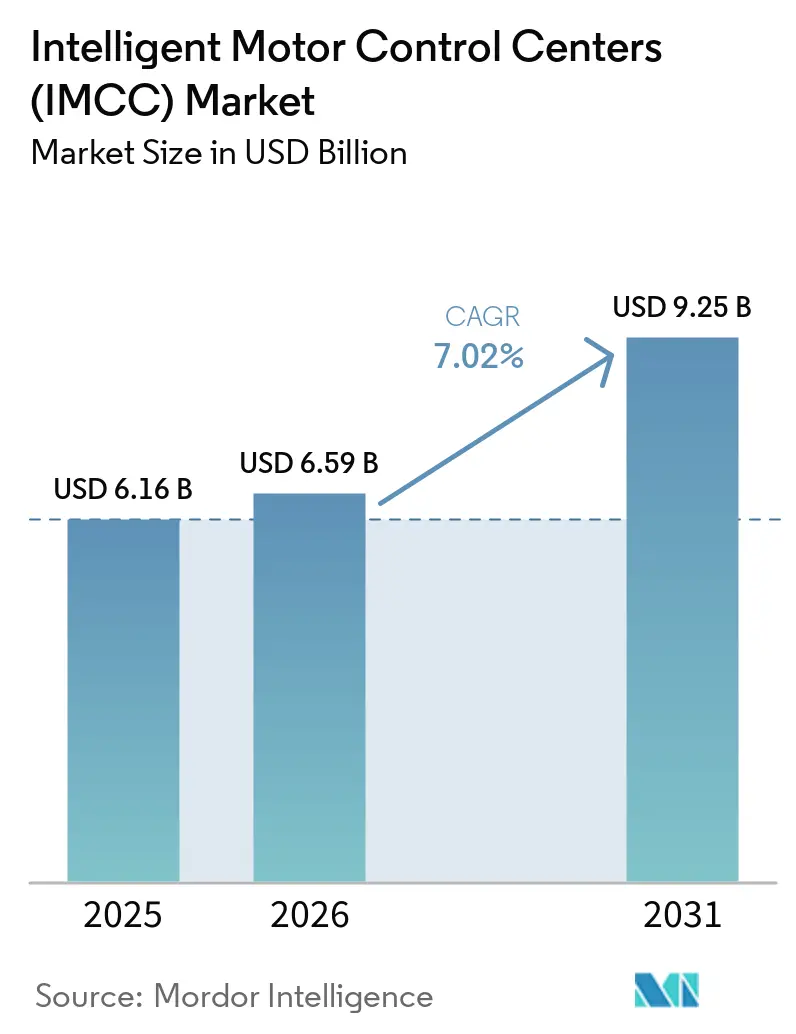
The intelligent motor control centers (IMCC) market size is expected to grow from USD 6.16 billion in 2025 to USD 6.59 billion in 2026 and is forecast to reach USD 9.25 billion by 2031 at 7.02% CAGR over 2026-2031. Rising digitalization of process plants, stringent energy-efficiency mandates, and demand for predictive maintenance continue to shift investment away from passive starters toward network-aware intelligent systems that help operators curb unplanned downtime and participate in tariff-based load management programs. Low-voltage solutions retained the bulk of installed capacity in 2024; however, medium-voltage variants are now attracting the fastest capital growth, as mining, desalination, and bulk-water projects require arc-flash mitigation and remote diagnostics. Variable speed drives (VSDs) are the standout component because they unlock real-time energy arbitrage and enable compliance with IE3-plus efficiency rules. Meanwhile, the Asia Pacific’s infrastructure build-out and manufacturing reshoring programs keep the region at the top of the demand curve, while North America and Europe register steady upgrade cycles focused on cybersecurity and efficiency standards. Competitive dynamics remain vigorous, with the top five suppliers accounting for approximately 60% of the market share. However, regional specialists maintain pricing pressure by tailoring retrofit kits that integrate with legacy control architectures.
Key Report Takeaways
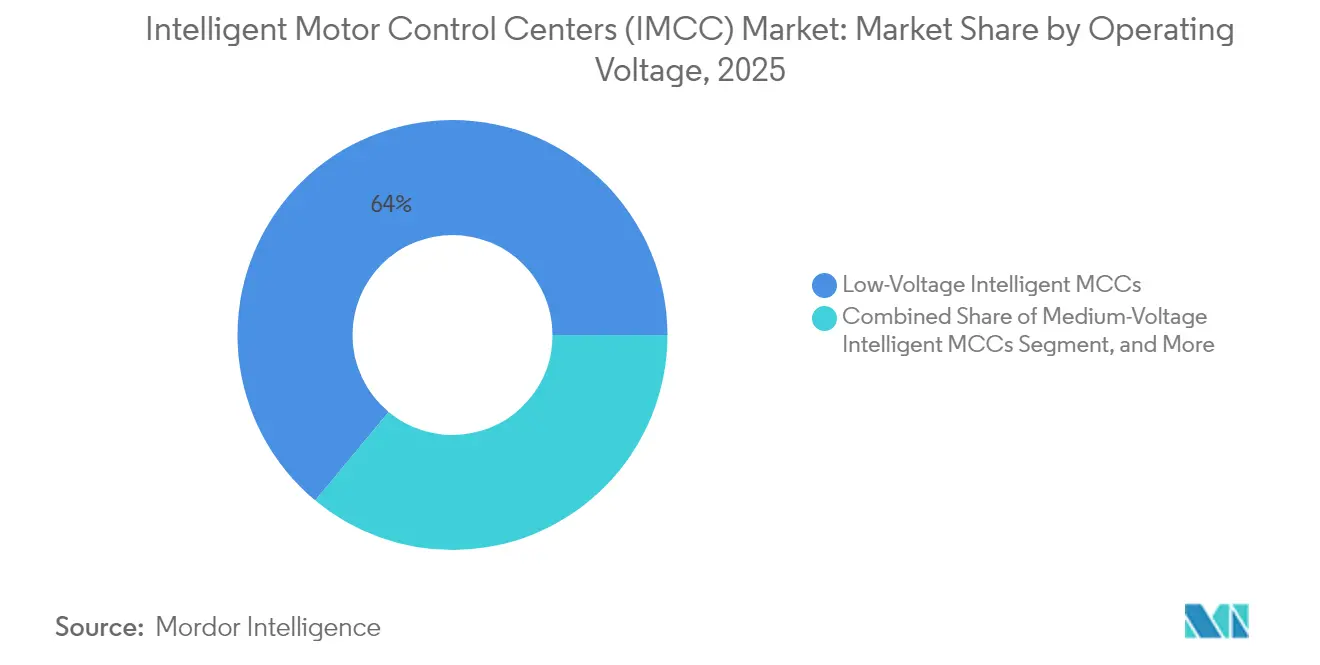
- By operating voltage, low-voltage units continue to dominate the intelligent motor control center market, retaining a 63.98% share in 2025, medium-voltage intelligent solutions are projected to expand at a 8.96% CAGR and remain the fastest-growing segment through 2031.
- By component, VSDs captured the highest growth rate, with a 9.62% CAGR through 2031, whereas busbars retained 24.05% of the intelligent motor control center market share in 2025.
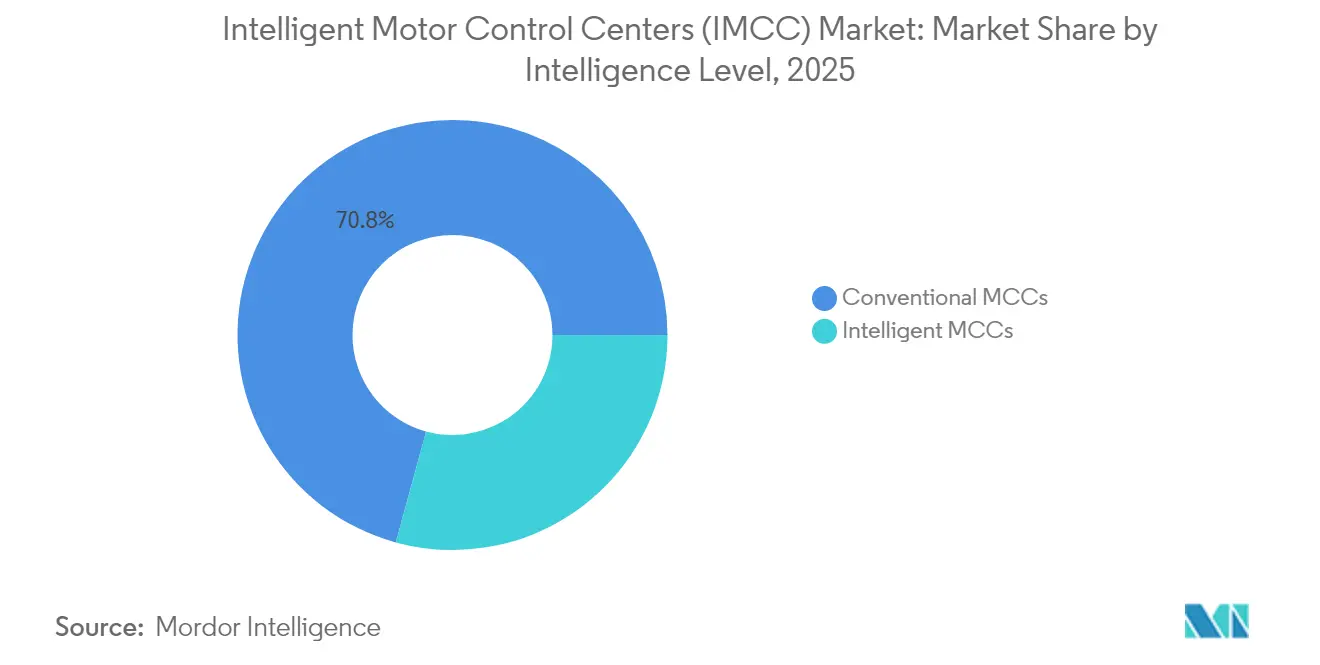
- By intelligence level, intelligent variants are forecast to accelerate at 12.15% CAGR through 2031, while conventional counterparts will continue to lose share.
- By end-user, the food and beverage sector is projected to grow at a 9.07% CAGR to 2031, surpassing industry growth projections, whereas the oil and gas sector maintained a 24.76% revenue lead in 2025.
- By geography, the Asia Pacific region dominated with 38.12% of 2025 revenue and is expected to grow at an 8.21% CAGR to 2031.
Note: Market size and forecast figures in this report are generated using Mordor Intelligence’s proprietary estimation framework, updated with the latest available data and insights as of 2026.
Market Trends and Insights
Drivers Impact Analysis of Intelligent Motor Control Centers (IMCC) Market*
| Driver | (~) % Impact on CAGR Forecast | Geographic Relevance | Impact Timeline |
|---|---|---|---|
| Proliferation of Industrial Automation and Industry 4.0 Initiatives | +1.8% | Global, led by Germany, China, United States | Medium term (2-4 years) |
| Energy Efficiency Regulations Driving Smart Motor Control Adoption | +1.5% | EU, North America, China | Short term (≤ 2 years) |
| Superior Diagnostics and Predictive Maintenance Capability | +1.3% | Global, early gains in oil and gas, mining | Medium term (2-4 years) |
| Integration of Digital Twins for Virtual Commissioning and Lifecycle Optimization | +0.9% | North America, Western Europe, Asia Pacific | Long term (≥ 4 years) |
| Rising Demand for Cybersecure Motor Control Centers in Critical Infrastructure | +0.7% | North America, EU, Middle East | Medium term (2-4 years) |
| Modular Retrofit Solutions Targeting Aging Brownfield Plants | +1.1% | North America, Europe, India | Short term (≤ 2 years) |
| Source: Mordor Intelligence | |||
Proliferation of Industrial Automation and Industry 4.0 Initiatives
Factory-floor digitalization positions intelligent MCCs as edge nodes that aggregate real-time telemetry and publish OPC UA data streams directly to cloud historians, eliminating round-trip latency to remote SCADA servers. Siemens reported that by 2024, more than 3,200 plants had adopted TIA Portal-based MCC configurations, resulting in a 30% reduction in commissioning labor. ABB rolled out Edgenius retrofit modules that transform legacy low-voltage panels into smart assets, compatible with IEC 61131-3 programming, resulting in a 25–30% price reduction compared to full replacement.[1] Policy incentives amplify the trend: China’s Made in China 2025 program earmarked RMB 45 billion (USD 6.2 billion) for intelligent motor upgrades across state-owned petrochemical complexes. Modular, software-defined control now enables operators to quickly reconfigure production cells, a crucial advantage as product varieties and life cycles become increasingly shorter. Equipment suppliers respond by incorporating cybersecurity features into new product lines to help plants meet IEC 62443 audit requirements.
Energy Efficiency Regulations Driving Smart Motor Control Adoption
Regulators now price inefficiency, effectively taxing conventional starters in favor of VSD-based schemes. The EU Ecodesign Regulation 2019/1781 banned direct-on-line starters for most motors above 0.75 kW beginning July 2023, steering capital toward integrated MCCs with embedded metering. Schneider Electric monitored 1,800 European facilities in 2024 and achieved electricity savings of 12-18% after implementing intelligent MCC retrofits, reducing payback periods to under 24 months.[2] In December 2024, the U.S. Department of Energy adopted tighter low-voltage motor rules that incentivize soft starters and VSDs. India’s Bureau of Energy Efficiency introduced a five-star scheme in March 2024 that bundles accelerated depreciation and goods and services tax relief for intelligent motor systems. These frameworks create a compliance floor that legacy panels struggle to meet, tilting lifecycle economics toward intelligent variants.
Superior Diagnostics and Predictive Maintenance Capability
Embedded condition monitoring converts MCCs into diagnostic hubs that detect bearing wear, insulation decay, and harmonic distortion, allowing for early detection of potential failures weeks before catastrophic failure. Rockwell Automation’s analytics stack captures 10 kHz current signatures to pinpoint rotor-bar cracks, helping automotive suppliers cut unplanned downtime by 35%.[3] Eaton’s Brightlayer suite combines vibration sensors with cloud models that predict faults 14 days ahead with 85% accuracy. In high-value sectors like oil and gas, where an hour of downtime can exceed USD 500,000, the incremental USD 15,000-25,000 cost of an intelligent MCC is trivial. Insurers reinforce adoption by offering 5-10% premium discounts to plants running certified predictive-maintenance programs anchored on intelligent MCCs.
Integration of Digital Twins for Virtual Commissioning and Lifecycle Optimization
Digital-twin technology enables engineers to simulate control logic and stress-test fault scenarios before installation. Siemens’ SIMIT environment cuts onsite startup time by up to 50% on greenfield lines. ABB’s System 800xA aligns physical MCCs with cloud models, enabling virtual testing of demand-response strategies, which resulted in a 7% annual reduction in energy costs for a European chemical plant. Digital twins maintain their value after commissioning by continually updating predictive models and maintenance schedules, thereby forming a closed feedback loop. Automotive OEMs utilize digital twins to recalculate motor loads for new battery chemistries without interrupting production, a practice highlighted in Volkswagen’s 2024 sustainability report.[4] Regulators now recognize virtual arc-flash studies, further easing compliance burdens for risk-averse sectors.
Restraints Impact Analysis of Intelligent Motor Control Centers (IMCC) Market*
| Restraint | (~) % Impact on CAGR Forecast | Geographic Relevance | Impact Timeline |
|---|---|---|---|
| High Upfront Capital Expenditure and Hidden Installation Costs | -0.9% | Global, acute in price-sensitive SMEs | Short term (≤ 2 years) |
| Availability of Low-Cost Conventional Motor Control Alternatives | -0.6% | South Asia, Africa, Latin America | Medium term (2-4 years) |
| Cybersecurity Skill Shortage Hindering Connected MCC Deployments | -0.5% | Global, severe in developing markets | Medium term (2-4 years) |
| Fragmented Communication Standards Complicating Interoperability | -0.4% | Global, multi-vendor environments | Long term (≥ 4 years) |
| Source: Mordor Intelligence | |||
High Upfront Capital Expenditure and Hidden Installation Costs
Even as component prices fall, intelligent MCCs still demand a 25-40% capital premium over conventional panels, and turnkey costs can double once network switches, firewalls, and software subscriptions are factored in. A typical 400 kW low-voltage smart panel costs USD 45,000-60,000, compared to USD 18,000-25,000 for a basic contactor-based unit, with an additional USD 15,000-20,000 required for Ethernet cabling and SCADA integration. Annual cloud analytics fees of USD 5,000-10,000 increase operating expenses, and mandatory cybersecurity audits can add USD 10,000-15,000 per site. Many SMEs, therefore, postpone upgrades, particularly in markets where labor is inexpensive and energy tariffs are low. Financing constraints also matter: smaller firms face higher borrowing costs and shorter payback thresholds, which favor incremental retrofits over full intelligent conversions.
Availability of Low-Cost Conventional Motor Control Alternatives
Low-cost producers in China, India, and Turkey retail conventional MCCs at up to 60% below Western-brand intelligent options. For stable loads, such as pumps and fans, the functional gap can appear narrow, encouraging budget-sensitive buyers to stick with legacy gear. Chinese vendors such as Chint Electric price a 400 kW panel at USD 8,000-12,000 and meet IEC 61439 standards, enabling quick procurement for municipal utilities and textile mills. This ample supply of affordable alternatives sustains a massive installed base that in turn supports a broad spare-parts ecosystem—making migration to intelligent platforms even less urgent for plants with minimal downtime penalties.
*Our forecasts treat driver/restraint impacts as directional, not additive. The impact forecasts reflect baseline growth, mix effects, and variable interactions.
Intelligent Motor Control Centers (IMCC) Market Segment Analysis
By Operating Voltage:
Medium-Voltage Variants Capture Electrification UpsideMedium-voltage intelligent solutions are projected to expand at a 8.96% CAGR through 2031, driven by electrification projects in mining haul-truck charging, large-scale pumping stations, and LNG liquefaction. Anglo American’s Quellaveco mine deployed 18 medium-voltage panels to manage conveyor and grinding motors, resulting in a 12% reduction in downtime in year one. Low-voltage units continue to dominate the intelligent motor control center market, retaining a 63.98% share in 2025, primarily due to their widespread use in discrete manufacturing and commercial buildings. High-voltage models above 11 kV remain a niche market, suited to applications such as pumped-storage and offshore platforms.
The medium-voltage segment also aligns with decarbonization: battery-electric haul trucks require 3-5 MW chargers, whose load spikes must be balanced in real-time. Intelligent MCCs orchestrate charging cycles without destabilizing site power systems, a capability BHP credited with enabling 24/7 electric-truck fleets. Low-voltage panels continue to post solid 6-7% growth, driven by modular retrofits and distributed manufacturing trends that favor compact footprints.

By Component:
Variable Speed Drives Monetize Energy Arbitrage and Grid ServicesVSDs are expected to log the fastest expansion at a 9.62% CAGR to 2031, as utilities roll out dynamic tariffs and demand-response programs. Schneider Electric’s Altivar Process drives let wastewater operators shift pumping to off-peak hours, saving up to USD 100,000 per plant annually. Busbars, although mature, held 24.05 of % intelligent motor control center market share in 2025 due to their universal presence in MCC construction.
Growth in communication gateways, power-quality filters, and power meters underscores the shift toward intelligence-enabling hardware. Soft starters gain traction where VSDs would be overengineered, offering 60-70% of the energy benefit at 40% of the cost, an attractive ratio for agricultural cooperatives and municipal water boards.
By Intelligence Level:
Greenfield Projects and Regulatory Pressure Accelerate Intelligent AdoptionIntelligent variants are projected to grow at a 12.15% CAGR, thanks to embedded analytics in new plants and compliance mandates that conventional gear struggles to meet. An Eaton lifecycle study concluded that savings from downtime avoidance yielded positive NPV within 30-36 months in continuous-process sectors. The intelligent motor control center market share will therefore expand steadily as insurers reward predictive maintenance and regulators enforce higher motor system efficiency.
Conventional MCCs persist in low-criticality applications and budget-sensitive regions, yet their long-term relevance wanes as intelligent components become more commoditized and interoperability improves. Retrofit kits that preserve busbars and enclosures accelerate conversion by slashing shutdown windows, making upgrades palatable even in brownfield sites with tight maintenance schedules.
By End-user Industry:
Food and Beverage Leads Growth on Traceability and Hygienic MandatesFood and beverage facilities must comply with stringent hygienic-design and batch-traceability rules that favor stainless-steel enclosures and embedded diagnostics. Nestlé allocated USD 1.2 billion for factory automation in 2024, specifying IP69K-rated intelligent panels that can withstand high-pressure washdowns. Oil and gas remains the largest vertical, with a 24.76% share in 2025, due to motor-intensive refining and pipeline operations.
Water and wastewater follow closely as municipalities modernize their aging assets to reduce energy costs and support remote operations. Mining, chemicals, and power generation also rely on intelligent MCCs to integrate renewable sources and manage variable loads. The automotive, pulp and paper, and cement industries focus on modular retrofits to maintain uptime while transitioning toward predictive operations. Mission-critical sites such as data centers and airports are emerging pockets of demand driven by high interruption costs and cybersecurity mandates.
Geography Analysis
APAC Intelligent Motor Control Centers (IMCC) Market
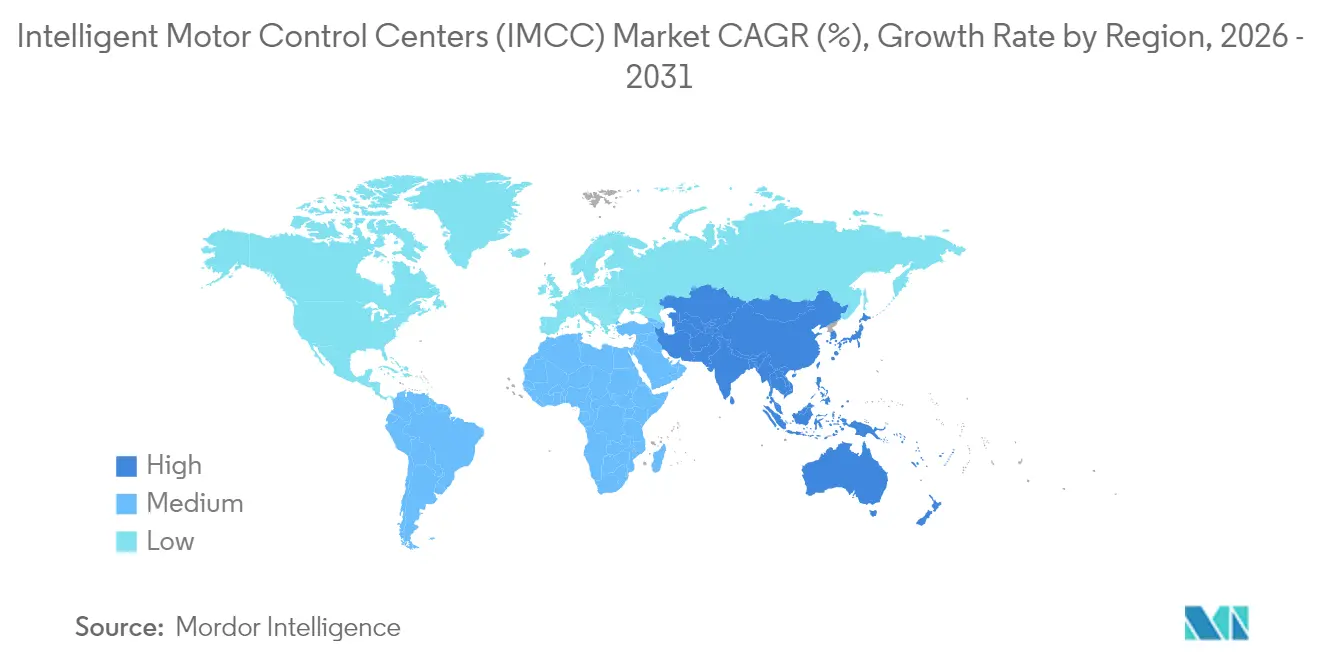
The Asia Pacific led the intelligent motor control centers (IMCC) market with 38.12% revenue share in 2025 and is projected to grow at an 8.21% CAGR through 2031. China’s State Grid committed RMB 520 billion (USD 72 billion) in 2024 to industrial power-distribution upgrades that include demand-responsive MCCs. India’s Production-Linked Incentive schemes are catalyzing the development of greenfield factories that specify intelligent panels from the outset, while local suppliers, such as Larsen & Toubro, deliver faster than their Western counterparts.
The Americas and EMEA Intelligent Motor Control Centers (IMCC) Market
North America held a just under 30% share in 2025 and is expected to grow at a 6-7% CAGR as reshoring initiatives and the Inflation Reduction Act channel capital into automated lines. Updated DOE efficiency rules and CISA cybersecurity advisories reinforce the case for intelligent starters. Europe commands a 22-24% share in 2025 and grows more modestly at a 5-6% CAGR, but strict energy and cybersecurity directives keep retrofit activity stable. The Middle East and Africa together account for 8-10% of 2025 revenue. Petrochemical megaprojects in Saudi Arabia and the UAE are projected to drive a 7-8% CAGR for medium-voltage solutions. Africa’s 4-5% growth reflects limited capital access and preference for lower-cost conventional panels. South America, led by Brazil and Argentina, is expected to register a 6-7% CAGR in mining and lithium extraction projects, supported by local vendors such as WEG.
Regulatory Landscape
The regulatory environment for IMCCs is increasingly shaped by energy-efficiency, machinery safety, and cybersecure control-system expectations. In the European Union, Ecodesign Regulation (EU) 2019/1781 has been steering motor-system upgrades since its July 2023 provisions took effect, which supports adoption of VSD-centric intelligent MCC architectures with embedded metering and monitoring.
Machinery and safety compliance is also moving toward explicit cyber-resilience expectations that affect connected motor-control and safety functions. The EU Machinery Regulation (EU) 2023/1230 introduces strengthened requirements around the safety and reliability of control systems and protection against corruption, and it applies on a mandatory basis from 20 January 2027, prompting suppliers and users to align documentation, conformity assessment, and control-system hardening earlier in the design cycle. In the United States, MSHA updated testing, evaluation, and approval requirements for electric motor-driven mine equipment and accessories on December 10, 2024, reinforcing sector-specific compliance needs for IMCC deployments in mining, alongside baseline assembly and design frameworks such as IEC 61439 for low-voltage assemblies and evolving MCC guidance such as IEEE 1683-2025 (published January 23, 2026).
Value Chain Analysis
IMCC value creation starts upstream with raw materials (copper and aluminum for busbars and conductors, steel for enclosures, engineering plastics, and insulating systems) and continues through power and control components such as circuit breakers, contactors, overload relays, soft starters, VSDs, power meters, sensors, and industrial Ethernet hardware. A key differentiator layer is software and firmware for diagnostics, cybersecurity controls, and integration with PLC/DCS/SCADA stacks, which increases the importance of semiconductor availability for drives and the ecosystem of protocol stacks (for example, PROFINET and EtherNet/IP) that enable multi-vendor interoperability.
Midstream, panel builders and OEMs design, engineer, and assemble MCC lineups to IEC/UL and customer specifications, incorporating arc-flash and compartmentalization requirements and factory acceptance testing. Downstream, system integrators, EPCs, and industrial distributors handle project design, installation, commissioning, and lifecycle services (spares, retrofit kits, analytics subscriptions, and condition-based maintenance programs). End users in oil and gas, mining, water and wastewater, chemicals, and food and beverage are increasingly buying outcomes such as reduced downtime and energy transparency rather than switchgear hardware alone. Manufacturer roadmaps and launches such as Rockwell Automation's FLEXLINE 3500 MCC (April 2024) underscore the value-chain shift toward modular architectures that reduce cabling, speed commissioning, and improve maintainability in both greenfield and brownfield projects.
Competitive Landscape
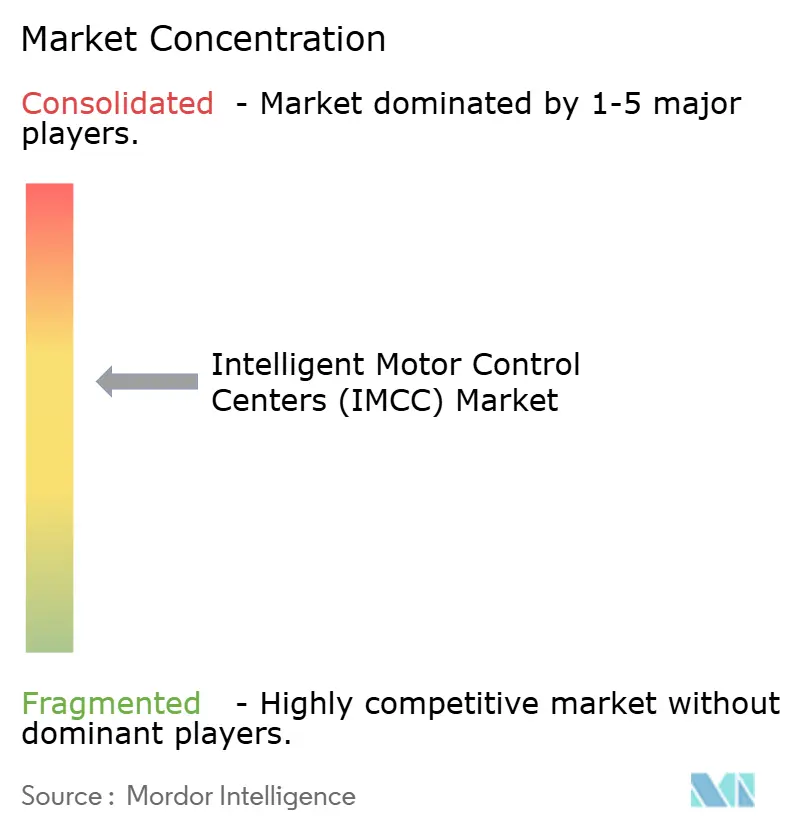
The intelligent motor control centers (IMCC) market shows moderate concentration. ABB, Siemens, Schneider Electric, Eaton, and Rockwell Automation collectively controlled approximately 60% of the 2024 revenue. Their vertically integrated portfolios create switching costs that translate into recurring revenue from software and services. Differentiation now centers on edge analytics and cybersecurity certifications; for example, Schneider Electric’s EcoStruxure models predict failures 10-14 days in advance, supporting price premiums of 15-20%.
Regional specialists dilute global dominance by offering modular retrofit kits that mesh with incumbent DCS architectures at roughly half the replacement cost. Eaton’s NXR kit installs in under a week and preserves existing busbars, an attractive proposition for food processors that cannot afford extended shutdowns. Software-centric entrants like Augury threaten hardware margins by attaching cloud diagnostics to commodity contactors.
Standardization across OPC UA, IEC 61850, and TSN weakens proprietary protocols, allowing users to pursue multi-vendor ecosystems. As a result, profit pools migrate toward analytics subscriptions, lifecycle services, and cybersecurity consulting.
Intelligent Motor Control Centers (IMCC) Industry Leaders
-
General Electric Co.
-
ABB Limited
-
Schneider Electric SE
-
Eaton Corporation
-
Siemens AG
- *Disclaimer: Major Players sorted in no particular order
Intelligent Motor Control Centers (IMCC) Market Companies Covered in this Report
- ABB Ltd.
- Siemens AG
- Schneider Electric SE
- Eaton Corporation plc
- General Electric Company
- Rockwell Automation Inc.
- Mitsubishi Electric Corporation
- Fuji Electric Co., Ltd.
- WEG S.A.
- Larsen and Toubro Limited
- Technical Control Systems Limited
- Powell Industries Inc.
- Marine Electricals (India) Limited
- Gemco Controls Limited
- Vidhyut Control India Private Limited
- Hyosung Heavy Industries Corporation
- LS Electric Co., Ltd.
- Toshiba Corporation
- Hyundai Electric and Energy Systems Co., Ltd.
- Rittal GmbH and Co. KG
- Schweitzer Engineering Laboratories Inc.
- Tesco Controls Inc.
- Sun-Tech Engineers
- Rolla Limited
- Ingeteam S.A.
- Emerson Electric Co.
Read Analysis of Intelligent Motor Control Centers (IMCC) Companies
Market Opportunities and Future Outlook
A key opportunity area is brownfield modernization, where operators retain existing enclosures and bus structures while adding intelligence through retrofit modules, gateways, and drive upgrades to capture diagnostics, energy metering, and remote operations without extended shutdowns. This aligns with observed buyer behavior around modular retrofit solutions and with measured outcomes cited in the report context, including commissioning labor reductions tied to Siemens TIA Portal-based MCC configurations and facility-level energy savings associated with intelligent monitoring and drive adoption.
Another near-term whitespace sits in sectors and projects where medium-voltage motor control, arc-flash mitigation, and remote diagnostics are procurement priorities, including mining electrification and large pumping and desalination assets. Regulatory and assurance requirements are also pulling cybersecurity into the motor-control discussion: the EU Machinery Regulation (EU) 2023/1230 applying from 20 January 2027 elevates expectations for control-system integrity and documentation, reinforcing demand for IMCC platforms that embed security controls alongside safety functions. Supplier activity points to expanding modular motor-management layers that can be deployed across water, chemicals, and energy environments, such as Schneider Electric's TeSys Tera launch (April 2026) and Lauritz Knudsen (L&T) introducing an intelligent motor management relay with multi-protocol connectivity (June 2026), which broaden upgrade paths for plants that need PLC/DCS/SCADA integration and condition-based maintenance capabilities.
Recent Industry Developments in Intelligent Motor Control Centers (IMCC) Market
- June 2026: Lauritz Knudsen (L&T) introduced the iMMR (Intelligent Motor Management Relay) with connectivity options spanning Modbus and major industrial Ethernet and fieldbus protocols. The release supports multi-vendor integration for motor protection and monitoring in PLC/DCS/SCADA environments, making incremental upgrades possible when full MCC replacement is constrained by outage windows.
- April 2026: Schneider Electric launched TeSys Tera, a modular intelligent motor management system positioned for industrial applications including water, chemicals, and energy. The product emphasis on predictive diagnostics and energy monitoring aligns with buyer demand for condition-based maintenance and measurable efficiency improvements inside motor-control lineups.
- March 2025: Rockwell Automation launched the M100 Electronic Motor Starter, focusing on smarter motor control with a safety-oriented, compact electronic approach. The introduction expands alternatives to traditional starter configurations and supports panel builders and end users seeking reduced wiring complexity and richer diagnostics in low-voltage motor-control deployments.
Intelligent Motor Control Centers (IMCC) Market Report Scope and Research Methodology
Market Definition and Coverage
This market covers intelligent motor control centers (IMCCs) sold as assemblies and systems that combine motor starting, protection, control, and monitoring with digital communications for industrial and utility motor loads, measured in revenue terms.
Scope exclusions: We exclude standalone motors, drives, PLCs, and sensors when they are sold outside an IMCC lineup, along with general field services not tied to an IMCC project.
Segments Covered in This Report
- By Operating Voltage
- Low-Voltage Intelligent MCCs
- Medium-Voltage Intelligent MCCs
- High-Voltage Intelligent MCCs
- By Component
- Busbars
- Circuit Breakers and Fuses
- Overload Relays
- Variable Speed Drives
- Soft Starters
- Others
- By Intelligence Level
- Intelligent MCCs
- Conventional MCCs
- By End-user Industry
- Automotive
- Chemicals and Petrochemicals
- Food and Beverage
- Mining and Metals
- Pulp and Paper
- Power Generation
- Oil and Gas
- Water and Wastewater
- Cement Manufacturing
- Others
- By Geography
- North America
- United States
- Canada
- Mexico
- South America
- Brazil
- Argentina
- Rest of South America
- Europe
- Germany
- United Kingdom
- France
- Italy
- Spain
- Rest of Europe
- Asia Pacific
- China
- Japan
- India
- South Korea
- Rest of Asia Pacific
- Middle East and Africa
- Middle East
- Saudi Arabia
- United Arab Emirates
- Turkey
- Rest of Middle East
- Africa
- South Africa
- Nigeria
- Kenya
- Rest of Africa
- Middle East
- North America
Data Sources, Market Sizing, and Validation
Desk Research
Desk work was used to set the fact base for demand drivers and to check whether the model output aligned with real-world industrial activity. We relied on public sources such as US Energy Information Administration data for power and fuel trends, US Census Bureau and Eurostat industrial production series, UN Comtrade trade statistics for electrical control equipment flows, and IEC or NEMA publications for common standards and definitions around motor control and switchgear.
In parallel, we reviewed company annual reports, investor presentations, project announcements, and association websites to capture sector-specific investment cues in industries like oil and gas, power, mining, water, and manufacturing. Where needed, paid subscriptions that compile company financials, patents, and shipment-level trade flows were used to cross-check inputs like revenue mix, product positioning, and import dependency. These desk sources are not exhaustive, and other public documents and data points were also referenced during collection, validation, and clarification.
Primary Interviews and Surveys
Primary interviews and structured surveys were conducted with IMCC suppliers, system integrators, distributors, and plant-level users to confirm what is counted as IMCC revenue and what typically sits outside the scope. Inputs were checked across APAC, EMEA, and the Americas so assumptions on pricing, retrofit intensity, and demand cycles could be adjusted before the final totals were locked.
Distribution of primary research fieldwork respondents
| Company type | Respondent position | Region |
|---|---|---|
| Top tier: 27% | CXOs: 15% | APAC: 44% |
| Mid tier: 56% | Functional/Unit leaders: 42% | EMEA: 32% |
| Smaller Players: 17% | Managers: 43% | Americas: 24% |
Market-Sizing & Forecasting
Sizing started with a top-down build where industrial capex cycles, power generation additions, and plant automation intensity were translated into an addressable motor-control demand pool, then filtered into the share that typically sits inside IMCC assemblies. We corroborated the totals through selective bottom-up checks, mainly using sampled vendor revenues by region, channel checks on project quotes, and a volume-by-ASP approximation for common panel lineups, then adjusted when the two views showed a persistent gap.
We tracked model inputs year by year, including the split between new build versus retrofit and upgrades in large plants, the mix shift between low-, medium-, and high-voltage IMCCs, penetration of VFD and soft starter inclusions inside lineups, and the average number of motor feeders per cabinet for typical sites. We also incorporated end-user spending patterns in sectors like power, oil and gas, water, and mining. For forecasting, scenario analysis was used because lead times, capex approvals, and energy efficiency upgrade schedules can change quickly, and scenarios were tied back to primary feedback on pricing moves, supply availability, and project timing. When bottom-up revenue signals were missing for smaller markets, we used regional ratioing based on industrial output and installed base proxies, then ran a reasonableness check against trade and project indicators.
Data Validation & Update Cycle
Outputs were triangulated across multiple steps so the final numbers stayed consistent with market signals, such as industrial production direction, power and utilities investment, and large project award flow. Any large variance by region or by voltage class triggered a re-check of assumptions, followed by a second pass of primary calls where the mismatch could be explained by pricing, mix, or timing.
Before sign-off, the model is reviewed by another analyst who checks math integrity, year-on-year movements, and whether the drivers used in the narrative match the values shown. The report is refreshed on an annual cycle, and interim updates are made when material events occur, followed by a final pre-delivery scan so clients receive the most current view.
Mordor Intelligence's Intelligent Motor Control Centers Imcc Market Size Measured Against Other Published Estimates
Published IMCC market values often differ because the market boundary is not always treated the same way, and because pricing and conversion assumptions can change totals even when unit demand is similar. Differences also show up when one estimate leans more on shipment proxies, while another leans more on installed base and retrofit activity.
In this study, the refresh cadence matters because recent panel price changes and mix shifts toward VFD and soft starter-rich lineups tend to move ASPs quickly, and currency timing can also change the USD view for the same local revenue. For that reason, the model is re-checked with fresh primary price points and cross-verified before publishing, a step that sits at the center of Mordor Intelligence.
Benchmark comparison
| Source | Market Size | Gaps in Research Methodology |
|---|---|---|
| Mordor Intelligence | USD 6.59 B (2026) | |
| Trade Journal A | USD 2.50 B (2024) | Uses an earlier base year and a narrower product boundary that can undercount medium-voltage lineups and bundled intelligence modules, and it is typically less sensitive to recent ASP movement from component mix upgrades. |
| Global Consultancy B | USD 2.21 B (2024) | Anchors sizing to a shorter history window and tends to apply generalized price curves across regions, which can miss currency timing effects and the higher priced configurations common in heavy industries and retrofit projects. |
Overall, the spread is mainly explained by year selection, what is included inside an IMCC bill of materials, and how pricing is carried forward when configurations shift. By tying the model to clear demand drivers, validating prices with fresh checks, and keeping conversion timing consistent, the final value stays easier to trace and repeat when assumptions are updated.
Key Questions Answered in the Report
What is the projected value of the intelligent motor control centers (IMCC) market in 2031?
The market is set to reach USD 9.25 billion by 2031.
Which region leads revenue and growth in intelligent MCC demand?
The Asia-Pacific region accounted for 38.12% of 2025 revenue and is forecast to expand at an 8.21% CAGR through 2031.
Which component records the fastest growth inside intelligent MCCs?
Variable speed drives are projected to post the highest CAGR at 9.62% through 2031, driven by efficiency and demand-response benefits.
Which end-use sector shows the strongest growth momentum?
Food and beverage plants are projected to lead with a 9.07% CAGR through 2031.
Why are medium-voltage intelligent MCCs gaining traction?
The electrification of mining haul-truck charging and large water projects drives adoption, as these panels provide arc-flash mitigation and remote diagnostics.
How do insurers influence intelligent MCC adoption?
Many insurers offer 5-10% premium discounts for facilities that run certified predictive-maintenance programs anchored on intelligent MCCs.