
Integrated Vehicle Health Management Market Size and Share
Market Overview
| Study Period | 2020 - 2032 |
|---|---|
| Market Size (2027) | USD 25.11 Billion |
| Market Size (2032) | USD 44.11 Billion |
| Growth Rate (2027 - 2032) | 11.93 % |
| Fastest Growing Market | Asia Pacific |
| Largest Market | Asia Pacific |
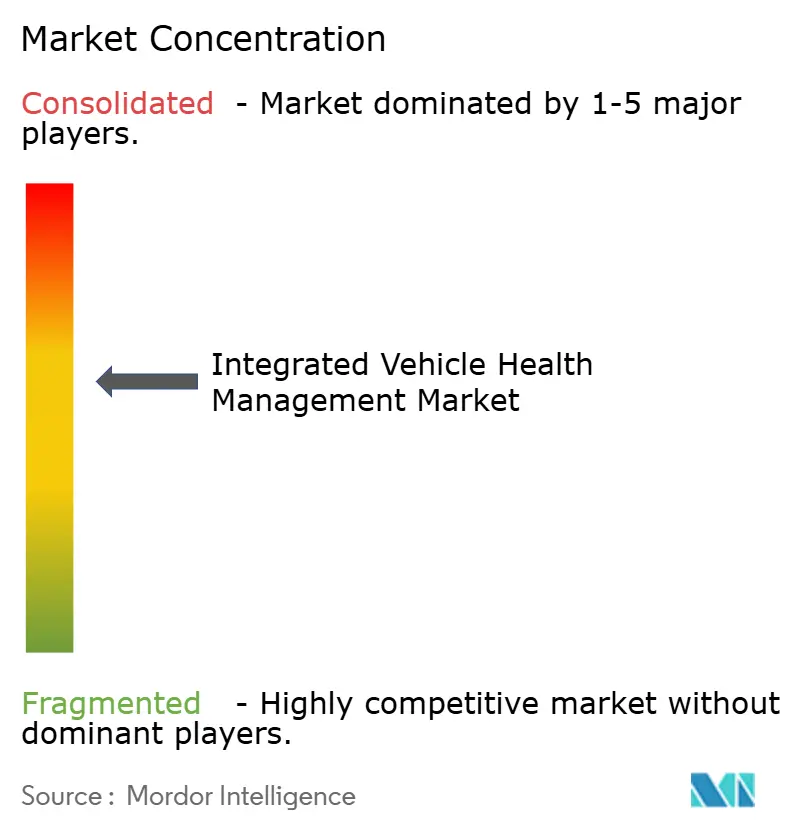
| Market Concentration | Medium |
Major Players *Disclaimer: Major Players sorted in no particular order Image © Mordor Intelligence. Reuse requires attribution under CC BY 4.0. | |
Integrated Vehicle Health Management Market Analysis by Mordor Intelligence
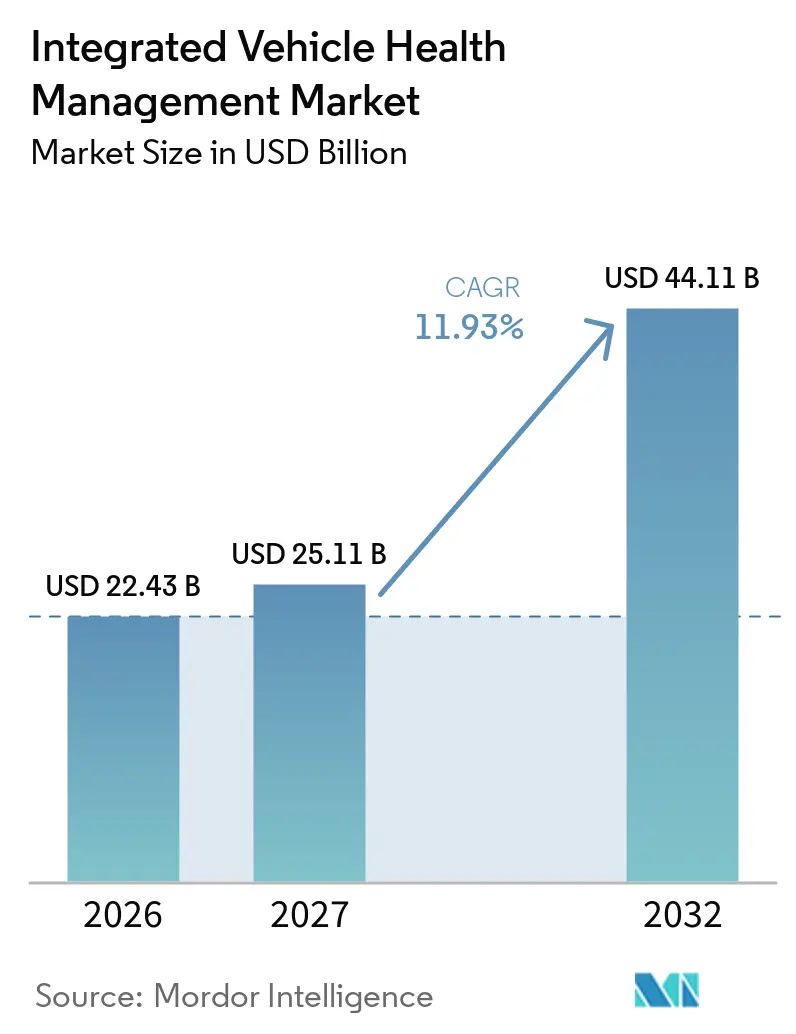
The Integrated Vehicle Health Management Market size was valued at USD 22.43 billion in 2026, is expected to reach USD 25.11 billion in 2027, and is forecast to reach USD 44.11 billion by 2032, at a 11.93% CAGR over 2027-2032. Greater sensor density in electric and autonomous platforms, combined with 5G-enabled edge analytics, transforms maintenance from reactive repair to near-real-time prognostics. Vehicle makers are redesigning electronics with secure over-the-air update pathways, while fleets demand guaranteed uptime metrics to meet e-commerce delivery windows. Cloud-native telematics ecosystems now ingest high-frequency health data that feeds machine-learning models for component-level life predictions. Rising cybersecurity compliance costs under ISO/SAE 21434 and China’s Network Data Security Regulations are reshaping deployment roadmaps and opening service revenue streams for vendors able to certify secure data flows.
Key Report Takeaways
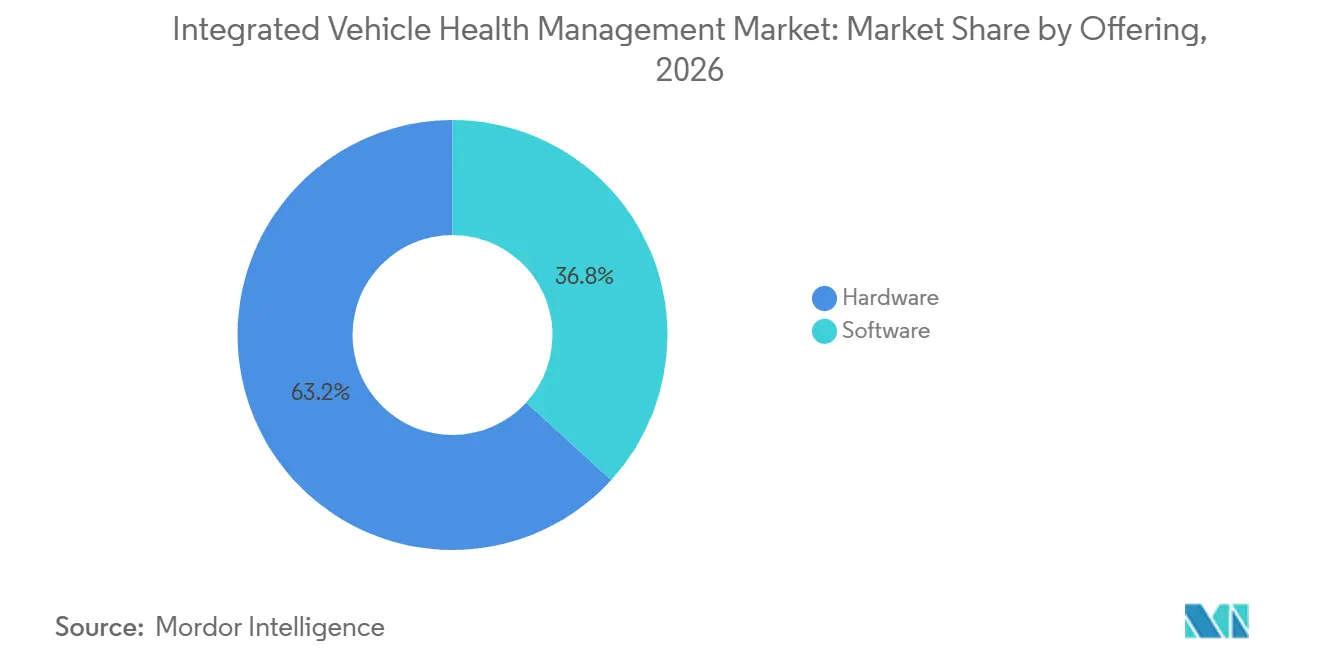
- By offering, hardware accounted for 63.21% share of the Integrated Vehicle Health Management market in 2026, while software is projected to grow at a 12.87% CAGR through 2032.
- By channel, OEM service centers led with 48.32% share of the Integrated Vehicle Health Management market in 2026, while remote diagnostics platforms are on track for an 13.14% CAGR to 2032.
- By application, predictive maintenance held 36.59% of the Integrated Vehicle Health Management market share in 2026; driver monitoring solutions are advancing at a 14.46% CAGR through 2032.
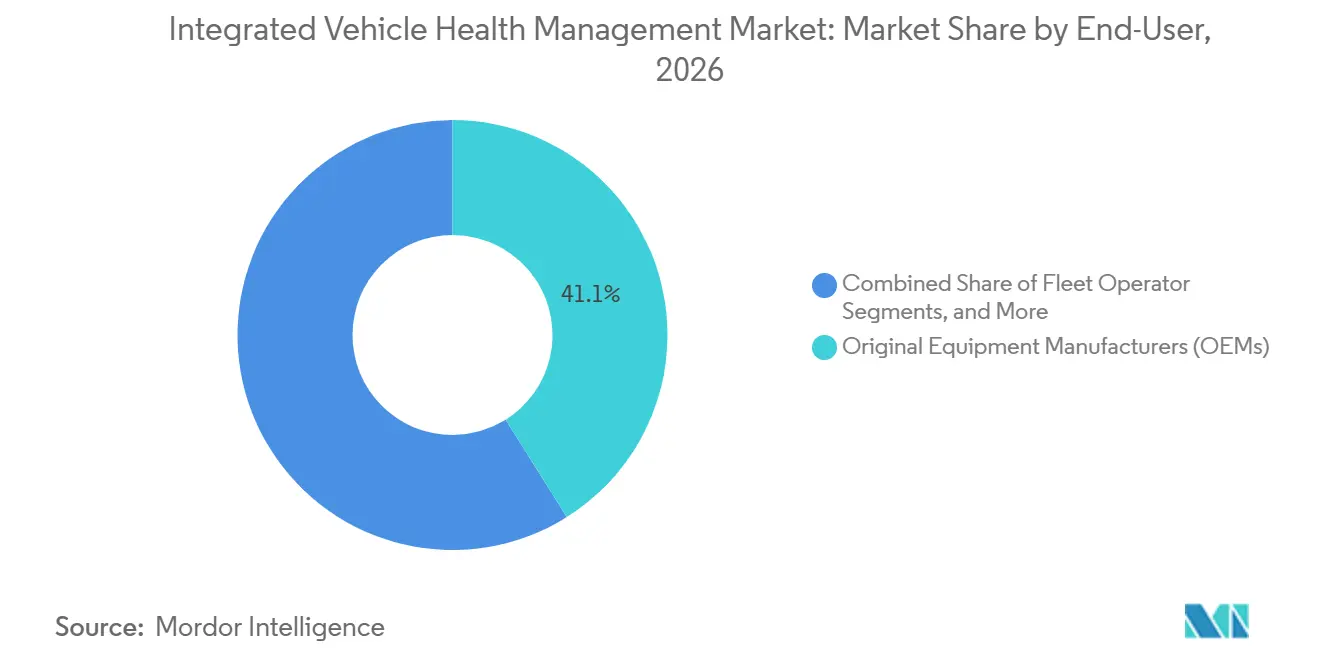
- By end-user, OEMs accounted for 41.08% of the Integrated Vehicle Health Management market in 2026, while service providers are set to expand at a 12.13% CAGR through 2032.
- By vehicle type, passenger vehicles accounted for 52.07% of the Integrated Vehicle Health Management market in 2026, whereas medium and heavy commercial vehicles are poised for a 12.26% CAGR through 2032.
- By geography, Asia-Pacific commanded 38.04% share of the Integrated Vehicle Health Management market in 2026 and is estimated to grow at a 13.92% CAGR through 2032.
Note: Market numbers in this report are based on Mordor Intelligence's proprietary estimation framework, which combines nine months of actuals with Q4 projections for base year 2026.
Market Trends and Insights
Drivers Impact Analysis of Integrated Vehicle Health Management Market*
| Driver | (~) % Impact on CAGR Forecast | Geographic Relevance | Impact Timeline |
|---|---|---|---|
| OEMs Shifting to Service-Based Revenue Models | +2.1% | Global, with Early Adoption in North America and Europe | Medium Term (2-4 Years) |
| Surge in EV Sensor Counts Enabling Richer Health Data | +1.8% | Asia-Pacific Core, Spill-Over to North America | Short Term (≤ 2 Years) |
| 5G/Edge-AI Lowering Latency for Prognostics | +1.5% | North America and EU, Expanding to Asia-Pacific | Medium Term (2-4 Years) |
| Stricter Uptime SLAs in E-Commerce Fleets | +1.3% | Global, with Concentration in Urban Logistics Hubs | Short Term (≤ 2 Years) |
| Standard SAE JA6268 "Health-Ready" Mandate Adoption | +1.0% | North America and Europe Regulatory Domains | Long Term (≥ 4 Years) |
| Defence Programmes Funding IVHM for Autonomous Assets | +0.8% | North America, Europe, Asia-Pacific Defense Corridors | Long Term (≥ 4 Years) |
| Source: Mordor Intelligence | |||
OEMs Shifting to Service-Based Revenue Models
Automotive manufacturers are restructuring their business models to capture aftermarket revenue streams. This shift requires OEMs to invest significantly in IVHM capabilities that support predictive maintenance services, remote diagnostics, and usage-based insurance products. BMW’s strategic partnerships with Tata Technologies and NTT DATA reflect this transition, focusing on software-defined vehicle architectures that generate recurring service revenue. Similarly, the TRATON GROUP’s collaboration with Applied Intuition on software-defined commercial vehicles demonstrates how commercial vehicle OEMs are prioritizing IVHM integration to differentiate their service offerings. This strategic shift is driving sustained demand for IVHM technologies that enable OEMs to monetize vehicle data throughout the ownership lifecycle.
Surge in EV Sensor Counts Enabling Richer Health Data
Electric vehicles incorporate significantly more sensors than internal combustion engine vehicles, particularly for battery thermal management, state-of-charge monitoring, and power electronics diagnostics. Embitel's battery management system technology solutions demonstrate compliance with ASIL-D safety requirements, which necessitate comprehensive sensor integration for EV health monitoring. Neural Concept's EV battery cooling optimization techniques show how thermal sensors support predictive maintenance algorithms that help prevent battery degradation and extend vehicle range. The growing adoption of IoT-based thermal management systems, including liquid cooling, phase-change materials, and immersion cooling technologies, generates unprecedented volumes of health data that integrated vehicle health management (IVHM) systems can analyze to derive predictive insights.
5G/Edge-AI Lowering Latency for Prognostics
Fifth-generation cellular networks combined with edge computing architectures enable real-time vehicle health analysis with minimal latency, which is crucial for safety-critical prognostic applications. Indian automotive suppliers are adopting edge computing solutions alongside 5G rollout through platforms such as Tata Communications CloudLyte, demonstrating regional infrastructure readiness[1]. Ford's partnership with AT&T for factory Multi-Access Edge Computing and Mercedes-Benz's collaboration with Telefónica for private 5G networks showcase OEM investments in ultra-low latency connectivity. GIGABYTE's Ultra-Reliable Low-Latency Communication solution for autonomous vehicle networks exemplifies the hardware infrastructure that supports 5G-enabled IVHM deployments.
Stricter Uptime SLAs in E-Commerce Fleets
E-commerce logistics operators are implementing increasingly stringent service-level agreements that penalize vehicle downtime, creating demand for predictive maintenance solutions that maximize fleet availability. Verizon Connect's 2025 Fleet Technology Trends report indicates that 80% of fleet operators use technology solutions, with 22% achieving cost reductions through predictive maintenance implementations [2]. SIXT Van & Truck's deployment of Geotab's predictive maintenance solution across its UK commercial vehicle fleet demonstrates how rental operators invest in IVHM to meet contract compliance requirements. By enabling proactive vehicle monitoring and maintenance scheduling, these solutions help operators reduce unplanned downtime and maintain fleet availability. ZM Trucks' selection of Sibros' Deep Connected Platform for its zero-emission commercial vehicles illustrates how electrification increases uptime requirements due to dependence on charging infrastructure. Connected vehicle platforms help operators monitor vehicle performance, manage charging-related issues, and support reliable fleet operations.
Restraints Impact Analysis of Integrated Vehicle Health Management Market*
| Restraint | (~) % Impact on CAGR Forecast | Geographic Relevance | Impact Timeline |
|---|---|---|---|
| Cyber-Security and Data-Sovereignty Compliance Burden | -1.4% | Global, with Stricter Requirements in EU and China | Short Term (≤ 2 Years) |
| Inter-Platform Data-Model Fragmentation | -1.1% | Global, Affecting Cross-OEM Compatibility | Medium Term (2-4 Years) |
| Shortage of Prognostics/Data-Science Talent at OEMs | -0.9% | North America and Europe Primarily | Medium Term (2-4 Years) |
| High Initial Sensor and Connectivity Capex for Legacy Fleets | -0.7% | Global, with Higher Impact in Cost-Sensitive Markets | Short Term (≤ 2 Years) |
| Source: Mordor Intelligence | |||
Cyber-Security and Data-Sovereignty Compliance Burden
Automotive cybersecurity regulations impose substantial compliance costs and technical complexities that constrain IVHM deployment, particularly among smaller fleet operators and aftermarket solution providers. The ISO/SAE 21434 automotive cybersecurity standard requires comprehensive Cybersecurity Management Systems, thereby increasing development costs and extending the time-to-market for IVHM solutions. UNECE WP.29 R155/R156 requirements for cybersecurity and software update management add further compliance obligations for OEMs deploying IVHM capabilities. China’s automotive-specific data security standard, T/CAAMTB 189-2024, highlights the growing number of regional cybersecurity requirements that fragment global IVHM development strategies.
Inter-Platform Data-Model Fragmentation
The lack of standardized data models and communication protocols across OEMs and IVHM solution providers creates integration challenges, limits market scalability, and increases deployment costs. Proprietary data formats hinder seamless integration across different vehicle brands in mixed fleets, forcing operators to maintain multiple IVHM platforms. The absence of universal diagnostic interfaces also complicates the development of aftermarket IVHM solutions, as providers must customize their offerings to each OEM's data architecture. This fragmentation raises software development costs and reduces the economic viability of comprehensive IVHM solutions for smaller fleet operators. In addition, cross-platform compatibility issues limit the effectiveness of predictive maintenance algorithms that depend on large datasets from diverse vehicle populations. Industry standardization initiatives led by organizations such as SAE International are addressing these challenges; however, implementation remains inconsistent across the automotive ecosystem.
*Our forecasts treat driver/restraint impacts as directional, not additive. The impact forecasts reflect baseline growth, mix effects, and variable interactions.
Integrated Vehicle Health Management Market Segment Analysis
By Offering:
Hardware Dominance Amid Software AccelerationHardware components hold a 63.21% share of the integrated vehicle health management market in 2026, reflecting the fundamental requirement for sensors, connectivity modules, and processing units that enable vehicle health monitoring capabilities. The sensor-intensive nature of IVHM systems necessitates significant hardware investments, particularly for electric vehicles, where battery management systems require comprehensive thermal and electrical monitoring infrastructure. Software solutions, despite their smaller current share, are experiencing rapid growth at a 12.87% CAGR through 2032, as OEMs prioritize cloud-based analytics platforms and artificial intelligence algorithms for predictive maintenance.
The transition toward software-defined vehicles enables OEMs to monetize IVHM capabilities through subscription-based services and over-the-air feature updates. Regulatory compliance frameworks like ISO/SAE 21434 for automotive cybersecurity increasingly emphasize software security requirements that drive investment in secure IVHM platforms. This segmentation dynamic reflects the automotive industry's evolution from hardware-centric to software-enabled business models.
By Channel:
OEM Dominance with Remote Platform EmergenceOEM Service Centers maintain the largest channel share at 48.32% of the integrated vehicle health management (IVHM) market in 2026, leveraging their direct customer relationships and comprehensive access to vehicle data to deliver IVHM services. This dominance reflects OEMs' strategic focus on capturing aftermarket revenue through factory-authorized service networks that can access proprietary diagnostic protocols and warranty management systems. Independent Service Centers represent a significant but constrained segment due to limited access to OEM-specific health data and diagnostic interfaces. Remote Diagnostics Platforms are experiencing the fastest growth, at a 13.14% CAGR through 2032, driven by cloud computing capabilities and 5G connectivity, which enable real-time vehicle health monitoring without physical service interventions.
Geotab's partnerships with multiple OEMs, including Kia Corporation and 42dot, demonstrate how telematics providers integrate with factory systems to enable cloud-to-cloud data sharing. Sibros' Deep Connected Platform deployment across commercial vehicle manufacturers underscores the growing importance of cloud-based IVHM architectures that bypass traditional service-channel limitations. The COVID-19 pandemic accelerated the adoption of remote diagnostics as fleet operators sought to minimize in-person service interactions while maintaining vehicle uptime. Fleet Europe's analysis indicates that by 2030, over 90% of vehicles sold in Europe will be connected, fundamentally shifting service delivery toward remote diagnostics. This channel evolution reflects the automotive service industry's digital transformation and the increasing sophistication of cloud-based IVHM platforms.
By Application:
Predictive Maintenance Leadership with Driver Monitoring SurgePredictive Maintenance applications hold the largest share at 36.59% share of the integrated vehicle health management market in 2026, reflecting the fundamental value proposition of integrated vehicle health management (IVHM) systems in preventing unplanned downtime and optimizing maintenance schedules. Driver Monitoring systems are experiencing exceptional growth at a 14.46% CAGR through 2032, driven by regulatory mandates, including the EU General Safety Regulation that requires driver attention monitoring in new passenger cars and light commercial vehicles. Euro NCAP and ANCAP rating systems now incorporate direct assessments of driver monitoring systems, creating competitive pressure for OEMs to implement advanced camera-based monitoring capabilities.
Fleet Management applications benefit from integrating telematics data with vehicle health information, enabling comprehensive asset optimization strategies. Vehicle Diagnostics applications remain essential for regulatory compliance and warranty management, particularly as automotive cybersecurity standards require comprehensive system monitoring capabilities. Neonode's MultiSensing platform for driver monitoring demonstrates how AI-powered in-cabin sensing technologies are expanding beyond basic distraction detection to include occupant position tracking and hands-on-wheel detection. The convergence of driver monitoring with vehicle health management creates opportunities for integrated safety systems that respond to both driver state and vehicle condition simultaneously. Regulatory influence from bodies such as the European Commission and NHTSA continues to drive adoption in safety-critical applications.
By End-User:
OEM Leadership with Service Provider AccelerationOEMs hold a 41.08% share of the integrated vehicle health management (IVHM) market in 2026, leveraging their access to comprehensive vehicle data and customer relationships to deliver IVHM services through factory-authorized channels. Service Providers are experiencing the fastest growth at 12.13% CAGR through 2032, as third-party maintenance specialists integrate IVHM capabilities into their service offerings to compete with OEM-authorized networks. This growth reflects the increasing sophistication of independent service providers investing in diagnostic equipment and cloud-based analytics platforms to access vehicle health data.
Fleet Operators constitute a significant user segment driven by stringent uptime requirements and total cost of ownership optimization strategies. Individual Vehicle Owners represent the smallest but fastest-growing segment as consumer awareness of the benefits of predictive maintenance increases through connected car services and mobile applications. LLumin's partnership with Azuga demonstrates how specialized CMMS providers integrate with telematics platforms to deliver comprehensive fleet asset management solutions. Sumitomo Rubber's strategic investment in Viaduct Inc. in AI-powered vehicle health analytics illustrates how traditional automotive suppliers are expanding into service-provider roles. The end-user landscape is evolving toward ecosystem partnerships where OEMs, service providers, and technology specialists collaborate to deliver comprehensive IVHM solutions.

By Vehicle Type:
Commercial Vehicle Growth MomentumPassenger Vehicles hold a 52.07% share of the integrated vehicle health management market in 2026, reflecting the large installed base and consumer market size. Still, growth rates are moderating as the market matures. Light Commercial Vehicles benefit from urban delivery applications where uptime requirements are becoming increasingly stringent due to last-mile logistics demands. Medium and Heavy Commercial Vehicles exhibit the strongest growth momentum, with a 12.26% CAGR through 2032, driven by e-commerce logistics requirements and the increasing adoption of autonomous freight systems, which demand comprehensive health-monitoring capabilities.
ZM Trucks' selection of Sibros' Deep Connected Platform for battery-electric medium and heavy-duty commercial vehicles demonstrates how electrification amplifies IVHM requirements in the commercial segment. The U.S. Army's Ground Equipment Autonomous Resupply System project illustrates that autonomous commercial vehicles require advanced health-monitoring capabilities for uncrewed operations. Commercial vehicle operators face higher penalties for unplanned downtime than passenger vehicle owners do, creating stronger economic incentives for IVHM investment. Geotab's cold chain telematics integration with Thermo King demonstrates how specialized commercial applications drive demand for industry-specific IVHM solutions. The commercial vehicle segment's growth reflects the increasing sophistication of fleet management operations and the transition toward autonomous freight systems.
Geography Analysis
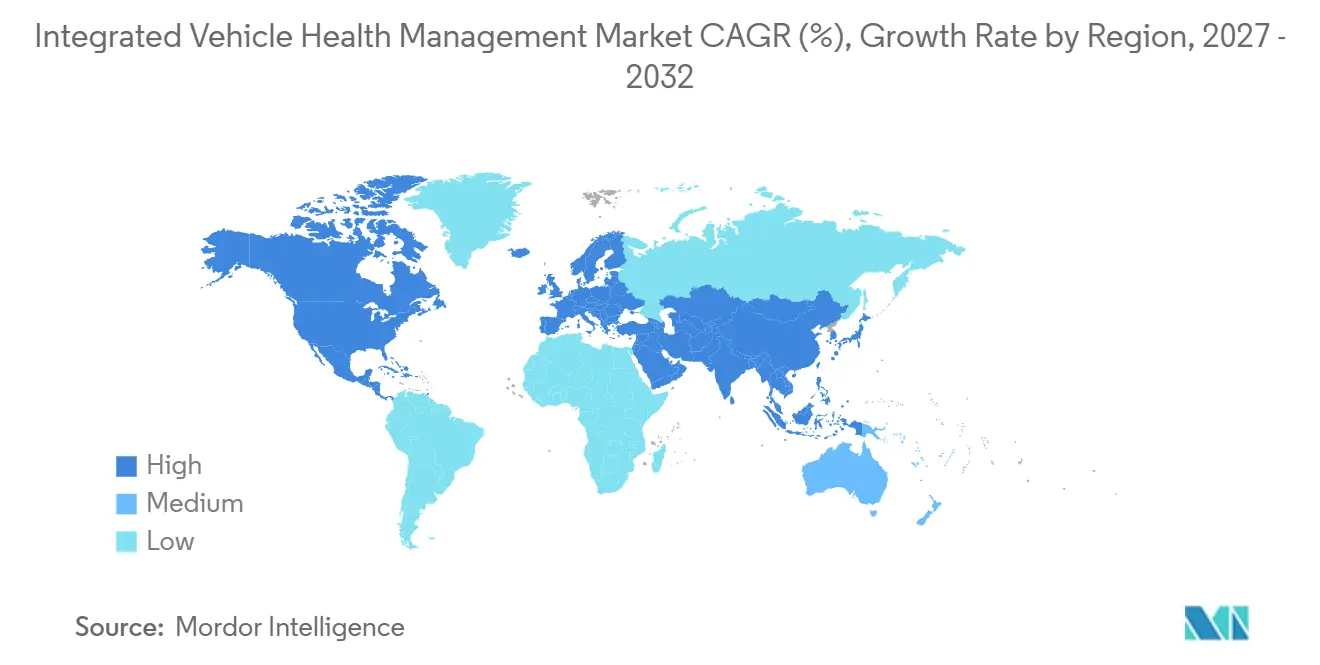
Asia-Pacific led with a 38.04% share of the integrated vehicle health management market in 2026 and is expected to grow at a CAGR of 13.92% through 2032, driven by accelerated EV adoption and 5G rollouts. Data-security mandates that compel sophisticated onshore analytics. China’s cross-border data licensing rules drive local cloud deployments with advanced encryption and audit logging. India’s 5G corridor along major freight routes hosts edge nodes for real-time truck prognostics, demonstrating national digital-infrastructure readiness. Japanese OEMs invest in software-defined vehicle platforms that embed health analytics as standard, raising regional baseline functionality.
North America remains an innovation hotbed, propelled by e-commerce fleets that quantify every hour of downtime in financial terms. The U.S. Army’s autonomous resupply projects steer defense dollars into ruggedized sensor suites and AI inference silicon. Private 5G pilots at vehicle plants exemplify industry-telecom collaboration to close feedback loops between manufacturing defects and field failures. Interstate telematics regulations are comparatively permissive, facilitating data aggregation across states and accelerating the adoption of the Integrated Vehicle Health Management market.
Europe experienced surges in legislated demand as the General Safety Regulation and UNECE WP.29 cybersecurity rules rolled out. BMW and Mercedes allocate substantial budgets to private 5G networks and secure connectivity stacks to remain compliant while unlocking paid digital services. Continental and Bosch test digital twins that simulate component lifecycles against real-world usage patterns, supporting predictive warranties across the continent. With connected-vehicle penetration expected to grow by 2030, Europe's integrated vehicle health management market is positioned for robust gains despite macroeconomic headwinds.
Competitive Landscape
Leading suppliers dominate the integrated vehicle health management market, while agile telematics entrants continue to identify opportunities through specialized software, analytics, and integration capabilities. Bosch invests significantly in middleware platforms that combine in-vehicle diagnostics with cloud-based digital twins, enabling more comprehensive vehicle monitoring and maintenance decision-making.
Telematics providers such as Geotab are expanding their cloud ecosystems to integrate with diverse OEM APIs and support connected-vehicle installations across fleet environments. Sibros positions its firmware-agnostic middleware to capture complete vehicle life-cycle logs, which are essential for battery warranty analytics and long-term performance assessment. Viaduct specializes in processing high-frequency sensor data to model component aging and has attracted investment from tire manufacturer Sumitomo. Competitive differentiation increasingly depends on inference accuracy, update frequency, interoperability, and certified cybersecurity compliance rather than sensor count.
Key strategic developments include SIXT’s large-scale deployment of Geotab’s predictive analytics across its rental van fleet, ZM Trucks’ selection of Sibros for electric freight platforms, and Bridgestone’s partnership with Geotab to develop tire-integrated health dashboards. Patent activity is concentrated in battery prognosis and edge AI coprocessors, highlighting the intensifying race to control intellectual property that is critical to the continued expansion of the integrated vehicle health management market.
Integrated Vehicle Health Management Industry Leaders
-
Continental AG
-
Robert Bosch GmbH
-
Aptiv PLC
-
Garrett Motion Inc.
-
ZF Friedrichshafen AG
- *Disclaimer: Major Players sorted in no particular order
Integrated Vehicle Health Management Market Companies Covered in this Report
- Continental AG
- Robert Bosch GmbH
- Aptiv PLC
- Garrett Motion Inc.
- ZF Friedrichshafen AG
- Siemens AG
- Valeo SA
- Harman International Industries Inc.
- Vector Informatik GmbH
- Teletrac Navman US Ltd
- Verizon Connect Inc.
- KPIT Technologies Limited
- Uptake Technologies Inc.
- Rolls-Royce PLC
Recent Industry Developments in Integrated Vehicle Health Management Market
- August 2026: Motive launched Motive Maintenance, an AI-powered system that integrates fleet health data, repair workflows, and spending. It helps teams identify issues earlier, improve uptime, and reduce repair costs.
- May 2025: Geotab partnered with Thermo King to integrate TracKing Pro cold chain telematics into the MyGeotab platform. This enables real-time cargo temperature monitoring and automated alert systems for temperature-sensitive goods transportation across North American fleets.
- March 2025: SIXT van & truck selected Geotab for a predictive maintenance deployment across 6,500 UK commercial vehicles, making it one of the largest European fleet IVHM implementations, with comprehensive telematics integration and real-time vehicle health monitoring capabilities.
Global Integrated Vehicle Health Management Market Report Scope
The scope of the report includes Offering (Hardware, Software), Channel (OEM Service Centers, Independent Service Centers, Remote Diagnostics Platforms), Application (Predictive Maintenance, and More), End-User (OEMs, and More), Vehicle Type (Passenger Vehicles, and More), and Geography (North America, South America, and More). The Market Forecasts are Provided in Terms of Value (USD).
Segmentation Overview
| Hardware |
| Software |
| OEM Service Centers |
| Independent Service Centers |
| Remote Diagnostics Platforms |
| Predictive Maintenance |
| Fleet Management |
| Driver Monitoring |
| Vehicle Diagnostics |
| Original Equipment Manufacturers (OEMs) |
| Fleet Operators |
| Service Providers |
| Individual Vehicle Owners |
| Passenger Vehicles |
| Light Commercial Vehicles |
| Medium and Heavy Commercial Vehicles |
| North America | United States |
| Canada | |
| Rest of North America | |
| South America | Brazil |
| Argentina | |
| Rest of South America | |
| Europe | United Kingdom |
| Germany | |
| Spain | |
| Italy | |
| France | |
| Russia | |
| Rest of Europe | |
| Asia-Pacific | India |
| China | |
| Japan | |
| South Korea | |
| Rest of Asia-Pacific | |
| Middle East and Africa | United Arab Emirates |
| Saudi Arabia | |
| Turkey | |
| Egypt | |
| South Africa | |
| Rest of Middle East and Africa |
| By Offering | Hardware | |
| Software | ||
| By Channel | OEM Service Centers | |
| Independent Service Centers | ||
| Remote Diagnostics Platforms | ||
| By Application | Predictive Maintenance | |
| Fleet Management | ||
| Driver Monitoring | ||
| Vehicle Diagnostics | ||
| By End-User | Original Equipment Manufacturers (OEMs) | |
| Fleet Operators | ||
| Service Providers | ||
| Individual Vehicle Owners | ||
| By Vehicle Type | Passenger Vehicles | |
| Light Commercial Vehicles | ||
| Medium and Heavy Commercial Vehicles | ||
| By Geography | North America | United States |
| Canada | ||
| Rest of North America | ||
| South America | Brazil | |
| Argentina | ||
| Rest of South America | ||
| Europe | United Kingdom | |
| Germany | ||
| Spain | ||
| Italy | ||
| France | ||
| Russia | ||
| Rest of Europe | ||
| Asia-Pacific | India | |
| China | ||
| Japan | ||
| South Korea | ||
| Rest of Asia-Pacific | ||
| Middle East and Africa | United Arab Emirates | |
| Saudi Arabia | ||
| Turkey | ||
| Egypt | ||
| South Africa | ||
| Rest of Middle East and Africa | ||
Key Questions Answered in the Report
What are the current market size and growth prospects of the Integrated Vehicle Health Management market?
The Integrated Vehicle Health Management Market size was valued at USD 22.43 billion in 2026, is expected to reach USD 25.11 billion in 2027, and is forecast to reach USD 44.11 billion by 2032, at a 11.93% CAGR over 2027-2032.
Which region leads the adoption of Integrated Vehicle Health Management solutions?
Asia-Pacific accounts for 38.04% of the global market value, driven by increasing EV adoption and supportive data security regulations.
Which application segment is expected to grow the fastest in the integrated vehicle health management market?
Driver monitoring solutions are expected to register a 14.46% CAGR through 2032, driven by new safety mandates in Europe.
How are OEMs monetizing integrated vehicle health management capabilities?
Manufacturers generate recurring revenue beyond vehicle sales by offering predictive maintenance subscriptions and remote diagnostic updates.
What is the primary restraint limiting the deployment of Integrated Vehicle Health Management systems?
Complying with diverse cybersecurity and data sovereignty regulations increases costs and operational complexity, particularly for global fleet operators.