
Market Overview
| Study Period | 2020 - 2031 |
|---|---|
| Market Size (2026) | USD 9.09 Billion |
| Market Size (2031) | USD 13.55 Billion |
| Growth Rate (2026 - 2031) | 8.33 % |
| Fastest Growing Market | Asia Pacific |
| Largest Market | North America |
| Market Concentration | Medium |
Major Players *Disclaimer: Major Players sorted in no particular order Image © Mordor Intelligence. Reuse requires attribution under CC BY 4.0. | |
Insulin Pens Market Analysis by Mordor Intelligence
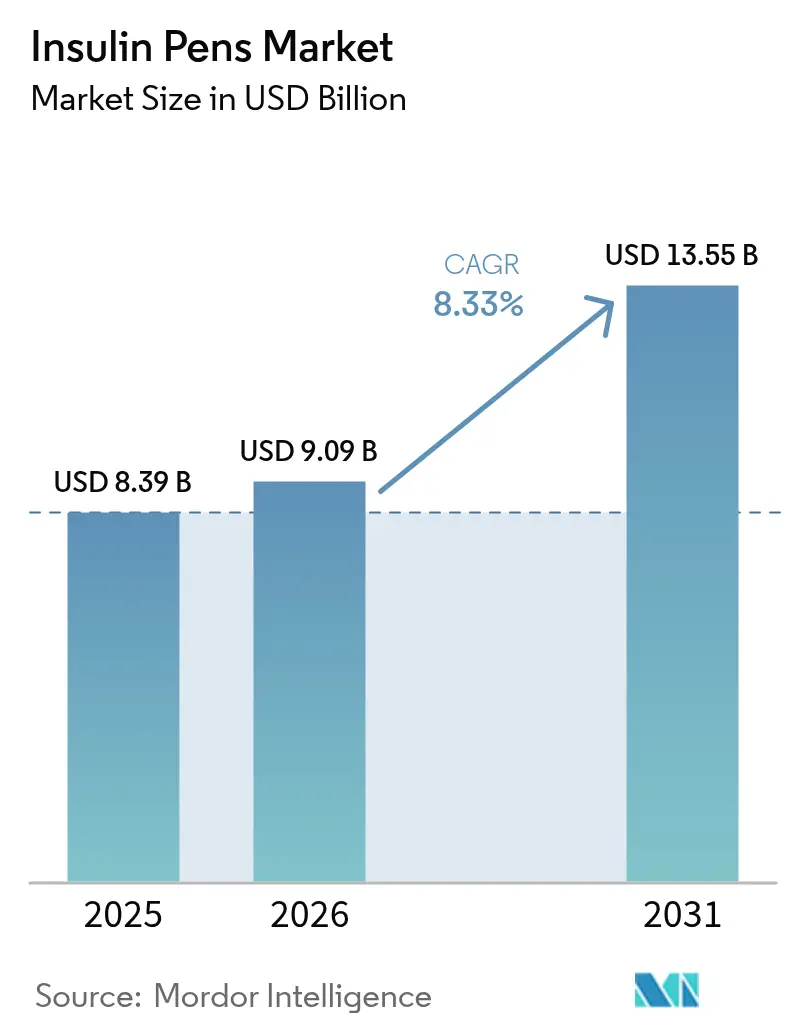
The insulin pens market size was valued at USD 8.39 billion in 2025 and estimated to grow from USD 9.09 billion in 2026 to reach USD 13.55 billion by 2031, at a CAGR of 8.33% during the forecast period (2026-2031). Strong momentum originates from the climbing global diabetes burden, the rapid normalization of smart-connectivity features, and the steady shift from hospital-centric to home-based diabetes care. Manufacturers are injecting capital into capacity scale-ups—Novo Nordisk is spending USD 4.1 billion on new capacity in North Carolina, while Eli Lilly is allocating USD 5.3 billion in Indiana—as they juggle insulin pen demand with parallel GLP-1 production priorities. Supply tightness, visible through Tresiba FlexTouch shortages that persist until January 2026, has nudged prescribers toward reusable and smart alternatives. In parallel, the diabetes population is projected to rise from 529 million in 2021 to 1.31 billion by 2050, a trend that hardwires structural volume growth into the insulin pens market[1]Centers for Disease Control and Prevention, “National Diabetes Statistics Report 2023,” CDC, cdc.gov.
Key Report Takeaways
- By product type, disposable pens held 55.12% of 2025 revenue, while smart/connected pens are projected to expand at a 10.15% CAGR through 2031.
- By diabetes type, type 2 patients accounted for 60.05% of 2025 demand, whereas gestational and other atypical categories are poised for a 9.54% CAGR to 2031.
- By end user, home-care settings represented 50.02% of 2025 consumption, while the “other” segment—including workplace programs and long-term care facilities—will advance at a 10.48% CAGR over the forecast period.
- By technology, mechanical spring-loaded systems captured 45.21% of 2025 sales, yet Bluetooth/NFC-enabled smart devices will record the fastest growth at an 11.28% CAGR through 2031.
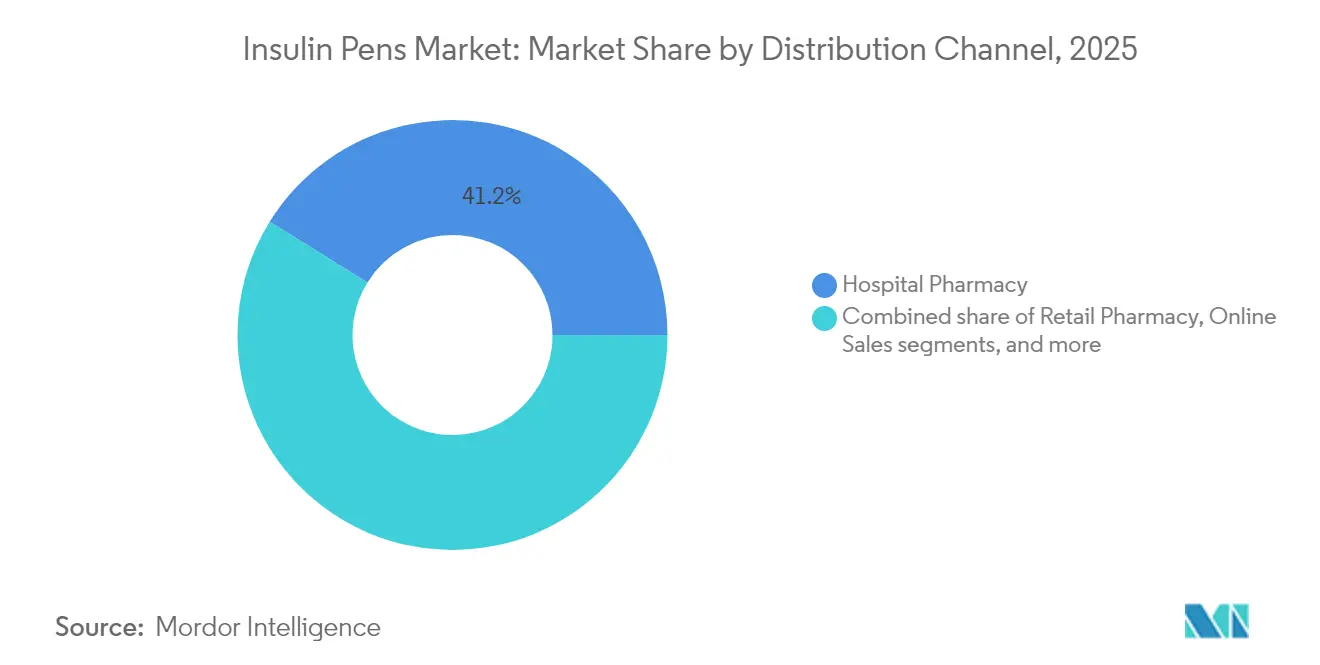
- By distribution channel, hospital pharmacies led with 41.18% share in 2025, whereas online sales are set to grow at a 12.22% CAGR between 2026 and 2031.
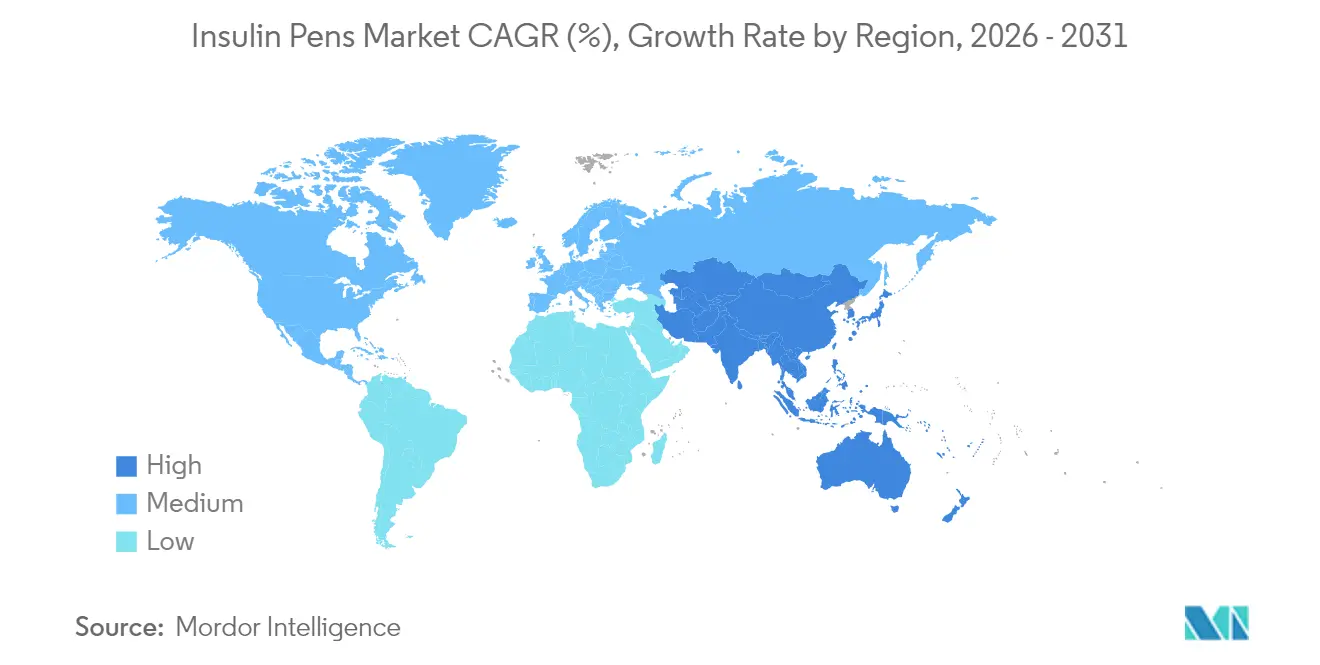
- By geography, North America dominated with 41.02% revenue share in 2025, while Asia-Pacific is expected to log a 9.52% CAGR over the same period.
Note: Market size and forecast figures in this report are generated using Mordor Intelligence’s proprietary estimation framework, updated with the latest available data and insights as of 2026.
Market Trends and Insights
Drivers Impact Analysis of Insulin Pens Market*
| Driver | % Impact on CAGR Forecast | Geographic Relevance | Impact Timeline |
|---|---|---|---|
| Increasing Diabetes Prevalence | +2.1% | Global — highest in Asia-Pacific and Middle East | Long term (≥ 4 years) |
| Rising Adoption Of User-Friendly Insulin Delivery Devices | +1.8% | North America, Europe, expanding to emerging markets | Medium term (2-4 years) |
| Technological Advancements In Smart Pen Connectivity | +1.5% | Developed markets first, then worldwide | Medium term (2-4 years) |
| Growing Preference For Home-Based Diabetes Management | +1.3% | Global, accelerated by post-pandemic care shifts | Short term (≤ 2 years) |
| Expansion Of Reimbursement Coverage For Pen Devices | +0.9% | North America and Europe primarily | Medium term (2-4 years) |
| Ecosystem Partnerships Integrating Pens With Digital Therapeutics | +0.6% | Technology-advanced markets | Long term (≥ 4 years) |
| Source: Mordor Intelligence | |||
Increasing Diabetes Prevalence
Global diabetes prevalence continues to swell, with type 2 diabetes comprising 96% of total cases and prompting sustained demand for reliable insulin delivery. The International Diabetes Federation projects 783.2 million cases by 2045, and middle-income nations are set to shoulder a 21.1% relative jump that magnifies insulin pens market demand[2]International Diabetes Federation, “IDF Diabetes Atlas 10th Edition,” IDF, idf.org. Emerging economies wrestle with resource constraints even as their patient pools expand, compelling manufacturers to balance volume with affordability. Brazil typifies the surge, where type 2 prevalence could rise from 9.2% to 27.0% by 2036 amid obesity rates that doubled between 2003 and 2019. Such epidemiological patterns lock-in baseline growth for the insulin pens market, regardless of technology cycles or competitive moves.
Rising Adoption of User-Friendly Insulin Delivery Devices
Close to 60% of global insulin users favor pens over syringes because pens offer consistent dosing, portability, and lower injection anxiety. Uptake accelerates where health-literacy programs and supply chains expand together, especially across Latin America and Southeast Asia. Clinical studies show measurable adherence gains when patients switch to pens, with fewer missed bolus doses and improved time-in-range glucose metrics[3]National Center for Biotechnology Information, “Impacts of China’s National Volume-Based Procurement on Insulin,” PubMed, pubmed.ncbi.nlm.nih.gov. Device makers that refine ergonomic design and needle micro-sharpness boost competitive stickiness, as shorter 4–5 mm needles reduce pain while sustaining accuracy. Such human-factor improvements reinforce patient loyalty and secure recurring cartridge revenue.
Technological Advancements in Smart Pen Connectivity
Connectivity has shifted from a premium add-on to a mainstream expectation. FDA-cleared platforms such as Medtronic’s InPen, now featuring missed-meal dose detection, illustrate how software turns dosing data into predictive insights. Novo Nordisk’s NovoPen 6 and Echo Plus log up to 800 doses and sync automatically with partner apps, allowing clinicians to verify real-world adherence without requiring manual diaries. Integration with continuous glucose monitors, exemplified by Dexcom’s link-up with Novo Nordisk pens, positions the insulin pens market at the center of closed-loop therapy ecosystems. The resulting data fabric encourages value-based care contracts that hinge on measurable outcomes rather than unit sales.
Growing Preference for Home-Based Diabetes Management
Pandemic-era telehealth adoption reshaped diabetes care pathways, lifting home-care to 50.34% of end-user demand in 2024. Expanded Centers for Medicare & Medicaid Services coverage for implantable continuous glucose monitors further legitimizes at-home management approaches[4]Centers for Medicare & Medicaid Services, “Expanded Coverage for Continuous Glucose Monitors,” CMS, cms.gov. Direct-to-consumer distribution, device coaching apps, and remote consultation integrations extend support previously tethered to clinic visits. Such decentralization enforces design priorities around ease of use, on-pen instruction cues, and cloud-enabled troubleshooting, favorably positioning smart pen suppliers for durable growth.
Restraints Impact Analysis of Insulin Pens Market*
| Restraints Impact Analysis | (~) % Impact on CAGR Forecast | Geographic Relevance | Impact Timeline |
|---|---|---|---|
| High Cost Of Advanced Pen Technologies | -1.2% | Emerging markets; pockets of developed economies | Medium term (2-4 years) |
| Stringent Regulatory Approval Processes | -0.8% | Global, intensity varies by region | Long term (≥ 4 years) |
| Environmental Concerns Over Disposable Plastic Waste | -0.6% | Europe and North America leading, global expansion | Long term (≥ 4 years) |
| Competitive Threat From Alternate Insulin Delivery Systems | -0.4% | Technology-advanced markets | Medium term (2-4 years) |
| Source: Mordor Intelligence | |||
High Cost of Advanced Pen Technologies
Smart pens bundle sensors, processors, and connectivity modules that inflate bill-of-materials costs, limiting affordability in price-sensitive countries despite clinical gains. Asia-Pacific studies highlight that upfront device prices remain the chief hurdle to insulin adoption among uninsured urban populations. Manufacturers are piloting subscription models that amortize device costs over cartridge purchases and exploring outcome-based discounts that hinge on real-world glycemic improvements. Continued silicon cost declines and design for manufacturability efforts should ease this restraint over the medium term.
Stringent Regulatory Approval Processes
Combination drug-device rules require dual compliance tracks. FDA guidance on essential delivery outputs stipulates exhaustive bench testing that can extend development timelines by 24 months or more for first-generation smart pens. Smaller innovators often outsource regulatory submissions, raising cash burn and diluting returns. Harmonization progress between the FDA, EMA, and Japanese PMDA remains uneven, making simultaneous multi-region launches complex and costly.
*Our forecasts treat driver/restraint impacts as directional, not additive. The impact forecasts reflect baseline growth, mix effects, and variable interactions.
Insulin Pens Market Segment Analysis
By Product Type:
Smart Connectivity Drives Premium Segment GrowthDisposable pens retained 55.12% of 2025 revenue as their one-piece format remains the default prescription starting point in most formularies. Familiar design lowers training costs and underpins the insulin pens market size leadership at the entry price tier. Reusable models deliver cartridge savings for high-volume users yet still hinge on manual record keeping. Smart Bluetooth/NFC pens, expanding at a 10.15% CAGR, embed memory chips and wireless radios that auto-log every bolus; this feature shortens clinic consultations by replacing paper diaries with objective data streams. As insurers reimburse the added value, experts expect connectivity to become table stakes by 2028, positioning smart pens to capture progressively larger slices of incremental growth within the insulin pens market.
Manufacturers are re-platforming entire portfolios to ensure feature parity. Sanofi’s AllStar Connect demonstrates how incremental electronics can coexist with established mechanical architecture, minimizing retraining hurdles. Dose-capture dashboards give clinicians line-of-sight to time-in-range metrics, reinforcing pay-for-performance models. The competitive spotlight thus shifts from hardware to analytics, prompting device makers to partner with algorithm specialists and cloud-hosting providers for holistic care offerings.


By Diabetes Type:
Type 2 Dominance Shapes Market DynamicsType 2 patients generated 60.05% demand in 2025, reflecting epidemiological reality rather than product preference. Later-stage progression to insulin therapy, plus higher volumes per patient, propels this cohort’s share of the insulin pens market size. Automated insulin dosing clearances for adults with type 2 diabetes extend the addressable market for connected pens that feed data to closed-loop algorithms. Type 1 users, though fewer, adopt premium devices earlier because they manage glycemia from diagnosis onward, making them critical early adopters of smart features.
Specialty categories—gestational and other atypical forms—grow at 9.54% CAGR as testing protocols improve and therapy guidelines recommend precise basal-bolus titration. Weekly insulin icodec trials promise lower injection burdens, yet clinicians still prescribe pens for prandial spikes, maintaining relevance across diabetes sub-types. For type 2, lifestyle comorbidities like obesity ensure a stable influx of new insulin initiations, solidifying volume prospects for the insulin pens market.
By End User:
Home Care Transformation AcceleratesHome-care absorbed 50.02% of 2025 shipments because self-administration aligns with patient convenience, cost containment, and infection-control priorities. Direct-to-consumer digital platforms now ship starter kits, schedule virtual training, and issue cartridge refill reminders, translating into consistent adherence and cartridge pull-through. Hospital and clinic channels remain essential for initiation and device troubleshooting but represent a diminishing share as care decentralizes. The “other” category—which includes corporate wellness programs and long-term care homes—will advance 10.48% CAGR, drawing on bulk purchasing and integrated population-health dashboards that rely on automated dose logging.
The home-first model reshapes supply chains: cold-chain fulfillment partners optimize last-mile temperature stability, while insurers reimburse telehealth-based device education. Smart pens that provide real-time alerts and share data with caregivers cater to seniors aging in place, reinforcing home-care primacy across the insulin pens market.
By Distribution Channel:
Online Sales Disruption AcceleratesHospital pharmacies captured 41.18% share in 2025 thanks to their prescribing role at diagnosis. Retail pharmacies balance convenience and counseling but face margin pressure from e-commerce entrants. Online channels, growing at a 12.22% CAGR, leverage subscription refills and transparent pricing to pull chronic users away from in-store queues. Amazon Pharmacy’s nationwide rollout bundled same-day shipping and coupon integration, pushing traditional chains to upgrade mobile experiences or partner with digital-health startups.
Cross-border e-pharmacy regulations continue to tighten to curb counterfeit risk, yet accredited platforms now maintain validated cold-chain records and serialized barcodes. Manufacturers experiment with direct-fulfillment portals that capture real-world usage data in exchange for loyalty pricing, though payer formularies still dictate brand selection in insured segments.
By Technology:
Smart Features Become StandardMechanical spring-loaded pens owned a 45.21% revenue slice in 2025 and will remain foundational where price sensitivity dominates. Embedded cap sensors represent a bridge tech, adding dose-capture capability without full wireless stacks, suitable for cost-controlled health systems transitioning toward data visibility. Fully connected Bluetooth/NFC pens show 11.28% CAGR momentum, underpinned by component price declines and standardization around low-energy communication protocols. Smart features catalyze physician buy-in by resolving adherence blind spots, making them a natural default in tech-literate regions.
Low-power chipsets, molded antenna inserts, and extended-life coin cells have flattened bill-of-materials curves, narrowing the price gap with mechanical peers. Regulators increasingly request digital traceability for medication errors, encouraging health systems to specify connected devices in procurement tenders. The near-term road map points to embedded cellular or ultra-wideband modules that enable over-the-air firmware updates, further future-proofing connected platforms inside the insulin pens market.
Geography Analysis
North America Insulin Pens Market
North America commanded 41.02% revenue in 2025, buoyed by comprehensive insurance coverage, strong clinician adoption of smart pens, and policy caps on insulin co-pays that expand patient access. Advanced interoperability standards facilitate rapid EHR integration, making connected pens attractive for hospital systems pursuing value-based contracts. Supply constraints stemming from GLP-1 line prioritization have nudged prescribers to trial alternative pen SKUs, preserving unit demand despite brand-level shortages.
Europe Insulin Pens Market
Europe, characterized by centralized tendering and a high biosimilar uptake rate, maintains robust volume but exerts price pressure on brand leaders. Environmental legislation is steering procurement toward recyclable or reusable formats, prompting lifecycle assessments that feed into tender scoring. Segment-specific reimbursement for connectivity, already active in Germany’s DiGA framework, paves a path for subscription reimbursement attached to digital therapeutic companions.
APAC Insulin Pens Market
Asia-Pacific is the fastest climber at 9.52% CAGR through 2031. Rising middle-class disposable income, state insurance rollouts, and urban diabetes hotspots converge to accelerate pen penetration. China’s National Volume-Based Procurement initiative cut insulin list prices yet also stipulates tighter quality and supply guarantees, rewarding companies with local production footprints. India’s National Digital Health Mission fosters electronic prescription uptake, laying groundwork for smart pen data-sharing uptake once device ASPs align with market affordability. Southeast-Asian private insurers bundle mobile coaching with connected pens, compressing the adoption curve often seen in Western markets.
LATAM and Middle East Insulin Pens Market
Latin America and the Middle East post mid-single-digit CAGRs; government-funded chronic-disease programs drive pen purchases yet still emphasize low unit cost. Smart connectivity remains niche but is gaining traction in private clinics catering to affluent urban populations.
Africa Insulin Pens Market
Africa remains the smallest region by value; global foundations focus on basal insulin vial access, but pilot smart-pen donations in South Africa’s private sector hint at future beachheads.

Regulatory Landscape
Insulin pens fall under combination product rules in major markets, which requires manufacturers to align drug and device compliance pathways. In the United States, 21 CFR Part 4 governs combination products and ties quality obligations to both drug CGMP (21 CFR 210/211) and device Quality System requirements (21 CFR 820), with the FDA Office of Combination Products coordinating jurisdictional assignment based on the primary mode of action.
In Europe, integral drug-device combinations are handled under the medicinal products framework, while still requiring evidence of conformity with the relevant General Safety and Performance Requirements in Annex I of EU MDR 2017/745. Globally, ISO 11608 provides a technical anchor for design verification of needle-based injection systems, and the May 2026 publication of EN ISO 11608-1:2022/A1:2026 updates requirements and test methods used in verification and submission packages across regions.
Competitive Landscape
The insulin pens market is moderately consolidated. Novo Nordisk, Eli Lilly, and Sanofi held roughly 70% combined share in 2024, leaning on proprietary insulin analog portfolios and high-volume manufacturing campuses that deliver scale advantages. Their depth in endocrine sales forces and formulary negotiating clout yields stickiness at both physician and payer levels. Smart-pen extensions such as NovoPen 6 and Lilly’s Tempo Pen embed device hooks that reinforce brand pull-through on matching insulin cartridges.
Second-tier players like Medtronic and BD push differentiation through platform interoperability and specialty biologic delivery capabilities rather than basal-bolus insulin volumes. BD’s tie-up with Ypsomed adds high-viscosity biologic competence, opening therapeutic frontiers beyond diabetes. Biosimilar entrants are targeting price-sensitive hospital tenders; FDA approval of Sanofi’s Merilog biosimilar to NovoLog underscores a pivot toward branded-biosimilar pen formats that pressure incumbent pricing while keeping delivery convenience intact .
Strategic partnerships and M&A center on data integration. Dexcom’s 2025 linkage with Novo Nordisk pens demonstrates how real-time glucose-dose pairing can unlock closed-loop recommendations for non-pump users. Device makers ink cloud-storage deals that facilitate HIPAA-compliant analytics dashboards for payers and research cohorts, converting raw dose logs into longitudinal evidence packs useful for regulatory submissions and formulary renewals. Meanwhile, sustainability pledges push leaders to decarbonize plastics, invest in chemical-recycling pilots, and design for disassembly, adding ESG credentials as a potential selection criterion in institutional tenders.
Insulin Pens Industry Leaders
Novo Nordisk A/S
Eli Lilly
Sanofi
Ypsomed
BD (Becton, Dickinson and Company)
- *Disclaimer: Major Players sorted in no particular order

Insulin Pens Market Companies Covered in this Report
- Novo Nordisk
- Eli Lilly and Company
- Sanofi
- Ypsomed
- Beckton Dickinson
- Terumo
- Owen Mumford
- Biocon
- Julphar
- Medtronic
- Roche
- Haselmeier
- Companion Medical / Medtronic (InPen)
- Emperra
- Dongbao
- Wockhardt
- HTL-Strefa
- Sun Pharmaceuticals Industries
- Lupin
- Bigfoot Biomedical
- Cambridge Consultants

Market Opportunities and Future Outlook
Interoperability with CGM and broader automated dosing ecosystems is opening whitespace for smart and connected pen propositions that support structured dose logging, shareable data, and integration into clinician workflows aligned with home-based care. In 2026, Abbott’s CE Mark (May 2026) for Libre Duo sensors, which continuously monitor glucose and ketone levels, and MiniMed’s June 2026 collaboration with Abbott to commercialize dual glucose-ketone sensors for integration with MiniMed smart dosing systems reinforce opportunities for pen makers and digital partners to connect dosing data to multi-sensor safety features, including DKA risk signaling, while providing payers and providers with objective adherence evidence.
Device miniaturization and integrated sensing also point to product direction that can affect pen roadmaps and competitive positioning versus other delivery formats. PharmaSens published first-in-human feasibility data (April 2026) for an insulin patch pump integrated with glucose sensing, while Diabeloop made DBLG2 AID available by prescription in Germany (July 2026) integrated with Kaleido and Dexcom G7. As closed-loop and sensor-linked therapy options expand, insulin pen manufacturers can pursue reusable and connected platforms to reduce supply risk from disposable shortages, support remote titration support, and strengthen formulary value propositions through measurable real-world dosing behavior.
Recent Industry Developments in Insulin Pens Market
- April 2026: Ro launched Eli Lillys FDA-approved Zepbound (tirzepatide) KwikPen nationwide in the United States. While not an insulin product, the rollout underscores ongoing investment and scaling in prefilled pen delivery formats and patient access pathways that share manufacturing and supply-chain priorities with insulin pens.
- March 2026: Novo Nordisk announced US FDA approval for Awiqli (insulin icodec-abae) 700 units/mL injection, the first once-weekly basal insulin for adults with type 2 diabetes, administered using the Awiqli FlexTouch device. The approval highlights how new dosing regimens can reshape pen utilization patterns and places additional emphasis on device reliability, training, and supply continuity during commercial launches.
- January 2026: BD and Ypsomed expanded their partnership to develop a 5.5 mL version of the BD Neopak XtraFlow glass prefillable syringe designed for compatibility with Ypsomeds YpsoMate 5.5 autoinjector platform. The work targets higher-volume delivery needs and signals continued component and platform development that can influence future pen and injector designs where viscosity, fill volume, and usability requirements tighten.


Insulin Pens Market Report Scope and Research Methodology
Market Definition and Coverage
For this study, the insulin pens market is defined as the annual sales value of insulin pen devices sold for diabetes care, including disposable pens and refill cartridges used in reusable pens, across all distribution channels and regions.
Scope exclusions: We exclude syringes, insulin pumps, inhaled insulin formats, software-only subscriptions, and veterinary use.
Segments Covered in This Report
- By Product Type
- Disposable Insulin Pens
- Reusable Insulin Pens
- Smart / Connected Insulin Pens
- By Diabetes Type
- Type 1 Diabetes
- Type 2 Diabetes
- Gestational / Other
- By End User
- Hospitals & Clinics
- Home-Care Settings
- Other End Users
- By Distribution Channel
- Hospital Pharmacy
- Retail Pharmacy
- Online Sales
- Diabetes Clinics
- By Technology
- Mechanical Spring-Loaded
- Smart (Bluetooth / NFC)
- Embedded Dose-Tracking Cap
- Geography
- North America
- United States
- Canada
- Mexico
- Europe
- Germany
- United Kingdom
- France
- Italy
- Spain
- Rest of Europe
- Asia-Pacific
- China
- Japan
- India
- Australia
- South Korea
- Rest of Asia-Pacific
- Middle East & Africa
- GCC
- South Africa
- Rest of Middle East & Africa
- South America
- Brazil
- Argentina
- Rest of South America
- North America
Data Sources, Market Sizing, and Validation
Desk Research
Desk research was used to build the starting structure of the market model and to make sure the demand-side story matches what is visible in public statistics. We reviewed non-paywalled sources such as the International Diabetes Federation (IDF) diabetes atlas and updates, the World Health Organization (WHO) diabetes briefs, CDC diabetes data, and World Bank population and health expenditure series.
To keep the model grounded in real supply and access conditions, we also referenced sources such as national drug regulators and procurement portals where available, peer-reviewed journals covering insulin delivery adherence and device switching, and company filings and investor presentations for portfolio and geographic commentary. In a few places, paid subscriptions were used for company financials and for patent databases to validate device innovation cycles. These examples are not exhaustive, and many other public and paid sources were also reviewed for data collection, validation, and clarification.
Primary Interviews and Surveys
Primary work focused on validating what portion of insulin-treated patients are actually using pens, how mix is shifting between disposable and reusable formats, and how pricing changes flow through different channels. We spoke with a mix of device and insulin value chain participants, along with clinicians and pharmacy-side stakeholders, and coverage was balanced across major demand regions so assumptions could be checked and adjusted where needed.
Distribution of primary research fieldwork respondents
| Company type | Respondent position | Region |
|---|---|---|
| Top tier: 33% | CXOs: 17% | APAC: 46% |
| Mid tier: 48% | Functional/Unit leaders: 34% | EMEA: 34% |
| Smaller Players: 19% | Managers: 49% | Americas: 20% |
Market-Sizing & Forecasting
Market size is first reconstructed using a top-down approach where diabetes prevalence and the insulin-treated population are converted into a realistic pen-using demand pool, and then translated into value using observed device mix and price points. The model is checked with selective bottom-up approximations such as sampled country roll-ups of pen volumes by channel, and ASP-by-format checks for disposable pens versus cartridges used in reusable pens, which helps correct any over- or under-counting.
Key inputs tracked include the number of people living with diabetes, insulin therapy penetration, the share of insulin users on pen delivery versus other methods, refill frequency patterns, and price movement signals by region (including currency timing). For forecasting, scenario analysis is used to reflect different adoption paths for smart and reusable pens, and then the output is smoothed using trend-consistent assumptions confirmed in interviews. When gaps exist in country-level pricing or mix, proxy markets with similar reimbursement and access patterns are used, and the proxy is revisited once better signals appear in the next refresh.
Data Validation & Update Cycle
Validation is done through multiple checks so the final numbers stay aligned with real-world signals. Outputs are compared against independent indicators such as diabetes population trends, therapy uptake, and region-level pricing movements, and any sharp deviations are reviewed before sign-off. If a variance cannot be explained by an adoption change or a policy shift, we re-check assumptions and, where needed, re-contact relevant interviewees.
The report is refreshed annually, and interim updates are triggered when material events occur, such as major pricing changes, reimbursement revisions, or supply disruptions that can shift device mix quickly. Before delivery, a final review pass is completed so clients receive the latest updated view instead of a static snapshot.
Mordor Intelligence's Insulin Pens Market Sizing Compared With Other Published Estimates
Published market values for insulin pens can differ quite a bit, even when they appear to cover the same devices. The gaps usually come from timing and pricing choices, plus how closely each model is checked against real adoption and channel behavior.
In this study, the refresh cadence and the way pricing is normalized to a consistent currency timing are big drivers of the result, since rapid list price changes and mix shifts can distort the year value if they are not revalidated close to publication. That is why the validation cycle described by Mordor Intelligence is treated as a key control for this market.
Benchmark comparison
| Source | Market Size | Gaps in Research Methodology |
|---|---|---|
| Mordor Intelligence | USD 9.09 B (2026) | |
| Global Consultancy A | USD 7.79 B (2024) | Uses an earlier base year and a different pricing window, and the scope presentation is device-focused without clearly separating refill cartridges economics versus full disposable pens across channels. |
| Industry Publisher B | USD 9.60 B (2024) | Applies a higher value in the same year, which can happen when ASP progression is modeled more aggressively and currency conversion timing is not aligned with the period when device mix actually shifted. |
The spread across sources is mainly explained by year selection, how ASPs are carried forward, and how often assumptions are rechecked against adoption signals. Our approach keeps the sizing steps traceable to patient counts, pen usage share, and format-level pricing so the final number can be repeated and audited with the same inputs.


Key Questions Answered in the Report
What is the current size of the insulin pens market?
The insulin pens market stands at USD 9.09 billion in 2026 and is projected to reach USD 13.55 billion by 2031, expanding at a CAGR of 8.33% during 2026-2031.
Which product segment is growing fastest?
Smart and connected pens show the highest momentum, advancing at a 10.15% CAGR through 2031 on the back of Bluetooth and NFC adoption.
How big is home-care demand for insulin pens?
Home-care users accounted for 50.02% of global shipments in 2025, reflecting the shift toward self-managed diabetes care.
Which region leads and which grows quickest?
North America holds the largest share at 41.02%, while Asia-Pacific registers the fastest growth with a 9.52% CAGR through 2031.
Who are the key players in the insulin pens market?
Novo Nordisk, Eli Lilly, and Sanofi together control about 70% of global revenue, with Medtronic and BD leading in smart-pen platform partnerships.
What major FDA approvals have shaped the market recently?
Key clearances include Merilog biosimilar insulin in 2025 and expanded automated insulin dosing indications for type 2 diabetes in 2024.
Page last updated on:


 Your data is secure and never sold or shared.


