
Insulation Coating Market Size and Share
Market Overview
| Study Period | 2020 - 2031 |
|---|---|
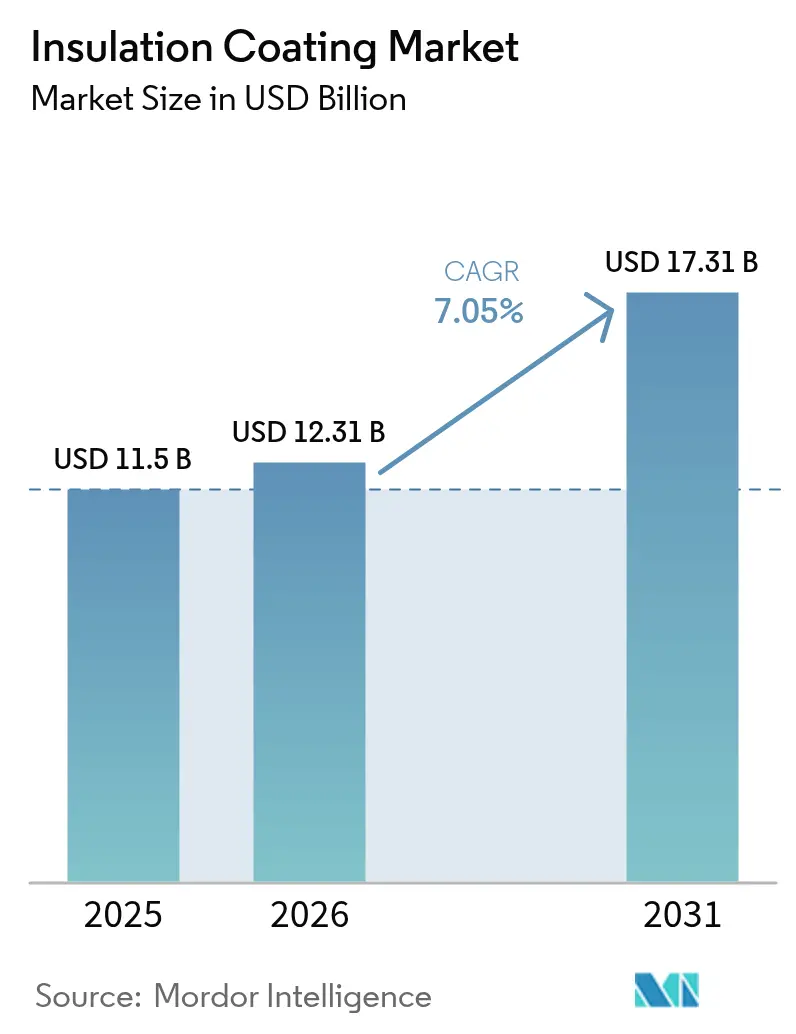
| Market Size (2026) | USD 12.31 Billion |
| Market Size (2031) | USD 17.31 Billion |
| Growth Rate (2026 - 2031) | 7.05 % |
| Fastest Growing Market | Asia Pacific |
| Largest Market | Asia Pacific |
| Market Concentration | Medium |
Major Players *Disclaimer: Major Players sorted in no particular order Image © Mordor Intelligence. Reuse requires attribution under CC BY 4.0. | |
Insulation Coating Market Analysis by Mordor Intelligence
The insulation coating market size is expected to grow from USD 11.50 billion in 2025 to USD 12.31 billion in 2026 and is forecast to reach USD 17.31 billion by 2031 at 7.05% CAGR over 2026-2031. This steady rise reflects global movement toward tighter energy-efficiency rules, modernization of industrial assets, and breakthrough material science that widens the performance envelope for thermal-management coatings. Product adoption spans construction, oil and gas, power generation, battery manufacturing, and other process industries, each seeking to cut heat loss, manage surface temperatures, and extend asset life. Asia-Pacific remains the demand anchor thanks to large-scale infrastructure outlays and manufacturing expansion, while North America and Europe shape product specifications through performance-based codes. Competitive strategies now emphasize portfolio realignment, R&D acceleration in aerogel and bio-based chemistries, and aftermarket service models that secure long-term revenue. Obstacles persist in the form of feedstock price swings and certification delays for new chemistries, yet the structural trend toward decarbonization keeps the insulation coating market on a growth path.
Key Report Takeaways
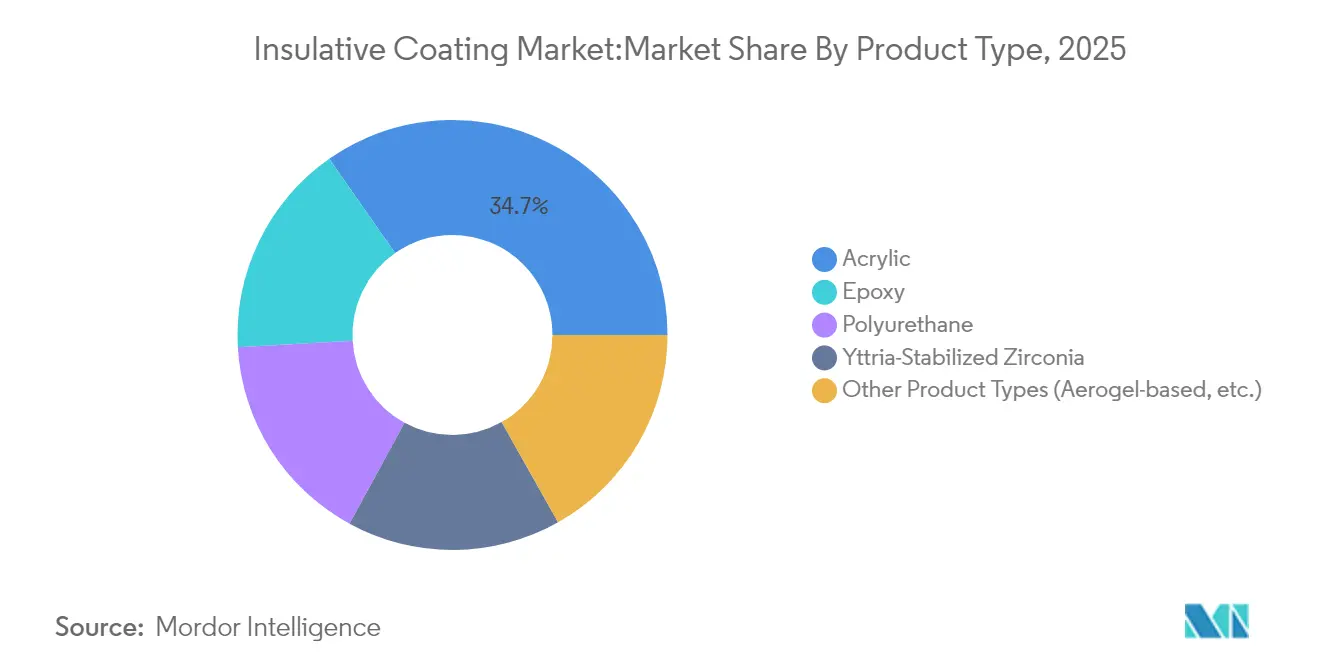
- By product type, acrylic formulations led with 34.72% revenue share in 2025; the “Other Product Types” segment is projected to grow at a 7.12% CAGR through 2031.
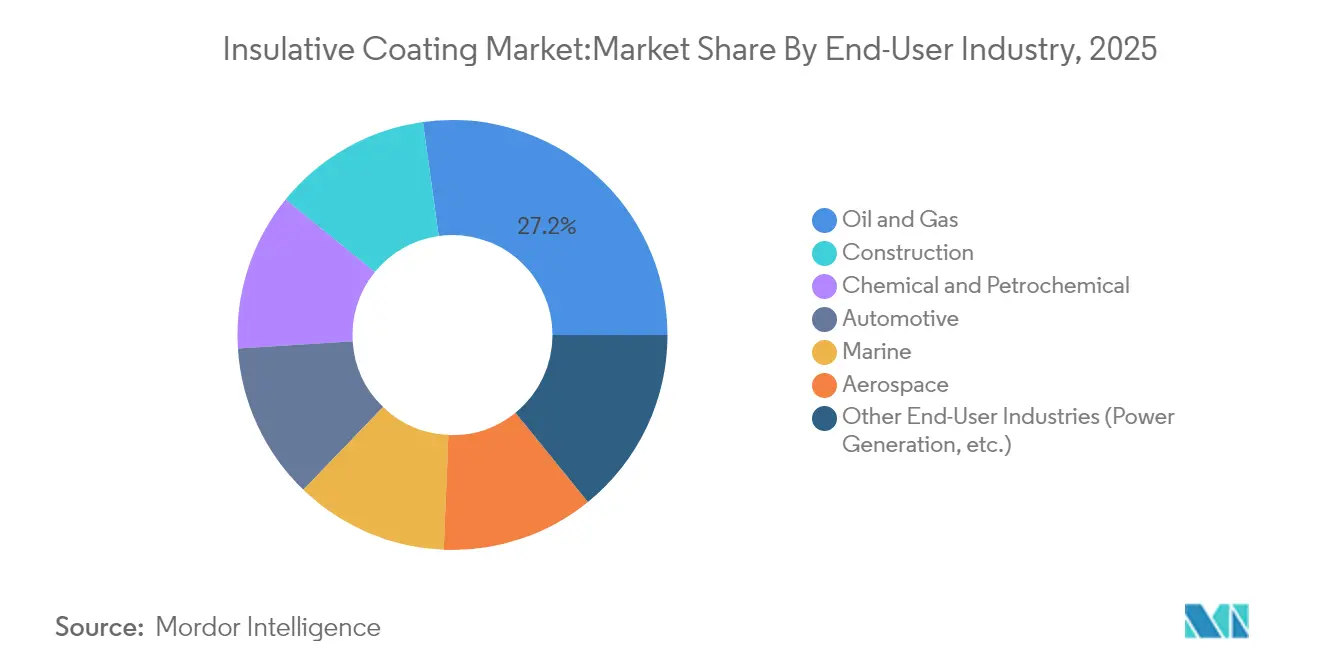
- By end-user industry, oil and gas held 27.20% of the insulation coating market share in 2025, while the “Other End-User Industries” segment is advancing at a 7.62% CAGR to 2031.
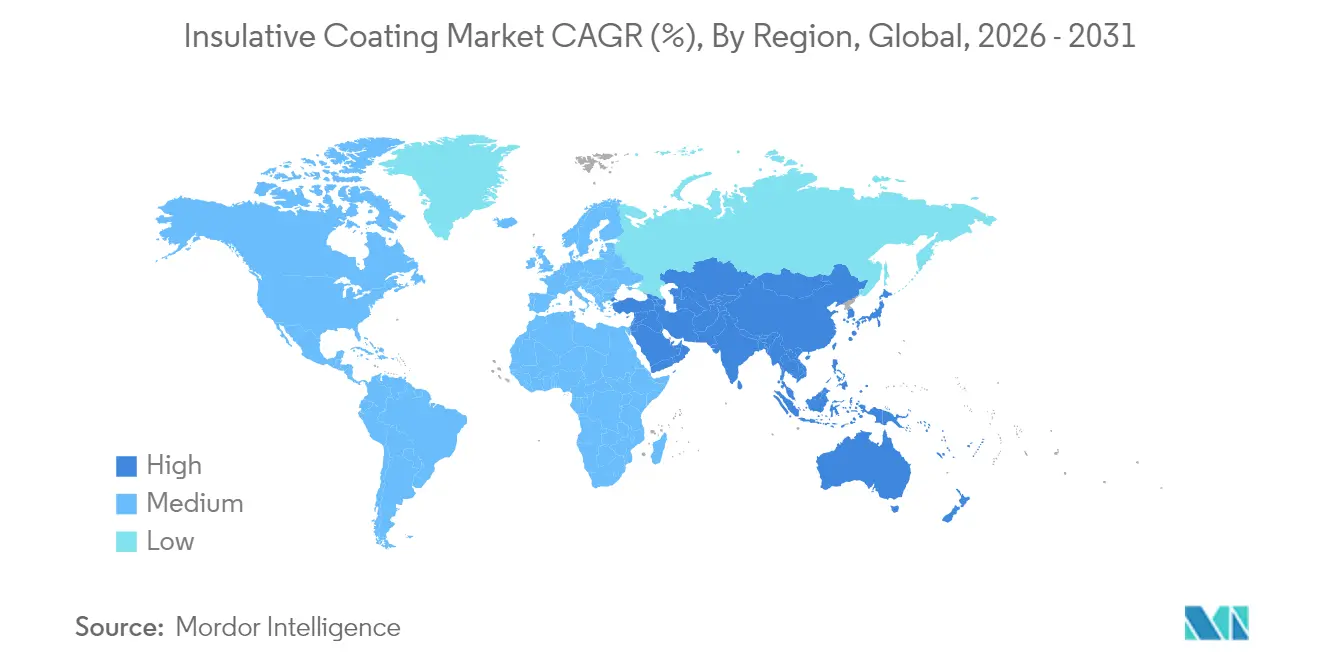
- By geography, Asia-Pacific accounted for 46.88% of the insulation coating market in 2025; the region is also the fastest growing, posting an 7.86% CAGR through 2031.
Note: Market size and forecast figures in this report are generated using Mordor Intelligence’s proprietary estimation framework, updated with the latest available data and insights as of 2026.
Global Insulation Coating Market Trends and Insights
Drivers Impact Analysis*
| Driver | (~) % Impact on CAGR Forecast | Geographic Relevance | Impact Timeline |
|---|---|---|---|
| Rapid growth in industrial LNG liquefaction trains | +1.2% | Global, with concentration in Qatar, Australia, North America | Medium term (2-4 years) |
| Tightening building-energy codes | +1.8% | North America & EU, expanding to APAC | Long term (≥ 4 years) |
| Retro-fit demand in aging offshore platforms | +0.9% | North Sea, Gulf of Mexico, Brazil offshore | Short term (≤ 2 years) |
| Surge in battery-gigafactory construction | +1.4% | Global, led by China, EU, North America | Medium term (2-4 years) |
| Super-insulative aerogel–filled top-coat launches | +0.7% | Global, early adoption in aerospace and industrial | Long term (≥ 4 years) |
| Source: Mordor Intelligence | |||
Rapid Growth in Industrial LNG Liquefaction Trains
Large-scale LNG projects require coatings that keep insulation properties intact at cryogenic temperatures as low as −162 °C. Upgraded U.S. Department of Transportation rules now cap allowable thermal conductance at 0.225 Btu h-1 ft-2 °F-1 at 60 °F for tank insulation, effectively establishing a global benchmark that favors high-performance polyurethane and aerogel systems[1]. Project operators prioritise coatings that minimise boil-off gas and slash maintenance intervals, which in turn sustains steady volumes for suppliers across construction and maintenance cycles. Emerging Qatar North Field South megatrains, Canadian LNG sites, and new liquefaction capacity in the United States illustrate how demand clusters near production hubs. As more sovereign LNG producers chase export revenue, the insulative coating market benefits from multi-year order backlogs tied to engineering, procurement, and construction contracts. Performance differentiation is expected to intensify as operators request thinner films and lower thermal conductivities to meet total installed cost targets.
Tightening Building-Energy Codes
The 2024 International Energy Conservation Code mandates continuous insulation values ranging from R-5 to R-30, accelerating demand for coatings that deliver verifiable R-value gains on complex roof and façade geometries[2]. California’s R-30 roof rule and Washington’s climate-zone-specific standards show how state-level regulations drive immediate specification shifts. Product developers respond with low-emissivity and highly reflective coatings such as AkzoNobel’s Interpon D1036 Low-E line, which promises up to 20% energy savings for commercial buildings. Code tightening cascades into renovation cycles, because once owners experience energy savings, similar coatings are considered during retrofit events. As APAC adopts performance-based codes, multinational manufacturers position their regional plants to deliver compliant systems locally, shortening lead-times and lowering landed costs. The compound effect is sustained volume growth and higher share for coatings validated through accredited third-party testing.
Retro-fit Demand in Aging Offshore Platforms
Corrosion under insulation is a chronic problem for North Sea and Gulf of Mexico structures, many of which operate beyond original design life. Asset owners now budget for thermal-insulating topcoats that also offer corrosion resistance, a dual functionality that enables partial replacement instead of wholesale rebuilding. Tenaris’ USD 182.6 million acquisition of Mattr’s pipe-coating business signals consolidation aimed at bundling anti-corrosion and flow-assurance technologies. Field studies presented through OnePetro highlight coating systems that cut thickness by 30% while improving hydrostatic pressure resistance, critical for subsea jumpers and risers. Quick-cure polyurethane hybrids are popular because they reduce offshore downtime, while remote-application robotics lower labour risk on high sea-states. Given that retrofit budgets are capitalised across 20-year asset lives, the insulation coating market secures recurring maintenance revenue alongside initial project volumes.
Surge in Battery-Gigafactory Construction
More than 180 gigafactory projects are in various planning or construction stages worldwide, each requiring coatings that curb thermal runaway and maintain ambient process temperatures. Resonac recently introduced an insulation coating with 0.03 W m-1 K-1 conductivity for EV refrigerant pipes, delivering up to 40% energy savings compared with bare metal baselines. European plants mandated under the EU Battery Regulation favour halogen-free chemistries that satisfy both fire safety and end-of-life recycling criteria. North American facilities, backed by Inflation Reduction Act incentives, are specifying thin-film aerogel composites that double as passive fire barriers. The result is predictable multi-year demand because coating systems must be reapplied or refurbished during scheduled line overhauls. In addition, secondary markets arise for containerised energy-storage enclosures that need similar thermal-event mitigation.
Restraints Impact Analysis*
| Restraint | (~) % Impact on CAGR Forecast | Geographic Relevance | Impact Timeline |
|---|---|---|---|
| Fire-safety certification delays for novel chemistries | -0.8% | Global, particularly stringent in EU and North America | Medium term (2-4 years) |
| Skilled-applicator shortage in emerging markets | -0.6% | APAC emerging markets, Latin America, MEA | Short term (≤ 2 years) |
| Volatility in epoxy & isocyanate feedstock prices | -1.1% | Global, supply chain concentrated in Asia | Short term (≤ 2 years) |
| Source: Mordor Intelligence | |||
Fire-Safety Certification Delays for Novel Chemistries
Advanced aerogel or intumescent systems must clear stringent tests such as NFPA 275 and EN 13381-8 before market release. UL Solutions notes that full evaluation cycles for innovative chemistries can extend beyond 15 months, especially when multiple fire, smoke, and toxicity metrics are required. Because building authorities rely on ICC-ES reports, suppliers must generate exhaustive fire-test data and engineering analyses, which raises market-entry costs and lengthens commercialisation timelines. Any failed test forces a reformulation loop, delaying revenue and eroding first-mover advantage. Established products therefore enjoy an incumbency edge, and project owners sometimes default to older systems to meet construction schedules. The bottleneck slows diffusion of next-generation coatings even when they promise superior thermal performance, limiting near-term growth in the insulation coating market.
Volatility in Epoxy & Isocyanate Feedstock Prices
Epoxy resins depend on bisphenol-A and epichlorohydrin supply chains centred in China, South Korea, and Taiwan. The U.S. International Trade Commission ruled in May 2025 that imports from key Asian exporters injure domestic producers, opening the door for anti-dumping duties that could inflate U.S. input costs[3]. Chinese BPA producers operated at a loss of Yuan 842 per tonne on average in H1 2024 amid capacity additions, creating price whipsaws that complicate long-term purchasing agreements. Storm-related shutdowns in the U.S. Gulf Coast further demonstrate supply risk, with 69% of composites fabricators reporting resin shortages after the 2024 winter storm. Manufacturers pass some cost increases through surcharges, but margin compression still occurs when contracts fix prices for six months or longer. Feedstock volatility thus subtracts momentum from the insulation coating market until bio-based or recycled alternatives scale.
*Our forecasts treat driver/restraint impacts as directional, not additive. The impact forecasts reflect baseline growth, mix effects, and variable interactions.
Segment Analysis
By Product Type: Acrylic dominance faces advanced material challenge
Acrylic formulations commanded 34.72% of the insulative coating market in 2025, a position earned through decades of regulatory acceptance and competitive pricing. These water-borne or solvent-borne systems deliver balanced adhesion, UV stability, and workability that make them staples in architectural and light-industrial settings. The insulation coating market size for acrylics equalled USD 3.99 billion in 2025 and is expanding, but growth is moderate as users weigh higher-performance options for demanding conditions. Epoxy-based products follow, prized for chemical resistance and strong substrate bonding in oil, gas, and petrochemical installations. Polyurethane technologies slot between acrylic and epoxy solutions by offering flexibility for substrates that experience thermal cycling, and bio-based grades are entering pilot production to meet sustainability mandates.
The “Other Product Types” cluster shows the strongest trajectory at a 7.12% CAGR as aerogel, yttria-stabilised zirconia, and other ceramic-filled formulations prove their value in cryogenic or ultra-high-temperature service. These advanced materials lower thermal conductivity to 0.01-0.03 W m-1 K-1 and enable coatings up to 50% thinner than legacy systems. Pilot projects on aerospace turbine blades and concentrated solar power receivers illustrate the technology-push pathway, while LNG and battery segments supply near-term volume. Yttria-stabilised zirconia continues to dominate extreme-heat environments, and the U.S. Department of Energy recently validated yttrium-aluminium-garnet topcoats for operation above 1 300 °C . As costs drop, advanced materials are likely to erode acrylic share in industrial applications, yet acrylics will maintain a sizeable presence where cost and code compliance outweigh performance gains.

By End-User Industry: Oil and gas leadership amid diversification
Oil and gas accounted for 27.20% of the insulative coating market in 2025, equivalent to a USD 3.13 billion slice of the insulative coating market size. Offshore platforms, LNG liquefiers, and cross-country pipelines require thermal and anti-corrosion performance that justifies premium pricing. New projects in Qatar, Texas, and Mozambique lock in multi-year demand, while retrofit campaigns sustain steady aftermarket volumes. Construction follows as the second-largest segment, propelled by continuous insulation requirements in building codes. Although individual building projects are smaller than LNG trains, the aggregate volume across commercial roofs and wall assemblies represents a significant opportunity for acrylic and polyurethane coatings.
The fastest growth belongs to “Other End-User Industries,” rising at a 7.62% CAGR as battery manufacturing, power generation, and data-centre cooling drive specialised thermal-management needs. High-energy-density facilities adopt coatings that resist thermal runaway propagation, and renewable energy installations use topcoats to minimise heat gain on equipment housings. Chemical and petrochemical plants maintain dependable consumption patterns for epoxy and ceramic solutions that handle corrosive process chemistries. Aerospace and marine remain niche by volume but act as technology incubators that later migrate into higher-volume industrial sectors. Diversification reduces dependency on oil prices and broadens the revenue base for suppliers in the insulation coating market.
Geography Analysis
Asia-Pacific led with 46.88% of the insulative coating market in 2025 and is forecast to grow at an 7.86% CAGR through 2031. Regional expansion is backed by massive industrial projects in China and India alongside manufacturing investments in Vietnam, Indonesia, and Malaysia. China’s domestic raw-material capacity, from BPA to zirconia powder, gives local producers cost leverage and reduces currency-exchange exposure for regional sales contracts. India accelerates capacity additions, as seen in the CPVC resin scale-up at Dahej, which spurs downstream demand for compatible coatings. Southeast Asia’s refinery and petrochemical build-out further anchors volume.
North America represents a mature yet innovation-rich market driven by stringent building-energy codes, offshore platform refurbishments in the Gulf of Mexico, and accelerating gigafactory construction. The insulative coating market share for North America remained robust in 2025 owing to tight alignment between regulatory frameworks and advanced product offerings. Federal incentives under the Inflation Reduction Act foster domestic battery supply chains, which elevates coating demand for thermal-runaway control. The region also benefits from well-established training networks that mitigate skilled-applicator shortages experienced elsewhere.
Europe ranks third by revenue but leads in sustainability mandates that prioritise low-VOC and bio-based formulations. Investments in hydrogen production, district-heating upgrades, and offshore wind fabrication yards underpin stable demand. South America records mid-single-digit growth, boosted by pre-salt field developments off Brazil, while Middle East and Africa activity centres on petrochemical expansion and infrastructure modernisation. The insulation coating market size for emerging Gulf Cooperation Council projects is rising as developers specify advanced coatings to manage desert heat and aggressive marine atmospheres.
Value Chain Analysis
The insulation coating value chain begins with petrochemical and mineral inputs (epoxy resins, isocyanates and polyols for polyurethane systems, acrylic monomers, silicones, ceramic fillers, and advanced additives such as aerogel or graphene). Formulators compound these materials into single- or multi-component coating systems, then qualify them through performance and compliance testing, which becomes a gating step for novel chemistries in industrial and building applications. Go-to-market reaches buyers through a mix of direct-to-project sales (EPCs, asset owners, and OEMs) and distributor networks, with certified applicators and inspection services taking on outsized importance because results depend on surface preparation, film build, and curing control on pipes, tanks, and building envelopes.
Recent moves show how innovation, approvals, and consolidation are shaping linkages across the chain. In June 2026, Sherwin-Williams introduced Heat-Flex AEB as a spray-applied insulative coating positioned as an alternative to bulky mechanical insulation and aimed at eliminating corrosion under insulation (CUI), reinforcing how formulation know-how and application execution are sold together. Regulatory clearance also functions as a commercialization checkpoint for advanced materials: GMG reported U.S. EPA approval enabling U.S. import and sale of its THERMAL-XR graphene-based coating system (March 2026), supporting new additive chemistries entering downstream distribution and contractor channels. On the ownership and capacity side, June 2026 saw Catchment Capital acquire Isolatek International, reflecting ongoing investment and consolidation among specialty insulation and passive fireproofing technology suppliers serving industrial maintenance and construction pathways.
Competitive Landscape
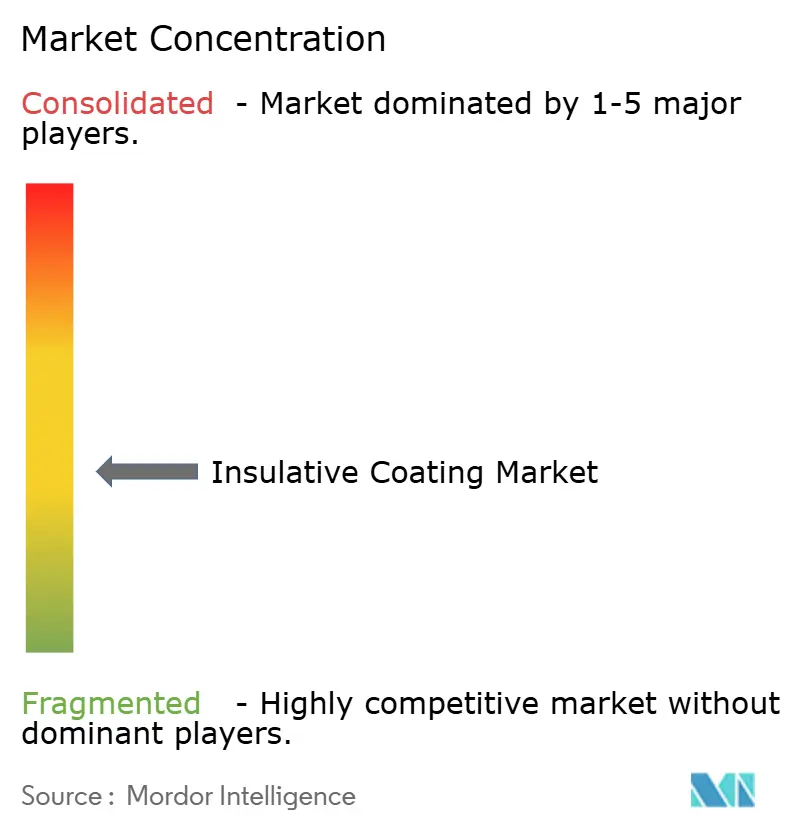
The competitive landscape is moderately fragmented, with key players like PPG, AkzoNobel, Sherwin-Williams, Hempel, and Jotun leveraging global distribution, application expertise, and regulatory knowledge to secure major contracts. Sustainability, particularly carbon footprint disclosures, increasingly influences tenders, prompting suppliers to launch life-cycle-assessment dashboards. Price competition is intense for standard acrylic and epoxy systems, but differentiated products achieve margins above 18%. Suppliers invest in installer training, digital tools, and asset-management platforms to monitor coating conditions. The market rewards firms balancing raw material cost control with technology investments and on-site application support, as the shift toward full-solution offerings blurs the line between product vendors and service providers.
Insulation Coating Industry Leaders
-
Akzo Nobel N.V.
-
PPG Industries, Inc.
-
The Sherwin-Williams Company
-
Kansai Paint Co., Ltd.
-
Jotun
- *Disclaimer: Major Players sorted in no particular order
Market Opportunities and Future Outlook
Near-term opportunity centers on performance-certified, spray-applied systems that replace or reduce conventional insulation on complex geometries while addressing CUI and maintenance access on industrial assets. Sherwin-Williams launch of Heat-Flex Advanced Energy Barrier (AEB) and PPG launch of PPG PITT-THERM 909 point to supplier focus on spray-on insulation for oil and gas and critical infrastructure, where downtime reduction and thinner systems can translate into more efficient installation and lifecycle outcomes. Advanced additives and new chemistries are also moving from pilot to commercialization when approvals clear: GMG cited U.S. EPA approval for THERMAL-XR sales in the United States, supporting applications in HVAC-R and industrial heat management where differentiated conductivity and corrosion performance can support premium pricing.
Building-envelope efficiency programs provide a second lane, especially for coatings positioned as reflective or low-emissivity complements to code-driven insulation upgrades. The California Energy Commission noted the 2025 Energy Code taking effect in January 2026 with increased energy-efficiency measures for new buildings and major renovations, while the EU’s recast Energy Performance of Buildings Directive maintains national pathways for minimum energy performance requirements tied to a zero-emission building stock by 2050. At the same time, upstream investment in feedstocks for high-performance coating systems supports supply availability and product development: BASF announced an October 2024 plan to expand Neopor capacity at Ludwigshafen by 50,000 metric tons per year (startup targeted for early 2027), and producers such as Covestro and KUMHO MITSUI CHEMICALS have disclosed capacity and network actions around MDI/HDI derivatives that support polyurethane and related coating technologies.
Recent Industry Developments
- June 2026: The Sherwin-Williams Company launched Heat-Flex Advanced Energy Barrier (AEB), a spray-applied insulative coating positioned to replace traditional mechanical insulation on assets such as tanks and piping. The product pitch focuses on simplifying insulation builds while reducing corrosion under insulation (CUI) risk, aligning with maintenance-led purchasing in oil and gas and process industries.
- July 2025: NCP Coatings acquired Glyptal Inc., expanding into insulating enamel technologies used in electric motors and transformers. The deal broadened capability in electrical insulation coatings, supporting access to industrial OEM and MRO channels where thermal and dielectric performance specifications are tightly controlled.
- August 2024: PPG Industries launched PPG PITT-THERM 909, a silicone-based spray-on insulation coating for high-heat environments in oil and gas and critical infrastructure, rated up to 500 degrees Fahrenheit. The launch reinforced competitive momentum in spray-applied insulation systems that target thinner profiles and faster installation compared with bulky insulation approaches.
Research Methodology Framework and Report Scope
Market Definition and Coverage
For this methodology, the insulation coating market covers coatings that are applied as a thin film to reduce heat transfer on assets such as pipes, tanks, equipment, and building surfaces, and they are counted in value terms in USD.
Scope exclusions: Conventional bulk insulation materials (for example boards, blankets, and wraps) and purely electrical varnishes are excluded.
Segmentation Overview
- By Product Type
- Acrylic
- Epoxy
- Polyurethane
- Yttria-Stabilized Zirconia
- Other Product Types (Aerogel-based, etc.)
- By End-User Industry
- Oil and Gas
- Chemical and Petrochemical
- Construction
- Automotive
- Marine
- Aerospace
- Other End-User Industries (Power Generation, etc.)
- By Geography
- Asia-Pacific
- China
- Japan
- India
- South Korea
- Rest of Asia-Pacific
- North America
- United States
- Canada
- Mexico
- Europe
- Germany
- France
- United Kingdom
- Italy
- Rest of Europe
- South America
- Brazil
- Argentina
- Rest of South America
- Middle East and Africa
- Saudi Arabia
- South Africa
- Rest of Middle East and Africa
- Asia-Pacific
Data Sources, Market Sizing, and Validation
Desk Research
Desk research was used to set the fact base for end-use demand signals, regional activity patterns, and realistic input ranges before we built the model. We referred to public sources such as the International Energy Agency for energy efficiency and fuel use signals, the US Energy Information Administration for industrial energy consumption trends, the US Census Bureau for construction spending indicators, and the World Bank for macro variables that influence project activity.
To avoid building the market only on macro trends, we also checked trade and manufacturing signals through sources such as UN Comtrade, relevant customs statistics, and technical literature indexed in platforms like Google Scholar for coating performance and use conditions. Company filings, investor presentations, and reputable press were used to map application areas and to sense-check pricing direction. In addition, a paid subscription for company financials and an import export shipment-level database were used selectively to confirm supplier presence and cross-border movement patterns. This list is illustrative, and many other sources were also used for data collection, validation, and clarification.
Primary Interviews and Surveys
Primary work was done through expert interviews and structured surveys with a mix of coating manufacturers, raw material participants, distributors, applicators, and large end users in industries such as oil and gas, power, and construction. Since this is a global market, we covered demand and supply views across APAC, EMEA, and the Americas so that assumptions like application intensity, replacement cycles, and pricing could be tightened and then rechecked.
Distribution of primary research fieldwork respondents
| Company type | Respondent position | Region |
|---|---|---|
| Top tier: 25% | CXOs: 15% | APAC: 43% |
| Mid tier: 56% | Functional/Unit leaders: 25% | EMEA: 30% |
| Smaller Players: 19% | Managers: 60% | Americas: 27% |
Market-Sizing & Forecasting
Market sizing was built using a top-down approach where industrial activity and construction indicators are used to reconstruct the demand pool for insulation coatings by region, and then converted into value using realistic adoption and pricing assumptions. To keep the output practical, the model leans on variables that can be tracked year to year, such as oil and gas maintenance activity, refinery and power plant operating levels, new build and retrofit construction momentum, insulation coating application intensity by asset type, and average selling price movement by coating chemistry.
After the first pass totals were formed, selective bottom-up approximations were used to check if the numbers were reasonable, and then adjustments were made where needed. These checks included sampling supplier revenue exposure to insulation coating lines, distributor channel feedback on volume direction, and a simple ASP times volume logic for a few high-use applications like piping and tanks. Where direct volume proxies were thin in a country, we filled gaps by using regional averages that were corrected using local industrial output and construction spending, and then confirmed through follow-up primary feedback.
For forecasting, we used scenario analysis supported by multivariate regression outputs for key demand drivers, so the outlook does not move only with GDP. The final forecast path was shaped by the primary consensus on how fast energy efficiency retrofits, industrial maintenance cycles, and high-temperature process investments are expected to progress.
Data Validation & Update Cycle
Validation was done in layers so outliers were not pushed into the final numbers without explanation. Model outputs were compared against independent signals like regional construction direction, industrial energy use trends, and trade movement for relevant coating inputs, and then any large variances were reviewed by a second analyst before sign-off.
When a gap stayed large, we rechecked assumptions like adoption rates, price progression, or the split between new build and maintenance use, and then re-contact was triggered with respondents to confirm what changed. Reports are refreshed annually, and interim updates are made when material events occur, such as major regulatory changes or sharp raw material price swings. Before delivery, a fresh pass is completed so clients receive the latest updated view.
Mordor Intelligence's Insulation Coating Market Size Versus Other Published Estimates
Published market sizes for insulation coatings can look different even when they sound like they cover the same thing, because each publisher draws the line around products and applications in its own way. Differences also show up when the base year is not the same, when the price build is handled differently, or when currency conversion timing is not clearly stated.
Key gap drivers for this market usually come down to what is counted as an insulation coating versus adjacent coatings, whether bulk insulation materials are accidentally blended into the value, and how much of construction and industrial maintenance demand is assumed to adopt coating solutions. Pricing is another big driver because some estimates apply one blended global price, which can miss regional mixes between low temperature building uses and high temperature industrial uses, followed by differences in refresh cadence that may not capture recent changes in industrial activity.
Benchmark comparison
| Source | Market Size | Gaps in Research Methodology |
|---|---|---|
| Mordor Intelligence | USD 12.31 B (2026) | |
| Global Consultancy A | USD 11.50 B (2025) | Uses a different base year and a longer forecast window, and the scope description suggests a broader bundle across coating functions, which can shift what is counted as insulation coating revenue. |
| Industry Research Publisher B | USD 10.45 B (2024) | Focuses on thermal insulation coatings with product based segmentation and may apply more generalized pricing and adoption assumptions across applications, which can pull the market total lower for years with weaker industrial project cycles. |
Energy-efficiency and industrial operating signals, followed by application-level checks from primary conversations, are what keep Mordor Intelligence's estimate aligned to insulation coatings used on pipes, tanks, equipment, and building surfaces rather than adjacent materials. Looking across the three figures, the spread is mainly explained by base year choices and how tightly the product boundary is held, which is why we keep the steps and inputs easy to trace and repeat.
Key Questions Answered in the Report
What is the current Insulation Coating Market size?
The market was valued at USD 12.31 billion in 2026 and is forecast to reach USD 17.31 billion by 2031.
Which region leads the insulative coating market?
Asia-Pacific leads with 46.88% share in 2025 and is the fastest growing at an 7.86% CAGR through 2031.
Which product type dominates sales?
Acrylic formulations held 34.72% revenue share in 2025 due to versatility and cost efficiency.
Why are building-energy codes important for demand?
New rules such as the 2024 IECC mandate higher R-values, driving increased use of performance-certified insulative coatings to meet compliance.