
Information Security Consulting Market Size and Share
Market Overview
| Study Period | 2023 - 2031 |
|---|---|
| Market Size (2026) | USD 32.61 Billion |
| Market Size (2031) | USD 53.44 Billion |
| Growth Rate (2026 - 2031) | 10.39% CAGR |
| Fastest Growing Market | Asia Pacific |
| Largest Market | North America |
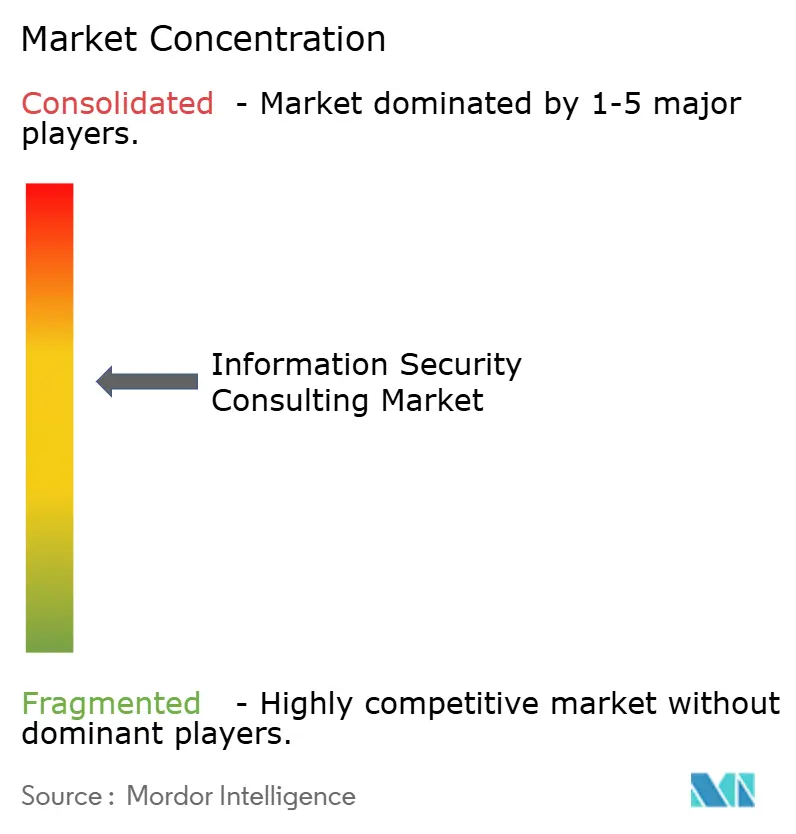
| Market Concentration | Medium |
Major Players *Disclaimer: Major Players sorted in no particular order Image © Mordor Intelligence. Reuse requires attribution under CC BY 4.0. | |
Information Security Consulting Market Analysis by Mordor Intelligence
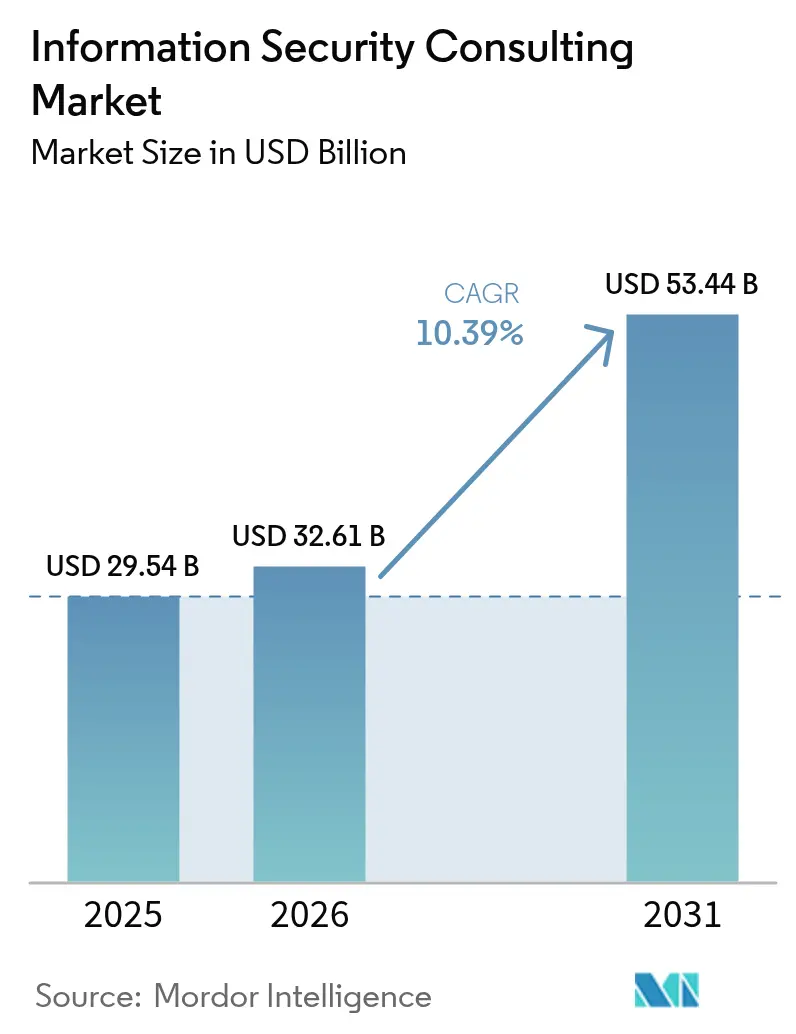
The information security consulting market size was valued at USD 29.54 billion in 2025 and estimated to grow from USD 32.61 billion in 2026 to reach USD 53.44 billion by 2031, at a CAGR of 10.39% during the forecast period (2026-2031). Heightened attack sophistication, far-reaching regulatory mandates, and hybrid work environments continue to shift spending from reactive breach response toward proactive threat intelligence, zero-trust design, and risk management advisory. Demand intensifies as artificial intelligence-enabled attacks, looming quantum risks, and sprawling multi-cloud estates outpace the in-house expertise of most enterprises. Strategic alliances between consultants and technology vendors accelerate platform-enabled service delivery, allowing firms to bundle assessment, implementation, and managed detection capabilities in a single engagement. At the same time, buyers increasingly favor outcome-based contracts that promise measurable reductions in dwell time, breach cost, and compliance exposure.
Key Report Takeaways
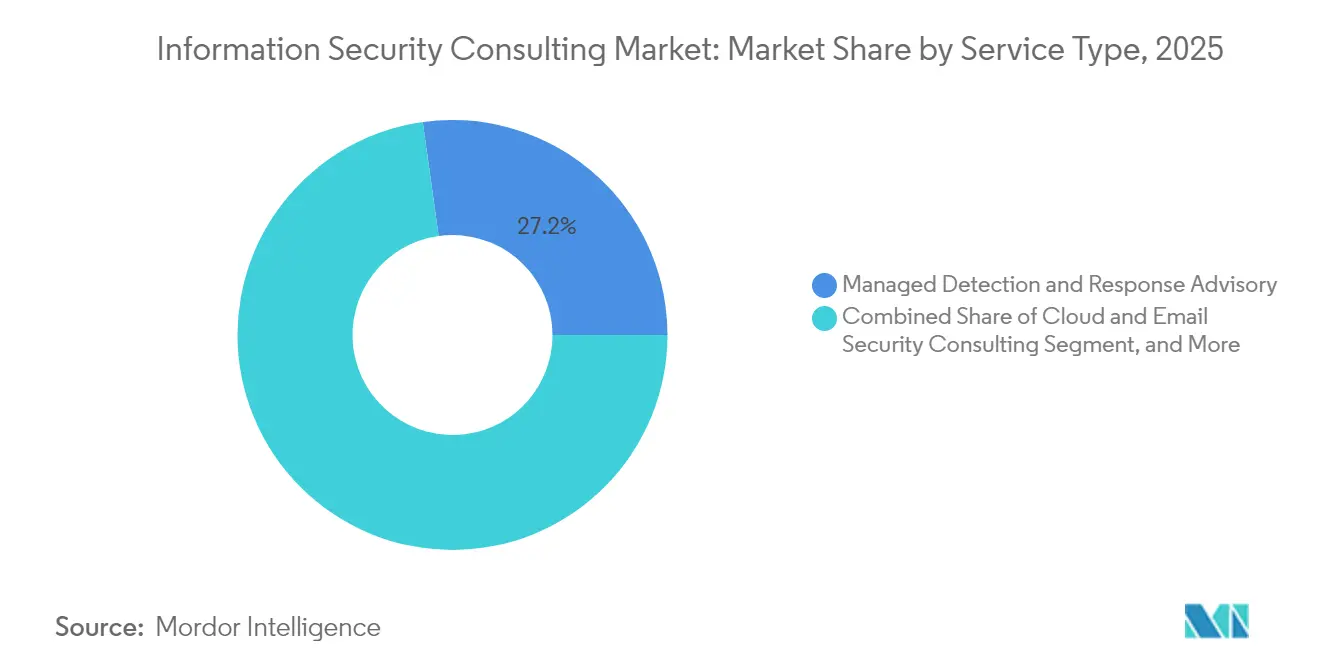
- By service type, managed detection and response advisory led with 27.21% information security consulting market share in 2025, while Cloud and Email Security consulting is advancing at a 10.66% CAGR through 2031.
- By deployment mode, cloud delivery accounted for 61.05% of the information security consulting market size in 2025 and is expanding at an 11.34% CAGR to 2031.
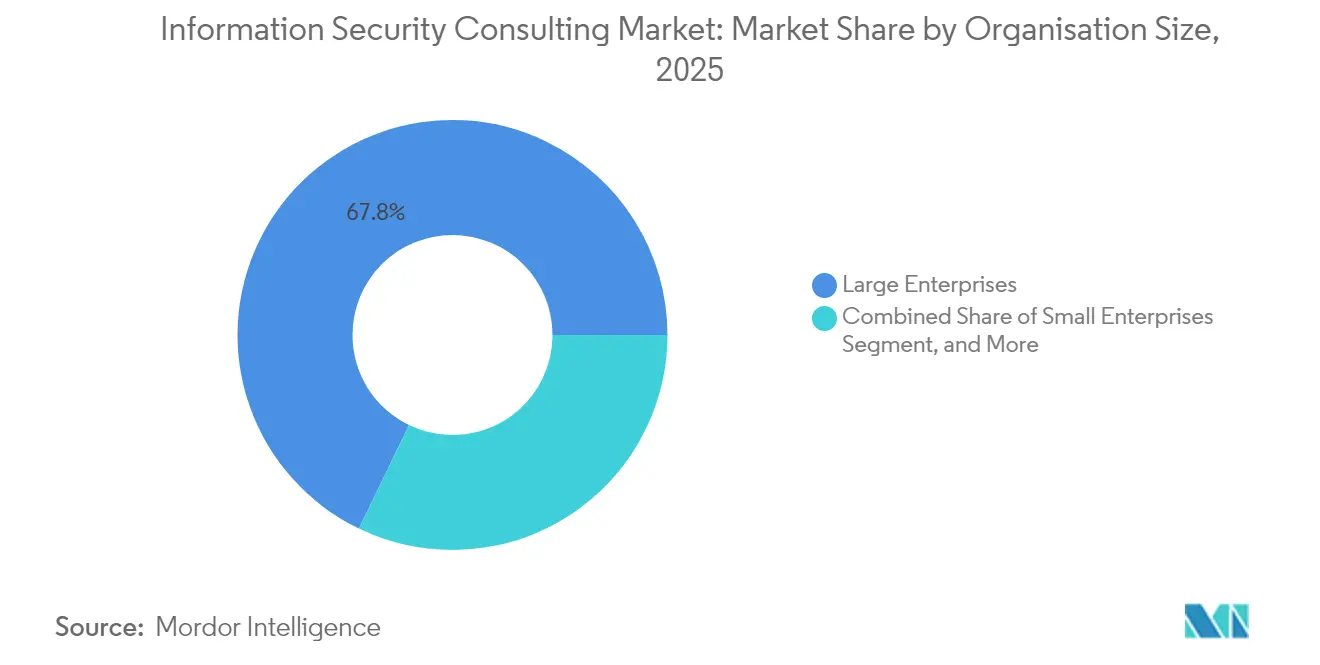
- By organization size, large enterprises commanded 67.84% share of the information security consulting market size in 2025; small and medium enterprises are pacing the field with an 11.28% CAGR through 2031.
- By vertical, BFSI held 24.41% revenue share in 2025 in the information security consulting market; healthcare and life sciences is forecast to expand at a 10.71% CAGR between 2026 and 2031.
- By geography, North America retained 39.55 of % information security consulting market share in 2025, while the Asia-Pacific is projected to post the fastest 10.90% CAGR to 2031.
Note: Market size and forecast figures in this report are generated using Mordor Intelligence’s proprietary estimation framework, updated with the latest available data and insights as of 2026.
Global Information Security Consulting Market Trends and Insights
Drivers Impact Analysis*
| Driver | (~) % Impact on CAGR Forecast | Geographic Relevance | Impact Timeline |
|---|---|---|---|
| Rising network and cloud complexities | +2.8% | Global, strongest in North America and EU | Medium term (2-4 years) |
| Escalating regulatory and compliance mandates | +2.1% | EU, North America, Asia-Pacific core markets | Long term (≥ 4 years) |
| Accelerated digital transformation and hybrid work adoption | +1.9% | Global, emerging-market acceleration | Short term (≤ 2 years) |
| GenAI safety and model governance advisory demand | +1.7% | North America, EU, spillover to APAC | Medium term (2-4 years) |
| Cyber-insurance underwriting requirements for SMEs | +1.4% | North America, EU, Australia | Short term (≤ 2 years) |
| Quantum readiness and post-quantum cryptography migration | +0.7% | Global, early uptake in government and finance | Long term (≥ 4 years) |
| Source: Mordor Intelligence | |||
Rising Network and Cloud Complexities
Sprawling multi-cloud estates, identity sprawl, and API interconnections multiply blind spots that traditional perimeter safeguards miss, fuelling premium demand for architects who can implement zero-trust frameworks and cloud-native controls. Advisory engagements increasingly bundle continuous posture management, workload segmentation, and DevSecOps enablement so clients can remediate misconfigurations before attackers exploit them. Deloitte’s MDR expansion illustrates how integrators pair consulting with always-on monitoring to shrink detection backlogs and reduce incident cost. Industrial IoT rollouts compound the complexity problem as operational-technology devices ship without embedded security, requiring consultants to converge IT and OT defenses. With cloud security projected to grow more than 25% annually through 2027, advisory partners that master container hardening, serverless protection, and platform automation secure first-mover advantage.[1]European Union Agency for Cybersecurity, “Cybersecurity Investments 2024,” enisa.europa.eu
Escalating Regulatory and Compliance Mandates
The European Union’s NIS2 Directive and Digital Operational Resilience Act jointly extend cybersecurity obligations to more than 100,000 entities, mandating incident reporting inside 24 hours and imposing stiff penalties for non-compliance. Organizations straddling multiple jurisdictions require gap assessments, remediation roadmaps, and automated evidence gathering to satisfy both frameworks without duplicating cost. Financial institutions face dual filings where DORA and NIS2 overlap, sharpening demand for advisory playbooks that reconcile encryption, logging, and third-party oversight provisions.[2]Vanta, “DORA and NIS 2 Explained,” vanta.com Outside Europe, the U.S. Securities and Exchange Commission’s cyber-disclosure rule and Australia’s critical-infrastructure reforms have similar ripple effects, pushing boards to seek independent assurance and continuous attestation services. As legislators revisit privacy, AI, and critical-supply-chain statutes, compliance complexity will remain a long-term growth flywheel for the information security consulting market.
Accelerated Digital Transformation and Hybrid Work Adoption
Hybrid work dissolves fixed perimeters and forces enterprises to elevate identity as the new control plane. Consulting demand surges for zero-trust strategy design, privileged-access cleanup, and high-assurance authentication rollouts that span SaaS, on-premises, and mobile users. Boards increasingly request KPI-driven metrics, such as lateral-movement dwell time or credential-stuffing success rate, when approving transformation budgets, placing added pressure on advisers to quantify risk reduction. Organizational change management emerges as a critical success factor; consultants must re-engineer processes so distributed workforces uphold least-privilege, resiliency, and data-residency mandates simultaneously. The information security consulting market thereby shifts from technology blueprints to holistic operating-model realignment that embeds security guardrails into DevOps, finance, and HR workflows.
GenAI Safety and Model Governance Advisory Demand
Enterprises racing to embed generative AI into products discover new threats: prompt injection, training-set poisoning, and model output manipulation. Consulting teams now blend data-science, privacy, and threat-hunting skills to craft AI-security frameworks covering model lifecycle, supply-chain vetting, and bias mitigation. A 2025 collaboration among Google, Microsoft, and the Polish government underscores the public-sector push to operationalize AI securely, opening doors for consultants versed in national-security standards. Advisory briefs increasingly include red-team simulations against large-language models and policy templates that align algorithmic decision-making with sector-specific regulations such as HIPAA or PSD2. As vendors release AI-enabled security operations platforms, consultants pivot to outcome-oriented service-level agreements that tie model-risk reductions to business KPIs, deepening recurring-revenue streams within the information security consulting market.
Restraints Impact Analysis*
| Restraint | (~) % Impact on CAGR Forecast | Geographic Relevance | Impact Timeline |
|---|---|---|---|
| Budget constraints among SMEs | -1.8% | Global, highest in emerging markets | Short term (≤ 2 years) |
| Shortage of qualified security talent | -1.2% | Global, acute in specialist domains | Medium term (2-4 years) |
| Tool-sprawl fatigue driving vendor consolidation | -0.9% | North America, EU mature markets | Medium term (2-4 years) |
| Rising liability exposure deterring smaller consultancies | -0.6% | North America, EU, Australia | Long term (≥ 4 years) |
| Source: Mordor Intelligence | |||
Budget Constraints among SMEs
Regulatory expansion pushes smaller firms to seek guidance, yet 34% of respondents in a 2024 ENISA study lacked funds to implement even basic NIS2 controls. To bridge that gap, advisers roll out subscription-based compliance-as-a-service bundles combining baseline assessments, virtual CISO hours, and automated evidence capture at predictable monthly rates. SaaS pricing lowers entry barriers, but margin pressure rises as consultancies absorb tooling and talent costs. Governments in Canada, Singapore, and Germany partially offset the restraint through tax incentives and matching grants, yet access varies widely, leaving emerging-market SMEs most vulnerable. Over the next two years, vendors that refine repeatable playbooks and leverage AI co-pilots for documentation stand to unlock underserved micro-segments of the information security consulting market.
Shortage of Qualified Security Talent
By 2025, global unfilled cyber positions exceed 4 million, with specialist gaps in cloud forensics, quantum-safe cryptography, and operational-technology defense. Consulting firms compete directly with hyperscalers and fintechs, forcing them to double intern cohorts, subsidize advanced certifications, and roll out skill-share alliances with universities. Talent scarcity lengthens engagement timelines and inflates day-rates, complicating fixed-fee bids. To counter headcount bottlenecks, leading advisers embed playbook automation, reusable infrastructure-as-code templates, and AI-driven control verifiers, enabling junior analysts to handle tasks once reserved for senior architects. While these strategies soften supply constraints, the talent gap will continue to shave roughly 1.2 percentage points off the long-run CAGR of the information security consulting market.
*Our forecasts treat driver/restraint impacts as directional, not additive. The impact forecasts reflect baseline growth, mix effects, and variable interactions.
Segment Analysis
By Service Type: MDR Advisory Dominates Amid Cloud-Security Surge
Managed Detection and Response advisory captured 27.21% information security consulting market share in 2025, reflecting client preference for outcome-based engagements that bundle 24×7 monitoring, threat hunting, and incident-response playbooks. The segment benefits from ransomware’s persistence, insurance demands for continual surveillance, and board-level pressure to demonstrate time-to-contain KPIs. MDR advisers increasingly integrate backup immutability, automated isolation, and forensic triage to shorten response cycles and prove return on investment. Conversely, standalone firewall or network-hardening projects face commoditization as cloud platforms embed baseline controls. Cloud and Email Security consulting, projected to grow at 10.66% annually, capitalizes on identity sprawl, misconfigured storage buckets, and business-email compromise attacks that proliferate in remote-work settings. Consultants differentiating through DevSecOps enablement, API visibility, and context-rich phishing simulations secure larger share-of-wallet. Governance, Risk, and Compliance retains stable demand as overlapping statutes multiply; however, forward-leaning firms now wrap continuous control monitoring and regulatory change-tracking into retainer contracts, creating stickier revenue. Finally, emerging sub-segments such as quantum-readiness, OT threat modeling, and AI-safety governance offer premium margins but require scarce expertise, positioning early movers to outperform the broader information security consulting market.


By Deployment Mode: Cloud Supremacy Accelerates Platform Consolidation
Cloud deployments accounted for 61.05% of the information security consulting market size in 2025 and are projected to expand at an 11.34% CAGR through 2031 as enterprises re-platform ERP, analytics, and dev environments. Consultants with deep hyperscaler alliances help clients align native security-reference architectures, identity governance, and workload segmentation, slashing time-to-production. Data-residency mandates and latency-sensitive OT workloads sustain a residual on-premises niche, yet even those projects increasingly embed cloud-delivered analytics and backup. Hybrid deployments therefore evolve toward unified control planes where cloud security posture management dashboards ingest signals from legacy firewalls, CASBs, and endpoint-detection agents. This convergence drives vendor consolidation: buyers favor advisers who prescriptively rationalize overlapping toolsets and streamline license portfolios. As a result, the information security consulting market gravitates toward multi-year transformation roadmaps that blend migration planning, control orchestration, and managed operations under shared success metrics.
By Organization Size: Enterprise Dominance Masks SME Growth Acceleration
Large enterprises remained the single largest client group at 67.84% in 2025, sustaining complex programs that span zero-trust blueprints, red-team testing, and supply-chain assurance. They routinely engage global consultancies capable of coordinating regulatory harmonization, multi-cloud telemetry integration, and continuous control validation across hundreds of subsidiaries. However, SMEs represent the fastest-expanding cohort, posting an 11.28% CAGR as cyber-insurance underwriting clauses mandate formal risk assessments, privileged-access baselines, and incident-response runbooks. To serve price-sensitive buyers, advisers deploy templated policy libraries, virtual audit rooms, and AI-assisted questionnaire auto-fill that compress delivery cost without diluting quality. Medium-sized firms sit at the innovation frontier: they pilot secure-coding guilds, infrastructure-as-code security gates, and usage-based MDR subscriptions before such models scale upward. Across all tiers, outcome-based fee structures tied to audit-finding closure rates and SLA adherence gain popularity, reshaping cash-flow profiles within the information security consulting market.
By End-User Vertical: Healthcare Disruption Challenges BFSI Leadership
Financial-services clients held a 24.41% revenue share in 2025, underpinned by payment-system criticality, strict supervisory stress tests, and mandatory 24-hour incident reporting. Banks demand layered controls, transaction integrity monitoring, fraud analytics, and quantum-safe key management, creating annuity-like consulting pipelines. Yet healthcare’s 10.71% CAGR through 2031 marks the sector as the most lucrative expansion arena. Hospitals grapple with Internet-connected diagnostic equipment, electronic-health-record interoperability, and ransomware that threatens patient safety, compelling boards to enlist advisers fluent in HIPAA, FDA premarket guidance, and medical-device hardening. Telecommunications, government, and energy operators likewise seek sector-specific blueprints: 5G core slicing security, classified-network segmentation, and substation anomaly detection, respectively. Consultants able to tailor control catalogs and threat models to each domain earn premium bill rates, advancing the competitive stratification of the information security consulting market.
Geography Analysis
North America retained 39.55% information security consulting market share in 2025, buoyed by mature enterprise budgets, a USD 13 billion federal civilian-cyber allocation, and an active venture-capital pipeline that catalyzes start-up partnerships. U.S. critical-infrastructure mandates and Canada’s national quantum-strategy funding channel sustained demand for post-quantum readiness and operational-technology segmentation projects. Cross-border data-flow agreements, such as the U.S.-EU Data Privacy Framework, further elevated advisory revenue as multinationals sought harmonized compliance roadmaps.
Asia-Pacific is forecast to post an 10.90% CAGR through 2031, reflecting digital-government initiatives, 5G rollouts, and heightened nation-state threats. Japan’s active-defense doctrine and record cyber budget expand the addressable consulting pool for incident-readiness, while India’s Digital Personal Data Protection Act fuels demand for privacy-impact assessments and data-localization strategies. Australia’s updated Critical Infrastructure Act widens coverage to more than 11 sectors, prompting small utilities and ports to solicit outsourced CISO services. Rapid cloud adoption across Southeast Asia simultaneously amplifies advisory needs for identity federations, workload encryption, and regional SOC integration.
Europe maintains steady momentum as NIS2 and DORA propel multi-year compliance roadmaps; more than 100,000 entities must re-architect governance, risk, and third-party oversight programs, ensuring robust consulting pipelines. Germany’s subsidized cyber-resilience grants and France’s post-ransomware hospital funding open fresh vertical niches. Meanwhile, Central and Eastern Europe benefit from substantial technology investments: Google and Microsoft pledged significant capital to Polish cyber-ecosystem development, creating spillover opportunities for local and international advisers. Although South America and the Middle East and Africa presently capture smaller revenue pools, aggressive digitalization plans in Brazil, Saudi Arabia, and Kenya, including sovereign cloud projects and smart-city rollouts, set the stage for above-average consulting spend once economic conditions stabilize. Together, these regional dynamics underscore the globally distributed yet locally nuanced growth profile of the information security consulting market.


Regulatory Landscape
Cybersecurity consulting demand is tightly coupled to fast-evolving disclosure, resilience, and product-security rules that raise documentation, testing, and continuous control monitoring requirements. In the United States, the SEC cybersecurity disclosure rules (Form 8-K Item 1.05) require public companies to disclose material cybersecurity incidents within four business days of determining materiality, pushing boards to formalize incident materiality processes, evidence capture, and communications playbooks that consultants design and rehearse.
Value Chain Analysis
The information security consulting value chain starts with demand signals from boards, CISOs, risk owners, and regulators, then moves through solution design (risk assessment, architecture, and compliance mapping), implementation (identity, cloud, and endpoint controls), and ongoing operations (managed detection and response advisory, continuous control monitoring, and incident readiness). Service delivery is anchored by global consultancies and systems integrators (for multi-country programs and large transformations), specialized boutiques (for niches such as OT security, medical-device hardening, or quantum readiness), and MSSPs that operationalize monitoring and response. Technology vendors and hyperscalers sit upstream as tool and telemetry providers, while procurement, cyber-insurance underwriting requirements, and third-party risk programs shape buying cycles and scope.
Key handoffs and bottlenecks cluster around data access and telemetry integration across multi-cloud and legacy estates, talent availability in specialist domains, and third-party dependencies in supply chains and IT/OT environments. As buyers push consolidation to reduce tool sprawl, consultancies increasingly package advisory with platform-enabled delivery via alliances, including integrations for threat intelligence feeds, backup immutability, and cloud-native controls, so assessments convert into implementable roadmaps and measurable operational outcomes. That approach also heightens the need for repeatable playbooks, automation for evidence capture, and standardized control libraries to balance large-enterprise complexity with SME budget constraints.
Competitive Landscape
The information security consulting market is highly fragmented, with more than 600 firms marketing managed detection and response offerings that range from true 24×7 analyst services to re-branded tooling. Global systems integrators, Accenture, IBM, Deloitte, PwC, and KPMG, anchor the upper tier through multi-disciplinary practices, proprietary threat-intelligence units, and global delivery centers. Yet specialized boutiques thrive by focusing on sector niches such as medical-device security, OT threat modeling, or quantum-readiness assessments, often capturing Fortune 1000 logos through demonstrable depth rather than breadth.
Strategic technology alliances define the current competitive battleground. NTT DATA’s expanded Rubrik partnership integrates immutable backup and ransomware containment into consulting playbooks, offering clients implementation plus ongoing recovery orchestration in a single statement of work. Protiviti’s integration of CYFIRMA threat intelligence feeds into its risk dashboards exemplifies the pivot toward platform-enabled advisory powered by external telemetry. Similarly, BlueVoyant’s cloud-native cyber-defense platform underpins its Japanese expansion via a reseller agreement with Marubeni, illustrating how partnerships accelerate in-region credibility.
Automation and AI differentiate emerging disruptors that promise rapid control validation, continuous compliance evidence gathering, and real-time risk scoring. Established firms counter by injecting machine-aided content generation for policy libraries and deploying low-code connectors to unify disparate telemetry sources. As buyers demand measurable outcomes, reduction in mean-time-to-detect, policy-exception closure, insurance-premium discounts, competition shifts away from hourly billing toward milestone-based or shared-risk pricing. Looking forward, white-space opportunities in AI model-red-team engagements, quantum-risk migration, and supply-chain software bill-of-materials assurance will favor consultancies that develop scarce skill sets early, reinforcing the dynamism of the information security consulting market.
Information Security Consulting Industry Leaders
Ernst & Young Global Limited
International Business Machines Corporation
Accenture PLC
Atos SE
Wipro Limited
- *Disclaimer: Major Players sorted in no particular order

Market Opportunities and Future Outlook
Product-security and vulnerability-management advisory is expanding as regulations and standards move security obligations upstream into software and device lifecycles. The EU Cyber Resilience Act (entered into force 10 December 2024) introduces timelines in 2026 that bring conformity-assessment readiness and vulnerability reporting processes into focus, including provisions applying from 11 June 2026 and reporting obligations applying as of 11 September 2026. This creates concrete whitespace for consultants that can operationalize secure development practices, SBOM governance, coordinated vulnerability disclosure workflows, and audit-grade evidence across complex supplier ecosystems.
Critical-infrastructure governance and public-sector readiness programs are also creating near-term, contractable demand for consulting partners that can deliver governance frameworks, capacity building, and measurable resilience outcomes. Examples include the White House issuing NSPM-12 in June 2026 to set minimum requirements for cryptology in national security systems, and the Gold Eagle Initiative launched in July 2026 to coordinate vulnerability management across critical infrastructure. On the procurement side, SONI (Northern Ireland) initiated a Cyber Security Governance Partner contract spanning July 2026 to June 2027, and Ohio scheduled the start of CyberSECURE Program Centers in September 2026 to provide assessment, consulting, and training to small businesses, signaling funded pathways for providers with packaged services for SMEs and regional ecosystems.
Recent Industry Developments
- July 2026: Accenture signed a multi-year contract with the NATO Communications and Information Agency for the Protected Business Network program. The deal ties cybersecurity services to large-scale defense digital infrastructure modernization, reinforcing demand for long-duration, outcome-driven consulting and managed delivery capabilities.
- June 2026: Accenture announced strategic acquisitions of Dragos, runZero, and NetRise to expand OT security and cyber asset intelligence capabilities. The move broadens Accenture's ability to pair consulting with specialized software for industrial and critical-infrastructure environments.
- November 2024: Accenture expanded its generative AI-powered cybersecurity services and capabilities. The update strengthened packaged offerings that blend advisory with AI-enabled delivery, supporting faster risk assessments, control validation, and SOC workflow modernization.


Research Methodology Framework and Report Scope
Market Definition and Coverage
This market covers professional services where a third party advises, assesses, designs, and supports programs that reduce cyber risk for organizations, and the revenue is counted when the work is delivered under a consulting engagement.
Scope exclusions: This sizing does not count pure hardware or software product sales, and it also excludes outsourcing style managed security operations that are priced and delivered as ongoing monitoring services.
Segmentation Overview
- By Service Type
- Governance, Risk and Compliance (GRC) Consulting
- Firewall and Network Security Consulting
- Cloud and Email Security Consulting
- Identity and Access Management Consulting
- Penetration Testing and Vulnerability Assessment
- Incident Response and Digital Forensics
- Managed Detection and Response Advisory
- Other Service Types
- By Deployment Mode
- On-Premises
- Cloud
- Hybrid
- By Organization Size
- Small Enterprises
- Medium Enterprises
- Large Enterprises
- By End-user Vertical
- Banking, Financial Services and Insurance (BFSI)
- IT and Telecommunications
- Government and Defense
- Healthcare and Life Sciences
- Retail and E-Commerce
- Manufacturing and Industrial
- Energy and Utilities
- Other End-user Verticals
- By Geography
- North America
- United States
- Canada
- South America
- Brazil
- Argentina
- Rest of South America
- Europe
- Germany
- United Kingdom
- France
- Italy
- Spain
- Netherlands
- Rest of Europe
- Asia-Pacific
- China
- Japan
- India
- South Korea
- Australia and New Zealand
- Rest of Asia-Pacific
- Middle East and Africa
- Middle East
- Saudi Arabia
- United Arab Emirates
- Rest of Middle East
- Africa
- South Africa
- Nigeria
- Rest of Africa
- Middle East
- North America
Data Sources, Market Sizing, and Validation
Desk Research
Desk research starts by mapping how security consulting demand is created inside customer budgets, and then linking it to measurable activity signals. We reviewed public indicators such as NIST publications, CISA advisories, FCC cyber-related actions for telecom, and ENISA threat landscape outputs to understand what drives advisory and assessment needs. For spending context, we also referred to sources such as U.S. Bureau of Labor Statistics data on security-related roles, SEC filings and investor decks for listed service providers, and association materials from groups such as ISACA.
To translate these signals into a usable model, we used public pricing cues, service mix descriptions, and typical engagement structures found in annual reports and reputable press coverage. In a few places, paid subscriptions for company financials and patent databases were used to validate provider footprints and capability expansion, and then these inputs were checked against what interviewees report from live deals. This source list is illustrative, and many other public documents and datasets were also consulted to fill gaps and confirm assumptions.
Primary Interviews and Surveys
Primary work focused on validating what is actually billed as consulting versus adjacent delivery work, and how demand is shifting by industry and region. We spoke with a mix of security advisors, practice leaders, delivery managers, and buyers from regulated industries to confirm service mix, deal sizes, and typical project duration. Since this is a global market, perspectives were balanced across APAC, EMEA, and the Americas so regional differences in compliance pressure and cloud adoption could be reflected in the final numbers.
Distribution of primary research fieldwork respondents
| Company type | Respondent position | Region |
|---|---|---|
| Top tier: 31% | CXOs: 13% | APAC: 46% |
| Mid tier: 50% | Functional/Unit leaders: 37% | EMEA: 34% |
| Smaller Players: 19% | Managers: 50% | Americas: 20% |
Market-Sizing & Forecasting
The core build uses a top-down approach where overall security services demand is reconstructed from enterprise IT and risk spending signals, and then filtered into consulting share using service mix splits confirmed in interviews. To keep it grounded, the totals were cross-checked with selective bottom-up approximations, including sampled provider revenue roll-ups, typical engagement pricing, and volume proxies such as counts of compliance projects and cloud migration security programs.
Inputs that meaningfully move the model include the pace of cloud adoption that triggers architecture reviews, the frequency of incident response retainers shifting into advisory work, audit and compliance cycles (for example, privacy and sector rules), penetration testing and vulnerability assessment volumes, and average consulting day rates by region and seniority. Where a bottom-up view was incomplete for smaller firms, we used gap-fills based on comparable service intensity per customer cohort and then re-checked the implied revenue per consultant against public labor and utilization signals.
Forecasting is handled through scenario analysis supported by light regression on macro and security drivers, such as digital transformation intensity, regulatory enforcement momentum, and breach disclosure trends, and then refined with expert views on how service mixes and pricing are likely to change. The result stays explainable, because each growth lever ties back to a visible demand trigger and a practical revenue translation.
Data Validation & Update Cycle
Outputs are validated through consistency checks across regions and service types, and then compared against independent signals like headcount trends, utilization cues, and large deal activity seen in public announcements. When sharp jumps appear, the assumptions are revisited, and respondents are re-contacted to confirm whether it is a real market shift or a modeling artifact.
Before sign-off, the model goes through multi-step analyst reviews that test math integrity, year-over-year movements, and whether the implied pricing and volumes remain realistic. Reports are refreshed annually, and interim updates are triggered when there are material events such as major regulatory changes, a step-change in breach activity, or a visible shift in consulting-to-managed service packaging. Right before delivery, a final pass is done so clients receive an updated view using the latest available inputs.
Mordor Intelligence's Information Security Consulting Market Estimate Compared With Other Published Estimates
Published market values for information security consulting rarely match, because the line between advisory work and ongoing operational security services is drawn differently, and the starting year and currency timing also vary. Differences also come from how firms treat bundled contracts, where a single deal can include assessment, implementation, and long-run monitoring.
Managed security services (like MDR subscriptions) sit outside Mordor Intelligence's scope, which tightens the demand pool to consulting-led revenue tied to assessments, design, compliance support, and project-based advisory, and that single inclusion rule explains a large part of the spread you see across published totals.
Benchmark comparison
| Source | Market Size | Gaps in Research Methodology |
|---|---|---|
| Mordor Intelligence | USD 32.61 B (2026) | |
| Trade Press Release A | USD 22.55 B (2024) | Uses an earlier base year and appears to mix advisory with broader security services narratives, and the scope details are not clearly specified which can compress or inflate the figure depending on interpretation. |
| Industry Publisher B | USD 38.83 B (2025) | Positions the market on a different base year and may include a wider set of delivery-led security service revenues packaged alongside consulting, and the split between project work and ongoing services is not transparent. |
The table shows that timing and service scope are the two practical reasons the numbers move. When consulting is separated from ongoing monitoring contracts, and when year selection and currency handling are kept consistent, the final size stays easier to replicate and to sanity-check against real engagement volumes and pricing.


Key Questions Answered in the Report
What is the current value of the information security consulting market?
The information security consulting market size is USD 32.61 billion in 2026, on track to reach USD 53.44 billion by 2031.
Which service line generates the highest revenue?
Managed Detection and Response advisory holds the lead with 27.21% market share in 2025.
Which region is growing fastest in consulting demand?
Asia-Pacific is forecast to expand at an 10.90% CAGR through 2031, outpacing all other regions.
How is cloud adoption influencing consulting engagements?
Cloud deployments already account for 61.05% of industry revenue and drive requests for multi-cloud posture management, container security, and zero-trust design.
Why are SMEs investing more in external security advice?
Cyber-insurance underwriting and expanding regulations such as NIS2 compel SMEs to adopt formal risk assessments and incident-response plans, fueling an 11.28% CAGR in SME consulting spend.
Page last updated on:






