
Market Overview
| Study Period | 2021 - 2031 |
|---|---|
| Market Size (2026) | USD 81.21 Billion |
| Market Size (2031) | USD 101.40 Billion |
| Growth Rate (2026 - 2031) | 4.54 % |
| Fastest Growing Market | Middle East and Africa |
| Largest Market | Asia Pacific |
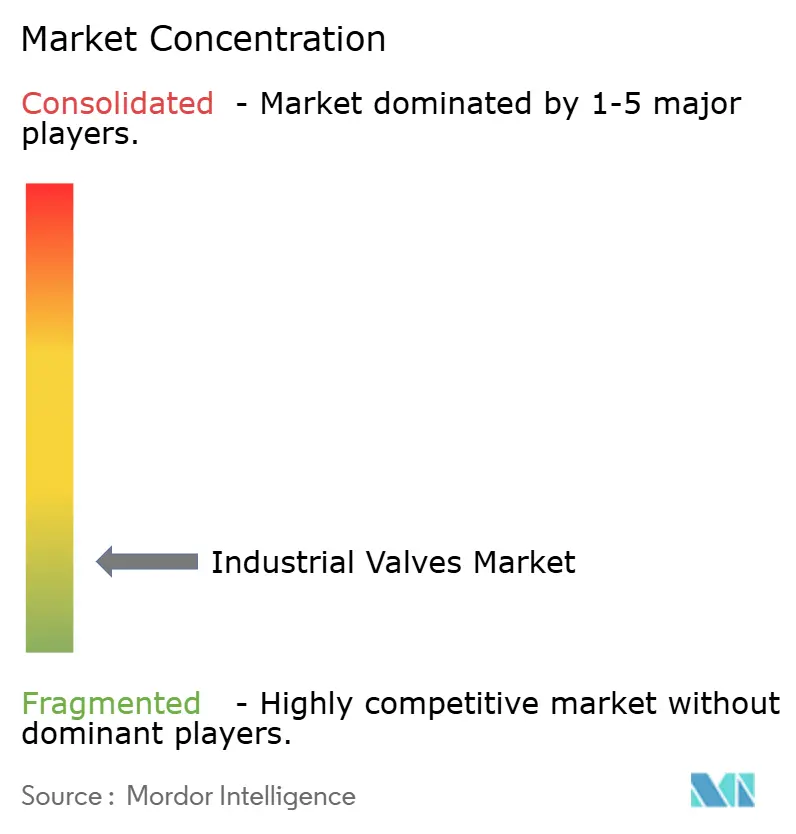
| Market Concentration | Low |
Major Players *Disclaimer: Major Players sorted in no particular order Image © Mordor Intelligence. Reuse requires attribution under CC BY 4.0. | |
Industrial Valves Market Analysis by Mordor Intelligence
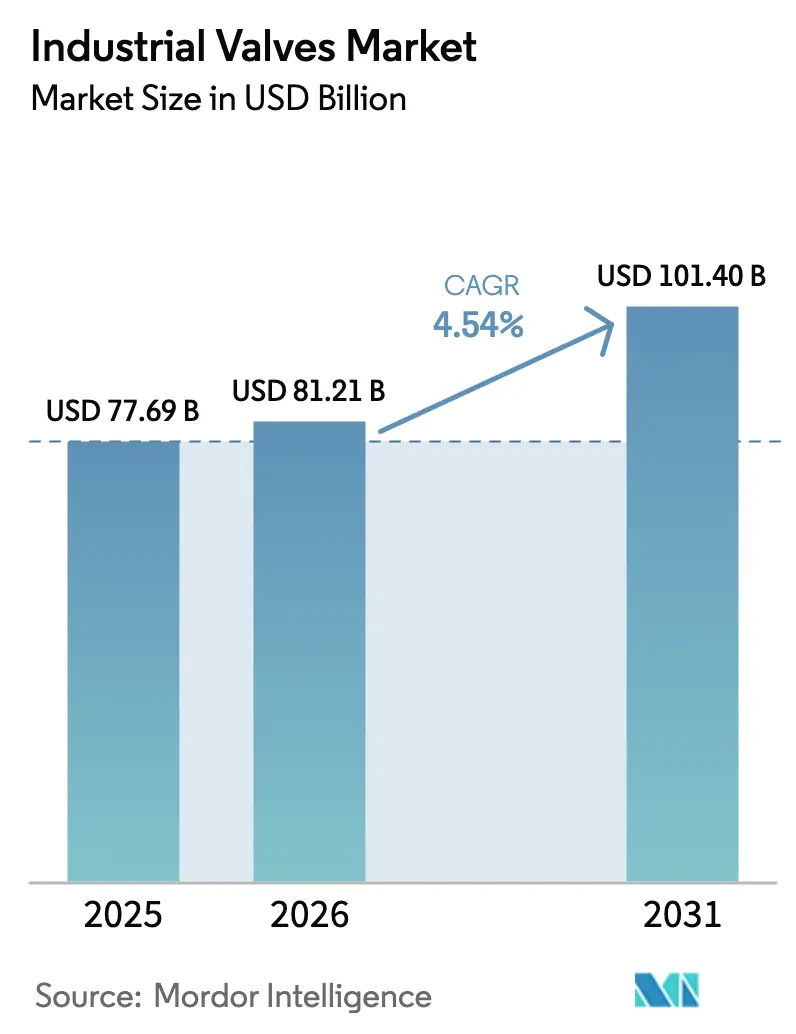
The Industrial Valves Market size is expected to increase from USD 77.69 billion in 2025 to USD 81.21 billion in 2026 and reach USD 101.40 billion by 2031, growing at a CAGR of 4.54% over 2026-2031. LNG build-outs, desalination mega-projects, hydrogen and carbon-capture networks, and the surge in semiconductor fabs are steering capital toward specialized valves that can withstand cryogenic temperatures, ultra-high pressures, and ultrapure media. These greenfield assets command premium pricing and longer lead times, shifting revenue mix away from commodity replacements. Asia-Pacific dominates the industrial valves market with 40.47% revenue share in 2025, anchored by new LNG terminals in Singapore, Thailand, and Indonesia. Meanwhile, the Middle East and Africa is the fastest-growing region at a 6.57% CAGR through 2031, buoyed by the UAE’s USD 920 million Hassyan and Qatar’s USD 2.8 billion Facility E desalination projects. Ball valves hold 40.48% of the type segment, yet check valves are expanding at 7.18% CAGR as operators retrofit for stricter fugitive-emission limits.
Key Report Takeaways
- By type, ball valves led with 40.48% revenue share in 2025; check valves are forecast to expand at a 7.18% CAGR to 2031.
- By product category, quarter-turn valves accounted for 55.18% of the industrial valves market share in 2025, while multi-turn valves are projected to grow at a 5.81% CAGR through 2031.
- By valve function, isolation valves commanded 61.17% of the industrial valves market size in 2025; check and safety valves are advancing at a 6.66% CAGR through 2031.
- By body material, steel held 45.22% of 2025 revenue, whereas alloy-based bodies are progressing at a 7.71% CAGR to 2031.
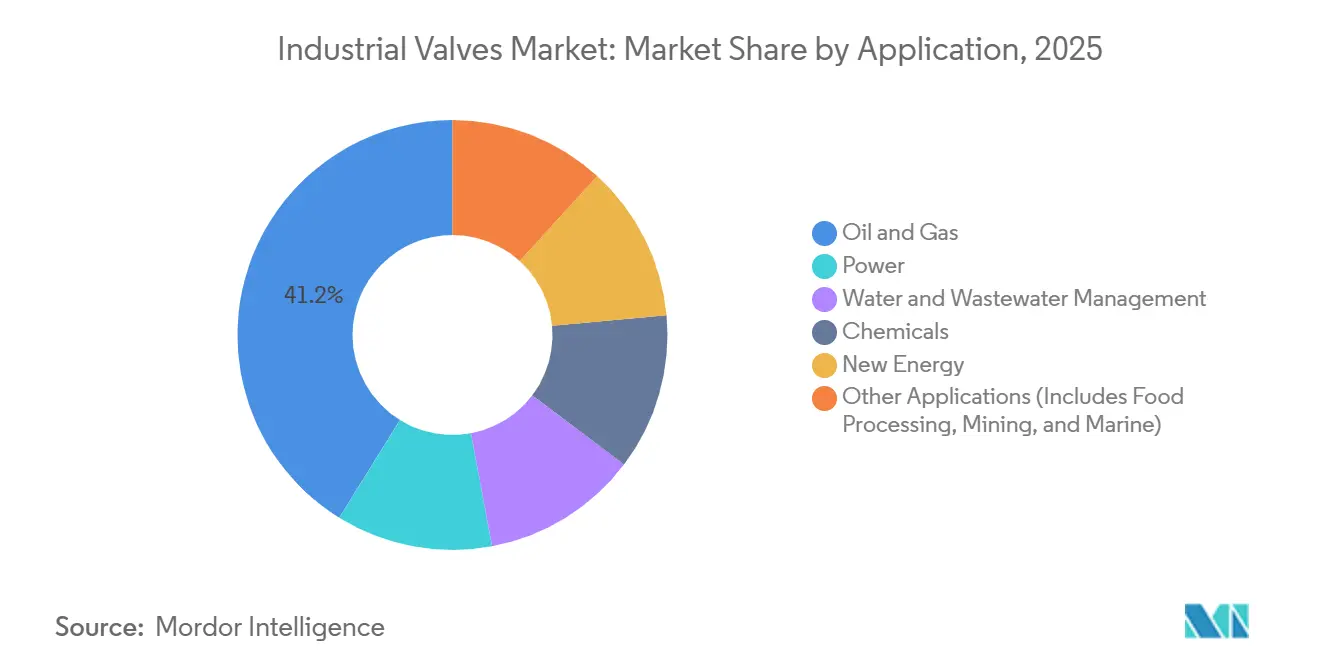
- By application, oil and gas captured 41.18% of 2025 revenue; the new-energy segment is the fastest-growing at 9.22% CAGR through 2031.
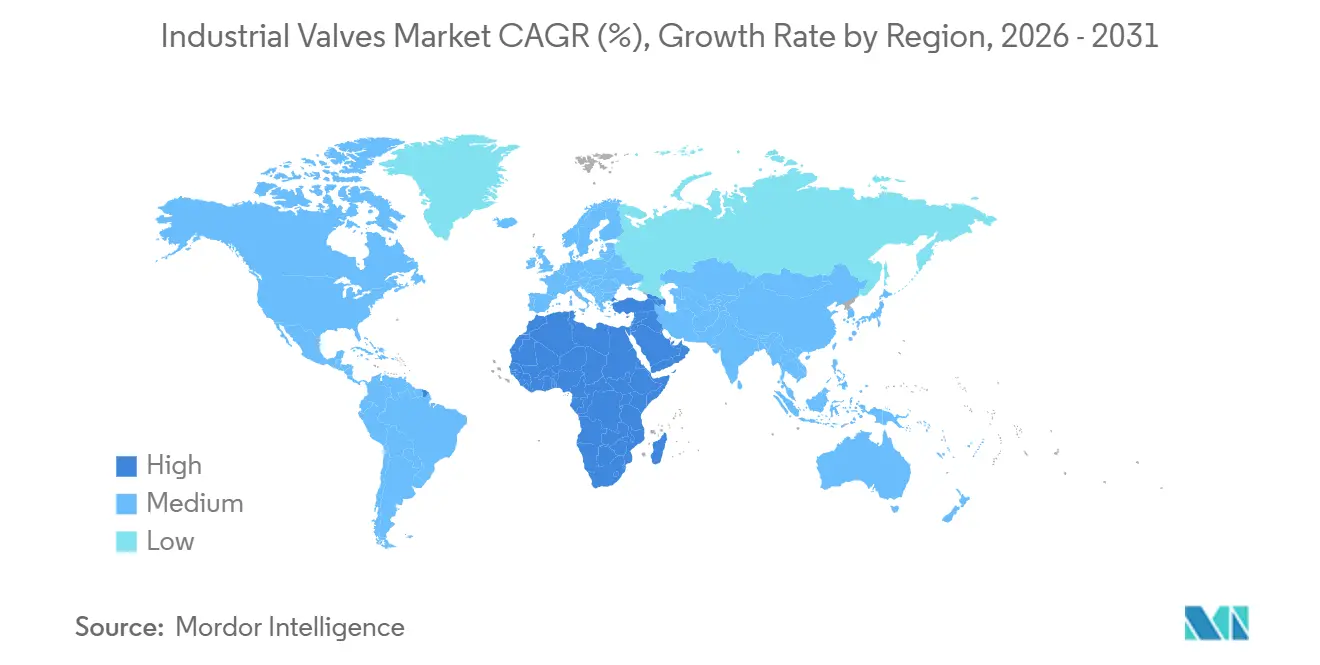
- By geography, Asia-Pacific represented 40.47% of 2025 demand, and the Middle East and Africa region is set to post a 6.57% CAGR to 2031.
Note: Market size and forecast figures in this report are generated using Mordor Intelligence’s proprietary estimation framework, updated with the latest available data and insights as of January 2026.
Market Trends and Insights
Drivers Impact Analysis of Industrial Valves Market*
| Driver | (~) % Impact on CAGR Forecast | Geographic Relevance | Impact Timeline |
|---|---|---|---|
| LNG-terminal build-outs across APAC | +1.20% | APAC core, spill-over to Oceania | Medium term (2-4 years) |
| Desalination CAPEX surge in GCC states | +0.90% | Middle East (Saudi Arabia, UAE, Qatar) | Long term (≥ 4 years) |
| Predictive-maintenance-driven replacement cycles in NA chemical sector | +0.70% | North America, Western Europe | Short term (≤ 2 years) |
| Hydrogen & CCS mega-projects demanding ultra-high-pressure valves | +1.10% | Global, with early concentration in EU, North America, Australia | Long term (≥ 4 years) |
| Semiconductor-fab ultrapure-valve boom | +0.60% | APAC (Taiwan, South Korea, Japan), North America (Arizona, Texas) | Medium term (2-4 years) |
| Source: Mordor Intelligence | |||
LNG-Terminal Build-Outs Across APAC
Singapore's Energy Market Authority awarded the country's second LNG terminal contract in 2024, specifying a floating storage and regasification unit with 200,000 cubic meters of storage and 5 million tonnes per annum throughput, operational by the end of the decade. Moreover, Thailand’s 7.5 million tpa Nong Fab facility and Indonesia’s 3.8 million tpa Tangguh Train 3 collectively require thousands of cryogenic ball and butterfly valves rated for −162°C service. Nickel-alloy supply constraints are stretching lead times to 24 weeks, favoring OEMs with captive foundries. Specification drift toward ASME B16.34-qualified nickel-alloy bodies is lifting average selling prices, bolstering margin potential for integrated suppliers in the industrial valves market.
Desalination CAPEX Surge in GCC States
The UAE's Hassyan desalination plant, awarded in early 2025 with a USD 920 million EPC contract, will produce 180 million imperial gallons per day by 2027 and stood 55% complete as of February 2025, employing reverse-osmosis technology that demands corrosion-resistant duplex-steel valves for high-salinity brine handling[1]. Each plant needs 2,000–3,000 duplex-steel gate and butterfly valves to handle high-salinity brine. Local foundry shortages push utilities to pre-qualify European and North American vendors, reallocating regional spend and creating joint-venture openings that enhance Gulf prospects for the industrial valves market.
Predictive-Maintenance-Driven Replacement Cycles in North American Chemicals
IoT positioners feeding cloud analytics compress replacement intervals from 10–12 years to 7–9 years, accelerating demand for smart globe and control valves[2]. The U.S. methane rule imposes quarterly leak surveys and fines, incentivizing early retirement of high-bleed valves. Large petrochemical operators adopt low-emission packings despite a 25% price premium, while smaller players defer, creating a two-speed purchasing pattern within the industrial valves market.
Hydrogen & CCS Mega-Projects Demanding Ultra-High-Pressure Valves
The UK's H2NorthEast project received Section 35 Direction approval in November 2024, paving the way for a hydrogen pipeline network linking Teesside industrial clusters to offshore storage caverns, a system requiring valves rated for 1,000 bar to 1,034 bar to handle compressed hydrogen without embrittlement. Weld-qualified labor shortages delay schedules by 6–9 months, steering EPC contractors toward pre-assembled valve skids. This trend is consolidating project awards among a handful of high-capability suppliers in the industrial valves market.
Restraints Impact Analysis of Industrial Valves Market*
| Restraint | (~) % Impact on CAGR Forecast | Geographic Relevance | Impact Timeline |
|---|---|---|---|
| Nickel-alloy casting shortages extending lead-times | -0.80% | Global, acute in North America and Europe | Short term (≤ 2 years) |
| Stricter fugitive-emission testing costs for SMEs | -0.50% | North America, EU, with gradual adoption in APAC | Medium term (2-4 years) |
| Rapid shift to electric actuators cannibalising manual-valve demand | -0.30% | Global, led by North America and Western Europe | Long term (≥ 4 years) |
| Source: Mordor Intelligence | |||
Nickel-Alloy Casting Shortages Extending Lead Times
Indonesia's 2020 nickel-ore export ban, extended through 2024 and 2025, and the Philippines' parallel restrictions have concentrated 70% to 80% of global refined-nickel output in China, creating a chokepoint for duplex and Inconel valve castings that require nickel content above 20%. Smaller fabricators lacking the balance-sheet strength to pre-purchase nickel are exiting specialty-alloy segments, ceding market share to vertically integrated players such as Flowserve and Velan that operate captive foundries or hold multi-year supply agreements. This consolidation dynamic is likely to persist until new nickel-refining capacity in Indonesia and the Philippines comes online in 2027 to 2028.
Stricter Fugitive-Emission Testing Costs for SMEs
The US EPA's December 2024 methane rule introduced a Super-Emitter Response Program requiring facilities to repair leaks detected by third-party satellite or aerial surveys within 5 days for emissions above 100 kilograms per hour, a threshold that captures valve-stem leaks in older gate and globe designs. Consequently, smaller suppliers are consolidating SKU portfolios or exiting regulated markets, while larger OEMs amortize testing costs across higher production volumes. This regulatory asymmetry is accelerating market concentration, with the top 5 valve suppliers projected to capture an additional 3% to 5% share by 2028.
*Our forecasts treat driver/restraint impacts as directional, not additive. The impact forecasts reflect baseline growth, mix effects, and variable interactions.
Industrial Valves Market Segment Analysis
By Type:
Ball Valves Dominate, Check Valves Surge on Safety MandatesBall valves captured 40.48% of market share in 2025, reflecting their quarter-turn simplicity and tight shut-off in oil, gas, and chemical applications, while check valves are expanding at 7.18% CAGR through 2031, the fastest rate among valve types. This acceleration stems from process-safety regulations mandating backflow prevention in hydrogen pipelines and CCS networks, where reverse flow can trigger catastrophic pressure excursions. Butterfly valves serve large-diameter, low-pressure water and wastewater systems, offering cost advantages over gate valves in municipal projects, yet their share remains stable as operators prioritize ball valves for critical isolation duties.
Steeper fire-safe and low-emission revisions to API 6D now favor ball-valve geometries, while dual-plate check valves protect LNG cryogenic pumps during emergency shutdowns. Butterfly valves retain water-sector relevance, and gate valves persist in high-pressure steam service. Plug valves capture slurry niches, rounding out the industrial valves market landscape for flow-control types.


By Product (Motion):
Quarter-Turn Speed Versus Multi-Turn PrecisionQuarter-turn valves held 55.18% share in 2025, a dominance rooted in their rapid actuation—90 degrees from open to closed—that reduces cycle time in automated batch processes and emergency shutdown systems. Multi-turn valves are projected to grow at a 5.81% CAGR as hydrogen and CCS projects specify gate and globe designs for sealing under 1,000-bar loads.
The shift toward electric actuators is reshaping product-mix economics. Emerson's Q3 2024 earnings call highlighted a 12% year-over-year increase in electric-actuator attachments for multi-turn valves, driven by petrochemical complexes replacing pneumatic systems to eliminate instrument-air compressors and reduce energy consumption by 15% to 20%. ISO 5211 mounting versatility keeps quarter-turn devices popular in retrofit work, while custom kits add cost complexity to multi-turn upgrades, shaping product-choice dynamics across the industrial valves market.
By Valve Function:
Isolation Leads, Check and Safety AccelerateIsolation valves commanded 61.17% of the functional share in 2025, reflecting their ubiquity in on-off service across every end-use sector, from crude-oil pipelines to municipal water distribution. Regulation valves, including control and throttling variants, serve continuous-process industries—pulp and paper, pharmaceuticals, power generation, where maintaining setpoint within ±2% is critical to product quality and thermal efficiency.
Isolation valves benefit from the broadest application base, yet their commodity nature—many ball and gate valves compete on price rather than performance—limits margin expansion. Regulation valves, by contrast, command 30% to 50% higher unit prices due to precision trim and positioner integration, yet their market share remains constrained by the capital intensity of continuous-process industries. Check valves occupy a middle ground: lower unit prices than regulation valves but higher volumes than safety valves, with dual-plate and tilting-disc designs gaining share in LNG service due to their compact footprint and low-pressure drop.
By Body Material:
Alloy-Based Variants Outpace Steel on Corrosion DemandsSteel-bodied valves retained 45.22% share in 2025, split roughly evenly between carbon steel (ASTM A216 WCB) for non-corrosive hydrocarbon and water service, and austenitic stainless steel (316/316L) for mildly corrosive chemical and food-processing applications. Cast and ductile iron valves serve low-pressure municipal water and wastewater systems, where cost per valve is paramount, and corrosion rates are manageable with cement or epoxy linings. However, alloy variants such as duplex 2205, Inconel 625, and 9% nickel steel will climb at a 7.71% CAGR as LNG and green-hydrogen assets demand elevated corrosion resistance.
Duplex stainless steels (2205, 2507) combine the corrosion resistance of austenitic grades with the strength of ferritic grades, allowing thinner-walled, lighter-weight valve bodies that reduce material costs by 15% to 20% relative to solid Inconel, yet their weldability challenges, requiring post-weld heat treatment to restore corrosion resistance, limit adoption in field-fabricated piping. Inconel and Hastelloy remain indispensable for sour-gas and supercritical-CO₂ service. Indonesia’s ore ban places procurement risk squarely on nickel-intensive alloys, influencing sourcing strategies within the industrial valves market.
By Application:
New Energy Surges as Oil and Gas MaturesOil and gas held 41.18% of application share in 2025, a figure that masks divergent trends: upstream offshore production is contracting in mature basins (North Sea, Gulf of Mexico) while expanding in frontier plays (Guyana, Suriname), midstream pipeline infrastructure is growing modestly to accommodate LNG exports, and downstream refining is stagnant in OECD markets yet robust in Asia and the Middle East. New-energy applications are expanding at 9.22% CAGR through 2031, more than double the market average, propelled by wind-turbine hydraulic pitch systems, solar-thermal molten-salt loops, and battery-energy-storage thermal-management circuits that collectively consumed negligible valve volumes a decade ago.
Municipal water projects underpin steady replacement demand, while semiconductor fabs consume ultrapure-media valves that meet SEMI F57 cleanliness limits. These emerging pockets collectively widen the total addressable industrial valves market.
Geography Analysis
APAC Industrial Valves Market
Asia-Pacific held 40.47% revenue in 2025, led by LNG terminals and semiconductor fabs that each require thousands of precision valves. China, Taiwan, and South Korea underpin fab demand, whereas Southeast Asia scales gas infrastructure to replace coal.
North America Industrial Valves Market
North America generates high aftermarket revenue from its vast installed base. The CHIPS Act’s USD 39 billion incentives spurred Intel, Micron, and Samsung fabs in Arizona, Texas, and Ohio, incorporating ultrapure-water loops with stringent valve cleanliness specs.
EMEA and LATAM Industrial Valves Market
The Middle East and Africa will post a 6.57% CAGR to 2031, fastest worldwide, on the back of GCC desalination CAPEX and Saudi petrochemical expansions. Europe’s offshore wind and CCS hubs partially offset fossil-power retirements, while Latin America’s pre-salt and shale projects sustain regional valve demand, illustrating geographic spread in the industrial valves market.
Regulatory Landscape
Environmental and safety compliance continues to tighten around valves used in chemical processing, pipelines, and other regulated process assets. In the United States, the EPA finalized amendments in April 2026 affecting chemical manufacturing area source NESHAP requirements, adding LDAR obligations that raise expectations for valve packing performance, documentation, and monitoring practices in affected facilities. On the pipeline side, PHMSA amended regulations in July 2025 to incorporate the 25th edition of API Spec 6D for pipeline valves, reinforcing standardized qualification expectations for critical isolation valves used in oil, gas, and related networks.
Standards updates are also shaping specifications and procurement globally. ASME approved B16.34-2025 in March 2025, updating pressure-temperature ratings and material requirements for valves, while CEN published EN 16668:2025 for metallic valves as pressure accessories used in industrial applications. Input-cost policy actions remain relevant for valve producers and buyers, including the June 2026 U.S. Section 232 tariff adjustments affecting steel and aluminum products and derivatives, which can affect landed costs and sourcing strategies for forged and cast valve bodies.
Value Chain Analysis
The industrial valves value chain runs from metals and alloy inputs (carbon steel, stainless, duplex, nickel alloys) through foundry and forging output, machining and finishing (including coatings and surface treatments), and then assembly and testing (pressure, fire-safe, fugitive emissions). Distribution follows through OEMs, EPC channels, and authorized distributors into end users across oil and gas, chemicals, power, and water. Quality documentation and traceability requirements, including EN 10204 3.1 material certification and heat number traceability, add administrative steps that can extend cycle time, especially for severe-service and regulated applications.
In 2026, supply-side constraints remain concentrated in cast and forged components and certified specialty alloys, keeping lead times elevated for large and custom-engineered valves. Buyers and manufacturers respond via standardization, regional stockholding of fast-moving sizes, and alternate manufacturing routes such as CNC machining from solid billets to bypass foundry bottlenecks when schedules are tight. On the demand side, larger process operators increasingly use strategic valve vendor programs, including Main Valve Vendor models in chemicals, to consolidate sourcing, enforce common specifications, and improve delivery reliability across multi-site operations.
Competitive Landscape
The Industrial Valves market is highly fragmented. Captive foundries and multi-year nickel contracts shield large OEMs from raw-material price shocks, while horizontal specialists like IMI Critical lock in 40%-plus margins in severe-service niches. White-space opportunities revolve around hydrogen-compatible coatings, modular actuator retrofits, and data-centric predictive-maintenance platforms. Regional challengers such as KITZ and AVK leverage shorter 12- to 16-week lead times to win EPC orders. Certification costs, USD 50k-80k per valve model, favor incumbents with amortized test portfolios, consolidating share inside the industrial valves market.
Industrial Valves Industry Leaders
-
Emerson Electric Co.
-
Flowserve Corporation
-
SLB
-
Crane Company
-
IMI
- *Disclaimer: Major Players sorted in no particular order
Industrial Valves Market Companies Covered in this Report
- Alfa Laval
- AVK Holding A/S
- Baker Hughes Company
- Circor International Inc.
- Crane Company
- Curtiss-Wright Corporation
- Danfoss A/S
- Emerson Electric Co.
- Engipro Solutions LLP,
- Flowserve Corporation
- Georg Fischer Ltd.
- Hitachi Ltd
- Honeywell International Inc.
- IMI Critical Engineering (IMI PLC)
- ITT Inc.
- KITZ Corporation
- KLINGER Holding
- Metso
- Mueller Co. LLC
- Nibco Inc.
- Okano Valve Mfg. Co. Ltd.
- SAMSON AKTIENGESELLSCHAFT
- SLB
- Technipfmc PLC
- The Weir Group PLC
- Valvitalia SpA
- Velan
- Xylem
Market Opportunities and Future Outlook
White-space activity is centering on faster delivery for engineered valves, localized manufacturing footprints, and product designs aligned with tightening emissions and safety compliance. India is emerging as a capacity and lead-time lever for instrumentation and process valve supply into Asia-Pacific and export programs, supported by Oliver Valves opening a 45,000-square-foot manufacturing facility in Chennai in February 2026 and AS-Schneider inaugurating a production facility in Coimbatore in March 2026. These expansions help buyers qualify multi-source supply and shorten replenishment cycles for projects and MRO, particularly where nickel-alloy casting constraints extend lead times.
Technology-driven opportunities are also visible in severe-service upgrades and corrosion-intensive applications. Additive manufacturing is being applied to specialized components such as thermal sleeves, illustrated by Velan introducing its Hexa-Shield additively manufactured thermal sleeve concept in February 2026 for extreme thermal cycling duty. Chemical processing demand supports differentiated linings and sealing solutions, with new fluorine-lined valve launches in 2026 targeting corrosive service and compliance-driven leakage reduction, consistent with LDAR-focused priorities in regulated process industries.
Recent Industry Developments in Industrial Valves Market
- June 2026: Flowserve completed its all-cash acquisition of Trillium Flow Technologies Valves Division for USD 490 million (excluding French valves operations). The deal expands Flowserve's valve portfolio and service footprint in nuclear and other power end markets, strengthening its ability to bid on complex, specification-heavy projects and long-cycle aftermarket programs.
- April 2026: Emerson introduced the Fisher IC2 cryogenic top-entry control valve for cold box applications in hydrogen liquefaction and LNG production. The launch targets leakage control and maintainability in cryogenic service, supporting OEMs and EPCs specifying high-integrity valves for LNG build-outs and emerging hydrogen infrastructure.
- February 2025: Flowserve launched the Worcester Cryogenic series of reduced-port, quarter-turn floating ball valves for LNG, hydrogen, and other industrial gas applications. By adding purpose-built cryogenic configurations in three-piece and flanged formats, Flowserve addressed specification shifts toward premium cryogenic isolation valves used in new terminals and liquefaction trains.
Industrial Valves Market Report Scope and Research Methodology
Market Definition and Coverage
For this study, the market covers industrial-grade valves used to control or isolate the flow of liquids, gases, and slurries in process and utility systems across major industries, with market value measured from product sales in USD.
Scope exclusions: Household plumbing faucets, micro-fluidic laboratory valves, and standalone actuators are excluded from the market totals.
Segments Covered in This Report
- By Type
- Ball Valve
- Butterfly Valve
- Gate Valve
- Globe Valve
- Plug Valve
- Other Types
- By Product
- Quarter-Turn Valve
- Multi-Turn Valve
- Other Products
- By Valve Function
- Isolation Valves
- Regulation Valves
- Check and Safety Valves
- By Body Material
- Steel (Carbon and Stainless Steel)
- Alloy-Based (Duplex, Inconel, etc.)
- Cast/Ductile Iron
- Cryogenic Nickel Alloys
- Others
- By Application
- Oil and Gas
- Power
- Water and Wastewater Management
- Chemicals
- New Energy
- Other Applications (Includes Food Processing, Mining, and Marine)
- By Geography
- Asia-Pacific
- China
- India
- Japan
- South Korea
- Indonesia
- Vietnam
- Malaysia
- Thailand
- Rest of Asia-Pacific
- North America
- United States
- Canada
- Mexico
- Europe
- Germany
- United Kingdom
- Italy
- France
- NORDIC Countries
- Turkey
- Russia
- Spain
- Rest of Europe
- South America
- Brazil
- Argentina
- Colombia
- Rest of South America
- Middle East and Africa
- Saudi Arabia
- United Arab Emirates
- Qatar
- Egypt
- Nigeria
- South Africa
- Rest of Middle East and Africa
- Asia-Pacific
Data Sources, Market Sizing, and Validation
Desk Research
Desk research was used to map the demand picture and keep assumptions grounded in observable activity. We leaned on public sources such as the US Energy Information Administration (EIA) for energy and refinery trends, the US Geological Survey (USGS) for mining and metals signals, the International Energy Agency (IEA) for power and fuel mix indicators, and the World Bank and OECD for macro and industrial production context.
On the infrastructure and trade side, references such as UN Comtrade and national customs statistics helped us sanity-check import dependence and direction of flows for valve-intensive equipment. We also reviewed company annual reports, investor presentations, and press releases to understand pricing commentary, backlog themes, and mix shifts between standard and engineered valves. In a few places, paid subscriptions focused on company financials, patents, and shipment-level trade records were used to speed up cross-checks, while keeping the model reproducible with public datapoints. These examples are illustrative, and many other public sources were also consulted for data collection, validation, and clarification during the work.
Primary Interviews and Surveys
Primary work focused on confirming where valves are actually being specified and bought, and how pricing is moving by application severity, for example corrosive services versus general duty. We spoke with a mix of manufacturers, channel partners, EPC-linked stakeholders, and end users across APAC, EMEA, and the Americas, so assumptions on replacement cycles, project timing, and average selling prices could be tightened where desk signals were broad.
Distribution of primary research fieldwork respondents
| Company type | Respondent position | Region |
|---|---|---|
| Top tier: 30% | CXOs: 22% | APAC: 46% |
| Mid tier: 48% | Functional/Unit leaders: 20% | EMEA: 30% |
| Smaller Players: 22% | Managers: 58% | Americas: 24% |
Market-Sizing & Forecasting
Sizing starts from a top-down build where end-use activity is translated into valve demand pools, and then value is reconstructed using typical valve intensity and pricing by service class. In practice, we anchor the model on indicators such as upstream and midstream project additions, power and industrial capex cycles, water and wastewater treatment spend, and the operating base that drives maintenance demand.
To keep the totals realistic, the first output is corroborated using selective bottom-up approximations, including sampled supplier revenue splits, channel checks on project versus MRO mix, and volume times ASP ranges for high-usage valve families. Inputs that mattered most for this market included the share of replacement demand versus new projects, average lead times (which affect revenue timing), stainless and alloy content for severe service valves, and the pace of automation or control valve upgrades in regulated plants. Where coverage is thinner for smaller countries or niche end uses, gaps are handled through proxy allocation using industrial output and installed base indicators, followed by expert review.
For forecasting, scenario analysis is used around a central case because the market moves with project timing, commodity-linked investment, and infrastructure budgets. Growth paths for key drivers are aligned to what primary respondents expect for their order books and pricing, and then the model applies calibrated ASP progression and mix shifts so growth is not overstated when volume is stable but value rises.
Data Validation & Update Cycle
Validation is done by checking the modeled totals against independent signals such as end-use capex trends, trade movement direction, and the implied per-plant spending levels that come out of the model. Variances are investigated country by country and application by application. When a number looks off, we re-check the underlying driver assumptions and reconnect with interviewees to confirm whether the cause is timing, price, or mix.
Before sign-off, the work goes through multi-step analyst reviews that look for unit consistency, currency conversion correctness, and jumps that are not supported by known project pipelines. Reports are refreshed annually, and interim updates are made when material events occur, such as major policy shifts, large project delays, or sharp commodity price changes. Right before delivery, a final pass is performed so clients receive the latest updated view rather than an older model snapshot.
Mordor Intelligence's Industrial Valves Market Size Measured Against Other Published Estimates
Published market sizes for industrial valves do not always match because authors draw the boundary of what counts differently, and they also choose different pricing paths and time cutoffs. The gaps usually show up when one estimate leans more on long-cycle project optimism, while another leans more on replacement demand and near-term order behavior.
Key differences in this market often come from how average selling prices are updated, especially for alloy-heavy and engineered valves, how currency conversion is timed across regions, and whether the study counts only valve bodies or also folds in adjacent hardware. Another driver is refresh cadence, since late-year project delays and price resets can shift the current-year number more than the long-term trend suggests. By using late-cutoff checks on price and order signals and then locking currency timing consistently, the 2025 total is kept closer to realized market conditions in the approach used by Mordor Intelligence.
Benchmark comparison
| Source | Market Size | Gaps in Research Methodology |
|---|---|---|
| Mordor Intelligence | USD 77.69 B (2025) | |
| Global Consultancy A | USD 80.40 B (2025) | Uses a broader revenue framing that can lift the 2025 value when higher-priced engineered and automation-linked valve demand is emphasized, and when ASP escalation is carried forward using a smoother curve. |
| Industry Study B | USD 103.00 B (2025) | Demand-based framing with wider product grouping can push totals upward, particularly if adjacent valve categories are included and regional currency conversion is not aligned to a single timing point. |
The spread in the table is mainly explained by timing and scope choices rather than a disagreement that valves are growing steadily. When scope is held to industrial valves only, and pricing and currency are updated on a consistent calendar with real-world checks, the final number becomes easier to trace back to clear drivers and repeat in future refreshes.
Key Questions Answered in the Report
What is the projected value of the industrial valves market in 2031?
The market is forecast to reach USD 101.40 billion by 2031, growing at a 4.54% CAGR.
Which valve type is expected to grow fastest through 2031?
Which valve type is expected to grow fastest through 2031?
Why are alloy-based valve bodies gaining traction?
Why are alloy-based valve bodies gaining traction?
Which region shows the highest growth potential?
Which region shows the highest growth potential?
How is predictive maintenance influencing valve demand?
How is predictive maintenance influencing valve demand?