
Global Industrial Microbiology Market Size and Share
Market Overview
| Study Period | 2020 - 2031 |
|---|---|
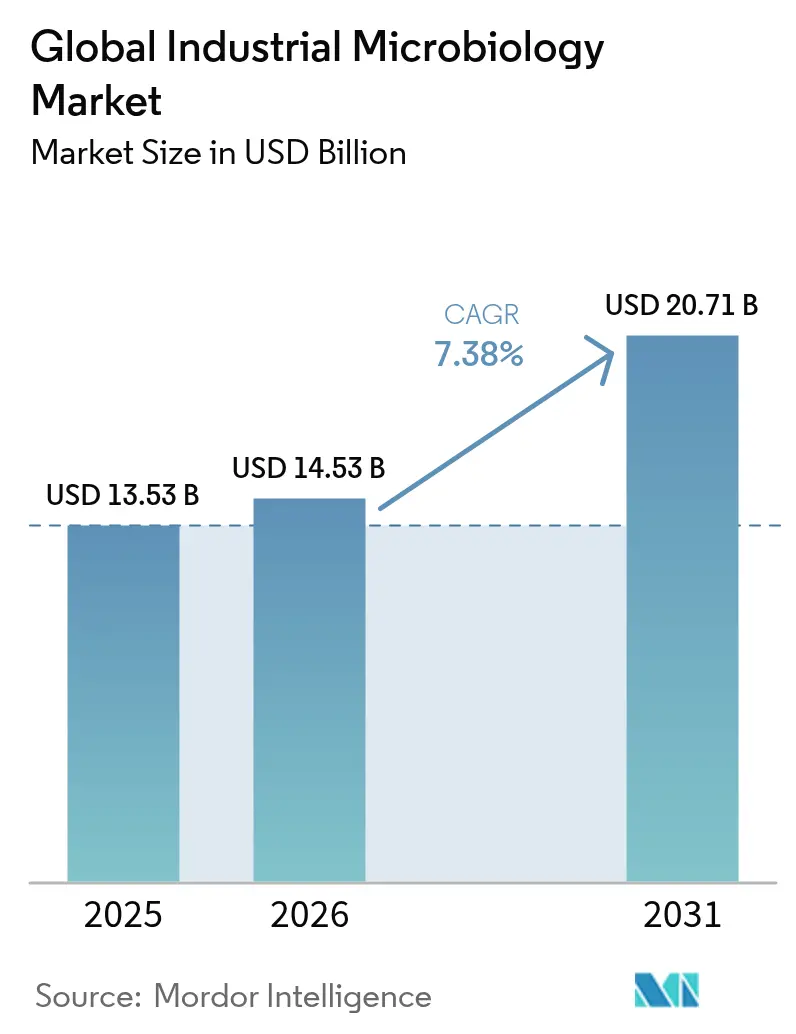
| Market Size (2026) | USD 14.53 Billion |
| Market Size (2031) | USD 20.71 Billion |
| Growth Rate (2026 - 2031) | 7.38 % |
| Fastest Growing Market | Asia Pacific |
| Largest Market | North America |
| Market Concentration | Medium |
Major Players *Disclaimer: Major Players sorted in no particular order Image © Mordor Intelligence. Reuse requires attribution under CC BY 4.0. | |
Global Industrial Microbiology Market Analysis by Mordor Intelligence
Industrial microbiology market size in 2026 is estimated at USD 14.53 billion, growing from 2025 value of USD 13.53 billion with 2031 projections showing USD 20.71 billion, growing at 7.38% CAGR over 2026-2031. Demand is widening beyond traditional quality-control testing as bioprocessing, precision fermentation, and ESG-driven waste-bioremediation projects create fresh revenue pools for service providers. Rapid sterility and endotoxin screening requirements originating from cultivated-meat facilities, together with stricter GMO oversight in multiple jurisdictions, are reshaping validation protocols across the global supply chain. Supplier disruptions—in particular BD’s shortage of BACTEC blood-culture vials in 2024—have amplified interest in multisource procurement strategies and automated inventory tracking to secure laboratory uptime. Competitive intensity is accelerating as leading vendors pursue acquisitions, single-use bioreactor innovations, and AI-driven contamination-detection software to differentiate on speed, data integrity, and cybersecurity resilience.
Key Report Takeaways
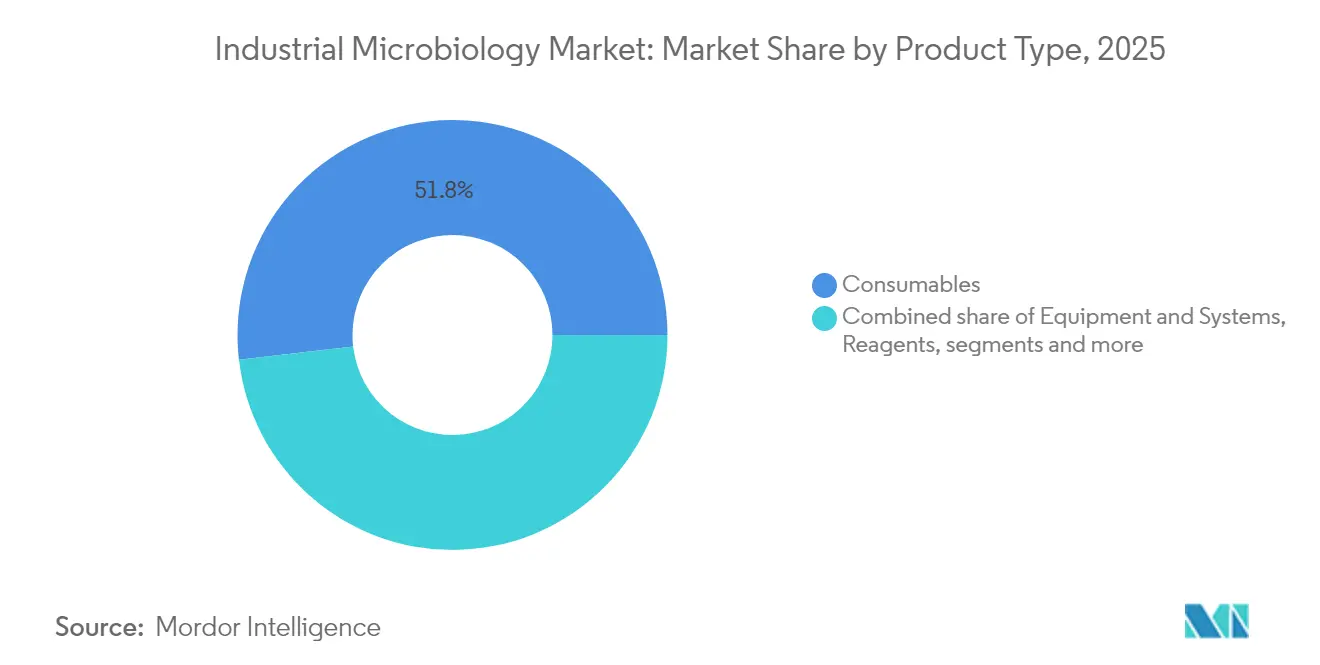
- By product type, consumables led with 51.84% revenue share in 2025, while reagents are projected to expand at a 9.04% CAGR through 2031.
- By application, food & beverage held 32.05% of industrial microbiology market share in 2025; pharmaceutical & biotechnology is advancing at a 9.96% CAGR to 2031.
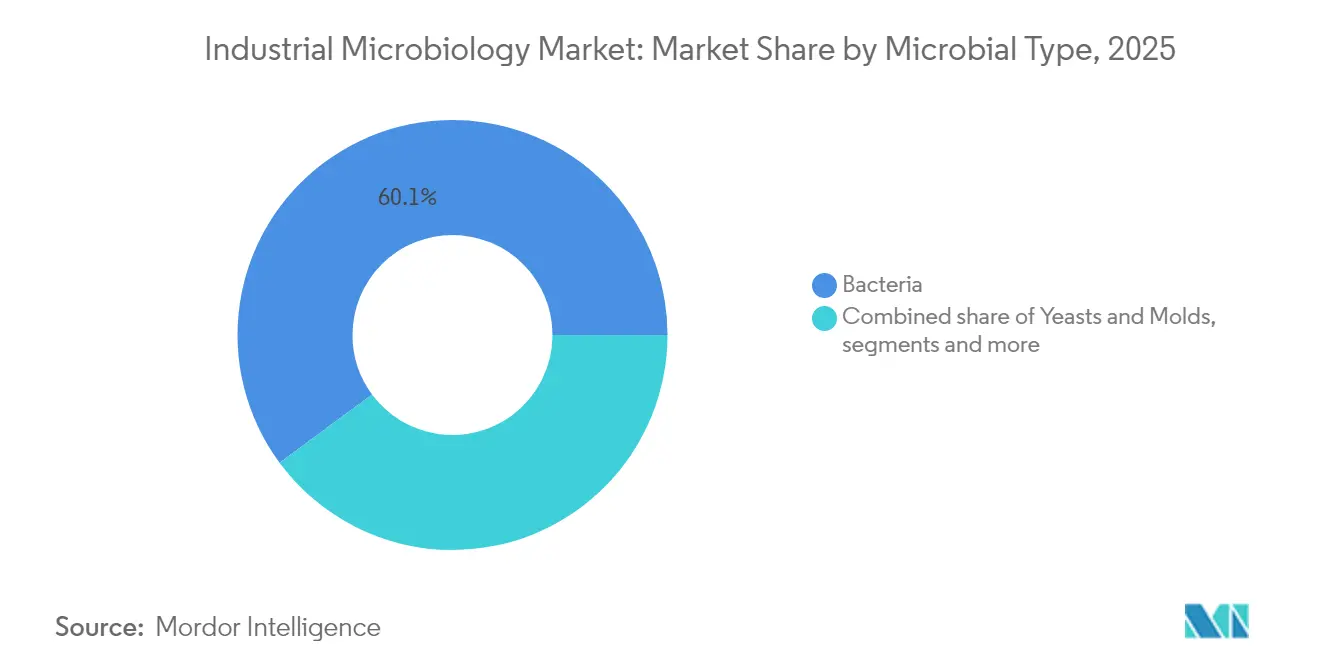
- By microbial type, bacteria accounted for 60.12% share of the industrial microbiology market size in 2025, whereas viruses & phages show the fastest 9.34% CAGR through 2031.
- By test type, bioburden testing commanded 45.58% share of the industrial microbiology market size in 2025, and endotoxin testing is set for a 9.01% CAGR to 2031.
- By geography, North America captured 36.34% of industrial microbiology market share in 2025, while Asia-Pacific is forecast to rise at a 10.05% CAGR through 2031.
Note: Market size and forecast figures in this report are generated using Mordor Intelligence’s proprietary estimation framework, updated with the latest available data and insights as of 2026.
Global Industrial Microbiology Market Trends and Insights
Drivers Impact Analysis*
| Driver | (~) % Impact on CAGR Forecast | Geographic Relevance | Impact Timeline |
|---|---|---|---|
| Growing demand for nutraceuticals & fermented products | +1.8% | Global, APAC leading growth | Medium term (2-4 years) |
| Rising concern for food safety & stringent regulations | +1.5% | North America & EU expanding globally | Short term (≤ 2 years) |
| Increasing R&D spend & biopharma pipeline expansion | +1.2% | North America, EU, APAC acceleration | Long term (≥ 4 years) |
| Expansion of industrial fermentation for biofuels & enzymes | +0.9% | Global, industrial hubs | Medium term (2-4 years) |
| Rapid QC needs in cultivated-meat manufacturing | +0.6% | North America & EU early adoption | Long term (≥ 4 years) |
| ESG-funded microbiome waste-bioremediation projects | +0.4% | Global, EU regulatory leadership | Long term (≥ 4 years) |
| Source: Mordor Intelligence | |||
Growing Demand for Nutraceuticals & Fermented Products
Surging probiotic consumption across Asia, highlighted by Zuellig Pharma’s decade-long alliance to distribute OMNi-BiOTiC strains in Indonesia, Philippines, and Taiwan, is pushing laboratories to offer localized strain-characterization services alongside metabolite profiling. The industrial microbiology market is therefore pivoting from pathogen detection toward deeper functional analytics that quantify bioactivity and regional taste preferences. Manufacturers are also tailoring formulations to match local regulatory requirements, which accelerates demand for rapid microbial-quality testing infrastructure in emerging economies. The widening palette of fermentation-derived ingredients—ranging from umami seasonings to bio-based sweeteners—is adding new QC checkpoints for contaminants and off-target metabolites. These shifts collectively sustain recurring consumable uptake and cement long-term reagent contracts for leading suppliers.
Rising Concern for Food Safety & Stringent Regulations
Recent Listeria-linked recalls involving supplement shakes prompted regulators to enforce tighter turnaround targets for contamination confirmation, spurring adoption of high-throughput PCR and whole-genome-sequencing workflows.[1] The FDA’s updated Pharmaceutical Microbiology Manual demands harmonized endotoxin and antimicrobial-effectiveness assays that integrate seamlessly with 21 CFR 11-compliant data-capture systems. Vendors such as bioMérieux responded with the 3P ENTERPRISE platform, pairing digital environmental monitoring with audit-ready electronic records. Blockchain-supported supply-chain transparency adds another documentation layer, compelling QC labs to generate tamper-proof microbial test reports. Collectively, these pressures increase spending on automated incubators, rapid readers, and middleware that can cut result cycles while meeting evolving global benchmarks.
Increasing R&D Spend & Biopharma Pipeline Expansion
Thermo Fisher’s USD 2 billion, four-year U.S. capacity upgrade underscores the sector’s focus on large-scale biologics, cell, and gene-therapy manufacturing. Sartorius’ EUR 560 million expansion, coupled with its collaboration with LFB Biomanufacturing, aligns equipment suppliers with rising demand for high-throughput sterility, mycoplasma, and genetic-stability assessments.[2] Precision-fermentation initiatives, exemplified by BASF and Acies Bio’s renewable-methanol platform, further inflate the need for strain-stability monitoring and pathway-validation assays. As biologics are projected to approach 45% of global pharmaceutical sales by 2028, specialized industrial microbiology market offerings—such as rapid endotoxin kits and viral-vector safety screens—are becoming integral to GMP compliance. Long-term, integrated single-use systems equipped with automated QC loops are expected to solidify vendor lock-in across large CDMOs.
Expansion of Industrial Fermentation for Biofuels & Enzymes
Novonesis emerged from the EUR 3.7 billion merger of Novozymes and Chr. Hansen and now runs more than 23 manufacturing sites and almost 40 R&D centers. The combined scale equips the company to meet rising demand for industrial enzymes and other fermentation-derived ingredients. This consolidation signals the sector’s drive to expand fermentation capacity and pushes process developers to install advanced microbial-monitoring tools that raise efficiency while cutting batch-failure rates across varied production settings Novonesis.[3]Thermo Fisher’s new single-use DynaDrive bioreactor improves productivity by 27%, reflecting the need for closed-loop contamination control in high-value enzyme and biofuel lines biopharmaapac.com. ESG mandates are incentivizing bio-refineries to adopt 24/7 automated microbial monitoring to certify sustainability claims. Consequently, service providers offering predictive analytics and cloud-based dashboards gain a competitive edge in the industrial microbiology market.
Restraints Impact Analysis*
| Restraint | (~) % Impact on CAGR Forecast | Geographic Relevance | Impact Timeline |
|---|---|---|---|
| Regulatory conflicts over GMOs in food sources | -0.8% | Global, EU–US divergence pronounced | Medium term (2-4 years) |
| Escalating product recalls heightening scrutiny | -0.6% | North America & EU | Short term (≤ 2 years) |
| Supply-chain volatility in specialty culture media inputs | -0.5% | Global, developing regions vulnerable | Short term (≤ 2 years) |
| Cyber-security risks to automated microbiology data systems | -0.3% | Global, automated facilities | Medium term (2-4 years) |
| Source: Mordor Intelligence | |||
Regulatory Conflicts Over GMOs in Food Sources
Divergent frameworks for CRISPR-edited crops create compliance complexity as the EU proposes dual regulatory pathways for new genomic techniques, while the U.S. leans on harmonization through the ICH. Testing laboratories servicing global clients must therefore maintain parallel protocols, certifications, and reporting formats, increasing operating costs and stretching skilled-labor capacity. China’s heightened biosafety oversight further obliges exporters to demonstrate traceability of genetically modified microorganisms from strain lineage to final product. As patent volumes for CRISPR crops exceed 1,900 yet lack uniform treatment, QC providers in the industrial microbiology market face uncertainty when planning capital investments in GMO-specific analytical platforms. These discrepancies slow cross-border adoption of rapid microbial assays tailored to engineered organisms.
Supply-Chain Volatility in Specialty Culture Media Inputs
The transfer of 3M’s food-safety line to Neogen forced laboratories to validate packaging and documentation changes across Petrifilm plates and Molecular Detection reagents, temporarily straining throughput. BD’s BACTEC vial shortage highlighted the fragility of single-source supply models, prompting hospitals to ration tests and source interim alternatives that risked result variability. Post-pandemic backlogs leave 80% of microbiology laboratories short-staffed, complicating contingency-planning efforts. Although initiatives such as Fisher Scientific’s SureTRACE offer enhanced provenance tracking, high-purity agar, protein hydrolysates, and specialty dyes still depend on geographically concentrated raw-material producers. Persistent input volatility therefore restrains the industrial microbiology market’s near-term growth until multisupplier qualification pipelines mature.
*Our forecasts treat driver/restraint impacts as directional, not additive. The impact forecasts reflect baseline growth, mix effects, and variable interactions.
Segment Analysis
By Product Type: Consumables Sustain Revenue Streams
Consumables represented 51.84% of global revenue in 2025, underscoring their vital role in day-to-day operations. Reagent volumes rise with each automation cycle, and the industrial microbiology market size attached to consumables is projected to grow at 7.22% CAGR to 2031 as high-throughput instruments demand larger lot-qualified batches. Media & culture preparations expand in tandem with stricter environmental-monitoring guidelines for pharmaceutical clean rooms. RFID-enabled vials and plates improve inventory accuracy and support remote batch-release verification, deepening laboratory reliance on branded disposables.
The equipment & systems segment benefits from single-use technologies that cut cleaning validation steps by 50%, yet its share grows more gradually because capital budgets follow multi-year cycles. Filtration and centrifugation innovations favor closed-system configurations that block adventitious microbes upstream. Automated colony-counters reduce analyst hours, which translates into higher throughput and greater reagent pull-through for suppliers. Such synergies help vendors defend margins even as competition intensifies.

By Application Area: Pharmaceutical Acceleration Outpaces Food Dominance
The food & beverage sector held 32.05% of industrial microbiology market share in 2025 on the back of global HACCP standards. However, the pharmaceutical & biotechnology segment is forecast to deliver a 9.96% CAGR through 2031, expanding the industrial microbiology market size for endotoxin, mycoplasma, and sterility testing kits. Growth is strongest in cell- and gene-therapy manufacturing, where rapid release testing can shave weeks off product lead-times.
Environmental testing is gaining traction as ESG-directed remediation funds sponsor microbiome-based clean-up of oil, heavy metals, and PFAS at industrial sites. Agricultural applications increasingly involve soil-health profiling using plant-growth-promoting rhizobacteria, while cosmetic brands invest in microbiome-friendly formulations that require live-culture stability assessments. These diversified use-cases spread risk for service providers and underpin broader instrument penetration across verticals.
By Microbial Type: Viruses & Phages Challenge Bacterial Dominance
Bacteria continued to account for 60.12% of global revenue in 2025, reflecting their prominence in fermentation and safety testing. Yet viruses & phages are growing at a 9.34% CAGR as gene-therapy vector production and phage-therapy trials progress. This shift drives procurement of high-sensitivity qPCR panels and next-generation sequencing workflows able to separate therapeutic vectors from adventitious agents.
Yeasts & molds retain importance where mycotoxin compliance is strict, notably in grain and beverage chains. Emerging synthetic-biology constructs blur classical taxonomy, obliging laboratories to deploy bioinformatics pipelines that map entire microbial communities. The industrial microbiology market therefore sees rising demand for modular platform assays able to toggle between bacterial, viral, and eukaryotic targets without complex revalidation.
By Test Type: Endotoxin Testing Gains Momentum
Bioburden testing led with 45.58% share in 2025, but endotoxin testing’s 9.01% forecast CAGR points to heightened vigilance around pyrogen contamination in biologics. The industrial microbiology market size for rapid endotoxin kits grows further as the FDA encourages alternatives to Limulus amebocyte lysate that reduce animal use. AI-enabled UV-absorbance spectroscopy can now cut sterility-test cycle time from 14 days to under 30 minutes, reshaping release-workflows for advanced therapies.
The “Others” category, covering genetic-stability, viral-clearance, and environmental monitoring assays, expands as continuous bioprocessing pushes manufacturers to embed real-time microbial surveillance. MilliporeSigma’s Aptegra CHO assay trims genetic-stability testing costs by 43%, exemplifying how next-generation sequencing redefines QC economics.
Geography Analysis
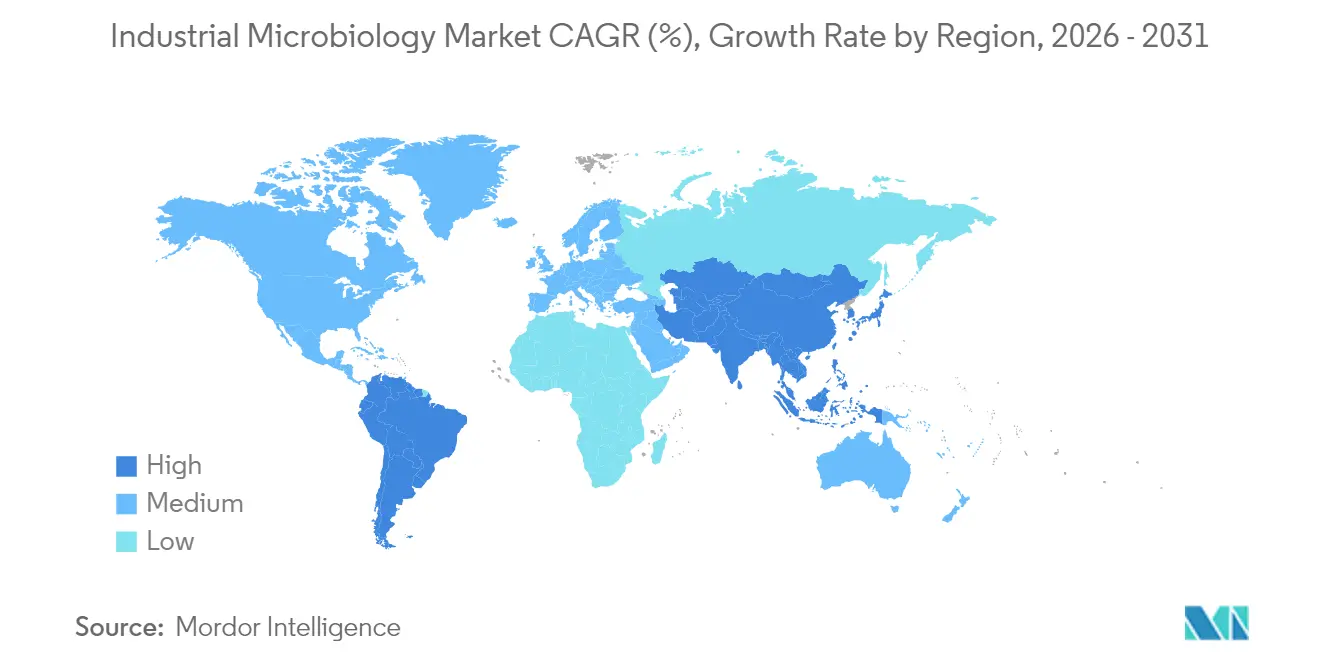
North America’s leadership stems from mature GMP enforcement and ongoing capital investment such as Thermo Fisher’s USD 2 billion U.S. upgrade program, which expands local single-use media output and strengthens supply resilience. Canadian biotech clusters leverage favorable R&D tax credits to develop microbial consortia for plant-based foods, whereas Mexican producers focus on cross-border harmonization to meet USMCA food-safety audits. Cybersecurity frameworks targeting automated data systems further differentiate regional vendors that embed role-based access controls and encrypted backups.
Asia-Pacific’s double-digit trajectory arises from China’s state-backed biologics plants seeking global cGMP accreditation, India’s vaccine and biosimilar exporters, and Japan’s functional-food incumbents requiring advanced strain-stability analytics. Government support for mRNA facilities in South Korea and Australia also accelerates demand for rapid QC solutions. Regional suppliers that localize consumable production reduce lead times and skirt import duties, capturing share from established multinationals.
Europe balances regulatory rigor with green-transition incentives. The EU’s push for ISCC Plus certification drives uptake of renewable-plastic consumables, as demonstrated by Sartorius’ 50% fossil-plastic reduction milestone. Germany and France spearhead bioprocess-4.0 pilot plants deploying predictive microbial analytics, while the UK channels public funding into phage-therapy R&D. Divergent GMO rules, however, oblige multi-national labs to run dual protocols, mildly constraining cross-border efficiencies.
Regulatory Landscape
Industrial microbiology demand continues to be shaped by tighter GMP and data-integrity expectations in biologics and advanced therapies, alongside modernization in food testing approaches. In the United States, FDA CGMP requirements (21 CFR Parts 210/211) remain a core baseline for microbial control programs, while a February 2026 final rule revoked 21 CFR 2.19 (methods of analysis). This change reinforces a move away from prescribing legacy methods and toward validated approaches that can accommodate modern rapid microbiological methods when properly demonstrated.
Regulatory scrutiny around bioprocess facilities intensified in 2026 through agency actions that affect inspection readiness and microbiological control strategies. FDA issued Compliance Program 7346.832M for prelicense and preapproval inspections of CDER-regulated biological product manufacturers (effective May 14, 2026), requiring manufacturers to present audit-ready contamination control and documentation aligned with application-linked inspections. In Europe, EMA updated stability testing for variations in December 2025 (effective January 15, 2026), and expanded Q&A for biological medicinal products on safety-related in-process controls and bioburden expectations. Parallel EU workstreams on revising GMP guidance for ATMPs add further compliance pressure for advanced-therapy manufacturers.
Value Chain Analysis
The industrial microbiology value chain spans (1) raw inputs (agar, hydrolysates, dyes, enzymes, primers, plastics and resins for sterile disposables), (2) formulation and manufacturing of media, reagents, and single-use consumables, (3) instrument and software platforms for incubation, detection, and data capture, and (4) distribution through direct sales, specialized distributors, and OEM channels to end users in food, beverage, biopharma, fermentation, and environmental applications. A recurring bottleneck sits in downstream processing, where converting fermentation broth into stable, consistent powders requires specialized engineering and contract processing capacity. This adds lead-time and qualification complexity for microbial materials used in production and QC.
CDMOs and specialized scale-up partners are increasingly central intermediaries, providing validated fermentation capacity, downstream processing, and regulatory support that reduce internal capex and shorten time to commercialization for innovators. Partnership patterns illustrate this structure: myBIOS aligned with Olon (March 2026) to pair a fermentation platform with industrial-scale manufacturing and downstream capacity, Dyadic broadened commercialization paths via Fermbox Bio (December 2025) and an OEM distribution agreement through IBT Bioservices (March 2026), and LBB Specialties partnered with Ruby Bio (July 2026) to advance market readiness for fermentation-derived emulsifiers in North America. Taken together, these moves point to a value chain where platform developers, CDMOs, and channel partners jointly support qualification, validation, and supply continuity, while geographic concentration of some key starting materials keeps resilience and multisourcing a priority for regulated end users.
Competitive Landscape
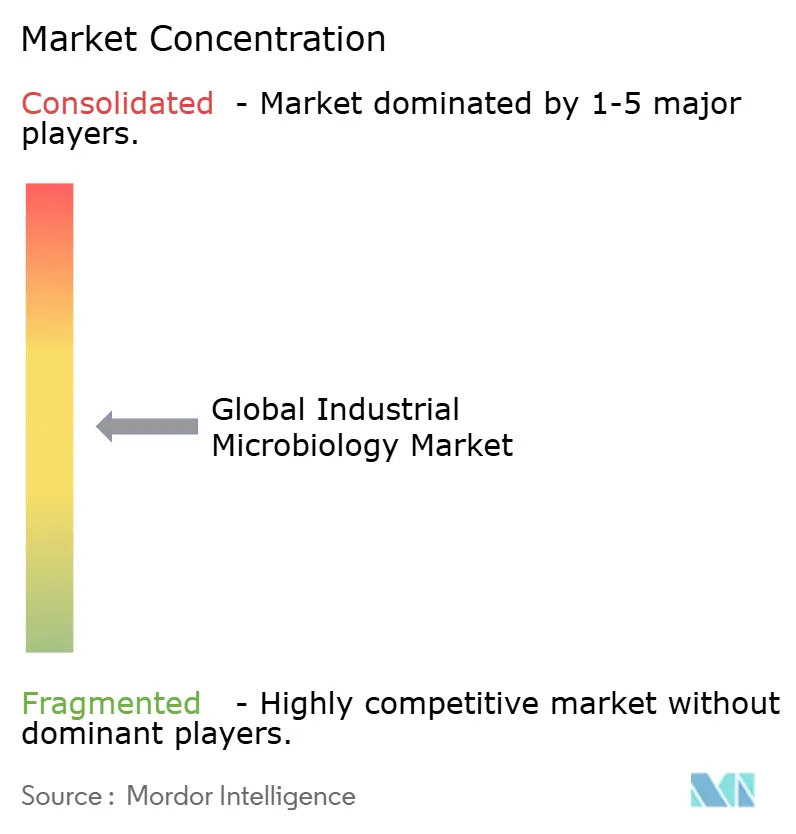
The industrial microbiology market exhibits moderate consolidation: Thermo Fisher’s USD 4.1 billion purchase of Solventum’s purification arm broadens its downstream footprint, while the contemplated USD 4 billion divestiture of its microbiology unit signals portfolio pruning to focus on high-growth adjacencies. bioMérieux, Merck KGaA’s MilliporeSigma, and Danaher’s Cytiva advance automation strategies that integrate sample prep, incubation, detection, and compliance archiving in one ecosystem. Novonesis leverages its expanded enzyme library to cross-sell QC reagents into food and biofuel accounts.
Private-equity interest is rising, evidenced by outreach to Thermo Fisher on the potential microbiology-unit sale and by BD’s intent to spin off its USD 3.4 billion Diagnostics & Biosciences arm, which could reshape competitive alignments. Smaller innovators like Tetsuwan Scientific attract seed funding for AI-driven robotic scientists that automate repetitive bench tasks, threatening to lower barriers for new entrants. Vendors investing early in cybersecurity-by-design obtain a reputational edge, as data-integrity audits become central to vendor-selection criteria across pharma and food customers.
Pricing pressure remains contained because consumable stickiness offsets equipment-margin dilution, and multi-year service contracts lock in software subscriptions. Still, labs continue to negotiate dual-sourcing agreements to buffer supply shocks. Suppliers that can guarantee continuity via regionally-redundant plants enjoy preferential status in OEM qualification lists, reinforcing barriers for late-stage challengers.
Global Industrial Microbiology Industry Leaders
-
bioMerieux SA
-
Bio-Rad Laboratories Inc.
-
Thermo Fisher Scientific Inc.
-
Becton Dickinson and Company
-
Qiagen NV
- *Disclaimer: Major Players sorted in no particular order
Market Opportunities and Future Outlook
Biologics and advanced-therapy manufacturing investments are expanding the installed base that operates under tighter contamination control, electronic data integrity, and rapid release pressures. That mix creates whitespace for faster, validated microbiological methods and integrated QC workflows. In 2026, major capacity announcements and expansions by Genentech (Holly Springs, North Carolina, approximately USD 2 billion investment increase), UCB (selection of Gwinnett County, Georgia, for a new 460,000-square-foot biologics facility), and Celltrion (Songdo expansion plans with total capacity cited at 180,000 liters, plus Branchburg, New Jersey expansion) illustrate the scale of new manufacturing footprints. These facilities require sustained sterility, bioburden, endotoxin, and environmental monitoring consumables, instruments, and compliant data systems.
Precision fermentation and alternative protein commercialization are also increasing demand for in-house species verification, spoilage control, and strain stability analytics, which fit directly within industrial microbiology toolkits. StrainX Bioworks raising USD 13 million in May 2026 to scale a precision fermentation platform in India supports that shift, while The Protein Brewery reporting EU novel food approval for Fermotein and an EUR 18 million Series B extension (June 2026) points to the growing need for standardized, high-throughput QC in food-grade and industrial-scale settings. With supply-chain disruptions and validation burdens still visible, the most immediate opportunities concentrate around multisource-qualified consumables, chemically defined media that reduce variability, and software-integrated systems that convert microbiology results into audit-ready records across global sites and contract manufacturing networks.
Recent Industry Developments
- July 2026: bioMeriéux launched GENE-UP PROBIOTIC SPECIES ID, a PCR solution designed for in-house quality control to verify probiotic species claims in dietary supplement manufacturing in under 90 minutes. The launch supports faster release decisions and tighter label-claim verification as supplement producers face higher scrutiny on strain identity and contamination control.
- December 2025: Thermo Fisher Scientific expanded its Gibco Bacto portfolio with next-generation chemically defined fermentation media for E. coli biomanufacturing. Chemically defined inputs reduce raw material variability and simplify qualification, strengthening reproducibility for microbial production runs and associated QC workflows.
- February 2024: BD reported shortages affecting BACTEC blood-culture vials, a disruption that cascaded into microbiology lab continuity planning and reinforced multisourcing behavior for critical consumables. The event elevated procurement focus on alternative qualified suppliers and inventory visibility tools to protect testing uptime.
Research Methodology Framework and Report Scope
Market Definition and Coverage
For this study, the industrial microbiology market is defined as the revenue generated from products and equipment used to grow, detect, identify, and control microorganisms in industrial production and quality environments.
Scope exclusions: We exclude clinical patient diagnosis activities, academic basic research use, and outsourced laboratory services when they are sold as services rather than product-led industrial workflows.
Segmentation Overview
- By Product Type
- Equipment & Systems
- Fermentation Systems
- Bioreactors & Fermenters
- Filtration & Centrifugation Systems
- Others
- Consumables
- Media & Culture Preparations
- Petri Dishes & Vials
- Other Consumables
- Reagents
- Enzymes & Buffers
- Others
- Equipment & Systems
- By Application Area
- Food & Beverage Industry
- Pharmaceutical & Biotechnology Industry
- Agricultural Industry
- Environmental Industry
- Cosmetic / Personal-Care Industry
- Other Application Areas
- By Microbial Type
- Bacteria
- Yeasts & Molds
- Viruses & Phages
- By Test Type
- Sterility Testing
- Bioburden Testing
- Endotoxin Testing
- Others
- By Geography (Value)
- North America
- United States
- Canada
- Mexico
- Europe
- Germany
- United Kingdom
- France
- Italy
- Spain
- Rest of Europe
- Asia-Pacific
- China
- Japan
- India
- Australia
- South Korea
- Rest of Asia-Pacific
- Middle East and Africa
- GCC
- South Africa
- Rest of Middle East and Africa
- South America
- Brazil
- Argentina
- Rest of South America
- North America
Data Sources, Market Sizing, and Validation
Desk Research
Desk research was used to set the factual base of the model and to avoid building assumptions in isolation. We pulled reference points from non-paywalled sources such as the US FDA (especially GMP and microbiological quality guidance), the US EPA for environmental and remediation signals, and publications from WHO and FAO where food safety microbiology practices are described.
To anchor adoption and operating activity, we also reviewed sources such as Eurostat, the US Census Bureau, and national customs and trade statistics that indicate manufacturing output and trade flows in relevant industries. Company annual reports, investor presentations, and reputable press were used to understand product mix language, regional exposure, and price direction. Where needed, a paid subscription source for company financials, patent databases, and shipment-level import or export records was used to cross-check the presence of product categories and the timing of demand changes. These examples are illustrative, and other public sources were used for data collection, validation, and research clarification.
Primary Interviews and Surveys
Primary work was conducted through expert interviews and structured surveys with manufacturers, distributors, and end users across quality assurance, production, and regulatory functions. We included demand-side users in food and beverage, industrial biotechnology, and environmental testing, then checked the direction of our assumptions with supply-side voices that track pricing and lead-time changes. Since this is a global market, regional coverage was balanced to reflect differences in manufacturing footprints and compliance intensity across APAC, EMEA, and the Americas.
Distribution of primary research fieldwork respondents
| Company type | Respondent position | Region |
|---|---|---|
| Top tier: 39% | CXOs: 16% | APAC: 38% |
| Mid tier: 45% | Functional/Unit leaders: 33% | EMEA: 37% |
| Smaller Players: 16% | Managers: 51% | Americas: 25% |
Market-Sizing & Forecasting
Sizing started with a top-down build where manufacturing activity and regulated quality-control intensity were used to reconstruct the addressable spend on industrial microbiology products. Once the demand pool was formed, it was translated into value using practical price and replacement assumptions, and then reviewed against selective bottom-up approximations from channel checks and sampled ASP times volume calculations.
Key inputs included indicators such as manufacturing output trends in relevant end industries, the frequency of sterility and environmental monitoring routines, installed base direction for key lab and monitoring equipment, consumables pull-through per testing workflow, and observed shifts toward rapid methods and single-use consumables. Where a data point was patchy by country, we filled the gap using proxy variables like industrial output and export mix, and then normalized results to avoid unrealistic jumps.
For forecasting, we used scenario analysis supported by expert consensus on drivers that move volumes and pricing, and then applied smoothing to avoid overreacting to one-time shocks. The model was stress-tested by changing a few core assumptions (for example, adoption speed of rapid methods and the pace of price progression) to make sure the final forecast stayed reasonable and explainable.
Data Validation & Update Cycle
Outputs were validated through multiple checks so the final number is not driven by one source or one assumption. We compared model totals with independent signals such as manufacturing production direction, regulatory activity indicators, and reported business momentum from public company disclosures, and then investigated large variances before sign-off.
Anomaly checks were done at the region level and for major product groupings to ensure the implied spend per site stayed realistic. If interview feedback or fresh public data pointed to a material change, respondents were re-contacted and assumptions were revisited. Reports are refreshed annually, with interim updates when major events occur, and a final pre-delivery review is completed so clients receive the latest updated view.
Mordor Intelligence's Industrial Microbiology Market Estimate Compared With Other Published Estimates
Published market sizes for industrial microbiology often differ because the included product basket and the usage setting are not consistent across sources, and then different price and adoption assumptions get layered on top. Differences also show up when one publisher picks an earlier base year, converts currencies using a different timing, or does not re-check the estimate after new regulatory or manufacturing signals emerge.
Some published figures appear to blend clinical diagnostic microbiology and outsourced testing services into the same total, which naturally lifts the number even if industrial activity is unchanged. In Mordor Intelligence, the estimate is restricted to industrial microbiology media, reagents, consumables, and relevant equipment used inside manufacturing and environmental workflows, and clinical patient diagnosis and service-only testing revenue are kept out of scope.
Benchmark comparison
| Source | Market Size | Gaps in Research Methodology |
|---|---|---|
| Mordor Intelligence | USD 14.53 B (2026) | |
| Industry Publisher A | USD 14.37 B (2024) | Uses an earlier base year and does not clearly state exclusions, so adjacent clinical or broader lab-testing uses can be unintentionally included. The lower value can also reflect limited carry-forward of equipment installed base and consumables pull-through into the current year. |
| Global Publisher B | USD 13.01 B (2024) | Relies on a broad segmentation structure but provides limited visibility on how industrial-only demand is separated from service revenue. Differences can also come from conservative assumptions on rapid-method adoption and price progression across consumables. |
The spread across the three values is mainly explained by the year selected and whether clinical and service revenues are folded into the same bucket as industrial product demand. By tying the model to manufacturing-linked testing routines, equipment presence, and consumables usage logic, our result stays traceable to a repeatable set of inputs that can be rechecked as new data is released.
Key Questions Answered in the Report
What is the current size of the industrial microbiology market?
The market is valued at USD 14.53 billion in 2026 and is projected to reach USD 20.71 billion by 2031.
Which region is growing fastest?
Asia-Pacific is forecast to expand at a 10.05% CAGR through 2031, driven by biopharmaceutical capacity additions and rising probiotic consumption.
Why are endotoxin tests in higher demand?
Biologics production is expanding, and regulators are tightening pyrogen limits, pushing endotoxin testing to a 9.01% CAGR—faster than any other test category.
How are suppliers responding to stricter food-safety rules?
Leading vendors now embed digital environmental monitoring, blockchain-ready documentation, and rapid PCR platforms to meet real-time traceability and 21 CFR 11 compliance needs.
What role does automation play in competitive advantage?
Integrated platforms that unite sample prep, incubation, detection, and data integrity lower turnaround times and improve audit readiness, helping vendors secure multi-year service contracts.