Industrial Furnace Market Size and Share
Market Overview
| Study Period | 2020 - 2031 |
|---|---|
| Market Size (2026) | USD 13.54 Billion |
| Market Size (2031) | USD 17.01 Billion |
| Growth Rate (2026 - 2031) | 4.68% CAGR |
| Fastest Growing Market | Asia Pacific |
| Largest Market | North America |
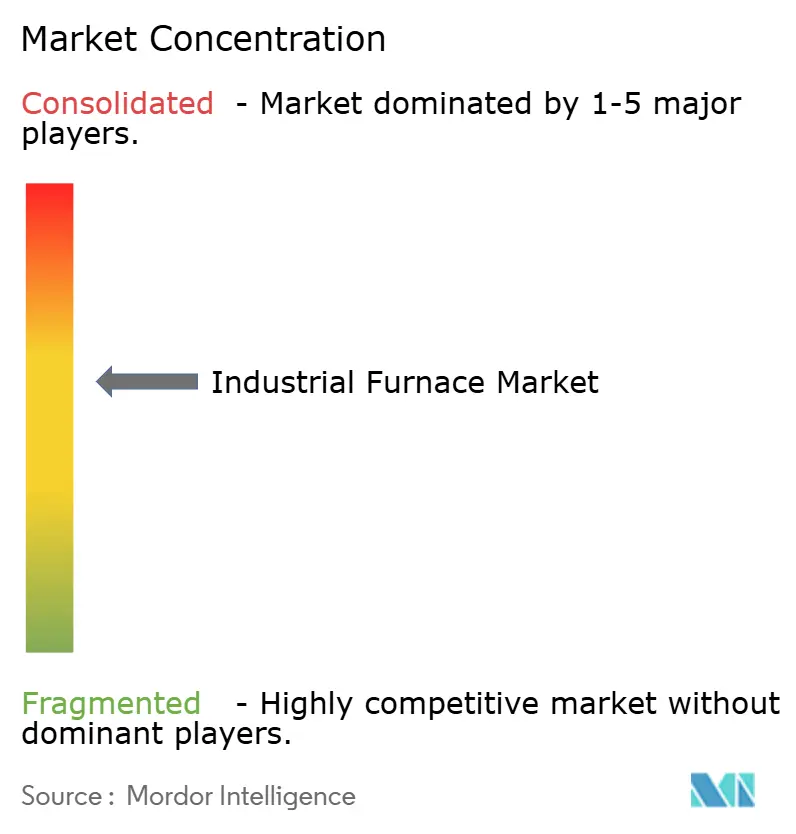
| Market Concentration | Medium |
Major Players *Disclaimer: Major Players sorted in no particular order Image © Mordor Intelligence. Reuse requires attribution under CC BY 4.0. | |
Industrial Furnace Market Analysis by Mordor Intelligence
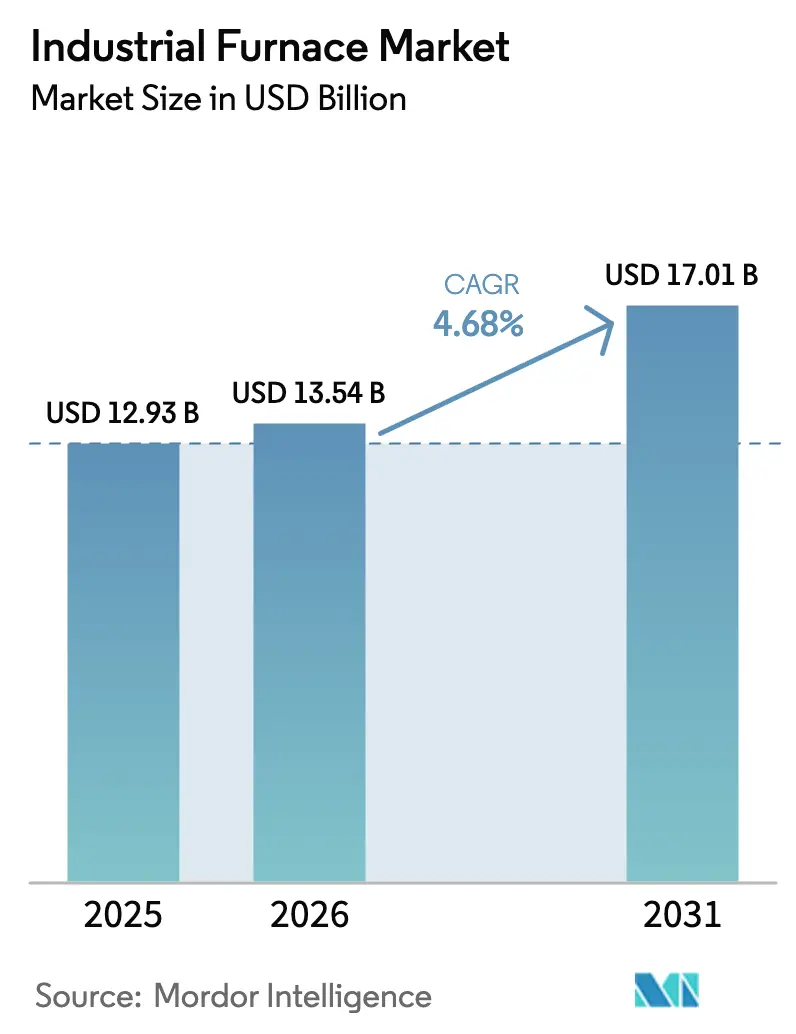
The industrial furnace market size is expected to grow from USD 12.93 billion in 2025 to USD 13.54 billion in 2026 and is forecast to reach USD 17.01 billion by 2031 at 4.68% CAGR over 2026-2031. Growth rests on steady demand for precision heat-treatment in automotive and aerospace manufacturing, accelerated adoption of hydrogen-ready and electric furnace technologies, and ongoing regulatory pressure to curb industrial emissions.[1]Primetals Technologies, “Hydrogen-Based Steel Production Technologies,” primetalstechnologies.com Manufacturers are investing in modular designs that lower installation time and enable distributed production, while digital control systems equipped with predictive maintenance reduce downtime and energy waste. Energy-efficiency retrofits in North America and decarbonization programs in Europe and Japan underpin short-term momentum, whereas large-scale capacity additions in the Asia-Pacific sustain long-term expansion. Competitive intensity is shaped by mid-sized engineering firms vying with global conglomerates for projects that bundle equipment, services, and software.
Key Report Takeaways
- By furnace type, gas/fuel roller hearth systems led with 44.10% of the industrial furnace market share in 2025; hydrogen-ready designs are forecast to expand at a 6.59% CAGR through 2031.
- By arrangement, box/chamber/muffle formats accounted for 37.45% of the industrial furnace market size in 2025, while tube/clamshell units posted the fastest 6.51% CAGR to 2031.
- By heating method, combustion-fired units held 51.10% of the industrial furnace market size in 2025; hybrid gas-electric solutions are set to grow at a 5.98% CAGR during the same period.
- By temperature range, operations between 1,000-1,500 °C dominated with 52.94% industrial furnace market share in 2025; installations rated above 1,500 °C are advancing at 5.58% CAGR.
- By end-user, metal and mining applications captured 33.72% of the industrial furnace market size in 2025; aerospace uses are progressing at a 6.55% CAGR through 2031.
- By geography, North America commanded 35.10% of the industrial furnace market size in 2025, whereas Asia-Pacific recorded the quickest 6.24% CAGR over the forecast horizon.
Note: Market size and forecast figures in this report are generated using Mordor Intelligence’s proprietary estimation framework, updated with the latest available data and insights as of 2026.
Global Industrial Furnace Market Trends and Insights
Drivers Impact Analysis*
| Driver | (~) % Impact on CAGR Forecast | Geographic Relevance | Impact Timeline |
|---|---|---|---|
| Surging demand for heat-treatment in automotive | +0.8% | North America and Europe | Medium term (2-4 years) |
| Investments in metal and mining capacity expansion | +0.9% | Asia-Pacific and Middle East-Africa | Long term (≥ 4 years) |
| Rapid adoption of electric furnaces | +0.7% | Europe and Japan; expanding to North America | Medium term (2-4 years) |
| Stringent energy-efficiency norms | +0.6% | North America and European Union | Short term (≤ 2 years) |
| Shift toward hydrogen-ready designs | +0.5% | Europe and Japan | Long term (≥ 4 years) |
| Growth of micro-scale modular furnaces | +0.4% | Global industrial clusters | Medium term (2-4 years) |
| Source: Mordor Intelligence | |||
Surging Demand for Heat-Treatment in Automotive Manufacturing
The pivot to electric vehicle production is reshaping thermal-processing requirements across global assembly plants. Battery housings, traction-motor cores, and lightweight body structures need heat-treatment profiles that minimize distortion and support tighter tolerances. Automakers therefore specify furnaces with rapid quench rates, inert atmospheres, and closed-loop controls that document every cycle for ISO 26262 compliance.[2]Tesla, “Manufacturing and Technology Updates,” tesla.com Suppliers integrating predictive-maintenance analytics achieve higher uptime, reducing total cost of ownership and strengthening competitive bids for long-term sourcing contracts.
Rising Investments in Metal and Mining Capacity Expansion
Steel and non-ferrous producers in China, India, and the Gulf Cooperation Council are building or revamping assets to meet infrastructure and energy-transition spending. Policies encouraging electric-arc furnaces (EAFs) over legacy blast furnaces drive replacement demand, while lower-grade ore processing boosts the need for furnaces with advanced refractory linings and oxygen-rich atmospheres that preserve throughput yet cut energy use.[3]China Iron and Steel Association, “Steel Industry Consolidation Policy,” chinaisa.org.cn Modular plants allow operators to stagger capital outlays and match future commodity cycles.
Accelerated Adoption of Electric Furnaces for Decarbonization Mandates
Carbon-pricing schemes, such as the European Union’s Carbon Border Adjustment Mechanism, elevate the cost advantage of low-emission manufacturing pathways. Steelmakers and foundries respond by deploying EAFs powered by renewable electricity, achieving up to 66% emission cuts relative to coke-fired routes. Government grants and tax credits in the United States further compress payback periods for electric retrofits, strengthening order pipelines for furnace OEMs specialized in high-current power supplies and off-gas capture systems.
Stringent Energy-Efficiency Norms Driving Furnace Retrofits
Minimum efficiency requirements enacted by the U.S. Department of Energy in 2024 oblige industrial facilities to upgrade burners, recuperators, and control software. The regulation accelerates replacement cycles for units reaching the end of service life and propels demand for real-time monitoring that verifies compliance. Vendors offering turnkey retrofit packages, including engineering, installation, and post-start-up training, secure multi-year service contracts that stabilize revenue streams.
Restraints Impact Analysis*
| Restraint | (~) % Impact on CAGR Forecast | Geographic Relevance | Impact Timeline |
|---|---|---|---|
| High capital and running costs for >1500°C installations | -0.6% | Global, particularly affecting specialty metals and advanced materials sectors | Medium term (2-4 years) |
| Volatility in natural gas and electricity prices | -0.4% | Europe and North America, with spillover effects in energy-intensive regions | Short term (≤ 2 years) |
| Skilled-operator shortage for complex heat-treat processes | -0.3% | Global, with acute shortages in North America and Europe | Long term (≥ 4 years) |
| Regulatory uncertainty on future carbon-pricing schemes | -0.2% | Europe and North America, expanding to Asia-Pacific | Medium term (2-4 years) |
| Source: Mordor Intelligence | |||
High Capital and Running Costs for > 1,500 °C Installations
Extreme-temperature furnaces cost upward of USD 10 million to install and consume 15-20% of plant operating budgets. Advanced refractories, custom alloys, and enhanced safety systems inflate upfront investment, while a global shortage of technicians specialized in ultra-high-temperature operations raises labor costs. Insurance premiums and stringent permitting add further overhead, extending payback periods and deterring adoption in smaller firms.
Volatility in Natural Gas and Electricity Prices
Geopolitical disruptions and supply-demand imbalances have lifted energy price variance beyond historical norms. For gas-fired furnaces in Europe, feedstock swings account for 40% of production cost uncertainty, complicating long-range budgeting.[4]Powernext, “European Natural Gas Price Volatility,” powernext.com Electric-furnace operators face similar volatility in regions with intermittent renewable penetration and capacity-market redesigns. Complex hedging raises financial overhead and dampens capital commitment to greenfield projects.
*Our forecasts treat driver/restraint impacts as directional, not additive. The impact forecasts reflect baseline growth, mix effects, and variable interactions.
Segment Analysis
By Furnace Type: Hydrogen Integration Reshapes Technology Landscape
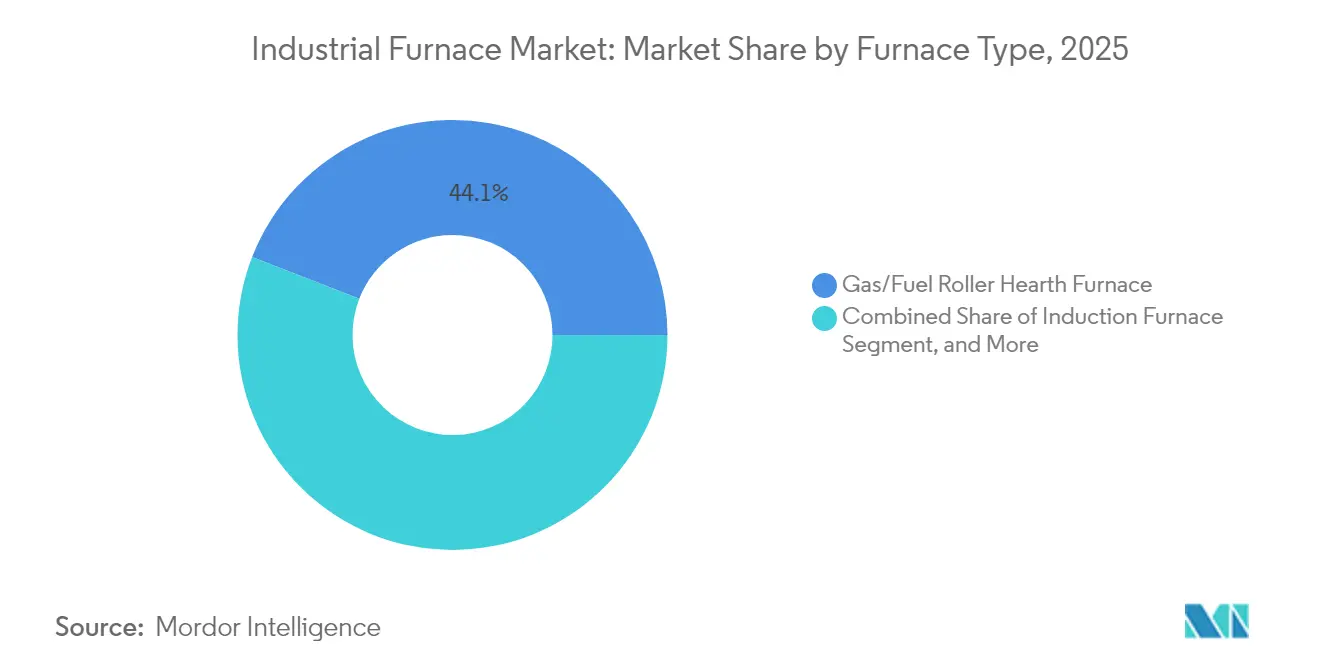
Hydrogen-ready designs form the fastest-moving segment with a 6.59% CAGR to 2031 as policy frameworks in Europe and Japan stipulate carbon-neutral process heat. Gas/fuel roller hearth equipment nonetheless retained 44.10% of the industrial furnace market share in 2025, favored for reliability and existing infrastructure. Hybrid burners allowing incremental hydrogen substitution widen user options, ensuring legacy assets remain productive throughout the transition.
Wider adoption of electric roller hearth furnaces in renewable-rich regions encourages OEMs to co-develop high-power transformers and sophisticated magnetic-field controls that reduce energy loss. Induction units remain the tool of choice for niche metallurgical applications requiring rapid heating and fine temperature gradients, whereas solar furnaces occupy a nascent but promising niche in high-irradiance zones willing to leverage concentrated solar power for specialty ceramics.


By Arrangement / Format: Modular Designs Drive Operational Flexibility
Box/chamber/muffle configurations delivered 37.45% of the industrial furnace market size in 2025 by serving batch processes across metals, machinery, and ceramics. Tube/clamshell systems are recording a 6.51% CAGR as producers switch to continuous-flow layouts that minimize dwell time and energy consumption. Car-bottom and bottom-loading designs retain importance in heavy-equipment production where oversized castings demand robust material-handling solutions.
Vacuum and controlled-atmosphere units capture rising share in aerospace and semiconductor back-end processing, reflecting chain-of-custody requirements for contamination-free surfaces. The industrial furnace industry now emphasizes plug-and-play skids that scale production without lengthy site work, aligning with lean manufacturing philosophies and reduced capital-risk appetites among mid-tier suppliers.
By Heating Method: Hybrid Systems Gain Strategic Importance
Combustion-based furnaces comprised 51.10% of the industrial furnace market size in 2025, yet face flat growth as emission caps tighten. Hybrid gas-electric solutions show 5.98% CAGR because they switch energy sources in real time, balancing grid charges against pipeline fuel prices. Resistance electric technology thrives in clean-environment sectors such as electronics, while induction electric units dominate specialty steels requiring fast, uniform heat penetration.
Heat-recovery and regenerative-burner upgrades boost the efficiency of existing combustion assets, extending their economic life and smoothing the pathway to low-carbon heat. OEMs bundle energy-management dashboards that guide operators toward the least-cost heat-source mix, reducing exposure to volatile spot markets.

By Temperature Range: Ultra-High-Temperature Applications Drive Innovation
Processes between 1,000-1,500 °C commanded 52.94% of the industrial furnace market share in 2025, integral to standard steel tempering, aluminum billet homogenization, and kiln-fired advanced ceramics. Demand for above-1,500 °C capabilities is rising 5.58% CAGR as aerospace engines and hypersonic systems need ultra-refractory alloys. Research programs at institutions such as Tohoku University spark supplier interest in next-generation insulation and cooling schemes that lengthen refractory life while trimming energy draw.
Below-1,000 °C furnaces serve food, pharmaceutical, and composites curing, where thermal uniformity rather than peak temperature dictates quality outcomes. Innovations in low-mass insulation reduce heat-up time by 25% and contribute incremental savings that multiply across continuous-flow lines running multiple shifts.
By End-User Industry: Aerospace Leads Growth Acceleration
Metal and mining held 33.72% of the industrial furnace market size in 2025, underpinned by primary steel, copper, and aluminum throughput. Aerospace registers the swiftest 6.55% CAGR to 2031 as manufacturers qualify advanced nickel-based superalloys and ceramic matrix composites necessitating precision temperature-soak profiles. Automotive OEMs and tier suppliers sustain steady spend on furnaces tailored to electric-vehicle components, while electronics and semiconductor producers adopt vacuum furnaces with sub-ppm contamination control for advanced node production.
Chemical and construction-machinery sectors represent durable demand pools, especially where national infrastructure programs boost cement, glass, and heavy-equipment volumes. Rising adoption of continuous-annealing lines and galvanizing furnaces in coated-steel markets further broadens end-user diversity and insulates suppliers from cyclical swings in any single vertical.
Geography Analysis
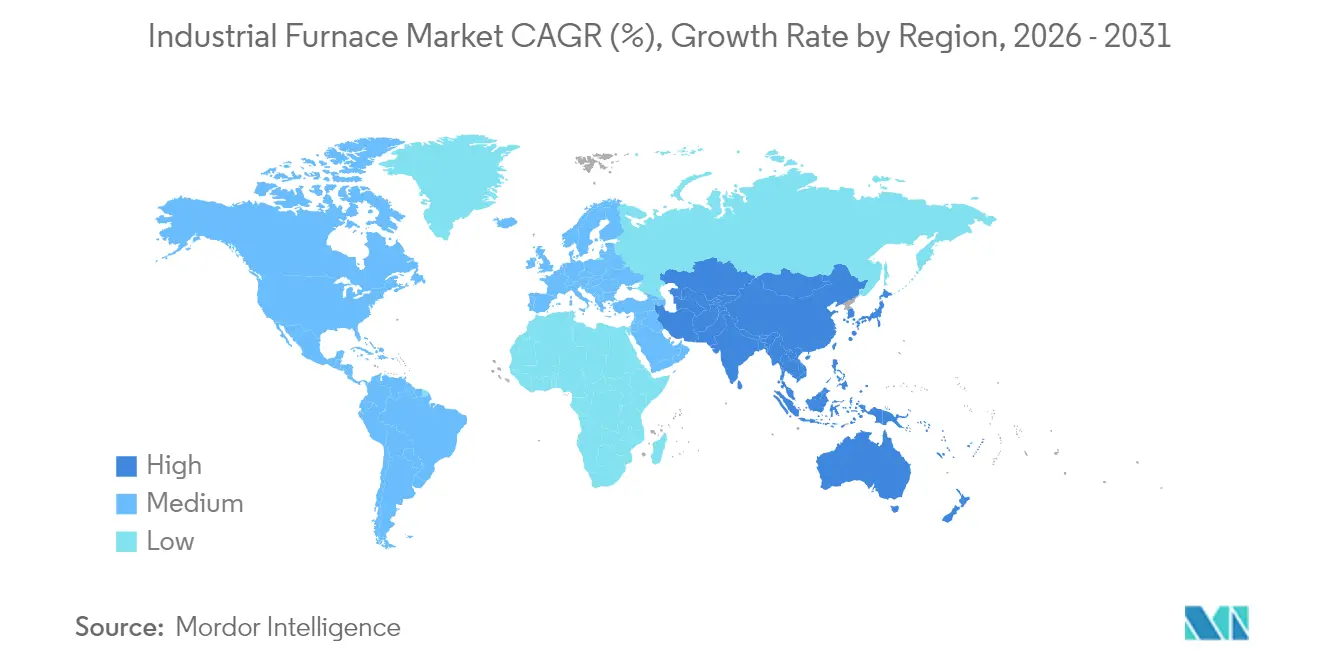
North America contributed 35.10% of the industrial furnace market size in 2025, driven by strong heat-treatment orders from U.S. automotive and aerospace hubs and compliance with updated Department of Energy standards. Expansion projects such as Nucor’s USD 3.0 billion EAF program and Canadian mining investments elevate baseline demand for high-capacity units. Skilled technical labor supports after-sales service revenue, though price volatility in natural gas and electricity remains a management priority.
Asia-Pacific records the quickest 6.24% CAGR, thanks to China’s steel sector modernization that replaces outdated blast furnaces with EAFs and India’s Production-Linked Incentive scheme that pulls forward capital spending on machinery and electronics capacity. Japan pioneers hydrogen-ready metallurgy, allocating JPY 329.4 billion to furnace upgrades that align with 2035 climate goals. South Korea, Singapore, and Australia round out regional growth by boosting semiconductor back-end and mineral-processing lines.
Europe sustains mid-single-digit growth anchored in climate policy compliance. Germany funnels public research grants toward hydrogen burners, while Italy modernizes heat-treatment fleets for specialty steel and automotive supply chains. The Carbon Border Adjustment Mechanism incentivizes furnace retrofits that cut Scope-1 emissions, and the Industrial Emissions Directive mandates best-available-technology upgrades in refractory, control systems, and waste-heat recovery. Eastern European markets, particularly Poland and Czechia, attract green-field investments in battery-component plants equipped with low-carbon furnaces.

Regulatory Landscape
Industrial furnace design and retrofit decisions are increasingly linked to emissions and energy-efficiency compliance, which is pushing buyers toward solutions that document performance. In the United States, air permitting and emissions compliance for volatile organic compounds (VOC) and hazardous air pollutants (HAP) are driving adoption of bundled furnace and abatement packages, including regenerative thermal oxidizer (RTO) integrations to satisfy destruction requirements while maintaining process stability. In addition, minimum efficiency requirements from the U.S. Department of Energy enacted in 2024 are accelerating upgrades to burners, recuperators, and control software, and they increase the value of monitoring systems that verify compliance.
In Europe, decarbonization and product-based carbon measures shape specification choices for low-emission process heat. The European Union Carbon Border Adjustment Mechanism and best-available-technology expectations under frameworks such as the Industrial Emissions Directive support demand for waste-heat recovery, off-gas handling, and modern controls that enable auditability and lower Scope 1 emissions intensity in energy-intensive operations.
Value Chain Analysis
The industrial furnace value chain starts with upstream inputs such as engineered steels, refractories, insulation, and high-temperature heating elements, including specialty materials such as molybdenum. It then extends to power and automation components, including transformers, PLCs, VFDs, sensors, and safety systems. OEMs and integrators carry out furnace thermal and mechanical design, fabrication, and assembly, increasingly packaging combustion, electric, or hybrid heating with digital controls and diagnostics. Emissions-control technologies, including RTOs, scrubbers, and associated ducting and heat recovery, act as a critical adjacent layer for projects where VOC/HAP abatement and permitting are central, as reflected in integrated furnace and thermal-oxidizer system configurations.
Downstream, engineering, procurement, and construction (EPC) partners, utilities, and specialist contractors support installation, commissioning, and operator training, while end users including metals and mining, automotive manufacturing, aerospace, electronics, and other process industries shape customization around temperature uniformity, atmosphere control, and throughput. Aftermarket services, such as spares, refractory relines, burner tuning, calibration, software updates, and predictive maintenance, are a material lifecycle element, particularly when modernization programs target existing assets like multi-furnace cell upgrades and revamps. Collaboration between technology providers and project partners is common in large metals lines, where multiple parties contribute terminals, line equipment, and furnace subsystems under an integrated delivery scope.
Competitive Landscape
The industrial furnace industry remains moderately fragmented, with the top five suppliers holding roughly 28% combined revenue. Global conglomerates such as Andritz AG, Tenova, and Inductotherm compete with niche engineering firms, including Ipsen International and SECO/WARWICK. Players differentiate through proprietary burner designs, digital twins, and tailored after-market service contracts that lock in recurring revenue.
Strategic moves center on digitalization and decarbonization. Ipsen retrofitted its global installed base with an IoT suite that trims unplanned downtime by 15%, whereas SECO/WARWICK introduced a cloud-based energy optimizer leveraging machine learning to cut cycle-fuel usage by up to 8%. RHI Magnesita acquired Resco Products for USD 340 million, gaining refractory technology vital for > 1,500 °C operations and strengthening supply security.
Emerging entrants target niche gaps: modular solar furnaces for specialty ceramics, skid-mounted induction units for additive-manufacturing post-processing, and hydrogen burner retrofits for existing batch lines. Incumbents respond through minority stakes or outright acquisitions to secure technology roadmaps while retaining scale economies in fabrication and global field-service teams.
Industrial Furnace Industry Leaders
Andritz AG
Carbolite Gero Limited
Epcon Industrial Systems LP
Gasbarre Products Inc.
International Thermal Systems LLC
- *Disclaimer: Major Players sorted in no particular order

Market Opportunities and Future Outlook
White-space is emerging around decarbonization-driven upgrades that combine core thermal equipment with power, controls, and compliance-ready emissions handling, especially for users balancing combustion assets with electrification and hydrogen readiness. In metals processing, ANDRITZ has highlighted a strategic focus on electrical steel production technology, including induction heating, supported by its December 2025 majority acquisition (51%) of Baoding Sanzheng Electrical Equipment. This underscores continued investment in specialized furnace and line technologies tied to electrical steel demand, alongside service-led opportunities that modernize installed bases rather than require full line replacements.
Modernization and retrofit programs continue to be a repeatable opportunity set across regions, particularly where operators extend furnace life through capacity, efficiency, and automation upgrades. Active multi-unit upgrade activity, including Henan Mingtai orders covering a new 120-ton furnace cell and modernization of existing 60-ton melting furnaces, illustrates demand for both greenfield and brownfield scope. Beyond metals, opportunities extend into high-value controlled-atmosphere and vacuum processes for advanced materials testing and processing, supported by specialized vacuum and atmosphere furnace offerings. There is also scope for integrated process-and-abatement packages for composites, adhesives, and sealants manufacturing, where VOC/HAP destruction requirements can drive procurement of ovens paired with RTO systems.
Recent Industry Developments
- June 2026: ANDRITZ AG - Announced a major contract to supply cold rolling mills, an annealing and pickling line, and skin-pass mills to Saritas Stainless Steel for a new plant in Yalova, Türkiye. The deal expands capacity for metals processing and strengthens high-capacity furnace systems for the Turkish stainless steel facility. The arrangement reflects expectations for Andritz to deliver end-to-end rolling and heat treatment lines, reinforcing its global metals equipment footprint.
- June 2026: Epcon Industrial Systems LP - Reported securing several major contracts and a robust project backlog in Q2 President's Business Outlook. The results point to continued demand momentum for industrial heating and thermal processing equipment. This backlog resilience supports firmer near-term market dynamics for Epcon's thermal processing offerings.
- June 2026: ANDRITZ AG - Announced a major contract to supply cold rolling mills, an annealing and pickling line, and skin-pass mills to Saritas Stainless Steel for a new plant in Yalova, Türkiye. The project solidifies Andritz involvement in Turkey's metal fabrication supply chain and expands its global footprint. The deal highlights Andritz capacity to deliver integrated heat treatment and rolling solutions across regions.


Research Methodology Framework and Report Scope
Market Definition and Coverage
For this study, the industrial furnace market covers revenue earned from industrial-grade heat processing furnaces used in manufacturing plants for melting, reheating, heat treatment, sintering, and similar controlled thermal operations.
Scope exclusions: We exclude residential and commercial HVAC furnaces, small lab ovens, and non-industrial heating equipment that is not used for production processing.
Segmentation Overview
- By Furnace Type
- Gas/Fuel Roller Hearth Furnace
- Electric Roller Hearth Furnace
- Induction Furnace
- Hydrogen-ready Furnace
- Solar Furnace
- By Arrangement / Format
- Box/Chamber/Muffle Furnace
- Tube/Clamshell Furnace
- Bottom Loading/Car Bottom Loading Furnace
- Top Loading Furnace
- Vacuum/Atmosphere/Heat-Treatment Furnace
- By Heating Method
- Combustion-Fired
- Resistance Electric
- Induction Electric
- Hybrid (Gas plus Electric)
- By Temperature Range
- Below 1 000 °C
- 1 000 – 1 500 °C
- Above 1 500 °C
- By End-user Industry
- Chemicals
- Metal and Mining
- Automotive Manufacturing
- Construction Machinery
- Aerospace
- Electronics and Semiconductors
- Other End-user Industries
- By Geography
- North America
- United States
- Canada
- Mexico
- South America
- Brazil
- Argentina
- Rest of South America
- Europe
- Germany
- United Kingdom
- France
- Italy
- Spain
- Rest of Europe
- Asia-Pacific
- China
- Japan
- South Korea
- India
- Singapore
- Australia
- Rest of Asia-Pacific
- Middle East and Africa
- Middle East
- Saudi Arabia
- United Arab Emirates
- Turkey
- Rest of Middle East
- Africa
- South Africa
- Nigeria
- Egypt
- Rest of Africa
- Middle East
- North America
Data Sources, Market Sizing, and Validation
Desk Research
Our desk work starts with mapping the demand centers that consistently buy furnaces and major retrofits, such as steelmaking and foundries, nonferrous metals, glass, ceramics, and chemical processing. We use public manufacturing and industrial output series to set direction, and then cross-check them with plant-level capacity additions and shutdown announcements reported in reputable press and association updates.
For grounded inputs, we refer to sources such as the World Steel Association, the US Energy Information Administration, Eurostat industrial production statistics, the US Geological Survey (metals and minerals indicators), and UN Comtrade trade data for relevant equipment categories. Company filings, annual reports, and investor presentations help verify order cycles, backlog commentary, and regional exposure, and a paid subscription for company financials and news is used to speed up screening and consistency checks. This list is not exhaustive, and many other public sources were also reviewed for data collection, validation, and research clarification.
Primary Interviews and Surveys
To pressure-test the desk assumptions, we run expert interviews and targeted surveys across furnace OEMs, component suppliers, engineering teams, plant operations, and maintenance decision-makers. Coverage is kept global, since replacement cycles, fuel switching, and emissions compliance timelines vary by region and strongly affect demand timing and average selling price assumptions.
Distribution of primary research fieldwork respondents
| Company type | Respondent position | Region |
|---|---|---|
| Top tier: 27% | CXOs: 21% | APAC: 43% |
| Mid tier: 51% | Functional/Unit leaders: 31% | EMEA: 35% |
| Smaller Players: 22% | Managers: 48% | Americas: 22% |
Market-Sizing & Forecasting
Sizing is built using a top-down view that reconstructs the furnace demand pool from end-use production activity and capital spending signals, which are then filtered through typical replacement cycles and modernization triggers. The total is corroborated with selective bottom-up approximations using sampled project values, supplier roll-ups for key furnace types, and channel checks on delivered systems and major retrofits, and then adjusted if the two views do not align.
Key inputs used in the model include crude steel output trends, growth in foundry and nonferrous casting volumes, industrial energy prices (gas and power), emissions compliance programs that push efficiency upgrades, and announced capacity additions in steel, glass, and chemicals. Since pricing can move with energy-efficiency features and automation content, average selling price progression is tested using primary feedback and recent contract narratives, before final totals are locked.
For forecasting, scenario analysis is used so downside cases capture delayed capex cycles and upside cases capture faster electrification and hydrogen-ready upgrades. Where bottom-up information is missing for smaller geographies, ratios based on industrial output and installed base proxies are applied, and then verified through follow-up calls to avoid overstatement.
Data Validation & Update Cycle
Outputs are validated through multiple checks, including year-on-year variance review, outlier detection by region, and consistency checks against independent signals such as steel and metals production, industrial electricity and gas usage trends, and announced plant investments. When a large mismatch is seen, assumptions are revisited and experts are re-contacted to confirm whether it is a real shift, a timing issue, or a scope mismatch.
Before sign-off, the model is reviewed in steps by another analyst to confirm inputs, formulas, and unit conversions, and then narrative drivers are checked against the final numbers. Reports refresh annually, and interim updates are made when material events occur, after which a final pre-delivery pass is completed so clients receive the latest updated view.
Mordor Intelligence's Industrial Furnace Market Size Versus Other Published Estimates
Published market values for industrial furnaces can differ because each publisher draws the market boundary differently and uses different plant investment signals, price logic, and base-year timing. Differences also come from whether the model leans more on new furnace installations, retrofits and rebuilds, or broader thermal equipment that sits close to this category.
Steel output direction, industrial energy-price movements, and a sanity check against announced furnace upgrade projects are the evidence points that keep Mordor Intelligence's estimate tied to the manufacturing heat-processing demand pool, instead of drifting into adjacent heating equipment. In practice, gaps usually show up in how service revenues are treated, how aggressive the replacement cycle is assumed to be, and how currency conversion and inflation are handled for multi-region totals.
Benchmark comparison
| Source | Market Size | Gaps in Research Methodology |
|---|---|---|
| Mordor Intelligence | USD 13.54 B (2026) | |
| Global Publisher A | USD 14.70 B (2028) | Uses a different forecast endpoint and may apply a broader segmentation that blends multiple furnace types and applications, which can lift totals when pricing is rolled forward uniformly across regions. |
| Industry Publisher B | USD 18.40 B (2031) | The higher endpoint value can be driven by a more aggressive capex cycle and wider inclusion of retrofit and service activity, with less visible checks against end-use production indicators and project timing. |
The comparison shows that spread is mainly explained by horizon differences and what gets counted around installations versus upgrades and services. By anchoring assumptions to repeatable signals and then cross-checking them with interview feedback, the final number stays traceable to clear drivers and can be updated consistently as new capacity and energy conditions change.


Key Questions Answered in the Report
What is the forecast value of the industrial furnace market in 2031?
The industrial furnace market is projected to reach USD 17.01 billion by 2031.
How fast is demand for hydrogen-ready furnaces growing?
Hydrogen-ready designs are expected to expand at a 6.59% CAGR through 2031 as decarbonization policies tighten.
Which region is growing the quickest for new furnace installations?
Asia-Pacific records the fastest 6.24% CAGR, propelled by Chinese steel upgrades and Indian manufacturing incentives.
Why are hybrid gas-electric furnaces gaining popularity?
They let operators switch energy sources in response to real-time fuel and electricity prices, improving cost control and emission compliance.
Which end-user sector shows the highest growth in furnace demand?
Aerospace leads with a 6.55% CAGR due to advanced materials that require precise, high-temperature processing.
How fragmented is the competitive landscape?
The market concentration score is 6, indicating moderate consolidation, with the top five firms holding roughly 60-70% combined revenue.
Page last updated on: