
Market Overview
| Study Period | 2021 - 2031 |
|---|---|
| Market Size (2026) | USD 59.57 Billion |
| Market Size (2031) | USD 74.67 Billion |
| Growth Rate (2026 - 2031) | 4.62 % |
| Fastest Growing Market | Asia-Pacific |
| Largest Market | Europe |
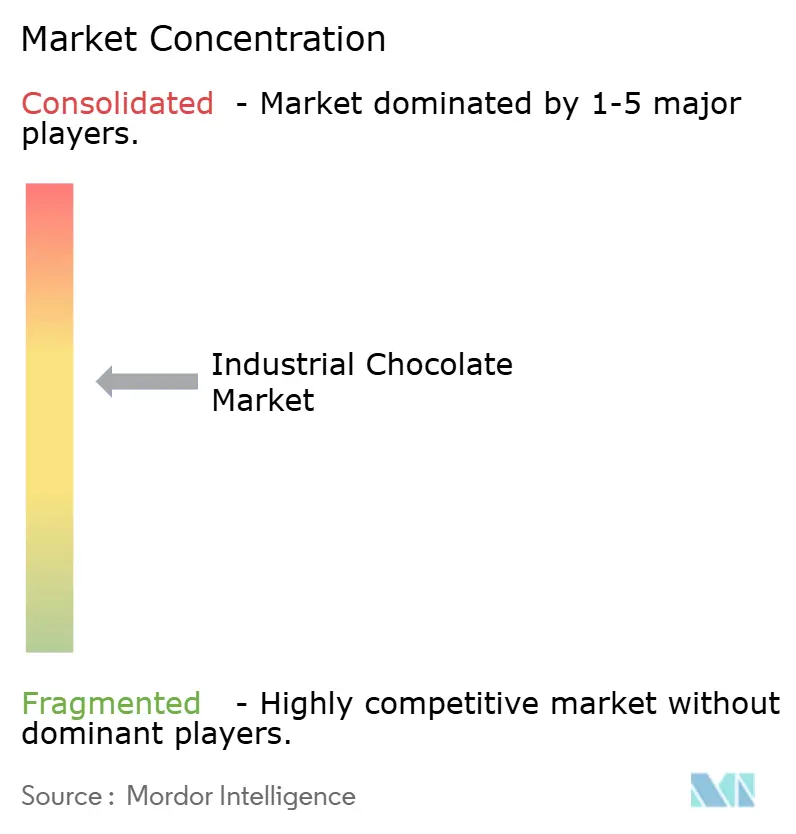
| Market Concentration | Medium |
Major Players *Disclaimer: Major Players sorted in no particular order Image © Mordor Intelligence. Reuse requires attribution under CC BY 4.0. | |
Industrial Chocolate Market Analysis by Mordor Intelligence
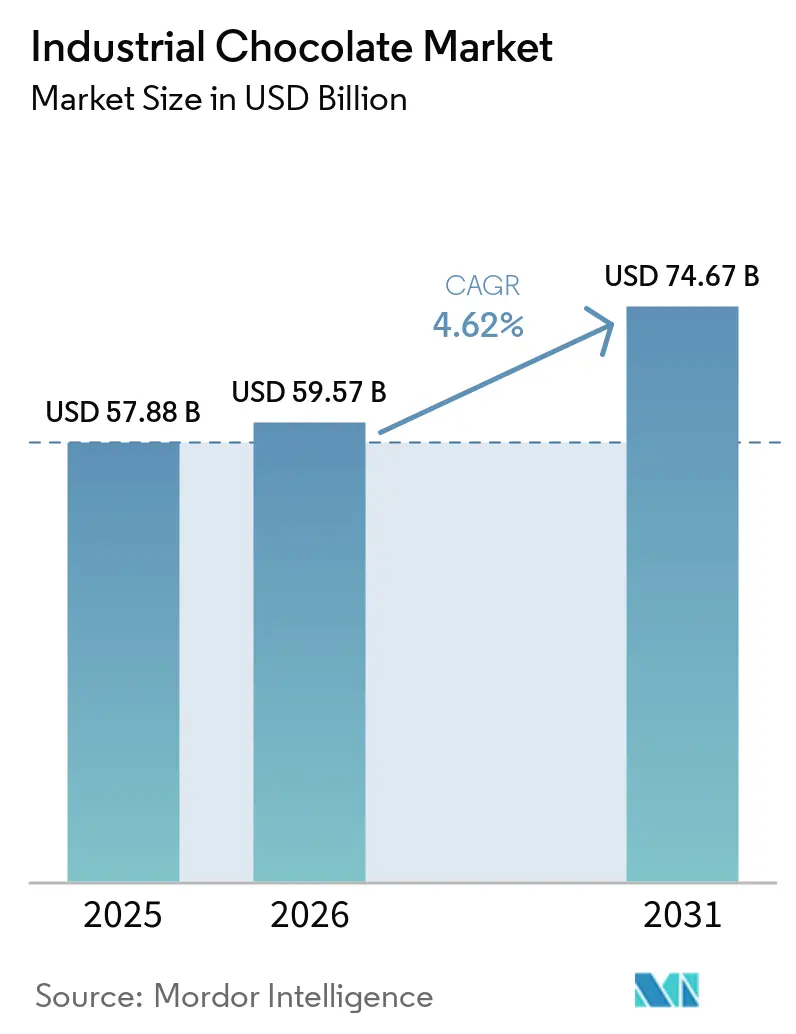
The industrial chocolate market was valued at USD 57.88 billion in 2025 and is estimated to grow from USD 59.57 billion in 2026 to reach USD 74.67 billion by 2031, registering a compound annual growth rate (CAGR) of 4.62% during 2026-2031. The global industrial chocolate market is experiencing growth driven by increasing demand from large-scale food manufacturers that use chocolate as a primary ingredient in bakery, confectionery, dairy products, and ready-to-eat desserts. Urbanization and rising disposable incomes have led to higher consumption of packaged sweets and indulgent snacks. According to the World Bank Group, the urban population as a percentage of the total population was 58% in 2024[1]. Product innovations, including premium, single-origin, organic, and reduced-sugar formulations, are further encouraging adoption by various brands. Moreover, the expansion of cafés, quick-service restaurants, and artisanal dessert chains has increased bulk chocolate procurement. According to the International Franchise Association, in 2024, 199,931 quick-service restaurant franchise establishments in the United States[2]. Seasonal gifting traditions and the growth of e-commerce distribution channels are also contributing to the rising demand for industrial chocolate production and supply.
Key Report Takeaways
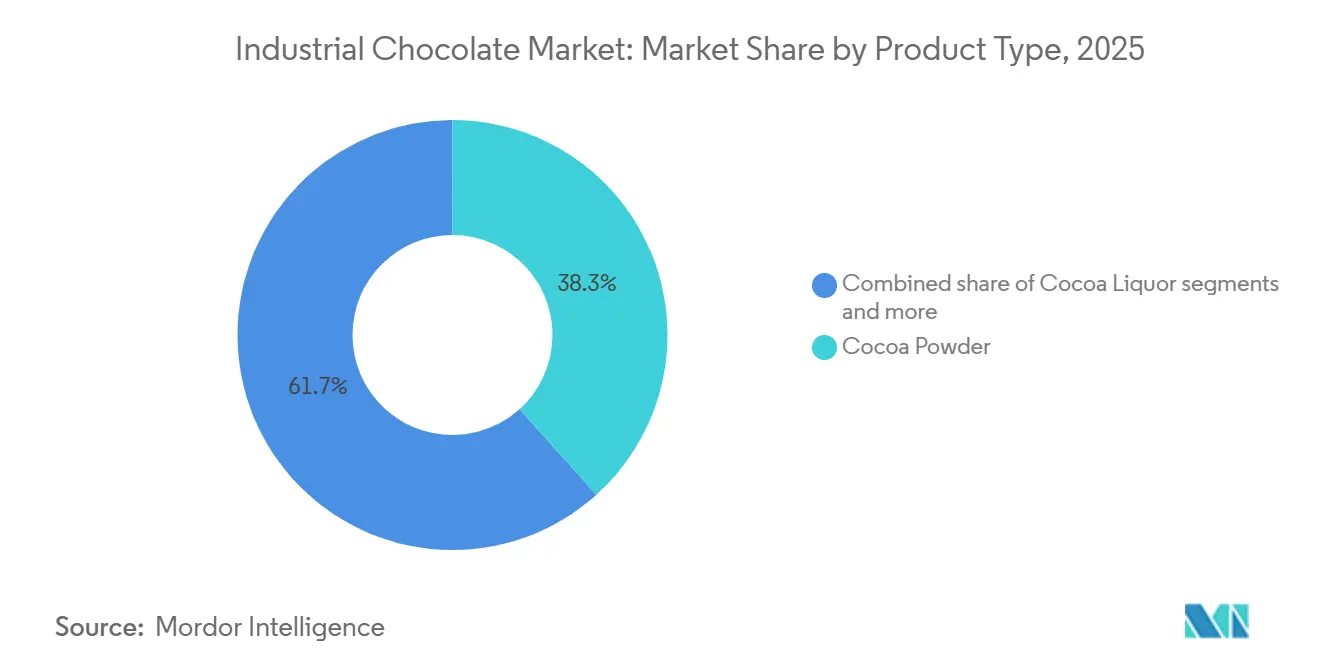
- By product type, cocoa powder led with 38.33% of the industrial chocolate market share in 2025, while compound chocolate is projected to rise at a 6.35% CAGR during 2026-2031.
- By cocoa content, medium-cocoa variants held 46.13% share in 2025; high-cocoa products are forecast to expand at a 6.24% CAGR through 2031.
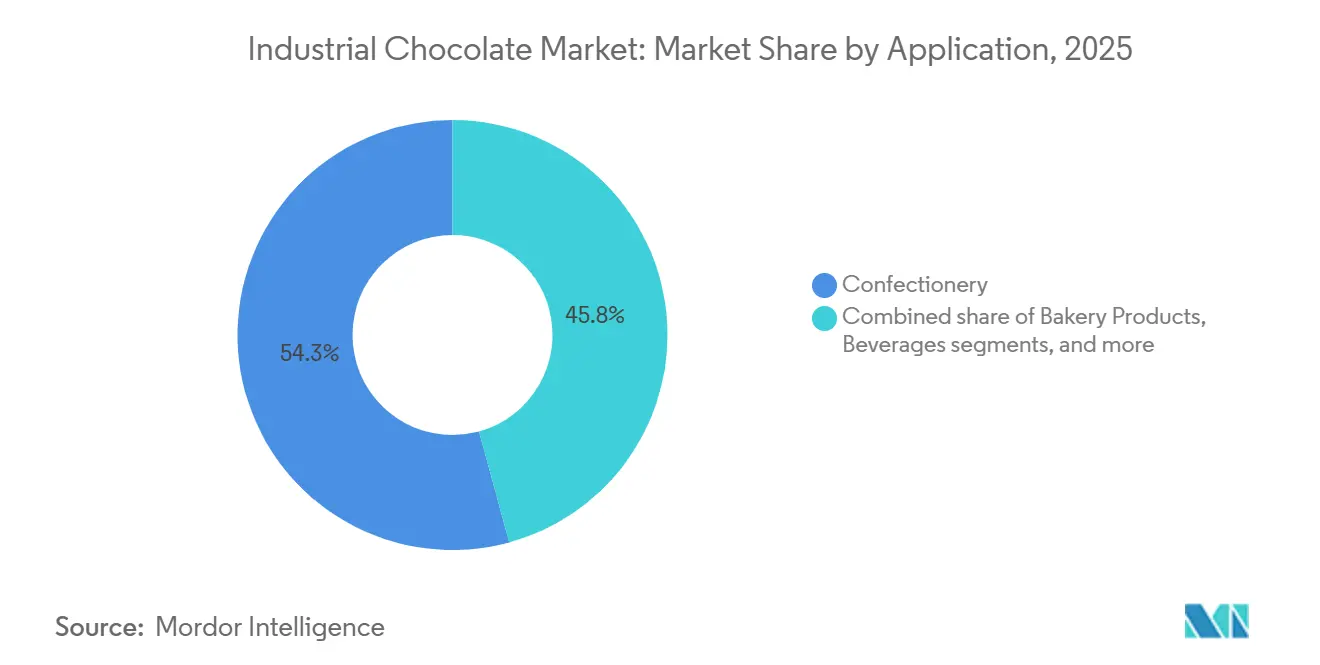
- By application, confectionery captured 54.25% of 2025 revenue, and frozen desserts and ice creams are on track for a 6.91% CAGR to 2031.
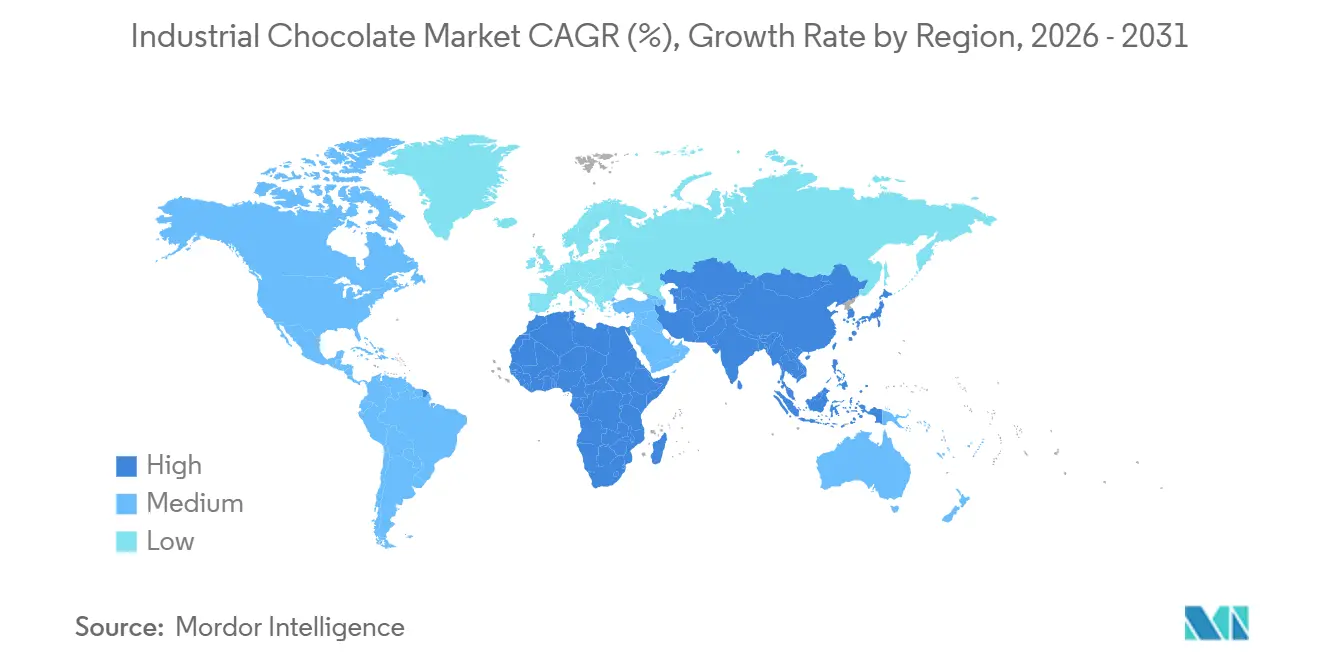
- By geography, Europe accounted for 34.05% of the 2025 value, whereas Asia-Pacific is expected to grow at a 6.58% CAGR over 2026-2031.
Note: Market size and forecast figures in this report are generated using Mordor Intelligence’s proprietary estimation framework, updated with the latest available data and insights as of January 2026.
Global Industrial Chocolate Market Trends and Insights
Drivers Impact Analysis*
| Driver | (~) % Impact on CAGR Forecast | Geographic Relevance | Impact Timeline |
|---|---|---|---|
| Expanding bakery, confectionery, dairy, dessert, and ice-cream sectors increasing demand for multi-use chocolate ingredients | +1.2% | Global, with pronounced growth in Asia-Pacific and Middle East | Medium term (2-4 years) |
| Growing preference for premium, artisanal, single-origin, and bean-to-bar chocolates | +0.9% | North America, Europe, urban Asia-Pacific hubs | Long term (≥ 4 years) |
| Rising demand for dark, low-sugar, sugar-free, and functional chocolates due to health benefits | +0.8% | North America, Europe, Australia | Medium term (2-4 years) |
| Advancements in processing technologies improving quality, efficiency, and specialized formulations | +0.6% | Global, led by Europe and North America | Short term (≤ 2 years) |
| Increasing adoption of organic ingredients, natural sweeteners, and clean-label formulations | +0.7% | North America, Europe, Australia | Medium term (2-4 years) |
| Stringent food safety, labeling, and sustainability regulations driving certified production practices | +0.5% | Europe (EFSA), North America (FDA), spreading to Asia-Pacific | Long term (≥ 4 years) |
| Source: Mordor Intelligence | |||
Expanding bakery, confectionery, dairy, dessert, and ice-cream sectors increasing demand for multi-use chocolate ingredients
The expansion of the bakery, confectionery, dairy, dessert, and ice cream industries is driving increased demand for versatile chocolate ingredients in bulk production. Food manufacturers are utilizing industrial chocolate in various forms, including chips, compounds, coatings, fillings, and cocoa powders, to produce a diverse range of products such as cakes, cookies, pastries, flavored milk, frozen desserts, and premium sweets. With growing consumer interest in indulgent and innovative flavors, producers are consistently introducing chocolate-based variations, necessitating a reliable and scalable supply of ingredients. This broad applicability positions industrial chocolate as a critical raw material for large-scale food processing, contributing to the global growth of the market.
Growing preference for premium, artisanal, single-origin, and bean-to-bar chocolates
The growing consumer preference for premium, artisanal, single-origin, and bean-to-bar chocolates is a significant driver of the global industrial chocolate market. Consumers increasingly value chocolate for its quality, authenticity, and sensory appeal rather than solely for its affordability. This trend has prompted brands to incorporate higher-grade cocoa, unique flavor profiles, and traceable sourcing into their products. To address these evolving preferences, confectionery and bakery manufacturers source specialized couverture, high-cocoa-content masses, and origin-specific ingredients from industrial suppliers that ensure consistent taste and standardized processing at scale. Even mass-market companies are enhancing their product lines with premium offerings, limited editions, and cleaner labels, thereby increasing the demand for high-quality bulk chocolate inputs and contributing to overall market growth.
Rising demand for dark, low-sugar, sugar-free, and functional chocolates due to health benefits
The growing demand for dark, low-sugar, sugar-free, and functional chocolates is driving significant growth in the global industrial chocolate market. Health-conscious consumers are increasingly seeking indulgent foods that align with wellness objectives, such as reduced sugar intake, higher antioxidant levels, and improved metabolic health. This trend is prompting food manufacturers to reformulate products with higher cocoa content, alternative sweeteners, and functional ingredients like fiber, protein, or probiotics, thereby increasing the demand for specialized bulk chocolate formulations. Industry data highlights this shift, according to Barry Callebaut's "Top Chocolate Trends 2024," 77% of consumers prefer milk with cocoa and chocolate with less sugar, 41% aim to reduce sugar consumption, and 15% are avoiding sugar entirely[3]. Consequently, industrial suppliers are broadening their portfolios to include high-cocoa, no-added-sugar, and functional chocolate bases, supporting large-scale production and driving overall market growth.
Increasing adoption of organic ingredients, natural sweeteners, and clean-label formulations
The increasing use of organic ingredients, natural sweeteners, and clean-label formulations is driving the growth of the global industrial chocolate market. Consumers are showing a preference for products made with identifiable and minimally processed ingredients, leading food brands to replace artificial additives, refined sugars, and synthetic flavors with organic cocoa, plant-based sweeteners like stevia or coconut sugar, and natural emulsifiers. To align with these preferences while ensuring taste, texture, and shelf stability, manufacturers rely on specialized industrial chocolate that adheres to certification standards and delivers consistent processing performance. This emphasis on transparency and ingredient traceability is boosting the large-scale procurement of certified and clean-label chocolate inputs, thereby increasing demand across confectionery, bakery, and dairy applications globally.
Restraints Impact Analysis*
| Restraint | (~) % Impact on CAGR Forecast | Geographic Relevance | Impact Timeline |
|---|---|---|---|
| Cocoa supply volatility | -0.8% | Global, most acute in Europe and North America dependent on West African imports | Short term (≤ 2 years) |
| Rise of plant-based, low-sugar substitutes, and non-chocolate snacks | -0.4% | North America, Europe, urban Asia-Pacific | Medium term (2-4 years) |
| Trade barriers, export restrictions from cocoa-origin countries | -0.3% | Europe, North America, Asia-Pacific importers | Medium term (2-4 years) |
| Quality consistency challenges | -0.2% | Global, particularly affecting mid-tier processors | Short term (≤ 2 years) |
| Source: Mordor Intelligence | |||
Cocoa supply volatility
Cocoa supply volatility significantly restrains the global industrial chocolate market, as chocolate production relies heavily on the stable availability and pricing of cocoa beans. Factors such as weather irregularities, including unpredictable rainfall patterns and temperature fluctuations, can severely impact cocoa yields. Crop diseases like black pod and frosty pod rot further reduce harvest volumes, while aging plantations with declining productivity exacerbate supply challenges. Geopolitical issues in major cocoa-producing regions, such as trade restrictions, political instability, and labor disputes, also contribute to supply disruptions. These factors collectively lead to sharp price fluctuations, raising procurement costs for manufacturers and complicating long-term pricing agreements. Companies are often forced to either absorb reduced margins or pass higher costs to customers, impacting profitability. Additionally, the uncertainty hinders production planning for large-scale food processors that depend on a consistent supply of ingredients, thereby slowing market growth and limiting predictable expansion.
Rise of Plant-Based, Low-Sugar Substitutes, and Non-Chocolate Snacks
The increasing popularity of plant-based alternatives, reduced-sugar substitutes, and non-chocolate snack options is constraining the growth of the global industrial chocolate market by shifting consumer preferences toward perceived healthier or more varied indulgence options. Consumers are increasingly substituting traditional chocolate products with fruit-based snacks, nut bars, protein treats, and cocoa-free confectionery made from ingredients like carob to reduce sugar consumption or avoid allergens and dairy. This trend is prompting food manufacturers to diversify their product formulations, moving away from chocolate-centric recipes, which in turn reduces the bulk demand for cocoa-derived ingredients. As retail shelves accommodate a growing range of functional and alternative snack categories, the resulting competitive pressure limits volume growth for industrial chocolate suppliers, thereby slowing the overall market expansion.
*Our forecasts treat driver/restraint impacts as directional, not additive. The impact forecasts reflect baseline growth, mix effects, and variable interactions.
Segment Analysis
By Product Type: Compound Chocolate Gains as Butter Costs Soar
Cocoa powder held 38.33% of the market value in 2025, driven by its versatile applications in bakery, beverages, dairy products, and ready-to-eat desserts. Manufacturers favor cocoa powder for its ability to deliver a strong chocolate flavor with low fat content. Its ease of mixing, extended shelf life, and compatibility with products such as drink premixes, biscuits, cakes, and breakfast cereals make it a cost-effective flavoring option for large-scale production. Additionally, the rising demand for chocolate-flavored health drinks, protein-based products, and reduced-fat formulations enhances its usage, as cocoa powder offers intense flavor while enabling brands to manage calorie content and maintain texture consistency.
Compound chocolate is the fastest-growing product type at 6.35% CAGR through 2031, due to its cost-effectiveness, ease of processing, and reliable performance in large-scale food production. Unlike pure chocolate, compound chocolate utilizes vegetable fats instead of cocoa butter, removing the need for complex tempering processes. This enables faster production of coatings, enrobing, fillings, and decorations in bakery and confectionery applications. Its superior heat resistance and consistent structure make it particularly suitable for warm climates and extended distribution chains. These attributes have led manufacturers to increasingly use compound chocolate in products such as biscuits, wafers, ice cream coatings, and snack bars, driving significant global volume growth.

By Cocoa Content: High-Cocoa Formulations Capture Health Halo
Medium-cocoa commanded 46.13% of the 2025 market share, supported by its balanced taste profile, which combines a distinct chocolate flavor with mild sweetness. This makes it well-suited for mass-market applications such as bakery products, biscuits, molded confectionery, and flavored dairy items. Manufacturers favor this type of chocolate due to its broad consumer appeal, particularly in everyday snacks and affordable treats, while still providing a recognizable chocolate experience. Its versatility in applications such as fillings, chips, and coatings enables producers to maintain consistent flavor across extensive product portfolios, supporting steady bulk purchases from industrial suppliers.
High-cocoa variants are expanding at 6.24% CAGR from 2026-2031 driven by growing consumer interest in intense flavors, premium positioning, and the perceived health benefits associated with higher cocoa content. Food manufacturers are incorporating it into dark chocolate bars, gourmet desserts, premium ice creams, and reduced-sugar formulations to differentiate their products and justify premium pricing. The growth of artisanal and high-quality product lines, coupled with the demand for antioxidant-rich indulgent offerings, is encouraging manufacturers to procure high-cocoa ingredients in significant volumes, thereby contributing to the growth of this segment within the industrial chocolate market.
By Application: Frozen Desserts Outpace Traditional Confectionery
Confectionery applications accounted for 54.25% of the 2025 revenue, encompassing enrobed bars, molded pralines, and seasonal novelties, where chocolate serves as the primary ingredient rather than a complementary flavor. The confectionery segment plays a key role in driving demand within the industrial chocolate market, supported by ongoing innovations in candies, molded chocolates, filled pralines, and seasonal gifting products. Manufacturers depend on substantial quantities of consistent-quality chocolate for applications such as shells, centers, coatings, and inclusions to ensure efficient high-speed production and uniform taste across batches. Factors such as increasing impulse snacking habits, the growth of affordable treats in emerging markets, and frequent limited-edition product launches prompt brands to boost production, resulting in consistent procurement of industrial chocolate ingredients.
Frozen desserts and ice creams represent the fastest-growing application, with a CAGR of 6.91% (2026-2031). The increasing consumption of premium and indulgent frozen desserts is driving the use of industrial chocolate in ice creams and related products. Chocolate is extensively utilized in syrups, coatings, chips, ripples, and cores to enhance texture and flavor complexity, particularly in multi-layered and filled formats. The rising popularity of café-style desserts, novelty frozen snacks, and take-home tubs has encouraged manufacturers to include more chocolate-based inclusions. Additionally, compound coatings with improved melt resistance facilitate large-scale distribution, further fueling demand in this application segment.
Geography Analysis
Europe accounted for 34.05% of the global market value in 2025. The industrial chocolate market in Europe is driven by the region's strong tradition of chocolate consumption and its well-established bakery, confectionery, and premium dessert industries, which require significant volumes of high-quality chocolate ingredients. Consumers demonstrate a strong preference for dark, high-cocoa, organic, and ethically sourced products, prompting manufacturers to procure specialized couverture and certified cocoa on a large scale. Continuous product innovation, such as filled chocolates, seasonal assortments, and gourmet pastries, supports steady industrial demand. Additionally, the growth of café culture and artisanal patisserie chains has increased the use of industrial chocolate in coatings, fillings, and decorations. Furthermore, the expansion of private-label offerings in supermarkets and the popularity of gifting occasions across the region contribute to sustained large-scale production and procurement of industrial chocolate.
Asia-Pacific is a key growth region, projected to achieve a CAGR of 6.58% through 2031, driven by markets such as China, India, and Southeast Asia. The industrial chocolate market in the region is expanding due to rapid urbanization and the increasing westernization of eating habits, which are fostering greater acceptance of chocolate-based snacks, particularly among younger consumers. The growth of organized retail, convenience stores, and online grocery platforms has enhanced product availability, encouraging manufacturers to scale up production using industrial chocolate ingredients. Multinational food brands are investing in local manufacturing facilities to streamline supply chains and adapt flavors to regional preferences, including matcha, red bean, and tropical fruit combinations, thereby boosting bulk ingredient procurement. Furthermore, the rising gifting culture during festivals and the popularity of small portion packs tailored to price-sensitive consumers are contributing to increased manufacturing volumes across the region.
In North America, the industrial chocolate market benefits from strong demand driven by large contract manufacturers and private brands supplying supermarkets, vending channels, and foodservice operators. This demand supports continuous bulk ingredient sourcing. In South America, market growth is supported by the presence of major cocoa-producing countries, which facilitate regional processing, reduce dependence on imports, and encourage local manufacturing of chocolate-based consumer goods. In the Middle East and Africa, market expansion is fueled by the increasing number of hospitality developments, which drive the production of chocolate-containing snacks and desserts designed for on-the-go consumption. Across these regions, manufacturers are investing in automated processing lines and enhanced storage infrastructure, boosting production capacity and streamlining the procurement of industrial chocolate.
Regulatory Landscape
Industrial chocolate is governed by food composition, safety, and labeling rules that affect cocoa solids thresholds, permitted fats, allergen declarations, and claims management. In the European Union, Directive 2000/36/EC provides the core framework for cocoa and chocolate products, while food businesses also follow national guidance for implementation and labeling in practice. Beyond product rules, sustainability compliance is becoming a direct market-access requirement for cocoa: the EU Deforestation Regulation (EUDR) applies to medium and large operators from December 30, 2026 (and to micro and small operators from June 30, 2027), requiring due diligence, plot geolocation, and deforestation-free verification for cocoa and cocoa-derived products.
Regulatory alignment is also tightening across major consuming and producing regions through updated standards. China updated its chocolate quality requirements under GB/T 19343-2025 (effective August 1, 2026), bringing more explicit technical and labeling requirements into procurement specifications for industrial users. In emerging markets, harmonization efforts such as ARSO CD-ARS 1816:2025 reference CODEX STAN 87-1981 (Rev. 1-2016) to standardize chocolate specifications across participating African member states, while Thailand’s Ministry of Public Health Notification No. 441 (2023) updates national requirements for chocolate and chocolate products in line with modern manufacturing practices.
Value Chain Analysis
The industrial chocolate value chain starts with cocoa cultivation and primary post-harvest processing (fermentation and drying), followed by multi-tier aggregation via local buyers, cooperatives, and exporters before beans reach grinders and processors. Midstream players convert beans into cocoa liquor, cocoa butter, and cocoa powder, then manufacture industrial formats such as couverture, compounds (with vegetable fats), chips, inclusions, fillings, and coatings. Downstream demand is concentrated among large confectionery, bakery, dairy, and frozen-dessert manufacturers, as well as foodservice and QSR-oriented producers that buy standardized, performance-driven chocolate inputs for high-speed lines and consistent sensory output.
Traceability and compliance have become structural steps in the chain rather than add-ons, particularly for Europe-bound volumes. Under EUDR, legally responsible operators must demonstrate due diligence for cocoa, which increases the importance of farm-level provenance despite the complexity created by multi-stage aggregation. This is accelerating the use of digital traceability workflows and data sources (including Copernicus-enabled monitoring alongside private audits) and is influencing commercial relationships, including supplier qualification and delisting decisions when deforestation risk is flagged. As a result, industrial processors with integrated sourcing, mapped supply sheds, and auditable documentation are better positioned to serve regulated markets and multinational food manufacturers with compliance-driven procurement.
Competitive Landscape
The industrial chocolate market is moderately consolidated. Major processors, including Barry Callebaut and Cargill, collectively manage a significant share of global cocoa processing. Leading companies are enhancing control over raw material sourcing through vertical integration and long-term partnerships with farming communities, aiming to improve supply security and ensure compliance with traceability standards. Additionally, they are investing in alternative fat technologies and formulation efficiencies to mitigate cost fluctuations and better serve large-scale bakery and food processing clients.
Mid-sized players, such as Puratos and Kerry Group, compete by offering application-specific solutions, including heat-resistant or performance-enhanced chocolate tailored to specific manufacturing environments. Innovation opportunities are also emerging in the functional chocolate segment, where smaller challenger brands are targeting nutrition-focused consumers with products featuring added bioactive ingredients. In response, large food corporations are increasing research and patent activity to develop nutrient-fortified chocolate that maintains stability during processing.
Smaller premium manufacturers differentiate themselves by sourcing rare cocoa varieties through direct trade, enabling them to achieve higher margins in specialty retail channels. Meanwhile, technology adoption is becoming a critical factor in competition. Market leaders are leveraging advanced quality monitoring tools and digital traceability systems to comply with stringent regulatory and sustainability requirements. In contrast, companies relying on traditional testing and documentation methods face a higher risk of exclusion from regulated supply chains. Certifications related to food safety and sustainable sourcing are now baseline requirements, raising entry barriers for less developed processing regions and intensifying competitive pressures across the industry.
Industrial Chocolate Industry Leaders
-
Fuji Oil Co. Ltd.
-
Cargill
-
Barry Callebaut
-
Puratos
-
Guittard
- *Disclaimer: Major Players sorted in no particular order
Market Opportunities and Future Outlook
Compliance-ready industrial chocolate and cocoa ingredients represent a clear whitespace as buyers tighten supplier qualification around deforestation-free and traceable cocoa for regulated end markets. The EUDR timeline (December 30, 2026 for medium and large operators) has moved traceability, plot geolocation, and due-diligence documentation into day-to-day commercial requirements for cocoa-based inputs, creating opportunities for processors that can provide verified data packs alongside ingredient deliveries. This also supports demand for digital traceability services, chain-of-custody controls, and reformulated industrial products (for example, compounds that reduce cocoa-butter dependence) that help manufacturers manage cost and supply volatility while still meeting labeling and composition rules.
Technology-led alternatives and region-specific standardization are opening new product-development pathways for industrial users. Puratos (via its venture arm Sparkalis) has stated commercialization ambitions for cultured cocoa chocolate in the United States by end-2026, indicating an avenue for ingredient solutions that reduce exposure to farm-side supply shocks while fitting industrial manufacturing needs. In parallel, the introduction of GB/T 19343-2025 in China (effective August 1, 2026) sharpens the technical and labeling baseline for chocolate and chocolate-derived products, encouraging suppliers to localize specifications and documentation for multinational customers producing within, or exporting to, the Chinese market.
Recent Industry Developments
- June 2026: Cargill announced a €56 million investment in Belgium, including €30 million to expand gourmet chocolate production capacity at the Mouscron facility by 10,500 square meters and €5.4 million for a new extrusion pilot plant at the Vilvoorde Innovation Center. The investment strengthens regional manufacturing capability and supports larger scale production for key bakery and confectionery customers.
- June 2026: Barry Callebaut announced the 'Focus for Growth' action plan, prioritizing targeted footprint investments in North America and capacity expansion in select emerging markets. The plan concentrates capacity where demand is strongest and aligns with strategic growth in premium chocolate. These investments aim to stabilize operations and foster accelerated growth in high-potential regions.
- February 2026: Barry Callebaut announced €250 million masterplan for Wieze chocolate factory and €125 million masterplan for Halle factory in Belgium. The expansions bolster European manufacturing capacity and improve supply security across the region. The capacity additions enable the company to better serve large-scale customers with increased production throughput and reliability.
Research Methodology Framework and Report Scope
Market Definition and Coverage
This market covers industrial chocolate sold as an ingredient for large-scale food and beverage manufacturing, where it is used in processed products like confectionery, bakery, desserts, and beverages. The sizing is done in value terms (USD) across major producing and consuming regions.
Scope exclusions: Retail-ready chocolate bars and boxed chocolates sold directly to consumers are not counted here, unless they are traded as industrial inputs.
Segmentation Overview
- By Product Type
- Cocoa Powder
- Cocoa Liquor
- Cocoa Butter
- Compound Chocolate
- By Cocoa Content
- Low Cocoa
- Medium Cocoa
- High Cocoa
- By Application
- Bakery Products
- Confectionery
- Bakery Premixes
- Beverages
- Frozen Desserts and Ice Creams
- Other Applications
- By Geography
- North America
- United States
- Canada
- Mexico
- Rest of North America
- South America
- Brazil
- Argentina
- Colombia
- Chile
- Peru
- Rest of South America
- Europe
- United Kingdom
- Germany
- France
- Italy
- Spain
- Netherlands
- Poland
- Belgium
- Sweden
- Rest of Europe
- Asia-Pacific
- China
- Japan
- India
- South Korea
- Australia
- Indonesia
- Thailand
- Singapore
- Rest of Asia-Pacific
- Middle East and Africa
- Saudi Arabia
- South Africa
- United Arab Emirates
- Nigeria
- Morocco
- Egypt
- Turkey
- Rest of Middle East and Africa
- North America
Data Sources, Market Sizing, and Validation
Desk Research
Desk work starts with mapping the supply chain from cocoa processing through industrial chocolate ingredients, followed by identifying the main demand pools in food manufacturing. For this, we rely on public, repeatable data points such as FAOSTAT cocoa production statistics, UN Comtrade trade flows for cocoa and chocolate ingredients, and national statistics agencies for food manufacturing output and price indices.
To keep assumptions realistic by region, we also reference sources such as the International Cocoa Organization for crop and grindings context, the USDA for cocoa and sugar related outlook signals, and food standards or labeling guidance from regulators such as the FDA and the European Commission where it affects product definitions. Company annual reports, investor presentations, and reputable press are used to understand capacity additions, procurement trends, and product mix shifts. Where needed, paid subscriptions for company financials and intelligence, shipment-level import and export data, and patent databases are used to cross-check scale, technology direction, and trade intensity. This list is not exhaustive, and other sources were also used during data collection, validation, and clarification.
Primary Interviews and Surveys
Primary work is used to pressure-test what desk sources cannot fully show, mainly pricing pass-through behavior, mix changes between cocoa powder, butter, liquor, and compounds, and how industrial buyers contract volumes across regions. We speak with a mix of ingredient suppliers, food manufacturers, distributors, and industry specialists so assumptions on utilization rates, application split, and near-term disruptions can be checked and then adjusted where needed.
Distribution of primary research fieldwork respondents
| Company type | Respondent position | Region |
|---|---|---|
| Top tier: 39% | CXOs: 12% | APAC: 45% |
| Mid tier: 45% | Functional/Unit leaders: 28% | EMEA: 37% |
| Smaller Players: 16% | Managers: 60% | Americas: 18% |
Market-Sizing & Forecasting
The model is built using a top-down approach where cocoa processing and industrial ingredient supply signals are reconstructed by region, and then filtered through end-use demand pools such as bakery, confectionery, and beverages. These totals are then corroborated with selective bottom-up approximations, such as sampling supplier revenue exposure to industrial ingredients, checking typical ASP ranges by product type, and validating volume direction through trade and channel checks.
A few inputs that matter most for industrial chocolate are cocoa grindings and processing capacity utilization, import and export intensity of cocoa butter, powder, and liquor, industrial chocolate pricing movements tied to cocoa bean costs, application-level consumption trends in bakery and confectionery, and regional manufacturing output indicators for packaged foods. When gaps appear in country splits or product mixes, they are filled using proxy indicators (like trade shares, production indices, and expert-validated mix ranges) before results are rebalanced back to the global total.
Forecasts are developed using scenario analysis supported by short time-series smoothing on pricing and volume drivers, because cocoa cost cycles and pass-through timing can change quickly. The final outlook is anchored to what respondents expect on procurement patterns, reformulation activity, and capacity additions, and then translated into year-by-year value growth using consistent currency timing.
Data Validation & Update Cycle
Outputs are validated through triangulation across supply signals, demand indicators, and pricing logic, and then checked for year-over-year movements that do not match known market events. Variances are reviewed step-by-step, starting with input sanity checks, followed by regional roll-up comparisons, and then a final analyst review where assumptions are re-tested against interview notes.
If a material mismatch is found, such as an unusual spread between trade flows and implied consumption, respondents are re-contacted and the model is recalibrated until the variance becomes explainable. Reports are refreshed annually, with interim updates when major events occur (for example, sharp cocoa price swings or notable capacity changes). Before delivery, a final check is completed so clients receive the most current view of the market.
Mordor Intelligence's Industrial Chocolate Market Sizing Compared With Other Published Estimates
Published market sizes for industrial chocolate can vary even when they use similar growth rates, because the included product forms, the treatment of compound chocolate, and the conversion between volume and value are not handled the same way. Differences also come from which year is treated as the base, how currency timing is applied, and whether pricing is assumed to move smoothly or in step-changes.
Retail-ready consumer chocolate sales sit outside Mordor Intelligence's scope here, which is one reason some broader chocolate figures look larger even if the industry direction is similar. Another common gap is the way compound chocolate is counted, since some sources treat it as a cocoa ingredient market while others keep it within industrial chocolate only when it is sold to food manufacturers. Finally, refresh cadence matters because cocoa prices can move quickly, and a model that does not re-check pass-through can understate or overstate the current-year value.
Benchmark comparison
| Source | Market Size | Gaps in Research Methodology |
|---|---|---|
| Mordor Intelligence | USD 57.88 B (2025) | |
| Global Data Publisher A | USD 63.55 B (2024) | The estimate appears to use a broader industrial chocolate revenue pool with an earlier base year, and the value build-up likely assumes a different pricing level during the cocoa cost cycle, which can lift the stated 2024 total versus a 2025 base. |
| Industry News Digest B | USD 60.60 B (2024) | The figure is presented with limited clarity on whether industrial compounds and adjacent cocoa-derived ingredients are fully included, and the conversion to USD can differ depending on exchange-rate timing and whether regional averages are updated in-year. |
Overall, the spread is mainly explained by scope edges (consumer retail versus industrial inputs), how compound and cocoa-derived items are grouped, and the year and pricing assumptions used to translate volumes into value. With clear inclusion rules and cross-checks on trade, processing, and application demand signals, the final market number stays traceable to inputs that can be reviewed and repeated.
Key Questions Answered in the Report
How big will global demand for industrial chocolate be by 2031?
The industrial chocolate market size is projected to reach USD 74.67 billion by 2031, supported by a 4.62% CAGR over 2026-2031.
Which product type is growing fastest?
Compound chocolate is forecast to register the highest growth at a 6.35% CAGR through 2031.
Why is Asia-Pacific attracting most new investment?
China’s rising middle class and India’s capacity expansions underpin a 6.58% regional CAGR, the strongest worldwide.
Who are the market leaders?
Barry Callebaut, Cargill, Puratos, Fuji Oil, and Olam are among the key players in the global industrial chocolate market.