
Indonesia Mortgage/Loan Brokers Market Size and Share
Market Overview
| Study Period | 2020 - 2031 |
|---|---|
| Forecast Data Period | 2026 - 2031 |
| Historical Data Period | 2020 - 2024 |
| Market Size (2026) | USD 24.39 Billion |
| Market Size (2031) | USD 37.94 Billion |
| Growth Rate (2026 - 2031) | 9.24 % |
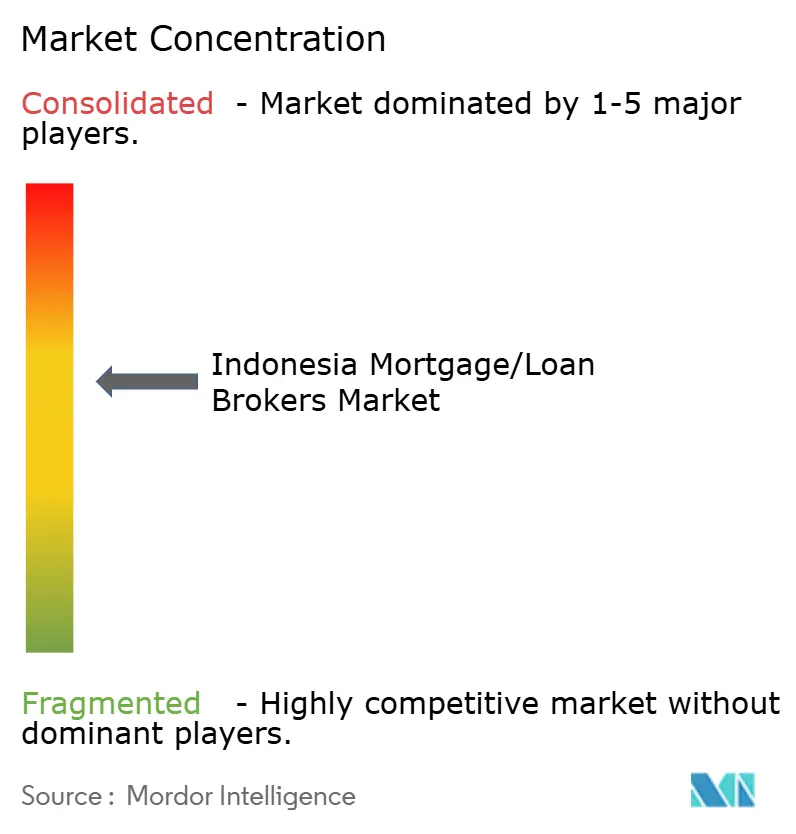
| Market Concentration | Medium |
Major Players *Disclaimer: Major Players sorted in no particular order Image © Mordor Intelligence. Reuse requires attribution under CC BY 4.0. | |
Indonesia Mortgage/Loan Brokers Market Analysis by Mordor Intelligence
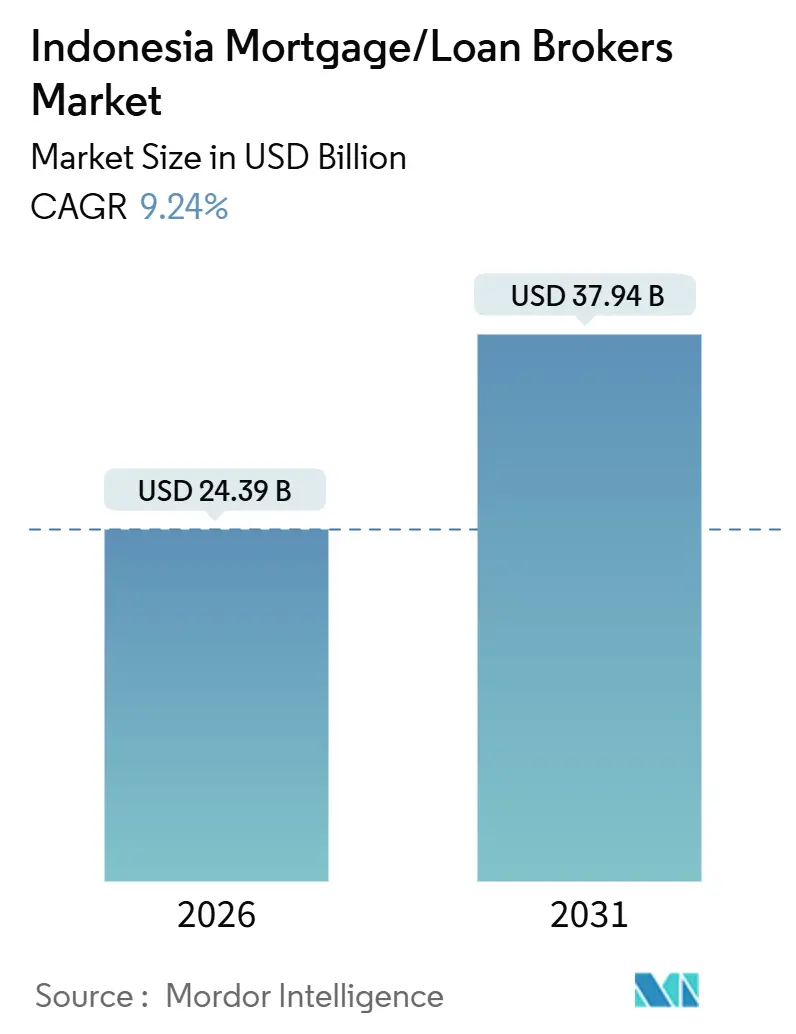
The Indonesia mortgage/loan brokers market size reached USD 24.39 billion in 2026 and is forecast to reach USD 37.94 billion by 2031, reflecting a 9.24% CAGR. Growth is shaped by the interaction of subsidized housing finance through FLPP, the measured transmission of Bank Indonesia’s easing cycle into mortgage rates, and the rapid shift of origination and servicing toward bank-owned and partner-led digital channels. Subsidy-backed fixed-rate offers and zero-to-low down-payment options keep affordability in reach for first-time buyers while risk controls from lenders have tightened amid consumer NPL normalization and selective LTV implementation at the bank level[1]. The Indonesia mortgage/loan brokers market continues to consolidate around state-owned banks that distribute a large share of subsidized loans and use mortgage entry products to cross-sell retail and ecosystem services. Momentum also reflects policy coordination, including OJK measures to preserve high LTV ceilings where appropriate, BI’s macroprudential liquidity incentives to real estate and public housing, and targeted inclusion initiatives for informal workers within the subsidized pipeline.
Key Report Takeaways
- By type of mortgage loan, conventional products led with 59.44% of the Indonesia mortgage/loan brokers market share in 2025, while government-insured mortgages are projected to expand at a 13.47% CAGR through 2031.
- By mortgage loan terms, 30-year tenors held 66.38% of the Indonesia mortgage/loan brokers market share in 2025, and 15-year maturities recorded the fastest growth at 14.38% annually.
- By interest rate, fixed-rate mortgages accounted for 72.87% of the Indonesia mortgage/loan brokers market share in 2025, while adjustable-rate instruments posted an 11.27% growth rate.
- By provider, primary lenders represented 78.74% of the Indonesia mortgage/loan brokers market share in 2025, and secondary lenders grew the fastest at a 14.36% CAGR.
- By geography, Java captured 57.85% of the Indonesia mortgage/loan brokers market share in 2025, while Sulawesi is the fastest-growing region with a projected 13.47% CAGR through 2031.
Note: Market size and forecast figures in this report are generated using Mordor Intelligence’s proprietary estimation framework, updated with the latest available data and insights as of January 2026.
Indonesia Mortgage/Loan Brokers Market Trends and Insights
Drivers Impact Analysis*
| Driver / Restraint (as applicable in title case) | (~) % Impact on CAGR Forecast | Geographic Relevance | Impact Timeline |
|---|---|---|---|
| Rising middle-class household income & first-time buyer demand | +2.1% | Java, Bali & Nusa Tenggara, with spillover to urban Sumatra | Medium term (2-4 years) |
| Government FLPP interest-subsidy program | +3.2% | National, concentrated in secondary cities such as Jember, Malang, Semarang, Surabaya | Short term (≤ 2 years) |
| Expansion of digital mortgage / fintech platforms | +1.8% | Greater Jakarta (Jabodetabek), urban Sumatra corridors | Medium term (2-4 years) |
| Declining Bank Indonesia benchmark rates | +1.5% | National with global context, rapid pass-through via primary lenders | Short term (≤ 2 years) |
| Urbanisation in secondary cities boosting broker coverage | +1.4% | Sulawesi, Kalimantan, Papua with early gains in Makassar, Manado, Balikpapan | Long term (≥ 4 years) |
| Growth of sharia-compliant mortgage offerings | +0.9% | National, with higher adoption in Aceh, West Java, West Sumatra | Long term (≥ 4 years) |
| Source: Mordor Intelligence | |||
Rising Middle-Class Household Income and First-Time Buyer Demand
The Indonesia mortgage/loan brokers market benefits from a growing first-time buyer cohort that responds strongly to fixed-rate subsidies and simplified onboarding journeys that banks and partners deliver through digital simulators and prequalification tools. Subsidized mortgages structured at 5% fixed rates over long tenors have enabled the conversion of creditworthy households that might otherwise delay purchases, anchoring a steady origination base for brokers and lenders[2]. Banks are scaling outreach by embedding mortgage offers within their super-app ecosystems, keeping early-stage leads engaged through calculators, document checklists, and branchless verification flows that cut the time to approval. Policy incentives, including high LTV flexibility where risk allows and liquidity incentives for housing credit, support purchasing power for younger buyers beyond Tier-1 cities. For the Indonesia mortgage/loan brokers market, the combination of targeted subsidies and digital origination has created a repeatable first-time buyer funnel that is less sensitive to small rate moves and more responsive to journey speed and certainty of approval.
Government FLPP Interest-Subsidy Program
The FLPP program continues to act as the single largest throughput engine for subsidized origination by locking a 5% fixed rate for eligible borrowers and channeling volume through distributing banks with defined quotas. BTN and other state-owned banks operationalize the pipeline at national scale and have used mass contract signings to secure future disbursements across dozens of provinces, enabling brokers to align with developers on predictable closings[3]. The subsidy structure narrows the affordability gap relative to market-rate mortgages and encourages long-tenor selections, which reduces monthly installment burdens for first-time owners. Participating banks are building cross-sell programs around subsidized buyers, bundling insurance and payments to improve retention and life-time value within the Indonesia mortgage/loan brokers market. Policy continuity signaled by sector regulators and the social-housing mandate sustains multi-year visibility, which supports broker capacity planning and regional coverage models.
Expansion of Digital Mortgage and Fintech Platforms
Digital channels have moved from auxiliary to central for origination, documentation, and servicing, with leading banks integrating mortgage journeys into their retail apps that already handle the majority of customer transactions. BCA’s myBCA platform added NFC Tap capabilities and cross-border QR features, signaling deeper reliance on mobile identity and payments rails that can also support mortgage verification and fee collection steps within the same interface. Aggregation models and property platforms are embedding prequalification and lender comparisons, improving lead quality for brokers while reducing duplicate processing. The Bank Indonesia Macroprudential Liquidity Incentive has steered sizable liquidity toward housing and related sectors, strengthening the economics of co-lending and bank-fintech origination partnerships within the Indonesia mortgage/loan brokers market. OJK’s supervisory stance codifies the broader digital financing ecosystem and supports technology adoption by licensed intermediaries that work directly with property developers and agents.
Declining Bank Indonesia Benchmark Rates
Bank Indonesia cut the policy rate cumulatively by 150 bps from September 2024 through December 2025, and the policy stance in late 2025 supported liquidity and credit expansion objectives while maintaining stability [4]. BI lifted the maximum KLM incentive to 5% of third-party funds and earmarked a larger allocation for housing, which reinforced lenders’ willingness to grow mortgage books in line with risk appetite. KSSK guidance maintained favorable LTV ceilings into 2026 subject to bank-level risk assessment, and that framework enabled zero-to-low down-payment mortgages when banks deemed borrower profiles sound. For the Indonesian mortgage/loan brokers market, rate stability combined with macroprudential incentives places more weight on journey speed, documentation readiness, and refinancing advisories as differentiators rather than on headline rate moves alone.
Restraints Impact Analysis*
| Restraint (as applicable in title case) | (~) % Impact on CAGR Forecast | Geographic Relevance | Impact Timeline |
|---|---|---|---|
| Stringent loan-to-value caps from OJK | -0.7% | National, with heightened enforcement in Java for non-subsidized loans | Medium term (2-4 years) |
| High informal-sector employment complicates underwriting | -1.3% | National, particularly acute in Papua, Kalimantan, Sulawesi | Long term (≥ 4 years) |
| Limited credit-bureau penetration raises risk costs | -0.9% | National; regulatory push via SLIK expansion underway | Medium term (2-4 years) |
| Slow building-permit process and land-bank issues | -0.6% | Jakarta, Jabodetabek; supply-side bottleneck | Medium term (2-4 years) |
| Source: Mordor Intelligence | |||
Stringent Loan-to-Value Caps from OJK
OJK and KSSK maintained accommodative LTV ceilings into 2026, but individual banks set stricter internal thresholds in response to rising consumer risk indicators, which raised effective down-payment burdens for non-subsidized borrowers. BCA disclosed tighter underwriting during 2025 and raised select LTV requirements for non-subsidized channels, aligning origination with risk-adjusted return goals. Bank Indonesia’s Q3 2025 Banking Survey signaled more cautious lending standards industry-wide, with tighter collateral and ceiling requirements echoing through broker pipelines. In the Indonesia mortgage/loan brokers market, higher rejection rates and longer application cycles become more likely when borrower credit files are thin or debt-service profiles are borderline, despite policy headroom for LTV at the macro level. Brokers respond by pre-screening applicants more intensively and coaching on documentation to ensure a cleaner first submission that aligns with lender risk thresholds.
High Informal-Sector Employment Complicates Underwriting
A large share of the labor force earns income outside formal payroll systems, challenging legacy credit models that rely on regular payslips and consistent tax documentation. OJK has advanced inclusion measures that allow alternative documentation and promote partnerships with credit-guarantee and alternative scoring institutions to expand responsible access to housing finance. BTN and other state-owned banks have piloted savings-linked and cooperative structures for gig workers and micro-entrepreneurs, channeling regular deposits and transaction histories into mortgage eligibility while preserving prudent risk management. The FLPP framework further supports dedicated allocations for lower-income and non-salaried borrowers through bank quotas and standardized origination protocols that brokers can navigate at scale. The Indonesia mortgage/loan brokers market adapts by integrating prequalification APIs and document-coaching workflows that turn heterogeneous earnings data into formats that align with lender underwriting engines.
*Our forecasts treat driver/restraint impacts as directional, not additive. The impact forecasts reflect baseline growth, mix effects, and variable interactions.
Segment Analysis
By Type of Mortgage Loan: Government guarantees outpace conventional volume growth
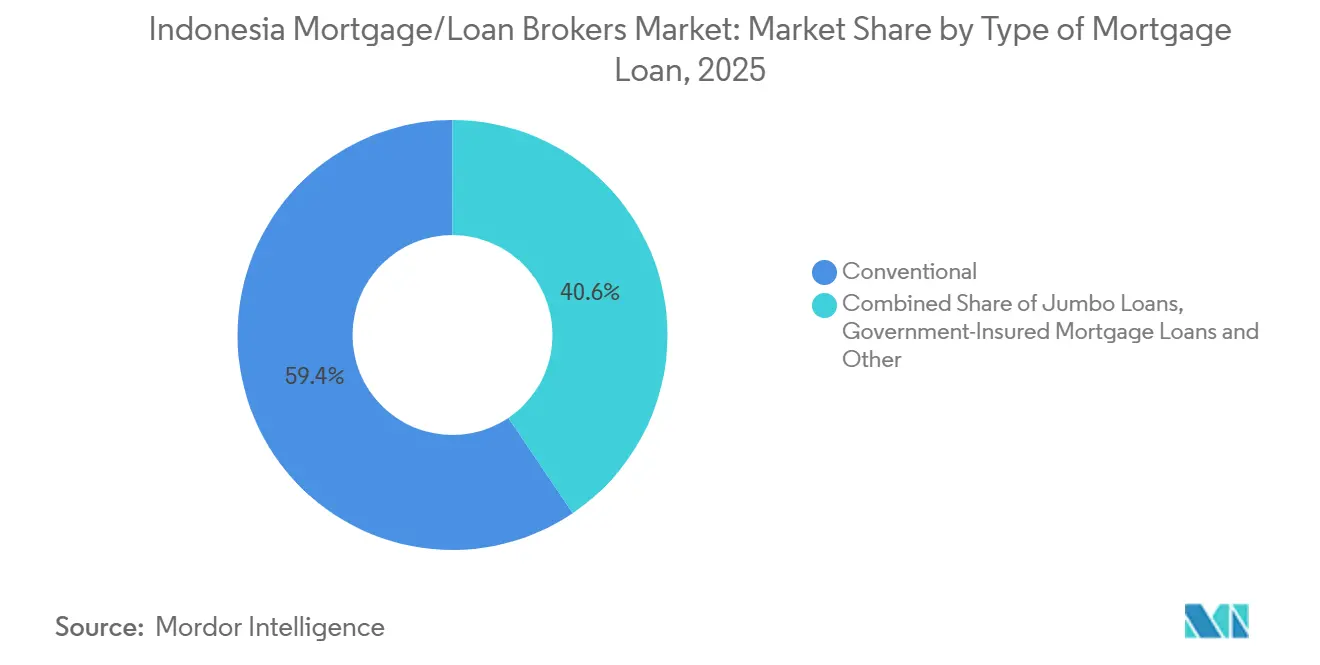
Conventional mortgage loans held 59.44% share in 2025, reflecting the entrenched role of market-rate products across urban and suburban borrower segments within the Indonesia mortgage/loan brokers market. Government-insured mortgages are positioned as the growth engine, with a projected 13.47% CAGR through 2031, due to sustained FLPP quotas that support fixed-rate pricing and predictable closing cycles for developers and banks. BTN anchors the subsidized pipeline and has built operational capacity to distribute down-payment assistance and interest subsidies, which has encouraged brokers to align buyer funnels with bank quota timetables. Jumbo loans remain a niche among affluent buyers in Greater Jakarta and select tourism corridors, where price levels and cash-flow profiles support larger tickets without subsidy reliance, and brokers match borrowers to premium lender service lines. Refinancing and top-up products have benefited from BI’s cumulative 150 bps easing cycle since late 2024, creating windows for rate and tenor optimization that brokers monetize via retention or lender-switch strategies.
As FLPP quotas move into secondary cities, brokers can direct buyer flows toward projects with faster handovers and clearer title conditions, which also lowers fall-through risk. Conventional volumes continue to supply the base of the Indonesia mortgage/loan brokers industry, and lenders differentiate with bundled insurance, fee waivers, and loyalty features to defend share against subsidized pull. Brokers bridge these paths by segmenting buyers early and routing them to the most efficient track, which improves approval rates and reduces the cycle time from property search to bank agreement. With macroprudential liquidity support in place, the balance between subsidized growth and conventional depth is likely to persist, preserving demand across diverse borrower profiles within the Indonesia mortgage/loan brokers market.

By Mortgage Loan Terms: Longer tenors dominate, yet mid-duration options gain traction
Thirty-year tenors commanded 66.38% share in 2025, reflecting borrower preferences for affordability through lower monthly installments in a market where income smoothing matters for first-time owners. Subsidized frameworks and public savings schemes have enabled durable long-tenor adoption, and brokers standardize these choices for buyers that prioritize payment stability over accelerated equity build. The Indonesia mortgage/loan brokers market has also seen mid-duration options gain visibility as banks promote structured fixed windows with clear reprice rules, which appeal to emerging affluent households. Banks’ digital channels present tenor tradeoffs transparently at the prequalification stage, improving decision confidence and reducing rework from late-stage tenor changes. The combination of standardized subsidy tenors and flexible conventional offers keeps the funnel broad, with brokers guiding households toward the tenor that fits income trajectories and rate views.
The Indonesia mortgage/loan brokers market size for 15-year maturities is advancing at a 14.38% CAGR, supported by bank campaigns that pair shorter tenors with promotional fixed windows to accelerate principal reduction. Twenty-year products remain important among salaried borrowers with steady income visibility, and brokers use lender calculators to show total-interest differences that inform tenor selection without introducing adverse payment shocks. Where buyers anticipate income step-ups, brokers sometimes position mid-tenor paths with refinancing checkpoints that keep long-run costs aligned with household preferences. Rate stability and policy clarity further lower uncertainty around tenor decisions, narrowing the gap between affordability and equity speed within the Indonesia mortgage/loan brokers market. Journey management at the broker level has become essential, since tenor selection influences underwriting routes, documentation stacks, and time to bank agreement.
By Interest Rate: Fixed-rate subsidies anchor share, adjustable instruments catch repricing wave
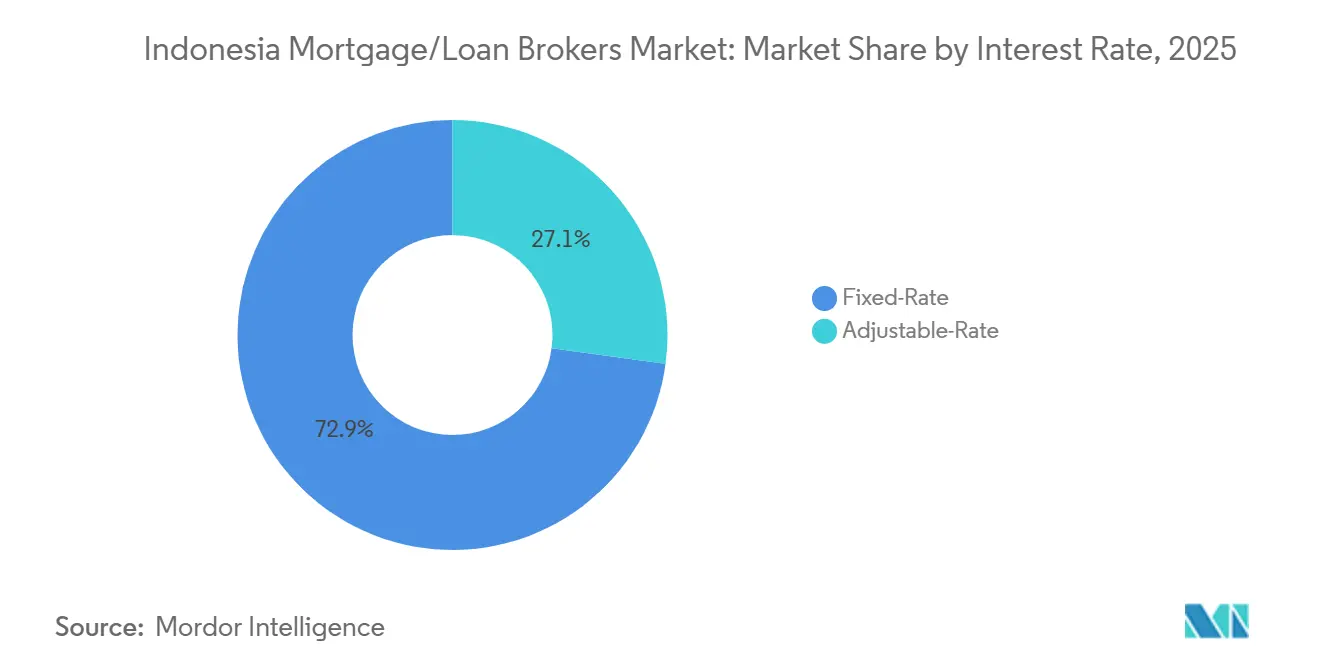
Fixed-rate mortgages held 72.87% of 2025 originations, anchored by the FLPP’s 5% fixed structure and bank promotions that guarantee rate certainty for an initial period before any reset. The subsidy’s pricing advantage versus market rates helps first-time buyers lock in affordability and reduces default risk related to payment shocks, reinforcing broker recommendations for fixed paths in subsidy-eligible cases. Banks have also introduced one-to-three-year fixed promotions within conventional KPR lines to attract customers early in the rate cycle, a strategy that brokers use to monetize pre-approvals into timely closings. Adjustable-rate mortgages are growing as lenders reprice legacy books following BI’s easing moves and as some borrowers position for future repricing windows with lower initial monthly costs. Hybrid structures, which combine a short fixed window followed by floating, remain a middle path that brokers explain in detail to align expectations with rate scenarios and repayment capacity.
The Indonesia mortgage/loan brokers market benefits from rate option diversity, and brokers have built rate-education steps into their flows so first-time buyers understand tradeoffs between predictability and potential savings over the full term. Where subsidy eligibility is absent, banks’ promotional fixed windows often become the default path to reduce early-stage payment strain and increase approval likelihood. As BI maintains a stable stance, lenders can balance growth with risk controls, and brokers can time refinancing advisories where rate resets approach and household income visibility has improved. Sharia-compliant profit-sharing contracts have tracked broader housing finance expansion and cater to regions with higher Islamic finance adoption, adding another option set to broker playbooks. The net effect is a rate landscape where fixed anchors subsidized demand, and floating instruments and hybrids add flexibility within the Indonesia mortgage/loan brokers market.
By Provider: Primary lenders leverage branch reach; secondary players scale through digital channels
Primary lenders accounted for 78.74% of 2025 origination, reflecting the branch reach, legacy customer bases, and quota-driven subsidy distribution capacity of state-owned banks and leading private banks. BRI and BCA reported healthy mortgage books through 2025, with underwriting calibrated to risk-adjusted returns and digital channels handling the majority of retail transactions supporting ancillary mortgage workflows. Bank Mandiri’s digital platform has scaled user adoption and embedded prequalification in its broader retail journey, creating a path for integrated origination and servicing that brokers can tap. Secondary lenders, including digital aggregators and P2P-linked originators working under tightened prudential standards, continue to take share by focusing on speed, transparency, and specialized borrower segments. The BI KLM facility, which directed substantial liquidity toward priority sectors including housing through 2025, has supported collaboration across lender tiers in the Indonesia mortgage/loan brokers market.
Secondary channels deploy prequalification APIs, document coaching, and marketplace integrations that surface lender choices to consumers at the search stage, reducing time-to-approval and improving match quality for bank underwriters. OJK’s ongoing framework for digital financing and information systems has clarified the roles and standards for technology-based originators and aggregators, which strengthens consumer protections and data sharing while expanding origination capacity. For primary lenders, partnership models with credible aggregators reduce acquisition costs and extend reach into secondary cities without duplicating physical branches. The Indonesia mortgage/loan brokers market shows that branch presence, digital funnels, and subsidy quotas are complementary rather than mutually exclusive when orchestrated through bank and broker ecosystems. As lenders refine underwriting automation and data pipelines, broker value shifts toward advisory, documentation quality, and routing efficiency within both subsidized and conventional lanes of the Indonesia mortgage/loan brokers industry.
Geography Analysis
Java accounted for 57.85% of 2025 originations, reflecting metropolitan density and the concentration of developers and lender networks in Jakarta, Surabaya, Bandung, and Semarang within the Indonesia mortgage/loan brokers market. BTN’s footprint in East Java, including subsidized units distributed under the FLPP umbrella, underscores the island’s scale and the operational predictability that brokers seek when closing volumes at pace. BCA’s portfolio data highlight regional loan exposure concentrated around Jakarta, reflecting the gravity of the Greater Jakarta region in lender strategies and broker routing. Outside Java, urban corridors in Sumatra and industrial hubs in Kalimantan continue to create pockets of stable demand that brokers engage using digital prequalification and developer partnerships. The Indonesia mortgage/loan brokers market remains anchored in Java for volume, while growth rotates to regions with targeted infrastructure and branch expansions.
Sulawesi is projected to expand at a 13.47% CAGR through 2031, reflecting sustained urbanization and logistics expansion in cities like Makassar where broker coverage and bank presence have increased. OJK’s TPAKD operates across all districts and cities, and that institutional presence supports financial access programs that brokers rely on to reach underserved provinces cost-effectively. Urbanization has advanced nationally and continues to shape housing demand in secondary cities where relative affordability and new projects align with subsidy eligibility and lender appetite. In Kalimantan and eastern provinces, brokers balance pipeline ambition with local land-title diligence and project stage certainty to reduce fall-through risks. Aggregation models help maintain lead quality where physical branches are sparse by collecting standardized documents and managing borrower communications centrally.
The Indonesia mortgage/loan brokers market size for Java reflects a 57.85% share in 2025, while regions like Sulawesi are positioned as growth leaders through 2031, creating a two-speed map for origination strategies. In Bali and Nusa Tenggara, specialized segments serve tourism-linked and expatriate-adjacent demand, with Islamic financing also present in line with demographic preferences. Papua remains the smallest segment given land-tenure complexities and limited bank presence outside key cities, reinforcing the role of digital funnels in early-stage screening. As banks and brokers coordinate quotas and campaigns, the emphasis shifts toward outreach, documentation quality, and project selection that align with policy signals and local infrastructure plans.
Regulatory Landscape
Indonesia’s mortgage/loan broker ecosystem operates under Otoritas Jasa Keuangan (OJK) conduct and prudential supervision, with Bank Indonesia (BI) shaping housing credit through macroprudential settings. On market conduct, OJK’s Board of Commissioners Regulation PADK 37/PADK.08/2025 on the provision and submission of information for marketing financial services products provides a clearer compliance baseline for how lenders and partner channels (including digital intermediaries) communicate product features, pricing, and terms to consumers.
Credit information and secondary mortgage-linked monitoring have also tightened in ways that affect broker conversion cycles. In July 2026, OJK implemented SLIK optimization measures requiring financial institutions to update credit repayment data within three working days and introduced a minimum threshold of Rp 1 million for displayed credit records, while reiterating that SLIK is a reference system rather than a blacklist and does not replace banks’ independent credit decisions. Separately, OJK mandated monthly reporting for secondary housing financing companies through SEOJK 3/SEOJK.06/2024, reinforcing transparency and oversight for institutions that support housing finance liquidity and refinancing channels.
Value Chain Analysis
In Indonesia mortgage/loan brokerage, lead generation and customer acquisition increasingly start with property developers, agents, and digital property or aggregator platforms that funnel buyers into bank KPR journeys. Bank branches and relationship managers still support verification and closing, particularly in segments that are not fully digitized. Primary lenders dominate underwriting and disbursement, with major state-owned banks (including Bank Mandiri, Bank Rakyat Indonesia, Bank Negara Indonesia, and Bank Tabungan Negara) anchoring subsidized throughput, while large private banks use app-led onboarding to capture prequalified demand and cross-sell payments and insurance.
The enabling infrastructure layer includes credit information (SLIK) and public housing finance plumbing that supports subsidized delivery. BP Tapera and the FLPP-related distribution pipeline influence eligibility, quota execution, and documentation standards that brokers must operationalize alongside developers’ project readiness and land-title clarity. OJK’s 2026 SLIK optimization, including faster update timelines, affects screening, re-application timing, and refinancing workflows, while OJK’s monthly reporting requirements for secondary housing financing companies add discipline to the liquidity and risk-monitoring loop that supports mortgage portfolios post-origination.
Competitive Landscape
The Indonesia mortgage/loan brokers market is characterized by medium concentration, with state-owned banks and BCA leading primary origination, especially in subsidized channels where quota allocations and operational scale matter most for throughput. BCA reported mortgage balances and digital usage that underline the centrality of its mobile ecosystem to customer engagement and product cross-sell, including service upgrades that support mortgage journey steps. BRI disclosed solid growth in its mortgage book through 1H 2025, supported by subsidized programs and promotional offers for premium segments, showing a dual-track approach to portfolio building. Bank Mandiri’s digital platform processed the vast majority of retail transactions by 2025, and the bank integrated mortgage prequalification and ecosystem payments to streamline acquisition and servicing. BTN remains a policy anchor for subsidized housing finance through its distribution capabilities and sustainable finance framework, which supported a structured approach to green and social housing credits.
Competition has shifted from pure price-based tactics to orchestrating end-to-end ecosystems that bundle insurance, payments, and developer relationships into a single journey that increases conversion and retention within the Indonesia mortgage/loan brokers market. OJK rules have tightened prudential and operational standards for digital financing, data use, and system control, which lifted sector discipline and clarified the role of aggregators as licensed partners within lender workflows. Bank Indonesia’s liquidity incentives for housing have reinforced co-lending and partnership economics by lowering effective funding frictions for priority segments. As lenders automate more of underwriting and monitoring, brokers differentiate on documentation quality, cycle-time management, and advisory that aligns loan structure with household income stability and rate outlooks. The rise of embedded finance within property search portals tightens collaboration between brokers, developers, and banks, and shifts acquisition economics toward lower-cost, higher-certainty channels.
Inclusion policies are broadening sustainable access while preserving risk controls, with OJK’s frameworks for UMKM, guarantees, and sustainable finance aligning banks and brokers around responsible growth in subsidized and conventional tiers. Sharia banking continues to add depth, and ESG-linked structures have mobilized capital for green and social housing projects that connect with mortgage pipelines across regions. The Indonesia mortgage/loan brokers market integrates these policy and technology vectors as competitive levers rather than constraints, producing a field where incumbents and digital-centric players collaborate and compete simultaneously. Execution quality in documentation, quota alignment, and post-origination servicing is steadily becoming the decisive factor for share capture across product and regional lines. As lenders keep a close watch on NPL trends and margin discipline, brokers that deliver stronger files and shorter cycles are better positioned to negotiate preferred routing and service levels within partner banks.
Indonesia Mortgage/Loan Brokers Industry Leaders
-
PT Bank Mandiri (Tbk)
-
PT Bank Rakyat Indonesia (Tbk)
-
PT Bank Central Asia (Tbk)
-
PT Bank Negara Indonesia (Tbk)
-
PT Bank Tabungan Negara (Tbk)
- *Disclaimer: Major Players sorted in no particular order
Market Opportunities and Future Outlook
A concrete opportunity for mortgage/loan brokers and partner platforms is to build higher-conversion prequalification and document-coaching workflows around the July 2026 SLIK optimization rules, including the three-working-day update requirement and the Rp 1 million display threshold. Faster, cleaner credit-information refresh cycles create room for brokers to run retry and remediation journeys for previously rejected borrowers, shorten time-to-approval for eligible first-time buyers, and standardize outreach to informal-income applicants using lender-acceptable supporting documents.
Policy-driven housing demand continues to create structured origination lanes that reward ecosystem execution. OJK’s stated support for accelerating the national 3 Million Houses Program, alongside SLIK policy strengthening and collaboration with housing stakeholders, reinforces the need for broker partnerships with distributing banks and developers that can execute mass signings and predictable handovers. Market evidence from OJK’s banking snapshot shows that as of May 2026 total banking credit reached Rp 8,918 trillion (+11.51% year-on-year) while housing credit grew 4.99% year-on-year, which leaves room for brokers to compete on process efficiency, borrower readiness, and lender routing rather than only on headline pricing.
Recent Industry Developments
- July 2026: OJK implemented optimized SLIK credit-information rules, requiring repayment data updates within three working days and applying a Rp 1 million minimum threshold for displayed credit records. The change can reduce friction from stale records in borrower screening and reapplication cycles, which is material for broker conversion rates in subsidized and mass-market mortgages.
- May 2026: PT Bank Rakyat Indonesia (Tbk) launched BRI KPR Solusi nationally, offering financing for auction and non-auction properties with multiple fixed-rate schemes and tenors up to 25 years. The rollout broadens product choice within a single bank program and gives brokers a clearer packaging option to route different property types and customer profiles through one underwriting framework.
- April 2026: PT Bank Central Asia (Tbk) conducted a mass credit agreement (akad massal) for 51 subsidized housing units in partnership with Vista Land Group across Serang, Bogor, and Tangerang. The transaction highlights the role of developer-bank coordination in accelerating subsidized closings and strengthens the playbook for brokers operating in project-based, quota-aligned pipelines.
Research Methodology Framework and Report Scope
Market Definition and Coverage
For this report, the market covers the value of mortgage and housing loan origination facilitated through brokerage or intermediary activity in Indonesia, where a broker supports the borrower and connects them with a lender through the application and approval process.
Scope exclusions: The sizing does not count lender balance sheet interest income, property developer sales value, or pure real estate agency commissions that are not tied to arranging a mortgage loan.
Segmentation Overview
- By Type of Mortgage Loan
- Conventional Mortgage Loan
- Jumbo Loans
- Government-Insured Mortgage Loans
- Other Types of Mortgage Loan
- By Mortgage Loan Terms
- 30-Year Mortgage
- 20-Year Mortgage
- 15-Year Mortgage
- Other Mortgage Loan Terms
- By Interest Rate
- Fixed-Rate
- Adjustable-Rate
- By Provider
- Primary Mortgage Lender
- Secondary Mortgage Lender
- By Geography
- Java
- Sumatra
- Kalimantan
- Sulawesi
- Bali & Nusa Tenggara
- Papua
Data Sources, Market Sizing, and Validation
Desk Research
Desk research was used to set the measurable boundaries of mortgage demand and lending supply that can realistically be served by brokers. We reviewed public financial and housing indicators to understand how mortgages are growing across cycles, then aligned them with policy and rate signals that typically change borrower behavior.
Typical sources included official publications such as OJK banking statistics and banking booklets, Bank Indonesia releases on interest rates and credit conditions, Statistics Indonesia (BPS) housing and demographic series, and Ministry of Public Works and Housing updates where relevant. We also used bank annual reports and investor decks, reputable Indonesian business press, and selected paid database subscriptions for company financials, news and financials, and import export shipment level checks where it supported broader macro assumptions. This list is not exhaustive, and other public sources were referenced during data collection, validation, and clarification.
Primary Interviews and Surveys
Primary work focused on validating how borrowers reach lenders in Indonesia and what portion of mortgage origination is influenced by intermediaries across major islands and city tiers. We spoke with a mix of lending side contacts, distribution and sales leaders, and practitioners who see day to day conversion drivers, which helped us firm up penetration assumptions and realistic fee and revenue capture patterns.
To reduce blind spots, responses were cross checked across borrower profiles (first time buyers versus refinance or switch), loan ticket sizes, and lender types. We then used those inputs to confirm what the secondary indicators were implying and where the model needed adjustment.
Distribution of primary research fieldwork respondents
| Company type | Respondent position |
|---|---|
| Top tier: 37% | CXOs: 19% |
| Mid tier: 43% | Functional/Unit leaders: 39% |
| Smaller Players: 20% | Managers: 42% |
Market-Sizing & Forecasting
Sizing starts from a top down demand pool build up using Indonesia mortgage outstanding and new lending direction, then shaped by the broker addressable share based on channel usage and lender distribution models. Those totals are then corroborated using selective bottom up checks, such as sampled broker revenue capture ranges, implied volumes from lender channel mix discussions, and sanity checks against a few observable operational indicators.
Key inputs used in the model included mortgage loan growth trends reported in banking statistics, policy rate movements and lending appetite signals, housing transaction and construction momentum where available, loan type mix (including government supported categories), and shifts in fixed versus adjustable rate preference. Forecasting used scenario analysis supported by expert views on how rates, affordability, and bank risk appetite could move, and then a blended path was selected after the assumptions were tested for internal consistency.
Where bottom up evidence was patchy, gaps were handled by using conservative penetration bands by geography and lender type, then re testing the implied market value against the macro lending series.
Data Validation & Update Cycle
Outputs are validated through multiple checks so that one data line does not drive the full result. We compare modeled market values against independent signals like mortgage outstanding growth, changes in lending standards, and housing demand indicators, then investigate any sharp variances before numbers are finalized.
A second analyst review is done to confirm that assumptions, units, and currency conversions are applied consistently across years, and that the forecast path matches the expected economic story. The report is refreshed annually, and interim updates are triggered if material events occur, such as large policy changes or clear breaks in lending momentum. Before delivery, a fresh data pass is completed so clients receive the most current view available.
Mordor Intelligence's Indonesia Mortgage Loan Brokers Market Sizing Compared With Other Published Estimates
Published market values for mortgage and loan brokers in Indonesia can look different because the underlying data is not directly reported as a single line item, so each publisher builds it up from proxy signals. Differences usually come from what is counted as broker activity, whether the estimate follows loan balances or new originations, and how currency timing and inflation are applied.
Mortgage outstanding trends, policy rate direction, and lender channel mix checks are the evidence points that keep Mordor Intelligence's estimate tied to an addressable broker mediated origination pool instead of broader mortgage lending value that includes non broker distribution.
Benchmark comparison
| Source | Market Size | Gaps in Research Methodology |
|---|---|---|
| Mordor Intelligence | USD 24.39 B (2026) | |
| Industry Association A | USD 18.60 B (2026) | Often framed using a narrower definition that counts only formally registered intermediary flows, and it can understate activity routed through bank sales partners or hybrid agent channels. |
| Trade Journal B | USD 30.80 B (2026) | Commonly built by applying a flat take rate to total mortgage lending value, which can over include direct bank origination and can assume faster fee expansion without re validating channel mix. |
The spread in the table mostly comes from two choices, which are whether the market follows total mortgage lending or only broker influenced origination, and how fee capture is applied across loan types. By keeping the sizing steps traceable to lending signals and then re checking them with practitioner feedback, the final number stays balanced and repeatable for decision making.
Key Questions Answered in the Report
What is the size and growth outlook for the Indonesia mortgage/loan brokers market through 2031?
The Indonesia mortgage/loan brokers market size is USD 24.39 billion in 2026 and is projected to reach USD 37.94 billion by 2031 at a 9.24% CAGR.
Which loan types are leading and which are growing fastest in the Indonesia mortgage/loan brokers market?
Conventional products led with 59.44% share in 2025 while government-insured mortgages are the fastest-growing at a 13.47% CAGR through 2031.
How are interest rates shaping borrower choices within the Indonesia mortgage/loan brokers market?
Fixed-rate mortgages held 72.87% of 2025 originations due to the FLPP 5% structure and bank fixed-window promotions, while adjustable-rate products are growing on the back of BI’s easing cycle.
Which regions should lenders and brokers prioritize for growth?
Java captured 57.85% share in 2025 for scale, but Sulawesi is the fastest-growing with a 13.47% projected CAGR, supported by urbanization and expanding bank coverage.
What policy programs most influence origination volumes today?
The FLPP subsidy program anchors fixed-rate affordability and quotas, and BI’s Macroprudential Liquidity Incentive channels liquidity to housing, which together stabilize origination pipelines.