
Market Overview
| Study Period | 2020 - 2031 |
|---|---|
| Forecast Data Period | 2026 - 2031 |
| Base Year Market Size (2025) | USD 1.35 Billion |
| Market Size (2026) | USD 1.62 Billion |
| Market Size (2031) | USD 4.06 Billion |
| Growth Rate (2026 - 2031) | 20.12% CAGR |
| Market Concentration | Medium |
Major Players *Disclaimer: Major Players sorted in no particular order Image © Mordor Intelligence. Reuse requires attribution under CC BY 4.0. | |
Indonesia Cybersecurity Market Analysis by Mordor Intelligence
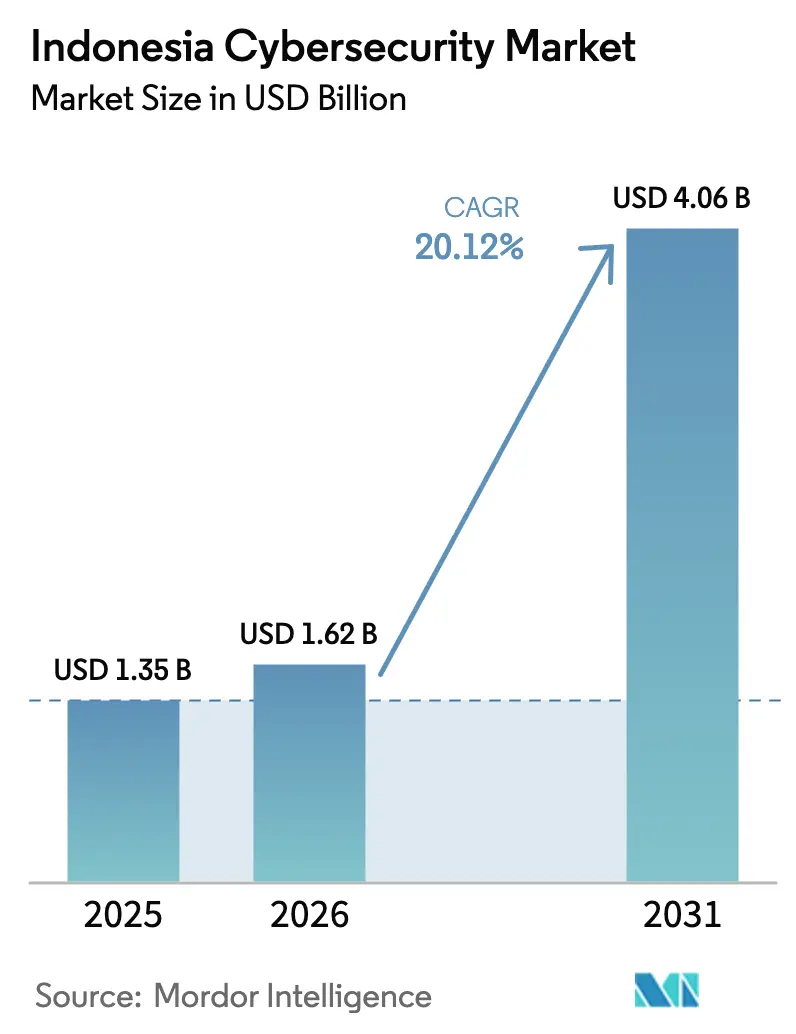
The Indonesia cybersecurity market size was valued at USD 1.35 billion in 2025 and estimated to grow from USD 1.62 billion in 2026 to reach USD 4.06 billion by 2031, at a CAGR of 20.12% during the forecast period (2026-2031). Expansion reflects Indonesia’s position as Southeast Asia’s most attacked digital economy, registering 3,300 attempted breaches each week while still allocating only 0.02% of GDP to security spending. Adoption of BI-FAST real-time payments, QRIS merchant codes, and the EUR 164 million National Data Center program has widened the threat surface, spurring rapid solution uptake. Intensifying ransomware campaigns—such as the USD 8 million Brain Cipher demand against the temporary National Data Center—have pushed state-owned enterprises and regulated industries to accelerate spending[1]Editorial Board, “Brain Cipher Demands USD 8 Million Ransom,” The Jakarta Post, thejakartapost.com . Simultaneously, Microsoft’s USD 1.7 billion AI infrastructure pledge and Telkom’s Rp 1.5 trillion Batam data-center project signal large-scale capacity buildouts that will reshape competitive dynamics. However, certified talent shortages and fragmented oversight among BSSN, Kominfo, and OJK temper near-term growth potential.
Key Report Takeaways
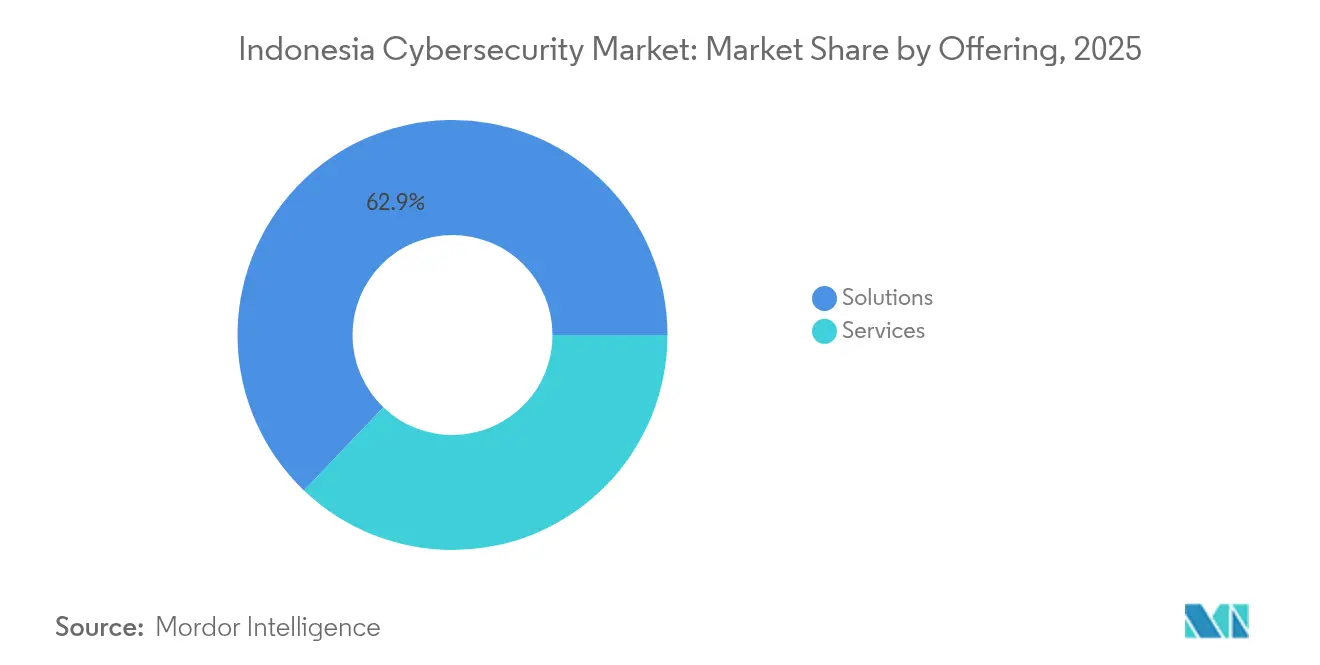
- By offering, Solutions led with 62.86% of Indonesia cybersecurity market share in 2025; Managed Services is poised for the fastest 17.14% CAGR to 2031.
- By deployment mode, On-Premise retained 53.33% of the Indonesia cybersecurity market size in 2025, while Cloud-Delivered protection is projected to grow at a 19.92% CAGR through 2031.
- By organization size, Large Enterprises held 70.15% of Indonesia cybersecurity market share in 2025; the SME segment is set to expand at an 17.93% CAGR through 2031.
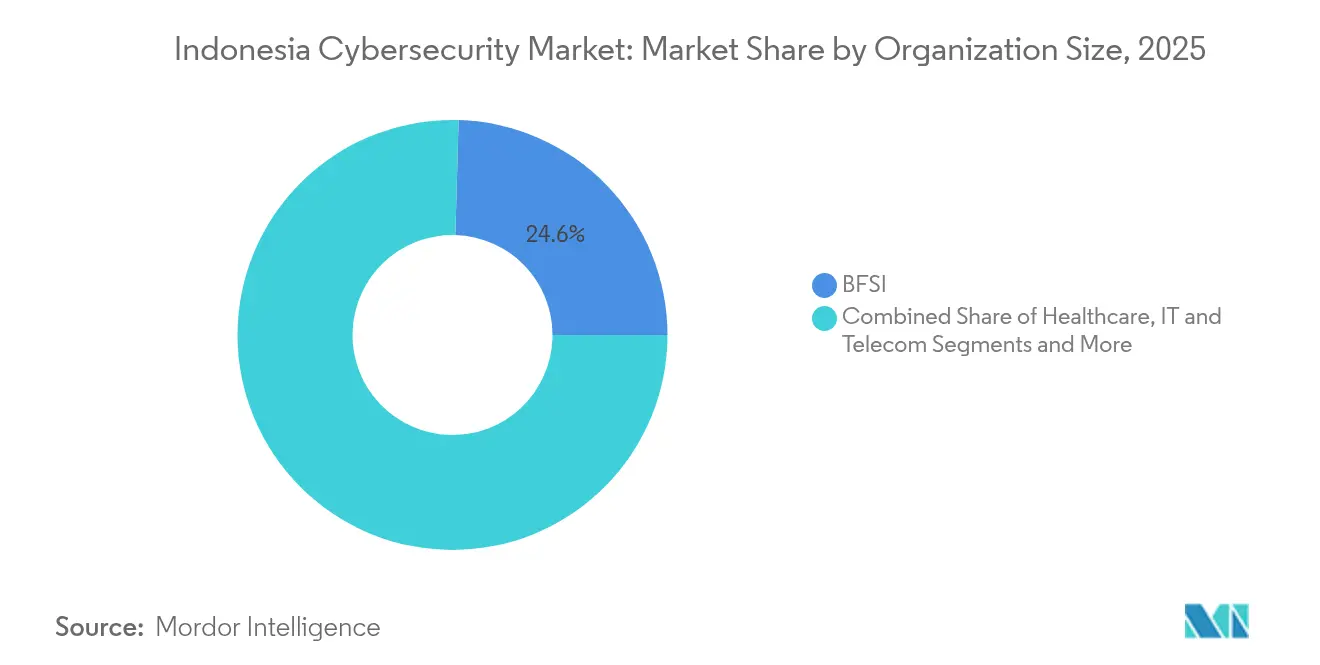
- By end-user vertical, the BFSI sector controlled 24.55% of the Indonesia cybersecurity market size in 2025, whereas Healthcare is forecast to achieve the fastest 18.58% CAGR to 2031.
Note: Market size and forecast figures in this report are generated using Mordor Intelligence’s proprietary estimation framework, updated with the latest available data and insights as of 2026.
Indonesia Cybersecurity Market Trends and Insights
Drivers Impact Analysis*
| Driver | ( ~ ) % Impact on CAGR Forecast | Geographic Relevance | Impact Timeline |
|---|---|---|---|
| Surge in digital payment transactions via BI-FAST and QRIS | +4.2% | National, concentrated in Java’s urban centers | Medium term (2-4 years) |
| Government National Data Center (PDN) rollout | +3.8% | National, key sites in Cikarang, Batam, Nusantara | Short term (≤ 2 years) |
| Rising ransomware incidents at SOEs | +3.1% | National, higher intensity in Jakarta and industrial zones | Short term (≤ 2 years) |
| 5G and Industry 4.0 adoption in Bekasi-Karawang | +2.9% | West Java manufacturing corridor | Medium term (2-4 years) |
| Personal Data Protection Act (UU PDP) enforcement | +2.7% | National, strictest in BFSI and Healthcare | Medium term (2-4 years) |
| Expansion of Islamic digital banking | +1.8% | National, strongest in Muslim-majority regions | Long term (≥ 4 years) |
| Source: Mordor Intelligence | |||
Surge in Digital Payment Transactions Fueled by BI-FAST and QRIS Mandates
QRIS volumes surged by 194.06% in April 2024 and 217.33% in August 2024, broadening the attack surface to 14.78 million SMEs now accepting real-time codes[2]Bank Indonesia, “QRIS Merchant Expansion Update,” perbanas.org. Transaction values are forecast to hit USD 115.34 billion in 2025, compelling issuers and acquirers to deploy advanced fraud analytics. Bank Neo Commerce has already flagged AI-driven deep-fake scams, underscoring the urgency for biometric and behavioral controls across payment rails. The BI National Payment System Blueprint pushes a shift from batch clearing to instant settlement, further elevating detection speed requirements. Consequently, network-based intrusion prevention and API-security tools are moving from optional to mandatory across retail payments ecosystems.
Government PDN (National Data Center) Program Accelerating Cybersecurity Spend
The Cikarang site alone houses 25,000 cores, 200 TB of memory, and 40 PB of storage, consolidating 629 legacy government data silos. A ransomware outage in June 2024 that disrupted 282 agencies validated vulnerability concerns and led to emergency procurement of zero-trust gateways and backup orchestration. Parallel builds in Batam and Nusantara will underpin sovereign-cloud strategies that demand micro-segmented networks, immutable backups, and automated incident response. Vendors offering data-center-in-a-box, AI-SOC platforms, and compliance dashboards are well positioned for this multiyear public-sector spend cycle.
Rising Ransomware Incidents Across Indonesian SOEs
LockBit 3.0 tactics used in the USD 8 million Brain Cipher extortion highlighted gaps in endpoint isolation and privileged-access management, prompting SOEs to reassess cyber-hygiene baselines. Bank Syariah Indonesia’s 1.5 TB breach and Bank Rakyat Indonesia’s December 2024 disclosure sparked sector-wide tabletop exercises and backup testing. BSSN documented 130 unique ransomware events in 2024, triggering its Regulation No. 1/2024 on mandatory incident reporting. The pattern has shifted procurement preference toward managed detection and response (MDR) and immutable-storage add-ons, with insurers tightening underwriting terms for entities lacking EDR coverage.
5G and Industry 4.0 Roll-outs in Bekasi-Karawang Manufacturing Belt
Pegatron’s Batam mega-factory showcases 5G-enabled robotic cells and edge-AI quality inspection that rely on real-time, low-latency links. With West Java now hosting 40% of recent industrial land sales, manufacturers are integrating OT and IT layers, exposing programmable-logic controllers and SCADA nodes to remote exploits. Local SMEs demonstrate a Technological Readiness Index score of 3.65 but need guidance on zoning firewalls and anomaly detection tuned for operational technology traffic. Providers delivering asset-discovery and industrial-protocol monitoring are gaining traction as factories shift toward predictive-maintenance data loops.
Restraints Impact Analysis*
| Restraint | ( ~ ) % Impact on CAGR Forecast | Geographic Relevance | Impact Timeline |
|---|---|---|---|
| Shortage of certified Bahasa-speaking cybersecurity talent | -2.8% | Nationwide, acute in Tier-2 cities | Long term (≥ 4 years) |
| Legacy on-prem stacks in Tier-2 enterprises | -2.1% | Secondary urban centers | Medium term (2-4 years) |
| Fragmented oversight among BSSN, Kominfo, OJK | -1.9% | Nationwide, all regulated sectors | Short term (≤ 2 years) |
| Low cyber-insurance penetration | -1.4% | National, weakest in SME cohorts | Medium term (2-4 years) |
| Source: Mordor Intelligence | |||
Shortage of Certified Bahasa-Speaking Cybersecurity Talent
Indonesia needs 100,000 security specialists by 2025 yet produces only a fraction of that number despite the Digital Talent Scholarship training 500,000 individuals from 2018-2024. Salary premiums divert senior staff to fintechs and telecoms, leaving critical infrastructure teams understaffed. Entry-level packages averaging IDR 120-180 million per year deter SMEs from hiring in-house analysts. Consequently, demand for MSSP contracts and automated SOC tools is growing, but lengthy onboarding times still delay incident-response readiness.
Fragmented Oversight Creating Compliance Ambiguity
Enterprises juggle parallel mandates—BSSN’s incident norms, Kominfo’s PDP enforcement, OJK’s fintech rules, and Bank Indonesia’s SysSec Regulation 2/2024—breeding audit fatigue and duplicated reporting. During the National Data Center outage, overlapping command structures slowed root-cause analysis, illustrating the absence of a unified cyber-doctrine. Multinationals therefore allocate disproportionate budgets to legal interpretation and extra layers of governance, dampening near-term investment in proactive defense tools, particularly among resource-restricted newcomers.
*Our forecasts treat driver/restraint impacts as directional, not additive. The impact forecasts reflect baseline growth, mix effects, and variable interactions.
Segment Analysis
By Offering: Mixed Solution Dominance and Services Upswing
Solutions generated 62.86% of 2025 revenue, led by network firewalls, secure web gateways, and endpoint agents that address Indonesia’s ransomware surge. The Indonesia cybersecurity market size for solutions amounted to USD 0.85 billion in 2025 and is tracking a double-digit growth arc as PDN build-outs and BI-FAST compliance drive holistic platform upgrades. Data-loss prevention and identity governance lines are benefiting from the Personal Data Protection Act’s penalties of up to 2% of turnover, pushing boards to fund encryption and privileged-access vaults. Meanwhile, demand for container workload protection is rising among digital-native banks deploying microservices.
Managed Services is projected to log a 17.14% CAGR, outpacing products as over-extended CISOs pivot toward outcome-based contracting. MDR, SOC-as-a-Service, and vulnerability management subscriptions are proving attractive to SMEs that lack round-the-clock analysts. Consulting arms are bundling zero-trust reference designs and regulatory-gap assessments to simplify onboarding. The Indonesia cybersecurity market continues to lean on hybrid delivery, with vendors packaging hardware refresh, software licensing, and managed detection in unified per-user pricing to ease capex barriers.


By Deployment Mode: Tradition Meets Cloud Acceleration
On-Premises estates captured 53.33% of 2025 spending because Bank Indonesia, OJK, and BSSN still prioritize data residency. Financial institutions demand local key management, and SOEs retain mainframes that integrate poorly with public cloud controls. As a result, the Indonesia cybersecurity market share for on-prem hardware security modules, network segmentation appliances, and SIEM boxes remained high despite their lengthy refresh cycles.
Cloud-Delivered security, however, is expanding at 19.92% CAGR as Microsoft Azure Indonesia Regions, AWS Jakarta, and Telkom’s Batam hyperscale sites go live. SaaS-delivered SWG, CASB, and SASE offerings resonate with digital-native banks and retail apps that scale transaction bursts. The Indonesia cybersecurity market size for cloud security is expected to exceed USD 1.85 billion by 2031, driven by “model-to-data” architectures mandated under the One Data Policy. Hybrid mesh approaches—local data plane, cloud control plane—are emerging as the design of choice to meet both compliance and agility needs.
By Organization Size: Enterprise Budgets Versus SME Momentum
Large Enterprises accounted for 70.15% of 2025 revenue, reflecting wide SOC footprints, multi-vector defenses, and compliance spending across banking, telco, and manufacturing. Boards sanction seven-figure outlays for AI-driven XDR, deception farms, and red-team retainers following headline breaches. Many have begun consolidating tool sprawl, moving toward platform vendors that promise cross-domain analytics and license rationalization.
Conversely, SMEs are posting an 17.93% CAGR, narrowing the gap as QRIS adoption and PDP enforcement compel even micro-merchants to implement PCI-DSP and basic endpoint protection. Cloud-native bundles priced per merchant are popular, and government e-procurement portals increasingly require proof of ISO 27001 alignment. Indonesia cybersecurity industry associations are piloting group-buy programs so cooperatives can access SOC alerts at fractional cost, further unlocking latent SME demand.
By End-User Vertical: BFSI Hold, Healthcare Surge
BFSI delivered 24.55% of 2025 value as traditional banks, digital challengers, and Islamic institutions all hardened API gateways and tokenization fences. The Indonesia cybersecurity market size for banking solutions is projected to crest USD 1.28 billion by 2031, guided by BI’s push for real-time payments and Basel III cyber-risk guidelines. Fraud-management suites with machine-learning payload analysis are now table stakes for top-ten lenders.
Healthcare, advancing at a 18.58% CAGR, is catching up quickly as electronic medical record rollouts and telemedicine expansion bring sensitive personal data online. Provincial ICT audits exposing a readiness gap of 2.74 on a 5-point scale triggered new budget lines for hospital information-system hardening. The first wave of security investments centers on patient-data encryption, secure PACS, and two-factor clinician access. Vendors offering HIPAA-style compliance mapping to Indonesia’s PDP enjoy first-mover advantage as hospital groups consolidate procurement across provinces.
Geography Analysis
Jakarta, Depok, Tangerang, and Bekasi form the epicenter of the Indonesia cybersecurity market, together contributing more than half of annual spend thanks to dense financial hubs and government ministries. Data center clusters in Cikarang feed sovereign-cloud rollouts, while the Greater Jakarta area hosts the majority of SOC facilities. West Java’s Bekasi-Karawang manufacturing axis follows closely, generating rising demand for OT firewalls and industrial IDS that shield 5G-linked production lines.
Sumatra’s Batam Island is maturing into a regional node after Microsoft, Telkom, and Pegatron backed hyperscale and 5G factories. The Indonesian cybersecurity market size in Batam is estimated at USD 92.4 million in 2026, on track for a 23.2% CAGR as cross-border connectivity to Singapore accelerates fintech and data analytics workloads. Eastern Indonesia, including Sulawesi and Papua, remains nascent but benefits from Kominfo’s Palapa Ring fiber project, which reduces latency and encourages secure e-government adoption.
Regional disparities persist: Tier-2 cities such as Semarang, Makassar, and Balikpapan often rely on outdated perimeter tools and face acute human-capital gaps. Government grant schemes tied to PDP compliance aim to narrow this divide by subsidizing cloud-delivered SWG and email-security adoption in municipal agencies. The forthcoming Nusantara capital offers a greenfield opportunity to design cyber-resilient infrastructure from scratch, potentially setting new benchmarks for secure smart-city deployments in Southeast Asia.
Regulatory Landscape
Indonesia’s cybersecurity governance is anchored by Badan Siber dan Sandi Negara (BSSN), which is designated as the national coordinator under Presidential Regulation No. 28 of 2021. A newer policy layer, Presidential Regulation No. 47 of 2023 (effective July 20, 2023), formalizes a national cybersecurity strategy and cyber crisis management structure, which raises expectations for cross-agency preparedness and clearer roles during major incidents.
Operational compliance is shaped by BSSN regulations and sector rules enforced by the Ministry of Communication and Digital (Komdigi), Bank Indonesia, and OJK, which leads to parallel obligations for incident handling and controls. BSSN Regulation No. 2 of 2024 strengthens continuity planning expectations for ministries and Electronic System Operators, while BSSN Regulation No. 8 of 2020 continues to set baseline requirements for electronic system security implementation, reinforcing demand for auditable controls, tested contingency plans, and reporting workflows across critical services.
Value Chain Analysis
The Indonesia cybersecurity value chain starts with global platform and product vendors supplying network, endpoint, identity, and cloud security technologies. Localization is typically handled by Indonesian distributors and system integrators, which manage bundling, deployment, and compliance documentation for local requirements. For public-sector and regulated deployments, products and solutions often go through assurance steps tied to Komdigi (including SDPPI-related certification practices referenced for government use) and alignment to BSSN standards, which increases the role of local partners in testing, documentation, and operationalization.
Service delivery and operations focus on domestic SOC and managed-service infrastructure. Providers such as Telkomsigma and Lintasarta operate local monitoring and response capabilities to meet data-residency and sovereignty preferences. Around these anchors, Indonesian specialists, including Xynexis, Defenxor, and Spentera, support upstream assessment and downstream incident response with penetration testing, forensics, and remediation services. Collaboration and capability-building initiatives, such as the Indonesia-Australia Cybersecurity Symposium involving RMIT and local firms, further connect academia, vendors, and practitioners to expand skills pipelines and implementation capacity.
Competitive Landscape
Global majors—IBM, Cisco, Fortinet, Palo Alto Networks—retain strong brand pull through broad product portfolios and proven compliance toolkits. Their local channels partner with PT Telkomsigma and PT Multipolar to satisfy data-localization clauses. Fortinet’s launch of Virtual FortiGate on IBM Cloud across 31 data centers exemplifies vendor cooperation aimed at slashing deployment friction for BFSI and manufacturing tenants[3]Fortinet Editorial, “Virtual FortiGate on IBM Cloud,” fortinet.com.
Indigenous specialists are building differentiated vertical offerings: PT Xynexis International provides red-team and OT-forensics services aligned to BSSN mandates, while Peris.ai offers AI-powered bug-bounty marketplaces to plug talent shortages. MSSPs such as Dwarapala and Bluesify Solutions are scaling MDR footprints after fresh capital injections, targeting SMEs and provincial agencies that lack 24×7 monitoring. Competitive intensity is mounting as hyperscalers embed native security features—Azure Sentinel, Google Chronicle—forcing pure-play vendors to stress analytics sophistication and regulatory mapping.
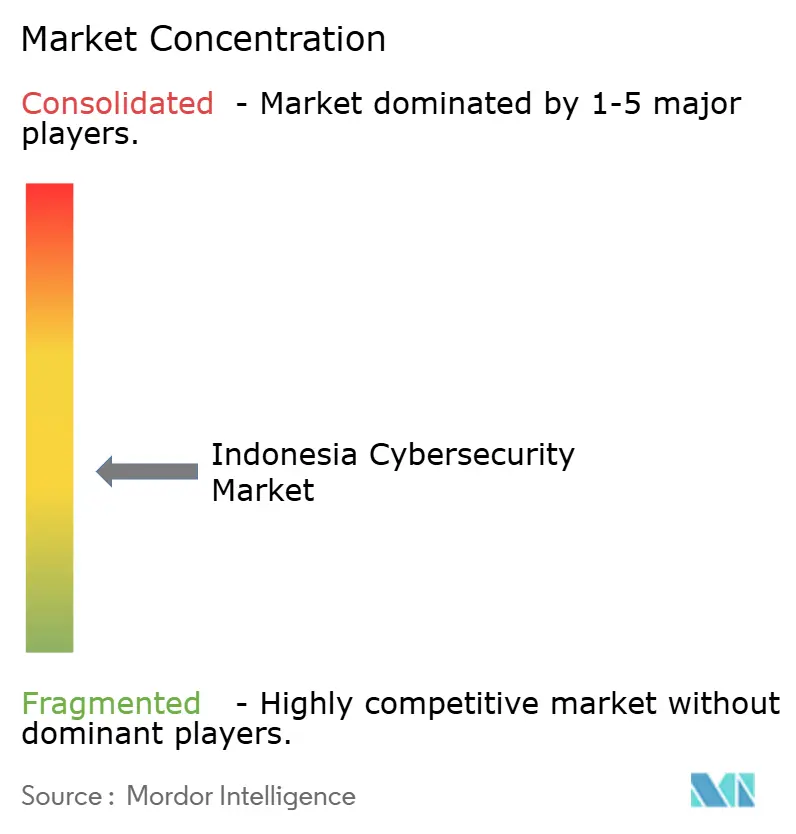
Partnership and investment trends reflect consolidation: CYFIRMA secured new funds from MDI Ventures to extend threat-intelligence nodes in Jakarta, and Indosat integrated NVIDIA’s Blackwell GPUs to boost AI-SOC throughput. Market entrants succeed when they tailor support, documentation, and dashboards to Bahasa-speaking teams. The top five suppliers hold roughly 38% combined revenue, placing the market in a moderately concentrated band but leaving growth white-space in SME bundles, OT defense, and Sharia-compliant banking.
Indonesia Cybersecurity Industry Leaders
IBM Corporation
Cisco Systems, Inc.
Dell Technologies Inc.
FUJITSU Limited
Intel Corporation
- *Disclaimer: Major Players sorted in no particular order

Market Opportunities and Future Outlook
Sovereign-aligned security operations and compliance execution create clear whitespace as government and regulated entities tighten incident readiness and continuity expectations under BSSN-led requirements. The operational impact of ransomware disruptions, including the June 2024 National Data Center outage affecting 282 agencies, has increased demand for tested contingency planning, immutable backup orchestration, and incident-response retainers. Buyers are also looking for measurable SOC outcomes (alerting, triage, containment) that can be audited.
Workforce development programs are also expanding a near-term on-ramp for managed services and standardized operating models, especially outside Jakarta where certified talent remains constrained. A 2030 target to train 1 million digital talents in cybersecurity through Kominfo in collaboration with Indosat Ooredoo Hutchison and Mastercard, alongside private initiatives such as Innov8’s June 2025 funding for a Jakarta-based cybersecurity training center, broadens the pipeline for SOC analysts and incident responders while supporting demand for playbooks, automation, and MDR packaging. Separately, the National Cyber Resilience Programme (Gerakan Nasional Ketahanan Siber) launched in 2026 by ITSEC Asia and ADIGSI targets 1,000+ participants and offers another channel for vendors and MSSPs to attach readiness assessments, tabletop exercises, and compliance-aligned tooling to a named national initiative.
Recent Industry Developments
- July 2026: Launch of Indonesia Sovereign Security Operations Center (SOC) utilizing Splunk Cloud Platform and Splunk Enterprise Security for real-time AI-based threat detection. The deployment expands sovereign-grade threat monitoring and aligns security data handling with national requirements. It demonstrates national-scale, AI-driven threat monitoring and data-sovereignty-aligned security services.
- March 2026: Launch of Security Command Center in collaboration with Cisco to leverage ML for real-time threat mitigation. The collaboration provides real-time cyber defense capability for Indonesian enterprises. It accelerates deployment of ML-driven security operations via telco-led ecosystem.
- March 2026: Introduction of Sovereign Core platform (autonomous AI management) with strengthened partnerships with Telkom Indonesia and BSSN. The autonomous AI-based cybersecurity infrastructure advances Indonesia's sovereign capabilities for critical NR and telecom assets. It positions IBM within national cybersecurity sovereignty initiatives and critical NR/telecom assets.


Research Methodology Framework and Report Scope
Market Definition and Coverage
For this study, the Indonesia cybersecurity market is defined as the spending in Indonesia on cybersecurity software, hardware, and services that prevent, detect, and respond to cyber risks across enterprise and public sector IT and cloud environments.
Scope exclusions: This sizing excludes general IT outsourcing that is not security-led, consumer-only antivirus sold at retail, and losses from cybercrime (they are not vendor revenues).
Segmentation Overview
- By Offering
- Solutions
- Application Security
- Cloud Security
- Data Security
- Identity and Access Management
- Infrastructure Protection
- Integrated Risk Management
- Network Security Equipment
- Endpoint Security
- Other Solutions
- Services
- Professional Services
- Managed Services
- Solutions
- By Deployment Mode
- On-Premise
- Cloud
- By Organization Size
- SMEs
- Large Enterprises
- By End-User Vertical
- BFSI
- Healthcare
- IT and Telecom
- Industrial and Defense
- Retail
- Energy and Utilities
- Manufacturing
- Others
Data Sources, Market Sizing, and Validation
Desk Research
Desk research helped us set the baseline for Indonesia's digital activity and the policy context that drives security budgets. We referred to public sources such as BSSN publications on cyber incidents, Kominfo updates tied to digital and data protection programs, and national statistics from BPS for business counts and ICT adoption signals.
To keep assumptions tied to what buyers actually deploy, we also looked at sources such as Bank Indonesia and OJK releases for banking digitization and risk priorities, as well as guidance from global standards bodies like ISO and NIST that are commonly referenced in local security programs. Company filings, investor presentations, reputable press coverage, and association websites were used to cross-check product focus and go-to-market intensity. Where needed, we used paid subscriptions for company financials and intelligence, news and financials, patent databases, and an import and export shipment-level database to validate directionally (the sources listed here are illustrative, and many other references were used for collection, validation, and clarification).
Primary Interviews and Surveys
Primary work was used to test adoption, pricing, and buying cycles across Indonesia, especially where public data stays high level. We spoke with a mix of security service providers, solution distributors, managed security teams, and enterprise buyers across regulated and fast-digitizing sectors to confirm how spend splits between services and tools and how cloud delivery is being purchased.
Distribution of primary research fieldwork respondents
| Company type | Respondent position | Region |
|---|---|---|
| Top tier: 32% | CXOs: 18% | |
| Mid tier: 47% | Functional/Unit leaders: 30% | |
| Smaller Players: 21% | Managers: 52% |
Market-Sizing & Forecasting
Sizing starts with a top-down build that reconstructs the demand pool from Indonesia's enterprise base and digital intensity, and then applies security spend propensity by sector before it is converted into vendor revenue. The output is then corroborated with selective bottom-up approximations, such as sampled average selling price (ASP) by workload, channel checks on services attach rates, and partial supplier roll-ups for categories where disclosure is clearer.
A few inputs that matter for this market include the pace of cloud workload migration, incident frequency and severity signals reported locally, data protection and critical infrastructure compliance activity, security staffing gaps that push managed services demand, and sector-wise digitization (especially BFSI, telecom, e-commerce, and government). Pricing was treated carefully because contract structures vary, so ASP ranges were validated through interviews and adjusted for multi-year deal structures and renewal patterns. For forecasting, we used scenario analysis supported by a simple multivariate regression view, where macro IT spend, cloud adoption, and regulatory enforcement intensity were the key drivers that were stress-tested with expert views. When bottom-up visibility was weak for smaller providers, gaps were handled using conservative revenue bands and channel share assumptions that were rechecked in follow-up calls.
Data Validation & Update Cycle
Totals were triangulated across multiple checks, so unusual spikes or dips were reviewed against independent signals like cloud services growth, breach reporting patterns, and procurement activity in regulated industries. If a category looked overstated, we re-validated the driver assumptions, re-checked pricing ranges, and then confirmed with additional industry contacts before final sign-off.
Each report is refreshed annually, and interim updates are made when material events change demand, such as new compliance deadlines, major incident waves, or notable public budget shifts. Before delivery, an analyst completes a fresh pass on key inputs and recent developments, which helps ensure clients receive an updated view that still follows the same repeatable steps.
Mordor Intelligence's Indonesia Cybersecurity Market Sizing Compared With Other Published Estimates
Published numbers for Indonesia cybersecurity often vary because researchers do not always count the same revenue pool, and they also apply different assumptions for services, cloud security, and managed detection coverage. Differences also come from how exchange rates are timed, which year is treated as the base, and whether estimates are refreshed after major policy or incident changes.
In practice, the biggest gaps are usually caused by scope choices, especially when one estimate folds in broad IT services or consumer security sales, while another keeps only enterprise and government security spending that maps to vendor revenue. Some figures also push aggressive growth by assuming rapid zero-trust adoption across all verticals without checking actual procurement cycles, and others keep pricing flat even when contract mixes shift toward managed services. The spread below is mainly explained by whether managed security services and cloud-delivered security are counted as full market revenue or only as tool spending, a choice applied after local buyer validation in Mordor Intelligence.
Benchmark comparison
| Source | Market Size | Gaps in Research Methodology |
|---|---|---|
| Mordor Intelligence | USD 1.35 B (2025) | |
| Global Consultancy A | USD 1.10 B (2025) | Often narrows the scope to software and appliance revenues and treats managed security services as IT services, which can undercount MSSP-led growth in Indonesia. |
| Industry Association B | USD 1.80 B (2025) | May include broader digital risk and adjacent IT consulting spend, and may use optimistic cloud security penetration assumptions without normalizing multi-year contract revenue timing. |
The table shows that the main differences are not about math, they are about what is included and when revenue is recognized. By keeping the scope tied to cybersecurity vendor revenue in Indonesia and then pressure-testing pricing and services mix with local checks, the final figure stays traceable to clear drivers and can be repeated when new data arrives.


Key Questions Answered in the Report
What is the current value of the Indonesia cybersecurity market?
The market is valued at USD 1.62 billion in 2026 and is projected to reach USD 4.06 billion by 2031 at a 20.12% CAGR.
Which segment is expanding fastest in the Indonesia cybersecurity market?
Managed Services is growing the quickest with a forecast 17.14% CAGR, fueled by acute talent shortages and rising demand for outsourced SOC functions.
How does regulatory enforcement influence spending?
The Personal Data Protection Act, in force since October 2024, imposes fines of up to 2% of annual turnover, prompting enterprises to invest aggressively in data-loss prevention and identity governance.
Why are SMEs adopting cybersecurity solutions more rapidly now?
QRIS mandates have pulled 14.78 million merchants into real-time payments, compelling even micro-enterprises to deploy endpoint and cloud-security tools to stay compliant and protect digital transactions.
Page last updated on:


