
India Steel Market Size and Share
Market Overview
| Study Period | 2021 - 2031 |
|---|---|
| Forecast Data Period | 2026 - 2031 |
| Base Year Market Size (2025) | 162.23 Million tons |
| Market Volume (2026) | 177.03 Million tons |
| Market Volume (2031) | 273.88 Million tons |
| Growth Rate (2026 - 2031) | 9.12 % |
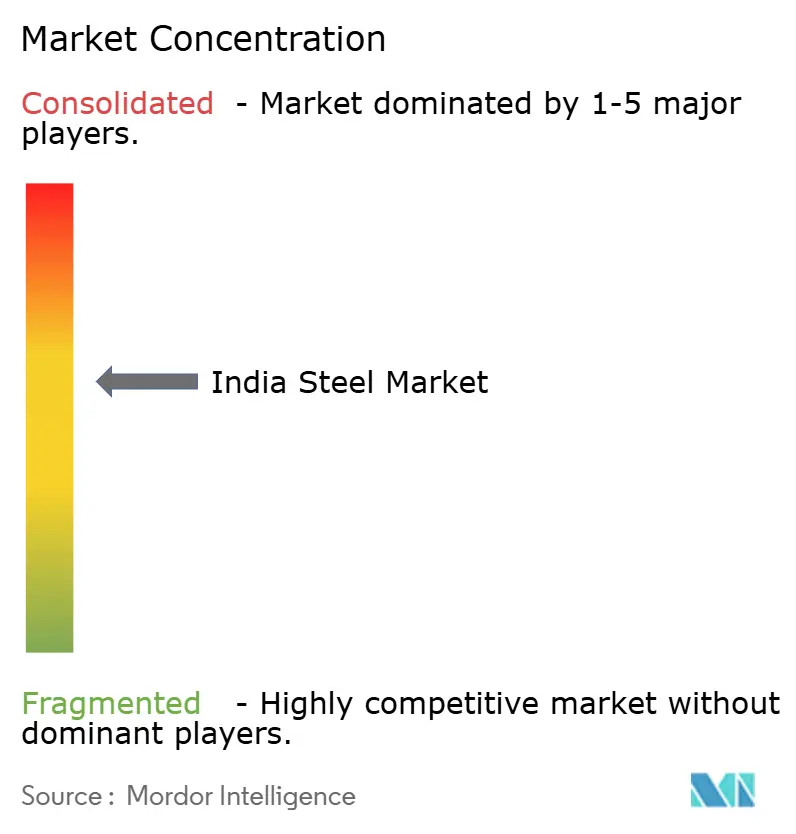
| Market Concentration | Medium |
Major Players *Disclaimer: Major Players sorted in no particular order Image © Mordor Intelligence. Reuse requires attribution under CC BY 4.0. | |
India Steel Market Analysis by Mordor Intelligence
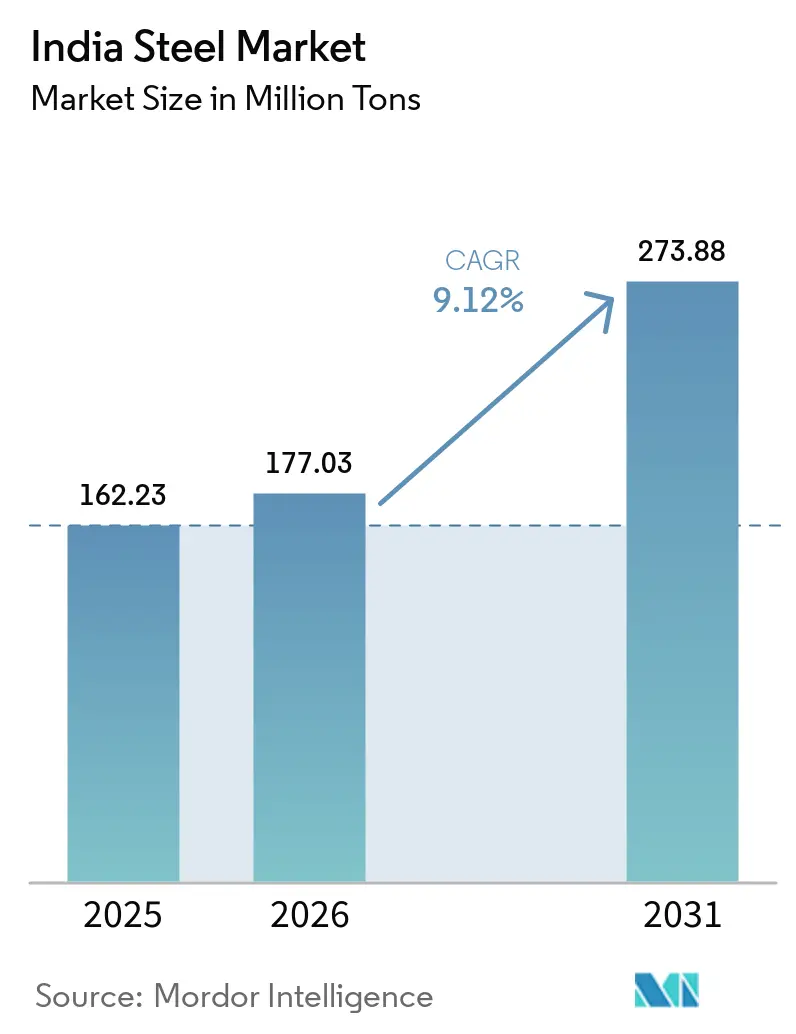
The India Steel Market size is expected to grow from 162.23 million tons in 2025 to 177.03 million tons in 2026 and is forecast to reach 273.88 million tons by 2031 at a 9.12% CAGR over 2026-2031. In 2025, India stood out as the sole top-10 producer to achieve a double-digit volume growth. In contrast, production in China, Japan, and the European Union either stagnated or declined. This sustained momentum can be attributed to three significant factors. Firstly, the Production Linked Incentive (PLI) scheme for specialty steel has catalyzed private commitments. However, by December 2025, less than half of the sanctioned projects had commenced, leading to a deferred-capacity wave that is expected to uphold pricing discipline until 2027. Secondly, integrated mills located in Odisha, Jharkhand, and Chhattisgarh have gained a competitive edge in landed costs. This advantage stems from securing long-term iron-ore leases under the revised Mines and Minerals Act. As a result, these mills, despite concerns over carbon intensity, managed to maintain a significant market share in 2025. Lastly, the National Infrastructure Pipeline's ambitious outlay has set a reliable demand baseline for structural sections and rebar. This is further bolstered by heightened demand for high-tensile products, driven by metro-rail initiatives in Tier-2 cities and the second phase of the Dedicated Freight Corridor.
Key Report Takeaways
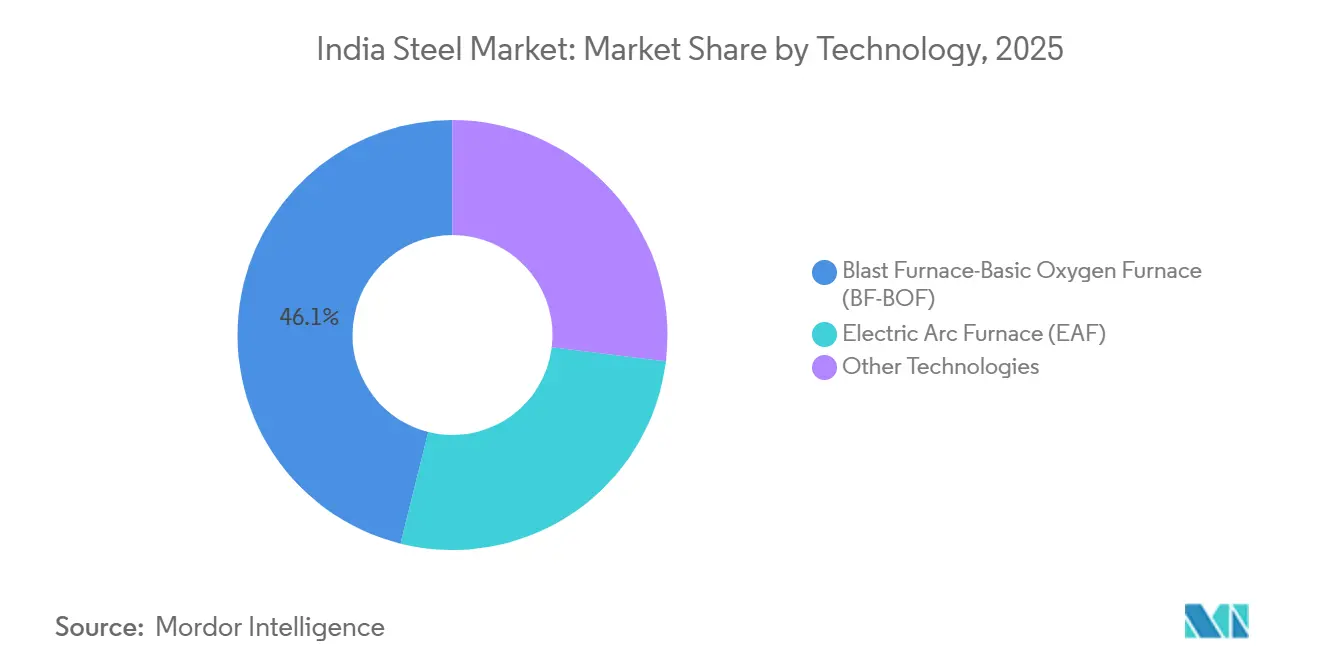
- By technology, Blast Furnace–Basic Oxygen Furnace routes held 46.12% of 2025 output and are forecast to grow at an 8.77% CAGR through 2031.
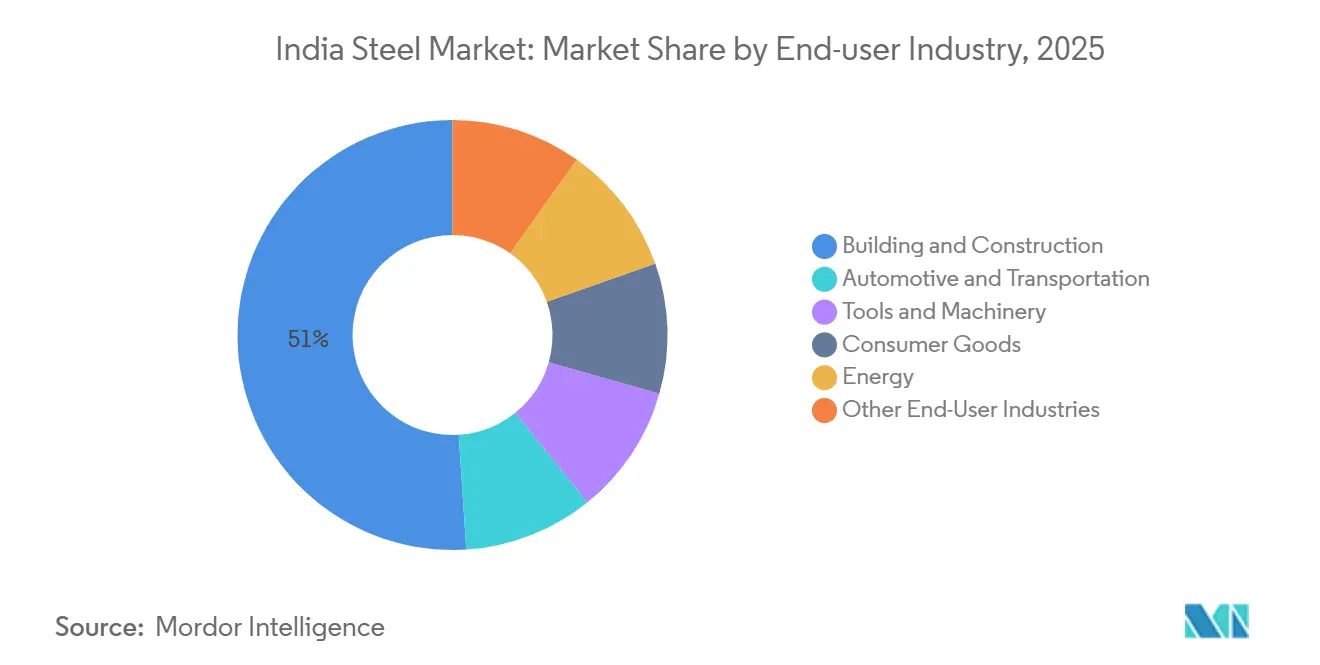
- By end-user, building and construction commanded 51.02% revenue share in 2025 and is projected to rise at a 9.84% CAGR, outpacing the India steel market average.
Note: Market size and forecast figures in this report are generated using Mordor Intelligence’s proprietary estimation framework, updated with the latest available data and insights as of 2026.
Market Trends and Insights
Drivers Impact Analysis of India Steel Market*
| Drivers | (~) % Impact on CAGR Forecast | Geographic Relevance | Impact Timeline |
|---|---|---|---|
| PLI scheme catalyzing specialty-steel investment | +1.2% | Gujarat, Odisha, Karnataka | Medium term (2-4 years) |
| Domestic and foreign CAPEX surge | +1.8% | Odisha, Jharkhand, Chhattisgarh, Karnataka, Maharashtra | Long term (≥ 4 years) |
| Large infrastructure pipeline | +2.1% | National, early impact in Uttar Pradesh, Maharashtra, Tamil Nadu | Medium term (2-4 years) |
| Auto-OEM shift to AHSS and EV grades | +1.0% | Gujarat, Maharashtra, Tamil Nadu, Karnataka | Short term (≤ 2 years) |
| Hydrogen-DRI pilots and scrap push | +0.7% | Odisha, Jharkhand, Gujarat | Long term (≥ 4 years) |
| Source: Mordor Intelligence | |||
Strong Policy Support Through the PLI Scheme for Specialty Steel
Despite three successive PLI tranches allocating significant funding for specialty capacity to be completed by 2027, only a portion had secured financial closure by December 2025. Early movers who commission coated, electrical, or alloy lines before mid-2027 can lock in an incentive for five years, translating to a substantial subsidy on production costs. The framework favors brownfield expansions, as existing integrated mills in the steel market in india can leverage shared captive power and logistics, reducing lead times by up to 18 months. In a strategic move, automotive OEMs are collaborating with steelmakers to co-invest in domestic coating lines, a decision poised to shift a significant portion of annual demand from imports by 2028.
Surge in Domestic and Foreign CAPEX for Capacity Expansion
Between January 2024 and December 2025, JSW Steel and Tata Steel spearheaded a surge in announced additions. JSW Steel's ambitious program spans across Vijayanagar, Dolvi, and Odisha. Meanwhile, Tata Steel is investing in a Phase-II expansion at Kalinganagar. In FY25, foreign direct investment saw a significant leap. This uptick was largely driven by ArcelorMittal's increased stake in AM/NS India and Posco's strengthened technical collaboration with JSW. The mineral-rich eastern states enjoy a freight advantage when catering to northern demand centers. However, this advantage might diminish if the eastern segment of the Dedicated Freight Corridor implements a reduction in rail tariffs by 2027.
Large Infrastructure Pipeline Driving Long-Cycle Demand
The National Infrastructure Pipeline allocates significant funds through 2030, with highways, metro rail, and housing absorbing a major share. Bharatmala Phase I consumed a substantial amount of steel, and Phase II is poised to need higher annual steel requirements from 2027 as elevated corridors employ more steel per kilometer. The Pradhan Mantri Awas Yojana (Urban) 2.0 targets a large number of dwellings by 2029, implying incremental demand in the steel industry in india steel that must meet revised seismic codes mandating higher rebar density in high-risk zones[1].
Auto-OEM Pivot to High-Strength and EV-Grade Steels
In FY25, demand for steel in passenger vehicles increased significantly. As OEMs pursue the 2027 CAFE norms, Advanced High-Strength Steels (greater than or equal to 980 MPa) now constitute a notable portion of the mix. The domestic supply remains constrained. Despite Tata Steel launching an AHSS line and JSW introducing a facility in 2024, these additions fall short of bridging the import gap. In 2025, with EV production rising, the industry turned to battery tray steels. Currently, only Tata Steel and AM/NS India can supply these steels at scale.
Restraints Impact Analysis of India Steel Market*
| Restraints | (~) % Impact on CAGR Forecast | Geographic Relevance | Impact Timeline |
|---|---|---|---|
| Per-capita steel consumption still below global average | -0.4% | National, with acute gaps in rural and eastern regions | Long term (≥ 4 years) |
| Volatile raw-material and energy costs | -0.7% | National, with higher exposure for coastal integrated mills | Short term (≤ 2 years) |
| Slow domestic scrap-collection ecosystem | -0.5% | National, with infrastructure deficits in Uttar Pradesh, Bihar, Madhya Pradesh | Medium term (2-4 years) |
| Source: Mordor Intelligence | |||
Per-Capita Steel Consumption Still Below the Global Average
In the first eight months of FY26, domestic consumption remained significantly below the global average and the levels typical of developed nations[2]. To meet the government's target by FY31, consumption must grow annually, and real GDP needs to expand at a steady rate. Both of these thresholds are susceptible to downturns in the credit cycle. Adding to the challenge are regional imbalances: while Odisha, Jharkhand, and Chhattisgarh account for over half of the production, they only consume a small portion locally. This discrepancy forces mills in the steel market in india to incur additional freight costs to deliver to customers in the western and southern regions.
Volatile Raw-Material and Energy Costs
In FY25, India imported coking coal at an average landed price that surged due to weather-related disruptions in Australia and logistical challenges in Mozambique, which tightened the supply. For integrated mills, every price hike in coal can shave off EBITDA margins unless these costs are passed on to customers. Following a price revision by Coal India, electricity tariffs for industrial consumers in Odisha and Jharkhand saw an uptick in FY25. This rise in tariffs diminished the savings from solar and wind installations, which require a hefty upfront investment.
*Our forecasts treat driver/restraint impacts as directional, not additive. The impact forecasts reflect baseline growth, mix effects, and variable interactions.
India Steel Market Segment Analysis
By Technology:
Integrated Routes Anchor Volume Despite Carbon IntensityBlast Furnace–Basic Oxygen Furnace lines produced 46.12% of 2025 output and are on track for 8.77% CAGR through 2031. Tata Steel’s Kalinganagar and JSW’s Vijayanagar plants, operating at high capacity, capitalize on captive ore and coal, achieving a cost advantage over rivals reliant on merchant sources. While Electric Arc Furnace capacity remains modest, it's slated for notable growth, buoyed by the Scrap Policy's boost of available feedstock by 2030. Though technologies like induction furnaces and nascent hydrogen-DRI pilots account for a smaller share of the tonnage, they grapple with challenges as Quality Control Orders phase out non-ISI-compliant steel from public projects.
Forecasts indicate the market for Electric Arc Furnace products in India will expand significantly by 2031. As construction codes increasingly emphasize tighter seismic standards, producers of stainless and micro-alloyed bars in the steel industry in india, who predominantly utilize scrap, stand to gain the most.

By Basic Form:
Crude Steel Universality Masks Downstream DifferentiationIn 2025, crude steel production hit significant levels and is expected to register a 7.73% CAGR through 2031. Yield optimization is bridging the divide between crude and finished volumes. An endless-strip line boasts higher yields, surpassing conventional mills. Meanwhile, a twin-roll caster has significantly reduced the melt-to-coil cycle. Odisha and Jharkhand exported semi-finished slabs to western processors, underscoring an inefficiency that may diminish with the launch of new hot-rolling lines in eastern clusters.
By Final Form:
Finished Steel Drives End-User EngagementIn 2025, finished steel shipments in India increased, aligning with the market's projected 9.12% CAGR growth. While hot-rolled products commanded a significant market share, their growth lagged, partly due to the rising adoption of aluminum structures in light-industrial constructions. Benefiting from PLI incentives that introduced new capacity, cold-rolled and coated products saw robust growth. Meanwhile, driven by infrastructure projects like highways and metro construction, long products are set to grow steadily.
In 2025, cold-rolled and coated products accounted for a notable portion of the Indian steel market share, with projections suggesting an increase by 2031, highlighting a strategic shift towards automotive and appliance sectors.
By End-User Industry:
Construction Dominance Meets Automotive SophisticationBuilding and construction absorbed 51.02% of finished steel in 2025 and is pegged for a 9.84% CAGR. This sector is projected to grow steadily, buoyed by the steel-intensive Bharatmala Phase-II and the housing-driven PMAY (Urban) 2.0. The automotive and transportation sectors, which currently make up a significant portion of steel demand in the steel industry in india, are expected to grow as well. This growth comes even as the intensity of steel used in vehicles is anticipated to decline due to the adoption of Advanced High-Strength Steel (AHSS). Energy projects, particularly solar mounting structures and wind tower wire rods, are set to experience the most rapid growth. This surge aligns with the ambitious renewable capacity target set by the Ministry of New and Renewable Energy.
Geography Analysis
In 2025, Odisha, Jharkhand, and Chhattisgarh collectively produced crude steel, accounting for a significant portion of India's national output. This achievement was bolstered by the fact that these states hold a majority of the country's iron ore reserves. Odisha is set to boost its capacity further by 2028, thanks to new furnaces being commissioned by AM/NS India and JSW. Chhattisgarh is at the forefront of regional growth, driven by NMDC Steel's new facility and Jindal Steel's expansion. In 2025, Western India, anchored by automotive hubs in Pune and Ahmedabad, accounted for a notable share of the national demand. Southern states, while consuming a substantial amount, still found themselves importing coated products, a necessity due to their limited local galvanizing capacity. Meanwhile, demand centers in the north and east collectively utilized significant volumes but faced freight penalties when sourcing from eastern mills. However, with the eastern arm of the Dedicated Freight Corridor projected to come online by 2027, it's anticipated to reduce those freight costs. This development could reroute a considerable amount of annual flows inland, significantly reshaping the competitive landscape.
Regulatory Landscape
India's steel sector is shaped by the Ministry of Steel (MoS) through policy direction on production, distribution, and trade, while product compliance is governed by the Bureau of Indian Standards (BIS) via mandatory Quality Control Orders (QCOs). As of December 31, 2025, 14 QCOs were active, tightening eligibility for steel used in public procurement and accelerating the phase-out of non-ISI-compliant products across infrastructure-led demand segments.
On the trade and procurement side, import flows are channeled through the Steel Import Monitoring System (SIMS), with SARAL-SIMS used for import registration and monitoring. Policy signals also favored domestic sourcing through the May 2025 revision of the Domestically Manufactured Iron and Steel Products (DMI&SP) policy. The Steel and Steel Products (Quality Control) Amendment Order, 2025 temporarily suspended enforcement for 55 standards as part of rationalization, which affected the timeline for mandatory conformity for certain grades.
Value Chain Analysis
India's steel value chain begins with raw materials concentrated in iron ore belts across Odisha, Jharkhand, Chhattisgarh, and Goa, feeding integrated and secondary producers. Integrated mills primarily operate BF-BOF routes, with coking coal as a critical input that remains cost-sensitive. In parallel, scrap-based routes are constrained by the domestic scrap ecosystem, which in turn shapes Electric Arc Furnace scale-up and the economics for specialty long products.
Midstream processing moves from crude steel to finished steel conversion, spanning hot rolling, cold rolling, and coating. Major incumbents, including Tata Steel, JSW Steel, SAIL, AM/NS India, and Jindal Steel and Power, are investing to deepen downstream capability and expand capacity. Downstream distribution is fragmented across company-owned channels and multi-tier wholesale and retail networks serving construction and industrial buyers, creating variation in realized pricing, working-capital intensity, and service levels by region and product form.
Competitive Landscape
The steel industry in india is moderately consolidated. Integrated leaders are boosting their coated, electrical, and AHSS lines, achieving impressive EBITDA margins. Meanwhile, Electric Arc Furnace players are honing in on specialty long products, capitalizing on the upcoming scrap mandate for more affordable feedstock. Strategic technology partnerships are proving beneficial: JSW's collaboration focuses on electrical steels, while Tata's partnership centers on hydrogen-DRI, positioning these incumbents advantageously in the low-carbon, high-value market segments. Disruptors such as NMDC Steel, bolstered by their own ore and a newly established coastal terminal, are setting their sights on underpricing seasoned exporters in Southeast Asia. Such a downturn historically ignites price competition, often trimming margins—a challenge that tends to benefit mills with their own mines and integrated logistics.
India Steel Industry Leaders
-
Tata Steel
-
JSW Steel Limited
-
Steel Authority of India Limited (SAIL)
-
AM/NS India
-
Jindal Steel & Power Limited
- *Disclaimer: Major Players sorted in no particular order
India Steel Market Companies Covered in this Report
- AM/NS India
- Godawari Power and Ispat
- Jindal Steel & Power Limited
- JSW Steel Limited
- Kalyani Steels
- Mukand Ltd.
- NMDC Steel Limited
- Rashtriya Ispat Nigam Limited
- Steel Authority of India Limited (SAIL)
- Tata Steel
- Vedanta Limited
- VISA STEEL
Market Opportunities and Future Outlook
Policy-linked capacity building and import substitution in higher-grade steels point to near- and mid-cycle whitespace in specialty and value-added products. The Production Linked Incentive (PLI) scheme for specialty steel, including the January 2025 Phase 1.1 rollout, supports incremental domestic capabilities in coated, electrical, and advanced high-strength categories. This aligns with observed OEM pull for AHSS and EV-related grades and with procurement rules that increasingly prioritize standards-compliant domestic supply.
Decarbonization-linked shifts in processes and feedstocks also open room for operators that can connect scrap availability, energy efficiency, and newer process routes. Tata Steel's emphasis on scrap-based EAF capacity at Ludhiana and process pathways such as HIsarna reflect active efforts to diversify beyond coal-intensive routes. Separately, the National Steel Policy 2017 capacity target of 300 MTPA by 2030-31 and the sector focus on reducing coking coal import dependence from 85% to 65% by 2030-31 support opportunities in domestic raw-material security, beneficiation, and logistics-linked coastal capacity that can lower delivered costs for both domestic demand centers and export corridors.
Recent Industry Developments in India Steel Market
- July 2026: JSW Steel commenced development of the 2 MTPA integrated steel plant in the Rayalaseema region of Andhra Pradesh (Rs 16,350 crore investment). The project expands capacity in a coastal region, supporting higher output and regional integration. It strengthens JSW's coastal footprint and long-term supply security, backing domestic demand growth and export potential.
- July 2026: Tata Steel invested Rs 10,000 crore in Jharkhand projects by 2028 to raise steelmaking capacity to 40 MTPA, including Rs 7,000 crore for HIsarna and Easy Melting Technology. The program expands Tata Steel's Indian capacity in a key market and brings additional high efficiency production methods into its portfolio. It reinforces leadership in value-added steel products and low-emission capabilities.
- May 2026: JSW Steel initiated construction of a 13.2 MTPA greenfield integrated steel plant in Paradeep, Odisha (Rs 65,000 crore investment). The capacity addition strengthens regional supply in the Odisha coast and improves coastal logistics. It boosts downstream value-chain growth and regional market presence.
India Steel Market Report Scope and Research Methodology
Market Definition and Coverage
For this study, we size the India steel market as the domestic volume of crude steel made and sold into India, along with the conversion to finished steel supplied to end users across the country.
Scope exclusions: We exclude downstream fabricated steel products and job-work fabrication services (such as structural fabrication and component assembly) when the value add is mainly processing, not steelmaking.
Segments Covered in This Report
- By Technology
- Blast Furnace-Basic Oxygen Furnace (BF-BOF)
- Electric Arc Furnace (EAF)
- Other Technologies
- By Basic Form
- Crude Steel
- By Final Form
- Finished Steel
- By End-user Industry
- Automotive and Transportation
- Building and Construction
- Tools and Machinery
- Consumer Goods
- Energy
- Other End-User Industries
Data Sources, Market Sizing, and Validation
Desk Research
We started by mapping the India steel value chain and the flow from crude steel output to finished steel availability, and then to end-use demand. Public datasets help here because they anchor the model to physical volumes, before price assumptions are applied.
Key non-paywalled references included official and industry sources such as the Ministry of Steel (India) releases, the Joint Plant Committee statistics, World Steel Association data series, UN Comtrade trade codes for steel products, and the Reserve Bank of India macro indicators that influence construction and industrial activity. We also reviewed company annual reports, investor presentations, and credible press to track capacity additions, shutdowns, and product mix shifts. Where needed, we used paid subscriptions for company financials and intelligence, shipment-level import and export visibility, and patents to cross-check technology and product direction. The desk sources listed here are illustrative, and we referred to many other public documents to collect data, validate assumptions, and clarify gaps.
Primary Interviews and Surveys
Primary work focused on steel producers, distributors and stockists, large industrial buyers, and sector specialists who track demand from construction, automotive, machinery, and energy. We used these conversations to test utilization assumptions, confirm product mix shifts between long and flat steel, and sanity-check how imports and exports are behaving versus domestic supply. Since this is a country market, we also ensured coverage across major producing and consuming clusters to avoid over-weighting one region.
Distribution of primary research fieldwork respondents
| Company type | Respondent position |
|---|---|
| Top tier: 38% | CXOs: 15% |
| Mid tier: 42% | Functional/Unit leaders: 26% |
| Smaller Players: 20% | Managers: 59% |
Market-Sizing & Forecasting
The core sizing uses a top-down build where production, net trade, and apparent steel availability are reconstructed for India, and then split into crude and finished steel flows using conversion factors and product mix signals. To keep the totals realistic, we corroborated the result with selective bottom-up checks, such as sampled capacity by major routes, utilization ranges gathered from interviews, and volume times average realized price checks where pricing was needed for consistency.
Inputs that mattered most included crude steel output and capacity additions, blast furnace versus electric arc furnace share, import and export volumes by key steel product codes, construction and infrastructure activity indicators, and automotive production trends that influence flat steel demand. For forecasting, we leaned on scenario analysis supported by expert views, since capacity ramp-ups, policy changes, and demand cycles can shift outcomes quickly. Where bottom-up data was patchy for smaller mills or informal distribution, we bridged gaps using cluster-level utilization ranges and cross-checked them against national supply and trade totals.
Data Validation & Update Cycle
We validate the model by comparing results against independent signals such as published output series, trade balances, and consumption indicators that should move in the same direction as steel demand. Variances are reviewed in steps, first at the input level (units, timing, conversion factors), and then at the output level (share splits and growth rates), before analyst sign-off.
If an anomaly shows up, like a sudden trade jump or a capacity change not reflected in output, the assumption is revisited and relevant experts are re-contacted to confirm what changed. Reports are refreshed annually, with interim updates when material events occur, and a final pre-delivery pass is completed so clients receive the most current view.
Mordor Intelligence's India Steel Market Size Measured Against Other Published Estimates
Published numbers for the India steel market often look different because the underlying unit is not always the same, and because some studies mix volume and value without clearly explaining the conversion. Differences also show up when one estimate is closer to crude steel output, while another leans toward finished steel shipments to end users.
The main gap comes from whether crude steel and finished steel are blended into one figure, where Mordor Intelligence keeps the sizing in volume terms and ties it to apparent availability (production plus net trade) before allocating into end-use demand, rather than inflating totals by double counting conversion stages.
Benchmark comparison
| Source | Market Size | Gaps in Research Methodology |
|---|---|---|
| Mordor Intelligence | USD 162.23 M (2025) | |
| Industry Association A | USD 175.00 M (2025) | This estimate appears closer to crude steel output reporting and can overstate market size when conversion to finished steel and net trade adjustments are not applied consistently across the year. |
| Trade Journal B | USD 150.00 M (2025) | This figure looks more conservative because it likely narrows the count to finished steel shipments only, and it may use a different timing cut for imports and exports, which shifts apparent availability. |
The spread in published values is mostly explained by unit choice and stage counting across crude and finished steel, followed by how trade is netted out and timed. Our approach stays traceable to physical tonnage and repeatable conversions, so the total can be rechecked as new production, trade, and capacity data comes in.
Key Questions Answered in the Report
What is the projected volume of the India steel market by 2031?
Demand is expected to reach 273.88 million tons by 2031, growing at a 9.12% CAGR, from 177.03 million tons in 2026.
Which segment will contribute the fastest growth in final form demand?
Finished steel products are forecast to expand at a 9.12% CAGR to 2031, outpacing other finished categories.
How will infrastructure spending influence steel consumption?
Bharatmala Phase-II and PMAY (Urban) 2.0 alone could create 30-plus million tons of incremental annual demand once fully mobilized after 2027.
What role does scrap play in India’s decarbonization roadmap?
The draft Scrap Policy aims to double domestic ferrous-scrap availability by 2030, lifting Electric Arc Furnace output and cutting carbon intensity.
Which region is set for the highest production growth?
Chhattisgarh is growing, helped by NMDC Steel’s Nagarnar plant and Jindal Steel’s Angul expansion.