
India Software Services Export Market Size and Share
Market Overview
| Study Period | 2020 - 2031 |
|---|---|
| Forecast Data Period | 2026 - 2031 |
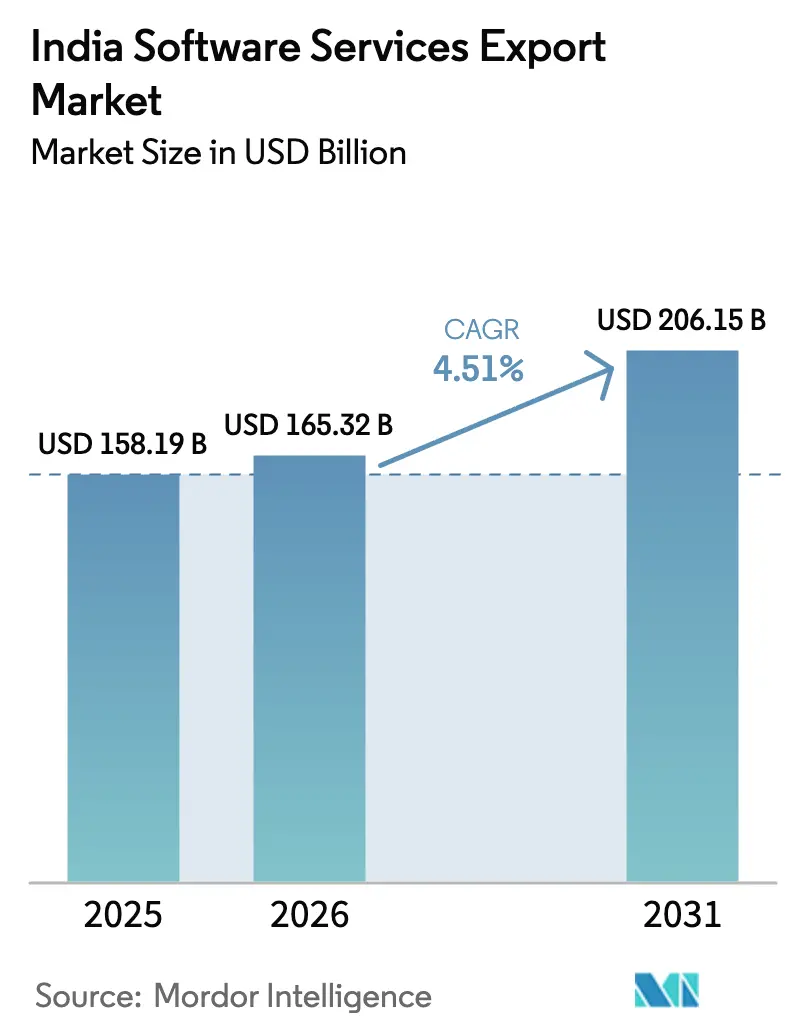
| Base Year Market Size (2025) | USD 158.19 Billion |
| Market Size (2026) | USD 165.32 Billion |
| Market Size (2031) | USD 206.15 Billion |
| Growth Rate (2026 - 2031) | 4.51 % |
| Market Concentration | Medium |
Major Players *Disclaimer: Major Players sorted in no particular order Image © Mordor Intelligence. Reuse requires attribution under CC BY 4.0. | |
India Software Services Export Market Analysis by Mordor Intelligence
The India software services export market size is expected to grow from USD 158.19 billion in 2025 to USD 165.32 billion in 2026 and is forecast to reach USD 206.15 billion by 2031 at 4.51% CAGR over 2026-2031. Its growth rests on a structural shift from pure cost-arbitrage contracts toward value-driven innovation partnerships that embed Indian teams inside clients’ product roadmaps and governance frameworks. Demand is amplified by India’s 55% share of global IT outsourcing, a workforce of more than 5 million professionals, and 1,650 global capability centers (GCCs) employing 1.6 million people. Macro forces including accelerated AI and machine-learning adoption in banking and insurance, government production-linked incentives, and a persistently weak rupee reinforce the competitive edge that Indian vendors hold in multi-year digital-transformation deals. Simultaneously, Japan’s mid-tier firms are pivoting toward near-shore partnerships with India because bilingual staffing and quality governance increasingly outweigh pure wage considerations.
Key Report Takeaways
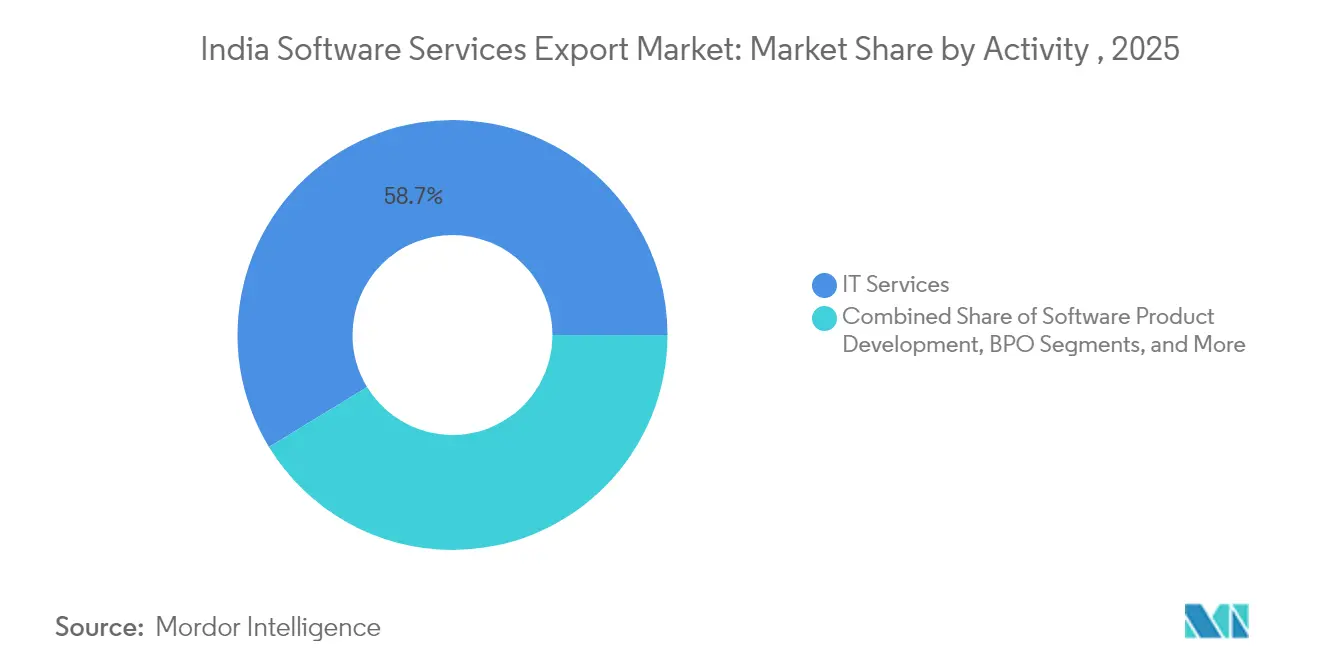
- By activity, IT services commanded 58.72% of the India software services export market share in 2025, while software product development is projected to expand at a 5.71% CAGR through 2031.
- By service-delivery model, offshore held 63.78% of the India software services export market size in 2025; GCCs are forecast to grow at a 6.03% CAGR to 2031.
- By client industry, BFSI led with 32.85% revenue share in 2025, whereas healthcare and life sciences is expected to grow at 5.15% CAGR.
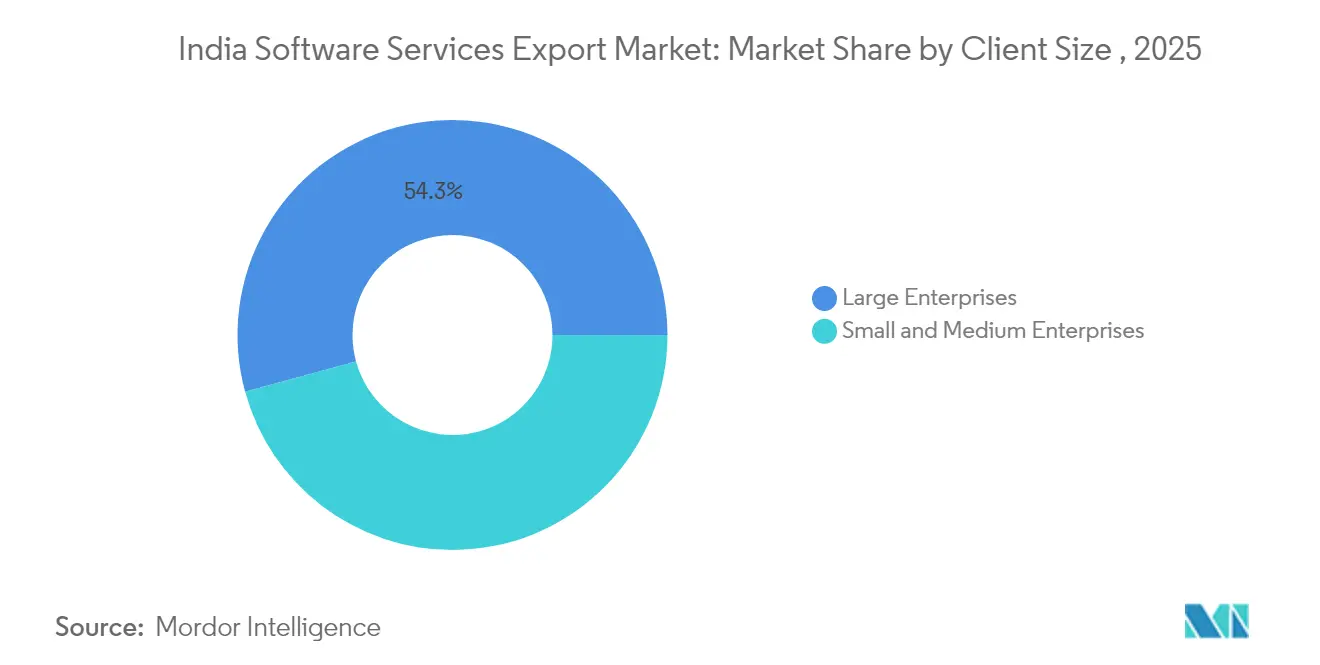
- By client size, large enterprises represented 54.25% of overall revenues in 2025; SMEs exhibit the strongest outlook with a 6.82% CAGR.
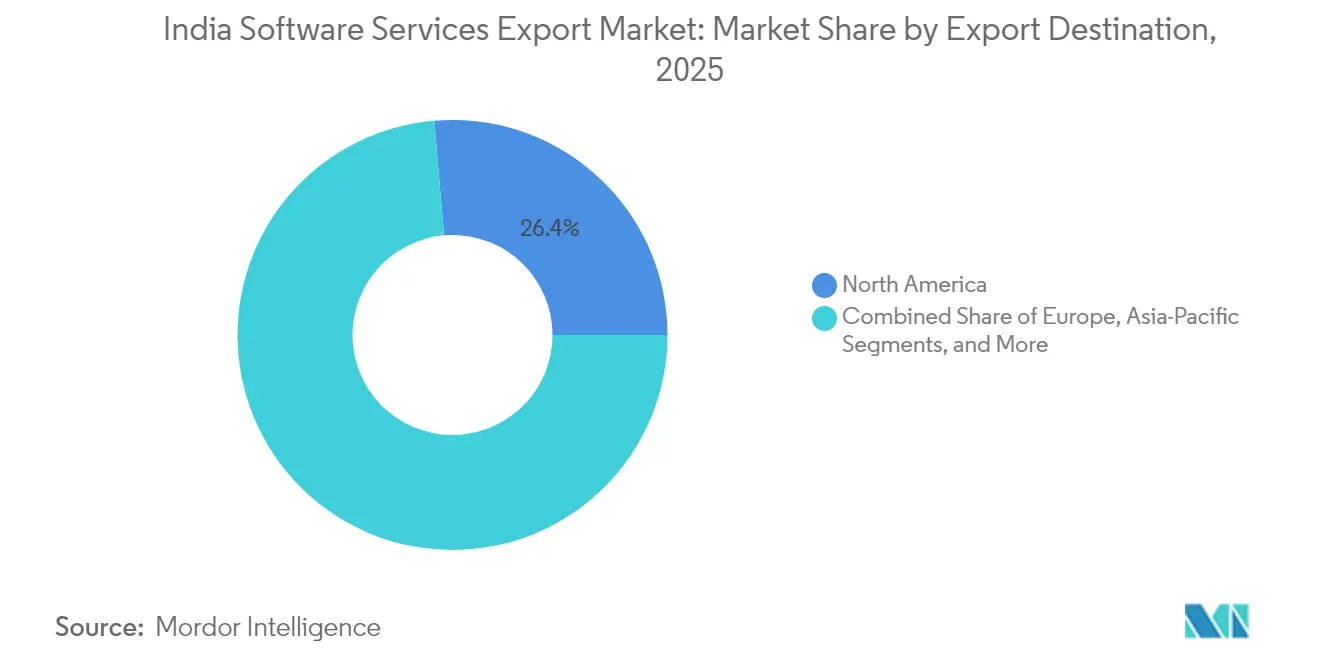
- By export destination, North America retained 26.35% of 2025 revenue, but the Middle East is the fastest-growing region at 5.44% CAGR.
Note: Market size and forecast figures in this report are generated using Mordor Intelligence’s proprietary estimation framework, updated with the latest available data and insights as of 2026.
Market Trends and Insights
Drivers Impact Analysis of India Software Services Export Market*
| Driver | (~) % Impact on CAGR Forecast | Geographic Relevance | Impact Timeline |
|---|---|---|---|
| Rising global demand for cost-efficient digital transformation services | +1.2% | Global, with concentration in North America and Europe | Medium term (2-4 years) |
| Expansion of cloud migration and managed services contracts | +0.9% | North America and Asia-Pacific core, spill-over to MEA | Short term (≤ 2 years) |
| Government incentives (SEZ, tax holidays, PLI) bolstering IT exports | +0.7% | National, with early gains in Bengaluru, Hyderabad, Chennai | Long term (≥ 4 years) |
| Accelerated AI/ML adoption by BFSI and retail clients | +0.8% | Global, led by North America and Europe | Medium term (2-4 years) |
| Japan mid-tier firms' near-shore preference for India | +0.3% | Asia-Pacific core, specific to Japan-India corridor | Medium term (2-4 years) |
| ESG-linked "green software engineering" outsourcing surge | +0.4% | Europe and North America, expanding to Asia-Pacific | Long term (≥ 4 years) |
| Source: Mordor Intelligence | |||
Rising Global Demand for Cost-Efficient Digital-Transformation Services
Enterprise technology spending is rising 11.2% to almost USD 160 billion in 2025, and Indian vendors deliver complex transformations at 40–60% lower cost than on-shore teams. Buyers now seek strategic capability building rather than simple cost-cutting, which lets Indian firms price premium specialty work such as cybersecurity and data analytics. Multi-year engagements improve revenue visibility, while measured ROI proofs Tata CLiQ lifted conversions by 11.3% after implementing personalization, encouraging repeat outsourcing. [1] Mid-tier suppliers benefit most because they combine domain depth with leaner overheads that global consultancies cannot easily match. Altogether, this driver adds an estimated 1.2 percentage-points to the forecast CAGR of the India software services export market.
Expansion of Cloud-Migration and Managed-Services Contracts
Strategic alliances with AWS, Azure, and Google Cloud let Indian providers capture migration fees plus 3-to-5-year managed-services annuities. HCLTech’s exclusive global services pact for Nuance customers underpins this shift toward cloud-native recurring revenue.[2] Skills in containerization, micro-services, and DevOps accelerate, and certification pipelines scale across tier-II cities, broadening the talent base. The operational-expenditure model resonates with mid-market buyers, expanding the total addressable pool for Indian exporters.
Government Incentives Bolstering IT Exports
The production-linked-incentive program, enhanced SEZ benefits, and revived RoDTEP credits reduce compliance friction and offshore P&L stress. The USD 5 billion allocation to local electronics aims to reinforce the upstream supply chain that undergirds software exports. BharatNet expansion and national payment-system upgrades lower digital-infrastructure bottlenecks in tier-II cities, giving new entrants cost advantages without quality compromise.
Accelerated AI/ML Adoption by BFSI and Retail Clients
TCS’s AI frameworks for BFSI clarify regulatory-compliant automation paths, while India’s 87% fintech adoption rate compounds demand for fraud analytics, robo-advisory, and risk evaluation tools. Retail personal-ization use cases have moved from pilots to enterprise roll-outs; AI adoption scores now show India at 2.47 on a 4-point maturity scale NASSCOM.[3] This driver sustains higher-margin service lines and justifies talent up-skilling budgets.
Restraints Impact Analysis of India Software Services Export Market*
| Restraint | (~) % Impact on CAGR Forecast | Geographic Relevance | Impact Timeline |
|---|---|---|---|
| Intensifying competition from Vietnam, Philippines and CEE | -0.8% | Global, particularly Asia-Pacific and Europe | Short term (≤ 2 years) |
| Talent attrition and wage inflation in Tier-I Indian cities | -0.6% | National, concentrated in Bengaluru, Hyderabad, Chennai | Medium term (2-4 years) |
| Cross-border data-residency and localisation mandates | -0.4% | Europe and select Asia-Pacific markets | Long term (≥ 4 years) |
| INR volatility-driven currency-hedging costs | -0.3% | Global impact on Indian exporters | Short term (≤ 2 years) |
| Source: Mordor Intelligence | |||
Intensifying Competition from Vietnam, Philippines and CEE
Vietnamese hourly rates of USD 1,000–3,500 undercut India’s USD 800–4,200 brackets, while attrition stays near 10–15% versus higher churn in Bengaluru and Hyderabad. Central and Eastern Europe lure EU clients needing cultural proximity, eroding India’s hold on commoditized services. To protect share, Indian vendors must double-down on IP creation and high-complexity consulting, or risk margin squeeze.
Talent Attrition and Wage Inflation in Tier-I Indian Cities
Salary pressure persists even after select firms deferred hikes, because AI, cybersecurity, and cloud skills remain scarce. Attrition jeopardizes delivery continuity and inflates hiring costs, especially for mid-tiers that cannot match global-product-company packages. Retention incentives and dispersed workforce strategies become essential to temper this 0.6 percentage-point drag on CAGR.
*Our forecasts treat driver/restraint impacts as directional, not additive. The impact forecasts reflect baseline growth, mix effects, and variable interactions.
India Software Services Export Market Segment Analysis
By Activity:
Software Product Development Drives Innovation PremiumIT services accounted for 58.72% of the India software services export market in 2025, reflecting historical reliance on application management and infrastructure support. However, software product development is growing fastest at 5.71% CAGR, signaling a turn toward IP-led revenue models. Product studios in Bengaluru and Hyderabad now prototype fintech, health-tech, and ed-tech platforms that compete globally. Product teams now integrate design thinking, domain SMEs, and agile governance, creating sticky client relationships that transcend typical T&M billing.

By Service Delivery Model:
GCCs Reshape Value CreationOffshore centers still deliver 63.78% of the India software services export market size, underscoring India’s deep labor pool and resilient digital infrastructure. Yet GCCs are expanding at 6.03% CAGR as multinationals set up captive hubs for R&D, data science, and product engineering. India hosts 1,580 GCCs today and may reach 2,400 by 2030, representing over USD 100 billion in service throughput.
This evolution blurs outsourcing boundaries: service providers now co-innovate with in-house teams or compete head-to-head for AI architects, cloud engineers, and product managers. The India software services export market benefits from ecosystem spillovers start-ups, academia, and government labs collaborate inside smart-city tech parks that accelerate time-to-solution.
By Client Industry:
Healthcare Digitization Accelerates GrowthBFSI maintained 32.85% of 2025 revenue through regulatory-driven modernization and seamless payment ecosystems. Conversely, healthcare and life sciences is poised for a 5.15% CAGR as telehealth, electronic health records, and AI diagnostics gain traction. The India software services export market size for healthcare is small today but scaling briskly as 10,088 digital-health start-ups demand integration talent.
Government schemes such as Ayushman Bharat Digital Mission create unified patient-ID frameworks, requiring interoperability expertise that Indian vendors already offer. Partnerships between pharma giants and local IT firms also amplify life-sciences analytics exports to the United States and Europe.
By Client Size:
SME Segment Democratizes Technology AccessLarge enterprises generated 54.25% of 2025 revenue, yet SMEs will grow at 6.82% CAGR through 2031. Rising MSME exports from INR 3.95 lakh crore (USD 4.6 Billion) in 2020-21 to INR 12.39 lakh crore (USD 14 Billion) in 2024-25 signal broader digital uptake. Cloud SaaS subscriptions, low-code platforms, and pay-as-you-go cybersecurity make enterprise-grade tech affordable.
Budget FY26 set aside INR 5 billion (USD 58 Million) for grants and low-interest loans that fund IT modernization. Consequently, the India software services export market benefits from diverse contract sizes and reduces concentration risk on Fortune 500 clients.
By Export Destination:
Middle East Emerges as Growth FrontierNorth America delivered 26.35% of 2025 export revenue, keeping the India software services export market anchored to US tech budgets despite economic swings. Yet the Middle East is clocking 5.44% CAGR, powered by USD 75 billion UAE infrastructure outlays and Saudi Arabia’s Vision 2030 digital agenda.
The India-Middle East-Europe Economic Corridor promises smoother logistics for data centers and subsea cables, creating fertile ground for cloud-consulting and smart-city deployments AGDA. Indian vendors also leverage NASSCOM InnoTrek cohorts to match deep-tech start-ups with Gulf investors, accelerating deal flow.
Geography Analysis
North America’s 26.35% slice of India's software services export market reflects entrenched client relationships, though Moody’s sovereign-rating downgrade last year briefly cooled discretionary US tech spend. A weak rupee offsets part of that risk because dollar billing converts to higher domestic margins for giants like TCS and Infosys Mint. Heightened demand for AI governance, cloud security, and data privacy keeps the pipeline healthy even amid macro uncertainty.
Europe offers steady but compliance-heavy growth as GDPR enforcement and ESG mandates reshape project scopes. Penalties of up to 4% of global turnover for data-privacy lapses push Indian vendors to fortify localization, sovereign-cloud, and green-software capabilities. Tech Mahindra’s commitment to carbon neutrality by 2030 resonates with EU buyers, aligning procurement with sustainability targets.
APAC, the Middle East, Africa, and South America together provide diversification. Saudi Arabia’s AI-talent hiring now ranks third worldwide, bolstering Indian exporters who supply cloud-native skill sets. The World Bank projects India’s economy to grow 7% in FY24/25, underpinning outbound investments in these frontier regions as domestic firms chase the USD 1 trillion merchandise-export goal by 2030.
Europe represents a strategic market for Indian international software services exports, demonstrating robust growth of approximately 25% during the period 2019-2024. The region's digital transformation journey has created significant opportunities for Indian IT service providers, particularly in areas such as cloud migration and IT infrastructure modernization. European businesses are increasingly recognizing India's expertise in delivering cost-effective, high-quality software solutions, leading to deeper strategic partnerships. The market is characterized by strong demand across various sectors, including banking, manufacturing, and healthcare, with particular emphasis on cybersecurity and data protection compliance. The region's focus on sustainable and innovative technology solutions has created new opportunities for Indian service providers to showcase their capabilities in emerging technologies. European organizations are increasingly partnering with Indian IT firms to leverage their extensive talent pool and technological expertise while maintaining compliance with stringent regional regulations. The growing adoption of cloud services and digital transformation initiatives continues to drive the demand for specialized IT services from India.
The Asia-Pacific region presents a dynamic growth opportunity for Indian offshore software services exports, with a projected growth rate of approximately 13.4% during the period 2025-2030. The region's accelerating digital transformation initiatives, particularly in countries like Singapore, Australia, and Japan, are creating new avenues for Indian IT service providers. The market is characterized by increasing investments in cloud computing, artificial intelligence, and digital infrastructure modernization across various industries. Countries in the region are actively pursuing smart city initiatives and digital economy transformations, creating substantial opportunities for Indian software service providers. The presence of mature technology markets alongside emerging digital economies provides a diverse range of opportunities for Indian IT companies to showcase their expertise. The region's focus on developing digital infrastructure and adopting advanced technologies has led to increased demand for specialized IT services, particularly in areas such as cloud migration, cybersecurity, and digital transformation consulting. The growing emphasis on innovation and technology adoption across various sectors continues to drive the demand for Indian IT expertise.
The Rest of the World region, encompassing Latin America and the Middle East & Africa, represents an emerging frontier for Indian international software services exports. These markets are characterized by increasing digital adoption and transformation initiatives, particularly in the Gulf Cooperation Council (GCC) countries. The region's focus on modernizing government services and developing smart cities has created new opportunities for Indian IT service providers. Countries in these regions are actively pursuing digital transformation initiatives across various sectors, including banking, retail, and public services. The growing emphasis on cloud adoption and cybersecurity has led to increased demand for specialized IT services. Indian IT companies are well-positioned to capitalize on these opportunities due to their extensive experience in digital transformation and cost-effective service delivery models. The region's diverse market dynamics and varying levels of digital maturity present unique opportunities for Indian software service providers to establish long-term partnerships and contribute to the digital evolution of these economies.
Regulatory Landscape
The regulatory environment for India software services exports is shaped by foreign-exchange compliance and tax-certainty frameworks that govern cross-border contracting and export proceeds realization. The Reserve Bank of India (RBI) introduced the Foreign Exchange Management (Export and Import of Goods and Services) Regulations, 2026, effective October 01, 2026, consolidating export declarations by moving to a single Export Declaration Form (EDF) for software and services. This replaces SOFTEX-related processes and shifts certification responsibilities to Authorised Dealer (AD) banks as the specified authority.
On the direct-tax side, signals in Union Budget FY 2026-27 include consolidation of IT services categories under a common 15.5% safe harbour margin, with a higher eligibility threshold of INR 2,000 crore. The budget also calls for fast-tracking unilateral Advance Pricing Agreement (APA) timelines toward a two-year completion window. In combination, these steps are aimed at reducing documentation friction for software and service exporters and improving transfer-pricing certainty for large and mid-tier firms running multi-year global delivery contracts.
Competitive Landscape
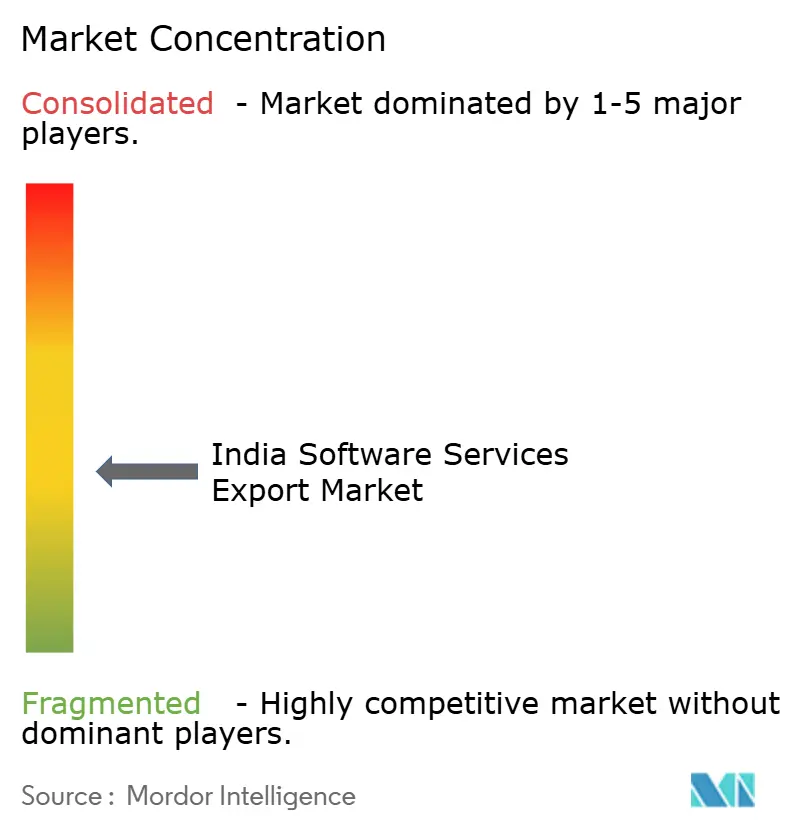
The India software services export market exhibits moderate fragmentation. Tier-I players—TCS, Infosys, Wipro, HCLTech—enjoy scale economics, global-delivery footprints, and balance-sheet strength that secure multi-billion-dollar deals. Yet margin pressures surface as talent inflation and hedging costs eat into operating leverage. Mid-tiers contest by specializing in vertical-specific IP, agile sprints, and outcome-based contracts that attract mid-market buyers.
Strategic moves emphasize platform-centric business models, hyperscaler alliances, and tuck-in acquisitions. Emerging disruptors include deep-tech start-ups building generative-AI code-assist tools and domain-rich boutique consultancies. GCCs likewise compete for scarce architects. Consequently, incumbents double-down on learning academies, patent filings, and campus-to-corporate hiring from tier-II cities to widen talent funnels.
India Software Services Export Industry Leaders
-
Tata Consultancy Services Limited
-
Infosys Limited
-
Wipro Limited
-
HCL Technologies
-
Tech Mahindra Ltd
- *Disclaimer: Major Players sorted in no particular order
India Software Services Export Market Companies Covered in this Report
- Tata Consultancy Services (TCS)
- Infosys
- Wipro
- HCL Technologies
- Tech Mahindra
- Cognizant Technology Solutions
- LTIMindtree
- Mphasis
- Oracle
- Microsoft
- IBM
- Accenture
- Deloitte
- PwC
- Capgemini
- Genpact
- Persistent Systems
- Hexaware Technologies
- Zensar Technologies
- LandT Technology Services
Market Opportunities and Future Outlook
A near-term whitespace is emerging around compliance-led transformation for export documentation, pricing governance, and audit-ready delivery, especially as the RBI moves software and services exporters toward the unified EDF regime effective October 01, 2026. Vendors that productize export-compliance workflows and embed controls into delivery and finance operations can differentiate in regulated client industries, while also tightening internal cycle times tied to export realization and certification.
IP-led services and co-innovation programs also offer a clear opportunity set as India continues its shift from time-and-materials delivery toward product engineering and monetizable accelerators. MeitY launched the IP Catalyst initiative and its digital platform (cipie.in) on May 12, 2026 to commercialize electronics and IT patents, which aligns with the market turn toward software product development and GCC-led engineering work. The export-diversification agenda is reinforced by NITI Aayog recommending structured trade missions to Japan, the Middle East, and Germany, and proposing a unified India tech-services brand platform, consistent with the report's emphasis on Japan-leaning demand patterns and the Middle East's rising share of export revenues.
Recent Industry Developments in India Software Services Export Market
- July 2026: Tata Consultancy Services (TCS) signed a multi-million, multi-year deal with ABB to transform global network operations with AI. The launch expands AI driven managed services for enterprise networks. The deal strengthens TCS's AI led offerings and global delivery footprint, reinforcing its enterprise network-operations transformation playbook.
- June 2026: Tata Consultancy Services (TCS) entered a strategic partnership with Anthropic to drive enterprise AI scaling. The collaboration provides enterprise grade AI deployment capabilities. It accelerates TCS’s AI native service offerings and differentiates in AI enabled transformation.
- June 2026: Infosys expanded multi year collaboration with GlobalFoundries to deliver AI led managed services. The partnership impacts AI driven semiconductor related services ecosystem. It broadens Infosys’s AI enabled managed services portfolio with semiconductor client initiatives and expands industry reach.
India Software Services Export Market Report Scope and Research Methodology
Market Definition and Coverage
This market covers revenue earned by India-based software and IT enabled service providers from clients outside India, where delivery can happen remotely or through onsite work billed as export services. The value is tracked in USD for the period measured, using consistent revenue recognition across the model.
Scope exclusions: This sizing excludes purely domestic IT services revenue and hardware product sales that may be reported alongside technology sector totals.
Segments Covered in This Report
- By Activity
- IT Services
- Software Product Development
- Business Process Services (BPO)
- Others
- By Service Delivery Model
- On-site
- Near-shore
- Offshore
- Captive / Global Capability Centres (GCCs)
- By Client Industry
- Banking and Financial Services
- Retail and Consumer
- Healthcare and Life Sciences
- Manufacturing
- Telecom and Media
- Others
- By Client Size
- Large Enterprises
- Small and Medium Enterprises
- By Export Destination
- North America
- Europe
- Asia-Pacific
- Middle East
- South America
- Africa
Data Sources, Market Sizing, and Validation
Desk Research
Desk work started with mapping the export revenue pool and how it is reported in public systems, since this industry is often mixed with domestic technology spending. We referenced official statistics and periodic releases such as the Reserve Bank of India software and ITES exports survey tables, India services trade and balance of payments releases, and Ministry of Commerce related export reporting where relevant.
To keep assumptions grounded, we also used public industry references such as NASSCOM strategic review publications, audited annual reports and investor presentations from listed exporters, and reputed press coverage of deal trends and pricing. Where needed, paid subscriptions that track company financials, patent activity, and shipment level trade data were used to cross-check directional movement and fill gaps on smaller firms. The desk sources listed here are illustrative only, and we used additional public and paid references to collect, verify, and clarify the data.
Primary Interviews and Surveys
Primary conversations and surveys were used to pressure test the export revenue split, pricing movement, and demand softness or strength by end user location. We spoke with delivery leaders, account managers, and finance roles across large and mid-sized exporters, and then checked themes with advisors who follow client spending cycles across major buying regions.
Findings from these discussions were used to validate desk assumptions around onsite versus offshore mix, billing rate resets, and how much adjacent work (such as engineering services or IT enabled services) is counted as export revenue in practice.
Distribution of primary research fieldwork respondents
| Company type | Respondent position |
|---|---|
| Top tier: 29% | CXOs: 12% |
| Mid tier: 50% | Functional/Unit leaders: 40% |
| Smaller Players: 21% | Managers: 48% |
Market-Sizing & Forecasting
Sizing was built using a top-down reconstruction of the export demand pool from official exports reporting, then normalized to keep the definition focused on software services and IT enabled services revenue earned from overseas clients. After setting the overall pool, shares were allocated using indicators such as export destination mix, the service delivery model split, the contribution of IT services versus BPM and engineering services, and the observed change in billing rates and utilization discussed by practitioners.
We then corroborated the totals with selective bottom-up checks, where a sampled set of exporter revenues and their export exposure were rolled up and compared with the top-down output, and then adjusted where the gap could be consistently explained (for example, differences in what firms count as onsite export billing). For forecasting, scenario analysis was used because buyer budgets and deal ramp timing can shift quickly, and inputs were guided by interview consensus on spending outlook, wage and attrition pressure, and currency translation effects. Where granular splits were not available, the model used conservative proxy ratios from official series and validated them again through primary checks before finalizing.
Data Validation & Update Cycle
Outputs were cross-checked against independent signals such as official export totals, company level export disclosures, and broad services trade movement so that any sudden jumps could be explained before sign-off. If a segment result looked out of line with known delivery mix or destination trends, assumptions were revisited, and relevant experts were re-contacted to confirm what changed.
A multi-step analyst review was followed, where calculations, unit conversions, and currency timing were checked, and then the story was tested for internal consistency. Reports are refreshed annually, and interim updates are made when material events occur, such as major macro shocks, sharp currency moves, or large changes in client spending patterns. Before delivery, a final data pass is completed so clients receive the most current view available.
Mordor Intelligence's India Software Services Export Industry Market Size Compared Against Other Published Estimates
Published numbers for India software services exports can look far apart because the underlying definition is not always the same, and reporting periods also vary between fiscal year and calendar year. Differences also come from whether a source counts only cross-border supply or also adds sales delivered through overseas affiliates.
The main gap is usually driven by scope choices, like including hardware, domestic projects, or broader technology sector revenue, and then treating that as exports. Another driver is currency handling, since some sources use reported currency without a consistent USD conversion timing, and some mix cash receipt reporting with accrued revenue. In our model, exports are counted only when services are billed to overseas clients under a consistent definition and then validated against official export survey totals and company disclosures, a choice applied by Mordor Intelligence.
Benchmark comparison
| Source | Market Size | Gaps in Research Methodology |
|---|---|---|
| Mordor Intelligence | USD 158.19 B (2025) | |
| Government Dataset A | USD 205.20 B (2024) | Adds exports delivered through overseas commercial presence and is reported on a fiscal-year basis, which raises the total versus a pure cross-border export view. |
| Industry Association B | USD 199.00 B (2024) | Often presented as a sector headline and can differ on what is excluded (for example, treatment of IT enabled services and currency conversion timing), which shifts the export total. |
The spread in the table is mostly explained by what gets counted as exports and whether affiliate delivered revenue is bundled into the total. By keeping the scope tied to clearly stated export service revenues, using consistent USD conversion, and rechecking assumptions with practitioners, the estimate stays traceable to repeatable inputs rather than broad sector headlines.
Key Questions Answered in the Report
What is the current value of the India software services export market?
It is valued at USD 165.32 billion in 2026 and is projected to reach USD 206.15 billion by 2031.
Which activity segment is growing fastest within the India software services export market?
Software product development is expanding at a 5.71% CAGR as firms pivot to IP-led offerings.
What are the key challenges facing Indian IT exporters?
Rising competition from Vietnam and Central Europe, talent attrition, data-localization rules, and currency volatility are the main braking factors.
How do government policies support the India software services export market?
Production-linked incentives, SEZ tax holidays, and RoDTEP credits lower operating costs and encourage export expansion.